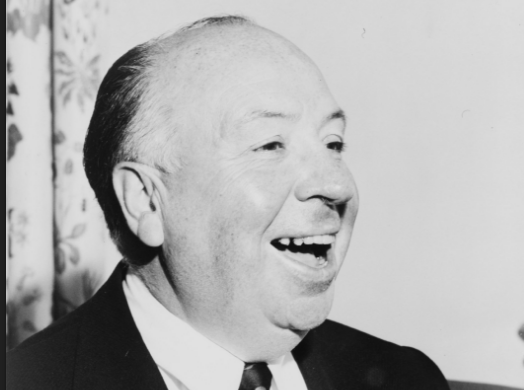
Close the doors. Shut the blinds. Turn out the lights. Make that room dark. Get ready for Alfred Hitchcock Presents Ghost Stories for Young People. Originally recorded in 1962, the album features 11 ghost stories introduced by Hitchcock himself and then read by actor John Allen. If you were a kid during the early 60s, this may bring back some very good memories. The recording is available on YouTube and Spotify, embedded below. (Download Spotify’s software for free here.)
Here’s a playlist of the tracks:
The Haunted And The Haunters (The Pirate’s Curse)
Novels — they’re in inevitable decline. They can’t compete with the movie screen, the TV screen and now the computer screen. Give things 25 years, and there will be just a small cult of readers left. That’s the prediction of American author, Philip Roth, who has 27 novels to his credit. And apparently, Roth is personally hastening the process. Earlier this year, he told a reporter for the Financial Times: “I’ve stopped reading fiction. I don’t read it at all. I read other things: history, biography. I don’t have the same interest in fiction that I once did.” When asked why, he quipped: “I don’t know. I wised up … ”
For Paul Auster, another productive novelist, the reports of the novel’s death are greatly exaggerated. Humans hunger for stories. They always will. And, the novel, it knows how to adapt and survive. Will it survive with the help of technology? Auster might not be the best person to ask. He owns neither a computer nor a mobile phone. Lucky man.
Bonus: You can listen to Paul Auster read The Red Notebook, a collection of short stories published in 2002, right here. (He starts reading at around the 8:30 mark.) We have it listed in our collection of Free Audio Books.
In 1956, Italo Calvino, one of Italy’s finest postwar writers, published Italian Folktales, a series of 200 fairy tales based sometimes loosely, sometimes more strictly on stories from a great folk tradition. When first published, The New York Times named Italian Folktalesone of the ten best books of the year, and, more than a half century later, the stories continue to delight. Case in point: in 2007, John Turturro, the star of numerous Coen brothers and Spike Lee films, began working on Fiabe italiane, a play adapted from Calvino’s collection of fables. Last year, Turturro’s play enjoyed a sold-out run in Turino.
Calvino, who died far too young, would have celebrated his 88th birthday this past Saturday.
Bonus: You can listen to Jeanette Winterson read Calvino’s short story, The Night, online here. The reading is also listed in our collection of Free Audio Books.
If you would like to support the mission of Open Culture, consider making a donation to our site. It’s hard to rely 100% on ads, and your contributions will help us continue providing the best free cultural and educational materials to learners everywhere. You can contribute through PayPal, Patreon, and Venmo (@openculture). Thanks!
Look what the vintage video gods have delivered today. Filmed in 1965, the black and white documentary Ladies and Gentlemen… Mr. Leonard Cohen introduces viewers to a young Leonard Cohen. Then only 30 years old (and looking a little like Dustin Hoffman), Cohen had already established himself as a poet and novelist. But his legendary career as a singer-songwriter was just barely getting underway. The 44 minute documentary all takes place in his hometown of Montreal, the city to which Cohen continually returns “to renew his neurotic affiliations” with family and old friends.
Ladies and Gentlemen… Mr. Leonard Cohen appears in our collection of Free Movies Online, where you will also find Lian Lunson’s 2005 documentary, Leonard Cohen: I’m Your Man, a fascinating retrospective of Cohen’s life and work that features tribute performances by famous artists, including Beth Orton, Nick Cave, Martha and Rufus Wainwright, and U2.
If you would like to support the mission of Open Culture, consider making a donation to our site. It’s hard to rely 100% on ads, and your contributions will help us continue providing the best free cultural and educational materials to learners everywhere. You can contribute through PayPal, Patreon, and Venmo (@openculture). Thanks!
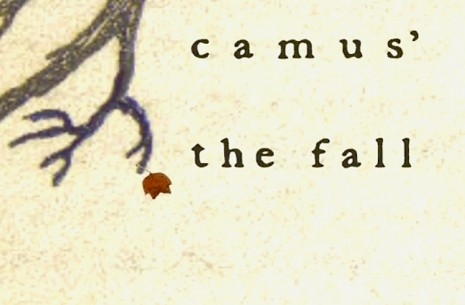
Now it’s time for something a little more modern — Mike McCubbins offers an animated adaptation of Albert Camus’ classic, The Fall, published in 1957, the same year that Camus won the Nobel Prize for Literature for his work that “illuminates the problems of the human conscience in our times.” Give McCubbins five minutes and he’ll give you the visual essence of the philosophical novel. You can watch it here.
It’s a good time to be a fan of Haruki Murakami. Last month, his short story, “Town of Cats,” was published in The New Yorker. Later in October, his new book 1Q84 hits the stands in the US. (Watch the book trailer above.) And, right now, the British bookmaker Ladbrokes is giving Murakami 7‑to‑1 odds of winning the Nobel Prize in Literature, to be named tomorrow morning. They’re strong odds. But the Syrian poet Adonis (read three poems here) is the actual favorite right now with 4‑to‑1 odds. Stay tuned. We’ll know more soon …
Get ready for it. This week, Knopf will release Paulo Coelho’s latest novel, Aleph. And we’re taking bets on three questions. How many copies will be legally sold? (The Alchemist has sold more than 65 million copies.) How many copies will be pirated and given away? And to what extent will the circulation of illegal copies actually benefit legit sales?
In recent years, Coelho has become something of a willing conspirator in the pirating of his own work. Sometimes he links on his own blog to pirated copies floating around the web. Other times he makes the texts available (in multiple languages) in a nice shareable widget.
Coelho explains how his adventures in self-pirating got underway in a Q&A appearing in yesterday’s New York Times.
Q. You’ve also had success distributing your work free. You’re famous for posting pirated version of your books online, a very unorthodox move for an author.
A. I saw the first pirated edition of one of my books, so I said I’m going to post it online. There was a difficult moment in Russia; they didn’t have much paper. I put this first copy online and I sold, in the first year, 10,000 copies there. And in the second year it jumped to 100,000 copies. So I said, “It is working.” Then I started putting other books online, knowing that if people read a little bit and they like it, they are going to buy the book. My sales were growing and growing, and one day I was at a high-tech conference, and I made it public.
Q. Weren’t you afraid of making your publisher angry?
A. I was afraid, of course. But it was too late. When I returned to my place, the first phone call was from my publisher in the U.S. She said, “We have a problem.”
Q. You’re referring to Jane Friedman, who was then the very powerful chief executive of HarperCollins?
A. Yes, Jane. She’s tough. So I got this call from her, and I said, “Jane, what do you want me to do?” So she said, let’s do it officially, deliberately. Thanks to her my life in the U.S. changed.
The rest of the interview continues here. And, in the meantime, you can find several Coelho books catalogued in our collection of Free eBooks.
Every year, thousands of American high school students read a common selection of great novels — classics loved by young and old readers alike. Today, we have selected 20 of the most popular books and highlighted ways that you can download versions for free, mostly as free audio books and ebooks, and sometimes as movies and radio dramas. You will find more great works — and sometimes other digital formats — in our twin collections: 600 Free eBooks for iPad, Kindle & Other Devices and 550 Free Audio Books. So please give them a good look over, and if we’re missing a novel you want, don’t forget Audible.com’s 14 day trial. It will let you download an audio book for free, pretty much any one you want.
1984 by George Orwell: Read Online
Although published in 1949, 1984 still captures our imagination generations later because it offers one of the best literary accounts of totalitarianism ever published. And it’s simply a great read.
Brave New World by Aldous Huxley: eText — Free Radio Dramatization (by Huxley himself)
Little known fact. Huxley once taught George Orwell French at Eton. And, years later his 1931 classic, Brave New World, is often mentioned in the same breath with 1984 when it comes to great books that describe a dystopian future.
Frankenstein by Mary Shelley - Free ebook — Free Audio Book (MP3) — Radio Drama version (1938) — Movie
Mary Shelley started writing the great monster novel when she was only 18 and completed it when she was 21. The 1823 gothic novel is arguably one of your first works of science fiction.
Heart of Darkness by Joseph Conrad: Free eBook — Free Audio Book (iTunes) — Radio Dramatization by Orson Welles (MP3)
More than 100 years after its publication (1902), Conrad’s novella still offers the most canonical look at colonialism and imperialism. So powerful was its influence that Orson Welles dramatized it in 1938, and the book also famously inspired Coppola’s Apocalypse Now in 1979.
Pride & Prejudice by Jane Austen – Free eBook — Free Audio Book (iTunes)
Jane Austen’s 1813 novel remains as popular as ever. To date, it has sold more than 20 million copies, and, every so often, it finds itself adapted to a new film, TV or theater production. A must read.
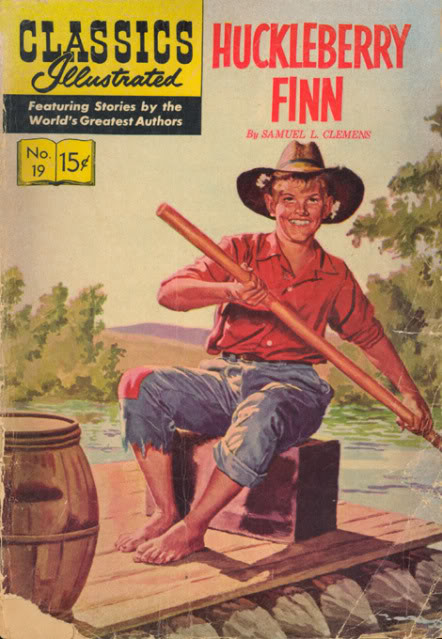
The Adventures of Huckleberry Finn by Mark Twain — Free eBook — Free Audio Book (iTunes)
When you think Huckleberry Finn, you think Great American Novel. It was controversial when it was first published in 1884, and it remains so today. But nonetheless Twain’s classic is a perennial favorite for readers around the world.
The Call of the Wild by Jack London — Free eBook — Free Audio Book (iTunes) The Call of the Wild, first published in 1903, is regarded as Jack London’s masterpiece. It’s “a tale about unbreakable spirit and the fight for survival in the frozen Alaskan Klondike.”
The Crucible by Arthur Miller - Free Audio Book from Audible.com
Arthur Miller’s 1952 play used the Salem witch trials of 1692 and 1693 to offer a commentary on McCarthyism that tarnished America during the 1950s. Today, The Crucible occupies a central place in America’s literary canon.
The Grapes of Wrath by John Steinbeck — Free Audio Book from Audible.com
This 1939 novel won the Pulitzer Prize in 1940 and later helped Steinbeck win the Nobel Prize for Literature in 1962. It’s perhaps the most important book to give literary expression to the Great Depression.
The Odyssey by Homer – Free eBook — Free Audio Book
The Western literary tradition begins with Homer’s epic poems The Iliad (etext here) and The Odyssey, both written some 2800 years ago. It has been said that “if the Iliad is the world’s greatest war epic, then the Odyssey is literature’s grandest evocation of everyman’s journey through life.” And that just about gets to the heart of the poem.
The Old Man and the Sea by Ernest Hemingway - Free Audio Book from Audible.com
It was Hemingway’s last major work of fiction (1951) and certainly one of his most popular, bringing many readers into contact with Hemingway’s writing for the first time.
The Red Badge of Courage by Stephen Crane — Free eBook — Free Audio Book (iTunes) — Free Movie
This Civil War novel won what Joseph Conrad called “an orgy of praise” after its publication in 1895, and inspired Ernest Hemingway and the Modernists later. The novel made Stephen Crane a celebrity at the age of 24, though he died only five years later.
The Scarlet Letter by Nathaniel Hawthorne – Free eBooks – Free Audio Book — Movie
Though set in Puritan Boston between 1642 and 1649, Hawthorne’s magnum opus explores “the moral dilemmas of personal responsibility, and the consuming emotions of guilt, anger, loyalty and revenge” that were relevant in 1850 (when the book was published). And they remain so today.
To Kill a Mockingbird by Harper Lee — Free Audio Book from Audible.com
Harper Lee’s 1960 novel takes an incisive look at attitudes toward race and class in the Deep South during the 1930s. It won the Pulitzer Prize a year later.
Note: We listed Audible.com as an option when books were still under copyright.
Meanwhile, educators don’t miss our collection of Free Courses. It features many free Literature courses, including courses on American literature.
We're hoping to rely on loyal readers, rather than erratic ads. Please click the Donate button and support Open Culture. You can use Paypal, Venmo, Patreon, even Crypto! We thank you!
Open Culture scours the web for the best educational media. We find the free courses and audio books you need, the language lessons & educational videos you want, and plenty of enlightenment in between.