William Faulkner Reads from As I Lay Dying
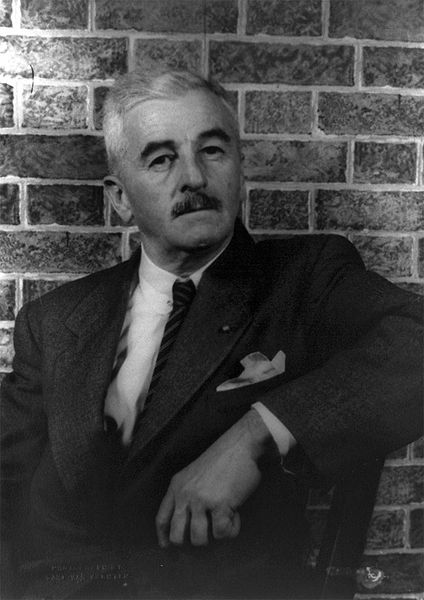 William Faulkner’s As I Lay Dying is widely considered one of the great American novels. Quite an accomplishment, especially considering that Faulkner wrote the novel in six weeks while working at a power plant in 1929–30. Read more about his day jobs here.
Thanks to HarperCollins, you can now listen to Faulkner, himself, reading from his masterpiece: .au file (4.4 Mb), .gsm file (0.9 Mb), .ra file (0.5 Mb). The audio can be a little difficult to make out at times. But you can read right along with the text in Google Books. Enjoy. Thanks MS.
For more audio classics, check out our collection of Free Audio Books.
“April is the Cruellest Month…”
T.S. Eliot reads from The Wasteland, one of the great poems of the last century. It begins famously:
APRIL is the cruellest month, breeding
Lilacs out of the dead land, mixing
Memory and desire, stirring
Dull roots with spring rain.
Winter kept us warm, covering
Earth in forgetful snow, feeding
A little life with dried tubers.
Summer surprised us, coming over the Starnbergersee
With a shower of rain; we stopped in the colonnade,
And went on in sunlight, into the Hofgarten,
And drank coffee, and talked for an hour.
Bin gar keine Russin, stamm’ aus Litauen, echt deutsch.
And when we were children, staying at the archduke’s,
My cousin’s, he took me out on a sled,
And I was frightened. He said, Marie,
Marie, hold on tight. And down we went.
In the mountains, there you feel free.
I read, much of the night, and go south in the winter.
Get the full text here.
Kurt Vonnegut Reads from Slaughterhouse-Five
 Kurt Vonnegut’s Slaughterhouse-Five was published back in 1969, and the anti-war sci fi novel quickly became a classic. (The book now appears, for example, on Time Magazine’s list of All Time 100 Novels.) Whether you’ve read the novel or not, you’ll want to check this out. HarperCollins has posted online a recording of Vonnegut himself reading a lengthy passage from the work. And he does it with the “casual irony that complements the novel’s wonderfully eccentric tone.” You can stream Vonnegut’s reading in the following formats: .au format (4.5 Mb), .gsm format (900 Kb), .ra format ( Mb). (Sorry a straightforward mp3 is not available.) Also, if you want some more Vonnegut, feel free to download his 1962 sci fi short story, 2BR02B, which is otherwise listed in our collection of Free Audio Books.
Note: Audible.com offers a version of Slaughterhouse-Five narrated by actor/writer Ethan Hawke. You can download it (or any another other book) for free if you start a free 14 day trial. It has no strings attached. Get some more basic details here.
Aldous Huxley Warns Against Dictatorship in America
Warnings of dictatorship are nothing new in America. We have them now, and we’ve had them before, and we’ve even had them come from the intelligentsia at times. Above, Aldous Huxley, author of Brave New World (get free text here), talks with Mike Wallace in 1958 — smack in the middle of the Cold War — about the major threats to American freedom. Who were the villains? Not elected representatives who passed laws with a majority in Congress. No, it was a different set of characters: overpopulation, bureaucracy, propaganda, drugs, advertising, and, yes, television. Part 1 of the interview appears above, and you can continue with Part 2, and Part 3. For more interviews from The Mike Wallace Interview (1957–1960), please revisit our earlier piece. You’ll find some more thought provoking interviews there (and lots of cigarette peddling).
If you would like to support the mission of Open Culture, consider making a donation to our site. It’s hard to rely 100% on ads, and your contributions will help us continue providing the best free cultural and educational materials to learners everywhere. You can contribute through PayPal, Patreon, and Venmo (@openculture). Thanks!
Marlon Brando Opens Up to Tennessee Williams
I had no idea that Marlon Brando was much of a writer, but this 1955 letter to Tennessee Williams is superb. Perhaps I just can’t help identifying him with Stanley Kowalski of the “Napoleonic code,” Stella!” and “Hoity-toity, describin’ me like a ape.” Especially interesting is his attitude towards success. (Note some of the language is a little strong/racy):
I have been afraid for you sometimes, because success sings a deadly lullaby to most people. Success is a real and subtle whore, who would like nothing better than to catch you sleeping and bite your cock off. You have been as brave as anybody I’ve known, and it is comforting to think about it. You probably don’t think of yourself as brave because nobody who really has courage does, but I know you are and I get food from that.
This passage echoes Williams’ own views on success, especially his beautiful (and ironically inspiring) essay On a Streetcar Named Success, written eight years earlier:
It is never altogether too late, unless you embrace the Bitch Goddess, as William James called her, with both arms and find in her smothering caresses exactly what the homesick little boy in you always wanted, absolute protection and utter effortlessness. Security is a kind of death, I think, and it can come to you in a storm of royalty checks beside a kidney-shaped pool in Beverly Hills or anywhere at all that is removed from the conditions that made you an artist, if that’s what you are or were intended to be. Ask anyone who has experienced the kind of success I am talking about–What good is it? Perhaps to get an honest answer you will have to give him a shot of truth-serum but the word he will finally groan is unprintable in genteel publications.
You’ll find the rest of Brando’s letter (including an image of the original) — which includes reflections on actors Anna Magnani and Burt Lancaster — here.
Wes Alwan lives in Boston, Massachusetts, where he works as a writer and researcher and attends the Institute for the Study of Psychoanalysis and Culture. He also participates in The Partially Examined Life, a podcast consisting of informal discussions about philosophical texts by three philosophy graduate school dropouts.
Orson Welles Reads Moby Dick
Welles is reading just a short introduction here. But if you want a complete audio download of Moby Dick, let me tell you how to get one. You can download a free reading of Melville’s classic at Librivox. The full mp3 zip file is right here.
If you would like to support the mission of Open Culture, consider making a donation to our site. It’s hard to rely 100% on ads, and your contributions will help us continue providing the best free cultural and educational materials to learners everywhere. You can contribute through PayPal, Patreon, and Venmo (@openculture). Thanks!
Mark Twain Captured on Film by Thomas Edison in 1909. It’s the Only Known Footage of the Author.
Here’s a little nugget for you. The great inventor Thomas Edison visited the home of Mark Twain in 1909, and captured footage of “the father of American literature” (says Faulkner) walking around his estate and playing cards with his daughters, Clara and Jean. The film is silent and deteriorated. But it’s apparently the only known footage of the author who gave us Huckleberry Finn and Tom Sawyer. Twain would die the next year.
Find works by Twain in our collection of Free Audio Books and Free eBooks.
And if you like what we serve up, don’t miss us on Twitter on Facebook. It’s any easy way to share cultural gems with family and friends.
Related Content:
Mark Twain Shirtless in 1883 Photo
Thomas Edison Recites “Mary Had a Little Lamb” in Early Voice Recording
Thomas Edison’s Boxing Cats (1894), or Where the LOLCats All Began
Support Us
We're hoping to rely on loyal readers, rather than erratic ads. Please click the Donate button and support Open Culture. You can use Paypal, Venmo, Patreon, even Crypto! We thank you!

About Us

Open Culture scours the web for the best educational media. We find the free courses and audio books you need, the language lessons & educational videos you want, and plenty of enlightenment in between.
Advertise With Us

