As we’ve discussed before on this blog, one of the major casualties in the shifting new media landscape is the traditional investigative journalist–someone with the time and resources to research in-depth stories. In response to this problem a new group called Pro Publica is proposing a novel economic model: hire the journalists into a foundation and give their work away to the publications where it will make the biggest impact.
The new initiative, headed up by Paul Steiger, head editor at the Wall Street Journal for 16 years, will spend $10 million annually to support a newsroom of 24 journalists and 12 other staff in New York City. The money comes from Herbert and Marion Sandler, former heads of Golden West Financial Corporation, a big player in mortgages and savings.
It seems likely to me that Pro Publica will succeed in attracting some high-level talent, both because of Steiger and because many journalists have come to fear for their jobs in the shrinking newsrooms of traditional papers. The real question is how well this system will work in digging up and delivering quality reporting. What do you lose, and what do you gain, when your employer is no longer a “paper of record” but a private foundation funded by people with their own political agendas? On the other hand, it’s easy to argue that every newspaper already has some kind of political position, so maybe Pro Publica will be no different.
I just heard Jimmy Wales, founder of Wikipedia, speaking at Stanford Law School today. Wales is working on some new projects that he hopes will harness the community-driven collaboration of Wikipedia. He’s already had some success in branching out from the encyclopedia idea with Wikia, which is a “wiki farm” compiling information on a variety of different subjects (some of the most successful so far relate to video games).
What Wales spoke about today, however, is a new collaborative search project. The concept is still in its early stages, it seems, but the idea would be to harness the intelligence and dedication of human beings to produce search results significantly better than Google’s. This raises a few questions:
Is Google broken? It’s amazing what Google pulls up, but maybe we’ve all gotten so good at working with an imperfect system that we just tune out the spam and misinterpretations that still crop up.
Is a collaborative social model the appropriate solution to this problem? People are good at compiling encyclopedias, but they may not be good at emulating search rank algorithms. Also, Google is powered by millions of servers in dozens of data centers over the world managing petabytes of information. In other words, this may be a technology+money business, not a people+transparency business.
These issues aside, Wikipedia is one of the most amazing things to come out of the whole Internet experiment, so I’m excited to see what Wales comes up with. Has search become a basic service? Would it work better as an open-source system?
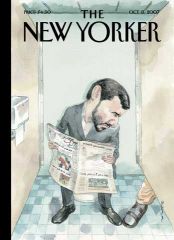
The satirists are getting a lot mileage out of Mahmoud Ahmadinejad’s declaration that Iran is gay-free. Last week, Saturday Night Live spoofed Ahmadinejad, as we noted. Then, The New Yorker parodied Ahmadinejad on the magazine’s cover with one of its famed cartoons. (The image included a not-so-oblique reference to Larry Craig, the conservative US Senator who recently got caught up in some mens’ room high jinks. Unfamiliar readers can get the scoop on Craig here.) Of all the inane comments Ahmadinejad has made, and there are many, it’s interesting that the satirists have chosen to focus on this one. Denying the existence of gays in Iran is no more empirically absurd than denying the Holocaust. So why the emphasis on the sexuality comment? Because Ahmadinejad has been playing the anti-semitism card for some time, but the homophobia card is relatively new, hence making it worthy of attention? Or is it because sexuality offers an always convenient way to take a political enemy down a peg? Or since there’s no good way to satirize a genocide, perhaps sexuality becomes a good default. Ok, I’m stumped. Note to self: think twice next time before over-analyzing jokes. Speaking of jokes, make you check out the footage we posted of Woody Allen doing standup in 1965.
The New Yorker has rolled out a series of animated cartoons, which puts in motion its famous cartoons. They can be watched as video podcasts or as streamed videos. You should definitely head over to The New Yorker web site to view the larger collection. But, if you want a little taste, take a look below:
Earlier this week I spoke on the phone with Alan Weisman, the author of The World Without Us. (See our initial piece on his book.) Alan was gracious enough to take some time out of his publicity schedule to share his thoughts on the book, the world, his writing process, and more. What follows is an edited transcript of our conversation.
Ed: This book addresses what on the surface seems to be a pretty far-fetched hypothetical: that humanity might suddenly disappear. What drew you to this premise in the first place?
Alan: Well, precisely that. Most great environmental writing does not get read by a lot of the people who ought to be learning about it because the nearer-term possibilities just seem sometimes so frightening, or so depressing, that nobody really wants to pick up a book to read it.
By structuring the book the way that I did, I disarm the automatic fear that repels a lot of people from reading about the environment. People don’t want to read something that seems too threatening. On a subconscious or even a conscious level, they don’t want to be worried we’re all going to die. In my book, killing us off in the first couple of pages means people don’t have to worry about dying because we’re already dead, and that’s a relief in a sense. The idea of glimpsing the future is irresistible to all of us and I establish pretty quickly that is not going to just be me speculating, it’s going to be some hard science writing based on a lot of reporting, of talking to experts or eyewitnesses whose guesses will be far more interesting than most peoples’.
The fact that it is far-fetched is really useful because on the one hand really it’s a remote possibility that we would leave, that we would disappear tomorrow. So people don’t go into a panic over this book, and it really gives people enough time to think about these things without panicking about it. So that’s how this device works, and I think it’s been proven to be very effective. I’m getting a lot more people to read it than just people who are hung up on the environment.
Effective at midnight, The New York Times will make the “TimesSelect” section of its website entirely free. (It used to cost subscribers $49.95 a year.) And it will also free up “its archives from 1987 to the present … , as well as those from 1851 to 1922, which are in the public domain.”
In making this move, the paper will be giving up $10 million in annual subscription revenue. But it will likely make up that money (and then some) by using ads to monetize those pages. For more info, read the full article here. And click here to see what formerly closed-off content will now become freely available.
Update: Have a look at Deeplinking’s piece called Mining the New York Times Archive. It pulls out of the archive some interesting finds, including reviews of James Joyce’s Ulysses (1922) and Oscar Wilde’s Disgrace (1895), plus articles that survey the dynamic art scene of the early 20th century.
HBO just started airing the sixth season of Curb Your Enthusiasm, so it seemed fitting to serve up this lengthy interview with Larry David. The talk is very funny. No shock there. But it also gets into some good substance. How Larry got into comedy; how he struggled during his early standup years and had to scratch together money for a can of Chef Boyardee; how he approaches writing comedy; how he has generated ideas for the most memorable episodes of “Curb” and Seinfeld — it all gets touched on here.
We have included the first part below, plus links to the other seven segments. For more Larry David interviews, check out the 60 Minutes piece on Larry from this past weekend. You can watch it online here.
Publisher’s Weekly announced last week that Lars Brownworth, a New York high school teacher, will publish with Crown (a Random House division) a new book that covers “1,200 years of Byzantine history, examining the culture’s forgotten role in preserving classical thought, connecting East and West, and building modern Western society.” It’s expected to hit the bookstores in early 2009.
There’s lots to say about this deal, but we wanted to delve a little into the backstory, and particularly how an unexpected chain of events, all built into Web 2.0, made this deal possible. (And, yes, we’ll also touch briefly on where Open Culture fits into the picture.)
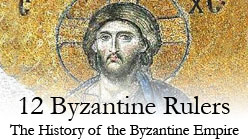
The story begins in March 2005, back when Brownworth started distributing on iTunes an educational podcast called 12 Byzantine Rulers: The History of the Byzantine Empire (iTunes — Feed — Site). Released in installments, the podcasts gave users the rare ability to download a complete academic course to their MP3 player, anytime, anywhere, for free. Brownworth was a pioneer, and by late 2006, people started taking notice. In December, Wired mentioned 12 Byzantine Rulers in a short web feature, which netted the podcast a small uptick in downloads. Then, days later, our fledgling blog followed up with a short piece —The Hottest Course on iTunes (and the Future of Digital Education). From there, things got interesting. Our post got almost immediately picked up on Digg.com, a massively popular website, and its users catapulted the story to Digg’s homepage. Downloads of Brownworth’s podcasts surged; the power of Web 2.0 was kicking in. Brownworth speculated during an interview last week that the “Digg effect” widely broadened the exposure of his podcast, and, soon enough, The New York Times was knocking on his door. By late January, the pillar of American journalism published a flattering feature: History Teacher Becomes Podcast Celebrity. Then, it all started again. Podcast downloads spiked higher, far exceeding the previous wave from Digg. More articles and an NPR interview followed. Next came the book agents’ calls. … That’s, in short, how we got to last week’s announcement.
Brownworth’s story, although unusual, is part of a growing trend. Book publishers seem increasingly willing to let the wisdom of crowds identify podcasts that translate into marketable books, and then let the podcasts stimulate book sales. This year, Mignon Fogarty notably inked deals to release spinoff books and audiobooks of her popular Grammar Girl podcast (iTunes — Feed — Web Site). And given that 12 Byzantine Rulers has been downloaded 735,000 times just this year, Brownworth and his new publisher felt rightly justified in taking a similar approach.
We’ll gradually find out whether this developing model provides a way for innovative podcasters to monetize their successful content. In the meantime, Lars is giving it all a good go. He recently gave up his New York teaching job, relocated to North Carolina (where his brother Anders provides technology and business support), and is now dedicating himself full-time to podcasting and writing. It’s a big change, but a change worth making. “Web 2.0 has enabled me,” Brownworth says, “to do things that I never would have been able to do otherwise. It’s a bit humbling to find myself on the ground floor of a revolution, but this move is undoubtedly the most exciting opportunity I’ve ever had.”
We’re pleased to have played even a bit part in Brownworth’s success. Keep an eye out for his book and, until then, give his podcast a good listen: 12 Byzantine Rulers: The History of the Byzantine Empire (iTunes — Feed — Site).
We're hoping to rely on loyal readers, rather than erratic ads. Please click the Donate button and support Open Culture. You can use Paypal, Venmo, Patreon, even Crypto! We thank you!
Open Culture scours the web for the best educational media. We find the free courses and audio books you need, the language lessons & educational videos you want, and plenty of enlightenment in between.