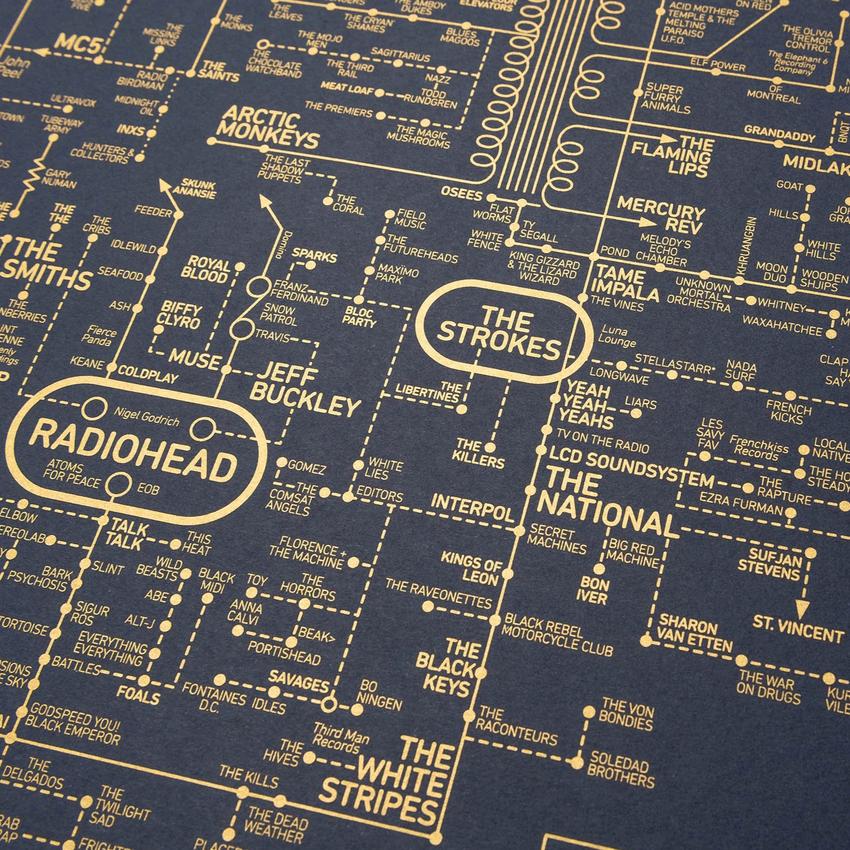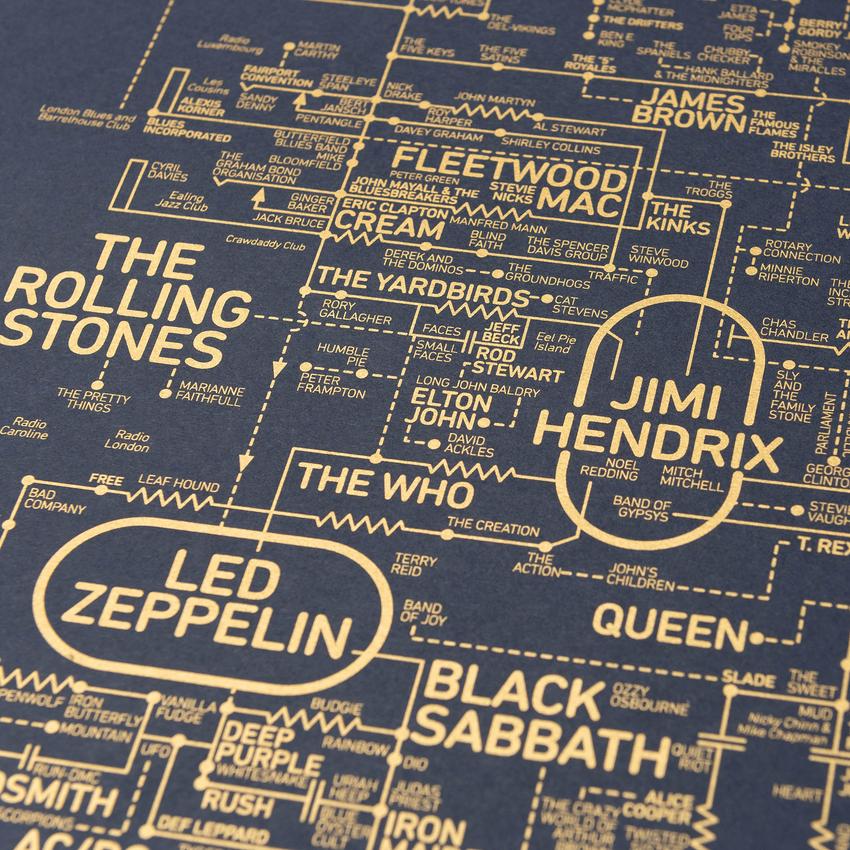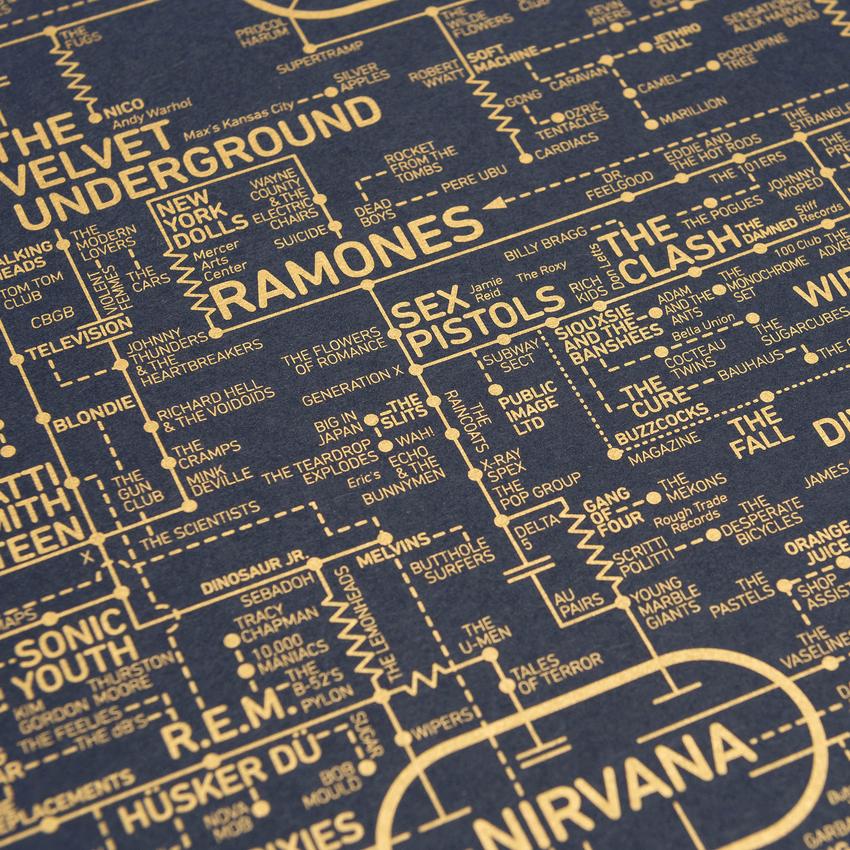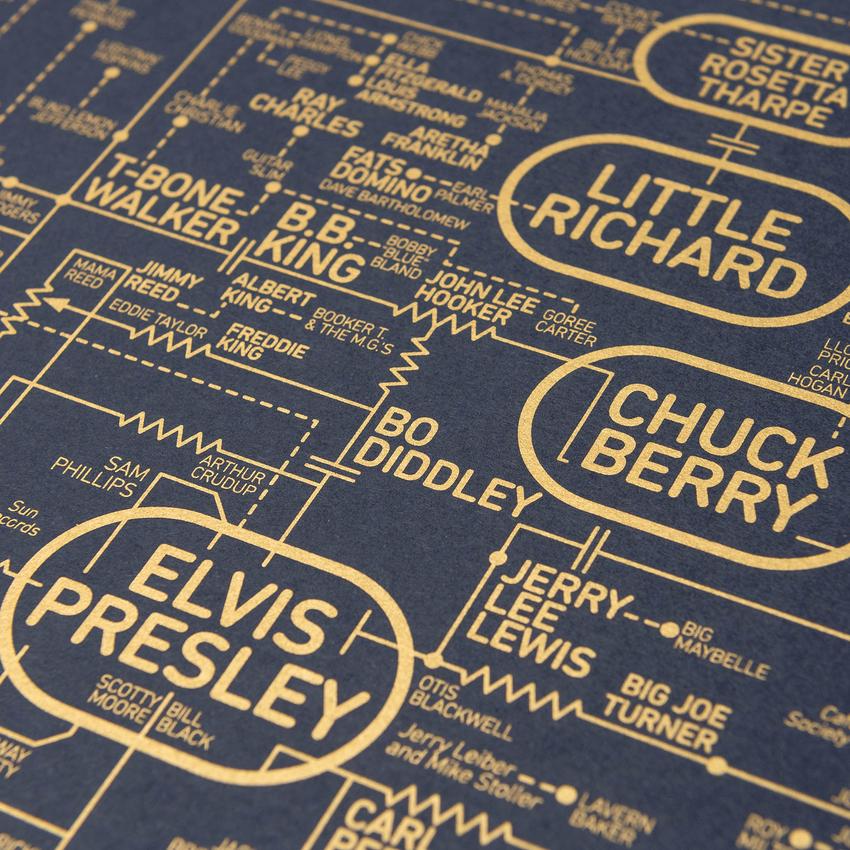
There are so many origin stories of punk that no single history can count as definitive. But there’s also no disputing its roots in the New York poetry scene from which Patti Smith emerged in the 1960s and 70s. She learned from Allen Ginsberg and William S. Burroughs, and Gregory Corso and Sam Shepherd inspired the poetry/rock hybrid that would become the music of Horses.
Corso, who called himself a “punk debauche” in his 1960 poem “1959,” lived up to the label. He would heckle poets “during their listless performances,” writes Kembrew McLeod in Downtown Pop Underground, “yelling, ‘Shit! Shit! No blood! Get a transfusion!’ Sitting at Corso’s side,” during poetry readings hosted by the Poetry Project at St. Mark’s Church, “Smith made a mental note not to be boring.”
She followed her friend Sam Shepard’s advice to add music to her first public reading and called guitar player Lenny Kaye to accompany her. “It was primarily a solo poetry reading,” McLeod writes, “with occasional guitar accompaniment.” The 1971 appearance, which you can hear in the recording above, set the tone for almost all of her subsequent performances for the next several decades.
“We did ‘Mack the Knife,” Kaye recalls, “because it was Bertolt Brecht’s birthday, and then I came back for the last three musical pieces. I hesitate to call them ‘songs,’ but in a sense they were the essence of what we would pursue.” Oddly, that year also marked the first usage of “punk” to describe a style of music, though it was applied to the garage rock of ? and the Mysterians, not to Smith and Kaye’s music. She herself has said she didn’t consider what they were doing to be “punk” at all.
This doesn’t much matter. It was attitude and the energy Smith translated from St. Marks to the CBGBs scene that secures her “Godmother” status. She was impressed, as she says above, by Jim Morrison and Jimi Hendrix. She was also impressed by a 1971 essay written by Andrew Wylie, who published her first book after her St. Mark’s reading. “Living as we were in an extremely violent, fragile time,” Smith’s Unauthorized Biographyrecounts, “[Wylie] was drawn to short, almost amputated works.” He concluded that “just to be alive in such times was an act of violence.”
Punk poetry, or whatever we want to call it, was born in a church on St. Mark’s Place in New York City in 1971. From then on, whatever other strains came together to make punk rock, Smith’s channeling of Corso, Shepard, Burroughs, Morrison, etc., backed by Kaye’s steady guitar work, has resonated through the music into the present.
Trauma is repetition, and the United States seems to inflict and suffer from the same deep wounds, repeatedly, unable to stop, like one of the ancient Biblical curses of which Bob Dylan was so fond. The Dylan of the early 1960s adopted the voice of a prophet, in various registers, to tell stories of judgment and generational curses, symbolic and historical, that have beset the country from its beginnings.
The verses of “Blowin’ in the Wind,” from 1963’s The Freewheelin’ Bob Dylan, enact this repetition, both traumatic and hypnotic. In its dual refrains—“how many times…?” and “the answer is blowin’ in the wind” (ephemeral, impossible to grasp)—the song cycles between earnest Lamentations and the acute, world-weary resignation of Ecclesiastes. “This ambiguity is one reason for the song’s broad appeal,” as Peter Dreier writes at Dissent.
Just three months after its release, when Dylan performed at the March on Washington for Jobs and Freedom on August 28, 1963, “Blowin’ in the Wind” had become a massive civil rights anthem. But he had already ceded the song to Peter, Paul & Mary, who played their version that day. Dylan ignored his sophomore album entirely to play songs from the upcoming The Times They Are a‑Changing—songs that stand out for their indictments of the U.S. in some very specific terms.
Dylan played three songs from the new album: “When the Ship Comes In” with Joan Baez, “Only a Pawn in Their Game,” and “With God on Our Side.” (He also played the popular folk song “Keep Your Eyes on the Prize.”) In contrast to his vaguely allusive popular anthems, “Only a Pawn in Their Game”—about the murder of Medgar Evers—isn’t coy about the culprits and their crimes. We might say the song offers an astute analysis of institutional racism, white supremacy, and stochastic terrorism.
A bullet from the back of a bush
Took Medgar Evers’ blood
A finger fired the trigger to his name
A handle hid out in the dark
A hand set the spark
Two eyes took the aim
Behind a man’s brain
But he can’t be blamed
He’s only a pawn in their game
A South politician preaches to the poor white man
“You got more than the blacks, don’t complain
You’re better than them, you been born with white skin, ” they explain
And the Negro’s name
Is used, it is plain
For the politician’s gain
As he rises to fame
And the poor white remains
On the caboose of the train
But it ain’t him to blame
He’s only a pawn in their game
The deputy sheriffs, the soldiers, the governors get paid
And the marshals and cops get the same
But the poor white man’s used in the hands of them all like a tool
He’s taught in his school
From the start by the rule
That the laws are with him
To protect his white skin
To keep up his hate
So he never thinks straight
‘Bout the shape that he’s in
But it ain’t him to blame
He’s only a pawn in their game
From the poverty shacks, he looks from the cracks to the tracks
And the hoofbeats pound in his brain
And he’s taught how to walk in a pack
Shoot in the back
With his fist in a clinch
To hang and to lynch
To hide ‘neath the hood
To kill with no pain
Like a dog on a chain
He ain’t got no name
But it ain’t him to blame
He’s only a pawn in their game
Today, Medgar Evers was buried from the bullet he caught
They lowered him down as a king
But when the shadowy sun sets on the one
That fired the gun
He’ll see by his grave
On the stone that remains
Carved next to his name
His epitaph plain
Only a pawn in their game
These lyrics have far too much relevance to current events, and they’re indicative of the changing tone of Dylan’s muse. His refrains drip with irony. The killer of Medgar Evers “can’t be blamed”—an evasion of responsibility that becomes a powerful force all its own.
Dylan revisits the themes of generational trauma and murder in “With God on Our Side” (hear him sing it with Baez at Newport, above). The song is a sharp satire of his historical education, with its inevitable repetitions of war and slaughter. Here, Dylan presents the exponentially gross, existentially dreadful, consequences of a national abdication of blame for historical violence.
Oh my name it ain’t nothin’
My age it means less
The country I come from
Is called the Midwest
I was taught and brought up there
The laws to abide
And that land that I live in
Has God on its side
Oh, the history books tell it
They tell it so well
The cavalries charged
The Indians fell
The cavalries charged
The Indians died
Oh, the country was young
With God on its side
The Spanish-American
War had its day
And the Civil War, too
Was soon laid away
And the names of the heroes
I was made to memorize
With guns in their hands
And God on their side
The First World War, boys
It came and it went
The reason for fighting
I never did get
But I learned to accept it
Accept it with pride
For you don’t count the dead
When God’s on your side
The Second World War
Came to an end
We forgave the Germans
And then we were friends
Though they murdered six million
In the ovens they fried
The Germans now, too
Have God on their side
I’ve learned to hate the Russians
All through my whole life
If another war comes
It’s them we must fight
To hate them and fear them
To run and to hide
And accept it all bravely
With God on my side
But now we got weapons
Of chemical dust
If fire them, we’re forced to
Then fire, them we must
One push of the button
And a shot the world wide
And you never ask questions
When God’s on your side
Through many a dark hour
I’ve been thinkin’ about this
That Jesus Christ was
Betrayed by a kiss
But I can’t think for you
You’ll have to decide
Whether Judas Iscariot
Had God on his side.
So now as I’m leavin’
I’m weary as Hell
The confusion I’m feelin’
Ain’t no tongue can tell
The words fill my head
And fall to the floor
That if God’s on our side
He’ll stop the next war
Dylan’s race/class analysis in “Only a Pawn in the Game” and his succinct People’s History of Christian Nationalism in “With God on Our Side” stand out as interesting choices for the March for several reasons. For one thing, it’s as though he had written these songs expressly to take the political, economic, and religious mechanisms and mythologies of racism apart. This was radical speech in an event that was policed by its organizers to tone down inflammatory rhetoric for the cameras.
23-year-old John Lewis, for example, was forced to temper his speech, in which he meant to say, “We will march through the South, through the heart of Dixie, the way Sherman did. We shall pursue our own scorched earth policy and burn Jim Crow to the ground — nonviolently.… the revolution is at hand, and we must free ourselves of the chains of political and economic slavery.” As a popular white artist, rather than a potentially seditious Black organizer, Dylan had far more license and could “use his privilege,” as they say, to describe the systems of political and economic oppression Lewis had wanted to name.
Dylan’s performance was one of a handful of memorable musical appearances. Most of the singers made a far bigger impression, like Mahalia Jackson, Marian Anderson, and Baez herself, whose “We Shall Overcome” created a legendary moment of harmony. No one sang along to Dylan’s new songs—they wouldn’t have known the words. But Dylan was never careless. He chose these words for the moment, hoping to have some impact in the only way he could.
The 1963 March’s purpose has been overshadowed by a few passages in Martin Luther King, Jr.‘s powerful “I Have a Dream” speech, co-opted by everyone and reduced to meme-able quotes. But the protest “remains one of the most successful mobilizations ever created by the American Left,” historian William P. Jones writes. “Organized by a coalition of trade unionists, civil rights activists, and feminists–most of them African American and nearly all of them socialists.”
Dylan sang stories of how the country got to where it was, through a history of violence still playing out before the marchers’ eyes. Whatever political tensions there were among the various organizers and speakers did not distract them from pushing through the 1964 Civil Rights Act and the Fair Employment Practices clause banning discrimination on the basis of race, religion, national origin, or sex—protections that have been broadened since that time, and also challenged, threatened, and stripped away.
Fifty-seven years later, as the RNC convention ends and another March on Washington happens, we might reflect on Dylan’s small but prescient contributions in 1963, in which he aptly characterized the traumatic repetitions we’re still convulsively experiencing over half a century later.
When did you last hear live music? Granted, this isn’t an ideal time to ask, what with the ongoing pandemic still canceling concerts the world over. But even before, no matter how enthusiastic a show-goer you considered yourself, your life of music consumption almost certainly leaned toward the recorded variety. This is just as John Philip Sousa feared. In 1906, when recorded music itself was still more or less a novelty, the composer of “The Stars and Stripes Forever” published an essay in Appleton’s Magazine prophesying a world in which, thanks to “the multiplication of the various music-reproducing machines,” humanity has lost its ability, feel, and appreciation for the art itself.
“Heretofore, the whole course of music, from its first day to this, has been along the line of making it the expression of soul states,” writes Sousa. “Now, in this the twentieth century, come these talking and playing machines, and offer again to reduce the expression of music to a mathematical system of megaphones, wheels, cogs, disks, cylinders,” all “as like real art as the marble statue of Eve is like her beautiful, living, breathing daughters.” With music in such easy reach, who will bother learning to perform it themselves? “What of the national throat? Will it not weaken? What of the national chest? Will it not shrink? When a mother can turn on the phonograph with the same ease that she applies to the electric light, will she croon her baby to slumber with sweet lullabys, or will the infant be put to sleep by machinery?”
In 1906 a famous composer warned recorded music would end lullabies and turn kids in human phonographs “without soul or expression”
The grandiloquence of Sousa’s writing, which you can hear performed in the clip from the Pessimists ArchivePodcastabove, encourages us to enjoy a knowing chuckle, but some of his points may give us pause. He foresees the decline of “domestic music,” and indeed, how many households do we know whose members all share in the making of music, or for that matter the listening? “Before you dismiss Sousa as a nutty old codger,” writes New Yorker music critic Alex Ross, “you might ponder how much has changed in the past hundred years.” With more music at our command than ever before, music itself “has become a radically virtual medium, an art without a face. In the future, Sousa’s ghost might say, reproduction will replace production entirely. Zombified listeners will shuffle through the archives of the past, and new music will consist of rearrangements of the old.”
The aesthetic half of Sousa’s argument has its descendants today in narratives of rock’s ruination by computers, diagnoses of popular culture’s addiction to its own past, and “DRUM MACHINES HAVE NO SOUL” stickers. The commercial half will also sound familiar: “The composer of the most popular waltz or march of the year must see it seized, reproduced at will on wax cylinder, brass disk, or strip of perforated paper, multiplied indefinitely, and sold at large profit all over the country, without a penny of remuneration to himself for the use of this original product of his brain,” Sousa writes. 114 years later, the relative entitlement of composers, lyricists, and performers (not to mention labels, distributors, and other business entities) to profits from recordings remains a hotly debated matter, due in no small part to the rise of streaming music services like Spotify. That probably wouldn’t surprise Sousa — nor would the longing, felt by increasingly many of us, to experience live music once again.
Based in Seoul, Colin Marshall writes and broadcasts on cities, language, and culture. His projects include the book The Stateless City: a Walk through 21st-Century Los Angeles and the video series The City in Cinema. Follow him on Twitter at @colinmarshall, on Facebook, or on Instagram.
Even COVID-19 can’t stop NPR’s series of Tiny Desk Concerts, which has previously featured Yo-Yo Ma, Adele, Wilco, The Pixies, and many, many other talented musicians. As NPR explains below, the performance involved a little bit of technology and some magic. Enjoy:
It didn’t take long for Billie Eilish to become one of the biggest pop stars in the world, sweep the Grammy Awards’ major categories and release the latest James Bond theme. And today, at just 18, she and her brother, Finneas, have accomplished what no one has been able to do for five and a half months: perform a Tiny Desk concert in what certainly appears to be the NPR Music offices.
Of course, due to safety concerns, even the NPR Music staff can’t set foot in the building that houses Bob Boilen’s desk. But if you look over Eilish’s shoulder, there’s no mistaking the signs that she’s appearing at the Tiny Desk in its present-day form: On the last day before staff began working from home, I took home the Green Bay Packers helmet that sat on the top shelf — the one Harry Styles had signed a few weeks earlier — for safe keeping. In this performance, that spot is empty.
So how the heck did they do it?
Honestly, it’s best that you watch the whole video to experience the extent of the technical feat — which, in the spirit of Eilish’s Saturday Night Live performance, they’re willing to share with you. And thankfully, we still have our ways of photographing the desk, even if the room has fallen silent.
So settle in for a welcome jolt of Tiny Desk innovation, not to mention two of the excellent standalone singles Billie Eilish has released in the past year: “my future” and “everything i wanted.” And, seriously, be sure to watch until the very end.
If you would like to sign up for Open Culture’s free email newsletter, please find it here. It’s a great way to see our new posts, all bundled in one email, each day.
If you would like to support the mission of Open Culture, consider making a donation to our site. It’s hard to rely 100% on ads, and your contributions will help us continue providing the best free cultural and educational materials to learners everywhere. You can contribute through PayPal, Patreon, and Venmo (@openculture). Thanks!
People do not tend to answer the question, “do you like Phish?” with, “yeah, I guess they’re okay.” Those who like Phish, love Phish, devotedly and without reservation. And those who don’t like Phish, well….
For the purposes of maintaining objectivity, I shall pretend to remain agnostic on the question, but I do happen to think this kind of polarization is a mark of greatness, wherever one lands. Great art provokes. What could be more provocative than awesome riffs, 20-minute jams, and obscure in-jokes? There is, admittedly, a significant you-had-to-have-been-there quality to Phish fandom.…
Phish, and The Grateful Dead before them, have been instrumental in keeping live music—played at length and with abandon—relevant, not only through their constant touring but through the number of bands in their orbit who inspire their own devoted followings. Now the pandemic has made it impossible for fans of Phish, the String Cheese Incident, the Dave Matthews Band, Widespread Panic, or the Avett Brothers to make it out to shows.
To ease their pain, JamBase launched a Live Video Archive, a music aggregator that allows fans to search 100,000 free streaming concerts on YouTube. “Looking to find videos of Phish performing ‘Harry Hood’ in 2013? Enter ‘Harry Hood’ in the song filter and you’ll see a list of every version in our database,” Jambase explains.
“Use the ‘Event Year’ filter to pick 2013. You’ll then see many videos to choose from. Press ‘Play’ to watch in the player or press ‘queue’ to start a list of videos that will display in the order you selected to view at your leisure.”
Given their audience, JamBase’s catalogue skews heavily toward jam and jam-adjacent bands. But you’ll also find a huge archive of performances, over 14,000 clips, from Seattle independent radio station KEXP. “Performances from The Barr Brothers, Wilco, Jason Isbell and Yo La Tengo are just a few of the dozens of acts featured in KEXP videos on the JBLVA.”
JamBase’s own homepage is also full of great stuff for fans not only of jams and bluegrass bands but other genres as well, from Lucinda Williams’ gritty country folk to Emily King’s acoustic R&B, such as her latest single “See Me,” released in support of Black Lives Matter. These are tough times all around. It can be easy to lose sight of the good things we’re missing as we watch current events unfold. Let the JamBase Live Video Archive remind us of groovy times we had, and will have again.
Prompted by the release of new album Folklore and the 2020 documentary Miss Americana, your hosts Mark Linsenmayer, Erica Spyres, and Brian Hirt speak with guest Amber Padgett about her love of Taylor, ranking the albums/eras, Taylor as songwriter/puppetmaster, why the hate, weird levels of fan engagement, double standards in expectations for female artists, and more. Like all of our discussions, this one is should be interesting to fans, haters, and folks who’re just curious as to what all the fuss is about.
It seems as inevitable as bell bottoms and shoulder-wide collars that Stevie Nicks would transform into the New Age priestess who greeted the 70s with a wave of a billowy, shawl-draped arm. “It makes sense,” Bill DeMain writes at Classic Rock, that her “signature song was inspired by a kind of ancient magic” of the kind that everybody was getting into. That song, “Rhiannon,” takes its name from “an old Welsh witch,” as Nicks would often announce onstage. During Fleetwood Mac’s Nicks/Buckingham heyday, Nicks embodied the character as though possessed, her performances of the song “like an exorcism,” Mick Fleetwood recalled.
The story of how “Rhiannon” came to be, however, is not as straightforward as Nicks’ reaching into the pages of the Mabinogion, the Welsh prose cycle in which Rhiannon first appears. The name came to her several steps removed from its mythical origins, from a novel by Mary Leader called Triad.
“It was just a stupid little paperback that I found somewhere at somebody’s house,” she recalls of the uncanny 1974 composition. “And it was all about this girl who becomes possessed by a spirit named Rhiannon. I read the book, but I was so taken with that name that I thought: ‘I’ve got to write something about this.’ So I sat down at the piano and started this song about a woman that was all involved with these birds and magic.”
“I come to find out,” she says, “after I’ve written the song, that in fact Rhiannon was the goddess of steeds, maker of birds.” The perfect anthem for a singer on the threshold of turning the already famous Fleetwood Mac into one of the biggest rock bands in the world. They were in a kind of wilderness period, having fired longtime guitarist and musical linchpin Danny Kirwan and lost guitarist Bob Welch. When Lindsay Buckingham, his replacement, insisted that Nicks join with him, she brought the song “about an old Welsh witch” along with the pair’s collection of shawls, capes, and kimonos.
You can learn more about the myths of the Mabinogion, the oldest known prose stories in Britain, in the Polyphonic video above. The collection inspired the epic fantasies of J.R.R. Tolkien, and by proxy the epic fantasies of Led Zeppelin and every heavy metal band thereafter. It also features in Lloyd Alexander’s 1960’s fantasy series Chronicles of Prydain (later poorly adapted in Disney’s The Black Cauldron). The pop culture of the 70s had been infused with ancient Welsh before Rhiannon came along, but the goddess herself seemed to belong exclusively to Stevie Nicks, who intuited a deep magic in the music of her ancient name.
We could say that the music of Johann Sebastian Bach transcends instrumentation. Wendy Carlos did a great deal to prove that with her 1968 album Switched-On Bach, composed entirely (and laboriously) on an early Moog synthesizer. Despite its controversial union of long-revered compositions with practically untested musical technology, that project won high praise, not least from as famed an interpreter of Bach as Glenn Gould. Here at Open Culture we’ve featured many of Gould’s own performances of Bach: of the Keyboard Concerto No. 1 in D minor in his 1960 U.S. television debut, of the cantata BWV 54 on a 1962 CBC special, of The Art of Fugue and the Goldberg Variationsas played toward the end of his life in the early 1980s.
Going back to 1959, we find a 27-year-old Gould playing Bach in a National Film Board of Canada documentary, and on “the piano he favors above all others for practicing: a 70-year-old Chickering with a resonant, harpsichord quality recalling the instruments of the time of Bach.” But to truly hear Bach’s music as Bach himself would have heard it, you need to bring out those very same instruments.
The ten selections on Voices of Music’s Bach playlist include the Cello Suite No. 2 in D Minor BWV 1008, Allemande and Courante played on the baroque cello by Eva Lymenstull; the Arioso from Cantata 156 (Sinfonia) with Marc Schachman on the baroque oboe; the Brandenburg Concerto No. 6 in B Flat Major BWV 1051 played by Kati Kyme and Elizabeth Blumenstock on baroque viola (viole da braccio), Elisabeth Reed and William Skeen on the viola da gamba, Tanya Tomkins on the baroque cello, Farley Pearce on the violone, and Hanneke van Proosdij on the harpsichord; and the Sonata No. 3 in C Major for baroque violin BWV 1005 interpreted by August and Georgina McKay Lodge, the former playing the baroque violin and the latter reading Ursula K. Le Guin’s poem “Hymn to Time.”
This isn’t the first time the work of Le Guin, now remembered as an influential author of science fiction and fantasy literature, has been set to music. Just after her death in 2018 we featured Rigel 9, the space rock opera she created in collaboration with avant-garde composer David Bedford in 1985. If Le Guin’s words suited a tale of the future told with high-tech New Wave sounds, they suit an acoustic return to the eighteenth century just as well.
This is a versatility much like Bach’s own, which has guaranteed that, more than 250 years after his death, his music retains its power and depth whether expressed through a piano, a synthesizer, or indeed the instruments of his day — not that the players of percussion tubes or wine glasses have done him great injustice either.
Based in Seoul, Colin Marshall writes and broadcasts on cities, language, and culture. His projects include the book The Stateless City: a Walk through 21st-Century Los Angeles and the video series The City in Cinema. Follow him on Twitter at @colinmarshall, on Facebook, or on Instagram.
We're hoping to rely on loyal readers, rather than erratic ads. Please click the Donate button and support Open Culture. You can use Paypal, Venmo, Patreon, even Crypto! We thank you!
Open Culture scours the web for the best educational media. We find the free courses and audio books you need, the language lessons & educational videos you want, and plenty of enlightenment in between.