Five years ago, Choir!Choir!Choir!, a large amateur choir from Toronto, got a rare chance to perform with Patti Smith, joining her onstage to sing her 1978 hit “Because the Night.” Still inspired by that experience, the group recently revisited the song during one of their weekly sessions. “The feeling in the room was electric, everyone was leaning in hard, and the end result is so powerful,” Choir!Choir!Choir! writes on their YouTube channel. You can watch the end result above.
If you would like to support the mission of Open Culture, consider making a donation to our site. It’s hard to rely 100% on ads, and your contributions will help us continue providing the best free cultural and educational materials to learners everywhere. You can contribute through PayPal, Patreon, and Venmo (@openculture). Thanks!
Drag superstar RuPaul’s Drag Race programcan be credited with bringing his subculture to a much wider audience.
For ten seasons, viewers outside the major metropolitan areas and select holiday destinations where drag has flourished have tuned in to root for their favorite competitors.
As a result, mainstream America has developed a much more nuanced appreciation for the labor and artistry behind successful drag performance and personae.
Vanity Fair’s “100 Years of Drag Queen Fashion,” above, is not so much an evolutionary history of the form as a salute to some of its pioneers, practitioners, and patron saints.
Each decade opens with a Drag Race alum facing the makeup mirror in a relatively naked state. Shangela Laquifa Wadley, Raja, and Detox all appear sans fard. Kim Chi’s heavily made up eyes are eyelash-free.
The 70’s spin on the late, great Divine is more reminiscent of cis-gender disco queen Donna Summer than the outrageous plus-sized muse director John Waters referred to as “the most beautiful woman in the world, almost.”
In reality, the resemblance is not quite so strong. Although Malin got dolled up in Mae West drag in 1933’s Arizona to Broadway, above, left to his own devices his stage presence was that of an openly effeminate gay man, or “pansy.” As Professor George Chauncey, director of Columbia University’s Research Initiative on the Global History of Sexualities observes in his book, Gay New York:
His very presence on the club floor elicited the catcalls of many men in the club, but he responded to their abuse by ripping them to shreds with the drag queen’s best weapon: his wit. ‘He had a lisp, and an attitude, but he also had a sharp tongue,’ according to one columnist. ‘The wise cracks and inquiries of the men who hooted at his act found ready answer.’ And if hostile spectators tried to use brute force to take him on after he had defeated them with his wit, he was prepared to humble them on those terms as well. ‘He was a huge youth,’ one paper reported, ‘weighing 200, and a six footer. Not a few professional pugilists sighed because Jean seemed to prefer dinner rings to boxing rings.’ Although Malin’s act remained tame enough to safeguard its wide appeal, it nonetheless embodied the complicated relationship between pansies and ‘normal’ men. His behavior was consistent with their demeaning stereotype of how a pansy should behave, but he demanded their respect; he fascinated and entertained them, but he also threatened and infuriated them.
Also some gender bending lad by the name David Bowie, though if Vanity Fair’s skinny Divine causes a slight sense of unease, the hideous vinyl raincoat sported by its snarling, whip-wielding Bowie facsimile may send fans scuttling for torches and pitchforks.
As to the future, Joan Jetson collars and pink wedding cake wigs appear to be part of drag’s fashion forecast.
Cis-male skeletal structures may not always lend themselves to period-appropriate female silhouettes, but the towering heels on display are faithful to the art of the drag queen, above all else.
It can be a little hard to take the word “riot” seriously when applied to a contentious ballet performance, given how regularly we now see police with machine guns, shields, and tanks rolling down city streets to overpower protesting citizens. But that is the word that has come down to us for the fracas that greeted the debut of Serge Diaghilev and Igor Stravinsky’s Rite of Springin Paris in 1913. The idea of a riot seems all the more incongruous, and funny, when considered in the light of Jean Cocteau’s description of the crowd:
The smart audience in tails and tulle, diamonds and ospreys, was interspersed with the suits and bandeaux of the aesthetic crowd. The latter would applaud novelty simply to show their contempt for the people in the boxes… Innumerable shades of snobbery, super-snobbery and inverted snobbery were represented.
This Parisian smart set came together on that evening of May 29th expecting “something potentially outrageous,” writes The Telegraph’s classical critic Ivan Hewett. Diaghilev’s Ballet Russes had previously “entranced and shocked Paris.”
Stravinsky was acquiring a reputation as a musical provocateur, having built his score for 1910’s The Firebird around the dissonant “Devil’s Interval.” Nonetheless, as the Rocketboom video below, “The Riot of Spring,” explains, audiences packed into the Théâtre des Champs-Élysées had no preparation for what they would see, and hear, when the curtain arose.
And what was that? A “high, almost strangled bassoon melody,” Hewett writes, “soon draped with fluttering, twittering woodwind sounds” set to “pulsating rhythms.” Choreographer Vaslav Nijinsky’s dancers “seemed pulled down to earth. Their strange, jerky movements and awkward poses defied every canon of gracefulness.” The audience reacted immediately, shouting and attacking one another: “canes were brandished like menacing implements of combat all over the theater.” Stravinsky himself remembers the theatergoers reactions with disdain in a short interview excerpt at the top.
“The storm broke,” he says, once the curtain opened on a group of “knock-kneed… Lolitas jumping up and down.” The audience “came for Scheherazade or Cleopatra, and they saw Le Sacre du Printemps. They were very shocked. They were very naïve and stupid people.” Did Stravinsky really not anticipate the degree of unrest his weird, dissonant ballet might provoke? It seems not. He hoped it would be a bigger hit than his widely-praised Petrushka of three years earlier. “From all indications,” he had written to set designer Nicholas Roerich, “I can see that this piece is bound to ‘emerge’ in a way that rarely happens.” This proved true, but not at all in the way he meant it.
For his part, writes Hewett, Diaghilev “was hoping for something more than an emergence. He wanted a scandal.” James Wolcott, in his account of the evening, Wild in the Seats, argues that the Russian impresario had “a genius for publicity that wouldn’t be matched until the advent of Andy Warhol and the pop cult of celebrity.” He knew he needed to rattle the “jaded elegants,” who “weren’t going to be stimulated by the same melting, yearning pantomime in pointe shoes.” The Rite of Spring premiere remains the most infamous scandal in the history of ballet to this day.
But while the sophisticates battled it out in the aisles, screaming over the orchestra, pulling down each other’s top hats, it’s said, and challenging each other to duels, a few spectators, Cocteau included, sat entranced by the performance. The work, he later wrote, “is, and will remain, a masterpiece: a symphony impregnated with wild pathos, with earth in the throes of birth, noises of farm and camp, little melodies that come to us out of the depths of the centuries, the panting of cattle, profound convulsions of nature, prehistoric georgics.”
See the opening movements performed above by the Joffrey Ballet in 1987, and imagine yourself in the midst of Paris’s highest society convulsing in a riotous outcry. What was so upsetting? “Perhaps the riot was a sign of disquiet,” Hewett speculates, “a feeling that that the world had lost its moorings, and that barbarism was about to be let loose in the streets.” According to eyewitnesses, some disturbed spectators even called in the police. You can learn much more about this fascinating history at the free Harvard edX course, “Stravinsky’s Rite of Spring: Modernism, Ballet, and Riots.”
If all of Prince’s official releases somehow disappeared from history—no Controversy, 1999, Purple Rain, Sign o’ the Times, Lovesexy—you could still make a case for him as a singular, if unheard, musical genius based on his massive trove of unreleased material alone. At least that’s my theory, but the evidence is somewhat lacking since we’ve yet to hear much from the notorious Paisley Park vault. We do know, as Rolling Stone reported in 2016, that it’s full of “thousands of hours of unheard live and studio material—jams, random songs and entire albums”…enough material, it seems, to recreate Prince should his career somehow get erased from the timeline.
One former Paisley Park employee, Scott LeGere, witnessed the Purple One’s manic energy during many a long recording session, as he churned out music at a superhuman rate, then relegated much of it, for reasons known only to Prince, to the Vault—an actual basement bank vault “complete with a time lock and large spinning handle.” Only Prince knew the combination. “At one point,” LeGere remembered, “I was holding tapes and he would beckon me to come in. I said, ‘Actually, sir, I’d rather not. That is your space and your work.’” I don’t know about you, but I probably would have gone in. Then again, I’ve never actually been to Paisley Park and experienced what seems to have been a very humbling atmosphere.
As you must have heard by now, the Vault is open, and unreleased material has begun to trickle out, like the original studio recording of “Nothing Compares 2 U,” above with previously unreleased rehearsal footage of Prince and his band. He “recorded every part himself,” writes Jon Pareles, as was his custom, “except some backing vocals (by Paul Peterson and Susannah Melvoin) and a saxophone solo (by Eric Leeds).” It is, without a doubt, “a crescendo of heartache underscored by everyday details, a finished song.”
You’ll have to be prepared to work weekends, holidays, evenings, and overtime. Benefits are not guaranteed but “may be be offered after successful completion of a sixty (60) day introductory period.” You must have a car and “adhere to a pescatarian environment.” I can’t speak to how these conditions compare to similar kinds of employment, but hey, for the chance to “work in a confidential work area,” including, we might assume, the mysterious Vault itself, some sacrifices may be worth it. You’ll likely get to see and hear, before anyone else, the profusion of unreleased film and audio Prince left behind—a lifetime’s worth of work that puts most other musicians to shame, stashed away in the basement for future generations to find. You can apply here.
From there, it’s not exactly a straight shot to the David Bowie Isexhibit at the Brooklyn Museum, but the Metropolitan Transit Authority will get you there for the price of a single $2.75 subway fare.
Given that the MTA stopped accepting tokens 15 years ago, you’ll also need to cough up $1 for a MetroCard. You may want to even if you already own one.
In celebration of all things Bowie, the MTA has teamed with Spotify to create 5 limited edition MetroCards, available in vending machines throughout the station for a New York minute—about as long as it takes Bowie fans to descend en masse to snag the instant collectibles of their hero in some of his many guises:
and, most touchingly, the teenage David Jones, aka Bowie, saxophonist for the Kon-Rads.
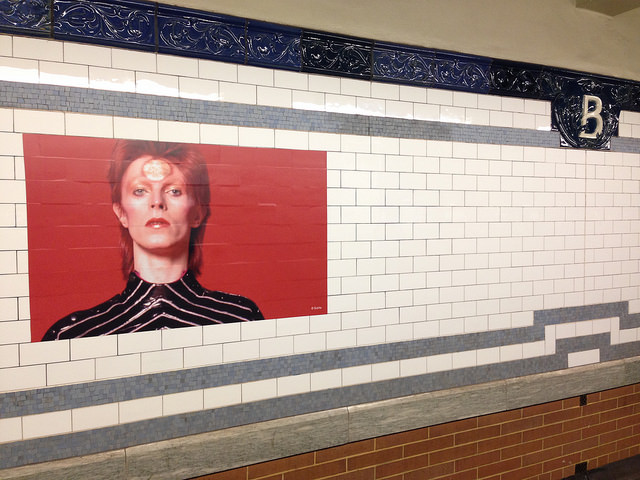
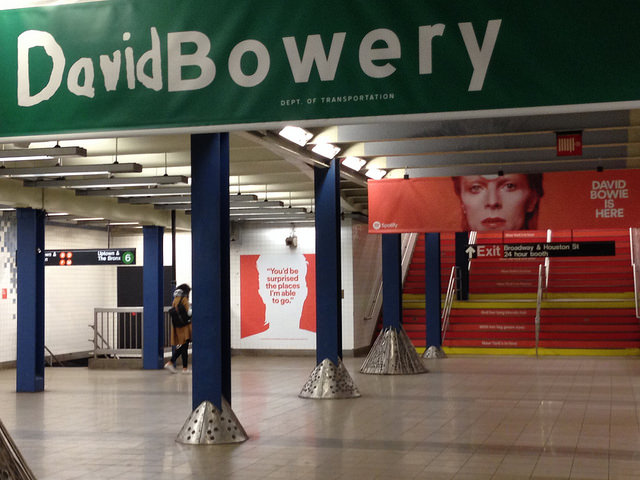
Underground Bowie mania extends way beyond MetroCards. Until Mother’s Day, the unusually lofty station is festooned with Bowie—everything from fan art to giant reproductions of photos from the current exhibition.
Many of the images are accompanied by a scannable Spotify code to transport riders to a relevant sound file, a nifty echo of the progressive audio museum-goers experience through their headphones.
The global exhibit has London roots, but the MTA is focused on Bowie’s ties to New York with photos and video stills from such locations as Carnegie Hall, Radio City Music Hall, Madison Square Garden, and the late, lamented Magic Shop studio.
Civic pride is also on display in the form of city-specific Bowie quotes posted throughout the station:
I have a great time here: we can go where we want, eat where we want, walk out with our child, go to the park, ride the subway, do the things that any family does.
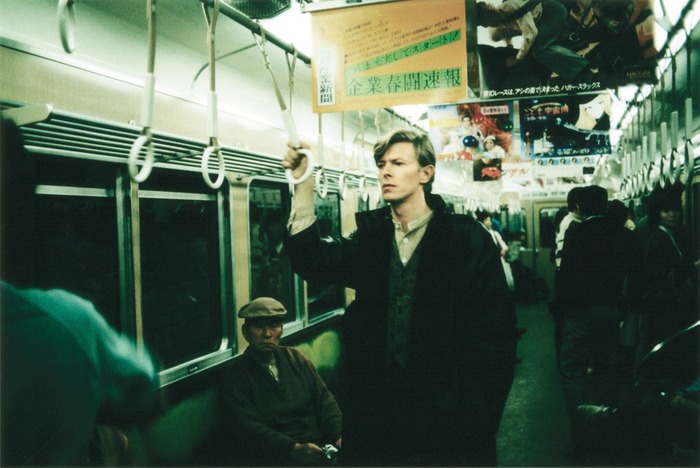
Ah ha! So he did ride the subway here, as well as in Japan (below).
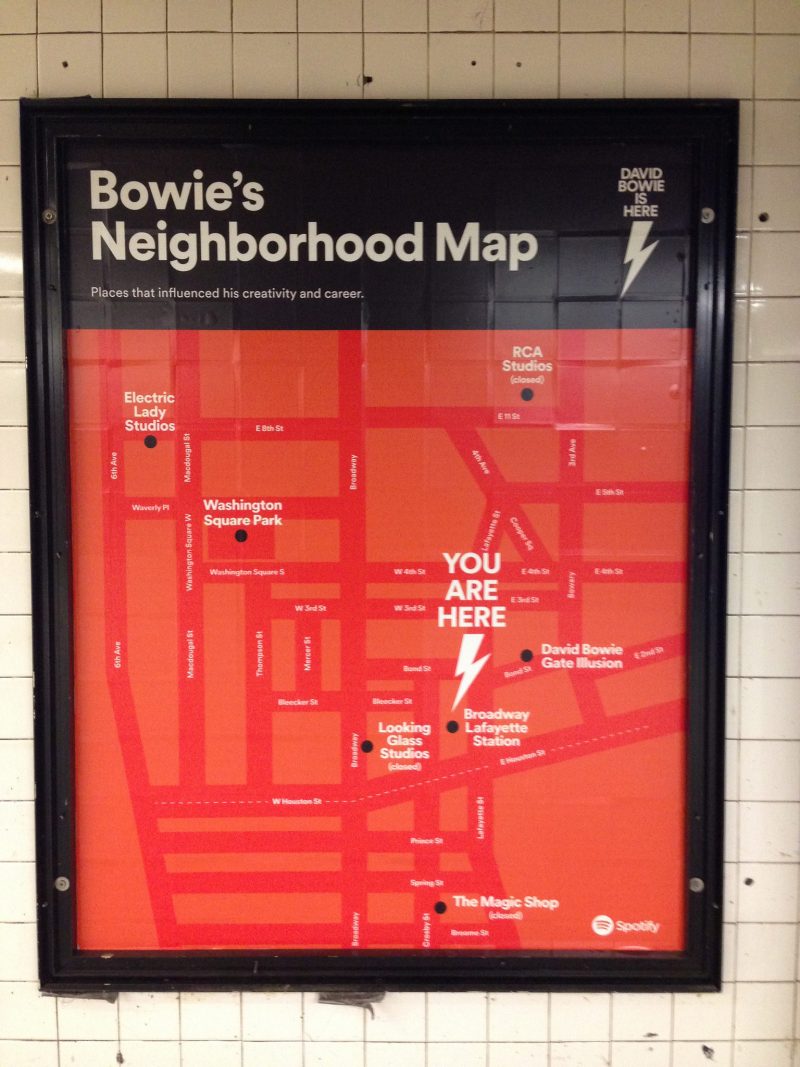
According to a fan on Bowery Boogie, he also popped up at the New York Public Library’s Mulberry Street branch, just around the corner from the subway’s entrance. To find your way there, consult the bright orange “Bowie’s Neighborhood Map” before leaving the station, where your location is denoted with a lightning bolt.
Why is it, as Brian Gilmore writes at JazzTimes, that “even people who hardly listen to jazz adore this album”? Miles Davis’ Kind of Blue hardly needs an introduction. Many thousands of words have been written about its legendary composition and recording, about the extraordinary ensemble responsible for its existence—Davis, John Coltrane, “Cannonball” Adderley, Paul Chambers, Jimmy Cobb, and a young Bill Evans—and about the year of its release, 1959, a watershed moment in the history of jazz, and of nearly all modern music.
“It’s no longer necessary to remind music lovers that Kind of Blue is essential listening,” argues The Guardian’s John Fordham, “and that everybody who wants to make sense of the music of our time ought to have at least some idea of what’s good about it.” Should your education in Kind of Blue be lacking, you can get caught up on the basics in the Polyphonic video just above, which quickly gets to the heart of Davis’ musical innovation: making the definitive break with bebop and setting the standard for modal jazz, and thus the explosion of free jazz innovations to come.
Where most forms of jazz had built increasingly complex chord changes over which soloists improvised, Davis shifted to using modes (the seven modes of modern music) as the basis for song structure. Without needing to get overly technical with music theory, you can understand immediately upon listening to the album that modal composition allowed Davis and his band to slow down, simplify, and create subtle, complex shifts in mood that can be at once lilting, cool, and kind of… blue. Davis had experimented with blues-based modal forms before. Here, he integrates that knowledge with classical ideas and improvisatory brilliance.
“As is now part of jazz folklore,” notes Fordham, “the New York sessions that produced this remarkable album were completed in a handful of takes over just a few hours, with a minimum of compositional materials.” From there, a revolution. It is “The most exquisitely refined of ambient music,” writes Richard Williams in his definitive monograph The Blue Moment, and the one record many music fans would rescue “from a burning house.” It may be the best-selling jazz album of all time. Steely Dan’s Donald Fagen called it “the Bible.” Quincy Jones called his “orange juice,” because he listens to it every day
“No one could disagree with Williams when he connects this with the developments of John Coltrane,” writes Sholto Byrnes, from his “shocking demolition of the dainty brickwork of Rodgers and Hammerstein’s ‘My Favorite Things,’ ” to his masterpiece A Love Supreme. Its influence, according to Williams, runs through the work of Ornette Coleman Steve Reich, John Cale, the Velvet Underground, James Brown, Sly Stone, Soft Machine, Brian Eno, Moby, and so on and so on. If you’ve never quite understood what makes Kind of Blue so great, get a crash course in the video explainer above. Then sit down and listen to it a few hundred times.
The Los Angeles-based choir, Angel City Chorale, above, captured the Internet’s imagination in a big way with their 2013 cover of Toto’s 1982 hit, “Africa,” in which the group’s 160 performers created a realistic-sounding thunderstorm using only their hands.
Delightful! And more common than you may at first think.
The Chorale acknowledges that they owe a great debt to Slovenian vocal group Perpetuum Jazzile’s thunderous 2008 rendition. Stagehands accustomed to creating credible thunderclaps by waving wiggly sheets of aluminum backstage may want to switch to hundreds of feet hopping up and down in unison, as heard at the 1‑minute mark, below.
Go a bit further back to find an actual African choir’s finger-snapping, thigh-smacking “Africa.”
The Kearsney College Choir is based near Durban, South Africa, and they appear to have been the first to open this number with the now-famous rainstorm effect. Its members are school boys ranging in age from 13 to 18. The video below shows them performing the tune in the 2008 World Choir Games, an annual competition that will be taking place on their home turf this year.
Interestingly, there’s not that much rain in the original. Over the years Toto’s songwriters, David Paich and Jeff Porcaro have made various statements about its origins—a guy transfixed by images of suffering Africans on TV, a lonely missionary, a visit to the 1964 World’s Fair’s Africa pavilion …
There’s a bit of rain to be seen in the very 80’s official music video, but nothing that rivals the choirs’ spectacular downpours.
If you’re moved to whip up a tempest of your own, Jbrary’s children’s librarians, Dana Horrocks and Lindsey Krabbenhoft, have created an instructional video that shows just how simple the effect is to master. The real trick is enlisting 100s of friends to do it at the same time.
An Indian guru travels to the West with teachings of enlightenment, world peace, and liberation from the soul-killing materialist grind. He attracts thousands of followers, some of them wealthy celebrities, and founds a commercial empire with his teachings. No, this isn’t the story of Bhagwan Shree Rajneesh, the head of the religious movement in Wild Wild Country. There was no miraculous city in the Oregon wilds or fleet of Learjets and Rolls Royces. No stockpile of automatic weapons, planned assassinations, or mass poisonings. Decades before those strange events, another teacher, Maharishi Mahesh Yogi inspired mass devotion among students around the world with the peaceful practice of Transcendental Meditation.
Rolling Stone’s Claire Hoffman—who grew up in a TM community—writes of the movement with ambivalence. For most of his disciples, he was a “Wizard of Oz-type character,” she says, distant and mysterious. But much of what we popularly know about TM comes from its most famous adherents, including Jerry Seinfeld, Katy Perry, David Lynch, the Beach Boys, and, of course, The Beatles, who famously traveled to India in 1968, meditated with Mia Farrow, Donovan, and Mike Love, and wrote some of their wildest, most inventive music after a creative slump following the huge success of Sgt. Pepper’s.
“They stayed in Rishikesh,” writes Maria Popova at Brain Pickings, “a small village in the foothills of the Himalayas, considered the capital of yoga. Immersed in this peaceful community and nurtured by an intensive daily meditation practice, the Fab Four underwent a creative growth spurt—the weeks at Rishikesh were among their most fertile songwriting and composing periods, producing many of the songs on The White Album and Abbey Road.” Unlike most of the Maharishi’s followers, The Beatles got a personal audience. The Indian spiritual teacher “helped them through the shock” of their manager Brian Epstein’s death, and helped them tap into cosmic consciousness without LSD.
They left on a sour note—there were allegations of impropriety, and Lennon, being Lennon, got a bit nasty, originally writing The White Album’s “Sexy Sadie” with the lyrics “Maharishi—what have you done? You made a fool of everyone.” But before their falling out with TM’s founder, before even the trip to India, all four Beatles became devoted meditators, sitting for two twenty-minute sessions a day and finding genuine peace and happiness—or “energy,” as Lennon and Harrison describe it in a 1967 interview with David Frost. The next year, happily practicing, and feverishly writing, in India, Lennon received letters from fans, and responded with enthusiasm.
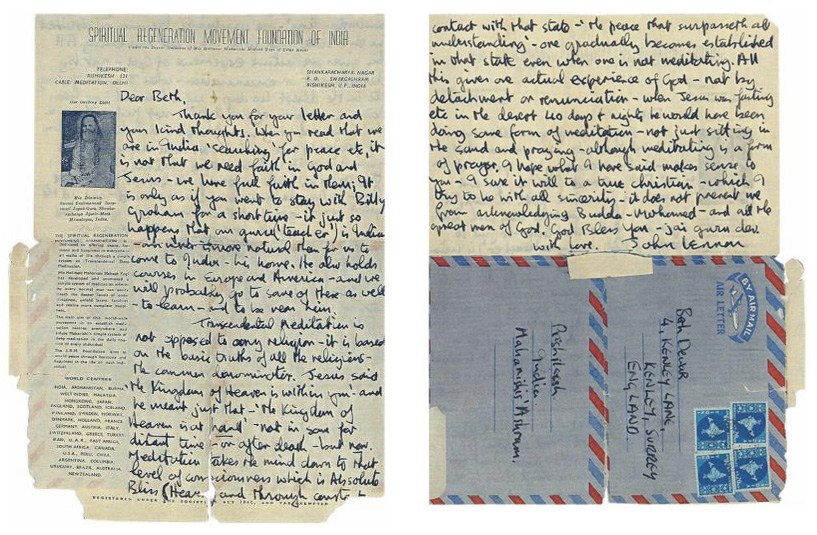
In answer to a letter from a fan named Beth, evidently a devout Christian and apparently threatened by TM and concerned for the bands’ immortal souls, Lennon wrote the following (see his handwritten reply at the top):
Dear Beth:
Thank you for your letter and your kind thoughts. When you read that we are in India searching for peace, etc, it is not that we need faith in God or Jesus — we have full faith in them; it is only as if you went to stay with Billy Graham for a short time — it just so happens that our guru (teacher) is Indian — and what is more natural for us to come to India — his home. He also holds courses in Europe and America — and we will probably go to some of these as well — to learn — and to be near him.
Transcendental meditation is not opposed to any religion — it is based on the basic truths of all religions — the common denominator. Jesus said: “The Kingdom of Heaven is within you” — and he meant just that — “The Kingdom of Heaven is at hand” — not in some far distant time — or after death — but now.
Meditation takes the mind down to that level of consciousness which is Absolute Bliss (Heaven) and through constant contact with that state — “the peace that surpasses all understanding” — one gradually becomes established in that state even when one is not meditating. All this gives one actual experience of God — not by detachment or renunciation — when Jesus was fasting etc in the desert 40 days & nights he would have been doing some form of meditation — not just sitting in the sand and praying — although me it will be a true Christian — which I try to be with all sincerity — it does not prevent me from acknowledging Buddha — Mohammed — and all the great men of God. God bless you — jai guru dev.
With love,
John Lennon
This hardly sounds like the man who imagined no religion. A fan in India wrote Lennon less to inquire and more to acquire, namely money for a trip around the world so that he could “discover the ‘huge treasure’ necessary for achieving inner peace.” Lennon responded with a brief rebuke of the man’s material aspirations, then recommended TM, “through which all things are possible.” (He signs both letters with “jai guru dev,” or “I give thanks to the Guru Dev,” the Maharishi’s teacher. The phrase also appears as the refrain in his “Across the Universe.”)
The letters come from an excellent collection of his correspondence, The John Lennon Letters, which includes other missives extolling the virtues of transcendental meditation. We might take his word for it based on the strength of the creative work he produced during the period. We could also take the word of David Lynch, who describes meditation as the way he catches the creative “big fish.” Or we could go out and find our own methods for expanding our minds and tapping into creative potential.
We're hoping to rely on loyal readers, rather than erratic ads. Please click the Donate button and support Open Culture. You can use Paypal, Venmo, Patreon, even Crypto! We thank you!
Open Culture scours the web for the best educational media. We find the free courses and audio books you need, the language lessons & educational videos you want, and plenty of enlightenment in between.