one thing you have to do today is watch this video of amiri and rahiem taylor covering the beatles — they sound exactly like lennon/mccartney and it gives me serious chills pic.twitter.com/lr3r9ew5Dm
From Matt Whitlock comes a tweet featuring Amiri and Rahiem Taylor, two New York City buskers, singing a spot-on version of The Beatles’ “Eight Days a Week.” Close your eyes and imagine listening to John and Paul.
According to their website, Amiri and Rahiem are twins from Bed Stuy, Brooklyn. And although they grew up “surrounded by hip hop culture and all it’s glory,” they had exposure to pop and funk, and they’ve steadily built up a Beatles repertoire. You can find plenty other Beatles covers by the twins on YouTube. Enjoy.
If you would like to sign up for Open Culture’s free email newsletter, please find it here. It’s a great way to see our new posts, all bundled in one email, each day.
If you would like to support the mission of Open Culture, consider making a donation to our site. It’s hard to rely 100% on ads, and your contributions will help us continue providing the best free cultural and educational materials to learners everywhere. You can contribute through PayPal, Patreon, and Venmo (@openculture). Thanks!
The most illustrious of inventors, Leonardo da Vinci, was not moved by conventional ideas about success. He took commission after commission from his wealthy, aristocratic patrons, created meticulous plans, then moved on to the next thing without finishing—as if he had learned all he needed and had no more use for the project. The works we remember him for were a tiny handful among thousands of planned designs and artwork. They have the distinction of being his major masterpieces because they happen to be completed.
Had Leonardo finished all of his proposed projects, they would fill the Louvre. He was content to leave many of his paintings unpainted, sculptures unsculpted, and inventions unbuilt—sketched out in theory in his copious notebooks, protected from theft by his ingenious cryptography, and left for future generations to discover.
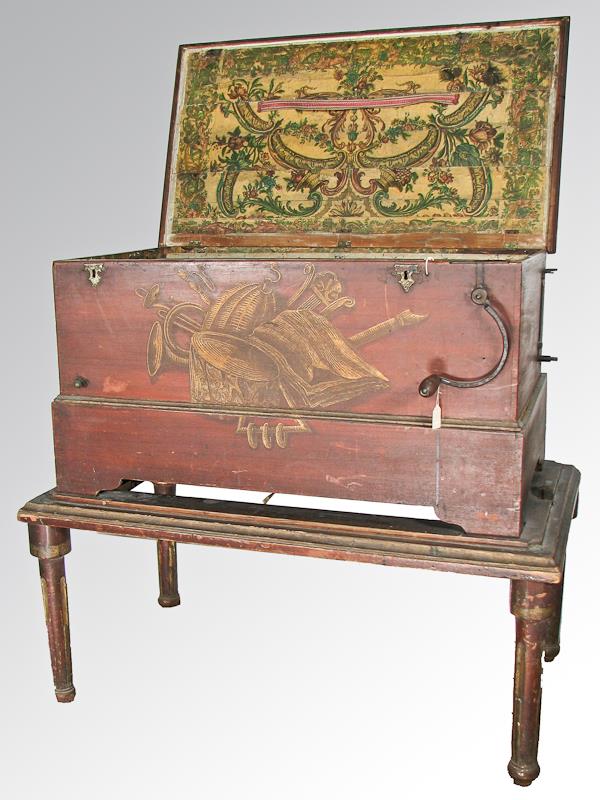
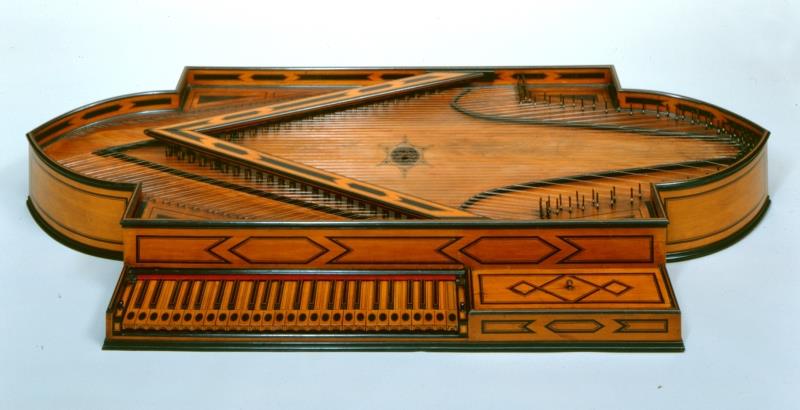
One such invention, the Viola Organista, might have changed the course of musical history had Leonardo had the wherewithal or desire to build one in his lifetime. Or it might have remained a minor curiosity; there is no way to know.
Sketched out in notebook pages contained in the Codex Atlanticus, the design showed “an outline of a construction concept for a bowed string instrument which at the same time is a keyboard instrument.” A violin that is also a piano, sort of…. Having built a version of the instrument 500 years after its invention, Polish concert pianist Slawomir Zubrzycki describes it as having “the characteristics of three [instruments] we know: the harpsichord, the organ and the viola da gamba.”
Zubrzycki spent four years working on his Viola Organista. A few years back, we featured a brief performance, his first public debut of the instrument in 2012. Now, we have much more audio of this incredible musical invention to share, including a longer performance from Zubrzycki at the top of the post, Marin Marais’ Suite in B Minor, performed in 2014 at the Copernicus Festival in Krakow. (You can see the full concert just above.) Despite these notable performances, and his notable creation, Zubrzycki is not the first to build a Viola Organista.
In 2011, Eduardo Paniagua, another musician devoted to Leonardo’s instrument—which does indeed sound like a “one person string ensemble,” as a commenter at this MetaFilter post noted—released a disc of 19 songs by Baroque composers, contemporaries of Leonardo, played on a Viola Organista built by Japanese maker Akio Obuchi. (Hear the full album on Spotify above.) Accompanying the album, writes Spanish site Musica Antigua (quoted in English here via Google translate), is “a profusely illustrated booklet with eleven of the organist viola prototypes that Leonardo himself devised,” with descriptions of the instrument’s operation by Paniagua.
Though Leonardo himself never built, nor heard, the instrument, it did attract interest not long after his death. “The oldest surviving model,” notes Musica Antigua, “is in El Escorial and is dated at the beginning of the seventeenth century.” Every version of the Viola Organista worked from original design specs like those in Leonardo’s hand above, using wheels to bow the strings when the keys are pressed, rather than hammers to strike them.
It’s an ingenious solution to a problem musicians had sought for many years to solve: creating a keyboard with rich dynamics and sustain. Whether Leonardo’s design is superior to other attempts, like the clavichord or, for that matter, the piano, I leave to musicologists to debate. We might all agree that the sound of his instrument, as played by Paniagua and Zubrzycki, is truly original and totally captivating.
When I get to muttering in my beard about kids today, the subject oft turns to digital music and how everything sounds the same and looks the same and “what ever happened to album covers, man….” I mean I know they still exist, but they’re terrible, right? Shiny thumbnail-sized afterthoughts with no more purpose than candy in a shop window display? I will admit it, and not without some chagrin, I’ve always thought that whoever designed Taylor Swift’s 1989 had a canny sense of the derivative as a quality one should wear proudly on one’s sleeve—it’s evocative!, in a fun way, not in the way of her most recent, severely Teutonic cover incarnation.
So, it’s not all bad, because there’s one good Taylor Swift album cover. But then album art has never been all good. Far from it. I remember album covers like this and this and these being the norm. And then there’s … well you’ve probably seen these jaw-dropping monstrosities from the distant past….
Maybe the truly awful album cover is as rare a treasure as the truly great one. Maybe the album cover is as it always was, despite so rarely appearing in a physical form: sometimes an inspired work of art, sometimes a half-assed, tossed-off marketing job, sometimes a half-baked, so-bad-its-good (or not) concept, completely unrelated to the music.
It can sometimes seem like all we have left is nostalgia, but nostalgia can be done well, as in 1989 (even if that record’s cover does evoke, in part, an image from Joni Mitchell’s weird stint in blackface). Or it can be done badly, as in Justin Timberlake’s widely disliked 2018 Man of the Woods, which makes a lame artsy attempt to dress up the fact that it’s kinda ripping off 1989 four years later. I do not know how to evaluate Miley Cyrus’ various Miami Vice-themed covers for her album Bangerz, which came out in the same year as 1989, except to say, good for her for going all the way with this, like, why hold back?
Other recent album covers mime the style of decades past with real swagger, like Swedish folk sister duo First Aid Kit’s Heart-inspired Ruins cover, at the top, featuring one of many retro 70s fonts that have returned of late, as easy to read in thumbnail images as they were on 8‑track tapes. The cover of London artist Arlo’s 2017 single “Safe” has its obvious 80s Duran Duran pastel and marble swirl deco trends down, tastefully and knowingly applied.
You can do your own cultural anthropology of the album cover, from 2018’s era of eye candy glamor, and the recent creative—and not-so-creative—repurposing of the past, to the genuine articles from the 50s, 60s, 70s, 80s, and 90s at the Cover Art Archive, a joint project of the Internet Archive and MusicBrainz, an “open music encyclopedia that collects music metadata and makes it available to the public.
The collection now numbers in the several hundred thousands—upwards of 800,000, according to its results counter—but some of the uploads are not yet complete with images. You are invited to contribute and help make this amazing resource even more comprehensive. “To get started,” the MusicBrainz blog writes, “log in with your MusicBrainz account (or create a new one) find your favorite release and then click on the cover art tab to view the existing pieces of art and/or upload new ones.”
You may find, as you browse and compare genres and eras, that perhaps the album cover is in decline, or you may find that it is alive and well, still an innovative form despite the massive shift in modes of production. At least aged British metal band Saxon, a true original, still keeps it real, further up, with the cover of their 22nd album, 2018’s Thunderbolt. Many of Saxon’s progeny have continued in the tradition of high fantasy metal cover art.
Some things will never return. There’ll never be another Diary of a Madman, that’s for sure, or another Ozzy. But the in-your-face soft-focus garishness of the 80s, and the styles of nearly every other decade, live on, to take a phrase from Childish Gambino’s 2013 outing, Because the Internet.
So unfashionable for so long, progressive rock has lately come in for a re-evaluation. The qualities that current music critics have come to appreciate — often the very same ones that bothered so many of their colleagues in the 1970s — include its technical virtuosity, its compositional inventiveness, its sheer performative unabashedness, and its willingness to draw from other forms of art, especially literature. Or literature of a certain kind, anyway: having previously featured prog-rock adaptations of Isaac Asimov’s I, Robot by the Alan Parsons Project, George Orwell’s 1984 by Rick Wakeman, and H.G. Wells’ War of the Worlds by Jeff Wayne, today we give you Jules Verne’s Journey to the Centre of the Earthas adapted by Wakeman in 1974.
You can listen to the album, which All Music Guide’s Mike DeGagne calls “one of progressive rock’s crowning achievements,” on Spotify (and if you don’t have Spotify’s free software, you can download it here). “With the help of the London Symphony Orchestra and the English Chamber Choir, Rick Wakeman turns this classic Jules Verne tale into an exciting and suspenseful instrumental narrative,” using not just his own Hammond organ and Moog synthesizer but Blow-Up star David Hemmings’ recitation of Verne’s words as well.
“Recorded at London’s Royal Festival Hall, the tale of a group of explorers who wander into the fantastic living world that exists in the Earth’s core is told musically through Wakeman’s synthesized theatrics and enriched by the haunting vocals of a chamber choir.”
Wakeman’s Journey to the Centre of the Earth demonstrates what not just Verne’s subterranean explorers but all the best prog-rockers have in spades: ambition. And though the work evidences deep familiarity with the novel on Wakeman’s part, you needn’t have read a page of Verne — nor of the recent books attempting to bring prog-rock to respectability — to enjoy it. You don’t even need to take it seriously, as one All Music Guide user-reviewer, present as a wide-eyed teenager at the Royal Festival Recording, adds: “It was all very avant garde and I felt quite sophisticated as a 16-year-old attending the show with smart kids who use to sit around crossed legged on the floor listening to Dark Side Of The Moon.” For him, the album now provides “a view back to the oh so earnest days of grandiose prog-rock and for that reason alone it can be seen as something it never was at the time… fun!”
Based in Seoul, Colin Marshall writes and broadcasts on cities and culture. His projects include the book The Stateless City: a Walk through 21st-Century Los Angeles and the video series The City in Cinema. Follow him on Twitter at @colinmarshall or on Facebook.
This is not an easy post to write. I am going to talk about something personal. Yes, it’s time to discuss underrated albums, a term that can mean so many things to so many people that we might as well talk about underrated dreams. But dreams can be shared, at least in pop culture and the subcultural caverns beneath it. And people can share opinions about an underrated album, especially in the disparate communities of the internet, where devotees can find each other easily.
When I was younger this was not so easy. One might discover an album at a local indie record shop and buy it just for the cover, having no idea what lay within. There were no songs on YouTube, Spotify, or iTunes. (My generation’s walking to school in the snow, uphill both ways.) One made chance discoveries at live shows and in the pages of print magazines. In such primitive conditions, it was easy to find records that you and only you loved, from start to finish, sometimes believing you must be the only person who had ever heard them.
As Richard Metzger puts it at Dangerous Minds, in writing about an underrated EP from a highly underrated band, “In the pre-Internet days, record collection was more than merely a hobby. It was almost like… a way of life.”
I take this little nostalgic trip to say that for me, underrated albums tend to fold into the category of underrated artists. Discovering them wasn’t a matter of cred—not at first. It was a secretive and private act, a tiny adolescent rebellion against the bad taste of friends and family. Given such musical solipsism, I find it hard to gauge what makes an album underrated. You’ll find lists aplenty, and they are odysseys of discovery for the adventurous. Lists filled with lesser-known records from very well-known artists. Lists made of picture galleries. Lists quoting such high-cred stars as Kurt Cobain, Björk, and Arcade Fire.
As for myself, I could go on for days, but humbly offer here a few eclectic albums that—start to finish—have captivated me over the years for various reasons. At the top, hear “Which Witch,” from TK Webb’s criminally underrated 2006 Phantom Parade, an album of plaintive laments that sounds like a truck stop ashtray—hypnotic roadhouse country blues played by the Velvet Underground with vocals parked somewhere between Tom Waits and Captain Beefheart.
Below it, hear a short excerpt from what is very likely the strangest live album ever recorded: Wire’s 1981 Document & Eyewitness. It’s hard to imagine listening to it without the liner notes in hand, but the overdubbed conversation on “Everything’s Going to Be Nice” will give you a taste of what the concert was like. The band, writes Pitchfork, “had pushed their art-student tendencies to the breaking point, turning what was expected to be a pogo-fueled punk show into a Dadaist, performance-art spectacle complete with Morris-dancing bells and a live goose.”
This track represents a brief interlude in the midst of recordings that capture the sound of a band taking itself apart onstage before a bewildered audience clamoring for the hits (or, rather, the hit, “I2XU” from their classic debut Pink Flag.)
In the Spotify playlist above, in addition to these two albums, hear former Screaming Trees singer Mark Lanegan’s Bubble Gum, English rockabilly revivalist Holly Golightly & Dan Melchoir’s Desperate Little Town, Afro-Turkish singer Esmeray’s 2013 collection of hits En lyileriyle Esmeray (hits in her native land, maybe, but sadly not well known in the English-speaking world), post-rock pioneers Bark Psychosis’s 1994 Hex; the alternatively hypnotic and hysterical Canadian indie rockers Frog Eyes’ 2002 debut The Bloody Hand; Pissed Jeans’ mostly terrifying Hope for Men; Gillian Welch’s trad folk/country Soul Journey (don’t miss closer “Wrecking Ball”); and the Staple Singers underrated early albums Uncloudy Day & Will the Circle Be Unbroken.
Depending on my mood, these are albums I listen to straight through—and think, while doing so, everyone should hear this. But of course the list is biased. Like telling people about your dreams, telling people about your favorite, underrated albums can never approach the experience of listening to them yourself. Nonetheless, reader, a personal question: what would you put on your list? What albums do you want fellow OC readers to put on their radar? Tell us in the comments below. And if we get enough good replies, who knows, maybe we’ll pull together a big meta playlist we all could share.
Last summer we checked in with the Internet Archive’s Great 78 Project, a volunteer effort to digitize thousands of 78rpm records—the oldest mass-produced recording medium. Drawing on the expertise and vast holdings of preservation company George Blood, L.P., the ARChive of Contemporary Music, and over 20 more institutions from around the world, the project aims to save the recorded sounds of the past, and not only those that have come down to us through the efforts of highly selective curators. What we think of as the sound of the early 20th century—the blues, jazz, country, classical, ragtime, gospel, bluegrass, etc.—only represents a popular sample.
Internet Archive founder Brewster Kahle wants to widen our sonic appreciation of the period, and include everything, “Midwest, different countries, different social classes, different immigrant communities and their loves and fears.”
This massive archive will eventually number in the millions, up to 3 million recordings, to be exact, and continues apace at the rate of about 5,000 new uploads per month.
Last August, the recordings in the archive numbered over 25,000. Now, the Great 78 Project contains more than 78,000 and counting digital transfers of fragile 78rpm records—everything from Prokofiev to the Carter Family (further up) to Mississippi John Hurt from 1928 (above) to international folk dances to field recordings of animal sounds.
The collected works of Al Jolson, spanning the years 1911 to 1926, appear (above), as does a fascinating collection from Argentina, brought to the U.S. by Tina Argumedo, who began collecting 78s in the 30s and continued to do so for another 20 years before moving to the States. Her digitized collection of almost 700 records “comprises primarily tango music, with boleros, sambas, mambo, and other dance music,” like the Argentine swing of Dajos Bela y su Orquestra from 1932 below.
As we noted in our previous post, the utmost care has gone into preserving the original sound of these records, with a variety of digital transfers made with different vintage styluses to represent the differences in playback systems. The process also preserves all the original records’ crackle and hiss—sometimes the music seems to swim below the surface noise, which only enhances the effect of hearing, transported through time, music from 80, 90, and 100 years ago and more.
Drummer Keith Moon was surely the most kinetic member of The Who—which is really saying a lot—but he was not the band’s best musician, even if he is routinely named one of the best drummers of all time. Moon knew the appeal of his playing often lay in the fact that it was like no one else’s: he described himself as the “greatest Keith Moon-type drummer in the world.” Nothing in rock approached his untamed excess, modeled after the far more disciplined flights of his hero, Gene Krupa.
But if the band “can be said to have an instrumental virtuoso,” writes Chris Jisi at Drum! magazine, “it is John Alec Entwistle,” their true solid center (they called him “The Ox”) and the perfect rhythmic foil to Moon, who “could sound like a drum kit falling downstairs,” Entwistle says. The bass player not only kept time, he tells Jisi, since Moon didn’t, and followed Moon’s “mess of cymbals” and “all over the place” snare drum, but he also filled in for a rhythm guitarist as Pete Townshend slashed away.
He kept his bass riffs relatively simple, he had to, and he “added top end or treble… to cut through the rest of the noise.” It works, for sure. He is rightfully singled out as one of the greatest rock bass players ever for his phenomenal skill and poise.
A lesser player trying to compete with Moon’s wall of drums and Townshend’s massive power chords might disappear entirely. Entwistle always stands out. His comments about Moon’s playing might sound disparaging, but they come off in context as honest and accurate, as do his descriptions of his own playing.
Entwistle suggests he wouldn’t be the player he became without Moon and the rest of the band. “We constructed our music to fit ‘round each other,” he says. “It was something very peculiar that none of us played the same way as other people.” In their best moments, some parts “slid together by magic and were gone forever.” This is the essence, really, of rock and roll, the serendipitous transcendence that arises from wildly colliding waves of sound.
But such controlled chaos can require, especially in a band like The Who, one cool, well-trained virtuoso who cannot be ruffled, no matter what, whose perfection looks effortless and who never breaks a sweat. The eternal archetype of that player is John Entwistle. At the top, hear Entwistle’s isolated bass in a live take of “Won’t Get Fooled Again.” (He comes in at 1:45, after a much-extended intro). Below it, you’ll easily pick out his every note in the studio version. And further up, after another extended synthesizer intro, hear him solo at 1:25 on “Baba O’Riley,” also live at Shepperton Studios in 1978. (The studio recording is above).
And just above, in one of his most energetic performances, hear him play a live version of “Pinball Wizard” (starting at 0:36). And then catch one more jaw-dropping solo, just for good measure, recorded live at Royal Albert Hall.
Entwistle is sometimes compared to Jimi Hendrix, but in some ways, The Ox came first with his fuzzed-out sound. The mild-mannered player “pioneered the use of feedback in music and smashing his instrument,” writes Ultimate Classic Rock, “with Jimi Hendrix following suit after seeing Entwistle do it.” For all his reserved English coolness, Entwistle first pushed the boundaries of loudness, “using 200 watts of power when most bands used 50,” just one of the reasons, as you’ll hear in these tracks, for his other nickname: “Thunderfingers.”
Even if we can’t name them, we’ve all seen hundreds of the most important paintings in art history, and even if we can’t name it, we’ve all heard “Classical Gas.” 3000 Years of Art, the 1968 experimental film above, officiates an aesthetic union of about 2500 of those much-seen, highly influential images and Mason Williams’ instrumental hit song, all in just over three minutes.
Initially released on The Mason Williams Phonograph Record in 1967, the track went on, with the help of 3000 Years of Art, to become “one of the earliest records that used a visual to help promote it on television, which probably qualifies it as one of the earliest music videos.” Those words come from Williams himself, who posted the video to his own Youtube channel.
When “Classical Gas” first became a hit, he writes, “I was also the head writer for The Smothers Brothers Comedy Hour on CBS. I had seen a film titled God Is Dog Spelled Backwards at The Encore, an off beat movie house in L.A. The film was a collection of approximately 2500 classical works of art, mostly paintings, that flashed by in three minutes. Each image lasted only two film frames, or twelve images a second! At the end of the film the viewer was pronounced ‘cultural’ since they had just covered ‘3000 years of art in 3 minutes!’ ”
Contacting the short’s creator, a UCLA student by the name of Dan McLaughlin, Williams asked if he could re-cut its imagery to “Classical Gas” for a Smothers Brothers segment. First airing on the show in the summer of 1968 — the same year that saw another of the show’s writers, a young man by the name of Steve Martin, bring his talents directly to the air — the resulting proto-music-video rocketed Williams’ song to another sphere of popularity entirely. Not only that, it “opened the door to realizations that the viewer’s mind could absorb this intense level of visual input” with its use of kinestasis, the phenomenon whereby a montage of still images creates its own kind of motion.
Following the idea to its then-logical conclusion, Williams soon after wrote a skit for the Smothers Brothers Comedy Hour “projecting the idea that someday VJs would be playing hit tapes on TV.” And so the trajectories of easy-listening instrumental music, gently subversive television comedy, and art history intersected to give the world an early glimpse of MTV, Youtube, and whichever host of even shorter-form, intenser viewing experiences comes next.
Based in Seoul, Colin Marshall writes and broadcasts on cities and culture. His projects include the book The Stateless City: a Walk through 21st-Century Los Angeles and the video series The City in Cinema. Follow him on Twitter at @colinmarshall or on Facebook.
We're hoping to rely on loyal readers, rather than erratic ads. Please click the Donate button and support Open Culture. You can use Paypal, Venmo, Patreon, even Crypto! We thank you!
Open Culture scours the web for the best educational media. We find the free courses and audio books you need, the language lessons & educational videos you want, and plenty of enlightenment in between.