In this short video, Romanian animator Sebastian Cosor brings together two haunting works from different times and different media: The Scream, by Norwegian Expressionist painter Edvard Munch (1863–1944), and “The Great Gig in the Sky,” by the British rock band Pink Floyd.
Munch painted the first of four versions of The Scream in 1893. He later wrote a poem describing the apocalyptic vision behind it:
I was walking along the road with two Friends the Sun was setting — the Sky turned a bloody red And I felt a whiff of Melancholy — I stood Still, deathly tired — over the blue-black Fjord and City hung Blood and Tongues of Fire My Friends walked on — I remained behind – shivering with anxiety — I felt the Great Scream in Nature
Munch’s horrific Great Scream in Nature is combined in the video with Floyd’s otherworldly “The Great Gig in the Sky,” one of the signature pieces from the band’s 1973 masterpiece, Dark Side of the Moon. The vocals on “The Great Gig” were performed by an unknown young songwriter and session singer named Clare Torry.
Torry had been invited by producer Alan Parsons to come to Abbey Road Studios and improvise over a haunting piano chord progression by Richard Wright, on a track that was tentatively called “The Mortality Sequence.” The 25-year-old singer was given very little direction from the band. “Clare came into the studio one day,” said bassist Roger Waters in a 2003 Rolling Stone interview, “and we said, ‘There’s no lyrics. It’s about dying — have a bit of a sing on that, girl.’ ”
Forty-two years later, that “bit of a sing” can still send a shiver down anyone’s spine. For more on the making of “The Great Gig in the Sky,” and Torry’s amazing contribution, see the clip below to hear Torry’s story in her own words.
If you would like to support the mission of Open Culture, consider making a donation to our site. It’s hard to rely 100% on ads, and your contributions will help us continue providing the best free cultural and educational materials to learners everywhere. You can contribute through PayPal, Patreon, and Venmo (@openculture). Thanks!
Jazz has become institutionalized, for both good and ill. On the upside, it has found a permanent home in prestigious performing arts centers like Jazz at Lincoln Center, where its memory will be preserved for generations. High priests like Wayne Shorter, Wynton Marsalis, and Herbie Hancock pass on the traditions to young jazz acolytes at universities. The American art form has achieved the level of respectability that some of its most innovative practitioners, such as Duke Ellington and Charles Mingus, had always sought, the recognition of the high art world.
On the other hand, we too easily forget how dangerous jazz used to be—how thoroughly cutting edge and disturbing to middlebrow sensibilities. But of course, jazz has passed through many cultural cycles, with each generation of artists shocking its elders by pushing against musical decorum. Late 40s and 50s bebop gave us the lean, mean combo as a challenge to the big band swing era, and produced superstar improvisers who veered thrillingly off script in every performance. But this incarnation of jazz, too, threatened to become staid as the sixties neared.
And so a handful of artists created, to take the title of Ornette Coleman’s groundbreaking 1959 album, “the shape of jazz to come,” free jazz, which represented, writes Chris Kelsey, “a final break with the music’s roots as a popular art form, casting it in an alternative role as an experimental art music.” The sixties saw profound innovation in jazz, as artists like Coleman, Coltrane, Eric Dolphy, Sun Ra, Pharoah Sanders, and others expanded its possibilities. But to read this music as solely experimenting “along the lines of the European ‘classical’ avant-garde” is to ignore the deep cultural wellspring from which it came.
As Amiri Baraka wrote in the liner notes for a 1965 compilation, The New Wave in Jazz, avant-garde jazz was a “touch stone of the new world,” a form that transcended the conditions of slavery, miseducation, and social control; it was the “music of contemporary black culture.”
The people who make this music are intellectuals or mystics or both. The black rhythm energy blues feeling (sensibility) is projected into the area of reflection, intentionally. As Expression…where each term is (equally) co-respondent.
Projection over sustained periods (more time given, and time proposes a history for expression, hence it becomes reflective projection.
Arbitrariness of Form (variety in nature)
Intention of performance as a Learning experience
These were the distinctive “new world” qualities of experimental jazz. Its hip signifiers, Baraka wrote, mark it as “an invention of Black Lives”; it is not music to lull and soothe but to instruct, with force, if necessary. “Getting hit in the head with a stick,” he writes with a wink, “can do you as much good as meditating.” It might be hard for us to hear, now that the music has been so thoroughly enshrined in academic departments and conservatories, but avant-garde jazz once had the power to thoroughly shock and surprise, as the statement of a culture both in dialogue with and revolt against oppressive traditional forms.
In the playlist above, The Sound of Avant-Garde Jazz, you recover a sense of the music’s edginess with recordings from some of its most experimental gurus, including Coleman, Sun Ra, McCoy Tyner, Yusef Lateef, Alice Coltrane, and many, many more. The playlist spans the last 60 years or so, featuring later white adopters like Pat Metheny, John Zorn, and Bill Frisell, and including rocking electric jazz from diverse, eclectic bands like Tony Williams’ Lifetime, whose “Proto-Cosmos,” at the top, epitomizes the expansive range of 70s fusion. The overall experience of this comprehensive playlist may not only shake up your preconceptions of jazz, but may, as Baraka writes, change your preconditioned sense of “the normal feeling of adventure.”
The playlist offers up 350 tracks, and runs 35 hours. If you need Spotify’s free software, download it here.
It can sometimes seem like so much qualitative science confirms what we already know through experience and folk wisdom. But that does not make such research redundant. Instead, it sets the stage for more detailed investigations into specific causes and effects, and can lead to more refined understanding of general phenomena. For example, “a new study out of Australia,” reports CNN, “confirms what we probably already knew,” by concluding that if you want to be happier, you should get out more.
Specifically, you should get out to concerts and music festivals and dance your you-know-what off. The Australian researchers found that “people who actively engaged with music through dancing and attending events like concerts and musicals reported a higher level of subjective wellbeing.” The March, 2017 study, cheekily titled “If You’re Happy and You Know It: Music Engagement and Subjective Wellbeing,” defines the latter phrase as “the scientific psychological term for general mood ‘happiness,’ which is positive, stable, and consistent over time.”
Subjective wellbeing (SWB), although a self-reported measure, helps psychologists identify effective therapies for depression and mood disorders. Engaging meaningfully with music is one of them, and one needn’t be a musician to reap the benefits. While “producing music and performing encourage self-exploration, emotional expression, self-esteem and confidence,” the study’s authors write, interacting with music as a fan is also “associated with higher mood when considered in terms of activation and valence.”
Simply consuming recorded music, however, will not have the same benefits. While “recent technological advances” and streaming services have “increased the availability of and accessibility to music… engaging with music extends beyond just passive listening.” In large part, the active participation in a music scene—as part of a fan community or festival audience, for example—shows positive outcomes because of the “social component of music engagement.” Listening by oneself “may improve physical health and emotional wellbeing.” Listening “in the company of others is associated with stronger positive experiences.”
As the site Live for Live Music puts it, “live music universally lowers stress levels, increases social bonds while decreasing levels of pain, and can even physiologically cause people to get “skin-gasms.” And if that’s not reason enough to get tickets to see your favs, I don’t know what is. One would also hope the study makes a convincing case for funding live music as a mental health initiative. Unless you live in a city with lots of free concerts, the expense of such events can be prohibitive. At least in Australia, the researchers note, “attending musical events is costly, and may be a privilege afforded to those who earn a higher income.”
Susan Perry at Minnpost sums up a few other limitations of the study, such as its lack of data on frequency of attendance, and that it does not “differentiate between people who are musically talented and those who aren’t.” Nonetheless, one particular finding should have you shedding inhibitions to increase your SWB. “Dancers,” Perry summarizes, were “more likely than non-dancers to be happy,” as were those who sing along.
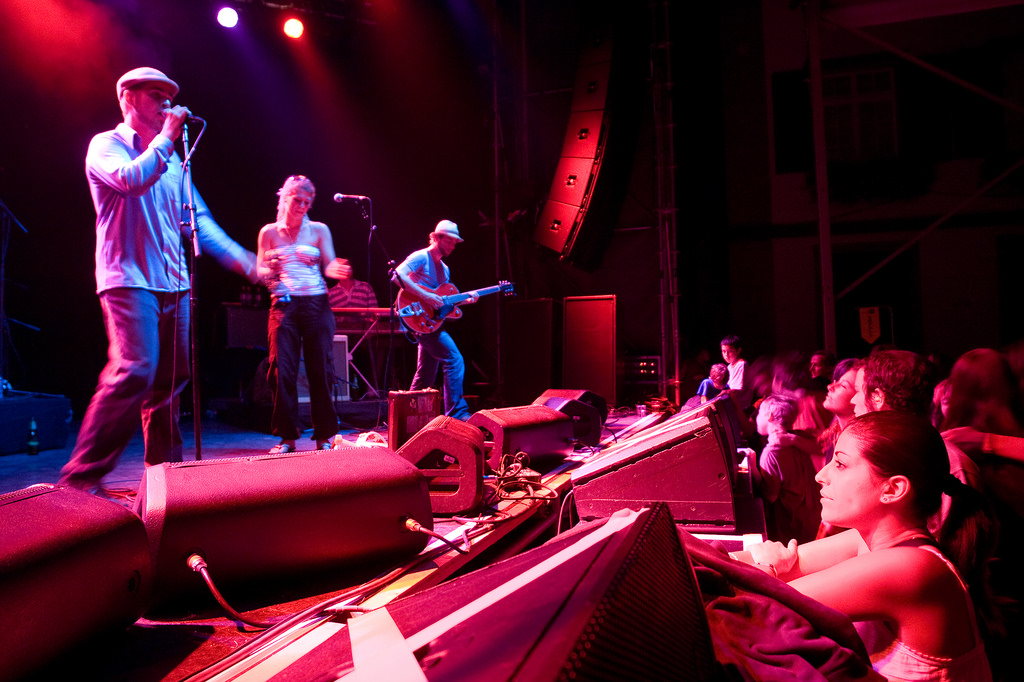
Last night, Dead & Company played a huge show at Citi Field in New York City. And when they performed “Touch of Grey” during their encore, a light show on the Empire State Building got underway, completely synchronized with the song. According to Jam Band, the lights were “controlled by veteran lighting designer Marc Brickman, who has worked on tour with Pink Floyd, Paul McCartney, Hans Zimmer and many more.” Enjoy the visual display above. And see the scene on the stage below:
If you would like to support the mission of Open Culture, consider making a donation to our site. It’s hard to rely 100% on ads, and your contributions will help us continue providing the best free cultural and educational materials to learners everywhere. You can contribute through PayPal, Patreon, and Venmo (@openculture). Thanks!
FYI: If you sign up for a MasterClass course by clicking on the affiliate links in this post, Open Culture will receive a small fee that helps support our operation.
Herbie Hancock’s jazz career started in his family’s living room, listening to his favorite records and trying to play along. Now, he’s one of the most celebrated musicians in the world. Join Herbie at the piano as he shares his approach to improvisation, composition, and harmony.
If you would like to support the mission of Open Culture, consider making a donation to our site. It’s hard to rely 100% on ads, and your contributions will help us continue providing the best free cultural and educational materials to learners everywhere. You can contribute through PayPal, Patreon, and Venmo (@openculture). Thanks!
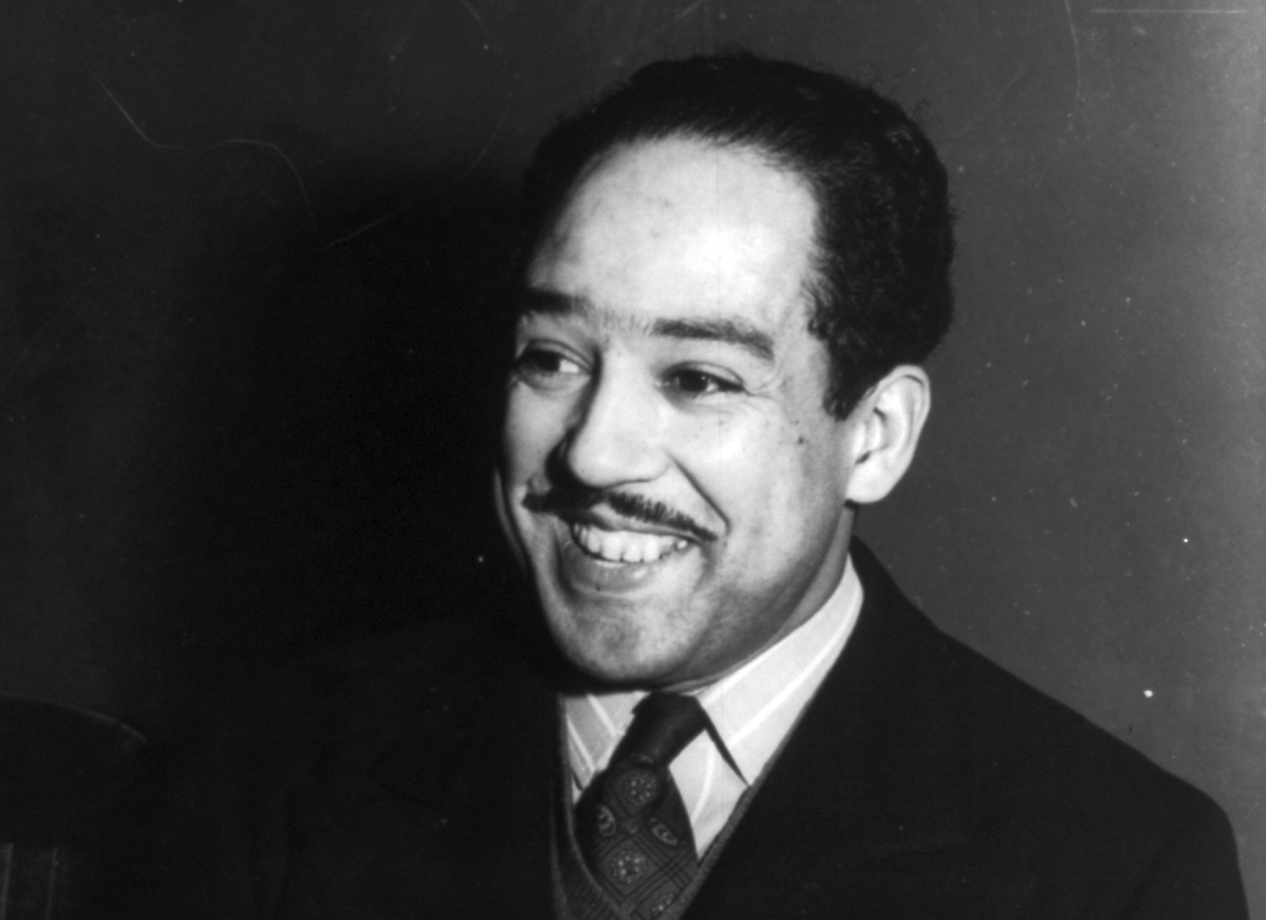
“Langston Hughes was never far from jazz,” writes Rebecca Gross at the NEA’s Art Works Blog. “He listened to it at nightclubs, collaborated with musicians from Monk to Mingus, often held readings accompanied by jazz combos, and even wrote a children’s book called The First Book of Jazz.” The 1955 book is a striking visual artifact, with illustrations by Cliff Roberts made to resemble jazz album covers of the period. Though written in simple prose, it has much to recommend it to adults, despite its somewhat forced—literally—upbeat tone. “The book is very patriotic,” we noted in an earlier post, “a fact dictated by Hughes’ recent [1953] appearance before Senator McCarthy’s Subcommittee, which exonerated him on the condition that he renounce his earlier sympathies for the Communist Party and get with a patriotic program.”
Earlier statements on music had been more candid and close to the heart: “jazz to me is one of the inherent expressions of Negro life in America,” Hughes wrote in a 1926 essay, “The Negro Artist and the Racial Mountain”—“the eternal tom-tom beating in the Negro soul—the tom-tom of revolt against weariness in a white world, a world of subway trains, and work, work, work; the tom-tom of joy and laughter, and pain swallowed in a smile.”
The sweet bitterness of these sentiments may lie further beneath the surface thirty years later in The First Book of Jazz, but the children’s introduction to that thoroughly original African-American form made it clear. “For Hughes,” as Cross writes, “jazz was a way of life,” even when life was constrained by red scare repression.
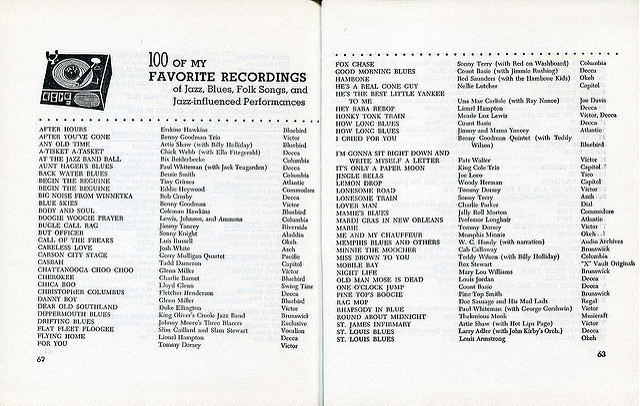
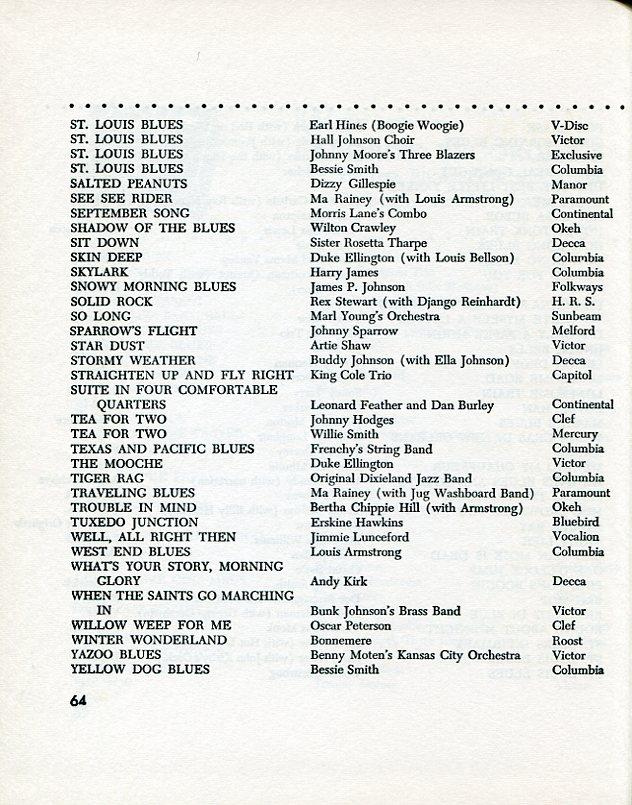
Hughes invites his readers, of all ages, to share his passion, not only through his careful history and explanations of key jazz elements, but also through a list of recommendations in an appendix: “100 of My Favorite Recordings of Jazz, Blues, Folk Songs, and Jazz-Influenced Performances.” (View them in a larger format here: Page 1 — Page 2.) In this playlist below, you can hear 81 of Hughes’ selections: classic New Orleans jazz from Louis Armstrong, blues from Bessie Smith, “jazz-influenced” classical from George Gershwin, bebop from Thelonious Monk, swing from Count Basie, guitar gospel from Sister Rosetta Tharpe, and much more from Sonny Terry, Tommy Dorsey, Charlie Parker, Memphis Minnie, Billie Holiday, and oh so many more artists who moved the Harlem Renaissance poet to put “jazz into words” as he wrote in “Jazz as Communication,” an essay published the following year. If you need Spotify’s free software, download it here.
For Hughes, jazz was a broad category that embraced all black American music—not only the blues, ragtime, and swing but also, by the mid-fifties, rock and roll, which he believed, would “no doubt be washed back half forgotten into the sea of jazz” in years to come. But whatever the future held for jazz, Hughes had no doubt it would be “what you call pregnant,” and as fertile as its past.
“Potential papas and mamas of tomorrow’s jazz are all known,” he concludes in his 1956 essay. “But THE papa and THE mama—maybe both—are anonymous. But the child will communicate. Jazz is a heartbeat—its heartbeat is yours. You will tell me about its perspectives when you get ready.” Just above, see Hughes recite the poem “Weary Blues” with jazz band accompaniment in a CBC appearance from 1958.
Having grown up in Georgia surrounded by blues, gospel, and country music—and having studied the classical composers when he was learning piano—Ray Charles was bound to become a polymath of musical genres. He is often credited with creating soul music, but a less remembered but equally important part of his career was recording one of the first major crossover records, 1962’s Modern Sounds in Country and Western Music. The record execs at ABC-Paramount understandably thought it would be career suicide, but Charles, who had a contract that gave him creative control (and ownership of his master tapes), insisted. It went on to be both a commercial and critical success, creating racial and genre bridges during the Civil Rights Movement.
So the above video of Willie Nelson performing a duet with Charles was not the oddity that it may first seem. The two recorded “Seven Spanish Angels” for the former’s Half Nelson album of duets, and the single would go on to be the most successful of Charles’ country releases, reaching the top of the country charts in 1985.
The song has become a favorite country cover, and judging by the YouTube comments is a favorite at funerals, seeing that it’s a tale of an outlaw couple pledging their love and going out shootin’. (That is, it’s good for honoring devoted couples, not for criminal parents. But we’re not here to judge.)
The 1984 TV special from which this excerpt came was filmed at the Austin Opry House, and featured Charles on five more songs with Nelson, including “Georgia on My Mind” and “I Can’t Stop Loving You.”
And although he didn’t write “Georgia on My Mind” (Hoagy Carmichael did), Charles’ name is synonymous with the well-loved soul number. That being said, Willie Nelson’s cover of the song reached higher in the charts in 1978, a kind of thank you to Charles for his country work.
After this 1984 video, the two would duet nine years later for Willie Nelson’s 60th birthday celebration where they once again sang “Seven Spanish Angels,” a testament to their long friendship.
Ted Mills is a freelance writer on the arts who currently hosts the FunkZone Podcast. You can also follow him on Twitter at @tedmills, read his other arts writing at tedmills.com and/or watch his films here.
A popular thought experiment asks us to imagine an advanced alien species arriving on Earth, not in an H.G. Wells-style invasion, but as advanced, bemused, and benevolent observers. “Wouldn’t they be appalled,” we wonder, “shocked, confused at how backward we are?” It’s a purely rhetorical device—the secular equivalent of taking a “god’s eye view” of human folly. Few people seriously entertain the possibility in polite company. Unless they work at NASA or the SETI program.
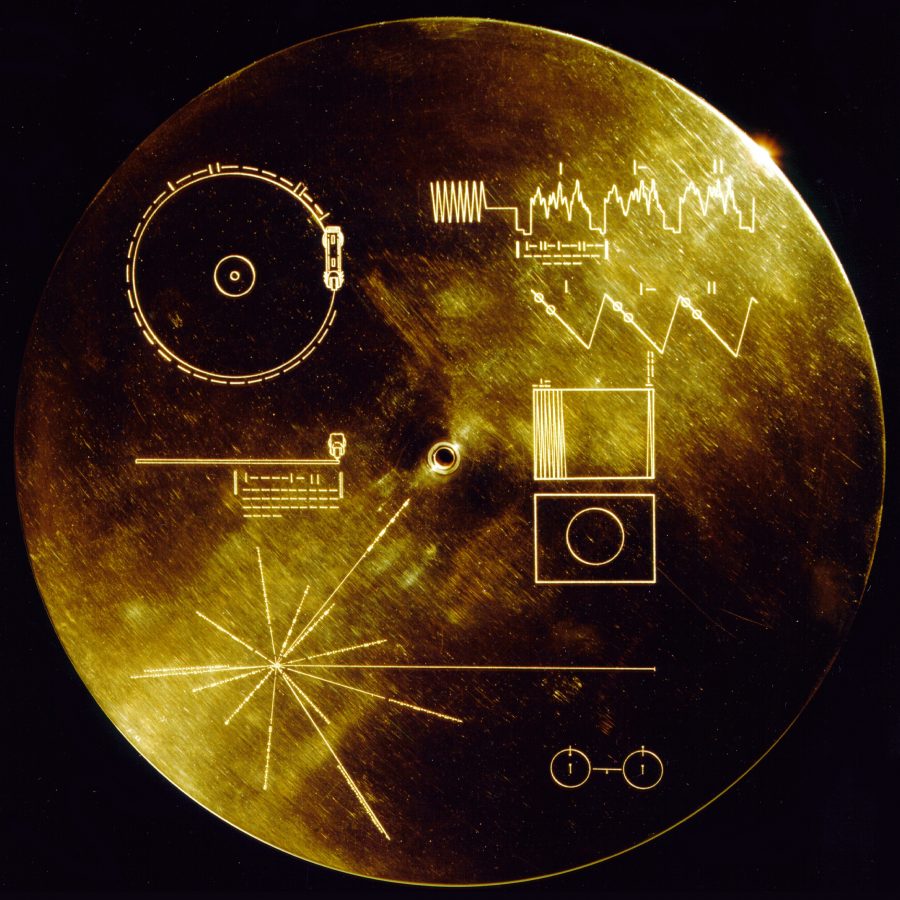
In 1977, upon the launching of Voyager 1 and Voyager 2, a committee working under Carl Sagan produced the so-called “Golden Records,” actual phonographic LPs made of copper containing “a collection of sounds and images,” writes Joss Fong at Vox, “that will probably outlast all human artifacts on Earth.” While they weren’t preparing for a visitation on Earth, they did—relying not on wishful thinking but on the controversial Drake Equation—fully expect that other technological civilizations might well exist in the cosmos, and assumed a likelihood we might encounter one, at least via remote.
Sagan tasked himself with compiling what he called a “bottle” in “the cosmic ocean,” and something of a time capsule of humanity. Over a year’s time, Sagan and his team collected 116 images and diagrams, natural sounds, spoken greetings in 55 languages, printed messages, and musical selections from around the world–things that would communicate to aliens what our human civilization is essentially all about. The images were encoded onto the records in black and white (you can see them all in the Vox video above in color). The audio, which you can play in its entirety below, was etched into the surface of the record. On the cover were etched a series of pictographic instructions for how to play and decode its contents. (Scroll over the interactive image at the top to see each symbol explained.)
Fong outlines those contents, writing, “any aliens who come across the Golden Record are in for a treat.” That is, if they are able to make sense of it and don’t find us horribly backward. Among the audio selections are greetings from then-UN Secretary General Kurt Waldheim, whale songs, Bach’s Brandenberg Concerto No. 2 in F, Senegalese percussion, Aborigine songs, Peruvian panpipes and drums, Navajo chant, Blind Willie Johnson’s “Dark Was the Night” (playing in the Vox video), more Bach, Beethoven, and “Johnny B. Goode.” Challenged over including “adolescent” rock and roll, Sagan replied, “there are a lot of adolescents on the planet.” The Beatles reportedly wanted to contribute “Here Comes the Sun,” but their record company wouldn’t allow it, presumably fearing copyright infringement from aliens.
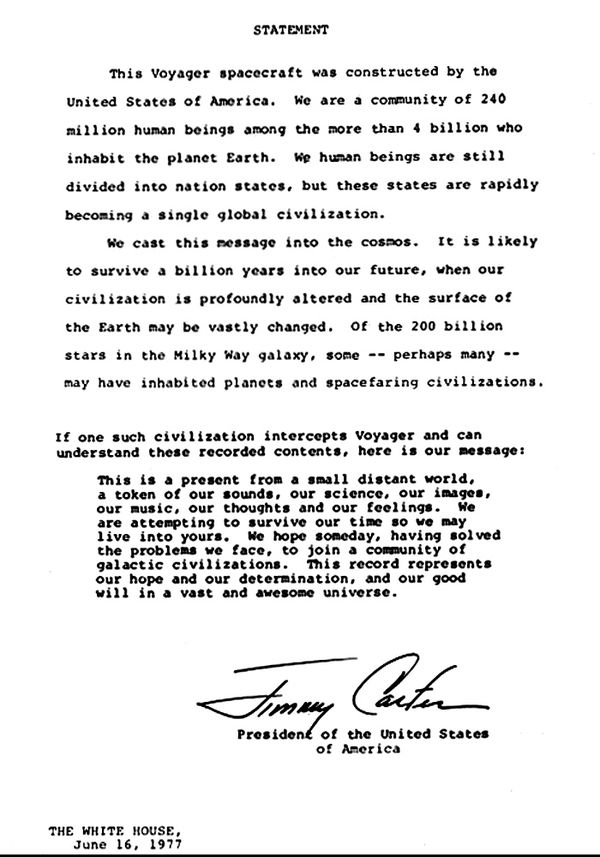
Also contained in the spacefaring archive is a message from then-president Jimmy Carter, who writes optimistically, “We are a community of 240 million human beings among the more than 4 billion who inhabit planet Earth. We human beings are still divided into nation states, but these states are rapidly becoming a single global civilization.” The messages on Voyagers 1 and 2, Carter forecasts, are “likely to survive a billion years into our future, when our civilization is profoundly altered and the surface of the Earth may be vastly changed.” The team chose not to include images of war and human cruelty.
We only have a few years left to find out whether either Voyager will encounter other beings. “Incredibly,” writes Fong, the probes “are still communicating with Earth—they aren’t expected to lose power until the 2020s.” It seems even more incredible, forty years later, when we consider their primitive technology: “an 8‑track memory system and onboard computers that are thousands of times weaker than the phone in your pocket.”
The Voyagers were not the first probes sent to interstellar space. Pioneer 10 and 11 were launched in 1972 and 1973, each containing a Sagan-designed aluminum plaque with a few simple messages and depictions of a nude man and woman, an addition that scandalized some puritanical critics. NASA has since lost touch with both Pioneers, but you may recall that in 2006, the agency launched the New Horizons probe, which passed by Pluto in 2015 and should reach interstellar space in another thirty years.
Perhaps due to the lack of the departed Sagan’s involvement, the latest “bottle” contains no introductions. But there is time to upload some, and one of the Golden Record team members, Jon Lomberg, wants to do just that, sending a crowdsourced “message to the stars.” Lomberg’s New Horizon’s Message Initiative is a “global project that brings the people of the world together to speak as one.” The limitations of analog technology have made the Golden Record selections seem quite narrow from our data-saturated point of view. The new message might contain almost anything we can imagine. Visit the project’s site to sign the petition, donate, and consider, just what would you want an alien civilization to hear, see, and understand about the best of humanity circa 2017?
We're hoping to rely on loyal readers, rather than erratic ads. Please click the Donate button and support Open Culture. You can use Paypal, Venmo, Patreon, even Crypto! We thank you!
Open Culture scours the web for the best educational media. We find the free courses and audio books you need, the language lessons & educational videos you want, and plenty of enlightenment in between.