I’ve always had the impression of John Lennon as an aloof figure, and I’ve sometimes had difficulty reconciling the give peace a chance persona with the angry young man and his acid tongue. Motorhead’s Lemmy once called him “the asshole of the band,” saying, “if you read his books, he’s not the peace-loving nice guy that you heard about.” That may be partly true (his first wife Cynthia might agree), but it needn’t negate his ideals nor his activism and charity. Lennon was complicated, and probably not an easy person to get close to. On the other hand, he may be the most self-revealing of all the Beatles (literally). Perhaps—as Lennon says in voice-over narration above—his life, like his experimental 8mm films, was “self-edited.”
Though not shot by Lennon himself (and not technically “home movies” as the YouTube uploader describes them), the candid films above and below show a relaxed and playful Lennon at his 31st birthday party on October 9, 1971, goofing off with Yoko and several other well-known figures (the same day, an exhibition of Lennon and Ono’s art opened in Syracuse). Allen Ginsberg, Ringo Starr, and Phil Spector bob in and out of the shaky frame below.
Above, Miles Davis hangs out with the couple and plays basketball with Lennon. Keener eyes than mine may spot other legendary celebrities. Avant-garde filmmaker and onetime Warhol cameraman Jonas Mekas shot the footage, calling it “Happy Birthday to John.” Mekas describes the audio track as “a series of improvised songs, sung by John, Ringo, Yoko Ono, and their friends—not a clean studio recording, but as a birthday singing, free and happy.” In a 2002 interview, he conveyed his impressions of Lennon:
John was very open and curious, a very quick sort of person, who caught on immediately. He did a lot of 8mm filming himself. At the beginning of Happy Birthday John, you will hear him talking about what he was trying to do.
It’s not unusual for introspective indie songwriters to make forays into poetry. Some do it rather successfully, like Silver Jews’ Dave Berman; some, like Will Oldham, stir up the poetry world by turning against poetry. Then there are indie stars like the indefatigably youthful Thurston Moore—formerly of Sonic Youth, currently of Chelsea Light Moving—who was asked to teach at the Jack Kerouac School of Disembodied Poetics at Naropa University. Better known for his numerous ventures in the New York experimental art world, Moore led a three-day poetry workshop at the Boulder, Colorado school’s summer writing program in 2011.
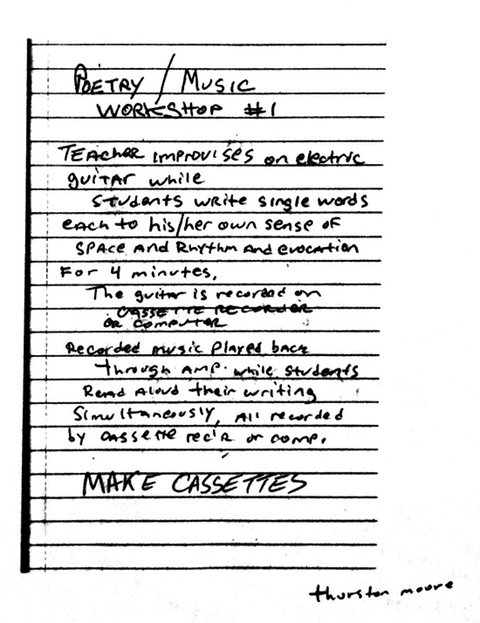
Moore was very much in demand. Anne Waldman, co-founder of Naropa’s writing program with Allen Ginsberg, said at the time, “We’ve been trying to get him for a while. We need him.” (Poetry teacher Kenneth Goldsmith recalls that the only one who wasn’t impressed with Moore was the recently departed Amiri Baraka, who said “he needs to work on those poems.”) Thanks to some very chatty students, we have detailed descriptions of Moore’s teaching style, as well as scans of his class notes. See the first page of Moore’s notes to himself for “Poetry / Music Workshop #1” at the top and a transcription of his elliptical, idiosyncratic method below:
Teacher improvises on electric guitar while students write single words each to his/her own sense of space and Rhythm and evocation For 4 minutes the guitar is recorded on cassette recorder or computer Recorded music played back through amp. while students Read aloud their writing Simultaneously, All recorded by cassette rec’r or comp.
MAKE CASSETTES
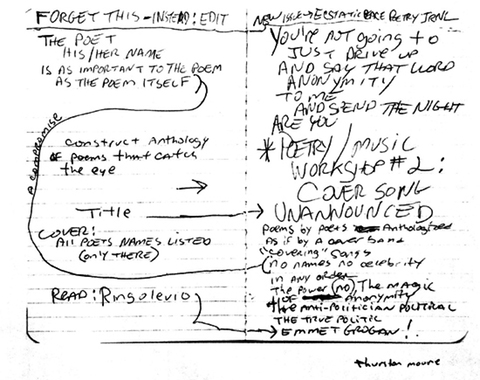
Student Katie Ingegneri, who interviewed Moore, brings us the page of text as well as the video above of Moore reading at Naropa. According to another one of Moore’s former students with the unlikely name Thorin Klosowski, the first day of the workshop consisted of a “rambling, three-hour introduction” during which Moore “revealed that when he initially moved to New York in the ’70s, it was not to make music, but rather to be a writer.” Klosowski’s piece includes additional pages of Moore’s notes, like that above, which cites countercultural hero Emmett Grogan’s autobiography, Ringolevio. Klosowski tells us that once things loosened up, Moore “did a better job of teaching than when he was pretending to be a lecturer.” The workshop also included some “gossipy tidbits”:
For instance, did you now that Kim Gordon had a texting relationship with James Franco? That Stephen Malkmus hates slam poetry? Or that even after years of being out of print, Moore’s list of ten essential free jazz records he wrote for Grand Royale was still brought into record stores (Twist & Shout and Wax Trax included)?
Moore had visited Naropa once before. In 2006 at a benefit for Burma Life and La Casa de la Esperanza, he read from his books Alabama Wildman, What I Like About Feminism, and Nice War and played some songs from Sonic Youth’s Rather Ripped. Hear the audio of that event above.
The state of music has changed radically in recent years. Of course, the largest change that springs to mind is Napster, the program that made collective musical sharing possible and triggered the inexorable decline in record sales in the early 2000s. Business model aside, however, the music industry has also weathered tremendously volatile changes in taste over the past half-century.
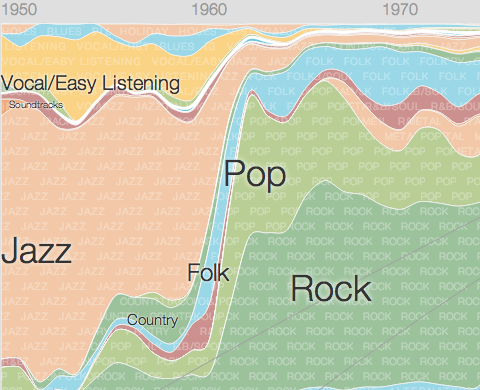
To see just how dramatic the changes in musical fashion have been, check out Google’s new Music Timeline, pictured above. This simple, color-coded chart displays the popularity of various genres from 1950 onwards (pre-50s sales data is just too spotty and inconsistent). While jazz record sales held the lion’s share of the market throughout much of the 1950’s, the advent of rock and pop acts such as the Beatles in the 1960s relegated jazz to the minor leagues.
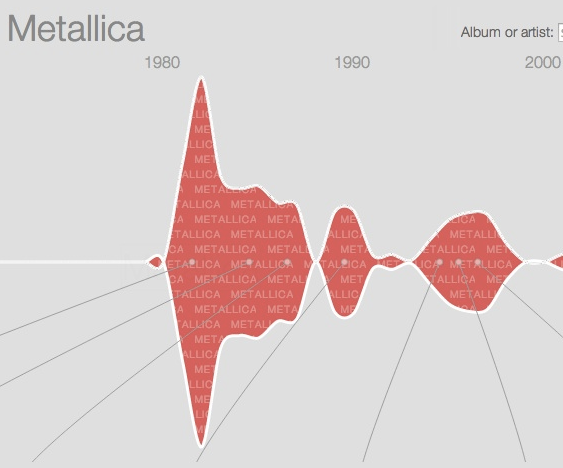
The timeline also allows you to look at the popularity of various bands throughout the course of their careers. Metallica, the litigious critics of Napster’s file-sharing ways, are an interesting example of the waxing and waning of a particular band’s success. Initial spike of popularity aside, as is clear from the image right above, the band had been relatively successful with each of their studio albums. After the release of their cover album in 1998, entitled Garage Inc., things quickly headed south. Whether it’s because of the Napster debacle of 2000, when the band’s lawsuit effectively shut down the company, or a regrettable change of direction, many former fans simply weren’t interested anymore.
Before fans come to the defense of whichever bands were slighted by Google’s visualization, a few caveats: the data used to judge relative success is derived from Google Play user libraries. The more users have an album, the more successful it’s deemed by the algorithm. Additionally, if you’re a classical music fan, you’re out of luck. For various logistical reasons, Google decided against its inclusion in the timeline.
For more information about Google’s Music Timeline, click here. For a Michael Hann’s first look review over at The Guardian’s music blog, which discusses the possible skews in the data, head this way.
Ilia Blinderman is a Montreal-based culture and science writer. Follow him at @iliablinderman.
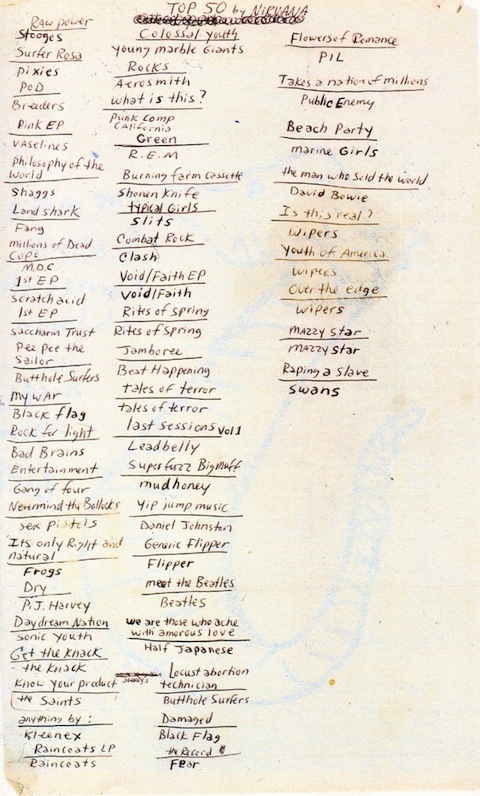
Circulating ‘round the internet recently is, wouldn’t you know it, yet another famous list of favorites. But it’s not a “listicle,” I’d say, one of those concocted clickbait hodgepodges that crop up in every corner with sometimes only the most tenuous, or lurid, of organizing principles. While we do have a tradition of showcasing lists here, they are generally on the order of those organically compiled by singular creative minds ranking and ordering their universes. I would say these things are true of Kurt Cobain’s list of albums above, which he titles “Top 50 by Nirvana” (see a full transcription at the bottom of the post, courtesy of Brooklyn Vegan). It not only presents a picture of the late Cobain and his bandmates’ musical heritage, it also offers us a genuine sampler of a generation’s protest music—plenty of classic angry ’80s hardcore punk and post-punk, lo-fi indie, a smattering of classic rock, some fringe outsiders like The Shaggs, and a rap album at #43, the fiercely political Public Enemy’s It Takes a Nation of Millions to Hold Us Back, a record beloved of almost all children of the 80s.
Having had an almost identical musical education as Cobain, it seems from the list, I can’t say that I find any of the choices here particularly surprising. It almost looks to me like the ideal code for producing a 90s alternative star—just add talent, teen angst, and the look of a bedraggled homeless puppy. But a Flavorwire take on the list does call Public Enemy (see their “Fight the Power” video above) one of a handful of “fascinating surprises.” Other than this stylistic departure, many of the selections from the list are particularly significant as influences on Cobain’s songwriting, and some of the artists listed are those the band covered on occasion.
One of Cobain’s major influences can also be easily claimed by nearly every indie artist of the 90s: Austin, Texas’ Daniel Johnston, a savant songwriter who has weathered a lifelong struggle with bipolar disorder yet produced one of the most honest, touching, and funny bodies of work in the past few decades. Cobain namechecks Johnston’s 1983 Yip Jump Music, from which comes the song above, “Worried Shoes,” an almost perfect example of his poignant lyricism and deft handling of emotional disaffection. One can see the appeal of Johnston’s spare homemade folk-blues to a sensibility like Cobain’s: “I took my lucky break / And I broke it in two / Put on my worried shoes / My worried shoes.” Johnston’s reaction to the interest of artists like Nirvana, Mudhoney, Beck, the Butthole Surfers, and Wilco is typically understated. “Ah, it’s pretty cool,” he says, “The attention was nice, ya know. Sells a few records.”
Cobain’s debt to David Bowie is evident in his swiping of some of Bowie’s chord changes and melodic phrasing. A touchstone for the grunge star was “The Man Who Sold the World,” which of course the band covered (above, unplugged) and which many a naïve Nirvana fan assumes was a Cobain original. Cobain places the album, The Man Who Sold the World at #45. Bowie is quoted in rock bio Nirvana: The Chosen Rejects as saying he was “simply blown away” when he found out that Cobain liked his work. Bowie “always wanted to talk to him about his reasons for covering ‘The Man Who Sold the World’’ and said “it was a good straight forward rendition and sounded somehow very honest.” He also expressed surprise at being “part of America’s musical landscape.” However, when young fans would approach Bowie and compliment him on his cover of a “Nirvana song” after he played the tune, his reactions were less than polite. According to Nicholas Pegg, Bowie said, “kids that come up afterwards and say, ‘It’s cool you’re doing a Nirvana song.’ And I think, ‘Fuc& you, you little tosser!’”
No shortage of ’90s artists, like their ’60s folk-rock forebears, named Leadbelly as a primary influence. Cobain places the iconic bluesman’s Leadbelly’s Last Sessions Vol. 1 at number 33. Whether or not anyone can hear acoustic Delta blues in Nirvana, most people are familiar with their unplugged cover of the Leadbelly standard “In the Pines,” aka “Where Did You Sleep Last Night” (Cobain learned the song from Screaming Trees singer Mark Lanegan). Above is a rare, much darker, Nirvana cover of the song from a bootleg album of live recordings called Ultra Rare Trax, performed at Pachyderm Studios in Cannon Falls, MN in 1993. (We will never know, of course, what Leadbellly would have thought of Kurt Cobain, though your guesses are appreciated.)
If the Nirvana list did not include Black Flag, someone would have to add it. Cobain places the L.A. hardcore band’s My War at number 11 on the list (first place is reserved for Iggy and the Stooges Raw Power). Above, former Black Flag vocalist Henry Rollins explains in a 1992 segment of MTV’s late-night alternative video show 120 Minutes what he thought were the reasons for the band’s phenomenal success. “It doesn’t take an idiot to realize that the mass media continually underestimates the intelligence of their audience,” he says, “You know how dissatisfied you’ve been with a lot of mainstream rock and roll.” Rollins goes on: “When a band like Nirvana comes along who are kicking the real thing, you like it because it’s real.”
Not every one of the artists Cobain lists had such nice things to say about him in return, however. The Sex Pistols’ Never Mind the Bullocks gets slotted at #14 on the list. In his autobiography, former Pistols leader and infamous contrarian John Lydon apparently “reserved some venom for the likes of Nirvana,” writes reviewer Tim Kennedy, “comparing them to the clueless metal bands [the Sex Pistols] were up against in the seventies.” For all the millions of Nirvana fans during the band’s heyday, there was also a small contingent of kids who felt similarly, no matter how rarified or representative Cobain’s musical tastes. In some of those cases, no doubt, rival bands felt that way because, as Henry Rollins describes it, while they were still taking the bus, “the other guy is sneering at you from a block-long limo.”
Kurt Cobain’s Favorite Albums
1. Iggy and the Stooges, “Raw Power”
2. Pixies, “Surfer Rosa”
3. The Breeders, “Pod”
4. The Vaselines, “Pink EP”
5. The Shaggs, “Philosophy of the World”
6. Fang, “Landshark”
7. MDC, “Millions of Dead Cops”
8. Scratch Acid, “Scratch Acid EP”
9. Saccharine Trust, “Paganicons”
10. Butthole Surfers, “Pee Pee the Sailor” aka “Brown Reason to Live”
11. Black Flag, “My War”
12. Bad Brains, “Rock for Light”
13. Gang of Four, “Entertainment!”
14. Sex Pistols, “Never Mind the Bollocks”
15. The Frogs, “It’s Only Right and Natural”
16. PJ Harvey, “Dry”
17. Sonic Youth, “Daydream Nation”
18. The Knack, “Get the Knack”
19. The Saints, “Know Your Product”
20. anything by Kleenex
21. The Raincoats, “The Raincoats”
22. Young Marble Giants, “Colossal Youth”
23. Aerosmith, “Rocks”
24. Various Artists, “What Is It”
25. R.E.M., “Green”
26. Shonen Knife, “Burning Farm”
27. The Slits, “Typical Girls”
28. The Clash, “Combat Rock”
29. The Faith/Void, “Split EP”
30. Rites of Spring, “Rites of Spring”
31. Beat Happening, “Jamboree”
32. Tales of Terror, “Tales of Terror”
33. Leadbelly, “Leadbelly’s Last Sessions Vol. 1”
34. Mudhoney, “Superfuzz Bigmuff”
35. Daniel Johnston, “Yip/Jump Music”
36. Flipper, “Generic Flipper”
37. The Beatles, “Meet the Beatles”
38. Half Japanese, “We Are They Who Ache With Amorous Love”
39. Butthole Surfers, “Locust Abortion Technician”
40. Black Flag, “Damaged”
41. Fear, “The Record”
42. PiL, “Flowers of Romance”
43. Public Enemy, “It Takes a Nation of Millions to Hold Us Back”
44. Marine Girls, “Beach Party”
45. David Bowie, “The Man Who Sold the World”
46. Wipers, “Is This Real?”
47. Wipers, “Youth of America”
48. Wipers, “Over the Edge”
49. Mazzy Star, “She Hangs Brightly”
50. Swans, “Young God”
We’ve previously brought you the origin story of Ziggy Stardust, David Bowie’s first and most flamboyant rock & roll character, as well as his later recollections of those times in a 1977 interview on Canadian television. Above, see the documentary that marked the end of that pivotal era, D.A. Pennebaker’s Ziggy Stardust and the Spiders from Mars, a concert film of Bowie’s last show as the glam rock kabuki space alien. (Part 1 can be found above, remaining parts reside here.) Bowie had grown tired of the character, feeling forced by his manager Tony DeFries to put on bigger, more elaborate stage shows (though there is speculation that record company RCA refused to finance planned US and Canadian stadium shows). In a later recollection, Bowie stated he was ready to move on:
I wanted the whole MainMan thing away from me. It was circusy. I was never much of an entourage person — I hated all of that. It’s a relief for all these years … not have a constant stream of people following me around to the point where, when I sat down, fifteen other people sat down. It was unbearable. I think Tony [DeFries] saw himself as a Svengali type, but I think I would have done okay anyway. Now, I look back on it with amusement more than anything else.
Along with brothers Albert and David Maysles, who made Gimme Shelter, Pennebaker had an uncanny knack for being in the right place at exactly the right time in music history. His Dont Look Back defined Bob Dylan for a generation and launched the much-imitated proto-music video with cue cards for “Subterranean Homesick Blues.”
The eponymous Monterey Pop documented the explosive 1967 festival that “crystallize[d] the energy of a counterculture that by then seemed both blessedly inevitable and dangerously embattled,” according to Robert Christgau. In 1973, Pennebaker found himself again positioned perfectly to document a pivotal moment—the end of Bowie’s Ziggy Stardust persona at London’s Hammersmith Odeon in what became known as “The Retirement Gig.”
Pennebaker, who’d only just signed on during the final London leg of the tour to make a full-length film and who knew little of Bowie’s music, was as surprised as anyone when Bowie announced Ziggy’s retirement by saying “this show will stay the longest in our memories, not just because it is the end of the tour but because it is the last show we’ll ever do.” No one knew at the time that Bowie would return, transformed into Aladdin Sane in an album of the same name that year (with the same band—watch them do a version of Lou Reed’s “White Light/White Heat” above at 1:18:10, a track recorded for, but cut from, 1973 covers album Pin Ups). The farewell concert opened with a medley of Bowie songs on solo piano performed by Mike Garson, who called the show “phenomenal” (hear Garson’s medley above, beginning at 2:30, after the introduction).
The retirement gig was the 60th of 40 tour dates on the third Ziggy UK tour and was, in fact, a replacement for a cancelled gig at Earl’s Court. Find a full list of the set here. Bowie and the Spiders were joined onstage by Jeff Beck for two songs before Bowie’s farewell speech, but Beck later had himself cut from Pennebaker’s film, unhappy with his solos, and perhaps his wardrobe. Though Beck was Bowie guitarist Mick Ronson’s hero, Ronson remembers being too distracted to be overwhelmed: “I was too busy looking at his flares. Even by our standards, those trousers were excessive!” See grainy bootleg footage from the show of Beck and his trousers in “Jean Genie,” and a snippet of “Love Me Do” (above), and Chuck Berry’s “Round and Round” (below).
A theory of merit states that Neil Young reinvents himself every 10 years or so, but the work in-between isn’t always pretty. Yet for an artist with a somewhat limited range, he remains one of the most interesting singers and songwriters in rock and roll well over four decades after his start. Young once played guitar in a garage band with Rick James in 1965 called the Mynah Birds; released a surprisingly listenable electro album in 1982 complete with Giorgio Morodor-like synths and vocoders; and last year, recorded a collection of folk standards like “Oh, Susanna” and “She’ll Be Coming ‘Round the Mountain” in the style of 1979’s Rust Never Sleeps (an album, Paul Nelson wrote at the time, that “burns [rock & roll] to the ground”). In-between the stylistic leaps and innovations are some painfully mediocre albums and some that define, or rather redefine, genres. One of the latter, Young’s 1972 Harvest picked up and refined the folk-rock of his first band Buffalo Springfield’s self-titled 1966 debut—an album widely credited with the creation of folk-rock.
Harvest—by any account one of Young’s best albums and the highest-selling of ’72—produced “Heart of Gold,” “Old Man,” and, indirectly led to Lynyrd Skynyrd’s “Sweet Home Alabama” (written in response to Harvest’s anti-segregation rocker, “Alabama”). It’s a surprisingly quiet album for the impact it’s had, and it set the standard for later folk-acoustic Young albums like 1992’s Harvest Moon and 2000’s Silver & Gold. And as much as Young can destroy a venue with a full-on electric attack (even now!), he can mesmerize an audience with just an acoustic guitar, piano, harmonica, and casual banter, even while playing a suite of songs they’d never heard before. See him do so above in a 1971 concert live at the BBC’s Shepherds Bush Empire Theatre. Young plays four songs that would appear on Harvest: “Out on the Weekend,” “Old Man,” “Heart of Gold,” and “A Man Needs a Maid.” He also does “Journey Through the Past” and “Love in Mind,” which would appear two years later on the bleak 1973 Time Fades Away, and “Don’t Let it Bring You Down,” a song from 1970’s brilliant After the Gold Rush. Young performed the last song, “Dance Dance Dance,” with Crosby, Stills, and Nash, but it went unreleased in a studio version until the 2009 box set The Archives, Volume 1: 1963–1972.
Some further evidence of Young’s continued relevance: just last week, he performed a series of shows at Carnegie Hall, and audience members took video of several songs, including the title track to Harvest (above). It’s a song Young almost never played live until 2007. Onstage, alone, with acoustic and harp, he is still, forty-three years later, a mesmerizing presence.
Quentin Tarantino cares about music, as you can tell from watching any of his films, from his maximally discomfiting use of Stealers Wheel’s “Stuck in the Middle with You” in Reservoir Dogs on out. A Telegraph article on that song’s writer Gerry Rafferty describes it as “written as a parody of Bob Dylan’s paranoia,” “little more than a joke but with a catchy pop arrangement” that unexpectedly sold more than a million copies. If Tarantino has a fascination with Dylan parodies, then he has an even deeper fascination with the real thing, as revealed in a post on his ten favorite records from Uncut’s Michael Bonner. He pulled Tarantino’s selections and comments from an interview he conducted with the director back around the time of Pulp Fiction. Above, you can watch Dylan play “Tangled Up in Blue,” which Tarantino calls his “all-time favorite song,” “one of those songs where the lyrics are ambiguous you can actually write the song yourself.” (Hear the original recording here.)
Just above, we have Freda Payne performing “Band of Gold,” another of Tarantino’s choice cuts, on Soul Train in 1970. “This is just so cool,” he says. “It’s a combination of the way it’s produced, the cool pop/R&B sound, and Freda’s voice. Its kinda kitschy in a way – y’know, it’s got a really up-tempo tune – and, the first few times I heard it, I was, like, totally into the coolness of the song. It was only on the third or fourth listen I realised the lyrics were so fucking heartbreaking.” Below you’ll find a cut from Phil Ochs’ I Ain’t Marching Anymore, which Tarantino calls “one of my favorite protest/folk albums. While Dylan was a poet Ochs was a musical journalist: he was a chronicler of his time, filled with humor and compassion. He’d write songs which would seem very black and white, and then, in the last verse, he’d say something which, like, completely shattered you.” This particular song, “Here’s To The State of Mississippi,” he considers “everything the movie Mississippi Burning should have been.”
We're hoping to rely on loyal readers, rather than erratic ads. Please click the Donate button and support Open Culture. You can use Paypal, Venmo, Patreon, even Crypto! We thank you!
Open Culture scours the web for the best educational media. We find the free courses and audio books you need, the language lessons & educational videos you want, and plenty of enlightenment in between.