In 2004, the Brazilian musician Seu Jorge recorded a series of Portuguese covers of David Bowie songs for Wes Anderson’s film The Life Aquatic with Steve Zissou. The next year, he released a full album of 13 Bowie classics, and in 2016–2017, he even took the songs on tour. Now, in 2026, to mark the 10th anniversary of Bowie’s passing, Jorge returns with the performance above. Set against a beautiful Brazilian coastline, he sings some of Bowie’s most beloved tracks, all while in character as Pelé dos Santos, the role he played in Anderson’s film. See the full track list below and enjoy.
Lady Stardust
Rock ’n’ Roll Suicide
Queen Bitch
Oh! You Pretty Things
Suffragette City
Changes
Rebel Rebel
Quicksand
Five Years
Team Zissou
Ziggy Stardust
Space Oddity
When I Live My Dream
Life on Mars?
Starman
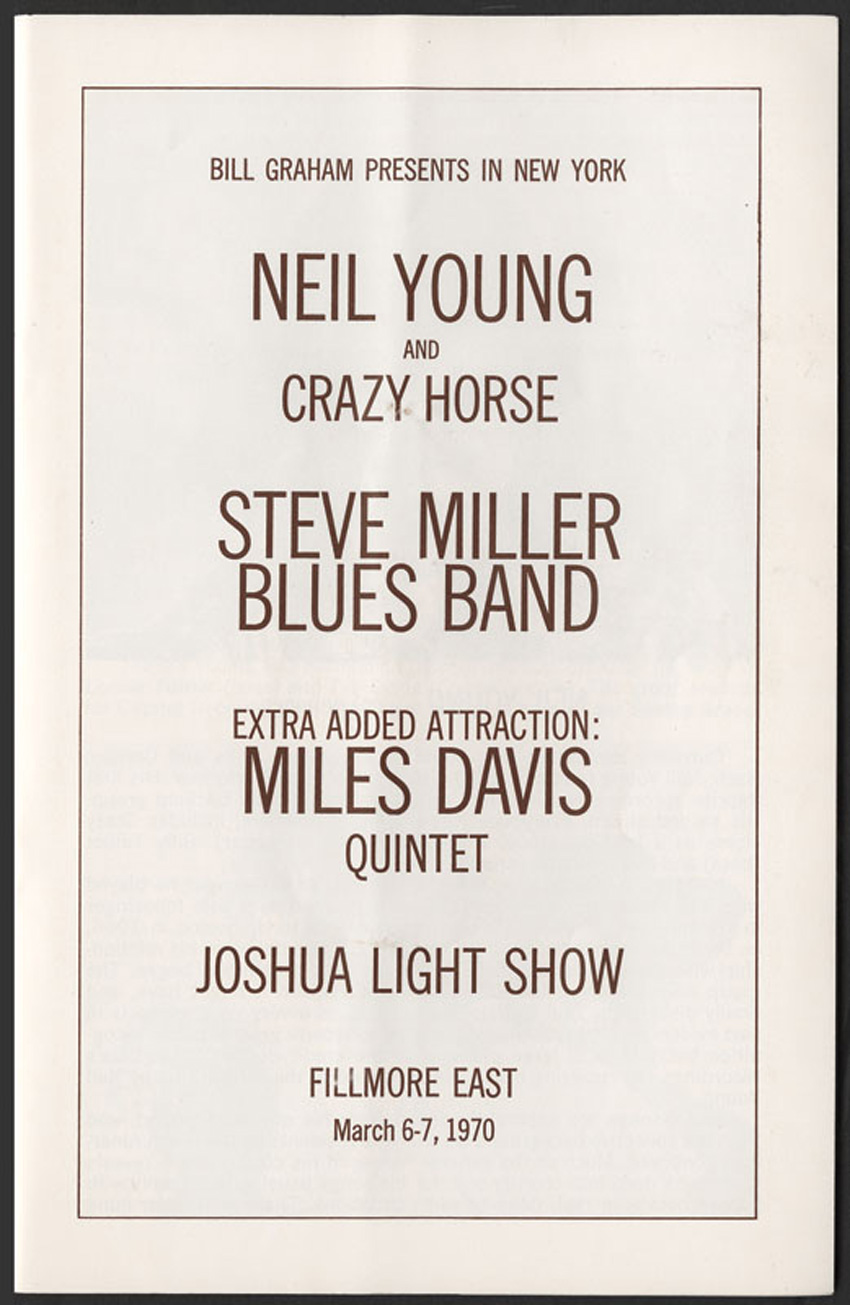
The story, the many stories, of Miles Davis as an opening act for several rock bands in the 1970s makes for fascinating reading. Before he blew the Grateful Dead’s minds as their opening act at the Fillmore West in April 1970 (hear both bands’ sets here), Davis and his all-star Quintet—billed as an “Extra Added Attraction”—did a couple nights at the Fillmore East, opening for Neil Young and Crazy Horse and The Steve Miller Band in March of 1970. The combination of Young and Davis actually seems to have been rather unremarkable, but there is a lot to say about where the two artists were individually.
Nate Chinen in At Length describes their meeting as a “minimum orbit intersection distance”—the “closest point of contact between the paths of two orbiting systems.” Both artists were “in the thrall of reinvention,” Young moving away from the smoothness of CSNY and into free-form anti-virtuosity with Crazy Horse; Davis toward virtuosity turned back into the blues.
Miles, suggested jazz writer Greg Tate, was “bored fiddling with quantum mechanics and just wanted to play the blues again.” The story of Davis and Young at the Fillmore East is best told by listening to the music both were making at the time. Hear “Cinnamon Girl” below and the rest of Neil Young and Crazy Horse’s incredible set here. The band had just released their beautifully ragged Everybody Knows this is Nowhere.
When it comes to the meeting of Davis and Steve Miller, the story gets juicier, and much more Miles: the difficult performer, not the impossibly cool musician. (It sometimes seems like the word “difficult” was invented to describe Miles Davis.) The trumpeter’s well-earned egotism lends his legacy a kind of rakish charm, but I don’t relish the positions of those record company executives and promoters who had to wrangle him, though many of them were less than charming individuals themselves. Columbia Records’ Clive Davis, who does not have a reputation as a pushover, sounds alarmed in his recollection of Miles’ reaction after he forced the trumpeter to play the Fillmore dates to market psychedelic jazz-funk masterpiece Bitches Brew to white audiences.
According to John Glatt, Davis remembers that Miles “went nuts. He told me he had no interest in playing for ‘those fu*king long-haired kids.’” Particularly offended by The Steve Miller Band, Davis refused to arrive on time to open for an artist he deemed “a sorry-ass cat,” forcing Miller to go on before him. “Steve Miller didn’t have his shit going for him,” remembers Davis in his expletive-filled autobiography, “so I’m pissed because I got to open for this non-playing motherfu*ker just because he had one or two sorry-ass records out. So I would come late and he would have to go on first and then when we got there, we smoked the motherfu*king place, and everybody dug it.” There is no doubt Davis and Quintet smoked. Hear them do “Directions” above from an Early Show on March 6, 1970.
“Directions,” from unreleased tapes, is as raw as they come, “the intensity,” writes music blog Willard’s Wormholes, “of a band that sounds like they were playing at The Fillmore to prove something to somebody… and did.” The next night’s performances were released in 2001 as It’s About That Time. Hear the title track above from March 7th. You can also stream more on YouTube. As for The Steve Miller Blues Band? We have audio of their performance from that night as well. Hear it below. It’s inherently an unfair comparison between the two bands, not least because of the vast difference in audio quality. But as for whether or not they sound like “sorry-ass cats”… well, you decide.
Note: An earlier version of this post appeared on our site in 2015.
MTV still exists. At least, it still exists in the United States, or in certain of that country’s markets, for the time being. A flurry of premature obituaries recently blew through the internet after the announcement that the network had shut down in other parts of the world, Europe included. But even there, some expressed the sentiment that MTV had already died long before. And indeed, in the U.S., where it originally launched, asking who remembers when MTV actually used to play music videos has been a common lament for decades, aired even by generations too young to remember those days themselves. But members of any generation can now relive them — or live them for the first time — through a new site called MTV Rewind.
The first music video that greets the visitor is The Buggles’ “Video Killed the Radio Star,” and appropriately so, since it inaugurated MTV itself when it went live on August 1st, 1981. What follows are all the rest of the videos played on that first day, like Phil Collins’ “In the Air Tonight,” Blondie’s “Rapture,” David Bowie’s “Boys Keep Swinging,” and Kate Bush’s “Wuthering Heights.”
(Other, less widely remembered entries include no fewer than three songs by Cliff Richard, which speaks to the then-incomplete formation of the kind of pop-musical culture we still associate with MTV.) The site’s other playlists recreate other eras and genre-specific programs, from 120 Minutes to Total Request Live, Headbanger’s Ballto Yo! MTV Raps.
Currently, MTV Rewind’s music video count comes to about 40,000, enough to ensure any former addict of the network a stream of nostalgia hits. But the site’s creator (a 43-year-old American resident in Albania, according to the New York Times, known pseudonymously as “Flex”) has also incorporated vintage station IDs and commercials, many of them liable to trigger downright Proustian sensations in the right viewer. What may feel refreshing even to curious younger visitors is that, whichever channel they choose, the next video that plays is determined not by an algorithm attempting to predict their personal tastes. Rather, each playlist is shaped by the popular culture of a particular era, with enough left-field selections to keep it interesting: just the sort of thing in hopes of which we used to flip over to MTV, back when the idea of streaming video on our computers still sounded like sheerest fantasy. Enter MTV Rewind here.
Based in Seoul, Colin Marshall writes and broadcasts on cities, language, and culture. He’s the author of the newsletterBooks on Cities as well as the books 한국 요약 금지 (No Summarizing Korea) and Korean Newtro.Follow him on the social network formerly known as Twitter at @colinmarshall.
Imagine, if you will, taking a seat at the piano before a full house of 2,000 music lovers ready to hear Mozart’s Piano Concerto No. 20 in D minor — and, more importantly, on stage with an orchestra and conductor more than ready to play it. That would be difficult enough, but now imagine that you thought you were supposed to play the Piano Concerto No.23 in A major, another piece of music entirely. This is the stuff of nightmares, and indeed, the very situation in which pianist Maria João Pires found herself in 2013, after she’d been recruited to fill in for another player at an open rehearsal held at Amsterdam’s Concertgebouw. You can watch it unfold, assuming you can bear it, in the clip above.
As Pires says in the Classic FM interview below, it had been “perhaps 11 months” since she’d last played the piece into which she could hear the orchestra launching, “and that’s the moment where you start losing the memory of the details. That’s how the memory functions, you know. And when people see this panic, they perhaps don’t know that the reality is, we lose our memories after just a couple of months.”
It seems to have been the encouragement of conductor Riccardo Chailly that got her through the moment of panic and into a creditable performance. “You know it so well!” he insisted to her, and indeed, as he remembered later, “The miracle is that she has such a memory that she could, within a minute, switch to a new concerto without making one mistake.”
The eleventh-hour call Pires received asking her to take the gig was part of the problem, but so was a misheard number. According to the Köchel catalogue, which organizes all of Mozart’s work, the Piano Concerto No. 20 in D minor is 466, whereas the Piano Concerto No. 23 in A major is 488. Whether Pires misheard the K‑number or the caller misspoke, she soon found herself faced with a musical challenge for which she felt completely unprepared. In fact, she wasn’t: as Chailly knew, or at least banked on, her career as a classical pianist up to that point had given her all the experience she needed to draw upon to overcome the crisis. As her recovery reminds us, professionalism isn’t so much about making sure that things always go right as being able to handle it when they go wrong. It happens that Pires has gone through this particular kind of mix-up three times, which makes her a consummate professional indeed.
Based in Seoul, Colin Marshall writes and broadcasts on cities, language, and culture. He’s the author of the newsletterBooks on Cities as well as the books 한국 요약 금지 (No Summarizing Korea) and Korean Newtro.Follow him on the social network formerly known as Twitter at @colinmarshall.
Formed in 1965, the Doors burned hot until Jim Morrison died in 1971, and the band finally broke up in 1973. The group left behind more than a few fine songs—“Light My Fire,” “Break On Through (To the Other Side),” “L.A. Woman,” and “Roadhouse Blues,” to name a few. Above, the music collective Playing for Change pays tribute to another Doors classic, “Riders on the Storm.” Featuring performances by the two surviving Doors members John Densmore and Robby Krieger, the video also weaves in appearances by 20+ musicians, everyone from Lukas and Micah Nelson, to Don Was and Foo Fighters keyboardist Rami Jaffee. According to Playing for Change, the “performance reimagines the classic anthem as a meditation on unity, hope, and shared humanity,” qualities that otherwise seem in short supply today. Enjoy!
If you would like to support the mission of Open Culture, consider making a donation to our site. It’s hard to rely 100% on ads, and your contributions will help us continue providing the best free cultural and educational materials to learners everywhere. You can contribute through PayPal, Patreon, and Venmo (@openculture). Thanks!
Down in Austin, Texas, music teacher Gavin Tabone leads the Barton Hills Choir, made up of 3rd- through 6th-grade students. Backed by professional musicians, the choir performs a wide-ranging mix of music, from classic pop and rock to indie songs by artists like Wilco, Muse, The Flaming Lips, and especially the Grateful Dead. Above and below, you can find performances of such Dead classics as “Ripple,” “Box of Rain” and “Going Down the Road Feeling Bad” → “I Know You Rider.” And if you head to their YouTube channel, you can find versions of “Cassidy,” “Touch of Grey,” “Scarlet Begonias,” “Brokedown Palace,” and more.
With the passing of Bob Weir this weekend, it seems like a fitting time to highlight these performances. Weir first joined the Dead when only a teenager, still basically a kid himself, and then continued the journey for the next 60 years, introducing the Dead’s songbook to successive generations of fans. In recent years, he talked about the Dead songbook enduring for the next 200 to 300 years, much as Beethoven remains with us today. As we watch elementary students perform Grateful Dead classics, it’s hard not to think that Weir was on to something.
Though it isn’t the kind of thing one hears discussed every day, serious Disney fans do tend to know that Goofy’s original name was Dippy Dawg. But how many of the non-obsessive know that Mickey’s faithful pet Pluto was first called Rover? (We pass over in dignified silence the quasi-philosophical question of why the former dog is humanoid and the latter isn’t.) It is Rover, as distinct from Pluto, who passes into the public domain this new year, one of a cast of now-liberated characters including Blondie and Dagwood as well as Betty Boop — who, upon making her debut in Fleischer Studios’ Dizzy Dishes of 1930, has a somewhat canoid appearance herself. You can see them all in the video above from Duke University’s Center for the Study of the Public Domain, with much more information available in their blog post marking this year’s “Public Domain Day.”
The year 1930, write the Center’s Jennifer Jenkins and James Boyle, was one “of detectives, jazz, speakeasies, and iconic characters stepping onto the cultural stage — many of whom have been locked behind copyright for nearly a century.”
Novels that come available this year include William Faulkner’s As I Lay Dying, Dashiell Hammett’s The Maltese Falcon, and Agatha Christie’s The Murder at the Vicarage; among the films are Lewis Milestone’s Best Picture-winning All Quiet on the Western Front, Victor Heerman’s Marx Brothers picture Animal Crackers, and Luis Buñuel and Salvador Dalí’s L’Âge d’Or. In music, compositions like “I Got Rhythm” and “Embraceable You” by the Gershwin Brothers as well as recordings like “Nobody Knows the Trouble I’ve Seen” by Marian Anderson and “Sweet Georgia Brown” by Ben Bernie and His Hotel Roosevelt Orchestra have also, at long last, gone public.
Reflection on some of these works themselves suggests something about the importance of the public domain. With the title of Cakes and Ale, another book in this year’s crop, Somerset Maugham makes reference to “a classic public domain work, in this case Shakespeare’s Twelfth Night”; so, for that matter, does Faulkner, given that the line “as I lay dying” comes from the Odyssey. “To tell new stories, we draw from older ones,” write Jenkins and Boyle. “One work of art inspires another — that is how the public domain feeds creativity.” Today, we’re free to take explicit inspiration for our own work from Nancy Drew, “Just a Gigolo,” Blondie, Mondrian’s Composition with Red, Blue, and Yellow, Hitchcock’s Murder!, and much else besides. And by all means use Rover, but if you also want to bring in Dippy Dawg, you’re going to have to wait until 2028.
Based in Seoul, Colin Marshall writes and broadcasts on cities, language, and culture. His projects include the Substack newsletterBooks on Cities and the book The Stateless City: a Walk through 21st-Century Los Angeles. Follow him on the social network formerly known as Twitter at @colinmarshall.
If you’re a regular listener, you know that Ezra Klein wraps up his podcast interviews with a familiar question: what three books would you recommend to the audience? When Klein interviewed Brian Eno in October, the producer had these three books to offer.
First up was Printing and the Mind of Man, a catalog from an exhibition held at the British Museum in 1963. “It was about the history of printing, but actually, the book is about the most important books in the Western canon and the impact that they had when they were released.” “It’s such a fascinating book because you really start to understand where the big, fundamental ideas that made Western culture came from.”
Next came A Pattern Language by the architect Christopher Alexander. “It’s really a book about habitat, about what makes spaces welcoming and fruitful, or hostile and barren.” Eno has returned to the book again and again over the years. “Over the course of my life, I’ve bought, I would say, 60 copies of that book because I always give it to anyone who is about to renovate a house or about to build a house. It’s a great read, and you would love it.”
His third recommendation was Naples ’44, a war diary kept by Norman Lewis, a British intelligence officer sent to Naples during World War II. “He kept a diary, and this is the most fabulous diary you’ll ever read. It’s just hilariously funny, deeply moving, and totally confusing—and you realize that Naples was, like, another planet.”
Understandably, Klein couldn’t let the interview end without also asking what albums influenced Eno most. In response, Eno offered The Rural Blues, a series of recordings of Black American music from the 1920s, 30s, and 40s. It’s the same music that later inspired pop and rock musicians in England when Eno came of age. He also pointed to the Velvet Underground’s self-titled third album, calling it a “beautiful, beautiful record, beautifully controversial in many ways.” He then added: “In fact, probably without that record, I wouldn’t have been a pop musician.” Many other musicians have said the same.
And finally, despite being an atheist, Eno selected a gospel recording act known as The Consolers, best known for their 1955 track “Give Me My Flowers.” You can listen to more of their greatest hits here.
We're hoping to rely on loyal readers, rather than erratic ads. Please click the Donate button and support Open Culture. You can use Paypal, Venmo, Patreon, even Crypto! We thank you!
Open Culture scours the web for the best educational media. We find the free courses and audio books you need, the language lessons & educational videos you want, and plenty of enlightenment in between.