The belief in a singular, coherent “Western tradition” in philosophy has led to a very insular, Eurocentric view in philosophy departments, as Jay L. Garfield and Bryan W. Van Norden write in a New York Times op-ed. “No other humanities discipline demonstrates this systemic neglect of most of the civilizations in its domain,” they argue, “The present situation is hard to justify morally, politically, epistemically or as good educational and research training practice.” In his follow-up book Taking Back PhilosophyVan Norden argues that educational institutions should “live up to their cosmopolitan ideals” by expanding the canon and teaching non-Western philosophical traditions.
One philosophy educator, Peter Adamson, professor of philosophy at the LMU in Munich and King’s College London, has taken up the challenge of teaching global philosophical traditions through his popular podcast The History of Philosophy Without Any Gaps, with series on the Islamic World, Africana, and India. With expert co-authors and guests, Adamson’s podcasts help us navigate cultural and historical differences without watering down the substance of diverse bodies of thought.
These surveys of non-Western traditions aim to be as exhaustive as the podcast’s coverage of Classical, Later Antiquity, and Medieval periods in Europe. We’ve featured Adamson’s podcasts on Islamic and Indian philosophy in an earlier post. Now we revisit his series on Indian philosophy, which has grown substantially in the interval, from thirty-two to sixty-two episodes, divided into three categories—“Origins,” “Age of the Sutra,” and “Buddhists and Jains.”
Very broadly, much Indian philosophy can be understood as a centuries-long conflict between the six orthodox Vedic schools (astika) and the heterodox (nastika) schools, including Buddhism, Jainism, and Carvaka, a materialist philosophy that denied all metaphysical doctrines. While some strains among these schools of thought can be associated with individual names, like Kanada, Patañjali, or Nagarjuna, much ancient Indian philosophy “is represented by a mass of texts,” as Luke Muehlhauser writes in his short guide, “for which the authors and dates of composition are mostly unknown.”
Adamson’s free podcast survey of Indian philosophy makes for entertaining, informative listening. You can download every episode in .zip form at the links above. Or find links to the individual episodes right below. To keep up with trends in the study of Indian philosophy in English, be sure to follow the Indian Philosophy Blog. And for an excellent list of “Readings on the Less Commonly Taught Philosophies (LCTP),” see this post by Bryan Van Norden here.
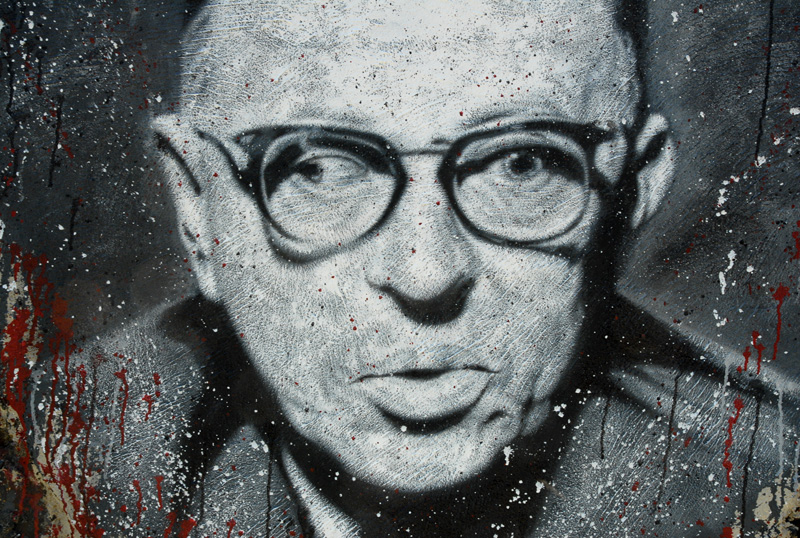
Sometimes when confronted with strange new ideas, people will exclaim, “you must be on drugs!”—a charge often levied at philosophers by those who would rather dismiss their ideas as hallucinations than take them seriously. But, then, to be fair, sometimes philosophers are on drugs. Take Jean-Paul Sartre. “Before Hunter S. Thompson was driving around in convertibles stocked full of acid, cocaine, mescaline and tequila,” notes Critical Theory, Sartre almost approached the gonzo journalist’s habitual intake.
According to Annie Cohen-Solal, who wrote a biography of Sartre, his daily drug consumption was thus: two packs of cigarettes, several tobacco pipes, over a quart of alcohol (wine, beer, vodka, whisky etc.), two hundred milligrams of amphetamines, fifteen grams of aspirin, a boat load of barbiturates, some coffee, tea, and a few “heavy” meals (whatever those might have been).
These details should not unduly influence our reading of Sartre’s work. Like Thompson, no matter how physically debilitating the booze and drugs might have been for him, they didn’t seem to cramp his productivity or intellectual vigor. But his one and only experience with mescaline almost sent him careening over the edge, and certainly contributed to an important motif in his work afterward.
While working on a book about the imagination, Sartre sought to have an hallucinatory experience. He got the chance in 1935 when an old friend, Dr. Daniel Lagache, invited him into an experiment at Sainte-Anne’s hospital in Paris, where he was injected with mescaline and observed under controlled conditions. “Sartre does not appear to have had a bad trip in the classic sense of suffering a major and prolonged panic attack,” Gary Cox writes in his Sartre biography. “But it was not a good trip and he did not enjoy it.”
The most ill effects came afterward: “His visual faculties remained distorted for weeks.” Sartre saw houses with “leering faces, all eyes and jaws.” Clock faces took on the features of owls. He confided in his partner Simone de Beauvoir that “he feared that one day he would no longer know” whether or not these were hallucinations. They were, however, not the worst aftereffects. As Sartre told political science professor John Gerassi in a 1971 interview, crabs began to follow him around. He described the experience as “a nervous breakdown.” The crabs followed him “all the time,” he said, “I mean they followed me in the streets, into class.”
I got used to them. I would wake up in the morning and say, “Good morning, my little ones, how did you sleep?” I would talk to them all the time, or I would say, “OK guys, we’re going into class now, so we have to be still and quiet,” and they would be there, around my desk, absolutely still, until the bell rang.
This went on for a year before Sartre went to see his friend Jacques Lacan for psychoanalysis. “We concluded, “ he says, “that it was a fear of becoming alone.” While he had previously confessed a fear of sea creatures, especially crabs, that went back to his childhood, after the mescaline trip, crabs featured prominently in his work, as Peter Royle shows at Philosophy Now.
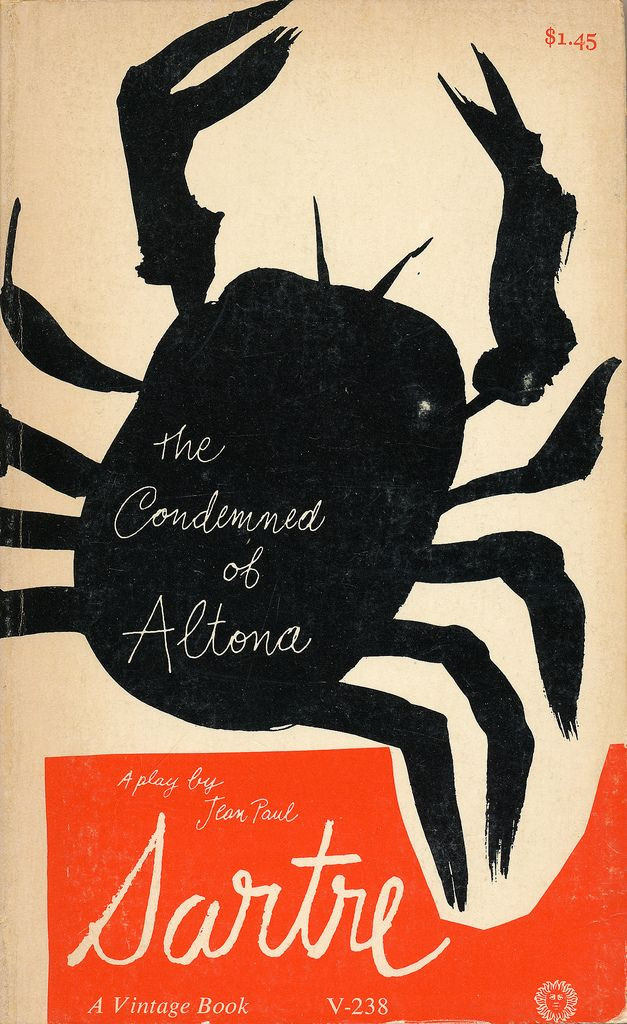
We find several references to crabs in his short story collection The Walland in his famous essay “Existentialism is a Humanism.” Samir Chopra quotes crab passages in Sartre’s first novel Nausea. (“At first I avoided them by writing about them,” he told Gerassi, “in effect, by defining life as nausea.”) “In one of his short stories, ‘Erostratus,’” notes Royle, “Sartre creates a character, Paul Hilbert, who looks down on human beings from a height and sees them as crabs.” The most striking use of the “crab motif” comes from his 1959 playThe Condemned of Altona, in which the protagonist Frantz imagines that by the Thirtieth Century, humans have become crabs sitting in judgment of the people of the Twentieth.
Crab images, Royle argues, “point to important philosophical ideas,” including “the possibility of ignominy inherent in the concept of freedom itself” and the “reprehensible ‘crabs’ who decline to assume their freedom” and thus scuttle around mindlessly in groups. Crustaceans continued to haunt the philosopher. While the effects of the mescaline eventually dissipated, “when he was feeling down,” writes Cox, Sartre would get the “recurrent feeling, the delusion, that he was being pursued by a giant lobster, always just out of sight… perpetually about to arrive.”
One of the “great, darkly comic features of Sartre folklore,” the huge, invisible lobster invites much speculation about Sartre’s mental health. But perhaps it was only the monstrous embodiment of his own feelings of mauvaise foi, given vivid form by a lingering psychotropic hangover and a daily diet of uppers and downers—a reminder of the “anxiety, anguish, dread, apprehension, fear of pain, fear of death… [and] fundamental absurdity of existence.” As Royle writes, Sartre, always fond of puns, “could only have been intrigued” by the French word for lobster, homard, which sounds like “homme-ard,” a coinage that might suggest something like “a bad man.”
Say what you will about the tenets of Objectivism—to take a fan favorite line from a little film about bowling and white Russians. At least it’s an ethos. As for Ayn Rand’s attempts to realize her “absurd philosophy” in fiction, we can say that she was rather less successful, in aesthetic terms, than literary philosophers like Albert Camus or Simone de Beauvoir. But that’s a high bar. When it comes to sales figures, her novels are, we might say, competitive.
Atlas Shrugged is sometimes said to be the second best-selling book next to the Bible (with a significant degree of overlap between their readerships). The claim is grossly hyperbolic. With somewhere around 7 million copies sold, Rand’s most popular novel falls behind other capitalist classics like Think and Grow Rich. Still, along with The Fountainhead and her other ostensibly non-fictional works, Rand sold enough books to make her comfortable in life, even if she spent her last years on the dole.
Since her death, Rand’s books have grown in popularity each decade, with a big spike immediately after the 2008 financial crisis. That popularity isn’t particularly hard to explain as an appeal to adolescent selfishness and grandiosity, and it has made her works ripe targets for satire—especially since they almost read like self-parody already. And who better to take on Rand than The Simpsons, reliable pop satirists of great American delusions since 1989?
The show’s take on The Fountainhead, above, has baby Maggie in the role of architect Howard Roark, the book’s genius individualist whose extraordinary talent is stifled by a critic named Ellsworth Toohey (a cardboard caricature of British theorist and politician Harold Laski). In this version, Toohey is a vicious preschool teacher in tweed, who insists on educating his charges in banality (“mediocrity rules!”) and knocks down Maggie’s block cathedral with a snide “welcome to the real world.”
In response to Toohey’s abuse, Maggie delivers a pompous soliloquy about her own greatness, as Rand’s heroes are wont to do. She is again subjected to preschool repression in the clip just above—this time not at the hands of a socialist critic but from the headmistress of the Ayn Rand School for Tots. The domineering disciplinarian tells Marge her aim is to “develop the bottle within” and dissuade her students from becoming “leeches,” a dig at Rand’s tendency—one sadly parroted by her acolytes—to dehumanize recipients of social benefits as parasites.
Readers of Roald Dahl will be reminded of Matilda’s Miss Trunchbull, and the barracks-like daycare, its walls lined with Objectivist slogans, becomes a site for some Great Escape capers. These sly references hint at a deeper critique—suggesting that the libertarian philosophy of hyper-individualism contains the potential for tyranny and terror as brutal as that of the most dogmatically collectivist of utopian schemes.
Fascism had been creeping back into European and North American politics for many years before the word regained its currency in mainstream discourse as an alarming description of present trends. In 2004, historian Enzo Traverso wrote of the “unsettling phenomenon” of “the rise of fascist-inspired political movements in the European arena (from France to Italy, from Belgium to Austria).” Many of those far-right movements have come very close to winning power, as in Austria and France’s recent elections, or have done so, as in Italy’s.
And while the sudden rise of the far right came as a shock to many in the US, political commentators frequently point out that the erosion of democratic civil rights and liberties has been a decades-long project, coinciding with the financialization of the economy, the privatization of public goods and services, the rise of the mass surveillance state, and the extraordinary war powers assumed, and never relinquished, by the executive after 9/11, creating a permanent state of exception and weakening checks on presidential power.
This is not even to mention the autocratic regimes of Turkey’s Recep Tayyip Erdoğan and Russia’s Vladimir Putin, which are tied to other anti-democratic movements across the West not only geopolitically but also philosophically, a subject that gets far less press than it deserves. When analysis of the philosophical underpinnings of neo-fascism comes up, it often focuses on Russian academic Alexander Dugin, “who has been called,” notes Salon’s Conor Lynch, “everything from ‘Putin’s brain’ to ‘Putin’s Rasputin.’” (Bloomberg calls Dugin “the one Russian linking Putin, Erdogon and Trump.”)
Dugin’s fusion of Heideggerian postmodernism and apocalyptic mysticism plays a significant role in the ideology of the globalized far right. But Yale historian Timothy Snyder—who has written extensively on both Soviet Russia and Nazi Germany—points to an earlier Russian thinker whom he says exercises considerable influence on the ideology of Vladimir Putin, the fascist philosopher Ivan Ilyin.
Anton Barbashin and Hannah Thoburn called Ilyin “Putin’s philosopher” in a Foreign Affairs profile. Ilyin was “a publicist, a conspiracy theorist, and a Russian nationalist with a core of fascistic leanings.” David Brooks identified Ilyin as one of a trio of nationalist philosophers Putin quotes and recommends. Snyder defines Ilyin’s philosophy as explicitly “Russian Christian fascism,” describing at the New York Review of Booksthe Russian thinker’s prolific writing before and after the Russian Revolution, a hodgepodge of German idealism, psychoanalysis, Italian fascism, and Christianity.
In brief, Ilyin’s theoretical works argued that “the world was corrupt; it needed redemption from a nation capable of total politics; that nation was unsoiled Russia.” Ilyin’s, and Putin’s, Russian nationalism has had a paradoxically global appeal among a wide swath of far right political parties and movements across the West, as Snyder writes in his latest book The Road to Unfreedom: Russia, Europe, America. “What these ways of thinking have in common,” write The Economist in their review of Snyder’s book, “is a quasi-mystical belief in the destiny of nations and rulers, which sets aside the need to observe laws or procedures, or grapple with physical realities.”
Snyder summarizes Ilyin’s ideas in the Big Think video above in ways that make clear how his thought appeals to far right movements across national borders. Ilyin, he says, is “probably the most important example of how old ideas”—the fascism of the 20s, 30s, and 40s—“can be brought back in the 21st century for a postmodern context.” Those ideas can be summarized in three theses, says Snyder, the first having to do with the conservative reification of social hierarchies. “Social advancement was impossible because the political system, the social system, is like a body… you have a place in this body. Freedom means knowing your place.”
“A second idea,” says Snyder, relates to voting as a ratification, rather than election, of the leader. “Democracy is a ritual…. We only vote in order to affirm our collective support for our leader. The leader’s not legitimated by our votes or chosen by our votes.” The leader, instead, emerges “from some other place.… In fascism the leader is some kind of hero, who emerges from myth.” The third idea might immediately remind US readers of Karl Rove’s dismissal of the “reality-based community,” a chilling augur of the fact-free reality of today’s politics.
Ilyin thought that “the factual world doesn’t count. It’s not real.” In a restatement of gnostic theology, he believed that “God created the world but that was a mistake. The world was a kind of aborted process,” because it lacks coherence and unity. The world of observable facts was, to him, “horrifying…. Those facts are disgusting and of no value whatsoever.” These three ideas, Snyder argues, underpin Putin’s rule. They also define American political life under Trump, he concludes in his New York Review of Books essay.
Ilyin “made of lawlessness a virtue so pure as to be invisible,” Snyder writes, “and so absolute as to demand the destruction of the West. He shows us how fragile masculinity generates enemies, how perverted Christianity rejects Jesus, how economic inequality imitates innocence, and how fascist ideas flow into the postmodern. This is no longer just Russian philosophy. It is now American life.” There are more than enough homegrown sources for American authoritarianism and inequality, one can argue. But Snyder makes a compelling case for the obscure Russian thinker as an indirect, and insidious, influence.
“Suicide,” writes Albert Camus in “The Myth of Sisyphus,” has never been dealt with except as a social phenomenon.” And yet, as Alain de Botton argues in his School of Life video above, at least when it comes to media and government priorities, contemporary societies prefer to hardly deal with the problem at all, even though it claims the lives of some 800,000 people every year. “It remains entirely strange,” says De Botton, “that through the media we should hear so much about killers and so little about those who take their own lives.”
Given that so much mass media seems to specialize in producing a fear of others, perhaps this is not so strange after all. However, when it comes to the allocation of government resources, most “in the wealthy nations tend overwhelmingly to direct their efforts to dealing with poverty, illness, and aging,” and devote little to the problem of suicide. This may be due to social stigma. “Suicide is the supreme reminder of our intense psychological vulnerability,” and in highly religious societies, like the United States, it carries an added stigmatization as a “sin.”
Nonetheless, “given that more people die by suicide than are collectively murdered, die in traffic accidents, or are killed by animals,” it should stand to reason that we would expend more effort on finding out why. Perhaps over and above philosophy and the social sciences, De Botton argues that literature alerts us to the importance of several qualities that make our lives matter, including “love, self acceptance, meaning, hope, status, pride, forgiveness.” Such intangibles have no price or value in the competitive marketplaces that increasingly dominate our lives.
The trivialization of psychological needs leads to another common feature of suicide—the “element of surprise.” The suicide of those we know, or thought we knew, nearly always comes as a shock, which De Botton takes as “evidence of an unwitting neglect of one another (and of ourselves).” It does not serve us at all to live in denial of suffering or push despair to the margins of thought. “We should always be mindful,” Arthur Schopenhauer wrote in 1818, “of the fact that no man is ever very far from the state in which he would readily want to seize a sword or poison in order to bring his existence to an end.”
Schopenhauer’s grim universalizing statement, however, does not accord with the vast differences in suicide rates across societies. Certain countries, like Kuwait, have rates close to zero, or 0.1 in 100,000. By contrast, China has the highest rate of all, at 25.6 in 100,000. One significant difference, De Botton argues, has to do with the “interpretation and acceptance of difficulty,” including “a greater acceptance of failure, a higher role for forgiveness,” and “a status system that honors intrinsic value over achievement.”
The difference in suicide rates between nations does not have anything to do, however, with wealth. “One of the most surprising aspects of suicide,” De Botton observes in the video above, is that rates tend to rise “markedly the richer and more developed a society becomes,” a phenomenon that might appear to “negate the whole purpose of economic growth”—that is, if we assume the purpose is the maximization of human well-being. The suicide rate of an “undeveloped country like the Democratic Republic of the Congo,” he notes, “is a fraction of the rate of a developed country like South Korea.”
De Botton does not address the problem of inequality within wealthy societies. The United States, for example, the wealthiest country in recorded history, also has the greatest degree of economic inequality in history. Here, suicide rates have risen an astonishing 25% overall and over 30% in half of the states since 1999. De Botton’s cultural explanation for widely varying suicide rates between different kinds of societies may help us understand that alarming increase.
Paraphrasing the work of sociologist Emile Durkheim, he tells us that “the crucial factor behind people’s decision to end their lives is not really wealth or poverty…. It’s the extent to which the surrounding culture ascribes responsibility for failure to individuals” rather than to external factors beyond our control. Ideologies of individualism and meritocracy create grossly exaggerated beliefs about our ability to influence events in our favor, and grossly exaggerate the shame and stigma heaped upon us when we cannot do so.
This makes high-profile celebrity suicides seem to us the ultimate conundrum, since such people appear, at least superficially, to have it “all”: wealth, power, talent, status, and acclaim. But the celebrity culture that elevates some people beyond the reach of ordinary mortals can also be profoundly isolating, creating illusions of happiness rather than genuine fulfillment. We can never truly know what private griefs and personal feelings of failure and sorrow other people live with. Tending to our emotional needs, in spite of societal pressures and narratives, is critical for suicide prevention and can greatly deepen our care and compassion for ourselves and those around us.
Suicide is one of the top 10 causes of death in the U.S. right now. Call 1–800-273-TALK (8255) for help and support.
In the introduction to his sweeping History of Western Philosophy, Bertrand Russell wastes no time getting to a definition of his subject. “The conceptions of life and the world which we call ‘philosophical,’” he writes in the first sentence, “are a product of two factors: one, inherited religious and ethical conceptions; the other, the sort of investigation which may be called ‘scientific,’ using the word in its broadest sense. … Philosophy, as I shall understand the word, is something intermediate between theology and science.” (Russell makes a similar argument, in slightly different terms, in the essay “Mysticism and Logic.”)
Although this distinction between broadly “theological” and broadly “scientific” thinking may not map directly onto the modern schism between “Continental” and “Analytic” philosophy, a comparison still seems highly relevant. Though some continental thinkers may not wish to admit it, their categories and modes of reasoning—or intuiting, reflecting, speculating, etc.—derive from theological thought denuded of its specific religious content or beliefs. Or as philosopher Thomas R. Wells writes at his blog The Philosopher’s Beard, the continental proceeds from a “direct concern with the human condition, its ambition, its reflexivity, its concern with the media as well as the message.”
The analytic, on the other hand, strives for “universal scope, clarity and public accountability…. It tries to systematize knowledge” and approximate scientific methods of inquiry (which also once mixed freely with the theological). Both approaches can move too close to the poles Russell identifies—can move too far away, that is, from philosophy and toward the obscure and purely mystical or the inhumanely, unreflectively rational. Perhaps one way of thinking about the history of philosophy is as a dance between this play of opposites, with each approach offering a corrective to the other’s excesses, sometimes within the same thinker’s body of work.
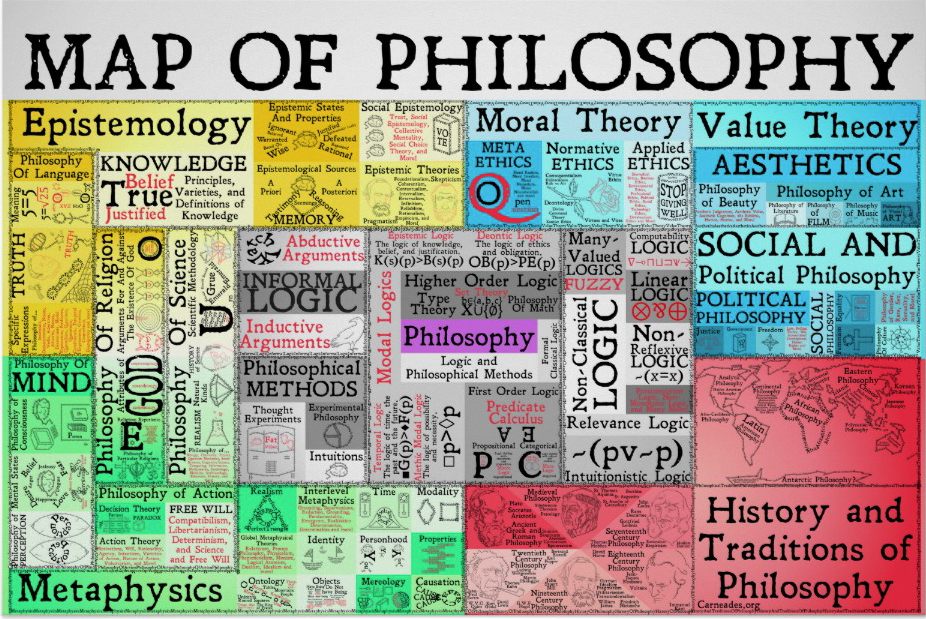
But before applying such abstractions, we should consider the ways philosophy developed as a discipline distinct from the hard sciences and theology—and from art, psychology, anthropology, physics, mathematics, linguistics, economics, etc. “Once upon a time,” notes the video at the top—a comprehensive “map of philosophy” made by Carneades.org— “Philosophy was anything you can study. Everything in the realm of study was a type of philosophy.” The breaking off of other fields into their own domains happened over the course of several hundred years. Nonetheless, “philosophy still had its fingers in all of those other pies.”
One can think philosophically about anything—philosophy can “put different disciplines on the same playing field to talk to each other.” It is, the video’s introduction declares, “the glue that holds all of academia together” (hence, the top academic degree, the Ph.D., or “doctor of philosophy”). For reasons of his own training, the video’s creator, who simply goes by the pseudonym “Carneades,” leans more heavily on the analytic side of things, neglecting or only lightly touching on much of the continental thought that flourished in the wake of Heidegger, Hegel, Nietzsche, Kierkegaard, Sartre, and others. (Further up, you can see a video focused on one specific school of moral philosophy—Consequentialism. See more such videos at the Carneades.org YouTube channel.)
Carneades admits his biases and blind spots and welcomes corrections from those better versed in other traditions. To his credit, he includes Native American, African, Latin American, Afro-Caribbean, Polynesian, Japanese, Islamic, Tibetan, and many other global philosophical traditions in his extensive map—traditions that are usually completely ignored or deemed “unphilosophical” in other such surveys. His sensitivity to global thought may have something to do with the fact that he is not based in a Western academic department, but in West Africa, where he does humanitarian work.
See a complete table of contents, with links to specific sections, for the lengthy “Map of Philosophy” just below, and an image of the full map just above (purchase a hard copy here). Carneades’ intention to bring “these ideas back to the modern agora from the Ivory Tower” is a noble one. If you agree, and find these videos informative and intellectually stimulating, you can donate to or become a patron of his efforts at the Carneades.org Patreon page.
Table of Contents:
00:00 Introduction 01:44 Logic and Philosophical Methods 02:14 Formal Classical Logic 04:55 Non-Classical Logic 06:35 Informal Logic 08:00 Philosophical Methods 10:20 The History of Philosophy 13:30 Philosophical Traditions Around the World 20:55 Aesthetics 22:35 Political Philosophy 23:34 Social Philosophy 25:00 Moral Theory & Ethics 28:08 Epistemology 30:34 Metaphysics 34:13 Philosophy of Science 37:35 Philosophy of Religion 40:17 Philosophy of Language 41:58 Philosophy of Mind 43:49 Philosophy of Action 44:57 Full Map
In pointing out the clear and present dangers posed by out-of-control consumerism, there is no need for Marxism 101 terms like “commodity fetishism.” Simply state in plain terms that we revere cheaply-mass-produced goods, made for the sake of endless growth and consumption, for no particular reason other than perpetual novelty and the creation of wealth for a few. Everyone nods in agreement, then gets back to scrolling through their social media feeds and inboxes, convincing themselves, as I convince myself, that targeted advertising in digital networks—what Jaron Lanier calls “mass behavior-modification regimes”—could not possibly have any effect on me!
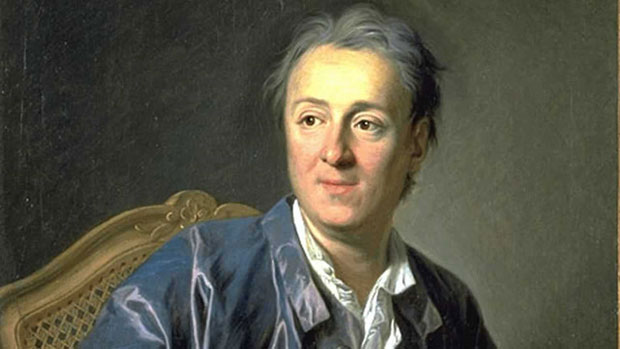
While 18th-century French philosopheDenis Diderot in no way predicted (as Lanier largely did) the mass behavior-modification schemes of the internet, he understood something critically important about human behavior and the nascent commodity culture taking shape around him, a culture of anxious disquiet and games of one-upmanship, played, if not with others, then with oneself. Renowned, among other things, for co-founding the Encyclopédie(the first Wikipedia!), Diderot has also acquired a reputation for the insights in his essay “Regrets on Parting with My Old Dressing Gown,” which inspired the concept of the “Diderot Effect.”
This principle states that modern consumption requires us to “identify ourselves using our possessions,” as Esther Inglis-Arkell writes at io9. Thus, when persuaded by naked lust or the enticements of advertising to purchase something new and shiny, we immediately notice how out of place it looks amongst our old things. “Once we own one thing that stands out, that doesn’t fit our current sense of unity, we go on a rampage trying to reconstruct ourselves” by upgrading things that worked perfectly well, in order to maintain a coherent sense of who we arein relation to the first new purchase.
The phenomenon, “part psychological, and part deliberate manipulation,” drives heedless shopping and creates needless waste. Diderot describes the effect in terms consistent with the tastes and prejudices of an educated gentleman of his time. He does so with perspicacious self-awareness. The essay is worth a read for the rich hyperbole of its rhetoric. Beginning with a comparison between his old bathrobe, which “molded all the folds of my body” and his new one (“stiff, and starchy, makes me look stodgy”), Diderot builds to a near-apocalyptic scenario illustrating the “ravages of luxury.”
The purchase of a new dressing gown spoiled his sense of himself as “the writer, the man who works.” The new robe strikes a jarring, dissociative note. “I now have the air of a rich good for nothing. No one knows who I am…. All now is discordant,” he writes, “No more coordination, no more unity, no more beauty.” Rather than get rid of the new purchase, he feels compelled to become the kind of person who wears such a thing, by means of further purchases which he could only newly afford, after receiving an endowment from Catherine the Great. Before this windfall, points out James Clear, he had “lived nearly his entire life in poverty.”
Clear gives several examples of the Diderot effect that take it out of the realm of 18th century aesthetics and into our modern big-box/Amazon reality. “We are rarely looking to downgrade, to simplify,” he writes, “Our natural inclination is always to accumulate.” To counter the tendency, he recommends corrective behaviors such as making sure new purchases fit in with our current possessions; setting self-imposed limits on spending; and reducing exposure to “habit triggers.” This may require admitting that we are susceptible to the ads that clutter both our physical and digital environments, and that limiting time spent on ad-driven platforms may be an act not only of self-care, but of social and environmental care as well. Algorithms now perform Diderot effects for us constantly.
Is the Diderot effect universally bad? Inglis-Arkell argues that “it’s not pure evil… there’s a difference between an Enlightenment screed and real life.” So-called green consumerism—“replacing existing wasteful goods with more durable, cleaner, more responsibly-made goods”—might be a healthy use of Diderot-like avarice. Besides, she says, “there’s nothing wrong with wanting to communicate one’s sense of self through aesthetic choices” or craving a unified look for our physical spaces. Maybe, maybe not, but we can take responsibility for how we direct our desires. In any case, Diderot’s essay is hardly a “screed,” but a light-hearted, yet candid self examination. He is not yet so far gone, he writes: “I have not been corrupted…. But who knows what will happen with time?”
Faced with the question, “who are the most important philosophers of the 20th century?,” I might find myself compelled to ask in turn, “in respect to what?” Ethics? Political philosophy? Philosophy of language, mind, science, religion, race, gender, sexuality? Phenomenology, Feminism, Critical theory? The domains of philosophy have so multiplied (and some might say siloed), that a number of prominent authors, including eminent philosophy professor Robert Solomon, have written vehement critiques against its entrenchment in academia, with all of the attendant pressures and rewards. Should every philosopher of the past have had to run the gauntlet of doctoral study, teaching, tenure, academic politics and continuous publication, we might never have heard from some of history’s most luminous and original thinkers.
Solomon maintains that “nothing has been more harmful to philosophy than its ‘professionalization,’ which on the one hand has increased the abilities and techniques of its practitioners immensely, but on the other has rendered it an increasingly impersonal and technical discipline, cut off from and forbidding to everyone else.” He championed “the passionate life” (say, of Nietzsche or Camus), over “the dispassionate life of pure reason…. Let me be outrageous and insist that philosophy matters. It is not a self-contained system of problems and puzzles, a self-generating profession of conjectures and refutations.” I am sympathetic to his arguments even as I might object to his wholesale rejection of all academic thought as “sophisticated irrelevancy.” (Solomon himself enjoyed a long career at UCLA and the University of Texas, Austin.)
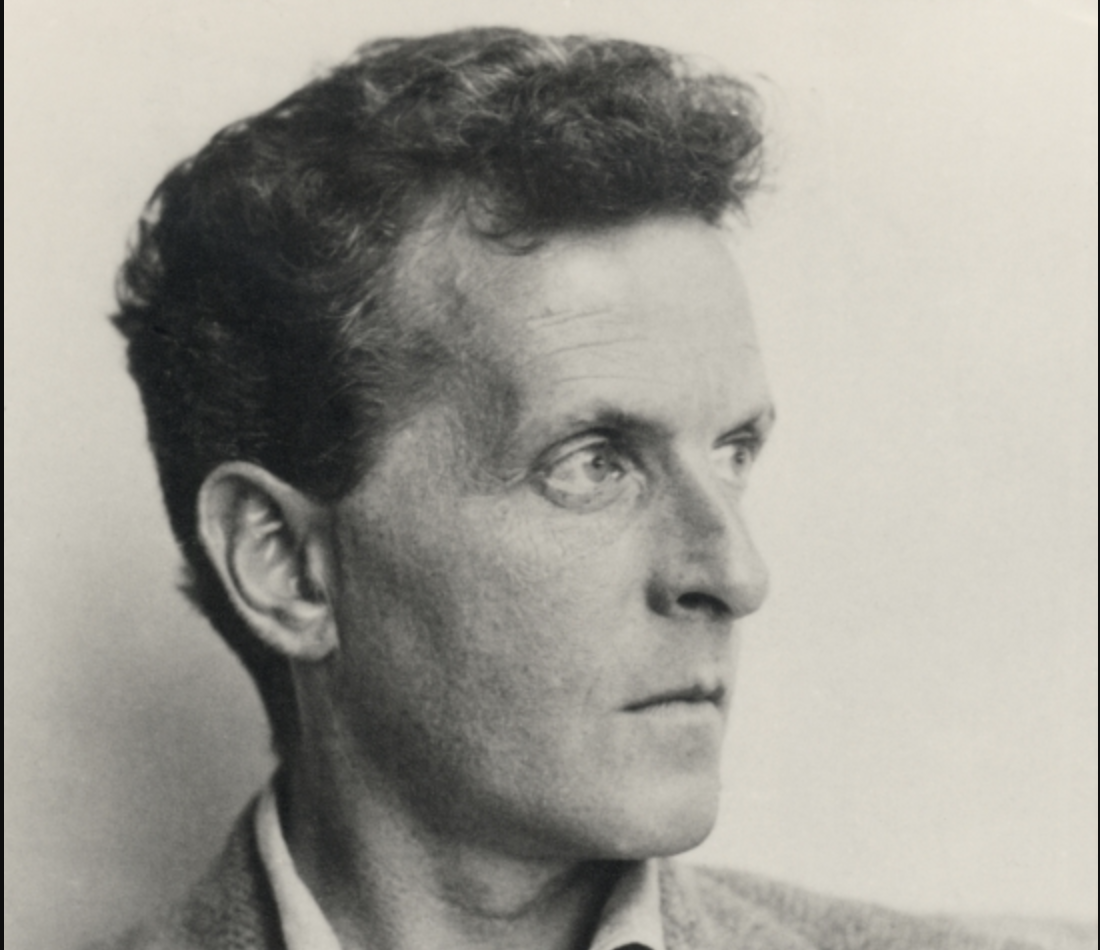
But if forced to choose the most important philosophers of the late 20th century, I might gravitate toward some of the most passionate thinkers, both inside and outside academia, who grappled with problems of everyday personal, social, and political life and did not shy away from involving themselves in the struggles of ordinary people. This need not entail a lack of rigor. One of the most passionate of 20th century thinkers, Ludwig Wittgenstein, who worked well outside the university system, also happens to be one of the most difficult and seemingly abstruse. Nonetheless, his thought has radical implications for ordinary life and practice. Perhaps non-specialists will tend, in general, to accept arguments for philosophy’s everyday relevance, accessibility, and “passion.” But what say the specialists?
One philosophy professor, Chen Bo of Peking University, conducted a survey along with Susan Haack of the University of Miami, at the behest of a Chinese publisher seeking important philosophical works for translation. As Leiter Reports reader Tracy Ho notes, the two professors emailed sixteen philosophers in the U.S., England, Australia, Germany, Finland, and Brazil, asking specifically for “ten of the most important and influential philosophical books after 1950.” “They received recommendations,” writes Ho, “from twelve philosophers, including: Susan Haack, Donald M. Borchert (Ohio U.), Donald Davidson, Jurgen Habermas, Ruth Barcan Marcus, Thomas Nagel, John Searle, Peter F. Strawson, Hilary Putnam, and G.H. von Wright.” (Ho was unable to identify two other names, typed in Chinese.)
The results, ranked in order of votes, are as follows:
As an addendum, Ho adds that “most of the works on the list are analytic philosophy,” therefore Prof. Chen asked Habermas to recommend some additional European thinkers, and received the following: “Axel Honneth, Kampf um Anerkennung (1992), Rainer Forst, Kontexte der Cerechtigkeit (1994) and Herbert Schnadelbach, Kommentor zu Hegels Rechtephilosophie (2001).”
The list is also overwhelmingly male and pretty exclusively white, pointing to another problem with institutionalization that Solomon does not acknowledge: it not only excludes non-specialists but can also exclude those who don’t belong to the dominant group (and so, perhaps, excludes the everyday concerns of most of the world’s population). But there you have it, a list of the most important, post-1950 works in philosophy according to some of the most eminent living philosophers. What titles, readers, might get your vote, or what might you add to such a list, whether you are a specialist or an ordinary, “passionate” lover of philosophical thought?
We're hoping to rely on loyal readers, rather than erratic ads. Please click the Donate button and support Open Culture. You can use Paypal, Venmo, Patreon, even Crypto! We thank you!
Open Culture scours the web for the best educational media. We find the free courses and audio books you need, the language lessons & educational videos you want, and plenty of enlightenment in between.