As an arts major who doodled my way through every required science course in high school and college, I am deeply gratified by filmmaker Michel Gondry’s approach to documenting the ideas of Noam Chomsky. Having filmed about three hours worth of interviews with the activist, philosopher, and father of modern linguistics in a sterile MIT conference room, Gondry headed back to his charmingly analog Brooklyn digs to spend three years animating the conversations. It’s nice to see a filmmaker of his stature using books to jerry-rig his camera set up. At one point, he huddles on the floor, puzzling over some sequential drawings on 3‑hole punch paper. Seems like the kind of thing most people in his field would tackle with an iPad and an assistant.
Gondry may have felt intellectually dwarfed by his subject, but there’s a kind of genius afoot in his work too. Describing the stop-motion technique he used for Is the Man Who Is Tall Happy?, he told Amy Goodman of Democracy Now, “I have a lightbox, and I put paper on it, and I animate with Sharpies, color Sharpies. And I have a 16-millimeter camera that is set up on a tripod and looks down, and I take a picture. I do a drawing and take a picture.”
A pretty apt summation—watch him in action above—but the curiosity and humanity so evident in such features as Eternal Sunshine of the Spotless Mindand The Science of Sleep is a magical ingredient here, too. He attributes biological properties to his Sharpie markers, and takes a break from some of Chomsky’s more complex thoughts to ask about his feelings when his wife passed away. He doesn’t seem to mind that he might seem a bit of a schoolboy in comparison, one whose talents lie beyond this particular professor’s scope.
As Chomsky himself remarks in the trailer, below, “Learning comes from asking why do things work like that, why not some other way?”
Is the Man Who Is Tall Happy? is available on iTunes.
Ayun Halliday puts her lifelong penchant for doodling to good use in her award-winning, handwritten, illustrated zine, The East Village Inky. Follow her @AyunHalliday
Alain de Botton is a not a philosopher’s philosopher. This means that his work is given little consideration inside academia. It also means that he speaks to many, many more people—ordinary people hungry for humanist ideas about living—than his peers. In his six-part video series, Philosophy:A Guide to Happiness, de Botton tells us that he’d always looked to philosophy as a discipline that “has wise things to say about everyday worries…. Philosophy promised something that might sound a little naïve, but was in fact rather profound: A way to learn to be happy.” I’m still not sure if this sounds more naïve or profound, but de Botton’s videos, each nearly 25 minutes long, concern thinkers who surely knew the difference. Each video also functions as a travelogue of sorts, as de Botton visits the cities that produced the thinkers, and tries to square their histories with the modern world around the relics.
Above, de Botton discusses Roman stoic philosopher and tragedian Seneca. An advisor to Nero, Seneca’s life may have been happy, at times, but it was hardly restrained. In any case, he had something to teach us about the futility of anger, and he was also, like de Botton, a great popularizer of other people’s ideas. Seneca characterized anger as a rational response that nonetheless relies on false premises, namely that we have more control over our circumstances than we actually do, and that our optimism about outcomes is unfounded and sets us up with unrealistic expectations. De Botton has before professed an affinity for the tragic view, and Seneca’s horribly bloody works, which inspired the Elizabethan genre known as “Revenge Tragedy,” are particularly grotesque explorations of anger. But perhaps it is those who most clearly see the pernicious effects of an emotion, or lack of it, who understand it best.
Take Arthur Schopenhauer, whom de Botton consults as his authority on love. Like Seneca, Schopenhauer seems very much at odds with much of his philosophical writing on love and compassion. His essay “On Women” earned him a permanent reputation as a misogynist, deserved or not. He’s rumored to have had a violent temper and wrote approvingly of keeping one’s distance from the mass of people, most of whom annoyed him disproportionately. Schopenhauer also famously wrote that it would have been preferable not to have been born at all, a position of extreme misanthropy known as antinatalism.
But there are other aspects of Schopenhauer’s romantic life to discuss, both its early successes and later failures. “Nothing in life,” says de Botton, “is more important than love for Schopenhauer.” Even with all of its pains of rejection, romantic love, Schopenhauer wrote in The World as Will and Representation, “is more important than all other aims in man’s life; and therefore it is quite worthy of the profound seriousness with which everyone pursues it.”
Another popular British philosophical thinker, John Gray, has a very different take on the great German pessimist, calling his philosophy “more subversive of humanist hopes than any other.” But de Botton’s technique seems in many ways calculated as a mild subversion of expectation, choosing as he does such contradictory, and often very solitary figures.
One solitary thinker who occupies a treasured place in the library of every humanist is Michel de Montaigne, the genial French essayist who invented the literary term essai, and who some might say also perfected the form. Montaigne has always struck me as the happiest of men, even in, or especially in his long stretches of solitude, punctuated by conscientious public service (despite his lifelong painful kidney stones). While both Schopenhauer and Montaigne engaged in lengthy self-examination, Montaigne seems to have genuinely liked himself and others. He treats himself in his writings as an old and honest friend with whom one can be perfectly candid without any fear of reprisal. This is perhaps why de Botton chose him to illustrate self-esteem.
Montaigne comes from a tradition much friendlier to philosophy as memoir (he invented the tradition). And so, in this age of the memoir, he has seen a great resurgence. In 2011, at least three popular books on Montaigne came out, one titled How to Live and another subtitled Montaigne and Being in Touch With Life. Of all the six philosophers de Botton surveys in his series, which also includes Nietzsche, Epicurus, and Socrates, Montaigne would seem the most complimentary to de Botton’s casual, personal approach to philosophy, which seeks not to dig new ground nor discover distant countries but to confront the vexing human questions that meet us always at home.
You can view all six episodes in the embedded playlist below:
Beethoven’s iconic Ninth Symphony premiered in Vienna in 1824, at “a time of great repression, of ultra-conservative nationalism” as the old orders fought back against the revolutions of the previous century. But it’s difficult to imagine the composer having any nationalist intent, what with his well-known hatred of authority, particularly imperialist authority (and particularly of Napoleon). Even less obvious is the imputation of nationalist tendencies to Friedrich Schiller, whose poem, “Ode to Joy” Beethoven adapts to a glorious chorus in the fourth movement. Schiller’s poem, writes Scott Horton in Harper’s, “envisions a world without monarchs” in which universal friendship “is essential if humankind is to overcome its darker moments.” And in his take on the ubiquitous piece of music, contrarian theorist Slavoj Žižek acknowledges in the clip above from his latest film, A Pervert’s Guide to Ideology, that the Ninth is generally taken for granted “as a kind of an ode to humanity as such, to the brotherhood and freedom of all people.”
And yet Žižek , being Žižek, draws our attention to the Ninth Symphony as a perfect ideological container, by reference to its unforgettable use in Stanley Kubrick’s A Clockwork Orange, as unsparing a look at humanity’s “darker moments” as one might find on film (excerpt above). Kubrick (and composer Wendy Carlos) drew on a long, dark history of associations with the Ninth. As evidence of its “universal adaptability,” Žižek points to its well-known use by the Nazis as a nationalist anthem, as well as by the Soviet Union as a communist song; in China during the Cultural Revolution, when almost all other Western music was prohibited; and at the extreme Apartheid right in South Rhodesia. “At the opposite end,” Žižek says, the Ninth Symphony was the favorite of ultra-leftist Shining Path leader Abimael Guzman, and in 1972, it became the unofficial “Anthem of Europe” (now of the European Union). The towering piece of music, Žižek claims, enables us to imagine a “perverse scene of universal fraternity” in which the world’s dictators, arch-terrorists, and war criminals all embrace each other. It’s a deeply disturbing image, to say the least. Watch the full excerpt for more of Žižek’s examination of the ideological weight Beethoven carries.
Neuroscientist Stuart Firestein, the chair of Columbia University’s Biological Sciences department, rejects any metaphor that likens the goal of science to completing a puzzle, peeling an onion, or peeking beneath the surface to view an iceberg in its entirety.
Such comparisons suggest a future in which all of our questions will be answered. In Dr. Firestein’s view, every answer can and should create a whole new set of questions, an opinion previously voiced by playwright George Bernard Shaw and philosopher Immanuel Kant.
A more apt metaphor might be an endless cycle of chickens and eggs. Or, as Dr. Firestein posits in his highly entertaining, 18-minute TED talk above, a challenge on par with finding a black cat in a dark room that may contain no cats whatsoever.
According to Firestein, by the time we reach adulthood, 90% of us will have lost our interest in science. Young children are likely to experience the subject as something jolly, hands-on, and adventurous. As we grow older, a deluge of facts often ends up trumping the fun. Principles of Neural Science, a required text for Firestein’s undergraduate Cellular and Molecular Neuroscience course weighs twice as much as the average human brain.
The majority of the general public may feel science is best left to the experts, but Firestein is quick to point out that when he and his colleagues are relaxing with post-work beers, the conversation is fueled by the stuff that they don’t know.
Hence the “pursuit of ignorance,” the title of his talk.
Given the educational context, his choice of wording could cause a knee-jerk response. He takes it to mean neither stupidity, nor “callow indifference,” but rather the “thoroughly conscious” ignorance that James Clerk Maxwell, the father of modern physics, dubbed the prelude to all scientific advancement.
I bet the 19th-century physicist would have shared Firestein’s dismay at the test-based approach so prevalent in today’s schools.
The ignorance-embracing reboot he proposes at the end of his talk is as radical as it is funny.
Even if you regularly read Open Culture, where we make a point of highlighting unusual intersections of cultural currents, you probably never expected a collaboration between the likes of Michel Gondry and Noam Chomsky. Gondry we’ve known as an imaginative filmmaker behind features like Eternal Sunshine of the Spotless Mind and Be Kind Rewind (as well as music videos for artists like Beck, Kanye West, and the White Stripes), one driven to pursue a Continental whimsy tempered by a dedication to elaborate, difficult-looking hand craft and an apparent interest in American culture.
Chomsky we’ve known, depending on our interests, as either a noted linguist or a controversial writer and speaker on politics, society, and the media. Gondry’s new documentary Is the Man Who Is Tall Happy?, the project that brings them together at least, showcases both the less-seen purely philosophical side of Chomsky, and the also rarely acknowledged inquisitive, conversational side of Gondry. In the New York Times“Anatomy of a Scene” clip at the top, the director explains his process.
Naturally, Gondry went through a fairly unusual process to make the film, given that he based the whole thing on nothing more elaborate than a long-form in-office conversation with the MIT-based professor and activist. To get the footage he needed of Chomsky talking, he brought in — naturally — his vintage wind-up Bolex 16-millimeter film camera. He then wove those shots in with his also highly analog hand-drawn animation, which illustrates Chomsky’s ideas as he describes them — and as Gondry prods him for more. “The camera is very loud,” Gondry explains over a deliberately shaky frame, “and that’s why I have to draw it each time you hear it.” Just above, you can watch the film’s trailer, which offers Chomsky’s voice as well as Gondry’s. “Why should we take it to be obvious that if I let go of a ball,” we hear the interviewee ask, “it goes down and not up?” We also hear the interviewer admit that he “felt a bit stupid here,” but these two men’s considerable differences — in generation, in nationality, in sensibility, in their concerns, in the forms of their work — provide all the more reason to listen when they talk. And if you find the intellectual trip not to your taste, just behold the visual one.
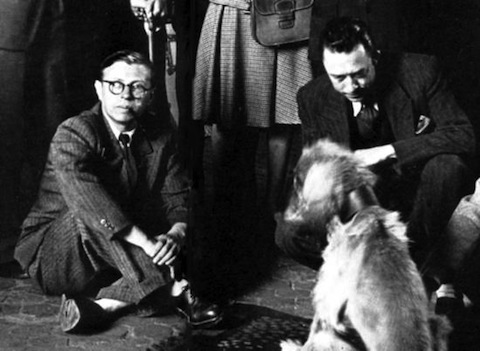
Today, as you must surely know, marks the 50th anniversary of John F. Kennedy’s assassination and also surely marks a revival of interest in the myriad conspiracy theories that abound in the absence of a satisfactory explanation for the events at Dealey Plaza on November 22nd, 1963. One theory I’ve never heard floated before comes to us via Andy Martin, lecturer in French at Cambridge University and author of The Boxer and the Goalkeeper: Sartre vs Camus. In an article for Prospect magazine, Martin writes:
To the massed ranks of the CIA, the Mafia, the KGB, Castro, Hoover, and LBJ, we can now add: Jean-Paul Sartre. FBI and State Department reports of the 1960s had drawn attention to Sartre’s membership of the Fair Play for Cuba Committee, of which Lee Harvey Oswald was also a member. And—prophetically?—Sartre had “dismissed the US as a headless nation.” […] Could he, after all, have been the Second Shooter?
It’s probably fair to say that Martin’s tongue is wedged firmly in his cheek throughout this opening of his fascinating chronicle of the FBI’s surveillance of Sartre and his onetime friend and editor Albert Camus. But Martin’s interest in the misalliance of Sartre and the Feds is very serious. What he finds during his investigation of the FBI files on existentialism is that “the G‑men, initially so anti-philosophical, find themselves reluctantly philosophizing. They become (in GK Chesterton’s phrase) philosophical policemen.”
While we have become accustomed, since the days of Joe McCarthy, to ideological witch hunts, it seems that Sartre and Camus served as test cases for the sort of thing that frequently plays out in overheated Congressional hearings and media denunciations—agents with furrowed brows and little philosophical training desperately trying to work out whether such and such abstruse academic is part of a grand conspiracy to undermine truth, justice, the American Way, etc.. Sartre appeared early on the anti-Communist radar, though, ironically, he did so as a plant of sorts, brought over in 1945 by the Office of War Information as part of a group of journalists the United States’ government hoped would put out good propaganda.
“Hoover wondered,” however, writes Martin, “what kind of good propaganda you can hope to get out of the author of Nausea and Being and Nothingness.” It turned out, not much, but a year later Hoover latched on to Sartre’s friend and editor Albert Camus, whose name he and his agents spelled, variously, as “Canus” or “Corus.” Where Sartre had breezed into the country—smitten by its literature and music—Camus was held at immigration on Hoover’s orders. He would spend a brief, depressing time and never return.
How we get from post-war surveillance of French existentialist philosophers to Sartre and the grassy knoll is a long and complicated tale, befitting the paranoid imaginings of J. Edgar Hoover. He was, after all, the conspiracy theorist par excellence and “he needed to know,” writes Martin, “if Existentialism and Absurdism were some kind of front for Communism. To him, everything was potentially a coded re-write of the Communist Manifesto.” What Hoover feared from Sartre, however, was that the latter was himself an influential believer in a conspiracy, one that cast doubt on the FBI’s strongly-held belief that Oswald was the lone gunman.
Despite gathering years of NSA-worthy surveillance on the philosophers, Hoover’s agents were never able to discern the ideological program of the French. “I can’t work out,” wrote one in a note in Sartre’s file, “if he’s pro-Communist or anti-Communist.” The black-and-white, spy-vs-spy world of the FBI left little room for philosophical nuance and literary ambiguity, after all. But they never stopped watching Sartre, convinced that “there must be some kind of conspiracy between communists, blacks, poets and French philosophers.” As it turns out, there were several—political and aesthetic conspiracies involving such terrifying figures as Frantz Fanon and Aimé Césaire. These poets and close relations of Sartre did, indeed, help foment revolution in the Caribbean and elsewhere—but theirs are stories for another day.
Missing for almost a month, imprisoned Pussy Riot member Nadezhda Tolokonnikova has been reported by her husband as recovering in a Siberian hospital from issues related to her hunger strike. As The Guardian reports, Tolokonnikova didn’t only resist by refusing to eat, she also kept up a lively correspondence with Slovenian theorist Slavoj Žižek while enduring reported abuse at the penal colony in Mordovia where she had been sentenced. It seems from the edited correspondence published by The Guardian that Žižek began the conversation in early January. “All hearts were beating for you” he writes, until “it became clear that you rejected global capitalism.” In a later, April 16 reply, Tolokonnikova explains exactly what Pussy Riot rejects:
As a child I wanted to go into advertising. I had a love affair with the advertising industry. And this is why I am in a position to judge its merits. The anti-hierarchical structures and rhizomes of late capitalism are its successful ad campaign. Modern capitalism has to manifest itself as flexible and even eccentric. Everything is geared towards gripping the emotion of the consumer. Modern capitalism seeks to assure us that it operates according to the principles of free creativity, endless development and diversity. It glosses over its other side in order to hide the reality that millions of people are enslaved by an all-powerful and fantastically stable norm of production. We want to reveal this lie.
Pshaw! As she’s very likely aware, there’s not a thing wrong with her dancing. If there were, I doubt she’d be sporting saucy hot pants in the above video for the first single off of the Plastic Ono Band’s Take Me to the Land of Hell.
Her 80-year-old stems are in fantastic shape. Mayhaps this youthful vibe is a reflection of the company she keeps. A bunch of nifty pals from Generations X and Y showed up to shake their tail feathers on camera—the surviving Beastie Boys (who also produced), Reggie Watts, Cibo Matto’s Yuka Honda and Miho Hatori, gender-bending performer Justin Vivian Bond, and public radio star Ira Glass, to name but a few.
Apparently, she’s not quite as tight with all her dance partners as the video would imply. Glass describes his involvement thusly:
She’s gracious, has to be reminded by a handler who in the world I am. Then totally acts nice, says something along the lines of “I appreciate the work you do” which either means she’s heard my work or she hasn’t…. The song is called “Bad Dancer” so I’m the perfect participant because—though I love to dance, I have no illusions. I’m a spaz. I stand in front of the camera and 20 handlers and hipsters and publicists and crew and Yoko Ono and I think a reporter from Rolling Stone and I tell myself to pretend I can do this and I dance.
Perhaps declaring herself a Bad Dancer is Ono’s way of encouraging self-conscious wall huggers to drop their inhibitions and join in the fun. It’s an approach to life, and aging, that made a cult classic of Harold and Maude.
We're hoping to rely on loyal readers, rather than erratic ads. Please click the Donate button and support Open Culture. You can use Paypal, Venmo, Patreon, even Crypto! We thank you!
Open Culture scours the web for the best educational media. We find the free courses and audio books you need, the language lessons & educational videos you want, and plenty of enlightenment in between.