Alan Watts moved from his native London to New York in 1938, then eventually headed west, to San Francisco in the early 1950s. On the left coast, he started teaching at the Academy of Asian Studies, wrote his bestseller Way of Zen, and began delivering a long-running series of talks about eastern philosophy on KPFA radio in Berkeley. During these years, Watts became one of the foremost popularizers of Zen Buddhism, Hinduism, and Taoism, which made him something of a celebrity, especially when the 60s counterculture movement kicked into gear.
Now, 40 years and change after his death, you can find no shortage of vintage Watts’ media online (including this archive of streaming lectures). And today we’re featuring an episode from a TV series called Eastern Wisdom and Modern Life, which aired in San Francisco circa 1960. “The Silent Mind” runs 28 minutes, and it offered American viewers an introduction to the philosophy and practice of meditation, something still considered exotic at the time. History in the making. You’re watching it happen right here. Find more meditation and Alan Watts resources below.
If you would like to sign up for Open Culture’s free email newsletter, please find it here. It’s a great way to see our new posts, all bundled in one email, each day.
If you would like to support the mission of Open Culture, consider making a donation to our site. It’s hard to rely 100% on ads, and your contributions will help us continue providing the best free cultural and educational materials to learners everywhere. You can contribute through PayPal, Patreon, and Venmo (@openculture). Thanks!
The film above documents a 1965 performance of his most celebrated piece, Youth, Maturity, Old Age, and Death, given at 42, the exact midpoint of his life. In four abstract minutes, he progresses through the seven ages of man, relying on nuances of gait and posture to convey each stage.
He performed it countless times throughout his extraordinary career, never straying from his own precisely rendered choreography. The playing area is just a few feet in diameter.
Observe the 1975 performance that filmmaker John Barnes captured for his series Marcel Marceau’s Art of Silence, below. Nothing left to chance there, from the timing of the smallest abdominal isolations to the angle of his head in the final tableau.
Time’s effects may have provided the subject for the piece, but its perennially lithe author claimed not to concern himself with age, telling the New York Times in 1993 that his focus was on “life-force and creation.”
When I started, I hunted butterflies. Later, I began to remember the war and I began to dig deeper, into misery, into solitude, into the fight of human souls against robots.
This would seem to support the theory that maturity is a side effect of age.
His alter ego Bip’s legacy may be the infernal invisible ropes and glass cages that are a mime’s stock in trade, but distilling human experience to its purest expression was the basis of Marceau’s silent art.
He feels his advancing age and fears that the art of mime will die with him. It’s a transitory, ephemeral art, he explains, as it exists only in the moment. As an old man, he works harder than ever, performing three hundred times a year, teaching four hours a day. He is named the UN Ambassador for Aging. Five nights a week he smears the white paint over his face, draws in the red bud at the center of his lips, follows the line of his eyelid with a black pencil. And then takes to the stage, his sideburns frayed, his hair dyed chestnut and combed forward, looking like a toupee.
His body is as elastic as ever, but the old suit of Bip hangs loose on him now. Beneath the whitened jawline is a baggy, sinewy neck. With each contortion of his face, the white paint reveals deep lines. At the end of his show, he folds in a deep bow and the knobs of his spine show above the low cut of Bip’s Breton top.
Ayun Halliday is an author, illustrator, and Chief Primatologist of the East Village Inky zine. In college, she earned a hundred dollars for appearing as a mime before a convention of hungover glassware salesmen, an experience briefly recalled in her memoir, Job Hopper. Follow her @AyunHalliday
Philosopher Immanuel Kant (1724–1804) is perhaps best known for his systematic philosophical ethics, conceived of as a post-religious framework for secular morality. His primary ethical mandate, which he called the “categorical imperative,” enables us—Alain de Botton tells us in his short School of Life video above—to “shift our perspective, to get us to see our own behavior in less immediately personal terms.” It’s a philosophical version, de Botton says, of the Golden Rule. “Act only according to that maxim,” Kant famously wrote of the imperative in his Groundwork of the Metaphysics of Morals, “by which you can at the same time will that it should become a universal law.”
This guide to moral behavior seems on its face a simple one. It asks us to imagine the consequences of behavior should everyone act in the same way. However, “almost every conceivable analysis of the Groundwork has been tried out over the past two centuries,” writes Harvard professor Michael Rosen, “yet all have been found wanting in some way or other.” Friedrich Nietzsche alluded to a serious problem with what Rosen calls Kant’s “rule-utilitarianism.” How, Nietzsche asks in On the Genealogy of Morals, are we to determine whether an action will have good or bad consequences unless we have “learned to separate necessary events from chance events, to think in terms of cause and effect, to see distant events as if they were present, to anticipate them….”
Can we ever have that kind of foresight? Can we formulate rules such that everyone who acts on them will predict the same positive or negative outcomes in every situation? The questions did not seem to personally disturb Kant, who lived his life in a highly predictable, rule-bound way—even, de Botton tells us, when it came to structuring his dinner parties. But while the categorical imperative has seemed unworkably abstract and too divorced from particular circumstances and contingencies, an elaboration of the maxim has had much more appeal to contemporary ethicists. We should also, Kant wrote, “act so as to treat people always as ends in themselves, never as mere means.” De Botton provides some helpful context for why Kant felt the need to create these ethical principles.
Kant lived in a time when “the identifying feature of his age was its growing secularism.” De Botton contends that while Kant welcomed the decline of traditional religion, he also feared the consequences; as “a pessimist about human character,” Kant “believed that we are by nature intensely prone to corruption.” His solution was to “replace religious authority with the authority of reason.” The project occupied all of Kant’s career, from his work on political philosophy to that on aesthetics in the Critique of Pure Judgment. And though philosophers have for centuries had difficulty making Kant’s ethics work, his dense, difficult writing has nevertheless occupied a central place in Western thought. In his defense of the authority of reason, Kant provided us with one of the most comprehensive means for understanding how exactly human reason works—and for recognizing its many limitations.
To read Kant’s work for yourself, download free versions of his major texts in a variety of digital formats from our archive of Free Philosophy eBooks. Kant is no easy read, and it helps to have a guide. To learn how his work has been interpreted over the past two hundred years, and how he arrived at many of his conclusions, consider taking one of many online classes on Kant we have listed in our archive of Free Philosophy Courses.
I once read a book by Larry King called How to Talk to Anyone, Anytime, Anywhere. Slavoj Zizek might well consider writing a book of his own called How to Make Intellectual Pronouncements About Anything, Anytime, Anywhere. From Beethoven’s “Ode to Joy” to political correctness to the Criterion Collection to Starbucks (and those just among the topics we’ve featured here on Open Culture) the Slovenian philosopher-provocateur has for decades demonstrated a willingness to expound on the widest possible variety of subjects, to the point where his career has begun to look like one continuous, free-associative analytical monologue, which in the Big Think video above reaches the inevitable subject: your love life.
Perhaps you’ve tried online dating — a practice that, given the increasingly thorough integration of the internet and daily life, we’ll probably soon just call “dating.” Perhaps you’ve had positive experiences with it, perhaps you’ve had negative ones, and most probably you’ve had a mixture of both, but how often can you take your mind off the awkward fact that you have to first “meet” the other person through an electronic medium, creating a version of yourself to suit that medium? Zizek calls this online dating’s problematic “aspect of self-commodification or self-manipulation.”
“When you date online,” he says, “you have to present yourself there in a certain way, putting forward certain qualities. You focus on your idea of how other people should perceive you. But I think that’s not how love functions, even at the very simple level. I think the English term is ‘endearing foibles’ — an elementary ingredient in love. You cannot ever fall in love with the perfect person. There must be some tiny small disturbing element, and it is only through noticing this element that you say, ‘But in spite of that imperfection, I love him or her.’ ”
Fair enough. But what to do about it? Zizek thinks that the way forward for romantic technologies lies not in a less technological approach, but a more technological approach — or at least a stranger technological approach. He imagines a world of “ideal sexual attraction” where “I meet a lady; we are attracted to each other; we say all the usual stuff — your place, my place, whatever, we meet there. What happens then? She comes with her plastic penis, electric dildo. I come with some horrible thing — I saw it, it’s called something like stimulating training unit — it’s basically a plastic vagina, a hole.”
Dare we examine where this scenario goes? The outcome may surprise you. They simply insert her electric dildo into his stimulating training unit, and voilà, “the machines are doing it for us, buzzing in the background, and I’m free to do whatever I want, and she.” With full tribute paid to the superego by their vulgar devices, “we have a nice talk; we have tea; we talk about movies. I talk with a lady because we really like each other. And, you know, when I’m pouring her tea, or she to me, quite by chance our hands touch. We go on touching. Maybe we even end up in bed. But it’s not the usual oppressive sex where you worry about performance. No, all that is taken care of by the stupid machines. That would be ideal sex for me today.”
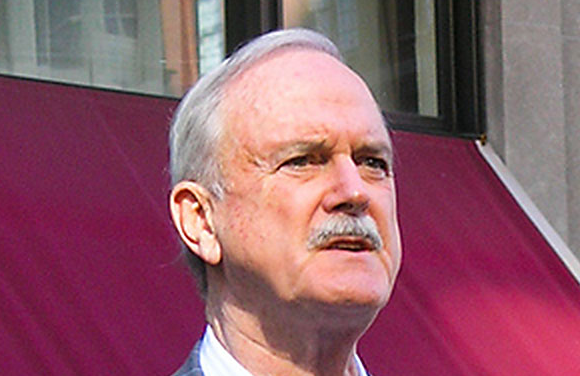
John Cleese, you say, a spokesman for the American Philosophical Association? Why would such a serious organization, whose stated mission is to foster the “broader presence of philosophy in public life,” choose a British comedian famous for such characters as the overbearing Basil Fawlty and ridiculous Minister of Silly Walks as one of their public faces?
They chose him, I imagine, because in his various roles—as a onetime prep school teacher and student of law at Cambridge, as a comedy writer and Monty Python star, and as a post-Python comedian, author, public speaker, and visiting professor at Cornell—Cleese has done more than his part to spread philosophy in public life. Monty Python, you’ll remember, aired a number of absurd philosophy sketches, notable for being as smart as they are funny.
Given these credentials, and his ability to apply his intelligence, wit, and comic timing to subjects not often seen as particularly exciting by the general public, Cleese seems like the perfect person for the job, even if he isn’t an American philosopher. The APA, founded in 1900, has recently hosted conferences on religious tolerance and “Cultivating Citizenship.” In 2000, as part of its centennial celebration, the organization had Cleese record 22 very short “Public Service Announcements” to introduce novices to the important work of philosophy. These range from the very general “What Philosophers Do” at the top of the post to the influence of philosophy on social and political reformers like Martin Luther King, Jr., Jane Addams, and Simone de Beauvoir (above), showing philosophy’s “bearing on the real world.”
In this PSA, Cleese makes the controversial claim that “the 21st century may belong far more to philosophy than to psychology or even traditional religion.” “What a strange thought,” he goes on, then explains that philosophy “works against confusion”—certainly a hallmark of our age. There’s not much here to argue with—Cleese isn’t formulating a position, but giving his listeners provocative little nuts to crack on their own, should they find his PSAs intriguing enough to draw them into further study. They might as well begin where most of us do, with Socrates, whom Cleese introduces below.
In ostensibly liberal democracies in the West, attitudes towards free speech vary widely given different historical contexts, and can shift dramatically over time. We’re living in the midst of a generational shift on the issue in the U.S.; a recent Pew survey found that 40 percent of millennials—18–34 year olds—favor government bans on offensive speech. The usual caveats apply when reading this data; New York magazine’s Science of Us blog breaks down the demographics and points out problems with definitions, particularly with that of the word “offensive.” They write, “plenty of folks freak out about anti-cop sentiments but are fine with racially loaded language—or insert your own examples.” As commentators note almost daily, various free speech advocates show all manner of partiality when it comes to whose speech they choose to defend and whose they, unwittingly perhaps, suppress.
European countries, of course, already have all sorts of laws that curb offensive speech and impose harsh penalties, from large fines to jail time. Those laws are extending to the internet as well, a speech domain long censored by Chinese authorities.
Whether European measures against racist and xenophobic speech actually lessen racism and xenophobia is an open question, as is the problem of exceptions to the laws that seem to allow certain kinds of prejudices as they strongly censor others. Much more extreme examples of the suppression of free speech have recently come to light under autocratic regimes in the Middle East. In Syria, software developer and free speech advocate Bassel Khartabil has been held in prison since 2012 for his activism. In Saudi Arabia, artist, poet, and Palestinian refugee Ashraf Fayadh has been sentenced to death for “renouncing Islam.”
We could add to all of these examples hundreds of others, from all over the world, but in addition to the statistics and the disturbing individual cases, it is worth asking broader, more philosophical questions about free speech as we draw our own conclusions about the issues. What exactly do we mean by “free speech”? Should all speech be protected, even that meant to libel individuals or whole groups or to deliberately incite violence? Should we tolerate a public discourse made up of lies, misinformation, prejudicial invective, and personal attacks? Should citizens and the press have the right to question official government narratives and to demand transparency?
To help us think through these politically and emotionally fraught discussions, we could listen to Free Speech Bites, a podcast sponsored by the Index on Censorship and hosted by freelance philosopher Nigel Warburton, who also hosts the popular podcast Philosophy Bites. The format is identical to that long-standing show, but instead of short conversations with philosophers, Warburton has brief, lively discussions with free speech advocates, including authors, artists, politicians, journalists, comedians, cartoonists, and academics. In the episode above, Warburton talks with DJ Taylor, biographer of the man considered almost a saint of free speech, George Orwell.
Of his subject, Taylor remarks, “I think it’s true to say that most of Orwell’s professional life, large amounts of the things that he wrote, are to do with the suppression of the individual voice.” At the same time, he points out that Orwell’s “view of free speech is by no means clear cut.” The “whole free speech issue became much more delicately shaded than it would otherwise have been” during the extraordinary times of the Spanish Civil War and World War II. Taylor refers to the “classic liberal dilemma: how far do we tolerate something that, if tolerated, will cease to tolerate us…. If you are living in a democracy and somebody’s putting out fascist pamphlets encouraging the end of that democracy, how much rope do you give them?”
In another episode, Irshad Manji—feminist, self-described “Muslim refusenik,” and author of The Trouble with Islam Today—talks free speech and religion, and offers a very different perspective than what we’re used to hearing reported from Islamic thinkers. When Warburton says that Islam and free expression sound “like two incompatible things,” Manji counters that as a “person of faith” she believes “free expression is as much a religious obligation as it is a human right.” In her estimation, “no human being can legitimately behave as if he or she owns a monopoly on truth.” Anything less than a society that tolerates civil disagreement, she says, means that “we’re playing God with one another.” In her religious perspective, “devoting yourself to one god means that you must defend human liberty.” Manji sounds much more like Enlightenment Christian reformers like John Locke than she does many interpreters of Islam, and she is well aware of the unpopularity of her point of view in much of the Islamic world.
Addressing the question of why free speech matters, broadcaster and writer Jonathan Dimbleby—former chair of the Index on Censorship—inaugurated the podcast in 2012 with a more classically philosophical discussion of John Stuart Mill’s On Liberty and the liberal argument against censorship Mill and others articulated. For Dimbleby, “freedom of expression [is] not only a right but a defining characteristic of what it means to be a civilized individual.” It’s a view he holds “very strongly,” but he admits that the valid exceptions to the rule are “where the difficult territory starts.” Dimbleby points to “very obvious circumstances when you don’t have freedom of expression and should not have freedom of expression.” One of the exceptions involves “laws that say that if you express yourself freely, you are directly putting someone else’s life at risk.” This is not as clear-cut as it seems. The “dangerous territory,” he argues, begins with circumscribing language that incites anger or offense in others. We are back to the question of offense, and it is not a uncomplicated one. Although activists very often need to be uncivil to be heard at all, there’s also a necessary place for public discussions that are as thoughtful and careful as we can manage. And for that reason, I’m grateful for the intervention of Free Speech Bites and the international variety of views it represents.
I TEACH YOU THE SUPERMAN. Man is something that is to be surpassed. What have ye done to surpass man?
All beings hitherto have created something beyond themselves: and ye want to be the ebb of that great tide, and would rather go back to the beast than surpass man?…
Lo, I teach you the Superman!
The Superman is the meaning of the earth. Let your will say: The Superman SHALL BE the meaning of the earth!
I conjure you, my brethren, REMAIN TRUE TO THE EARTH, and believe not those who speak unto you of superearthly hopes! Poisoners are they, whether they know it or not.
Despisers of life are they, decaying ones and poisoned ones themselves, of whom the earth is weary: so away with them!
Once blasphemy against God was the greatest blasphemy; but God died, and therewith also those blasphemers. To blaspheme the earth is now the dreadfulest sin, and to rate the heart of the unknowable higher than the meaning of the earth!
As Eva Cybulska observes in an article on Philosophy Now, Nietzsche never quite spelled out what he meant by Übermensch/The Superman, leaving it to later interpreters to fill in the blanks. She notes: “RJ Hollingdale (in Nietzsche) saw in Übermensch a man who had organised the chaos within; [Walter] Kaufmann (Nietzsche) a symbol of a man that created his own values, and Carl Jung (Zarathustra’s Seminars) a new ‘God’. For Heidegger it represented humanity that surpassed itself, whilst for the Nazis it became an emblem of the master race.”
You can now add to the list of interpretations another by Alain de Botton’s School of Life. In a newly-released animated video, de Botton treats The Superman as the incarnation of human perfection. Embodying characteristics possessed by Goethe, Montaigne, Voltaire and Napoleon (people who came closest to achieving perfection in Nietzsche’s mind), the Übermenschen/Supermen will live by their own values (Pagan in nature); delight in their superiority and take pity on the weak; perhaps hurt people in the name of achieving great things; accept that suffering can be a necessary evil; use culture to raise the mentality of the society around them; and beyond.
Whether you see The Superman differently is another question. You can download Thus Spake Zarathustra from our Digital Nietzsche collection and come up with your own take.
When writer, politician, and BBC radio and television personality Melvyn Bragg began his long-running radio program In Our Time, which brings academics together to discuss philosophy, history, science, religion, and culture, he didn’t think the show would last very long: “Six months,” he told The Scotsman in 2009, “but I’ll have a go.” Now, seventeen years after the show began in 1998, In Our Time is going strong, with millions of listeners from around the world who tune in on the radio, or download the In Our Time podcast. Though it’s easy to despair when faced with the onslaught of mass media devoted to triviality and sensationalism, Bragg has shown there’s still a sizable audience that cares about thoughtful engagement with matters of import, and in particular that cares about philosophy.
Though the subject takes a beating these days, especially in unfavorable comparisons to the hard sciences, the concerns articulated by philosophers over the centuries still inform our views of ethics, language, politics, and human existence writ large. In Our Time’s philosophy programs follow the same format as the show’s other topics—in Bragg’s words, he gets “three absolutely top-class academics to discuss one subject and explore as deeply as time allow[s].” In this case, the “subject,” is often a proper name, like Simone Weil, David Hume, Albert Camus, Simone de Beauvoir or Socrates.
The show just as often tackles philosophical movements like Skepticism, Neoplatonism, or The Frankfurt School, that aren’t associated with only one thinker; likewise, Bragg and his guests have devoted their discussions to longstanding philosophical problems, like the existence of Free Will, and historical developments, like the Continental-Analytic Split in Western philosophy.
Though there is certainly no shortage of high quality resources for people who wish to learn more about philosophy—such as the many free courses, podcasts, and lectures we’ve featured on this site—few are as immediately accessible as In Our Time’s philosophy discussions. Bragg describes his preparation for each show as “swotting”—or cramming. He’s not an expert, but he’s knowledgeable enough to ask pertinent questions of his guests, who then go on to educate him, and the listeners, for the almost hour-long conversation. Hear how well the approach works in the In Our Time philosophy programs featured here. At the top, Bragg discusses the philosophy and activism of Bertrand Russell with academic philosophers A.C. Grayling, Mike Beaney, and Hilary Greaves. Below that, he talks Kierkegaard with Jonathan Ree, Clare Carlisle, and John Lippitt. Just above, hear Bragg discuss Jean-Paul Sartre with Jonathan Rée, Benedict O’Donohoe, and Christina Howells. Finally, below, hear his conversation on Karl Marx with Anthony Grayling, Francis Wheen, and Stedman Jones.
We're hoping to rely on loyal readers, rather than erratic ads. Please click the Donate button and support Open Culture. You can use Paypal, Venmo, Patreon, even Crypto! We thank you!
Open Culture scours the web for the best educational media. We find the free courses and audio books you need, the language lessons & educational videos you want, and plenty of enlightenment in between.