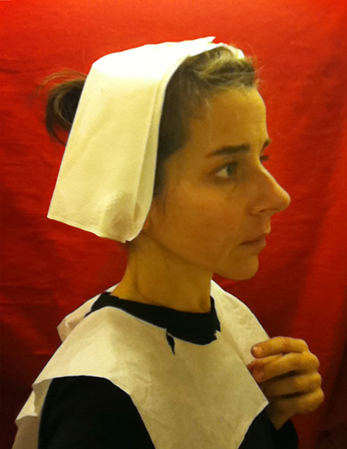
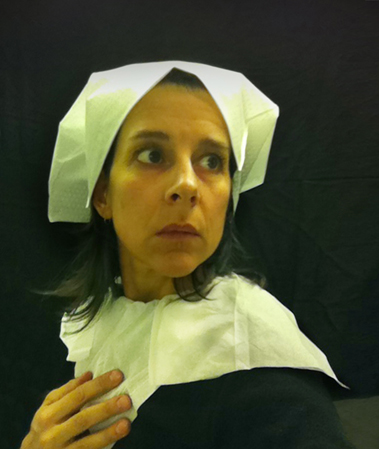
The work of artist Nina Katchadourian is highly accessible. So much so that it’s likely her fault if the line for the bathroom on your next flight stretches all the way from tail to the cockpit. Such is the power of Lavatory Self-portraits in the Flemish Style, the best known segment of her ongoing Seat Assignment project. How can passengers pass up the opportunity to recreate Katchadourian’s widely disseminated images, knowing that the originals were shot in the mirror on an iPhone, using props like disposable seat covers and an inflatable neck pillow?
Shy and/or civic-minded types who don’t relish the implications of tying up the johnny at high altitudes should have a go at restaging the other aspects to Katchadourian’s inflight work, on display above.
(Hint: book a window seat and exercise restraint when the fight attendant hands you your complimentary bag of mini pretzels.)
Honestly, much of what you’ll see, from the unnervingly named Disasters to the genius of Sweater Gorillas, can be accomplished without leaving the ground. Though it may prove more creatively rewarding to delay until the only palatable alternative is an unregulated amount of reality TV screening on the seat back ahead of you.
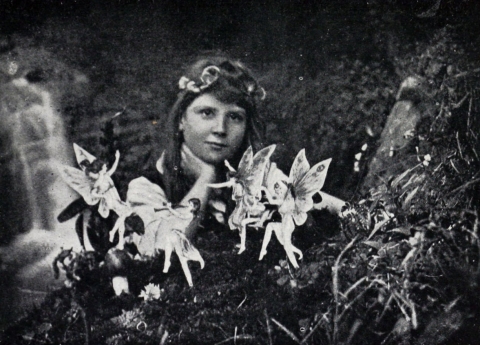
In a previous post, we brought you what is likely the only appearance on film of Sir Arthur Conan Doyle—an interview in which he talks of Sherlock Holmes and spiritualism. Although Conan Doyle created one of the most hardnosed rational characters in literature, the author himself later became converted to a variety of supernatural beliefs, and he was taken in by a few hoaxes. One such famous hoax was the case of the so-called “Cottingley Fairies.” As you can see from the photo above (from 1917), the case involved what Conan Doyle believed was photographic evidence of the existence of fairies, documented by two young Yorkshire girls, Elsie Wright and her cousin Frances Griffiths (the girl in the photo above). According to The Haunted Museum, the story of Doyle’s involvement goes something like this:
In 1920, Conan Doyle received a letter from a Spiritualist friend, Felicia Scatcherd, who informed of some photographs which proved the existence of fairies in Yorkshire. Conan Doyle asked his friend Edward Gardner to go down and investigate and Gardner soon found himself in the possession of several photos which showed very small female figures with transparent wings. The photographers had been two young girls, Elsie Wright and her cousin, Frances Griffiths. They claimed they had seen the fairies on an earlier occasion and had gone back with a camera and photographed them. They had been taken in July and September 1917, near the Yorkshire village of Cottingley.
The two cousins claimed to have seen the fairies around the “beck” (a local term for “stream”) on an almost daily basis. At the time, they claimed to have no intention of seeking fame or notoriety. Elsie had borrowed her father’s camera on a host Saturday in July 1917 to take pictures of Frances and the beck fairies.
Elsie’s father, a skeptic, filed the photos away as a joke, but her mother, Polly Wright, believed, and brought the images to Gardner (there were only two at first, not “several”), who circulated them through the British spiritualist community. When Conan Doyle saw them in 1920, he gave each girl a camera and commissioned them to take more. They produced three additional prints. The online Museum of Hoaxesdetails each of the five photos from the two sessions with text from Edward Gardner’s 1945 Theosophical Society publication The Cottingley Photographs and Their Sequel.
These photos swayed thousands over the course of the century, but arch-skeptic James Randi seemingly debunked them for good when he pointed out that the fairies were ringers for figures in the 1915 children’s book Princess Mary’s Gift Book, and that the prints show discrepancies in exposure times that clearly point to deliberate manipulation. The two women, Elsie and Frances, finally confessed in the early 1980s, fifty years after Conan Doyle’s involvement, that they had faked the photos with paper cutouts. Watch Randi and Elsie Wright discuss the trickery above.
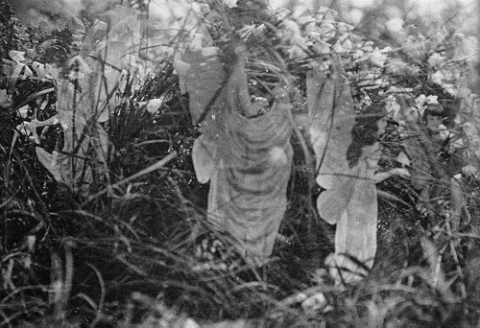
The daughter and granddaughter of Griffiths possess the original prints and one of Conan Doyle’s cameras. Both once believed that the fairies were real, but as the host explains, they were not simply credulous fools. Throughout much of the twentieth century, people looked at the camera as a scientific instrument, unaware of the ease with which images could be manipulated and staged. But even as Frances admitted to the fakery of the first four photos, she insisted that number five was genuine. Everyone on the show agrees, including the host. Certainly Conan Doyle and his friend Edward Gardner thought so. In the latter’s description of #5, he wrote:
This is especially remarkable as it contains a feature quite unknown to the girls. The sheath or cocoon appearing in the middle of the grasses had not been seen by them before, and they had no idea what it was. Fairy observers of Scotland and the New Forest, however, were familiar with it and described it as a magnetic bath, woven very quickly by the fairies and used after dull weather, in the autumn especially. The interior seems to be magnetised in some manner that stimulates and pleases.
I must say, I remain seriously unconvinced. Even if I were inclined to believe in fairies, photo number five looks as phony to me as numbers one through four. But the Antiques Roadshow appearance does add a fun new layer to the story and an air of mystery I can’t help but find intriguing, as Conan Doyle did in 1920, if only for the historical angle of the three generations of Griffiths who held onto the legend and the artifacts. Oh, and the appraisal for the five original photos and Arthur Conan Doyle’s camera? Twenty-five to thirty-thousand pounds—not too shabby for an adolescent prank.
Josh Jones is a freelance writer, editor, and musician based in Washington, DC. Follow him @jdmagness
Ask a photographer from the century that just passed to name his or her favorite film, and the answer, very often, will be Kodachrome.
The crisp emulsion, beautifully saturated colors and archival stability of Kodachrome made it a sentimental favorite among photographers long after other, more practical color films had all but pushed it out of the marketplace. The problem was, the very qualities that made the film special stemmed from a highly cumbersome technical process. Kodachrome was a “non-substantive” film, meaning the dye couplers were not built into the emulsion, as they are in other color films, but had to be added during development. The process was complex, and few labs could afford to offer it. Even before the digital revolution, Kodachrome was an endangered species.
So while it came as an emotional shock to many photographers, it was no real surprise when the Eastman Kodak Company announced in 2009 that it was halting production of Kodachrome. One of the photographers who had long-since moved on to digital imaging but who was saddened by the demise of Kodachrome was Steve McCurry, an award-winning photojournalist for National Geographic who is best known for his haunting 1984 image (shot on Kodachrome) of a 12-year-old Afghan refugee girl with piercing green eyes. When McCurry heard the news, he arranged to obtain the very last roll of Kodachrome to come off the assembly line at the Kodak plant in Rochester, New York. The challenge, then, was this: What do you do with the last 36 exposures of a legendary film?
The half-hour documentary above from National Geographic tells the story of that roll and how McCurry used it. The filmmakers followed the photographer on an odyssey that began at the factory in Rochester and ended at a laboratory (the last Kodachrome lab open) in a small town in Kansas. Over the course of about six weeks, from late May to early July, 2010, McCurry traveled halfway around the world to make those final 36 exposures. The resulting photographs iclude street scenes in New York and Kansas, portraits of a movie star (Robert De Niro) in New York, intellectuals and ethnic tribesmen in India, colleagues in Turkey and New York, and one of himself. It’s a remarkable take. Although a few of the shots appear spontaneous, most are the result of careful planning. McCurry donated all 36 slides to the George Eastman House International Museum of Photography and Film, but you can see almost all of the photos online at the Vanity Fair Web site. As McCurry tells the magazine:
I’ve been shooting digital for years, but I don’t think you can make a better photograph under certain conditions than you can with Kodachrome. If you have good light and you’re at a fairly high shutter speed, it’s going to be a brilliant color photograph. It had a great color palette. It wasn’t too garish. Some films are like you’re on a drug or something. Velvia made everything so saturated and wildly over-the-top, too electric. Kodachrome had more poetry in it, a softness, an elegance. With digital photography, you gain many benefits [but] you have to put in post-production. [With Kodachrome] you take it out of the box and the pictures are already brilliant.
Too bad there are no leopard seals on National Geographic’s payroll. Photographer Paul Nicklen’s intimate portraits of the one who took particular interest in him on a recent Antarctic expedition are delightful. Imagine how great it would be to have some reverse angle reaction shots of Nicklen as his new friend attempts to serve him a succession of live, dead, and mutilated penguins.
He may have turned up his nose at his subject’s cuisine, but Nicklen brings something else to the table, namely four days’ worth of up close and personal shots of an animal doing something other than going about its business. Without anthropomorphizing its intentions over much, this creature went out of its way to acclimate its strange guest to his new surroundings, sticking around when lesser hosts would have abandoned him alongside the buffet. Pretty cool when you consider that Nicklen’s entire head could — and briefly did — fit inside its massive, sharp fanged jaws.
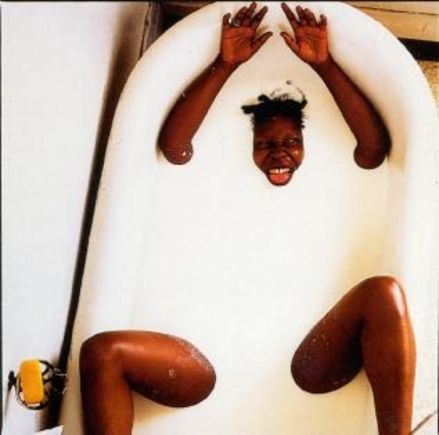
One must take care, when writing about well-connected cultural figures, not to abuse the word iconic. But when one writes about the photographer Annie Leibovitz, one almost has to abuse it. Here we have a woman who took two of the most memorable photos of John Lennon, collaborated (to the extent possible) with Hunter S. Thompson, went on tour with the Rolling Stones, followed Richard Nixon out of the White House the last time he left it, convinced Whoopi Goldberg to get into a bathtub of milk, and loved Susan Sontag. This whole post couldn’t possibly contain a complete list of her professional and personal involvement with the, yes, icons of twentieth-century popular culture. Her portraits of them became icons themselves, which, in turn, made Leibovitz herself iconic. For a visually rich sense of the scope of her life and career, look no further than the documentary above, Life Through a Lens.
This 2008 production comes from the PBS-distributed American Masters television series, which we featured on Tuesday. Directed by Leibovitz’s own sister and therefore possessed of the unusual familial insight you’d expect, Life Through a Lens also includes a great many of the hard-to-interview luminaries without which no profile of this photographer could be complete. We hear from Arnold Schwarzenegger, Jann Wenner, Hillary Clinton, Gloria Steinem, Patti Smith, Mick Jagger, Keith Richards, Bette Midler, Yoko Ono, and George Clooney, to name but a few of her admirers who’ve held their own at the business end of her camera. In the four years since this documentary, Leibovitz’s photographs — now of 21st-century celebrities like Miley Cyrus, Sasha Baron Cohen, Lady Gaga, Rihanna, and LeBron James — have continued to impress in the pages of Vogue and Vanity Fair. Whenever someone rises toward iconic status, Annie Leibovitz’s visual imagination can’t be far behind.
We all have our fascinations. Some of us are enamored of a particular historical era. If I had to pick a time period I’d want to visit, I’d say the 1930s—after the Depression, before World War II—a “tweener” decade if there ever was one.
Jo Hedwig Teeuwisse takes her interest in the 1930s to extraordinary lengths. She wears vintage clothing and attends 1930s-theme parties. She is also a historical consultant and expert on daily life from 1930–1945.
Teeuwisse lives in The Hague but once, while visiting Amsterdam, she stumbled upon a treasure on the street. It was a box filled with old photographic negatives. Some had identifying notes but most did not. A history nut, Teeuwisse went to work immediately trying to sort out where the shots were taken and, if possible, the identities of people in the retro photos.
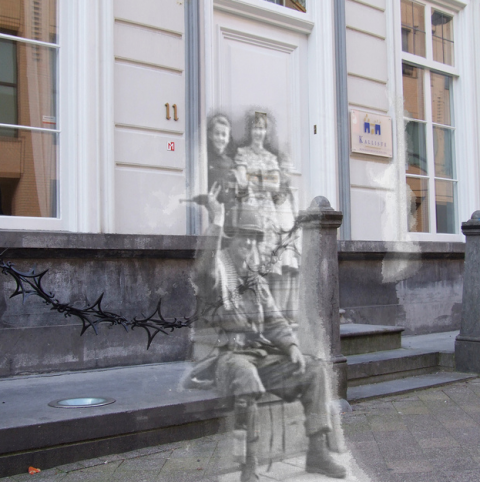
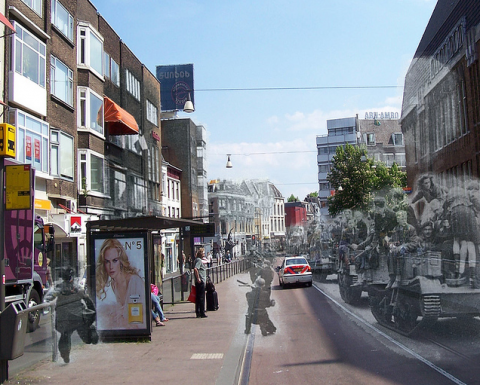
The results are an impressive and amazing archive Teeuwisse calls Ghosts of History. More than simply figuring out which building is featured in a picture, Teeuwisse created photo mash-ups by combining elements of a vintage image with an image of her own taken in the same place today.
We see members of the underground press marching down a main Amsterdam thoroughfare in June, 1945 alongside shoppers and tourists strolling down the same street today.
In a powerful juxtaposition of then and now, three Dutch scouts risk their lives crossing Amsterdam’s Dam Square in the aftermath of a Nazi attack just two days after Germany surrendered. Note the hats left behind by people who had fled for their lives, and the contemporary students walking nonchalantly on.
What is so potent about Teeuwisse’s work is that it is so quiet. She doesn’t have to point out irony because it is so immediately evident: Those same cobbles that so many have trod on the way to Madame Tussaud’s Wax Museum are scuffed by the boots of soldiers, famished victims of war austerity and ordinary working people on their way to the factory.
There are still many World War II images from that box that remain unidentified. Teeuwisse loaded them all up to her flickr site. Take a look. Maybe you’ll find a familiar face from your own past.
Kate Rix writes about digital media and education. Read more of her work at and thenifty.blogspot.com.
Philosophers have often ruminated on the aesthetics of photography. Roland Barthes’ Camera Lucida begins with a poignant memorialization of his mother, as remembered through her photograph. Pierre Bourdieu’s Photography: A Middle-Brow Artwondered why and how the medium became so widespread that “there are few households, at least in towns, which do not possess a camera.” And Jacques Derrida’s posthumous Athens, Still Remains, a travel memoir accompanied by the photographs of Jean-Francois Bonhomme, begins with the mystical phrase “We owe ourselves to death.”
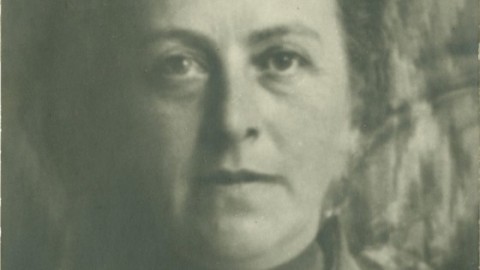
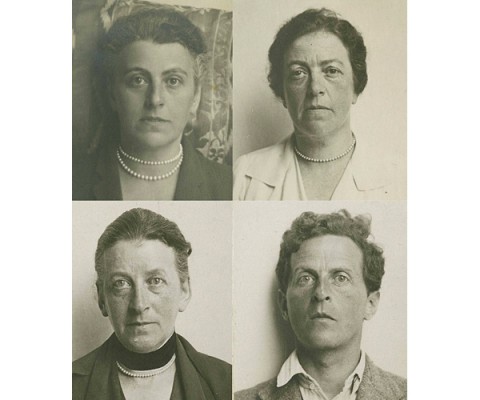
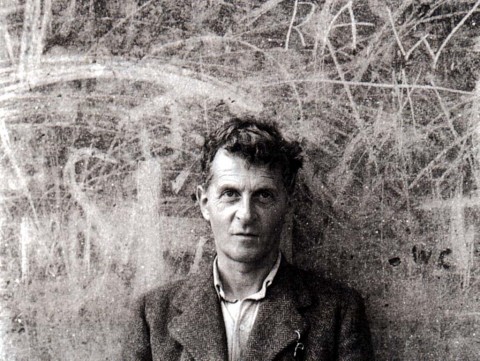
For Barthes and Derrida, photography was a medium of suspended mortality—every photograph a memento mori. For another philosopher, the cryptic, polymath, and notoriously surly Ludwig Wittgenstein, photography was a concrete expression of his preferred means of perception. As he famously wrote in the Philosophical Investigations, “Don’t think, look!” For the unsentimentally cerebral Wittgenstein, a photograph is not a memorial, but a “probability.” The philosopher’s archive at the University of Cambridge includes the photograph above, a true “probability” in that it does not represent any one person but is a composite image of his face and the faces of his three sisters, made in collaboration with the “founding father of eugenics,” Francis Galton. The four separate photographs that Wittgenstein and Galton blended together are below.
Of the composite image, keeper of the Wittgenstein archives Michael Nedo writes that “Wittgenstein was aiming for different clarity expressed by the photography of fuzziness.”:
Galton wanted to work out one probability, whereas Wittgenstein saw this as a summary in which all manner of possibilities are revealed in the fuzziness.
Fuzziness is a word rarely applied to Wittgenstein’s thought—at least his early work in the Tractatus Logico-Philosophicus where his only goal is a clarity of thought that supposedly dissolves all the “fuzzy” problems of philosophy in a series of elliptical aphorisms. The philosopher also called himself a “disciple of Freud,” in that he sought to “think in pictures,” and reach beyond language to the images produced by dreams and the unconscious, “to enable us to see things differently.” Wittgenstein’s photographs are as strangely detached and mysterious as the man himself. Salon has a gallery of the philosopher’s photographs, which includes the portrait of him (below), taken at his instruction in Swansea, Wales in 1947. It’s an iconic image; Wittgenstein half-sneers disdainfully at the camera, his steady gaze a challenge, while the blackboard behind him shows a riot of scratches and scrawls. In the upper right-hand corner, the word RAW hangs ominously above the philosopher’s head.
Josh Jones is a doctoral candidate in English at Fordham University and a co-founder and former managing editor of Guernica / A Magazine of Arts and Politics.
Award-winning filmmaker Matt Morris appreciates craft, hard work and people who just show up for each other.
His Emmy-nominated film Pickin’ and Trimmin’follows the men who cut hair and play bluegrass music together at Drexel’s barbershop in North Carolina. In Mr. Happy Man, an 88-year-old man talks about the hours he spends every morning greeting Bermuda’s commuters as they endure traffic.
The subject of his most recent work came to him in a round-about way, but features the same careful, affectionate filmmaking of his other films. American Tintypechronicles the process of photographer Harry Taylor, who discovered a passion for the Civil War-era “wet plate” photography.
Taylor, based in Wilmington, North Carolina, specializes in tintypes and ambrotypes. He makes them with the same big cameras and messy chemicals used during the late 1800s. At that time, the process produced a whole new layer of detail than earlier techniques had done, and allowed for an infinite number of prints to be made.
Time consuming, laborious and unpredictable, the process requires the photographer to use a portable dark room when shooting outside of the studio. Tin photographic plates are coated with collodion emulsion. (The technique is also called collodion process. There’s a nice tutorial here.) The plate must be coated, exposed and developed within fifteen minutes, before the collodion loses its sensitivity. It’s an inconvenient system, especially by today’s standards, but it pleases Taylor immensely as it forces both him and his subjects to slow down. You can view some of Taylor’s images here.
Morris allows Taylor to speak for himself in the four-minute documentary, letting the camera linger on Taylor’s wood and metal equipment, the dreaminess of his images and on Taylor’s own observations about how long-exposure photography reveals more of the subject’s thoughts. Even the flaws are interesting.
Make a point to notice the music. Morris approached composer Hanan Townshend, known for the scores he composed for director Terrence Malick. Morris blogs about the process of recording American Tintype’s soundtrack at Marin County’s Skywalker Sound—a fun little peek behind the scenes.
Kate Rix writes about digital media and education. Read more of her work at and thenifty.blogspot.com.
We're hoping to rely on loyal readers, rather than erratic ads. Please click the Donate button and support Open Culture. You can use Paypal, Venmo, Patreon, even Crypto! We thank you!
Open Culture scours the web for the best educational media. We find the free courses and audio books you need, the language lessons & educational videos you want, and plenty of enlightenment in between.