What drives someone to collect Star Wars figures or Transformers or LEGOs or whatever else? Your Pretty Much Pop hosts Mark Linsenmayer, Erica Spyres, and Brian Hirt are joined by guest Matt Young of the Hello from the Magic Tavern and Improvised Star Trek podcasts to talk about this potentially expensive and life-eating habit. No kidulting required.
After the episode, Matt remained on the line for our Aftertalk, which is typically only available for supporters via patreon.com/prettymuchpop, but this this case we’ve unleashed it to the public:
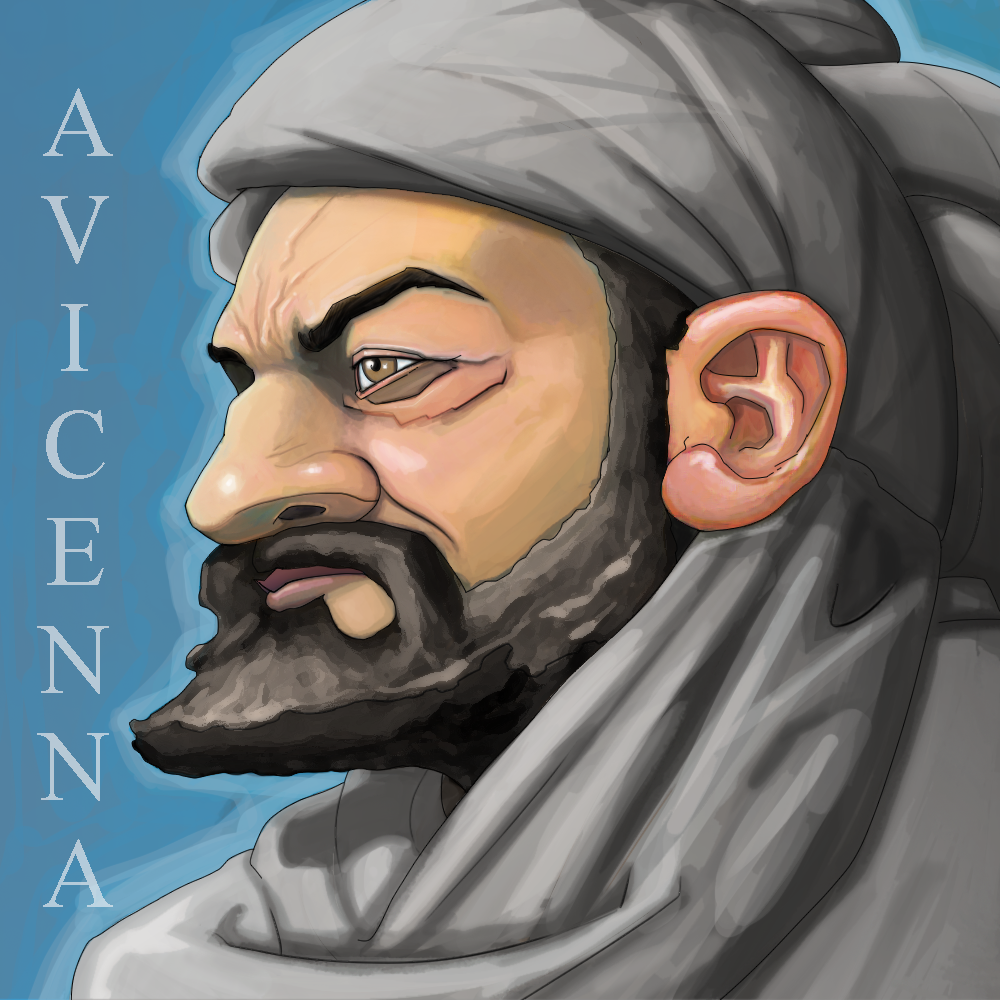
Most American students in philosophy live on a diet of ancient Greek philosophy on the one hand, and then “modern” philosophy, which starts around the time of Descartes (the 17th century), with numerous schools and approaches spilling into the present day. If you get anything from between those ancient days and modernity, it’s probably some churchmen, i.e. Augustine (from the 4th century) and Thomas Aquinas (the 13th century), with perhaps a few Romans thrown in there and (if you’re Jewish) Maimonides (12th century).
But a key part of this lineage was the Eastward turn that the great works of Greek and Roman philosophy took during the so-called Dark Ages, when they were preserved and copied in the Islamic world, and this period produced a wealth of philosophy including two figures who became influential enough in the West that their names were Latinized: Ibn Sīnā (980‑1037 C.E.) and Ibn Rushd, a.k.a. Averroes (1126–1198). Aquinas was very familiar with these figures and incorporated them into his influential works, and in the case of Ibn Sina, at least, important figures like John Locke had definitely known at least about his views, if not his actual works.
On the Partially Examined Life Philosophy Podcast, which has been going for 13 years now, we range widely over the history of philosophy but had not actually cracked the Islamic world. Luckily, Ibn Sīnā is one of the favorite philosophers of one of our favorite guests, Peter Adamson of King’s College London. Peter runs his own podcast, The History of Philosophy (Without Any Gaps), which as the name implies, covers Medieval philosophy with admirable thoroughness, covering not only Ibn Sīnā and Ibn Rushd, but also figures like al-Rāzī, al-Fārābī, Al-Ghazālī, and many others.
Peter was good enough to recommend some readings to introduce us and our listeners to this figure, some of which he actually wrote. Because of the volume, redundancy, and style of Ibn Sīnā’s writings, some sort of guide to collect and to some degree explain passages is essential for getting a handle on this idiosyncratic and brilliant thinker. He wrote at least three different versions of his all-encompassing system, which was influenced by and meant to supplant Aristotle’s. In addition to philosophical/theological topics, it included mathematics, science, psychology, and more. So instead of trying to read a whole work covering all that, it makes more sense to pick individual topics and then look at the various formulations he gave about these.
Our two topics for this discussion were a peculiar argument for the existence of God — with important implications for talking about metaphysics more generally — and an argument for the immateriality of the soul, which likewise tells us a lot about the way that Ibn Sīnā thought about knowledge and its relation to the world.
The argument for the existence of God was later called by Thomas Aquinas “the argument from contingency.” It posits that things in the world don’t simply exist, but that they require something else to support their existence. This isn’t a cause is the chronological sense that we talk about it: a prior event that gave rise to the thing. Rather, the material components of something in a certain arrangement make it continue to exist as that thing right now; for example, a house exists because its component wood parts exist, with nails and such holding them in place. And the wood in turn has its character because of its physical/chemical components, etc. If these component causes weren’t in place, the thing would not exist; the thing is thus “contingent,” meaning it might well not have existed were it not for those causes.
This picture of the universe thus includes a giant network of causality, but does that network itself rest on anything? According to Ibn Sīnā, there must be something that is not contingent that holds everything else up. But is this thing God (in the sense that a good Muslim of his time would recognize it)? Ibn Sīnā then has a long series of arguments to show one by one that just by being “the necessary being,” this entity also must be unique, must be all-powerful, generous, and all the other things one would expect God to be.
The argument for the immortality of the soul is perhaps Ibn Sīnā’s most famous argument, often called the flying or floating man argument. It’s a thought experiment whereby you imagine you’ve just been created, but fully mature, so you can think, but with no memory, and your senses are inoperable. You can’t even feel gravity or the ground under your feet (thus the “flying” part). According to Ibn Sīnā, you would still in such a situation know that you exist. Since your apprehension of self did not include any part of your body (you couldn’t feel your body at all), that is supposed to prove that your body is not an essential part of what you are.
Ibn Sīnā thought this argument definitive because of his theory of knowledge by which if you know anything at all, then you know about the essential components of that thing. If you know what a triangle is, you know that it’s an abstract geometrical figure with three straight sides. If you know what a horse is, you know that it’s a biological animal with a particular character that you can identify. And to know what you are essentially, you only need know that feeling of your own mind; anything else about that mind being associated with a particular body that lives in a particular part of the world and is just knowledge of contingent, relational facts about yourself.
PEL hosts Mark Linsenmayer and Dylan Casey grapple in detail with Peter about these arguments, both on this recording and on a second part of the discussion for those that want to hear more. To read more about these arguments and get the citations to the texts we read for this discussion, see the essay for this episode at partiallyexaminedlife.com. The History of Philosophy podcast also features four monologues and an interview about Ibn Sīnā. Don’t let this gap in your knowledge of major figures in intellectual history remain unfilled!
What is with the weird relationship we Americans have with our pets? Many of us treat them as our babies, yet of course they’re our captives. Dog trainer Hannah Branigan joins your hosts Mark Linsenmayer, Erica Spyres, and Brian Hirt to talk about pets as entertainment, as hobby, and as pandemic companions. How can we make this relationship as beneficial as possible for all involved, and how can learning to be a better pet owner inform our treatment of other people? Plus, what do we want out of TV talking animals, dog training TV, and the abomination that is Pooch Perfect.
Marshall McLuhan famously said “The medium is the message,” by which he meant that when we receive information, its effect on us is determined as much by the form of that information as by the actual content.
Neil Postman, in his 1985 book Amusing Ourselves to Death: Public Discourse in the Age of Show Business, ran with this idea, arguing that TV has conditioned us to expect that everything must be entertaining, and that this has had a disastrous effect on news, politics, education, and thinking in general.
In this discussion, your Pretty Much Pop hosts Mark Linsenmayer and Brian Hirt join with the rest of the Partially Examined Life crew: Seth Paskin, Dylan Casey and Wes Alwan.
The result is much more philosophical context than you’d get in a typical Pretty Much Pop discussion. Plato, for example, argued (through the character of Socrates) in the Phaedrus against writing, which he said amounts to off-loading thought to this inert thing, when it should be lively in our minds and our direct conversations. Postman’s book describes the Age of Print as highly congenial toward lengthy, abstract reasoning. High literacy rates, particularly in America, conditioned people to expect that this is how information is to be received, and as such they were, for instance, prepared to listen raptly to the Lincoln-Douglas debates in which the speakers provided lawyerly speeches that might span multiple hours.
Postman, an educational theorist, described television as not just providing a no-context experience whose high level of visual and auditory stimulation beats its spectators into thoughtless passivity, but that its popularity positively infects all the other communication channels available. Of course there is still in-person teaching, but television shortens attention spans such that teachers now feel the need to constantly entertain instead of forcing students to make the effort required to attend carefully to what they have to teach. Of course there are still books, but they are less read, and the competition of television for our time has changed the presentation within books so that they must be as immediately and consistently appealing as television.
McLuhan described television as a “hot” medium due to its high level of stimulation, where a “cool” one like a textbook requires more active participation of the recipient. We discuss how Postman’s critique fares in the Age of the Internet, which interestingly mixes things up, with more interactivity (in that sense cooler) yet even more possibility for sensory distraction (in that perhaps more important sense hotter). To supplement Postman, we also consulted a widely read article from The Atlantic written by Nicholas Carr in 2008 called “Is Google Making Us Stupid.”
What’s the meaning behind the continued international popularity of kaiju media in which giant creatures stomp on cities and beat each other up? Is this just pro wrestling drama with special effects, or does it relate to deep-seated feelings of helplessness in the face of natural disasters? Perhaps both?
Your Pretty Much Pop hosts Mark Linsenmayer, Erica Spyres, and Brian Hirt reflect on the MonsterVerse films: Godzilla (2014), Kong: Skull Island (2017), Godzilla: King of the Monsters (2019), and chiefly Godzilla vs. Kong (2021). We also go into the history of Godzilla in Japan from the 1954 original to 2016’s award-winning Shin Godzilla. Do we care at all about the humans in these films? Are King Kong films too sad? Is there any legitimate sci-fi or political commentary in this genre? We touch on Pacific Rim, The Host, Cloverfield, Colossal, When a Monster Calls, Rampage, giant video game bosses, and more.
In lieu of an Oscars episode, the Pretty Much Pop podcast this week considers one of the nominated films, The Trial of the Chicago 7, and the career of its writer/director, Aaron Sorkin, which started with A Few Good Men through four TV series (most notably The West Wing), and films like The Social Network, Steve Jobs, and Molly’s Game.
Your hosts Brian Hirt, Erica Spyres, and Mark Linsenmayer consider Sorkin’s stock recurring characters and their political diatribes, plots often based on true events, and how his writing creates drama. Do we feel uplifted or vaguely dirty after a Sorkin bath? It’s great to have characters that aren’t stupid, but are they actually smart or just designed to seem that way? Are the deviations from fact just good use of dramatic license or positively harmful? We touch on virtually all of Sorkin’s productions (well, except for the plays; he actually considers himself natively a playwright) and still have energy for a few Oscars musings and reflections about including real locations or news events in fiction.
Here are some articles we used to prepare ourselves:
In the perennial conflict between art and our corporate entertainment machine, animation seems designed to be mechanized, given how labor-intensive it is, and yes, most of our animation comes aimed at children (or naughty adults) from a few behemoths (like, say, Disney).
Your hosts Mark Linsenmayer, Erica Spyres, and Brian Hirt are joined by Benjamin Goldman to discuss doing animation on your own, with only faint hope of “the cavalry” (e.g. Netfilx money or the Pixar fleet of animators) coming to help you realize (and distribute and generate revenue from) your vision. As an adult viewer, what are we looking for from this medium?
We talk about what exactly constitutes “indie,” shorts vs. features, how the image relates to the narration, realism or its avoidance, and more. Watch Benjamin’s film with Daniel Gamburg, “Eight Nights.”
Follow Benjamin on Instagram @bgpictures. Here’s something he did for a major film studio that you might recognize, from the film version of A Series of Unfortunate Events:
The buddy comedy is a staple of American film, but using this to explore female friendship is still fresh ground. Erica, Mark, Brian, and Erica’s long-time friend Micah Greene (actor and nurse) discuss tropes and dynamics within this kind of film, focusing primarily on Barb and Star Go to Vista Del Mar, the 2021 release written and starring Kristin Wiig and Annie Mumolo as a couple of middle aged near-twin oddballs expanding their horizons in a surrealistic, gag-filled tropical venue.
While male pairings of this sort (Cheech and Chong, Bob and Doug McKenzie, Beavis and Butthead et al) stick to silly jokes, Barb and Star base their antics around their evolving relationship toward each other. As with the 2019 film Booksmart and many TV shows including Dead to Me, PEN15, and Grace and Frankie, the trend is toward dramedy as the dynamics of friendship are taken seriously. We also touch on Bridesmaids, Sisters, The Heat, BAPS, I Love You Man, and more.
We're hoping to rely on loyal readers, rather than erratic ads. Please click the Donate button and support Open Culture. You can use Paypal, Venmo, Patreon, even Crypto! We thank you!
Open Culture scours the web for the best educational media. We find the free courses and audio books you need, the language lessons & educational videos you want, and plenty of enlightenment in between.