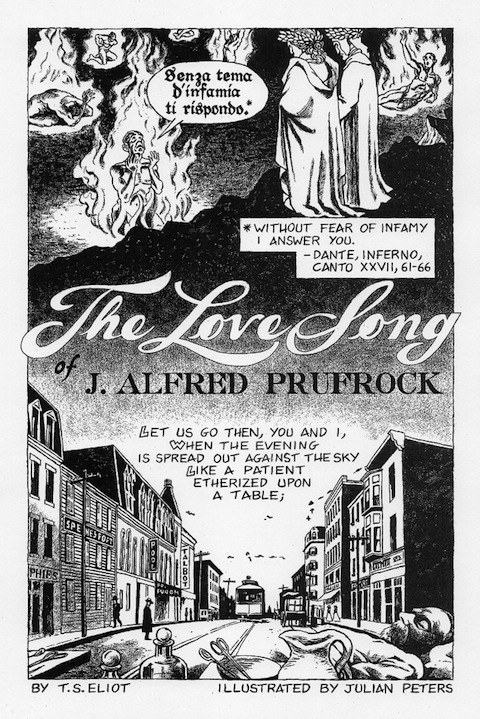
Poetry is as close as written language comes to the visual arts but, aside from narrative poems, it is not a medium easily adapted to visual forms. Perhaps some of the least adaptable, I would think, are the high modernists, whose obsessive focus on technique renders much of their work opaque to all but the most careful readers. The major poems of T.S. Eliot perhaps best represent this tendency. And yet comic artist Julian Peters is up to the challenge. Peters, who has previously adapted Poe, Keats, and Rimbaud, now takes on Eliot’s “The Love Song of J. Alfred Prufrock,” and you can see the first nine pages at his site.
Written in 1910 and published five years later, “Prufrock” has become a standard reference for Eliot’s doctrine of the “objective correlative,” a concept he defines in his critical essay, “Hamlet and His Problems,” as “a set of objects, a situation, a chain of events which shall be the formula of that particular emotion.” It’s a theory he elaborates in “Tradition and the Individual Talent” in his discussion of Dante. And Dante is where “Prufrock” begins, with an epigraph from the Inferno. Peters’ first page illustrates the agonized speaker of Dante’s lines, Guido da Montefeltro, a soul confined to the eighth circle, whom you can see at the top of the title page shown above. Peters’ visual choices place us firmly in the hellish emotional realm of “Prufrock,” a seeming catalogue of the mundane that harbors a darker import. Peters gives us no hint of when we might expect new pages, but I for one am eager to see more.
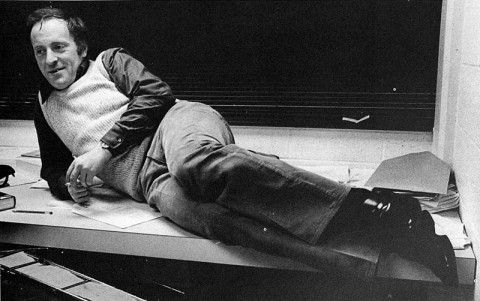
Although Joseph Brodsky was one of the most celebrated Soviet dissidents of the 20th century, the Nobel Prize-winning poet had been unerringly hounded by the repressive Soviet government, which had labeled his poetry as “pornographic and anti-Soviet.” Refusing to abandon his writing, Brodsky was repeatedly brought to court, and once sentenced to 18 months of labor in the Arctic region of Arkhangelsk. During one of his courtroom appearances, the young poet displayed an admirable level of testicular fortitude when the judge asked him, “Who has recognized you as a poet? Who has enrolled you in the ranks of poets?” Brodsky, defiant, replied “No one. Who enrolled me in the ranks of the human race?”
Brodsky’s remarks are far from the galvanizing dose of inspiration that many commencement addresses impart, and certainly not what Michigan graduates were expecting. Rather than uplift, the poet’s words soberly ground the audience; instead of wrapping them in a warm self-assuredness, the life tips are jarring, like an ice bath. Brodsky’s address is a mix of wry humour, acknowledgement of our absurdist existential dilemma, and bold, honest compassion. Reading Brodsky’s advice, one can’t help but feel that the poet valued his flawed humanity even more than his art; likely, they were inseparable.
Here’s a boiled-down version of the poet’s remarks:
1) “Treat your vocabulary the way you would your checking account.” Expression often lags behind experience, and one should learn to articulate what would otherwise get pent up psychologically. Learn to express yourself. Get a dictionary.
2) “Parents are too close a target… The range is such that you can’t miss.” Be generous with your family. Even if your convictions clash with theirs, don’t reject them—your skepticism of your infallibility can only benefit you. It will also save you a good deal of grief when they are gone.
3) “You ought to rely on your own home cooking.” Do not expect society to arrange itself to your benefit—there are too many people whose desires conflict for that to happen. Learn to rely on yourself, and help those who cannot.
4) “Try to not to stand out.” Do not covet money or fame for their own sake. It is best to be modest. There is comfort joining the ranks of those who follow their own discreet paths.
5) “A paralyzed will is no dainty for angels.” Do not indulge in victimhood. By blaming others, you undermine your determination to change your circumstances. When life confronts you with hardships, remember that they are no less an intrinsic part of existence. If you must struggle, do so with dignity.
6) “To be social is to be forgiving.” Do not let those who have hurt you live on in your complaints. Forget them.
The full text—irrevocably more pithy and eloquent—may be found here.
Yes, Halloween is behind us, and some people may desire a break from the Lou Reed tributes in order to mourn him silently. Fair enough. But indulge us once more, because Reed’s best music and the dark imaginative work of Edgar Allan Poe are always relevant, and when they come together, it’s reason to celebrate. And come together they did ten years ago with the recording of Reed’s concept album The Raven, a selection of musical and dramatic pieces put together by Reed. The album notably features actors such as Willem Dafoe, Steve Buscemi, Elizabeth Ashley, and Amanda Plummer and guest artists like David Bowie, Kate and Anna McGarrigle, and Ornette Coleman.
The collaboration, if you can call it such, between Reed and Poe makes perfect sense. As Mark Deming at Allmusic writes, “it’s no wonder why Lou Reed regards Poe as a kindred spirit.” Reed said as much in the liner notes: “I have reread and rewritten Poe to ask the same questions again. Who am I? Why am I drawn to do what I should not? … Why do we love what we cannot have? Why do we have a passion for exactly the wrong thing?” Despite its collection of seemingly mismatched parts, Reed’s The Raven worked, Deming writes, and Reed hadn’t “sounded this committed and engaged” in “over a decade” (Pitchfork had a decidedly different take on the album).
The Raven was originally a commissioned work for a stage production called POEtry, an adaptation of Poe’s work by Robert Wilson (who had previously worked with Tom Waits on The Black Rider). The title recording of Reed’s adapted “The Raven” (top) is actually read by a creepy-voiced Willem Dafoe. Ten years later, we have Reed himself reading his version of “The Raven” (above) at Cannes just this past June. He looks and sounds rather frail, but he’s mentally in top form. He breaks into his own reading to point out the fact that his version of the poem uses Poe’s “exact rhythm.” “If you don’t believe me,” he says, “you can check it line-by-line.” And so you can. Read Reed’s “The Raven” against Poe’s original. Of his modernization, Reed said:
The language is difficult, because there are a lot of arcane words that probably no one knew that they meant, even at the time – architectural terms and whatnot. So I spent a lot of time with the dictionary, to make it more contemporary, easy to read. Or easier, I should say.
The Reed/Poe/Robert Wilson collaboration also produced a 2011 book, also called The Raven and illustrated by artist Lorenzo Mattotti.
Back in college, I took a fall-quarter introductory music course. We happened to have class on Halloween (an event quite seriously taken around the University of California, Santa Barbara, in case you didn’t know), and the professor held an especially memorable lecture that day. He had us study “Der Erlkönig,” music by Franz Schubert, words by none other than Johann Wolfgang von Goethe. While I will not claim that this tale of the haunting of a moribund child, even with its driving score, genuinely frightened me, I will say that it put the fear into me in a more existential way, a blow which only a simple story can land effectively.
“Who rides, so late, through night and wind?” asks Goethe’s poem, translated from the German. “It is the father with his child. He has the boy well in his arm. He holds him safely, he keeps him warm.” The man feels concern for his ailing son, but the boy has troubles of his own: “Father, do you not see the Erlking?” The father explains his son’s vision of this menacingly regal figure away as the fog, as the wind, as the trees. But the child insists: “My father, my father, he’s grabbing me now! The Erlking has done me harm!” By the time their horse reaches home, indeed, the Erlking — or some obscure agent of mortality — has him. Hear this fable sung, and watch it vividly animated with sand on glass (no doubt a painstaking process) by Ben Zelkowicz above. Halloween itself may have just passed, but “Der Erlkönig” remains timelessly haunting.
We’ll add “Der Erlkönig” to the Animation section of our collection of Free Movies Online.
Ah, the ancient art of rhetoric. There’s no escaping it. Variously defined as “the art of argumentation and discourse” or, by Aristotle in his fragmented treatise, as “the means of persuasion [that] could be found in the matter itself; and then stylistic arrangement,” rhetoric is complicated. Aristotle’s definition further breaks down into three distinct types, and he illustrates each with literary examples. And if you’ve ever picked up a rhetorical guide—ancient, medieval, or modern—you’ll be familiar with the lists of hundreds of unpronounceable Greek or Latin terms, each one corresponding to some quirky figure of speech.
Well, as usual, the internet provides us with an easier way in the form of the video above of 10 figures of speech “as illustrated by Monty Python’s Flying Circus,” one of the most literate of popular artifacts to ever appear on television. There’s “paradiastole,” the fancy term for euphemism, demonstrated by John Cleese’s overly decorous newscaster. There’s “epanorthosis,” or “immediate and emphatic self-correction, often following a slip of the tongue,” which Eric Idle overdoes in splendid fashion. Every possible poetic figure or grammatical tic seems to have been named and catalogued by those philosophically resourceful Greeks and Romans. And it’s likely that the Pythons have utilized them all. I await a follow-up video in lieu of reading any more rhetorical textbooks.
Perhaps the most famous of all literary recluses, despite herself, Emily Dickinson left a posthumously discovered cache of poetry that did not receive a proper scholarly treatment until the publication of The Poems of Emily Dickinson by Thomas H. Johnson in 1955, which made available Dickinson’s complete body of 1,775 poems in their intended state of punctuation and capitalization. For the first time, readers outside the small Dickinson family circle could read the work she circulated privately in so-called “fascicles” as well as the hundreds of poems no one had seen during her lifetime. There is some question over whether Dickinson wished to publish for a wider audience. She shared her work only with family and friends, some of whom published ten of her poems in newspapers between 1850 and 1866, most likely without her knowledge or consent. Many urged Dickinson to publish. Author Helen Hunt Jackson wrote to her: “You are a great poet—and it is a wrong to the day you live in, that you will not sing aloud.” Nevertheless, Dickinson “hesitated,” an important word in her lexicon, expressive of her profound agnostic doubts about the value of fame, success, and immortality.
Possibly due to the lack of scholarly interest before Johnson’s collection, Dickinson’s trove of manuscript drafts has remained scattered across several archives, sending researchers hoofing it to several institutions to view the poet’s handiwork. As of today, that will no longer be necessary with the inauguration of the online Emily Dickinson Archive, “an open-access website for the manuscripts of Emily Dickinson” that brings together thousands of manuscripts held by Harvard, Amherst, the Boston Public Library, the Library of Congress, and four other collections. Though nothing can substitute for the almost mystical feeling of being in the physical presence of a favorite author’s artifacts, the site is an enormous boon to scholars and lay readers alike, since it is open to anyone, unlike most special collections in university libraries (although browsing the thousands of handwritten images can be exhausting unless one knows what to look for).
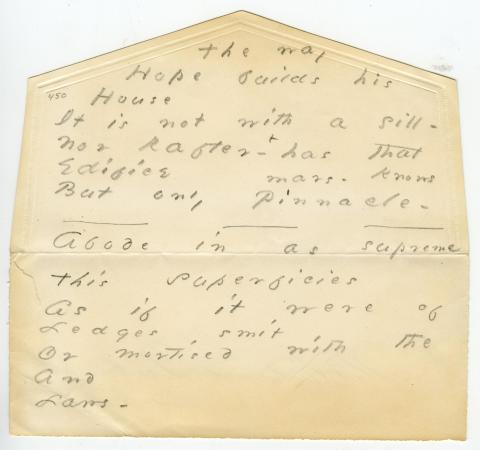
As The New York Times describes it, the archives’ creation led to some dissention among participating institutions. For the past year, Amherst has maintained an online database of their Dickinson collection (including the manuscript of “The way Hope builds his house,” above). Harvard has been more reluctant to make its manuscripts available. Nevertheless, the project’s general editor, Leslie M. Morris, says that the aim of the archive “was to downplay the issue of ownership and focus on Emily Dickinson and her manuscripts.” No behind the scenes wrangling seems to have interfered with the website’s ease of use. Readers can search the text of manuscript images or browse images by library collection, first line, date, recipient (of letters), or edition. The site also includes a “Lexicon,” with definitions of the poet’s favorite words from her own dictionary, Webster’s 1844 American Dictionary of the English Language, and users can also search for poems by word. All in all it’s an impressive project made all the more so by its free availability.
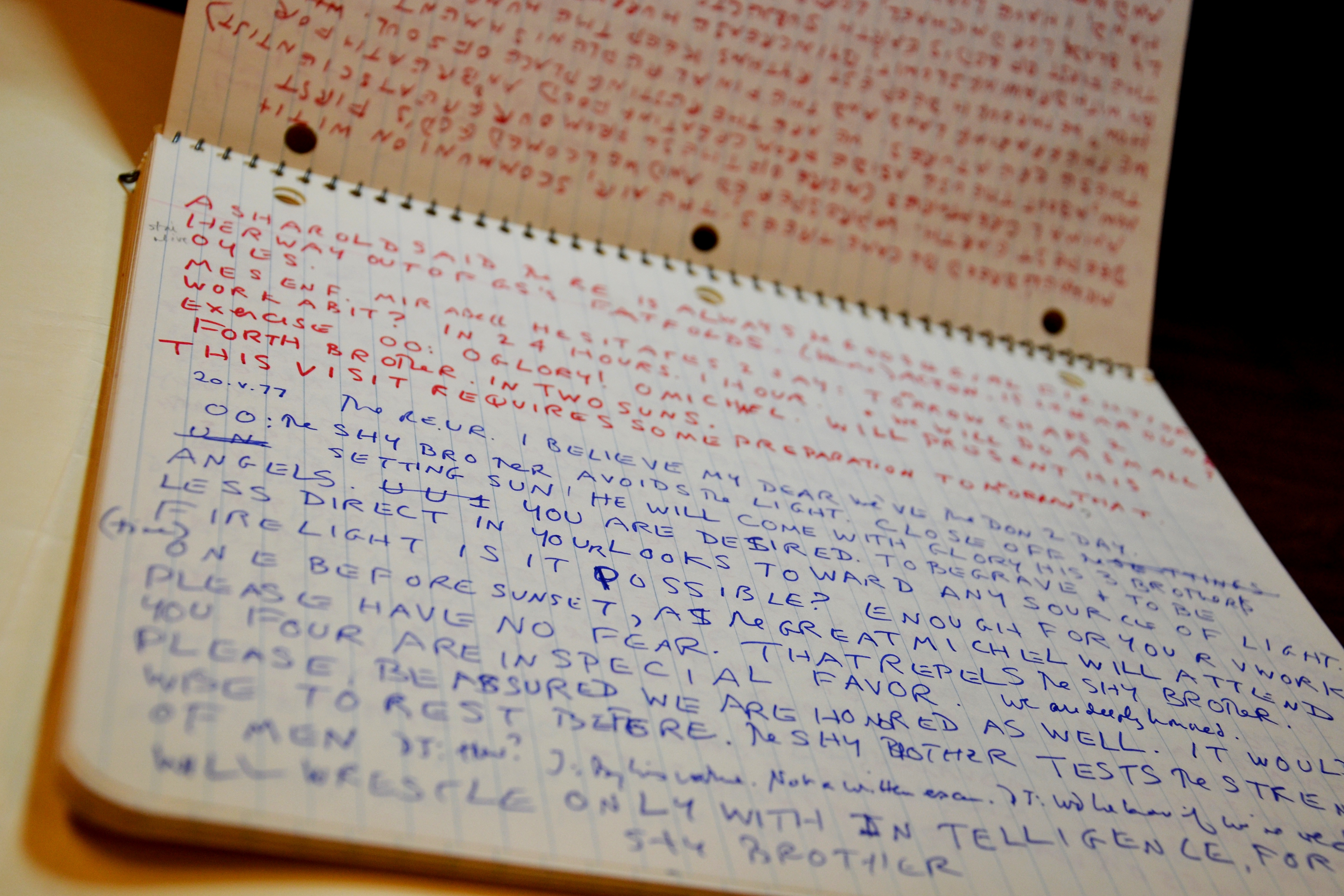
The Ouija-inspired poetry of Pulitzer Prize-winning poet James Merrill (1926–1995) comes alive in a newly launched digital archive from Washington University in St. Louis. Visitors to the site can explore notebook after notebook bearing Merrill’s handwritten notes in all caps—colorful transcripts from his “Thousand and One Evenings Spent/ With [partner] David Jackson at the Ouija Board/ In Touch with Ephraim Our Familiar Spirit.” Merrill, the son of Charles E. Merrill, cofounder of the Merrill Lynch investment firm, was considered one of the most significant American poets of his generation.
The occult was central to all of Merrill’s later work, including “The Book of Ephraim,” which is the current focus of the James Merrill Digital Archive. Merrill’s complex and highly unusual creative process is evident in the materials presented, all of them drawn from the extensive James Merrill Papers housed in the university’s Special Collections.
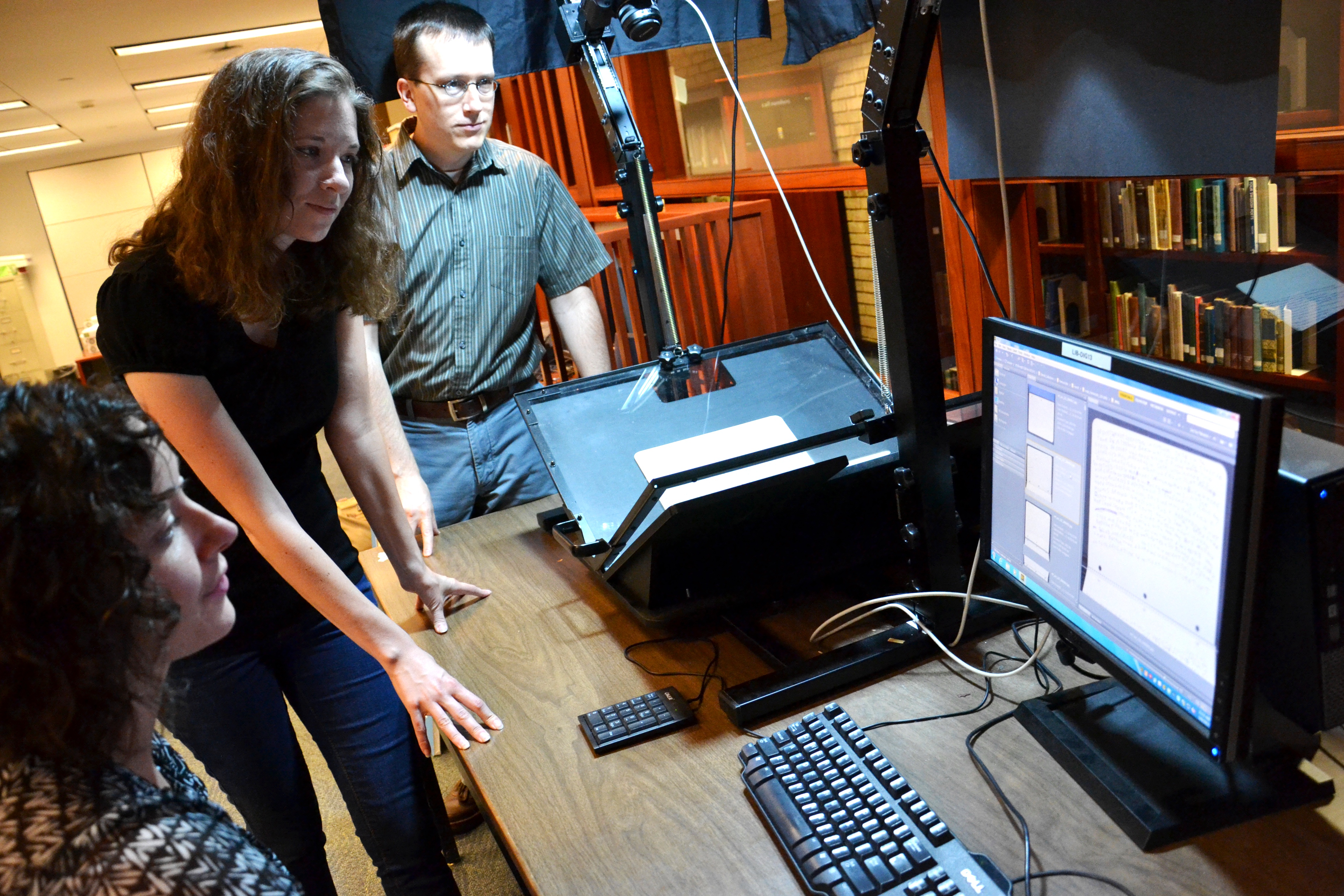
In a description on the site, project collaborator and graduate student Annelise Duerden (pictured at center below) points out that “the opening to ‘The Book of Ephraim’ clamors for a medium ‘that would reach / The widest public in the shortest time,’ and we hope that digital archiving can provide such an entrance to Merrill’s work, and to the richness of the process behind his finished poem.”
Duerden, herself an active poet, says she was impressed by Merrill’s “imaginative force” and “relentless energy for revision” while helping build the archive this past summer along with staff from Washington University Libraries and the Humanities Digital Workshop.
“Merrill originally imagined constructing his story of Ephraim in the form of a novel,” she says. “He planned to write it for some time, began work on it, then lost the pages in a taxi, and gave up on the idea of the novel of Ephraim, instead writing it in poetic form. In a Ouija session, Ephraim later claimed credit for losing the novel.”
“The Book of Ephraim” was first published in Merrill’s book Divine Comedies in 1976 and later as the first installment of his apocalyptic epic The Changing Light at Sandover, one of the longest poems in any language and featuring voices ranging from the then-recently deceased poet W. H. Auden to the Archangel Michael.
In 1993, the GAP used the ghost of Jack Kerouac to help sell khakis to desk jockeys across the nation. That was odd. 20 years later, Dewars has called upon Charles Bukowski, dead since 1994, to peddle Scotch. That makes complete sense. As you may recall, Bukowski once told Sean Penn in a 1987 Interview magazine piece: “Alcohol is probably one of the greatest things to arrive upon the earth — alongside of me. Yes…these are two of the greatest arrivals upon the surface of the earth. So…we get along.” Bukowski liked to drink. He also liked to talk about his memorable hangovers. Dead or alive, Bukowski has the creds to sell Scotch.
As the Dewars ad rolls (above), you’ll hear lines from Bukowski’s poem “so you want to be a writer?” (below). And if you’re familiar with the poem, you’ll notice that the narration in the commercial is abridged. They’ve removed various lines referring to the writing life, making it so that the narration speaks to a broader audience. Rock climbers. Motorcycle mechanics. Musicians. Journalists. People who aspire — or need to be inspired — to “live true.”
We're hoping to rely on loyal readers, rather than erratic ads. Please click the Donate button and support Open Culture. You can use Paypal, Venmo, Patreon, even Crypto! We thank you!
Open Culture scours the web for the best educational media. We find the free courses and audio books you need, the language lessons & educational videos you want, and plenty of enlightenment in between.