Patti Smith Documentary Dream of Life Beautifully Captures the Author’s Life and Long Career (2008)

My wife jokes that I’m pre­ten­tious for my love of what she calls “tiny awards” on the cov­ers of movies—little lau­rel leaf-bound seals of fresh­ness from the art film fes­ti­val cir­cuit. It’s true, I near­ly always bite when unknown films come to me preap­proved. Were I to encounter the cov­er of the 2008 Pat­ti Smith doc­u­men­tary Dream of Life I should be forced to watch it even if were I total­ly igno­rant of Pat­ti Smith. It won sev­er­al tiny awards—including a Sun­dance Prize for best cin­e­matog­ra­phy, a well-deserved hon­or that shows direc­tor Steven Sebring’s high regard for his sub­ject. Any worth­while film about Smith—singer, writer, poet, artist—must priv­i­lege the visu­al as well as the musi­cal and lit­er­ary. Smith’s world has always been one of high con­trast and dan­ger­ous pre­science, like the work of her child­hood friend, pho­tog­ra­ph­er Robert Map­plethor­pe, with whom she moved to the Chelsea Hotel in 1969 and who took the icon­ic pho­to on the cov­er of her first album, Hors­es. Her and Mapplethorpe’s sto­ried part­ner­ship helped both take New York City by storm. As a young Smith says above, “New York is the thing that seduced me; New York is the thing that formed me; New York is the thing that deformed me.”

Born in Chicago—“mainline of Amer­i­ca” she calls it—Smith’s fam­i­ly moved across the Mid­west to rur­al New Jer­sey. Her work also bespeaks of an expe­ri­ence of East­ern Migra­tion, with nos­tal­gic traces of long­ing for open spaces. The film opens with a gal­lop­ing herd of hors­es, nod­ding to Smith’s 1975 debut, a blast of punk poet­ry that still sounds men­ac­ing and raw. But the documentary’s title comes from a 1988 record that marked a sort of cesura for Smith, as one peri­od of her life end­ed and anoth­er wait­ed to begin. Pro­duced by her hus­band, Fred “Son­ic” Smith (for­mer­ly of the MC5), whom she met in 1976, it’s an album of “pol­ished love songs, lul­la­bies, and polit­i­cal state­ments” and it’s a very grown-up record, the some­times adult con­tem­po­rary sound saved from bland­ness by Smith’s com­pelling lyri­cism and beau­ti­ful voice.

Fred “Son­ic” Smith fell ill not long after the album, and Pat­ti retired, more or less, from music. She returned to per­form­ing and record­ing after her husband’s death in 1994, after the loss also of her broth­er and Map­plethor­pe. Always an intense­ly emo­tion­al writer and per­former, her lat­er peri­od is marked by memo­ri­als and med­i­ta­tions on loss—not unusu­al for an old­er poet and long­time sur­vivor of rock and roll, as well as the lit­er­ary and art worlds. All of Smith’s many changes occur before us above as she remem­bers and reflects in her poet’s voice over that Sun­dance-win­ning cin­e­matog­ra­phy. It’s hard to imag­ine anoth­er document—save her Nation­al Book Award-win­ning mem­oir Just Kids—doing more jus­tice to Smith’s vision than Dream of Life.

This comes to us via BrainPicking’s Maria Popo­va, who points us toward a cof­fee-table book of pho­tographs from the film. The select­ed few she fea­tures are stun­ning indeed.

Relat­ed Con­tent:

Pat­ti Smith Reads Her Final Words to Her Dear Friend Robert Map­plethor­pe

1976 Film Blank Gen­er­a­tion Doc­u­ments CBGB Scene with Pat­ti Smith, The Ramones, Talk­ing Heads, Blondie & More

Four Female Punk Bands That Changed Women’s Role in Rock

Josh Jones is a writer and musi­cian based in Durham, NC. Fol­low him at @jdmagness

Highlights from the First Ever Stanford Code Poetry Slam

I was lucky enough to be liv­ing in Chica­go when Marc Smith’s Poet­ry Slam move­ment became a thing. What fun it was to hit the Green Mill on Sun­day nights to hear such inno­va­tors as Lisa Bus­cani or Patri­cia Smith tear­ing into their lat­est entries in front of packed-to-capac­i­ty crowds. Those ear­ly slam poets inspired a lot of oth­er word­smiths to brave the mic, a glo­ri­ous rev­o­lu­tion whose gleam was inevitably tar­nished for me once it caught on for real.

I remem­ber think­ing some­thing like, “If I nev­er hear anoth­er poem about some­one’s rela­tion­ship trou­bles, it’ll be too soon.”

To fur­ther illus­trate my wan­ing enthu­si­asm, here’s the above thought, ren­dered in Stan­dard Spo­ken Word Venac­u­lar:

If

I nev­er heeeear  

Anoth­er Po

Em About Some­one’s 

Re-la-tion-ship…

Trou­bles, it’ll be

Too

Soon.

Some two-and-a-half decades fur­ther along, Leslie Wu, a doc­tor­al stu­dent in Com­put­er Sci­ence at Stan­ford Uni­ver­si­ty, has been crowned the win­ner of the inau­gur­al Code Poet­ry Slam, and I’m mourn­ing the loss of those long-ago rela­tion­ship trou­bles.

To cre­ate her win­ning entry, “Say 23,” Wu donned a Google Glass head­set, as she recit­ed and typed 16 lines of com­put­er code, which were pro­ject­ed onto a screen. When Wu ran the script, three dif­fer­ent com­put­er­ized voic­es took over per­for­mance duties, sam­pling the 23rd Psalm along with an uncred­it­ed snip­pet of In the Hall of the Moun­tain King.

I may be too hot-blood­ed to appre­ci­ate the artistry here.

Melis­sa Kagen, who orga­nized the com­pe­ti­tion with fel­low grad­u­ate stu­dent Kurt James Wern­er, stat­ed on the uni­ver­si­ty’s web­site that in order “to real­ly get into the intri­ca­cies you real­ly need to know that lan­guage.”

I guess that goes dou­ble for the com­peti­tors. Accord­ing to Wern­er, Wu’s poem wove togeth­er a num­ber of dif­fer­ent con­cepts, tools, and lan­guages, includ­ing Japan­ese, Eng­lish, and Ruby. Philis­tine that I am, I had always thought of the lat­ter as an uncap­i­tal­ized gem­stone and noth­ing more.

Not that I’m align­ing myself with those cur­mud­geons whose typ­i­cal reac­tion to a Rothko or a Jack­son Pol­lack is, “My two-year-old could do bet­ter.” For one thing, I’ve got teenagers, and giv­en their druthers, they’d eat their way through the con­tents of Wern­er Her­zog’s shoe clos­et before agree­ing to learn so much as a sin­gle line of code.

What a won­der­ful world in which so many of us are free to pur­sue our indi­vid­ual pas­sions to the point of poet­ry!

If you’re the type to whom code poet­ry speaks—nay, sings—you should con­sid­er putting some­thing togeth­er for the fast approach­ing sec­ond slam. Have a look at the work of the eight final­ists, if you’re in need of inspi­ra­tion. Entries are being accept­ed through Feb. 12.

Find 74 free cours­es from Stan­ford in our col­lec­tion: 825 Free Online Cours­es from Top Uni­ver­si­ties.

Relat­ed Con­tent:

Learn to Code with Harvard’s Intro to Com­put­er Sci­ence Course And Oth­er Free Tech Class­es

Codecademy’s Free Cours­es Democ­ra­tize Com­put­er Pro­gram­ming

Ayun Hal­l­i­day is the Chief Pri­ma­tol­o­gist of the East Vil­lage Inky, an award-win­ning, hand­writ­ten zine. Fol­low her @AyunHalliday

William Blake’s Hallucinatory Illustrations of John Milton’s Paradise Lost

When I saw William Blake’s illus­tra­tions for the book of Job and for John Milton’s L’Allegro and Il Penseroso at the Mor­gan Library a few years ago, I was first struck by how small the intri­cate water­col­ors are. This should not have been surprising—these are book illus­tra­tions, after all. But William Blake (1757–1827) is such a tremen­dous force, his work so mon­u­men­tal­ly strange and beau­ti­ful, that one expects to be over­pow­ered by it. In per­son, his draw­ings are indeed impres­sive, but they are equal­ly so for their care­ful atten­tion to design and com­po­si­tion as for their heavy, often quite ter­ri­fy­ing sub­jects.

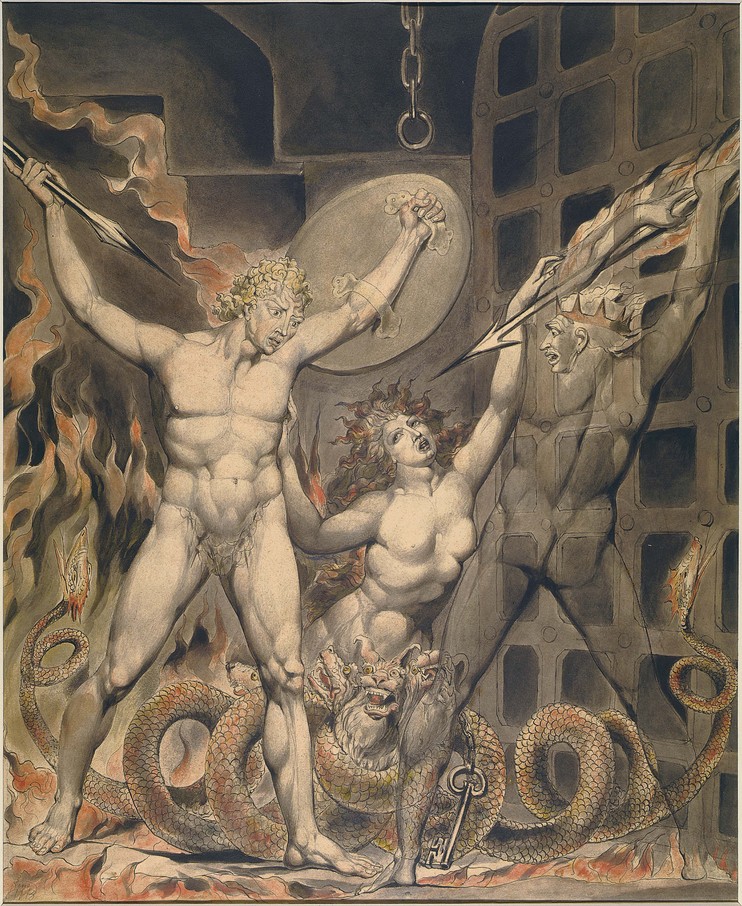
Look, for exam­ple, at the play of pat­terns behind the fig­ures in the illus­tra­tion above, from an edi­tion of Milton’s Par­adise Lost. The fig­ure in the cen­ter depicts Milton’s grotesque­ly graph­ic alle­gor­i­cal con­struc­tion of Sin. In Mil­ton, this char­ac­ter “seemed woman to the waist, and fair,”

But end­ed foul in many a scaly fold
Volu­mi­nous and vast, a ser­pent armed
With mor­tal sting: about her mid­dle round
A cry of hell hounds nev­er ceas­ing barked
With wide Cer­ber­ian mouths full loud, and rung
A hideous peal: yet, when they list, would creep,
If ought dis­turbed their noise, into her womb,
And ken­nel there, yet there still barked and howled,
With­in unseen.

Blake spares us the hor­ror of the lat­ter image—in fact he gets a lit­tle vague on the details of the creature’s nether­parts, which were always dif­fi­cult to imag­ine, and empha­sizes the “fair” parts above (in the ver­sion below, the serpent/dog thing looks like a cos­tume prop). Milton’s descrip­tion always seemed to me one of the cru­elest, most misog­y­nis­tic ren­der­ings of the female body in lit­er­a­ture. Blake’s por­trait relieves Milton’s nas­ti­ness, mak­ing Sin sym­pa­thet­ic and, well, kin­da hot, a Blakean feat for sure. The char­ac­ters to her left and right are Satan and Death, respec­tive­ly.


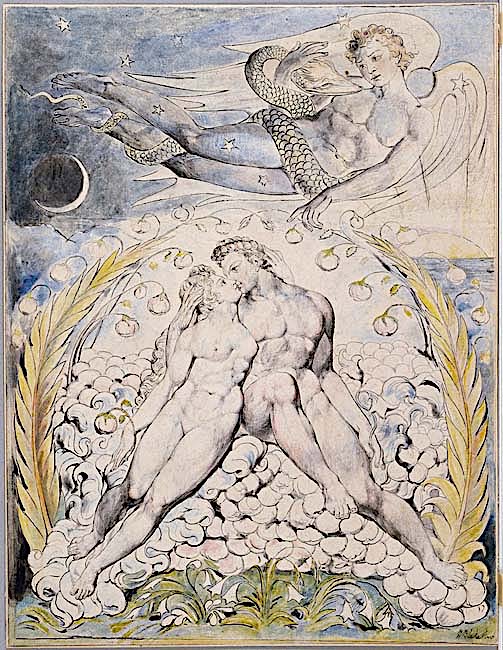
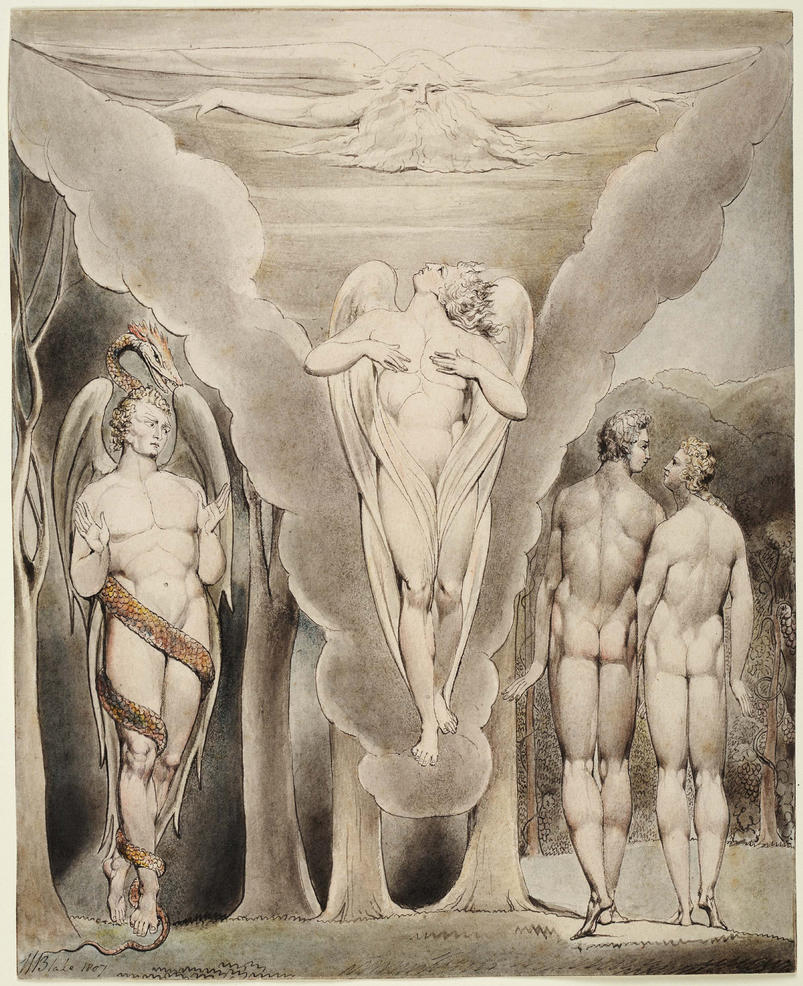
Blake loved Mil­ton, and illus­trat­ed his work more than any oth­er author. And he illus­trat­ed Par­adise Lost more than any oth­er Mil­ton, in three sep­a­rate com­mis­sions (peruse them all here).  The first set dates from 1807, com­mis­sioned by Joseph Thomas. (The Satan, Sin, and Death scene above comes from the Thomas set.) The sec­ond set, from which the image at the top comes, was com­mis­sioned in 1808 by Thomas Butts. Blake patron John Lin­nell com­mis­sioned the third set of illus­tra­tions in 1822. Only three of the Lin­nell paint­ings survive—none of the scene above. In one of the 1822 illus­tra­tions (below), Satan spies on Adam and Eve as they canoo­dle in the gar­den.

Blake’s obses­sion with Par­adise Lost inspired his own cracked the­o­log­i­cal fable, Mil­ton: a Poem in Two Books, with its bizarre pre­am­ble in which Blake promis­es to “buil[d] Jerusalem / In England’s green and pleas­ant land.” One writer calls Blake’s Mil­ton “a lengthy and dif­fi­cult apoc­a­lyp­tic poem with a fas­ci­nat­ing hal­lu­ci­na­to­ry qual­i­ty.” The poem caused many of Blake’s con­tem­po­raries to con­clude that “he was quite mad.” But I think his work shows us a man with all of his fac­ul­ties, and maybe a few extra besides, although his paint­ings, like his weird­er poet­ry, can also seem like crazed hal­lu­ci­na­tions. He meant his var­i­ous Par­adise Lost illus­tra­tions to cor­rect ear­li­er ren­der­ings by oth­er artists, includ­ing a polit­i­cal satire by car­toon­ist James Gill­ray in 1792 and a 1740 paint­ing by William Hog­a­rth that today resem­bles the cov­er of a bad fan­ta­sy nov­el. See both of those ear­li­er ver­sions here.

via Bib­liokept

Relat­ed Con­tent:

Gus­tave Doré’s Dra­mat­ic Illus­tra­tions of Dante’s Divine Com­e­dy

Alber­to Martini’s Haunt­ing Illus­tra­tions of Dante’s Divine Com­e­dy (1901–1944)

Spenser and Mil­ton (Free Course)

Find Works by Mil­ton in our Free Audio Books and Free eBooks Col­lec­tions

Josh Jones is a writer and musi­cian based in Durham, NC. Fol­low him at @jdmagness

The New Yorker Launches a New Poetry Podcast: Listen to Robert Pinsky Reading Elizabeth Bishop

A quick fyi: The New York­er has just launched a new poet­ry pod­cast, and it’s intro­duced and host­ed by Paul Mul­doon, the Pulitzer Prize-win­ning poet who for­mer­ly taught poet­ry at Oxford. On The New York­er’s web site, Mul­doon writes:

I can’t be but thrilled at the prospect of the first of a series of New York­er Poet­ry Pod­casts. For decades, The New York­er has led the field of poet­ry in print jour­nal­ism. But the eye is not the only buy­er into, and ben­e­fi­cia­ry of, the poem. The ear has been in the poet­ry busi­ness for much longer, giv­en poetry’s ori­gins in the oral tra­di­tion. That’s why it’s par­tic­u­lar­ly appro­pri­ate for us to take this oppor­tu­ni­ty to fore­ground poet­ry as an aur­al expe­ri­ence.

He then explains the for­mat of the pod­cast. “Each pod­cast con­sists of a con­ver­sa­tion between myself and a guest poet. In each, the guest reads not only a poem of hers that has appeared in The New York­er but also intro­duces, and reads, a poem by anoth­er con­trib­u­tor to the mag­a­zine that she par­tic­u­lar­ly admires.”  The first episode fea­tures Philip Levine. Feel free to play it above.

You can sub­scribe to The Poet­ry pod­cast on iTunes, and it should even­tu­al­ly find a home (I’d imag­ine) on Sound­Cloud too. More poems read aloud can be found in our col­lec­tion of Free Audio Books.

Relat­ed Con­tent:

The New Yorker’s Fic­tion Pod­cast: Where Great Writ­ers Read Sto­ries by Great Writ­ers

Hear the Very First Record­ing of Allen Gins­berg Read­ing His Epic Poem “Howl” (1956)

Bill Mur­ray Reads Poet­ry at a Con­struc­tion Site

Hear Sylvia Plath Read Fif­teen Poems From Her Final Col­lec­tion, Ariel, in 1962 Record­ing

by | Permalink | Make a Comment ( 1 ) |

Bob Dylan Reads From T.S. Eliot’s Great Modernist Poem The Waste Land

As a recent piece in The Inde­pen­dent notes, “stu­dents of lit­er­ate song­writ­ing” are unsur­prised to find ref­er­ences to T.S. Eliot scat­tered through­out the pop canon: Gen­e­sis, Man­ic Street Preach­ers, Arcade Fire… and of course, Bob Dylan. Dylan arguably makes ref­er­ence to Eliot’s mas­ter­work The Waste Land with the line “in the waste­land of your mind” from “When The Night Comes Falling from the Sky.”

And in the penul­ti­mate verse of “Des­o­la­tion Row,” he gives us an image of “Ezra Pound and T.S. Eliot / Fight­ing in the captain’s tow­er.” As with every oth­er line in the song, this could mean just about any­thing. But giv­en Dylan’s admi­ra­tion for The Waste Land, it could eas­i­ly refer to the edi­to­r­i­al tug-of-war between the two poets, as it was Pound who shaped Eliot’s poem into the work we have today. And then there’s the tow­er image so promi­nent in Eliot’s great poem, an occult motif Dylan returned to.

Just above, hear Dylan riff on the first four lines of The Waste Land for his XM Radio show Theme Time Radio Hour, which aired from May 2006 to April 2009. On the show, Dylan played records, respond­ed to (fake) lis­ten­er emails, read poet­ry, told jokes, and did musi­cal bits, all in keep­ing with themes like “Mon­ey” and “Weath­er.” (You can catch two episodes a day on dylanradio.com).

He reads Eliot in a faux-beat cadence—sounding like Tom Waits—with a juke joint piano bang­ing away behind him. Dylan opens his read­ing with some brief com­men­tary, telling us that Eliot’s poem “com­mem­o­rat­ed the death of Abra­ham Lin­coln.” This throw­away line may just give us a fas­ci­nat­ing glimpse into Dylan’s lit­er­ary sen­si­bil­i­ties. Know­ing that Eliot’s lilacs refer to Lin­coln seems almost cer­tain­ly to indi­cate that Dylan knows they first refer to Walt Whit­man, whose “When Lilacs Last in the Door­yard Bloom’d” direct­ly com­mem­o­rates Lin­coln.

Of course, he isn’t going to tell us that, if he knows it, just like he won’t give any­thing away in “Des­o­la­tion Row,” a song so filled with ref­er­ences to famous fig­ures and works of art that it’s hard to tell how much is “orig­i­nal” Dylan and how much a patch­work of para­phrase. The dis­tinc­tion hard­ly mat­ters, Dylan seems to sug­gest in his eli­sion of Whit­man. Eliot’s poem is, line by line, so much a col­lage of allu­sion and cita­tion that there seems to be no Eliot at all, just a mani­a­cal edi­tor (or two). The first line of the poem—“April is the cru­elest month”—traces in part to French Sym­bol­ist Jules Laforgue, one of Eliot’s favorites, who begins his “October’s Lit­tle Mis­eries” with “Every Octo­ber I start to get upset.” And Eliot’s orig­i­nal title, “He Do the Police in Dif­fer­ent Voic­es” comes ver­ba­tim from Dick­ens’ Our Mutu­al Friend. As any­one who’s read Eliot in an aca­d­e­m­ic set­ting knows, the list goes on, and on.

One of the effects of Eliot’s mas­tery of oth­er people’s work (hear him read his poem above), which he could dis­as­sem­ble and make mon­strous­ly his own, is that his crit­ics and fans will nev­er tire of pulling apart his dense­ly com­pressed vers­es and pok­ing around inside them. Like­wise Dylan. The lat­ter nev­er passed him­self off as a poet explic­it­ly (although he’s often read that way), but as a song­writer he’s spawned a cot­tage cul­ture indus­try as pro­duc­tive as Eliot’s. Even his erst­while radio show, in which he offered his own com­men­tary and crit­i­cism, has its com­men­tary and crit­i­cism from fans. I may nev­er be con­vinced that songs—pop, folk, hip-hop, or otherwise—work the same way as poems, but if any­one fig­ured out how to leap nim­bly over what­ev­er gap lies between them, Dylan cer­tain­ly did. Maybe one of the con­nec­tions he made is this: what seems to set both Dylan and Eliot apart from their peers is their com­pete dis­re­gard for notions of authen­tic­i­ty in favor of the play of “dif­fer­ent voices”—impersonation, quo­ta­tion, and homage to the artists they admire.

Relat­ed Con­tent:

T.S. Eliot Reads His Mod­ernist Mas­ter­pieces “The Waste Land” and “The Love Song of J. Alfred Prufrock”

Lis­ten to T.S. Eliot Recite His Late Mas­ter­piece, the Four Quar­tets

Bob Dylan Final­ly Makes a Video for His 1965 Hit, “Like a Rolling Stone”

Josh Jones is a writer and musi­cian based in Durham, NC. Fol­low him at @jdmagness

92nd Street Y Launches a New Online Archive with 1,000 Recordings of Literary Readings, Musical Performances & More

Kurt Von­negut once com­ment­ed, in an inter­view with Joseph Heller, that the best audi­ence he had ever encoun­tered was at the 92nd Street Y in New York. “Those peo­ple know every­thing. They are wide awake and respon­sive.”

Locat­ed at the cor­ner of 92nd Street and Lex­ing­ton Avenue, the 92Y has a ven­er­a­ble his­to­ry of pub­lic per­for­mance, con­ver­sa­tion, poet­ry and beyond. Von­negut him­self appeared at the 92Y sev­en times to read aloud from his own work. (Includ­ing this read­ing from Break­fast of Cham­pi­ons three years before the book was pub­lished.)

Cul­tur­al pro­gram­ming has been a focus at the 92Y since it opened in 1874. Orig­i­nal­ly, it served most­ly Ger­man-Jew­ish men (note, it isn’t a YMCA, but a YM-YWHA—Young Men’s and Women’s Hebrew Asso­ci­a­tion). But the Kauf­mann Con­cert Hall opened in 1930, and that’s where a ver­i­ta­ble Who’s Who of not­ed enter­tain­ment, pol­i­tics, sports, and sci­ence fig­ures have appeared over the years, speak­ing to that “wide awake and respon­sive” audi­ence.

Lucky for the rest of us, the 92Y record­ed the vast major­i­ty of those per­for­mances. And now 1,000 record­ings appear on a new site, 92Y On Demand. It’s a fan­tas­tic archive of audio and video files, search­able by top­ic, year or per­former name.

It’s all there: Yogi Berra look­ing back on his life and career. A 1961 read­ing by a young Nadine Gordimer. Harold Pin­ter read­ing his own short sto­ries and weigh­ing in on the Bea­t­les vs. the Rolling Stones. Andrés Segovia play­ing a clas­si­cal gui­tar recital. Lou Reed speak­ing on the eve of his live per­for­mance of Berlin (top). Bil­ly Crys­tal (below) on roast­ing Muham­mad Ali.

92Y is home to the Unter­berg Poet­ry Cen­ter, so the new archive abounds with poet­ry read­ings. Dylan Thomas read there in 1953. Two years ear­li­er play­wright Thorn­ton Wilder appeared and read from Emi­ly Dickinson’s work. And clos­er to our own time, Paul McCart­ney recent­ly read from his own poet­ry.

See many more cel­e­brat­ed fig­ures such as Maria Bam­fordMau­rice SendakDan Sav­ageJunot Díaz and Jamaica Kin­caid read and dis­cuss their work at 92Y On Demand.

Relat­ed Con­tent:

Hear Kurt Vonnegut’s Very First Pub­lic Read­ing from Break­fast of Cham­pi­ons (1970)

Lou Reed Rewrites Edgar Allan Poe’s “The Raven.” See Read­ings by Reed and Willem Dafoe

Allen Gins­berg Gets Heck­led by Beat Poet Gre­go­ry Cor­so at a 1973 Poet­ry Read­ing

Kate Rix writes about dig­i­tal media and edu­ca­tion. Fol­low her on Twit­ter.

Hear Ezra Pound Read From His “Cantos,” Some of the Great Poetic Works of the 20th Century

No stu­dent of mod­ernism, no lover of mod­ern poet­ry, can avoid Ezra Pound, or the prob­lem that is Ezra Pound. Although a noto­ri­ous and enthu­si­as­tic boost­er of Mussolini’s Ital­ian state dur­ing the Sec­ond World War, Pound’s influ­ence over the shape and char­ac­ter of Amer­i­can lit­er­a­ture in the ear­ly 20th cen­tu­ry always seems to trump his regret­table, if not par­tic­u­lar­ly sur­pris­ing, pol­i­tics. T.S. Eliot, James Joyce, H.D.—all are deeply indebt­ed to Pound. His attempts to bridge East­ern and West­ern aes­thet­ics are pro­found, and his own poet­ry, informed by his devo­tion to Chi­nese poet­ics and immer­sion in the Euro­pean canon, com­pris­es an often bril­liant, gen­er­al­ly intim­i­dat­ing body of work.

Over the course of five decades, dur­ing each of Pounds’ var­i­ous phases—as lit­er­ary impre­sario, lan­guage schol­ar, edi­tor, and deeply con­tro­ver­sial weirdo—he was hard at work on what became known as The Can­tos, a long, loose­ly con­nect­ed series of poet­ic chap­ters in Eng­lish, Chi­nese, Ital­ian that were pub­lished at var­i­ous times in var­i­ous forms. Pound’s tra­vails as the author of this long and exceed­ing­ly dif­fi­cult series may be the reward of a fool and his fol­ly (as his col­leagues thought) or the rocky, lone­ly path of genius, unap­pre­ci­at­ed in its time. I’m not sure I would rec­om­mend him as the lat­ter, but I’ve often found not only his pol­i­tics, but also his delib­er­ate obscu­ri­ty a stum­bling block. And yet, there may be no sub­sti­tute for hear­ing poet­ry read aloud, some­times best by its author, who knows every nuance. At the top, hear Pound read “Can­to I,” built of clas­si­cal mod­els on Anglo-Sax­on scaf­fold­ing. Direct­ly above, Pound reads from a chap­ter pub­lished almost ten years lat­er. His voice is more ragged and qua­ver­ing, and he rails against usury, a theme close to his often anti-Semit­ic eco­nom­ic the­o­ries. You can hear dozens more record­ings of Pound, made from 1939 to the year of his death, 1972, at the Penn Sound archive. And also over at UBUweb.

You can find more read­ings of clas­sic poems in the Poet­ry sec­tion of our Free Audio Books col­lec­tion. Oth­er works by Pound can be found in our col­lec­tion of Free eBooks.

Relat­ed Con­tent: 

Ernest Hem­ing­way Writes of His Fas­cist Friend Ezra Pound: “He Deserves Pun­ish­ment and Dis­grace” (1943)

Ezra Pound’s Fiery 1939 Read­ing of His Ear­ly Poem, ‘Ses­ti­na: Altaforte’

Pier Pao­lo Pasoli­ni Talks and Reads Poet­ry with Ezra Pound (1967)

Josh Jones is a writer and musi­cian based in Durham, NC. Fol­low him at @jdmagness

Charles Bukowski Takes You on a Very Strange Tour of Hollywood

The world tends to think rather loose­ly about the con­cepts of Los Ange­les, Hol­ly­wood, and the motion pic­ture indus­try, throw­ing them around, run­ning them togeth­er, nam­ing one when they mean anoth­er — still, noth­ing a brac­ing splash of Charles Bukows­ki can’t sort out. Above, the famous Los Ange­les-res­i­dent poet, a fig­ure as sham­bol­i­cal­ly glo­ri­ous and stealth­ily inspir­ing as much of the city itself, gives a brief back-seat tour of Hol­ly­wood. No, he does­n’t take us past the movie stu­dios, nor the Walk of Fame, nor the site of Schwab’s Phar­ma­cy. He stays clos­er to home — his home, the sto­ried bun­ga­low at 5124 De Long­pre Avenue. We see his neigh­bor­hood, his neck of Hol­ly­wood, the north­west­ern dis­trict of vast Los Ange­les that con­tains much less of the capital‑I Indus­try than you’d think, but more of gen­uine (if often grotesque) inter­est.

“That’s a lady for­tune teller there,” Bukows­ki says, ges­tur­ing toward one of the mod­est hous­es around him. “I went in there one time. She read my palm. She said, ‘You’re an alco­holic.’ ‘Real­ly? Do I gam­ble, too?’ ‘Yes, you gam­ble. That’ll be five dol­lars.’ ” The dri­ver con­tin­ues down Hol­ly­wood’s epony­mous boule­vard, pass­ing West­ern Avenue, which gets the poet remem­ber­ing more: “There used to be cement bench­es out front, and all the insane peo­ple would sit there. The street peo­ple. They’d talk to each oth­er all day long.” We pass impor­tant land­marks as well: “There’s the old Sex Shop. Keeps chang­ing hands.” He even points out the wheel­ers and deal­ers liv­ing amid this stretch of bars, broth­els, and burg­er stands: “There’s a woman who’s not a hook­er. There’s a dope deal­er.” Give me Bukowski’s Hol­ly­wood tour over those dou­ble-deck­er bus­es you see around town, their con­duc­tors bark­ing about minor celebri­ty sight­ings, any day. “I’ve been to this liquor store many a time,” Bukows­ki notes. “Many a time.”

If you would like to sign up for Open Culture’s free email newslet­ter, please find it here. It’s a great way to see our new posts, all bun­dled in one email, each day.

If you would like to sup­port the mis­sion of Open Cul­ture, con­sid­er mak­ing a dona­tion to our site. It’s hard to rely 100% on ads, and your con­tri­bu­tions will help us con­tin­ue pro­vid­ing the best free cul­tur­al and edu­ca­tion­al mate­ri­als to learn­ers every­where. You can con­tribute through Pay­Pal, Patre­on, and Ven­mo (@openculture). Thanks!

Relat­ed Con­tent:

Charles Bukows­ki Tells the Sto­ry of His Worst Hang­over Ever

“Don’t Try”: Charles Bukowski’s Con­cise Phi­los­o­phy of Art and Life

Five Cul­tur­al Tours of Los Ange­les

The Last (Faxed) Poem of Charles Bukows­ki

Col­in Mar­shall hosts and pro­duces Note­book on Cities and Cul­ture and writes essays on lit­er­a­ture, film, cities, Asia, and aes­thet­ics. He’s at work on a book about Los Ange­lesA Los Ange­les Primer. Fol­low him on Twit­ter at @colinmarshall.

« Go BackMore in this category... »
Quantcast