Hear Allen Ginsberg’s Short Free Course on Shakespeare’s Play, The Tempest (1980)

Image by Michiel Hendryckx, via Wiki­me­dia Com­mons

Gins­berg Class One

Gins­berg Class Two

Like so many great poets, Allen Gins­berg com­posed extem­po­ra­ne­ous­ly as he spoke, in eru­dite para­graphs, recit­ing lines and whole poems from memory—in his case, usu­al­ly the poems of William Blake. In a 1966 Paris Review inter­view, for exam­ple, he dis­cuss­es and quotes Blake at length, con­clud­ing “The thing I under­stood from Blake was that it was pos­si­ble to trans­mit a mes­sage through time that could reach the enlight­ened.” Eight years lat­er, Gins­berg would begin to mid­wife this con­cept as a teacher at the new­ly-found­ed Jack Ker­ouac School of Dis­em­bod­ied Poet­ics at the Naropa Insti­tute in Boul­der, Col­orado. Gins­berg taught sum­mer work­shops at the school from 1974 until the end of his life, even­tu­al­ly spend­ing the remain­der of the year in a full-time posi­tion at Brook­lyn Col­lege. The Inter­net Archive hosts record­ings of many of these work­shops, such as his lec­tures on 19th Cen­tu­ry Poet­ry, Jack Ker­ouac, Spir­i­tu­al Poet­ics, and Basic Poet­ics. In the audio lec­tures here, from August 1980, Gins­berg teach­es a four-part course on Shakespeare’s The Tem­pest (parts one and two above, three and four below), a play he often returned to for ref­er­ence in his own work.

Gins­berg Class Three

Gins­berg Class Four

Ginsberg’s method of teach­ing Shake­speare is unlike any­one else’s. He’s not inter­est­ed in exe­ge­sis so much as an open conversation—with the text, with his stu­dents, and with any ephemera that strikes his inter­est. It’s almost a kind of div­ina­tion by which Gins­berg teas­es out the “mes­sages” Shakespeare’s play sends through the ages, work­ing with the rhyth­mic and syn­tac­ti­cal odd­i­ties of indi­vid­ual lines instead of grand, abstract inter­pre­ta­tive frame­works. Ginsberg’s ped­a­gogy requires patience on the part of his stu­dents. He doesn’t dri­ve toward a point as much as arrive at it cir­cuitous­ly as by the chance oper­a­tions of his med­i­ta­tive mind. His first of four lec­tures above, for exam­ple, begins with a great deal of futz­ing around about dif­fer­ent edi­tions, which can seem a lit­tle tedious to an impa­tient lis­ten­er. Give in to the urge to fast-for­ward, though, and you’ll miss the dia­mond-like bits of wis­dom that emerge from Gins­berg’s dis­cur­sive explo­ration of minu­ti­ae.

Gins­berg explains to his class why he thinks the Pen­guin G.B. Har­ri­son edi­tion was the best avail­able at the time because it draws from the orig­i­nal folio and has “more respect than the actu­al arrange­ment of the lines for speak­ing as deter­mined by the edi­tions print­ed in Shakespeare’s day.” Harrison’s text, he says, recov­ers the idio­syn­crasies of Shakespeare’s lines: “Since [Alexan­der] Pope and [John] Dry­den and oth­ers messed with Shakespeare’s texts—straightened them out and mod­ern­ized them and improved them—they’ve always been repro­duced too smooth­ly.” Such was the hubris of Pope and Dry­den. Gins­berg spends a few min­utes “cor­rect­ing” the punc­tu­a­tion of a line for stu­dents with more mod­ern­ized edi­tions. One can see the appeal of the first folio for Gins­berg as he insists that its text is “not all exact­ly prop­er­ly lined up pen­ta­met­ric blank verse but is more bro­ken, more irreg­u­lar lines, more like free verse actu­al­ly, because it fit­ted exact­ly to speech.” Much like his own work in fact, and that of his fel­low Beats, whom he reads and draws into the dis­cus­sion of The Tem­pest’s poet­ics through­out the course of his lec­tures. The Allen Gins­berg Project has more on the poet­’s teach­ing of Shake­speare dur­ing his Naropa days.

When Gins­berg found­ed the Jack Ker­ouac School with Anne Wald­man in 1974, he and his fel­low Beats had not taught before. They sim­ply invent­ed their own ways of pass­ing on their poet­ic enlight­en­ment. Invit­ed to cre­ate the school at Naropa Uni­ver­si­ty in Boul­der by his spir­i­tu­al teacher and Naropa founder Chogyam Trung­pa Rin­poche, Gins­berg seemed to com­bine in equal parts the Bud­dhist tra­di­tion of spir­i­tu­al lin­eage with that of West­ern lit­er­ary fil­i­a­tion. He dis­tilled this syn­the­sis in his ellip­ti­cal 1992 text “Mind Writ­ing Slo­gans,”: “two decades’ expe­ri­ence teach­ing poet­ics at Naropa Insti­tute” and a “half decade at Brook­lyn Col­lege,” Gins­berg writes, “boiled down to brief mot­toes from many sources found use­ful to guide myself and oth­ers in the expe­ri­ence of ‘writ­ing the mind.’” This doc­u­ment is an excel­lent source of Ginsberg’s eclec­tic wis­dom, as is his “Celes­tial Home­work” read­ing list for his class “Lit­er­ary His­to­ry of the Beats.”

Gins­berg and company’s rela­tion­ship to Trungpa’s Shamb­ha­la Bud­dhist school, and to the artis­tic com­mu­ni­ty of Boul­der, was not with­out its detrac­tors. Poet Ken­neth Rexroth and oth­ers accused Gins­berg and his teacher of a kind of cul­tic exploita­tion of Bud­dhist teach­ings, of “Bud­dhist fas­cism.” The con­flict between Ginsberg’s guru and poets like W.S. Merwin—who appar­ent­ly had a humil­i­at­ing expe­ri­ence at Naropa—is doc­u­ment­ed in Tom Clark’s polem­i­cal The Great Naropa Poet­ry Wars. Oth­ers remem­ber the Naropa founder much more fond­ly. Two doc­u­men­taries offer dif­fer­ent por­traits of life at Naropa. The first, Fried Shoes, Cooked Dia­monds (above)—filmed in 1978 and nar­rat­ed by Gins­berg himself—presents a raw, in-the-moment pic­ture of the anar­chic Ker­ouac School’s ear­ly days. For­mer Naropa stu­dent Kate Lindhardt’s “micro-bud­get” Crazy Wis­dom, below, offers a more detached look at the school and asks ques­tions about what she calls the “insti­tu­tion­al­iza­tion” of cre­ativ­i­ty from a more fem­i­nist per­spec­tive.

Gins­berg’s Tem­pest course will be added to our col­lec­tion of 875 Free Online Cours­es; the films men­tioned above can be found in our col­lec­tion of 640 Free Movies Online. The Tem­pest and poems by Gins­berg can be found in our col­lec­tion of Free eBooks.

Relat­ed Con­tent:

Allen Ginsberg’s “Celes­tial Home­work”: A Read­ing List for His Class “Lit­er­ary His­to­ry of the Beats”

Allen Ginsberg’s Last Three Days on Earth as a Spir­it: The Poet’s Final Days Cap­tured in a 1997 Film

Allen Gins­berg Record­ings Brought to the Dig­i­tal Age. Lis­ten to Eight Full Tracks for Free

Josh Jones is a writer and musi­cian based in Durham, NC. Fol­low him at @jdmagness

Orson Welles Reads From America’s Greatest Poem, Walt Whitman’s “Song of Myself” (1953)

Walt Whitman’s Leaves of Grass often makes its way into the hands of over­sized Amer­i­can char­ac­ters of, shall we say, uncer­tain repute. We learned, for exam­ple, under scan­dalous cir­cum­stances, of Bill Clin­ton’s admi­ra­tion for the book, and we’ll nev­er for­get the role it played in the rise and fall of sim­i­lar­ly allit­er­a­tive­ly named, pow­er-mad Wal­ter White.

Anoth­er fic­tion­al mastermind—Sideshow Bob—quotes glee­ful­ly from Leaves of Grass in a recent Simp­sons episode. And per­haps the most out­ré char­ac­ter of them all—the florid speech of the rogue and pimp Al Swearen­gen in HBO’s Dead­woodderives in part from the “bar­bar­ic yawp” Whit­man describes as his native tongue in the poem from which the book’s title comes, “Song of Myself.”

One of the many rea­sons this par­tic­u­lar poem from Leaves of Grass cap­tures the imag­i­na­tion of out­law intel­lec­tu­als (and nar­cis­sists) may be Whitman’s inven­tion of a new Amer­i­can poet­ic idiom for the elo­quent asser­tion of stri­dent­ly defi­ant per­son­al iden­ti­ties. (As Ezra Pound put it, Whit­man “broke the new wood.”) The Guardian placed “Song of Myself” at the top of a 10 best Amer­i­can poems list for the “peer­less self-per­for­mance” of the poem’s hyp­not­ic cadences. Who bet­ter to inter­pret those lines than anoth­er self-invent­ed Amer­i­can con­trar­i­an, Orson Welles?

Dur­ing some dif­fi­cult times in the fifties—in part due to Welles’ IRS trouble—the great actor/di­rec­tor/­mul­ti-media impre­sario found work on radio plays in Eng­land, includ­ing The Lives of Har­ry Lime (based on his char­ac­ter in The Third Man) and The Adven­tures of Sher­lock Holmes (as Mori­ar­ty). In 1953, the BBC con­tract­ed with Welles to record an hour of read­ings from “Song of Myself.” BBC 3 broad­cast the ses­sion, and it lat­er saw release as an LP, now sad­ly out of print. For­tu­nate­ly, how­ev­er, much of this record­ing has been dig­i­tal­ly pre­served. At the top, hear Welles read sec­tion VI of the poem, and direct­ly above, hear him read the hereti­cal sec­tion XLVIII. The Mick­le Street Review, an online jour­nal of Whit­man stud­ies, hosts a small part of Side 1 and, it appears, all of Side 2 of the record, below. The text of the poem was too long for a full treat­ment, and Welles, it seems, abridged and adapt­ed some of the work him­self. His read­ing was appar­ent­ly very well received by the UK press.

Side 1:

Side 2:

While the BBC com­mis­sioned the recordings—and Welles no doubt need­ed the money—he already had an affin­i­ty for Whit­man. In the same year he com­plete­ly re-invent­ed Amer­i­can film with Cit­i­zen Kane, he also began broad­cast­ing the Orson Welles Show on CBS Radio, on which he and his guests gave dra­mat­ic read­ings from dra­ma, poet­ry, and fic­tion. Welles pro­duced 19 episodes, though only 8 have sur­vived. One of the lost episodes, from Decem­ber 1, 1941, fea­tured Welles read­ing from Leaves of Grass. As fur­ther evi­dence, we have this pho­to­graph of Welles read­ing Gay Wil­son Allen’s The Soli­tary Singer, a crit­i­cal biog­ra­phy of the poet.

What draws Welles, and rest­less per­son­al­i­ties like him, to Whit­man, and espe­cial­ly to Leaves of Grass? One answer lies in Whit­man’s own life. Ear­ly on, PBS’s Amer­i­can Expe­ri­ence tells us, Whit­man staked out “rad­i­cal posi­tions… putting him in near con­stant oppo­si­tion to soci­ety’s pre­vail­ing sen­ti­ments.” He nev­er mod­er­at­ed his views or his voice, though faced with charges of blas­phe­my, obscen­i­ty, bad writ­ing, and var­i­ous oth­er pub­lic vices at the time. Whit­man’s stead­fast com­mit­ment to his polit­i­cal and artis­tic vision brought him world­wide acclaim, as well as cen­sure, in his life­time. A par­tic­u­lar­ly scathing 1882 Atlantic review of the sec­ond print­ing of Leaves of Grass cat­a­logues Whit­man’s lit­er­ary abus­es and con­cludes that “the book can­not attain to any very wide influ­ence.” Despite this ter­ri­bly wrong­head­ed pre­dic­tion, the review­er at least rec­og­nizes Whit­man’s “gen­er­ous aspi­ra­tion,” a qual­i­ty held in com­mon by all of Whit­man’s admir­ers, be they heroes, vil­lains, or just aver­age peo­ple respond­ing to the poet­’s raw self-asser­tion and capa­cious, grandiose, and par­tic­u­lar­ly Amer­i­can, form of long­ing.

Relat­ed Con­tent:

Orson Welles Reads Coleridge’s “The Rime of the Ancient Mariner” in a 1977 Exper­i­men­tal Film

Orson Welles Meets H.G. Wells in 1940: The Leg­ends Dis­cuss War of the Worlds, Cit­i­zen Kane, and WWII

Hear Walt Whit­man (Maybe) Read­ing the First Four Lines of His Poem, “Amer­i­ca” (1890)

Josh Jones is a writer and musi­cian based in Durham, NC. Fol­low him at @jdmagness

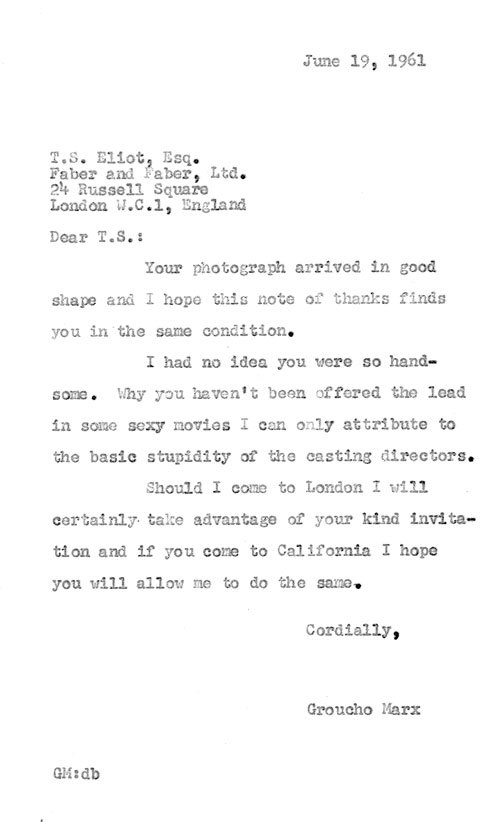
Groucho Marx and T.S. Eliot Become Unexpected Pen Pals, Exchanging Portraits & Compliments (1961)

grouchoeliot

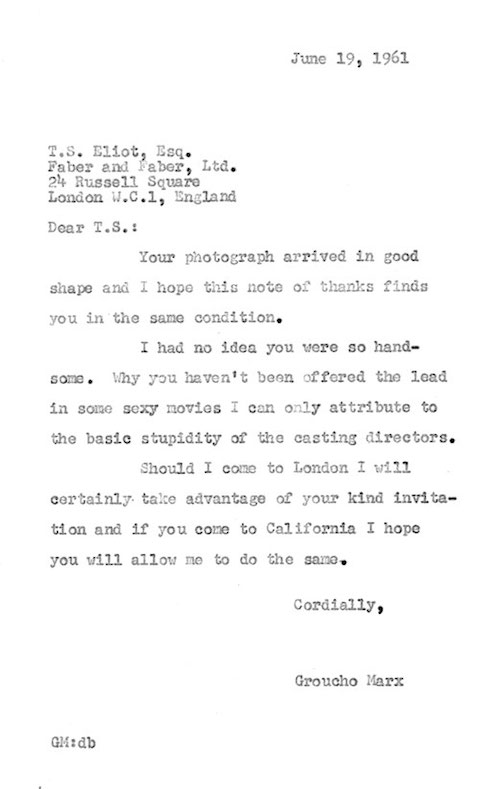
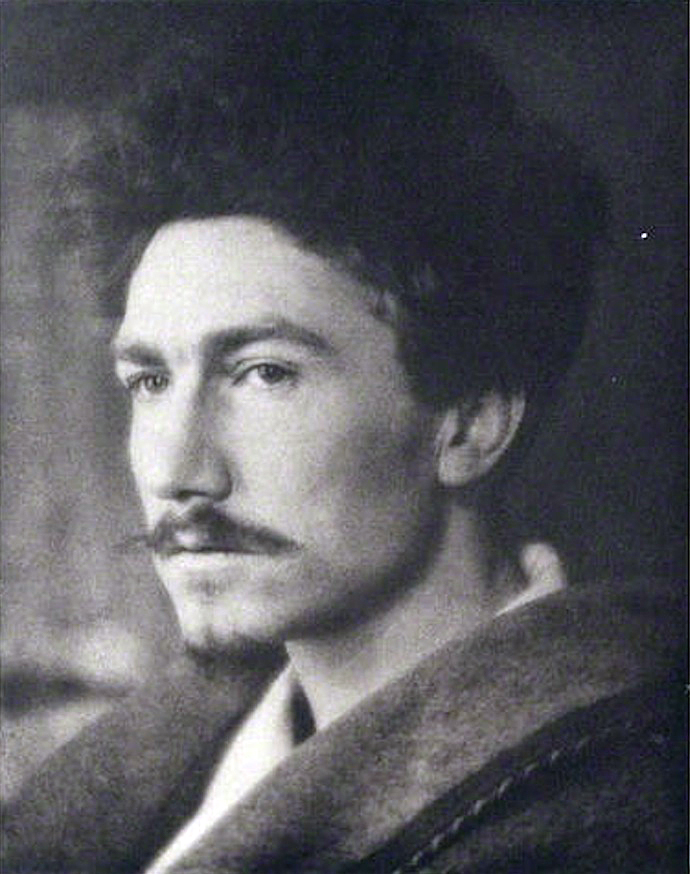
Grou­cho Marx and T.S. Eliot: they’ve got to rank as one of the twen­ti­eth cen­tu­ry’s most sur­pris­ing pair of pen pals. More intrigu­ing­ly still, they first got in touch — as lumi­nar­ies seem to do — out of the spir­it of mutu­al admi­ra­tion. Marx took the praise beyond Eliot’s poet­ry to his looks: “Why you haven’t been offered the lead in some sexy movies I can only attribute to the basic stu­pid­i­ty of the cast­ing direc­tors.” This he wrote in the let­ter of June 19, 1961 above, after hav­ing received a por­trait of the poet, from the poet, in exchange for a por­trait of the come­di­an, from the come­di­an. This con­sti­tutes only part of what The Econ­o­mist calls “among the strangest and most delight­ful epis­tles ever cre­at­ed.” That same arti­cle quotes a dark­er obser­va­tion on Eliot from Antho­ny Julius’ T.S. Eliot, Anti-Semi­tism, and Lit­er­ary Form: “Anti-Semi­tism sup­plied part of the mate­r­i­al out of which he cre­at­ed poet­ry.”

There we have only one of the rea­sons to believe that the author of The Waste Land count­ed as no friend of the Jew­ish peo­ple. Yet at least in cor­re­spon­dence, between 1961 and 1964, he did befriend one par­tic­u­lar Jew­ish per­son. “Enter Grou­cho,” the Econ­o­mist arti­cle con­tin­ues, “whose wit was as unique­ly Jew­ish as it was uni­ver­sal­ly com­ic. Where Eliot was the famous defend­er of tra­di­tion, order and civilised taste, the crux of Grou­cho’s humour was flout­ing tra­di­tion, foment­ing chaos and out­rag­ing taste. ‘I have had a per­fect­ly won­der­ful evening,’ he once said to a host, ‘but this was­n’t it.’ ” The famous quip could well have come at the end of Marx and Eliot’s first, and last, meet­ing in per­son, a din­ner at the Eliot house. “There were awk­ward lulls in the con­ver­sa­tion,” accord­ing to Anna Knoebel at The Out­let. “Nei­ther man was inclined to dis­cuss his own work, while the oth­er was eager to praise it. They stopped writ­ing short­ly there­after.”

Relat­ed Con­tent:

Ray Brad­bury Gabs with Grou­cho Marx on You Bet Your Life (1955)

T.S. Eliot, as Faber & Faber Edi­tor, Rejects George Orwell’s “Trot­skyite” Nov­el Ani­mal Farm (1944)

T.S. Eliot Reads His Mod­ernist Mas­ter­pieces “The Waste Land” and “The Love Song of J. Alfred Prufrock”

Col­in Mar­shall hosts and pro­duces Note­book on Cities and Cul­ture and writes essays on cities, Asia, film, lit­er­a­ture, and aes­thet­ics. He’s at work on a book about Los Ange­les, A Los Ange­les Primer. Fol­low him on Twit­ter at @colinmarshall or on his brand new Face­book page.

Read Two Poems David Foster Wallace Wrote During His Elementary School Days

WallacePoems

Some read­ers dis­cov­er David Fos­ter Wal­lace through his fic­tion, and oth­ers dis­cov­er him through his essays. (Find 30 Free Sto­ries & Essays by DFW here.) Now that the pub­lish­ing indus­try has spent more than five years putting out every­thing of the late writer’s left­over mate­r­i­al they can rea­son­ably turn into books, new DFW fans may arrive through more forms still: his inter­views, Keny­on com­mence­ment speech, phi­los­o­phy the­sis, etc.. And though he pro­duced too few of them to appear col­lect­ed between cov­ers, Wal­lace once wrote poems as well, though judg­ing by the hand­writ­ing of the two shown here, he seems to have both start­ed down and aban­doned that par­tic­u­lar lit­er­ary avenue in child­hood. Still, that very qual­i­ty — and the oppor­tu­ni­ty it holds out to see the lin­guis­tic for­ma­tion of a man lat­er regard­ed as a prose genius — makes them all the more intrigu­ing. First, we have the unti­tled poem above, a sym­pa­thet­ic paean to the labors of moth­er­hood:

My moth­er works so hard
And for bread she needs some lard.
She bakes the bread. And makes the bed.
And when she’s threw
She feels she’s dayd.

dfwviking

Sec­ond, we have ”Viking Song”, which he prob­a­bly wrote lat­er. (The Har­ry Ran­som Cen­ter at UT-Austin, where the text resides, believes he was 6 or 7 when he wrote the poem.)

Vikings oh! They were so strong
Though there war­riors won’t live so long.
For a long time they rode the stormy seas.
Whether there was a great big storm or a lit­tle breeze.
There ships were made of real strong wood
As every good ship real­ly should.
If you were to see a Viking today
It’s best you go some oth­er way.
Because they’d kill you very well
And all your gold they’ll cer­tain­ly sell
For all these rea­sons stay away
From a Viking every day.

Though not what we would call mature works, these two poems still offer much of inter­est to the ded­i­cat­ed DFW exegete. “Note Wallace’s uncom­mon phras­ing in ‘so hard and for bread,’ ” writes Jus­tine Tal Gold­berg of the first. “I can’t think of a sin­gle child who would opt for this phras­ing over, say, a more sim­ple ‘so hard to make bread,’ ” a choice that demon­strates he “was already exhibit­ing the mas­ter­ful grasp of lan­guage for which he would lat­er become famous.” Alex Balk at The Awl calls “Viking Poem” “ ‘charm­ing and trag­ic,” adding that “the obvi­ous enthu­si­asm with which he wrote it makes me reflect on the joys of child­hood that we tend to for­get.” Wal­lace’s biog­ra­ph­er D.T. Max goes into more depth at the New York­er, iden­ti­fy­ing “moments in these poems that her­ald (or just acci­den­tal­ly fore­shad­ow?) the mature David’s Amer­i­can plain­song voice.” I’ve heard it assert­ed that every child has a nat­ur­al capac­i­ty for poet­ry, but the young Wal­lace, preter­nat­u­ral­ly per­cep­tive even then, must have soon real­ized that his tex­tu­al strengths resided else­where.

Relat­ed Con­tent:

David Fos­ter Wallace’s Love of Lan­guage Revealed by the Books in His Per­son­al Library

30 Free Essays & Sto­ries by David Fos­ter Wal­lace on the Web

David Fos­ter Wal­lace: The Big, Uncut Inter­view (2003)

David Fos­ter Wallace’s 1994 Syl­labus

Col­in Mar­shall hosts and pro­duces Note­book on Cities and Cul­ture and writes essays on cities, Asia, film, lit­er­a­ture, and aes­thet­ics. He’s at work on a book about Los Ange­les, A Los Ange­les Primer. Fol­low him on Twit­ter at @colinmarshall or on his brand new Face­book page.

Read Ezra Pound’s List of 23 “Don’ts” For Writing Poetry (1913)

1922 image by Alvin Lang­don Coburn, via Wiki­me­dia Com­mons

Ezra Pound was a key fig­ure in 20th cen­tu­ry poet­ry. Not only did he demon­strate impres­sive poet­ic skill in his Can­tos; he also proved to be a cru­cial ear­ly sup­port­er of sev­er­al famous con­tem­po­raries, cham­pi­oning the likes of Robert Frost, T. S. Eliot, James Joyce, Ernest Hem­ing­way, and H.D.. Before deserved­ly being con­demned for his fas­cist pol­i­tics and anti­semitism, Pound estab­lished him­self as one of the lead­ing lit­er­ary crit­ics of his time. David Perkins, in A His­to­ry of Mod­ern Poet­ry, wrote, “Dur­ing a cru­cial decade in the his­to­ry of mod­ern lit­er­a­ture, approx­i­mate­ly 1912–1922, Pound was the most influ­en­tial and in some ways the best crit­ic of poet­ry in Eng­land or Amer­i­ca.”

Ear­ly in the 20th cen­tu­ry, Pound helped found the Imag­ist poet­ry move­ment, which abid­ed by three key laws:

1. Direct treat­ment of the “thing” whether sub­jec­tive or objec­tive.

2. To use absolute­ly no word that does not con­tribute to the pre­sen­ta­tion.

3. As regard­ing rhythm: to com­pose in the sequence of the musi­cal phrase, not in sequence of a metronome.

In 1913, Pound wrote an essay enti­tled “A Few Don’ts.” Its rules, enu­mer­at­ed below, pro­vide young poets with a much-need­ed reminder to reign in their egos and apply them­selves assid­u­ous­ly to their craft.

In a nut­shell, the rules state that each verse should be lean and pur­pose­ful, with no frills or filler to pro­vide padding. They also empha­size the impor­tance of pos­sess­ing an aware­ness of the work of pre­vi­ous poets, and of using this under­stand­ing in the cre­ation of new work.

  1. Pay no atten­tion to the crit­i­cism of men who have nev­er them­selves writ­ten a notable work. Con­sid­er the dis­crep­an­cies between the actu­al writ­ing of the Greek poets and drama­tists, and the the­o­ries of the Grae­co-Roman gram­mar­i­ans, con­coct­ed to explain their metres.
  2. Use no super­flu­ous word, no adjec­tive which does not reveal some­thing.
  3. Don’t use such an expres­sion as ‘dim lands of peace’. It dulls the image. It mix­es an abstrac­tion with the con­crete. It comes from the writer’s not real­iz­ing that the nat­ur­al object is always the ade­quate sym­bol.
  4. Go in fear of abstrac­tions. Do not retell in mediocre verse what has already been done in good prose. Don’t think any intel­li­gent per­son is going to be deceived when you try to shirk all the dif­fi­cul­ties of the unspeak­ably dif­fi­cult art of good prose by chop­ping your com­po­si­tion into line lengths.
  5. What the expert is tired of today the pub­lic will be tired of tomor­row. Don’t imag­ine that the art of poet­ry is any sim­pler than the art of music, or that you can please the expert before you have spent at least as much effort on the art of verse as an aver­age piano teacher spends on the art of music.
  6. Be influ­enced by as many great artists as you can, but have the decen­cy either to acknowl­edge the debt out­right, or to try to con­ceal it. Don’t allow ‘influ­ence’ to mean mere­ly that you mop up the par­tic­u­lar dec­o­ra­tive vocab­u­lary of some one or two poets whom you hap­pen to admire. A Turk­ish war cor­re­spon­dent was recent­ly caught red-hand­ed bab­bling in his dis­patch­es of ‘dove-grey’ hills, or else it was ‘pearl-pale’, I can not remem­ber.
  7. Use either no orna­ment or good orna­ment.
  8. Let the can­di­date fill his mind with the finest cadences he can dis­cov­er, prefer­ably in a for­eign lan­guage, so that the mean­ing of the words may be less like­ly to divert his atten­tion from the move­ment; e.g. Sax­on charms, Hebridean Folk Songs, the verse of Dante, and the lyrics of Shake­speare — if he can dis­so­ci­ate the vocab­u­lary from the cadence. Let him dis­sect the lyrics of Goethe cold­ly into their com­po­nent sound val­ues, syl­la­bles long and short, stressed and unstressed, into vow­els and con­so­nants.
  9. It is not nec­es­sary that a poem should rely on its music, but if it does rely on its music that music must be such as will delight the expert.
  10. Let the neo­phyte know asso­nance and allit­er­a­tion, rhyme imme­di­ate and delayed, sim­ple and poly­phon­ic, as a musi­cian would expect to know har­mo­ny and coun­ter­point and all the minu­ti­ae of his craft. No time is too great to give to these mat­ters or to any one of them, even if the artist sel­dom have need of them.
  11. Don’t imag­ine that a thing will ‘go’ in verse just because it’s too dull to go in prose.
  12. Don’t be ‘viewy’ — leave that to the writ­ers of pret­ty lit­tle philo­soph­ic essays. Don’t be descrip­tive; remem­ber that the painter can describe a land­scape much bet­ter than you can, and that he has to know a deal more about it.
  13. When Shake­speare talks of the ‘Dawn in rus­set man­tle clad’ he presents some­thing which the painter does not present. There is in this line of his noth­ing that one can call descrip­tion; he presents.
  14. Con­sid­er the way of the sci­en­tists rather than the way of an adver­tis­ing agent for a new soap. The sci­en­tist does not expect to be acclaimed as a great sci­en­tist until he has dis­cov­ered some­thing. He begins by learn­ing what has been dis­cov­ered already. He goes from that point onward. He does not bank on being a charm­ing fel­low per­son­al­ly. He does not expect his friends to applaud the results of his fresh­man class work. Fresh­men in poet­ry are unfor­tu­nate­ly not con­fined to a def­i­nite and rec­og­niz­able class room. They are ‘all over the shop’. Is it any won­der ‘the pub­lic is indif­fer­ent to poet­ry?’
  15. Don’t chop your stuff into sep­a­rate iambs. Don’t make each line stop dead at the end and then begin every next line with a heave. Let the begin­ning of the next line catch the rise of the rhythm wave, unless you want a def­i­nite longish pause. In short, behave as a musi­cian, a good musi­cian, when deal­ing with that phase of your art which has exact par­al­lels in music. The same laws gov­ern, and you are bound by no oth­ers.
  16. Nat­u­ral­ly, your rhyth­mic struc­ture should not destroy the shape of your words, or their nat­ur­al sound, or their mean­ing. It is improb­a­ble that, at the start, you will he able to get a rhythm-struc­ture strong enough to affect them very much, though you may fall a vic­tim to all sorts of false stop­ping due to line ends, and caesurae.
  17. The Musi­cian can rely on pitch and the vol­ume of the orches­tra. You can not. The term har­mo­ny is mis­ap­plied in poet­ry; it refers to simul­ta­ne­ous sounds of dif­fer­ent pitch. There is, how­ev­er, in the best verse a sort of residue of sound which remains in the ear of the hear­er and acts more or less as an organ-base.
  18. A rhyme must have in it some slight ele­ment of sur­prise if it is to give plea­sure, it need not be bizarre or curi­ous, but it must be well used if used at all.
  19. That part of your poet­ry which strikes upon the imag­i­na­tive eye of the read­er will lose noth­ing by trans­la­tion into a for­eign tongue; that which appeals to the ear can reach only those who take it in the orig­i­nal.
  20. Con­sid­er the def­i­nite­ness of Dan­te’s pre­sen­ta­tion, as com­pared with Mil­ton’s rhetoric. Read as much of Wordsworth as does not seem too unut­ter­ably dull. If you want the gist of the mat­ter go to Sap­pho, Cat­ul­lus, Vil­lon, Heine when he is in the vein, Gau­ti­er when he is not too frigid; or, if you have not the tongues, seek out the leisure­ly Chaucer. Good prose will do you no harm, and there is good dis­ci­pline to be had by try­ing to write it.
  21. Trans­la­tion is like­wise good train­ing, if you find that your orig­i­nal mat­ter ‘wob­bles’ when you try to rewrite it. The mean­ing of the poem to be trans­lat­ed can not ‘wob­ble’.
  22. If you are using a sym­met­ri­cal form, don’t put in what you want to say and then fill up the remain­ing vac­u­ums with slush.
  23. Don’t mess up the per­cep­tion of one sense by try­ing to define it in terms of anoth­er. This is usu­al­ly only the result of being too lazy to find the exact word. To this clause there are pos­si­bly excep­tions.

To read Pound’s com­plete essay, along­side sev­er­al oth­er works of his crit­i­cism, head over to Poet­ry Foun­da­tion.

Texts and read­ings by Pound can be found in our Free eBooks and Free Audio Books col­lec­tions.

Ilia Blin­d­er­man is a Mon­tre­al-based cul­ture and sci­ence writer. Fol­low him at @iliablinderman.

Relat­ed Con­tent:

Hear Ezra Pound Read From His “Can­tos,” Some of the Great Poet­ic Works of the 20th Cen­tu­ry

Ezra Pound’s Fiery 1939 Read­ing of His Ear­ly Poem, ‘Ses­ti­na: Altaforte’

Pier Pao­lo Pasoli­ni Talks and Reads Poet­ry with Ezra Pound (1967)

Ernest Hem­ing­way Writes of His Fas­cist Friend Ezra Pound: “He Deserves Pun­ish­ment and Dis­grace” (1943)

Read Allen Ginsberg’s Poignant Final Poem “Things I’ll Not Do (Nostalgias)”

Things I'll Not Do

Allen Gins­berg died on April 5, 1997. Less than a week before, after the long ter­mi­nal­ly ill poet had made part­ing phone calls to near­ly every­one in his address book, he wrote the poem above, “Things I’ll Not Do (Nos­tal­gias).” He once called all his work extend­ed biog­ra­phy, and we might call this par­tic­u­lar work a piece of biog­ra­phy extend­ed into spec­u­la­tion, com­pris­ing all the places (Tibet, Moroc­co, Los Ange­les), peo­ple (com­pos­er Philip Glass, not­ed Tang­i­er expat Paul Bowles, his own rel­a­tives), and things (attend­ing con­certs, teach­ing stu­dents, smok­ing var­i­ous sub­stances) he knew he would nev­er expe­ri­ence again, or indeed for the first time — items left over, in short, from what we might now call Gins­berg’s buck­et list. The tran­script runs as fol­lows:

Nev­er go to Bul­gar­ia, had a book­let & invi­ta­tion
Same Alba­nia, invit­ed last year, pri­vate­ly by Lot­tery scam­mers or
recov­er­ing alco­holics,
Or enlight­ened poets of the antique land of Hades Gates
Nor vis­it Lhasa live in Hilton or Ngawang Gelek’s house­hold & weary
ascend Pota­la
Nor ever return to Kashi “old­est con­tin­u­ous­ly habit­ed city in the world”
bathe in Ganges & sit again at Manikarni­ka ghat with Peter,
vis­it Lord Jag­ganath again in Puri, nev­er back to Bib­hum take
notes tales of Kha­ki B Baba
Or hear music fes­ti­vals in Madras with Philip
Or enter to have Chai with old­er Sunil & Young cof­feeshop poets,
Tie my head on a block in the Chi­na­town opi­um den, pass by Moslem
Hotel, its rooftop Tin­smith Street Choudui Chowh Nim­tal­lah
Burn­ing ground nor smoke gan­ja on the Hoogh­ly
Nor the alley­ways of Achmed’s Fez, nev­er­more drink mint tea at Soco
Chico, vis­it Paul B. in Tang­iers
Or see the Sphinx in Desert at Sun­rise or sun­set, morn & dusk in the
desert
Ancient sol­lapsed Beirut, sad bombed Baby­lon & Ur of old, Syr­i­a’s
grim mys­ter­ies all Ara­by & Sau­di Deserts, Yemen’s spright­ly
folk,
Old opi­um trib­al Afghanistan, Tibet — Tem­pled Beluchis­tan
See Shang­ha again, nor cares of Dun­huang
Nor climb E. 12th Street’s stair­way 3 flights again,
Nor go to lit­er­ary Argenti­na, accom­pa­ny Glass to Sao Pao­lo & live a
month in a flat Rio’s beach­es and favel­la boys, Bahi­a’s great
Car­ni­val
Nor more day­dream of Bali, too far Ade­laide’s fes­ti­val to get new scent
sticks
Not see the new slums of Jakar­ta, mys­te­ri­ous Bor­neo forests & paint­ed
men and women
Nor mor Sun­set Boule­vard, Mel­rose Avenue, Oz on Ocean Way
Old cousin Dan­ny Lee­gant, mem­o­ries of Aunt Edith in San­ta Mon­i­ca
No mor sweet sum­mers with lovers, teach­ing Blake at naropa,
Mind Writ­ing Slo­gans, new mod­ern Amer­i­can Poet­ics, Williams
Ker­ouac Reznikoff Rakosi Cor­so Creely Orlovsky
Any vis­its to B’nai Israel graves of Buda, Aunt Rose, Har­ry Meltzer and
Aunt Clara, Father Louis
Not myself except in an urn of ash­es

March 30, 1997, A.M.

Allen Gins­berg

As much of a final state­ment as it sounds like, “Things I’ll Not Do (Nos­tal­gias)” remains, in a way, a work in progress, giv­en the man­u­scrip­t’s semi-deci­pher­able hand. “Although many of his poems’ first drafts looked like this,” say the care­tak­ers of AllenGinsberg.org, “if any­thing was unclear, we could just ask. That, obvi­ous­ly, was­n’t an option after April 5 that year.” Ten of Gins­berg’s asso­ciates passed the paper around, Google- and Wikipedi­aless­ly try­ing to piece togeth­er all of his char­ac­ter­is­ti­cal­ly far-flung ref­er­ences. The Caves of Dun­huang “went incor­rect­ly tran­scribed for the first edi­tion as ‘cares of Dun­huang’, since none of us were aware these were caves,” and “when we got to the ‘antique lands of Hades Necro­man­teion,” we could­n’t find a sin­gle ref­er­ence to it any­where, and in the end sim­ply stat­ed ‘Hades Gates.’ That’s how it’s pub­lished today — still. Till the next edi­tion that is.”

Relat­ed Con­tent:

The Last (Faxed) Poem of Charles Bukows­ki

Hear the Very First Record­ing of Allen Gins­berg Read­ing His Epic Poem “Howl” (1956)

Allen Ginsberg’s “Celes­tial Home­work”: A Read­ing List for His Class “Lit­er­ary His­to­ry of the Beats”

James Fran­co Reads a Dream­i­ly Ani­mat­ed Ver­sion of Allen Ginsberg’s Epic Poem ‘Howl’

Col­in Mar­shall hosts and pro­duces Note­book on Cities and Cul­ture and writes essays on cities, Asia, film, lit­er­a­ture, and aes­thet­ics. He’s at work on a book about Los Ange­les, A Los Ange­les Primer. Fol­low him on Twit­ter at @colinmarshall or on his brand new Face­book page.

Jeremy Irons Reads T.S. Eliot’s Four Quartets

In 1914, T.S. Eliot moved from his birth coun­try, the Unit­ed States, to Eng­land at the age of 25 and soon there­after estab­lished him­self as one of the most influ­en­tial poets of this gen­er­a­tion, writ­ing some of the best known poems of the 20th cen­tu­ry includ­ing The Love Song of J. Alfred Prufrock (1915), The Waste Land (1922) and The Hol­low Men (1925).

Yet Eliot con­sid­ered his Four Quar­tets cycle to be his finest. Pub­lished indi­vid­u­al­ly over the course of six years, the series con­sists of four poems – Burnt Nor­ton (1936), East Cok­er (1940), The Dry Sal­vages (1941) and Lit­tle Gid­ding (1942) – that are pro­found medi­a­tions on time, the cos­mos and the divine.

Eliot dis­cussed the cycle with the Paris Review in 1959. “I’d like to feel that they get bet­ter as they go on. The sec­ond is bet­ter than the first, the third is bet­ter than the sec­ond, and the fourth is the best of all. At any rate, that’s the way I flat­ter myself.”

The BBC has pro­duced an audio ver­sion of Eliot’s Four Quar­tets with none oth­er than Oscar-win­ning actor Jere­my Irons serv­ing as a read­er. The video above is a clip of that read­ing, tak­en from Burnt Nor­ton.

You can read along to Iron’s leo­nine nar­ra­tion:

Foot­falls echo in the mem­o­ry
Down the pas­sage which we did not take
Towards the door we nev­er opened
Into the rose-gar­den.
My words echo
Thus, in your mind.
But to what pur­pose
Dis­turb­ing the dust on a bowl of rose-leaves I do not know.
Oth­er echoes
Inhab­it the gar­den.
Shall we fol­low?
Quick, said the bird, find them, find them,
Round the cor­ner.
Through the first gate,
Into our first world, shall we fol­low
The decep­tion of the thrush?
Into our first world.
There they were, dig­ni­fied, invis­i­ble,
Mov­ing with­out pres­sure, over the dead leaves,
In the autumn heat, through the vibrant air,
And the bird called, in response to
The unheard music hid­den in the shrub­bery,
And the unseen eye­beam crossed, for the ros­es
Had the look of flow­ers that are looked at.
There they were as our guests, accept­ed and accept­ing.
So we moved, and they, in a for­mal pat­tern,
Along the emp­ty alley, into the box cir­cle,
To look down into the drained pool.
Dry the pool, dry con­crete, brown edged,
And the pool was filled with water out of sun­light,
And the lotos rose, qui­et­ly, qui­et­ly,
The sur­face glit­tered out of heart of light,
And they were behind us, reflect­ed in the pool.
Then a cloud passed, and the pool was emp­ty.
Go, said the bird, for the leaves were full of chil­dren,
Hid­den excit­ed­ly, con­tain­ing laugh­ter.
Go, go, go, said the bird: human kind
Can­not bear very much real­i­ty.

The com­plete cycle read by Irons is on the BBC web­site for a lim­it­ed time. (If you want to skip the pro­gram’s lengthy intro­duc­tion, start at the 7:45 mark­er.)

And if you want to hear the Four Quar­tets read by T.S. Eliot him­self, check out the video below. More read­ings can be found in our col­lec­tion of Free Audio Books.

via The Poet­ry Foun­da­tion

Jonathan Crow is a Los Ange­les-based writer and film­mak­er whose work has appeared in Yahoo!, The Hol­ly­wood Reporter, and oth­er pub­li­ca­tions. You can fol­low him at @jonccrow.

Relat­ed Con­tent:

Lis­ten to T.S. Eliot Recite His Late Mas­ter­piece, the Four Quar­tets

Bob Dylan Reads From T.S. Eliot’s Great Mod­ernist Poem The Waste Land

T.S. Eliot, as Faber & Faber Edi­tor, Rejects George Orwell’s “Trot­skyite” Nov­el Ani­mal Farm (1944)

T.S. Eliot Reads The Waste Land

Sonic Youth Guitarist Thurston Moore Teaches a Poetry Workshop at Naropa University: See His Class Notes (2011)

thurstonmooreworkshop1

It’s not unusu­al for intro­spec­tive indie song­writ­ers to make for­ays into poet­ry. Some do it rather suc­cess­ful­ly, like Sil­ver Jews’ Dave Berman; some, like Will Old­ham, stir up the poet­ry world by turn­ing against poet­ry. Then there are indie stars like the inde­fati­ga­bly youth­ful Thurston Moore—for­mer­ly of Son­ic Youth, cur­rent­ly of Chelsea Light Mov­ing—who was asked to teach at the Jack Ker­ouac School of Dis­em­bod­ied Poet­ics at Naropa Uni­ver­si­ty. Bet­ter known for his numer­ous ven­tures in the New York exper­i­men­tal art world, Moore led a three-day poet­ry work­shop at the Boul­der, Col­orado school’s sum­mer writ­ing pro­gram in 2011.

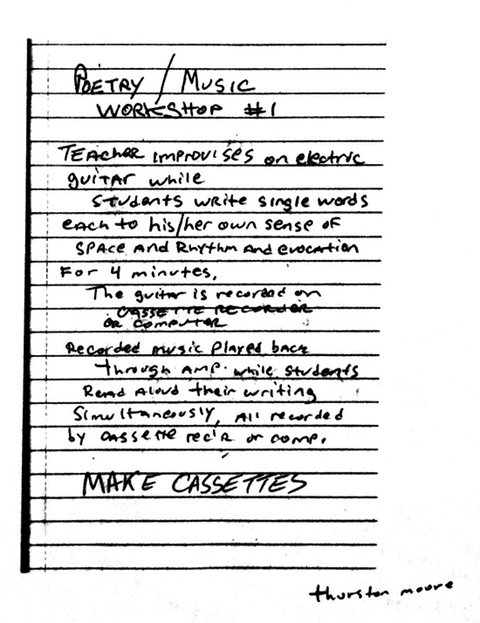
Moore was very much in demand. Anne Wald­man, co-founder of Naropa’s writ­ing pro­gram with Allen Gins­berg, said at the time, “We’ve been try­ing to get him for a while. We need him.” (Poet­ry teacher Ken­neth Gold­smith recalls that the only one who was­n’t impressed with Moore was the recent­ly depart­ed Amiri Bara­ka, who said “he needs to work on those poems.”) Thanks to some very chat­ty stu­dents, we have detailed descrip­tions of Moore’s teach­ing style, as well as scans of his class notes. See the first page of Moore’s notes to him­self for “Poet­ry / Music Work­shop #1” at the top and a tran­scrip­tion of his ellip­ti­cal, idio­syn­crat­ic method below:

Teacher impro­vis­es on elec­tric
gui­tar while
     stu­dents write sin­gle words
each to his/her own sense of
     space and Rhythm and evo­ca­tion
For 4 min­utes
     the gui­tar is record­ed on
        cas­sette recorder
       or com­put­er
Record­ed music played back
      through amp. while stu­dents
   Read aloud their writ­ing
Simul­ta­ne­ous­ly, All record­ed
by cas­sette rec’r or comp.

     MAKE CASSETTES

thurstonmooreworkshop2

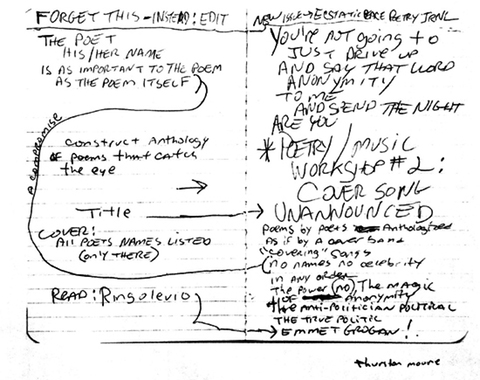
Stu­dent Katie Ingeg­neri, who inter­viewed Moore, brings us the page of text as well as the video above of Moore read­ing at Naropa. Accord­ing to anoth­er one of Moore’s for­mer stu­dents with the unlike­ly name Thorin Klosows­ki, the first day of the work­shop con­sist­ed of a “ram­bling, three-hour intro­duc­tion” dur­ing which Moore “revealed that when he ini­tial­ly moved to New York in the ’70s, it was not to make music, but rather to be a writer.” Klosowski’s piece includes addi­tion­al pages of Moore’s notes, like that above, which cites coun­ter­cul­tur­al hero Emmett Gro­gan’s auto­bi­og­ra­phy, Ringole­vio. Klosows­ki tells us that once things loos­ened up, Moore “did a bet­ter job of teach­ing than when he was pre­tend­ing to be a lec­tur­er.” The work­shop also includ­ed some “gos­sipy tid­bits”:

For instance, did you now that Kim Gor­don had a tex­ting rela­tion­ship with James Fran­co? That Stephen Malk­mus hates slam poet­ry? Or that even after years of being out of print, Moore’s list of ten essen­tial free jazz records he wrote for Grand Royale was still brought into record stores (Twist & Shout and Wax Trax includ­ed)?


Moore had vis­it­ed Naropa once before. In 2006 at a ben­e­fit for Bur­ma Life and La Casa de la Esper­an­za, he read from his books Alaba­ma Wild­man, What I Like About Fem­i­nism, and Nice War and played some songs from Son­ic Youth’s Rather Ripped. Hear the audio of that event above.

Relat­ed Con­tent:

Fear of a Female Plan­et: Kim Gor­don (Son­ic Youth) on Why Rus­sia and the US Need a Pussy Riot

Allen Ginsberg’s “Celes­tial Home­work”: A Read­ing List for His Class “Lit­er­ary His­to­ry of the Beats”

“Expan­sive Poet­ics” by Allen Gins­berg: A Free Course from 1981 

William S. Bur­roughs’ Short Class on Cre­ative Read­ing 

Josh Jones is a writer and musi­cian based in Durham, NC. Fol­low him at @jdmagness

« Go BackMore in this category... »
Quantcast