Gregory Corso was kind of the Joey Bishop of the Beats—a member of the inner circle of Kerouac, Burroughs, and Ginsberg, but never quite achieving their degree of notoriety. Nevertheless, he outlived them all, and he was also arguably the biggest comedian in a group of inveterate pranksters (see him crack up an interviewer in this clip). A streetwise Greenwich Village kid, Corso learned his craft on the streets of Little Italy, and briefly in a psych ward and a prison cell, as much as in Harvard classes and the San Francisco poetry scene, where he relocated along with Allen Ginsberg in 1955, arriving just one day too late for Ginsberg’s historic Six Gallery reading of “Howl.”
Perhaps in order to make up for his absence then, Corso decided to make his presence decidedly known nearly twenty years later in a Ginsberg reading at New York’s 92nd St. Y in February of 1973. Ginsberg is captivating as always, reading in that almost hypnotic cadence, with elliptical conversational asides, that he and Kerouac both mastered. Listen to the whole reading above. You won’t be disappointed. But for a laugh, skip ahead to 5:50.
Corso interrupts the solemn proceedings with some wiseguy heckling, calling out Ginsberg’s “poesy bullshit.” Ginsberg takes it in stride, improvising and tossing back banter. Ginsberg’s father Louis is also onstage, and he takes up a muttering defense against Corso’s verbal siege as Ginsberg begins singing around 10:30.
Whether the whole thing was staged or a spontaneous outburst by Corso is anyone’s guess, but the two lifelong friends could put on quite a show when they wanted to, like this happening in 1981. Wherever Ginsberg and Corso lived and breathed poetry—as Michelle Dean writes at The Rumpus—heckling was “an integral part of poetry reading.”
In the spring of 1958 Jack Kerouac went into the studio with tenor saxmen Al Cohn and Zoot Sims to record his second album, a mixture of jazz and poetry called Blues and Haikus. The haiku is a traditional Japanese poetry form with three unrhyming lines in five, seven, and five syllables. But Kerouac took a freer approach. In 1959, the year Blues and Haikus was released, he explained:
The American haiku is not exactly the Japanese Haiku. The Japanese Haiku is strictly disciplined to seventeen syllables but since the language structure is different I don’t think American Haikus (short three-line poems intended to be completely packed with Void of Whole) should worry about syllables because American speech is something again … bursting to pop.
Above all, a Haiku must be very simple and free of all poetic trickery and make a little picture and yet be as airy and graceful as a Vivaldi Pastorella.
The opening number on Blues and Haikus is a 10-minute piece called “American Haikus.” It features Kerouac’s expressive recitation of a series of poems punctuated by the improvisational saxophone playing of Cohn and Sims. The video above is animated by the artist Peter Gullerud. For more of Kerouac’s haikus — some 700 of them — see his Book of Haikus.
You don’t need to understand French to appreciate the project. In 1964, the Swiss pharmaceutical company Sandoz (now Novartis) commissioned the Belgian writer, poet and painter Henri Michaux to produce a film that demonstrated the effects of hallucinogenic drugs. The company saw the film as a way to help its scientists get closer to the hallucinogenic experience — not surprising, given that Sandoz was the company that first synthesized LSD back in 1938.
Henri Michaux had already published accounts where he used words, signs and drawings to recount his experiences with trip-inducing drugs. (See his translated book, Miserable Miracle.) And that continued with the new film, Images du monde visionnaire (Images of a Visionary World.) At the top, you can find the trippy segment devoted to mescaline, and, below that, Michaux’s visual treatment of hashish. Watch the complete film, except for one unfortunately blemished minute, here.
The poet Wallace Stevens‘ reclusiveness would have made him an unlikely candidate for karaoke, but death is a great leveler. One who’s shuffled off this mortal coil can no longer claim to be publicity shy or highly protective of his privacy. Nor can he object if a living author—Rob Sheffield, say—selects a song for him to hypothetically butcher.
This is how a quiet poet-accountant of Stevens’ stature finds himself holding the mic in a beyond-the grave karaoke suite, facing the scrolling lyrics of The Velvet Underground’s“Sunday Morning” (above).
It’s all in fun, naturally, but Sheffield, the music journalist and karaoke convert, is not just having an ironic laugh at his favorite poet’s expense. (Though no doubt Stevens’ poem, “Sunday Morning,” factored heavily into the decision-making process.)
Here’s how we know Sheffield is sincere. Karaoke became his unlikely emotional rescuer following the untimely death of his first wife, and helped forge bonds with a new romantic partner. Listen to his passionate description of its transformative effects in the video below. He could be a poet describing his muse. Even die hard karaoke resistors may be moved to give it a whirl after hearing him speak.
May we suggest “Sunday Morning” for your first outing? If you’re feeling nervous, dedicate it to Wallace Stevens. There in spirit, surely.
We were among millions deeply saddened to learn today that Seamus Heaney had passed away at age 74. Called the greatest Irish poet since Yeats, Heaney was not only a national treasure to his home country but to the global poetry community. The 1995 Nobel laureate worked in a rich bardic tradition that mined mythic language and imagery, Celtic and otherwise, to get at primeval human verities that transcend culture and nation.
One prominent theme in Heaney’s work—connected to the Irish struggle, but accessible to anyone—is the persistence of tribalism and its damaging effects on future generations. In one of his darker poems, “Punishment,” one I’ve often taught to undergraduates, Heaney’s speaker implicates himself in the execution of a woman found buried in a bog many centuries later. In the last two stanzas, the speaker betrays empathy clothed in helpless recognition of the tribal violence and hypocrisy at the heart of all systems of justice.
I who have stood dumb
when your betraying sisters,
cauled in tar,
wept by the railings,
who would connive
in civilized outrage
yet understand the exact
and tribal, intimate revenge.
The theme of tribal violence and its consequences is central to the Old English poem Beowulf, which Heaney famously translated into a rich new idiom suited for a post-colonial age but still consonant with the distinctive poetic rhythms of its language. You can hear Heaney read his translation of Beowulf online. Above, we have the Prologue. (Apologies in advance for the irritating ad that precedes it.) The remainder of the reading appears on YouTube — listen to Part 1 and Part 2. Plus find more of Heaney’s work at the Poetry Foundation.
Finally, you can also listen to his Nobel lecture delivered on 7 December 1995. It was posted on YouTube today, and we thought it worth your while. It’s presented in full below.
T.S. Eliot’s “The Love Song of J. Alfred Prufrock” contains some of the most unforgettable images in modern poetry: the “pair of ragged claws / Scuttling across the floors of silent seas”; the yellow fog that “rubs its back upon the window panes”; the evening “spread out against the sky / Like a patient etherized upon a table.” The poem’s sudden juxtapositions disrupted and dismantled the staid poetic conventions of its time. Like his beloved metaphysical model John Donne, Eliot pushed the resources of literary language to their outer extremes, while still maintaining a respectful relationship with traditional form, deploying Shakespearean pentameter lines whose music is deceptive, since they are the vehicles of such strange, neurotic content.
“Prufrock,” first published in 1915 in Poetry magazine—at the instigation of literary impresario Ezra Pound—caused a shock at its first appearance. Students today are apt to remember it as a bewildering swirl of references—to Dante, the Bible, Shakespeare—and as sardonic commentary on what Eliot saw as the profoundly enervated and impotent condition of modern man (and of himself). It is a daunting study, to be sure, but the poem’s first readers and critics tended to dismiss it as either shockingly anarchic or trivial and meandering.
By 1947, “Prufrock” was recognized as a modernist classic, and Harvard University recorded Eliot reading the poem (above). His thin voice may not carry the weight of the poem’s dense allusive grandeur, so we have Anthony Hopkins at the top of the post reading “Prufrock” as well. Hopkins seems to rush through the poem a bit, capturing, perhaps, the nervous energy of its title character’s psychic anguish.
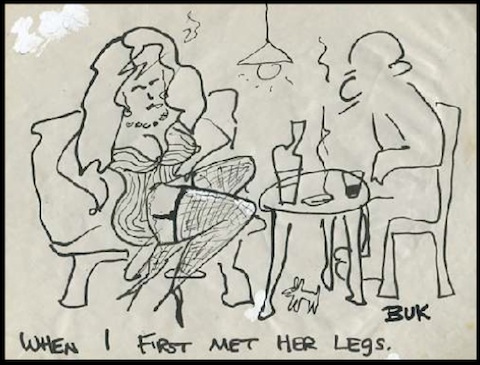
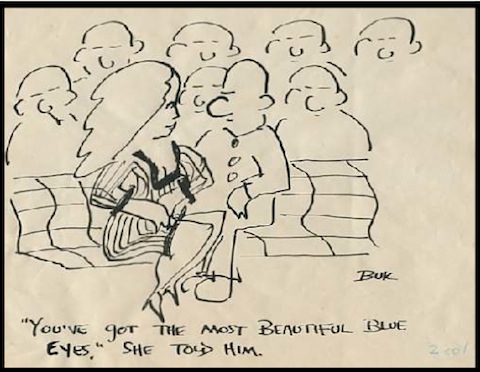
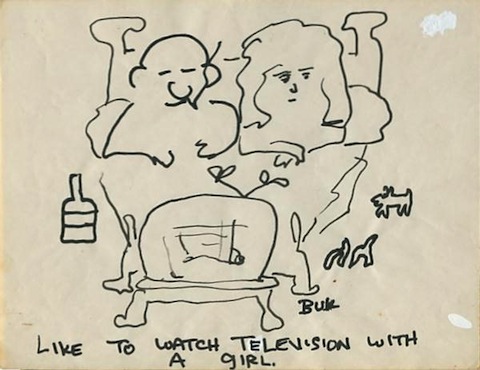
The poet Charles Bukowski has appeared often on Open Culture lately, and I have no objection. Not only do I savor writing about a literary figure thoroughly representative of Los Angeles, where I live, but about one who, even nineteen years after his death, keeps producing interesting things. Or at least we keep finding them.
A case in point comes from this post by Stephen J. Gertz of Booktryst about evidence rediscovered earlier this year of Bukowski’s efforts as a cartoonist: “Nineteen long-lost original drawings by Charles Bukowski, America’s poet laureate of the depths, surfaced at the 46th California International Antiquarian Book Fair February 15–17, 2013, offered by ReadInk of Los Angeles. Sixteen of them appeared as accompaniment to Bukowski’s classic column in the Los Angeles Free Press (The Freep), ‘Notes of a Dirty Old Man’. The remaining three originally appeared in Sunset Palms Hotel, Issue #4 (1974).”
Less comics per se than drawn windows into Bukowski’s worldview, these panels show, in a shaky yet bold line, the poet’s views on drinking, smoking, staying in bed, and conducting relations with the fairer sex. “Until its termination in 1976,” Gertz continues, “Bukowski’s ‘Notes of a Dirty Old Man’ was probably the single biggest contributing factor to both the spread of his literary fame and his local notoriety as a hard-living, hard-drinking L.A. character.” The very idea of Bukowski as a regular columnist may strike some familiar with his poetry as incongruous, but you can get an idea of how the gig formed his literary persona by reading the 1969 collection Notes of a Dirty Old Man and the 2011 More Notes of a Dirty Old Man: The Uncollected Columns. Neither, however, contain Bukowski’s illustrations, but now you can appreciate them on the internet. They almost make you believe the man could have published a cartoon or two in the New Yorker, but no — wrong coast. (And wrong sensibility, certainly.)
An old friend of mine and I have a code phrase for a phenomenon that everyone knows well: One learns that an artist one admires, maybe even loves, is not only a flawed and warty mortal, but also an abusive monster or worse. The phrase is “Ezra Pound.” We’ll look at each other knowingly whenever a conversation turns to a troubling but brilliant figure and say in unison, “Ezra Pound.” Why? Because Ezra Pound was crazy.
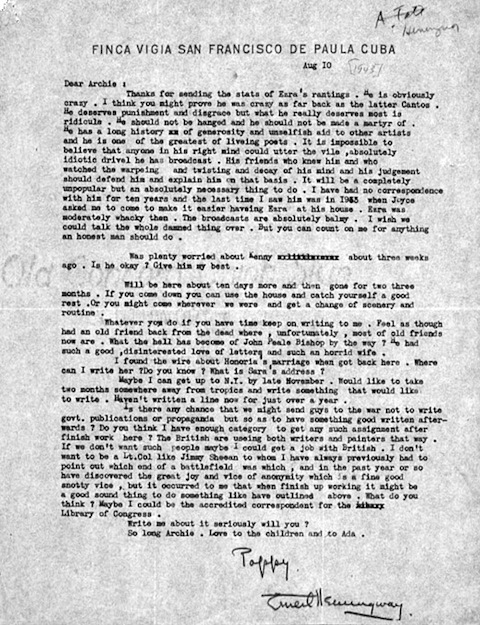
Or at least that was Ernest Hemingway’s explanation for why one of the greatest literary benefactors and most innovative and influential poets of the early twentieth century became a raving lunatic booster for anti-Semitic fascism in a series of over one hundred broadcasts he made in Italy during WWII. Pound wasn’t simply a crank—he was a deeply enthusiastic supporter of Hitler and Mussolini, and his rantings—many available here in transcript and some in original audio here (or right below) —made no secret about whom he considered the enemies of Europe and America: the Jews.
Hemingway wrote the letter above to Archibald MacLeish expressing his shock and dismay that their mutual friend and colleague had completely run off the rails. For Hemingway, the only way to deal with the situation was to “prove [Pound] was crazy as far back as the latter Cantos.” Hemingway writes, “He deserves punishment and disgrace but what he really deserves most is ridicule”
He should not be hanged and he should not be made a martyr of…. It is impossible to believe that anyone in his right mind could utter the vile, absolutely idiotic drivel he has broadcast. His friends who knew him and who watched the warpeing and twisting and decay of his mind and his judgement should defend him and explain him on that basis. It will be a completely unpopular but an absolutely necessary thing to do. [sic]
This Pound’s many friends did do, and when he was finally captured in Italy and tried for treason, Pound was sentenced to a psych ward, where he wrote and published the award-winning The Pisan Cantos amid great uproar and outrage from many in the literary community. This is unsurprising. Although Pound publicly repudiated his stint as a fascist broadcaster, his hard-right racist views did not change. In his later life, he formed friendships with white supremacists and remained controversial, contrarian, and… well, crazy.
And yet, it is hard to dismiss Pound, even if his star has fallen below the horizon of modernist literary history. It may be possible to argue that his fascist streak was in fact several miles long, extending back into his post-WWI politics and his humorous but haranguing book-length essays on Western Culture and Its Decline throughout the 30s. As Louis Menand writes in The New Yorker, this Pound may have been ripe for misinterpretation by the more brutish and less refined, a la Nietzsche, since he “believed that bad writing destroyed civilizations and that good writing could save them, and although he was an élitist about what counted as art and who mattered as an artist, he thought that literature could enhance the appreciation of life for everyone.” Pound was also a mother hen figure for a generation of modernists who flourished under his editorial direction—as well as that of Poetry magazine founder Harriet Monroe. Menand writes:
No doubt Eliot, James Joyce, William Butler Yeats, Robert Frost, William Carlos Williams, H.D., Ernest Hemingway, Ford Madox Ford, and Marianne Moore would have produced interesting and innovative work whether they had known Pound or not, but Pound’s attention and interventions helped their writing and sped their careers. He edited them, reviewed them, got them published in magazines he was associated with, and included them in anthologies he complied; he introduced them to editors, to publishers, and to patrons; he gave them the benefit of his time, his learning, his money, and his old clothes.
And all of this is not even to mention, of course, Pound’s incredible poetic output, which demonstrates such a mastery of form and language (East and West) that he is well-remembered as the founder of one of the most influential modernist movements: Imagism. This side of Pound cannot be erased by his later lapse into despicable hatred and paranoia, but neither does the early Pound cancel out the latter. Both Pounds exist in history, for as long as he’s remembered, and every time I learn some new disturbing fact about an artist I admire, I shake my head and silently invoke the most extreme and bafflingly troubling case—one that can’t be resolved or forgotten—“Ezra Pound.”
We're hoping to rely on loyal readers, rather than erratic ads. Please click the Donate button and support Open Culture. You can use Paypal, Venmo, Patreon, even Crypto! We thank you!
Open Culture scours the web for the best educational media. We find the free courses and audio books you need, the language lessons & educational videos you want, and plenty of enlightenment in between.