Dr. Fauci Reads an Undergrad’s Entire Thesis, Then Follows Up with an Encouraging Letter

Pho­to via the Nation­al Insti­tute of Aller­gy and Infec­tious Dis­eases 

What are some qual­i­ties to look for in a leader?

  • A thirst for knowl­edge
  • A sense of duty
  • The scru­ples to give cred­it where cred­it is due
  • A calm, clear com­mu­ni­ca­tion style
  • Humil­i­ty

Dr. Antho­ny Fau­ci brings these qual­i­ties to bear as Direc­tor of the Nation­al Insti­tute of Aller­gy and Infec­tious Dis­eases at the Nation­al Insti­tute of Health.

They’re also on dis­play in his mes­sage to then-under­grad Luke Mes­sac, now an emer­gency med­i­cine res­i­dent at Brown Uni­ver­si­ty, whose research focus­es on the his­to­ries of health pol­i­cy in south­ern Africa and the US, and who recent­ly tweet­ed:

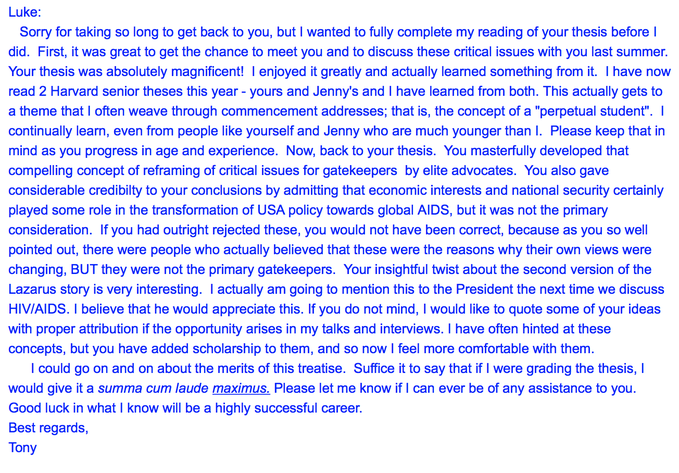
13 years ago, I emailed Dr. Fau­ci out of the blue to ask if I might inter­view him for my under­grad the­sis. He invit­ed me to his office, where he answered all my ques­tions. When I sent him the the­sis, HE READ THE WHOLE THING (see his over­ly effu­sive review below). Who does that?!

Here’s what Fau­ci had to say to the young sci­en­tist:

It cer­tain­ly reads like the work of a class act.

In addi­tion to serv­ing as one of the COVID-19 pandemic’s most rec­og­niz­able faces, Dr. Fau­ci has acquired anoth­er duty—that of scape­goat for Don­ald Trump, the 6th pres­i­dent he has answered to in his long career.

He seems to be tak­ing the administration’s pot­shots with a char­ac­ter­is­ti­cal­ly cool head, though com­pared to the furi­ous crit­i­cisms AIDS activists direct­ed his way in the 80s and 90s, he’s unlike­ly to find much of edu­ca­tion­al val­ue in them.

Last March, The Body Pro, a newslet­ter for work­ers on the front lines of HIV edu­ca­tion, pre­ven­tion, care, and ser­vices quot­ed ACT UP NY’s Jim Eigo on the doctor’s response to a let­ter demand­ing par­al­lel track­ing, a pol­i­cy revi­sion that would put poten­tial­ly life-sav­ing drugs in the hands of those who test­ed pos­i­tive far ear­li­er than the exist­ing clin­i­cal tri­al require­ments’ sched­ule would have allowed:

Lo and behold, he read the let­ter and liked it, and the fol­low­ing year he start­ed pro­mot­ing the idea of a par­al­lel track for AIDS drugs to the FDA. Had he not helped us push that through, we couldn’t have got­ten a lot of the cousin drugs to AZT, such as ddC and ddI, approved so fast. They were prob­lem­at­ic drugs, but with­out them, we couldn’t have kept so many peo­ple alive. 

Fau­ci, despite being straight and Catholic, was not only not homo­pho­bic, which much of med­ical prac­tice still was in the late 1980s, he also wouldn’t tol­er­ate homo­pho­bia among his col­leagues. He knew there was no place for that in a pub­lic-health cri­sis.

Speak­ing of cor­re­spon­dence, Dr Mes­sac seems to have tak­en the “per­pet­u­al stu­dent” con­cept Dr. Fau­ci impressed upon him back in 2007 to heart, as evi­denced by a recent tweet, regard­ing a les­son gleaned from Arnold Schwarzeneg­ger in Pump­ing Iron, a 1977 doc­u­men­tary about body­builders:

Schwarzeneg­ger explained how he would fig­ure out what to work out every day by look­ing in a mir­ror and find­ing his weak­est mus­cles. It’s pret­ty good advice for study­ing dur­ing res­i­den­cy. Every shift reveals a weak­ness, and greats nev­er stop look­ing for their own.

In writ­ing to Mes­sac, Dr. Fau­ci allud­ed to his com­mence­ment speech­es, so we thought it appro­pri­ate to leave you with one of his most recent ones, a vir­tu­al address to the grad­u­at­ing class of his alma mater, Col­lege of the Holy Cross:

“Now is the time, if ever there was one” he tells the Class of 2020, “to care self­less­ly about one anoth­er… Stay safe, and I look for­ward to the good work you will con­tribute in the years ahead.”

Relat­ed Con­tent: 

Real Women Talk About Their Careers in Sci­ence

Richard Feynman’s Tech­nique for Learn­ing Some­thing New: An Ani­mat­ed Intro­duc­tion

Nov­el­ist Cor­mac McCarthy Gives Writ­ing Advice to Sci­en­tists … and Any­one Who Wants to Write Clear, Com­pelling Prose

Ayun Hal­l­i­day is an author, illus­tra­tor, the­ater mak­er and Chief Pri­ma­tol­o­gist of the East Vil­lage Inky zine. Fol­low her @AyunHalliday.

Watch the Famous James Baldwin-William F. Buckley Debate in Full, With Restored Audio (1965)

When James Bald­win took the stage to debate William F. Buck­ley at Cam­bridge in 1965, it was to have “a debate we shouldn’t need,” writes Gabrielle Bel­lot at Lit­er­ary Hub, and yet it’s one that is still “as impor­tant as ever.” The propo­si­tion before the two men—famed prophet­ic nov­el­ist of the black expe­ri­ence in Amer­i­ca and the con­ser­v­a­tive founder of the Nation­al Review—was this: “The Amer­i­can Dream is at the Expense of the Amer­i­ca Negro.”

The state­ment should not need defend­ing, Bald­win argued, because it is so obvi­ous­ly true. The wealth cre­at­ed by hun­dreds of years of slav­ery has passed down through gen­er­a­tions of fam­i­lies. So too has the pover­ty. These divi­sions have been stren­u­ous­ly main­tained by Jim Crow, redlin­ing, and racist polic­ing. “Prof­its from slav­ery,” write Stephen Smith and Kate Ellis at APM Reports, “helped fund some of the most pres­ti­gious schools in the North­east, includ­ing Har­vard, Colum­bia, Prince­ton and Yale,” which hap­pened to be Buckley’s alma mater and was found­ed by an actu­al slave trad­er.

Slave labor fund­ed, built, and main­tained near­ly every part of the for­ma­tive uni­ver­si­ty sys­tem in the ear­ly U.S., and built the wealth of many oth­er pow­er­ful insti­tu­tions. Bald­win says it is “awk­ward” to have to point out these facts. Rather than recite them, he per­son­al­izes, speak­ing, he says, as “a kind of Jere­mi­ah” in nam­ing crimes gone unre­dressed for too long: “I am stat­ing very seri­ous­ly, and this is not an over­state­ment. I picked the cot­ton, I car­ried it to the mar­ket, and I built the rail­roads under some­one else’s whip for noth­ing. For noth­ing…. The Amer­i­can soil is full of the corpses of my ances­tors. Why is my free­dom or my cit­i­zen­ship, or my right to live there, how is it con­ceiv­ably a ques­tion now?”

Buckley’s response drips with con­de­scen­sion and con­tempt. He begins with a stan­dard con­ser­v­a­tive line: deplor­ing the acts of a few “indi­vid­ual Amer­i­can cit­i­zens” who “per­pet­u­ate dis­crim­i­na­tion,” but deny­ing that his­toric, sys­temic racism still exists. He then cites “the fail­ure of the Negro com­mu­ni­ty itself to make cer­tain exer­tions, which were made by oth­er minor­i­ty groups dur­ing the Amer­i­can expe­ri­ence.” He damns an entire group of peo­ple with plat­i­tudes about hard work while also declar­ing loud­ly that race has noth­ing to do with it.

This contradiction—engaging in racist scape­goat­ing while claim­ing not to see race—was part of the strat­e­gy of “col­or­blind” con­ser­vatism the Nation­al Review adopt­ed after the pas­sage the Civ­il Rights Act. Pri­or to the ear­ly six­ties, how­ev­er, Buck­ley had been a stri­dent seg­re­ga­tion­ist who pub­licly defend­ed insti­tu­tion­al­ized white suprema­cy rather than claim­ing it had dis­ap­peared. In 1957, he wrote an edi­to­r­i­al titled “Why the South Must Pre­vail” and argued that white south­ern politi­cians must “take such mea­sures as are nec­es­sary to pre­vail, polit­i­cal­ly and cul­tur­al­ly” over black cit­i­zens.

Buck­ley had not fun­da­men­tal­ly changed in 1965, though he posi­tioned him­self as a mod­er­ate mid­dle ground between lib­er­als and seg­re­ga­tion­ists like Strom Thur­mond, whom he con­sid­ered crude. His posi­tion amounts to lit­tle more than a defense of dom­i­na­tion, couched in what his­to­ri­an Joshua Tait calls the “racial inno­cence of intel­lec­tu­al con­ser­vatism” that delib­er­ate­ly ignores or dis­torts his­tor­i­cal truths and present real­i­ties. “Bristling at Baldwin’s claim that the Amer­i­can econ­o­my was built by the unre­mu­ner­at­ed labour of Black peo­ple,” writes Joss Har­ri­son, “Buck­ley cries: ‘My great grand­par­ents worked too!’”

The debate “now stands as one of the arche­typ­al artic­u­la­tions of the divid­ing line between US pro­gres­sives and con­ser­v­a­tives on ques­tions of race, jus­tice and his­to­ry,” writes Aeon, who bring us the full ver­sion above with restored audio by Adam D’Arpino. Buck­ley responds to Baldwin’s pow­er­ful rhetoric with insults, out of con­text “facts and fig­ures – as well as an ad hominem shot at Baldwin’s speak­ing voice.” He pro­pos­es that one road to equal­i­ty lies in dis­en­fran­chis­ing poor South­ern whites as well as black cit­i­zens.

Buck­ley dis­plays a “com­plete igno­rance of the prob­lems faced by black Amer­i­cans in soci­ety,” writes Har­ri­son. Such igno­rance, “allied with pow­er,” Bald­win said else­where, con­sti­tutes “the most fero­cious ene­my jus­tice can have.” For Bald­win, Buck­ley’s atti­tude sim­ply con­firmed the “great shock,” that he mov­ing­ly describes in his debate state­ment, “around the age of five, or six, or sev­en, to dis­cov­er that the flag to which you have pledged alle­giance, along with every­body else, has not pledged alle­giance to you.”

via Aeon

Relat­ed Con­tent:

Why James Baldwin’s Writ­ing Stays Pow­er­ful: An Art­ful­ly Ani­mat­ed Intro­duc­tion to the Author of Notes of a Native Son

Great Cul­tur­al Icons Talk Civ­il Rights: James Bald­win, Mar­lon Bran­do, Har­ry Bela­fonte & Sid­ney Poiti­er (1963)

James Bald­win: Wit­ty, Fiery in Berke­ley, 1979

Josh Jones is a writer and musi­cian based in Durham, NC. Fol­low him at @jdmagness

Pretty Much Pop: A Culture Podcast #49 Considers Conspiracy Theories as Pop

Ex-philoso­pher Al Bak­er works at the UK-based Log­i­cal­ly, a com­pa­ny that fights mis­in­for­ma­tion.

He joins your hosts Mark Lin­sen­may­er, Eri­ca Spyres, and Bri­an Hirt to try to answer such ques­tions as: What’s the appeal of con­spir­a­cy the­o­ries? How sim­i­lar is being con­sumed them to being a die-hard fan of some pop cul­ture prop­er­ty? What’s the rela­tion between per­ni­cious con­spir­a­cy the­o­ries and fun spec­u­la­tion (like, maybe Elvis is alive)? Is there a harm­less way to engage in con­spir­a­cy the­o­riz­ing as a hob­by? Is some­thing still a con­spir­a­cy the­o­ry in the pejo­ra­tive sense if it turns out to be true?

We touch on echo cham­bers, the role of irony and humor in spread­ing these the­o­ries, how both oppo­nents and pro­po­nents claim to be skep­tics, Dan Brown Nov­els, Tom Han­ks, the Mel Gib­son film Con­spir­a­cy The­o­ry, and doc­u­men­taries like Behind the Curve (about Flat Earth­ers) and The Fam­i­ly.

For expert opin­ions on the psy­chol­o­gy of con­spir­a­cy the­o­ries, try The Con­ver­sa­tion’s Antill Pod­cast, which had a whole series on this top­ic. For even more pod­cast action, try FiveThir­tyEight, BBC’s The Why Fac­tor pod­cast, Skep­toid, and The Infi­nite Mon­key Cage.

Here are some more arti­cles:

If you enjoy this, try Pret­ty Much Pop #14 on UFOs. The Par­tial­ly Exam­ined Life episodes referred to in this dis­cus­sion are #96 on Oppen­heimer and the Rhetoric of Sci­ence Advis­ers and #82 on Karl Pop­per.

Learn more at prettymuchpop.com. This episode includes bonus dis­cus­sion that you can only hear by sup­port­ing the pod­cast at patreon.com/prettymuchpop. This pod­cast is part of the Par­tial­ly Exam­ined Life pod­cast net­work.

Pret­ty Much Pop: A Cul­ture Pod­cast is the first pod­cast curat­ed by Open Cul­ture. Browse all Pret­ty Much Pop posts or start with the first episode.

John Trumbull’s Famous 1818 Painting Declaration of Independence Virtually Defaced to Show Which Founding Fathers Owned Slaves

Stat­ues of slave­hold­ers and their defend­ers are falling all over the U.S., and a lot of peo­ple are dis­traught. What’s next? Mount Rush­more? Well… maybe no one’s like­ly to blow it up, but some hon­esty about the “extreme­ly racist” his­to­ry of Mount Rush­more might make one think twice about using it as a lim­it case.

On the oth­er hand, a sand­blast­ing of the enor­mous Klan mon­u­ment in Stone Moun­tain, Geor­gia—cre­at­ed ear­li­er by Rush­more sculp­tor Gut­zon Borglum—seems long over­due.

We are learn­ing a lot about the his­to­ry of these mon­u­ments and the peo­ple they rep­re­sent, more than any of us Amer­i­cans learned in our ear­ly edu­ca­tion. But we still hear the usu­al defense that slave­hold­ers were only men of their time—many were good, pious, and gen­tle and knew no bet­ter (or they ago­nized over the ques­tion but, you know, every­one was doing it….) Peo­ple sub­ject­ed to the vio­lence and hor­ror of slav­ery most­ly tend­ed to dis­agree.

Before the Hait­ian Rev­o­lu­tion ter­ri­fied the slave­hold­ing South, many promi­nent slave­hold­ers, Jef­fer­son and Wash­ing­ton includ­ed, expressed intel­lec­tu­al and moral dis­gust with slav­ery. They could not con­sid­er abo­li­tion, how­ev­er (though Wash­ing­ton freed his slaves in his will). There was too much prof­it in the enter­prise. As Jef­fer­son him­self wrote, “It [would] nev­er do to destroy the goose.”

What we see when we look at the Rev­o­lu­tion­ary peri­od is the fatal irony of a repub­lic based on ideals of lib­er­ty, found­ed most­ly by men who kept mil­lions of peo­ple enslaved. The point is made vivid­ly above in a vir­tu­al deface­ment of Dec­la­ra­tion of Inde­pen­dence, John Trumbull’s famous 1818 paint­ing which hangs in the U.S. Capi­tol rotun­da. All of the founders’ faces blot­ted out by red dots were slave­own­ers. Only the few in yel­low in the cor­re­spond­ing image freed the the peo­ple they enslaved.

These images were not made in this cur­rent sum­mer of nation­al upris­ings but in August of 2019, “a bloody month that saw 53 peo­ple die in mass shoot­ings in the US,” notes Hyper­al­ler­gic. Their cre­ator, Arlen Parsa sought to make a dif­fer­ent point about the Sec­ond Amend­ment, but wrote force­ful­ly about the founders’ enslav­ing of oth­ers. “There were no gen­tle slave­hold­ers,” writes Parsa. “Count­less chil­dren were born into slav­ery and died after a rel­a­tive­ly short lifes­pan nev­er know­ing free­dom for even a minute.” Many of those chil­dren were fathered by their own­ers.

Some found­ing fathers paid lip ser­vice to the idea of slav­ery as a blight because it was obvi­ous that kid­nap­ping and enslav­ing peo­ple con­tra­dict­ed demo­c­ra­t­ic prin­ci­ples. Slav­ery hap­pened to be the pri­ma­ry metaphor used by Enlight­en­ment philoso­phers and their colo­nial read­ers to char­ac­ter­ize the tyran­ni­cal monar­chism they opposed. The philoso­pher John Locke wrote slav­ery into the con­sti­tu­tion of the Car­oli­na colony, and prof­it­ed from it through own­ing stock in the Roy­al African Com­pa­ny. Yet by his lat­er, huge­ly influ­en­tial Two Trea­tis­es, he had come to see hered­i­tary slav­ery as “so vile and mis­er­able an estate of man… that ‘tis hard­ly to be con­ceived” that any­one could uphold it.

There were, of course, slave­hold­ing founders who resist­ed such talk and felt no com­punc­tion about how they made their mon­ey. But lofty prin­ci­ples or no, the U.S. founders were often on the defen­sive against non-slave­hold­ing col­leagues, who scold­ed and attacked them, some­times with frank ref­er­ences to the rapes of enslaved women and girls. These crit­i­cisms were so com­mon that Thomas Paine could write the case for slav­ery had been “suf­fi­cient­ly dis­proved” when he pub­lished a 1775 tract denounc­ing it and call­ing for its imme­di­ate end:

The man­agers of [the slave trade] tes­ti­fy that many of these African nations inhab­it fer­tile coun­tries, are indus­tri­ous farm­ers, enjoy plen­ty and lived qui­et­ly, averse to war, before the Euro­peans debauched them with liquors… By such wicked and inhu­man ways, the Eng­lish are said to enslave towards 100,000 year­ly, of which 30,000 are sup­posed to die by bar­barous treat­ment in the first year…

So mon­strous is the mak­ing and keep­ing them slaves at all… and the many evils attend­ing the prac­tice, [such] as sell­ing hus­bands away from wives, chil­dren from par­ents and from each oth­er, in vio­la­tion of sacred and nat­ur­al ties; and open­ing the way for adul­ter­ies, inces­ts and many shock­ing con­se­quences, for all of which the guilty mas­ters must answer to the final judge…

The chief design of this paper is not to dis­prove [slav­ery], which many have suf­fi­cient­ly done, but to entreat Amer­i­cans to con­sid­er:

With that con­sis­ten­cy… they com­plain so loud­ly of attempts to enslave them, while they hold so many hun­dred thou­sands in slav­ery and annu­al­ly enslave many thou­sands more, with­out any pre­tence of author­i­ty or claim upon them.

Jef­fer­son squared his the­o­ry of lib­er­ty with his prac­tice of slav­ery by pick­ing up the fad of sci­en­tif­ic racism sweep­ing Europe at the time, in which philoso­phers who prof­it­ed, or whose patrons and nations prof­it­ed, from the slave trade began to coin­ci­den­tal­ly dis­cov­er evi­dence that enslav­ing Africans was only nat­ur­al. We should know by now what hap­pens when racism guides sci­ence.…

Maybe turn­ing those who will­ful­ly per­pet­u­at­ed the country’s most intractable, damn­ing crime against human­i­ty into civic saints no longer serves the U.S., if it ever did. Maybe ele­vat­ing the founders to the sta­tus of reli­gious fig­ures has pro­duced a wide­spread his­tor­i­cal igno­rance and a very spe­cif­ic kind of nation­al­ism that are no longer ten­able. Younger and future gen­er­a­tions will set­tle these ques­tions their own way, as they sort through the mess their elders have left them. As Locke also argued, in a para­phrase from Amer­i­can His­to­ry pro­fes­sor Hol­ly Brew­er, “peo­ple do not have to obey a gov­ern­ment that no longer pro­tects them, and the con­sent of an ances­tor does not bind the descen­dants: each gen­er­a­tion must con­sent for itself.”

via Hyper­al­ler­gic

Relat­ed Con­tent:

What the Text­books Don’t Tell Us About The Atlantic Slave Trade: An Ani­mat­ed Video Fills In His­tor­i­cal Gaps

The Names of 1.8 Mil­lion Eman­ci­pat­ed Slaves Are Now Search­able in the World’s Largest Genealog­i­cal Data­base, Help­ing African Amer­i­cans Find Lost Ances­tors

The Atlantic Slave Trade Visu­al­ized in Two Min­utes: 10 Mil­lion Lives, 20,000 Voy­ages, Over 315 Years

The “Slave Bible” Removed Key Bib­li­cal Pas­sages In Order to Legit­imize Slav­ery & Dis­cour­age a Slave Rebel­lion (1807)

Josh Jones is a writer and musi­cian based in Durham, NC. Fol­low him at @jdmagness

John Cleese’s Comedically Explains the Psychological Advantages of Extremism: “It Makes You Feel Good Because It Provides You with Enemies”

Extrem­ist: in any polit­i­cal squab­ble, and espe­cial­ly any online polit­i­cal squab­ble, the label is sure to get slapped on some­one soon­er or lat­er. Of course, we nev­er con­sid­er our­selves extrem­ists: it’s the para­me­ters of accept­able polit­i­cal dis­cus­sion that wrong­ly frame our entire­ly rea­son­able, truth-informed views. But what if we were to embrace the extreme? “What we nev­er hear about extrem­ism is its advan­tages,” says Mon­ty Python’s John Cleese in the tele­vi­sion adver­tise­ment above. “The biggest advan­tage of extrem­ism is that it makes you feel good because it pro­vides you with ene­mies.” When you have ene­mies, “you can pre­tend that all the bad­ness in the whole world is in your ene­mies and all the good­ness in the whole world is in you.”

If you “have a lot of anger and resent­ment in you any­way,” you can jus­ti­fy your own unciv­i­lized behav­ior “because these ene­mies of yours are such very bad per­sons, and that if it was­n’t for them, you’d actu­al­ly be good-natured and cour­te­ous and ratio­nal all the time.” Sign on with the “hard left,” Cleese says, and you’ll receive “their list of autho­rized ene­mies: almost all kinds of author­i­ty, espe­cial­ly the police, the City, Amer­i­cans, judges, multi­na­tion­al cor­po­ra­tions, pub­lic schools, fur­ri­ers, news­pa­per own­ers, fox hunters, gen­er­als, class trai­tors — and of course, mod­er­ates.” If you pre­fer the “hard right,” they have a list of their own, one includ­ing “noisy minor­i­ty groups, unions, Rus­sia, weirdos, demon­stra­tors, wel­fare sponges, med­dle­some cler­gy, peaceniks, the BBC, strik­ers, social work­ers, com­mu­nists — and of course, mod­er­ates.”

As Cleese tweet­ed this past week­end, “Hard to tell if I record­ed this 30 years or 10 min­utes ago.” In fact he record­ed it more than 30 years ago, as an endorse­ment of the cen­trist SDP-Lib­er­al Alliance between the Unit­ed King­dom’s Social Demo­c­ra­t­ic Par­ty and Lib­er­al Par­ty. Hav­ing formed in 1981 and gone defunct by 1988 (when it became the par­ty now known as the Lib­er­al Democ­rats), the SDP-Lib­er­al Alliance leaves lit­tle in the way of a lega­cy, but this clip has only grown more rel­e­vant with time. As an extrem­ist, Cleese reminds us “you can strut around abus­ing peo­ple and telling them you could eat them for break­fast and still think of your­self as a cham­pi­on of the truth, a fight­er for the greater good, and not the rather sad, para­noid schizoid that you real­ly are” — a state­ment that, uttered in our inter­net era, would sure­ly make more than a few ene­mies.

via Boing­Bo­ing

Relat­ed Con­tent:

Mon­ty Python’s John Cleese Wor­ries That Polit­i­cal Cor­rect­ness Will Lead Us into a Humor­less World, Rem­i­nis­cent of Orwell’s 1984

John Cleese on How “Stu­pid Peo­ple Have No Idea How Stu­pid They Are” (a.k.a. the Dun­ning-Kruger Effect)

John Cleese Cre­ates Ads for the Amer­i­can Philo­soph­i­cal Asso­ci­a­tion

The Psy­chol­o­gy That Leads Peo­ple to Vote for Extrem­ists & Auto­crats: The The­o­ry of Cog­ni­tive Clo­sure

John Cleese Plays the Dev­il, Makes a Spe­cial Appeal for Hell, 1966

Based in Seoul, Col­in Mar­shall writes and broad­casts on cities, lan­guage, and cul­ture. His projects include the book The State­less City: a Walk through 21st-Cen­tu­ry Los Ange­les and the video series The City in Cin­e­ma. Fol­low him on Twit­ter at @colinmarshall, on Face­book, or on Insta­gram.

When Punk & Reggae Fans Launched the “Rock Against Racism” Movement and Pushed Back Against Britain’s Racist Right (1976)

The UK of the late-70s was, in many unfor­tu­nate respects, like the UK (and US) of today, with far-right attacks against West Indi­an and Asian immi­grants becom­ing rou­tine, along with increased aggres­sion from the police. Enoch Powell’s inflam­ma­to­ry 1968 “Rivers of Blood” speech (denounced in the papers as a naked “appeal to racial hatred) ener­gized the far-right Nation­al Front. Nazi punks and skin­heads began vio­lent cam­paigns in the mid-70s. A very hot sum­mer in 1976 saw a riot at the Not­ting­ham Car­ni­val, when police attacked the West Indi­an fes­ti­val. Car­ni­val-goers fought back, includ­ing the Clash’s Joe Strum­mer and Paul Simenon, who describe the events below.

Strum­mer was inspired to pen “White Riot,” a call to arms for white punks against the police and far right, and the band moved increas­ing­ly toward reg­gae, includ­ing a cov­er of Junior Murvin’s “Police & Thieves.”

Into this boil­ing caul­dron stepped Eric Clap­ton to drunk­en­ly declare his sup­port for Pow­ell onstage in Birm­ing­ham and repeat­ed­ly chant the Nation­al Front slo­gan “keep Britain white!” In out­raged response, pho­tog­ra­ph­er and for­mer Clap­ton fan Red Saun­ders and oth­ers found­ed Rock Against Racism, pub­lish­ing a let­ter in the NME to recruit peo­ple to join the cause. The short note addressed Clap­ton’s glar­ing hypocrisy direct­ly: “Come on Eric… Own up. Half your music is black. You’re rock music’s biggest colonist.”

The let­ter artic­u­lat­ed the dis­gust felt by thou­sands around the coun­try. Paul Fur­ness, work­ing as a med­ical records clerk in Leeds at the time, found the anti-racist dec­la­ra­tion “pos­i­tive” and “life affirm­ing,” as he says in the short film at the top. He helped orga­nize the first Rock Against Racism car­ni­val in 1978 and was amazed “that there were thou­sands and thou­sands and thou­sands of peo­ple descend­ing on Lon­don. The excite­ment of it, just this real­iza­tion…. That you can change things, that you can could actu­al­ly make a dif­fer­ence.”

Cre­at­ed with the Anti-Nazi League, the April 1978 Rock Against Racism Car­ni­val in London’s Vic­to­ria Park was the moment “punk became a pop­ulist move­ment to be reck­oned with,” writes Ian Fort­nam at Clas­sic Rock. (Learn more in the doc­u­men­tary above.) “Nev­er before had so many peo­ple been mobi­lized for that sort of cause,” head­lin­er Tom Robin­son remem­bers. “It was our Wood­stock.” The Clash were there—you can hear their per­for­mance just above. It was, writes Fort­nam, “their finest hour”:

The Clash were on fire, feed­ing off of an ecsta­t­ic audi­ence and pre­mier­ing as yet unrecord­ed mate­r­i­al (even­tu­al­ly released on Give ‘Em Enough Rope the fol­low­ing Novem­ber) like Tom­my Gun and The Last Gang In Town. The show was a rev­e­la­tion.

The Rock Against Racism Car­ni­val brought togeth­er punk and reg­gae bands, and fans of both, start­ing a tra­di­tion of mul­ti-racial line­ups at RAR con­certs into the 80s that fea­tured X‑Ray Specs, the Ruts, the Slits, Gen­er­a­tion X, Elvis Costel­lo, Steel Pulse, Aswad, and Misty in Roots, among many oth­ers. “When you saw a band like ours jam­ming with Tom Robin­son or Elvis Costel­lo,” says singer Poko of Misty in Roots, who played more RAR shows than any oth­er band, “it showed that if you love music we can all live togeth­er.”

That mes­sage res­onat­ed through­out the coun­try and the sound sys­tems of the streets. At the first Car­ni­val, Fort­nam writes, “pha­lanx­es of police held back counter-demon­strat­ing skin­heads” while an esti­mat­ed 80,000 peo­ple marched through the streets chant­i­ng “Black and white unite and fight, smash the Nation­al Front.” Rock Against Racism became a mas­sive move­ment that did cre­ate uni­ty and pushed back suc­cess­ful­ly against far-right attacks. But it wasn’t only about the pol­i­tics, as pho­tog­ra­ph­er Syd Shel­ton recalls below. It was also a fight for what British punk would become—the music of fas­cism and the far right or a syn­the­sis of sounds and rhythms from the for­mer Empire and its for­mer colonies.

Relat­ed Con­tent:

“Stay Free: The Sto­ry of the Clash” Nar­rat­ed by Pub­lic Enemy’s Chuck D: A New 8‑Episode Pod­cast

Lon­don Call­ing: A New Muse­um Exhi­bi­tion Cel­e­brates The Clash’s Icon­ic Album

The Clash Play Their Final Show (San Bernardi­no, 1983)

Josh Jones is a writer and musi­cian based in Durham, NC. Fol­low him at @jdmagness.

Tom Morello Responds to Angry Fans Who Suddenly Realize That Rage Against the Machine’s Music Is Political: “What Music of Mine DIDN’T Contain Political BS?”

I, Danc­ing Bear,” a song by an obscure folk artist who goes by the name Bir­d­engine, begins thus:

There are some things that I just do not care to know

It’s a love­ly lit­tle tune, if maudlin and macabre are your thing, a song one might almost call anti-polit­i­cal. It is the art of solip­sism, denial, an inward­ness that dances over the abyss of pure self, navel gaz­ing for its own sake. It is Kaf­ka-esque, pathet­ic, and hys­ter­i­cal. I love it.

My appre­ci­a­tion for this weird, out­sider New Roman­ti­cism does not entail a belief that art and cul­ture should be “apo­lit­i­cal,” what­ev­er that is.

Or that artists, writ­ers, musi­cians, actors, ath­letes, or whomev­er should shut up about pol­i­tics and stick to what they do best, talk about them­selves.

The idea that artists should avoid pol­i­tics seems so per­va­sive that fans of some of the most bla­tant­ly polit­i­cal, rad­i­cal artists have nev­er noticed the pol­i­tics, because, I guess, they just couldn’t be there.

One such fan just got dunked on, as they say, a whole bunch on Twit­ter when he raged against Tom Morel­lo for the “polit­i­cal bs.”

That’s Tom Morel­lo of Rage Against the Machine, whose debut 1992 album informed us that the police and the Klan work hand in hand, and that cops are the “cho­sen whites” for state-sanc­tioned mur­der. That Rage Against the Machine, who raged against the same Machine on every album: “Bam, here’s the plan; Moth­er­fuck Uncle Sam.”

The poor sod was burned so bad­ly he delet­ed his account, but the laughs at his expense kept com­ing. Even Morel­lo respond­ed.

Why? Because the dis­grun­tled for­mer fan is not just one lone crank who didn’t get it. Many peo­ple over the years have expressed out­rage at find­ing out there’s so much pol­i­tics in their cul­ture, even in a band like Rage that could not have been less sub­tle. Many, like for­mer lever-puller of the Machine, Paul Ryan, seem to have cyn­i­cal­ly missed the point and turned them into work­out music. Morel­lo’s had to point this out a lot. (Dit­to Spring­steen.)

This uncrit­i­cal con­sump­tion of cul­ture with­out a thought about icky polit­i­cal issues is maybe one rea­son we have a sep­a­rate polit­i­cal class, paid hand­some­ly to do the dirty work while the rest of us go shop­ping. It’s a recipe for mass igno­rance and fas­cism.

You might think me crazy if I told you that the CIA is part­ly respon­si­ble for our expec­ta­tion that art and cul­ture should be apo­lit­i­cal. The Agency did, after all, fol­low the lead of the New Crit­ics, who exclud­ed all out­side polit­i­cal and social con­sid­er­a­tions from art (so they said).

Influ­en­tial lit­er­ary edi­tors and writ­ing pro­gram direc­tors on the Agency pay­roll made sure to fall in line, pro­mot­ing a cer­tain kind of writ­ing that focused on the indi­vid­ual and ele­vat­ed psy­cho­log­i­cal con­flict over social con­cerns. This influ­ence, writes The Chron­i­cle of High­er Edu­ca­tion, “flat­tened lit­er­a­ture” and set the bound­aries for what was cul­tur­al­ly accept­able. (Still, CIA-fund­ed jour­nals like The Paris Review pub­lished dozens of “polit­i­cal” writ­ers like Richard Wright, Gabriel Gar­cia Mar­quez, and James Bald­win.)

Then there’s the whole busi­ness of Hol­ly­wood film as a source of Pen­ta­gon-fund­ed pro­pa­gan­da, sold as innocu­ous, apo­lit­i­cal enter­tain­ment….

When it comes to jour­nal­ism, an ide­al of objec­tiv­i­ty, like Emerson’s inno­cent, dis­em­bod­ied trans­par­ent eye, became a stan­dard only in the 20th cen­tu­ry, osten­si­bly to weed out polit­i­cal bias. But that ide­al serves the inter­ests of pow­er more often than not. If media rep­re­sents exist­ing pow­er rela­tion­ships with­out ques­tion­ing their legit­i­ma­cy, it can claim objec­tiv­i­ty and bal­ance; if it chal­lenges pow­er, it becomes too “polit­i­cal.”

The adjec­tive is weaponized against art and cul­ture that makes cer­tain peo­ple who have pow­er uncom­fort­able. Say­ing “I don’t like polit­i­cal bs in my cul­ture” is say­ing “I don’t care to know the pol­i­tics are there.”

If, after decades of pump­ing “Killing in the Name,” you final­ly noticed them, then all that’s hap­pened is you’ve final­ly noticed. Cul­ture has always includ­ed the polit­i­cal, whether those pol­i­tics are shaped by mon­archs or state agen­cies or shout­ed in rap met­al songs (just ask Ice‑T) and fought over on Twit­ter. Maybe now it’s just get­ting hard­er to look away.

Relat­ed Con­tent:

The Pol­i­tics & Phi­los­o­phy of the Bauhaus Design Move­ment: A Short Intro­duc­tion

Hear a 4 Hour Playlist of Great Protest Songs: Bob Dylan, Nina Simone, Bob Mar­ley, Pub­lic Ene­my, Bil­ly Bragg & More

Love the Art, Hate the Artist: How to Approach the Art of Dis­graced Artists

Josh Jones is a writer and musi­cian based in Durham, NC. Fol­low him at @jdmagness

Imagining the Martin Luther King and Malcolm X Debate That Never Happened

Amer­i­can his­to­ry as it’s usu­al­ly taught likes to focus on rival­ries, and there are many involv­ing big per­son­al­i­ties and major his­tor­i­cal stakes. Abra­ham Lin­coln and Stephen Dou­glas, Thomas Jef­fer­son and Alexan­der Hamil­ton, W.E.B. DuBois and Book­er T. Wash­ing­ton. These fig­ures are set up to rep­re­sent the “both sides” we expect of every polit­i­cal ques­tion. While the issues are over­sim­pli­fied (there are always more than two sides and pol­i­tics isn’t a sport) the fig­ures in ques­tion gen­uine­ly rep­re­sent­ed very dif­fer­ent per­spec­tives on pow­er and progress.

When it comes to the his­to­ry of the Civ­il Rights move­ment, we are giv­en anoth­er such rival­ry, between Mar­tin Luther King, Jr. and Mal­colm X. Their ideas and influ­ence are pit­ted against each oth­er as though they had shared a debate stage. In fact, the two lead­ers met only once, dur­ing Sen­ate debates on the Civ­il Rights Act of 1964. “King was step­ping out of a news con­fer­ence,” writes DeNeen L. Brown at The Wash­ing­ton Post, when Mal­colm X, dressed in an ele­gant black over­coat and wear­ing his sig­na­ture horn-rimmed glass­es, greet­ed him.”

“Well, Mal­colm, good to see you,” King said.

“Good to see you,” Mal­colm X replied.

Cam­eras clicked as the two men walked down the Sen­ate hall togeth­er.

“I’m throw­ing myself into the heart of the civ­il rights strug­gle,” Mal­colm X told King.

Lat­er, King would express his dis­agree­ment with Malcolm’s “polit­i­cal and philo­soph­i­cal views—at least inso­far as I under­stand where he now stands.” The com­ment allowed for an evo­lu­tion in X’s thought that would, in fact, occur that year, while lat­er events would push King in a far more rad­i­cal direc­tion. As Brown writes:

Although the two men held what appeared to be dia­met­ri­cal­ly oppos­ing views on the strug­gle for equal rights, schol­ars say by the end of their lives their ide­olo­gies were evolv­ing. King was becom­ing more mil­i­tant in his views of eco­nom­ic jus­tice for black peo­ple and more vocal in his crit­i­cism of the Viet­nam War. Mal­colm X, who had bro­ken with the Nation of Islam, had dra­mat­i­cal­ly changed his views on race dur­ing his 1964 pil­grim­age to Mec­ca.

“Much of Amer­i­ca did not know the rad­i­cal King—and too few know today,” writes Cor­nell West in his intro­duc­tion to The Rad­i­cal King, a col­lec­tion of less­er-known speech­es and writ­ings. But “the FBI and US gov­ern­ment did. They called him ‘the most dan­ger­ous man in Amer­i­ca.’” Mal­colm X’s extreme­ly harsh crit­i­cism of King as “a 20th-cen­tu­ry or mod­ern Uncle Tom” is even more unfair and unwar­rant­ed against this back­ground, espe­cial­ly giv­en the title of King’s final, unde­liv­ered, ser­mon: “Why Amer­i­ca May Go to Hell.”

In the years after X’s death, King fought for labor rights and advo­cat­ed for “a bet­ter dis­tri­b­u­tion of wealth,” writ­ing in 1966, “Amer­i­ca must move toward demo­c­ra­t­ic social­ism.” His anti-impe­ri­al­ist, anti-colo­nial stance alien­at­ed many for­mer sup­port­ers and enraged the gov­ern­ment, but “he refused to silence his voice in his quest for unarmed truth and uncon­di­tion­al love,” West writes. Maybe Malcolm’s unre­lent­ing crit­i­cisms played a part in King’s rad­i­cal­iza­tion.

The video “debate” above—actually a 9‑minute edit of their inter­view dis­cus­sions of each other—begins with one of Mal­colm X’s with­er­ing state­ments about King’s non­vi­o­lent resis­tance, which he char­ac­ter­izes as “defense­less­ness.” One can see, giv­en the ad hominem attacks, why King refused requests for a debate. Had it hap­pened, how­ev­er, it might have gone some­thing like this, with ques­tions focused sole­ly on vio­lence vs. non­vi­o­lence as effec­tive and/or moral­ly jus­ti­fi­able tac­tics for the Civ­il Rights strug­gle.

The nuances and sick­en­ing his­tor­i­cal ironies of the ques­tion get lost when dis­agree­ment is staged as a zero-sum prize­fight, as the Rocky theme in the intro not-so-sub­tly sug­gests it is. King, X, and vir­tu­al­ly every oth­er civ­il rights leader through­out his­to­ry, under­stood the prac­ti­cal impor­tance of self-defense in a vio­lent­ly racist state. “Even the paci­fist King was a firm advo­cate of black gun own­er­ship,” writes John Mer­field at Wis­con­sin Pub­lic Radio,” although he, like oth­ers, drew a sharp dis­tinc­tion between self-defense, which he saw as legit­i­mate, and polit­i­cal vio­lence, which he called fol­ly.”

King also staunch­ly refused to address the ques­tion of vio­lence out­side the larg­er ques­tion of jus­tice, with­out which, he said, there could be no peace. Move­ment lead­ers like Angela Davis who car­ried for­ward the rad­i­cal, anti-impe­ri­al­ist analy­sis of both the lat­er King and X would con­tin­ue to push against the sim­plis­tic ques­tion of whether vio­lence is jus­ti­fied as a response to bru­tal oppres­sion. In a famous inter­view clip above, she demon­strates the absur­di­ty of the idea that peo­ple sub­ject­ed to racial ter­ror­ism by the author­i­ties and groups pro­tect­ed by them should have to answer charges of com­mit­ting polit­i­cal vio­lence.

The his­to­ry of racist killings is a long “unbro­ken line,” said Davis more recent­ly dur­ing the Fer­gu­son upris­ing. While Civ­il Rights lead­ers of the 20th cen­tu­ry may have dis­agreed about the right response, all of them agreed it had to end imme­di­ate­ly if the coun­try is to sur­vive and the promise of true free­dom to be real­ized.

Relat­ed Con­tent:

Watch Mal­colm X Debate at Oxford, Quot­ing Lines from Shakespeare’s Ham­let (1964)

Mar­tin Luther King Jr. Explains the Impor­tance of Jazz: Hear the Speech He Gave at the First Berlin Jazz Fes­ti­val (1964)

Ava DuVernay’s Sel­ma Is Now Free to Stream Online: Watch the Award-Win­ning Director’s Film About Mar­tin Luther King’s 1965 Vot­ing-Rights March

Josh Jones is a writer and musi­cian based in Durham, NC. Fol­low him at @jdmagness

« Go BackMore in this category... »
Quantcast