What Does “Machiavellian” Really Mean?: An Animated Lesson

The word Machi­avel­lian has come to invari­ably refer to an “unscrupu­lous schemer for whom the ends jus­ti­fy the means,” notes the ani­mat­ed TED-Ed video above, a descrip­tion of char­ac­ters “we love to hate” in fic­tion past and present. The adjec­tive has even become enshrined in psy­cho­log­i­cal lit­er­a­ture as one third of the “dark tri­ad” that also fea­tures nar­cis­sism and psy­chopa­thy, per­son­al­i­ties often mis­tak­en for the Machi­avel­lian type.

The ter­m’s “last­ing noto­ri­ety comes from a brief polit­i­cal essay known as The Prince,” writ­ten by Renais­sance Ital­ian writer and diplo­mat Nic­colò Machi­avel­li and “framed as advice to cur­rent and future mon­archs.” The Prince and its author have acquired such a fear­some rep­u­ta­tion that they seem to stand alone, like the work of the Mar­quis de Sade and Leopold von Sach­er-Masoch, who like­wise lent their names to the psy­chol­o­gy of pow­er. But Machi­avel­li’s book is part of “an entire tra­di­tion of works known as ‘mir­rors for princes’ going back to antiq­ui­ty.”

Machi­avel­li inno­vat­ed on the tra­di­tion by cast­ing fuzzy abstrac­tions like jus­tice and vir­tu­ous­ness aside to focus sole­ly on virtù, the clas­si­cal Ital­ian word derived from the Latin vir­tus (man­hood), which had lit­tle to do with ethics and every­thing to do with strength, brav­ery, and oth­er war­like traits. Though thinkers in the tra­di­tion of Aris­to­tle argued for cen­turies that civic and moral virtue may be syn­ony­mous, for Machi­avel­li they most cer­tain­ly were not, it seems. “Through­out [The Prince] Machi­avel­li appears entire­ly uncon­cerned with moral­i­ty except inso­far as it’s help­ful or harm­ful to main­tain­ing pow­er.”

The work became infa­mous after its author’s death. Catholics and Protes­tants both blamed Machi­avel­li for the oth­ers’ excess­es dur­ing the bloody Euro­pean reli­gious wars. Shake­speare coined Machi­av­el “to denote an amoral oppor­tunist.” The line to con­tem­po­rary usage is more or less direct. But is The Prince real­ly “a man­u­al for tyran­ny”? The book, after all, rec­om­mends com­mit­ting atroc­i­ties of all kinds, oppress­ing minori­ties, and gen­er­al­ly ter­ri­fy­ing the pop­u­lace as a means of quelling dis­sent. Keep­ing up the appear­ance of benev­o­lence might smooth things over, Machi­avel­li advis­es, unless it doesn’t. Then the ruler must do what­ev­er it takes. The guid­ing prin­ci­ple here is that “it is much safer to be feared than loved.”

Was Machi­avel­li an “unsen­ti­men­tal real­ist”? A Renais­sance Kissinger, so to speak, who saw the greater good in polit­i­cal hege­mo­ny no mat­ter what the cost? Or was he a neo-clas­si­cal philoso­pher hear­ken­ing back to antiq­ui­ty? He “nev­er seems to have con­sid­ered him­self a philoso­pher,” writes the Stan­ford Ency­clo­pe­dia of Phi­los­o­phy—“indeed, he often overt­ly reject­ed philo­soph­i­cal inquiry as beside the point.” Or at least he seemed to have reject­ed the Chris­t­ian-influ­enced human­ism of his day. Nonethe­less, “Machi­avel­li deserves a place at the table in any com­pre­hen­sive sur­vey of phi­los­o­phy,” not least because “philoso­phers of the first rank did (and do) feel com­pelled to engage with his ideas.”

Of the many who engaged with Machi­avel­li, Isa­iah Berlin saw him as reclaim­ing ancient Greek val­ues of the state over the indi­vid­ual. But there’s more to the sto­ry, and it includes Machiavelli’s polit­i­cal biog­ra­phy as a defend­er of repub­li­can gov­ern­ment and a polit­i­cal pris­on­er of those who over­threw it. On one read­ing, The Prince becomes a “scathing descrip­tion” of how pow­er actu­al­ly oper­ates behind its var­i­ous masks; a guide not for princes but for ordi­nary cit­i­zens to grasp the ruler’s actions for what they are tru­ly designed to do: main­tain pow­er, pure­ly for its own sake, by any means nec­es­sary.

Relat­ed Con­tent:

Salman Rushdie: Machiavelli’s Bad Rap

How Machi­avel­li Real­ly Thought We Should Use Pow­er: Two Ani­mat­ed Videos Pro­vide an Intro­duc­tion

What “Orwellian” Real­ly Means: An Ani­mat­ed Les­son About the Use & Abuse of the Term

Josh Jones is a writer and musi­cian based in Durham, NC. Fol­low him at @jdmagness

It’s Official: The “Nones”– People Who Profess No Religion–Are Now as Big as Catholics & Evangelicals in the United States

The usu­al irreg­u­lar­i­ties and shenani­gans notwith­stand­ing, the vot­ing pat­terns of the U.S. elec­torate may under­go a sea change in the com­ing decades as the num­bers of peo­ple who iden­ti­fy as non-reli­gious con­tin­ue to rise. One of the biggest demo­graph­ic sto­ries of the last few decades, the rise of the “nones” has been inter­pret­ed as a threat and as an inevitable reck­on­ing for cor­rupt and scan­dal-rid­den insti­tu­tions dri­ving mil­lions of peo­ple out of church­es across the coun­try.

Pol­i­tics and social issues are hard­ly the only rea­sons, though they poll sec­ond in list from a 2017 Pew sur­vey. At num­ber one is “I ques­tion a lot of reli­gious teach­ings,” at num­ber three, the slight­ly more vague “I don’t like reli­gious orga­ni­za­tions.” It’s maybe a sur­prise that non­be­lief in God appears all the way at num­ber four. Which speaks to an impor­tant point.

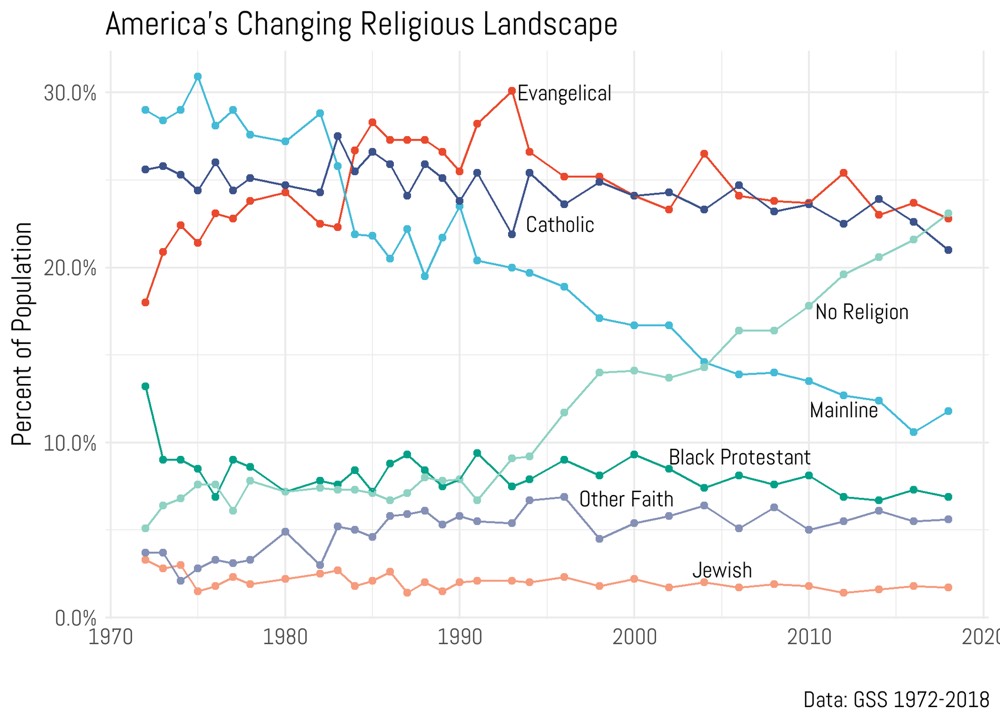
Not all of those exit­ing the pews have renounced their faith or con­vert­ed to anoth­er, but huge num­bers have joined the ranks of those who claim “no reli­gion” in sur­vey and polling data. Their num­bers are now equiv­a­lent to Catholics and evan­gel­i­cals, the two reli­gious groups most in decline behind main­line Protes­tant church­es. Polit­i­cal sci­en­tist Ryan P. Burge of East­ern Illi­nois Uni­ver­si­ty is not sur­prised. “It’s been a con­stant steady increase for 20 years now,” he says, point­ing to data from a Gen­er­al Social Sur­vey visu­al­ized in the graph above.

The last decade has seen the sharpest upturn yet, with “nones” now esti­mat­ed at 23.1 per­cent of the pop­u­la­tion. If this rise—and sub­se­quent plateaus and declines in the major reli­gious groups sur­veyed (and the batch of non-Judeo-Chris­t­ian “Oth­er Faith”s dis­mis­sive­ly lumped together)—continues, the shift could be dra­mat­ic. In 2014, 78% of the unaf­fil­i­at­ed, accord­ing to Pew polling, were raised in and walked away from a reli­gion. The shift in iden­ti­ty among young peo­ple tends to cor­re­late with a shift in pol­i­tics.

The “ris­ing tide of reli­gious­ly unaf­fil­i­at­ed vot­ers,” writes Jack Jenk­ins at Reli­gion News Ser­vice, is “a group that a 2016 PRRI analy­sis found skews young and lib­er­al.” It’s one that might off­set the over­sized influ­ence of white evan­gel­i­cals, who now make up 26% of the elec­torate and 22.5% of the pop­u­la­tion.

Any such con­clu­sions should be drawn with sev­er­al caveats. “Evan­gel­i­cals punch way above their weight,” says Burge. “They turn out a bunch at the bal­lot box. That’s large­ly a func­tion of the fact that they’re white and they’re old.” And, he might have added, many are in less eco­nom­i­cal­ly pre­car­i­ous straits than their chil­dren and grand­chil­dren, more sus­cep­ti­ble to mass media mes­sag­ing, and less prone, by design, to find­ing their vote sup­pressed. A 2016 PRRI report not­ed that “reli­gious­ly unaf­fil­i­at­ed Amer­i­cans do not vote in the same per­cent­ages as evan­gel­i­cals, and are often under­rep­re­sent­ed at the polls.”

Addi­tion­al­ly, and most impor­tant­ly to point out any time these num­bers come up: “the nones” is an entire­ly overde­ter­mined cat­e­go­ry full of peo­ple who agree on lit­tle, but they’re not sign­ing up for any church com­mit­tees any time soon for a hand­ful of loose­ly-relat­ed rea­sons. If herd­ing athe­ists, only one part of this group, is like herd­ing cats, try­ing to cor­ral 23% of the pop­u­la­tion with­out any shared creed or spe­cif­ic ide­ol­o­gy is cor­ralling an even less pre­dictable menagerie. We need to know far more about what peo­ple affirm, as well as what they deny, if we want a clear­er pic­ture of where the country’s politics—if not its gov­ern­ment or policies—might be head­ed.

via Kot­tke

Relat­ed Con­tent:

A Visu­al Map of the World’s Major Reli­gions (and Non-Reli­gions)

Ani­mat­ed Map Shows How the Five Major Reli­gions Spread Across the World (3000 BC – 2000 AD)

Does Democ­ra­cy Demand the Tol­er­ance of the Intol­er­ant? Karl Popper’s Para­dox

Josh Jones is a writer and musi­cian based in Durham, NC. Fol­low him at @jdmagness

Does Democracy Demand the Tolerance of the Intolerant? Karl Popper’s Paradox

Pho­to via Wiki­me­dia Com­mons

In the past few years, when far-right nation­al­ists are banned from social media, vio­lent extrem­ists face boy­cotts, or insti­tu­tions refuse to give a plat­form to racists, a faux-out­raged moan has gone up: “So much for the tol­er­ant left!” “So much for lib­er­al tol­er­ance!” The com­plaint became so hack­neyed it turned into an already-hack­neyed meme. It’s a won­der any­one thinks this line has any rhetor­i­cal force. The equa­tion of tol­er­ance with acqui­es­cence, pas­siv­i­ty, or a total lack of bound­aries is a reduc­tio ad absur­dum that denudes the word of mean­ing. One can only laugh at unse­ri­ous char­ac­ter­i­za­tions that do such vio­lence to rea­son.

The con­cept of tol­er­a­tion has a long and com­pli­cat­ed his­to­ry in moral and polit­i­cal phi­los­o­phy pre­cise­ly because of the many prob­lems that arise when the word is used with­out crit­i­cal con­text. In some absurd, 21st cen­tu­ry usages, tol­er­ance is even con­flat­ed with accep­tance, approval, and love. But it has his­tor­i­cal­ly meant the opposite—noninterference with some­thing one dis­likes or despis­es. Such non­in­ter­fer­ence must have lim­its. As Goethe wrote in 1829, “tol­er­ance should be a tem­po­rary atti­tude only; it must lead to recog­ni­tion. To tol­er­ate means to insult.” Tol­er­ance by nature exists in a state of social ten­sion.

Accord­ing to vir­tu­al­ly every con­cep­tion of lib­er­al democ­ra­cy, a free and open soci­ety requires tense debate and ver­bal con­flict. Soci­ety, the argu­ment goes, is only strength­ened by the oft-con­tentious inter­play of dif­fer­ing, even intol­er­ant, points of view. So, when do such views approach the lim­its of tol­er­a­tion? One of the most well-known para­dox­es of tol­er­ance was out­lined by Aus­tri­an philoso­pher Karl Pop­per in his 1945 book The Open Soci­ety and Its Ene­mies.

Pop­per was a non-reli­gious Jew who wit­nessed the rise of Nazism in the 20s in his home­town of Vien­na and fled to Eng­land, then in 1937, to Christchurch, New Zealand, where he was appoint­ed lec­tur­er at Can­ter­bury Col­lege (now the Uni­ver­si­ty of Can­ter­bury). There, he wrote The Open Soci­ety, where the famous pas­sage appears in a foot­note:

Unlim­it­ed tol­er­ance must lead to the dis­ap­pear­ance of tol­er­ance. If we extend unlim­it­ed tol­er­ance even to those who are intol­er­ant, if we are not pre­pared to defend a tol­er­ant soci­ety against the onslaught of the intol­er­ant, then the tol­er­ant will be destroyed, and tol­er­ance with them. — In this for­mu­la­tion, I do not imply, for instance, that we should always sup­press the utter­ance of intol­er­ant philoso­phies; as long as we can counter them by ratio­nal argu­ment and keep them in check by pub­lic opin­ion, sup­pres­sion would cer­tain­ly be unwise. But we should claim the right to sup­press them if nec­es­sary even by force; for it may eas­i­ly turn out that they are not pre­pared to meet us on the lev­el of ratio­nal argu­ment, but begin by denounc­ing all argu­ment; they may for­bid their fol­low­ers to lis­ten to ratio­nal argu­ment, because it is decep­tive, and teach them to answer argu­ments by the use of their fists or pis­tols. We should there­fore claim, in the name of tol­er­ance, the right not to tol­er­ate the intol­er­ant.

This last sen­tence has “been print­ed on thou­sands of bumper stick­ers and fridge mag­nets,” writes Will Harvie at Stuff. The quote might become almost as ubiq­ui­tous as Voltaire’s line about “defend­ing to the death” the right of free speech (words actu­al­ly penned by Eng­lish writer Beat­rice Eve­lyn Hall). Pop­per saw how fas­cism cyn­i­cal­ly exploit­ed lib­er­al tol­er­a­tion to gain a foothold and incite per­se­cu­tion, vio­lent attacks, and even­tu­al­ly geno­cide. As he writes in his auto­bi­og­ra­phy, he had seen how “com­pet­ing par­ties of the Right were out­bid­ding each oth­er in their hos­til­i­ty towards the Jews.”

Popper’s for­mu­la­tion has been been used across the polit­i­cal spec­trum, and some­times applied in argu­ments against civ­il pro­tec­tions for some reli­gious sects who hold intol­er­ant views—a cat­e­go­ry that includes prac­ti­tion­ers of near­ly every major faith. But this is mis­lead­ing. The line for Pop­per is not the mere exis­tence of exclu­sion­ary or intol­er­ant beliefs or philoso­phies, how­ev­er reac­tionary or con­temptible, but the open incite­ment to per­se­cu­tion and vio­lence against oth­ers, which should be treat­ed as crim­i­nal, he argued, and sup­pressed, “if nec­es­sary,” he con­tin­ues in the foot­note, “even by force” if pub­lic dis­ap­proval is not enough.

By this line of rea­son­ing, vig­or­ous resis­tance to those who call for and enact racial vio­lence and eth­nic cleans­ing is a nec­es­sary defense of a tol­er­ant soci­ety. Ignor­ing or allow­ing such acts to con­tin­ue in the name of tol­er­ance leads to the night­mare events Pop­per escaped in Europe, or to the hor­rif­ic mass killings at two mosques in Christchurch this month that delib­er­ate­ly echoed Nazi atroc­i­ties. There are too many such echoes, from mass mur­ders at syn­a­gogues to con­cen­tra­tion camps for kid­napped chil­dren, all sur­round­ed by an echo cham­ber of wild­ly unchecked incite­ment by state and non-state actors alike.

Pop­per rec­og­nized the inevitabil­i­ty and healthy neces­si­ty of social con­flict, but he also affirmed the val­ues of coop­er­a­tion and mutu­al recog­ni­tion, with­out which a lib­er­al democ­ra­cy can­not sur­vive. Since the pub­li­ca­tion of The Open Soci­ety and its Ene­mies, his para­dox of tol­er­ance has weath­ered decades of crit­i­cism and revi­sion. As John Hor­gan wrote in an intro­duc­tion to a 1992 inter­view with the thinker, two years before his death, “an old joke about Pop­per” reti­tles the book “The Open Soci­ety by One of its Ene­mies.”

With less than good humor, crit­ics have derid­ed Popper’s lib­er­al­ism as dog­mat­ic and itself a fas­cist ide­ol­o­gy that inevitably tends to intol­er­ance against minori­ties. Ques­tion about who gets to decide which views should be sup­pressed and how are not easy to answer. Pop­per liked to say he wel­comed the crit­i­cism, but he refused to tol­er­ate views that reject rea­son, fact, and argu­ment in order to incite and per­pe­trate vio­lence and per­se­cu­tion. It’s dif­fi­cult to imag­ine any demo­c­ra­t­ic soci­ety sur­viv­ing for long if it decides that, while maybe objec­tion­able, such tol­er­ance is tol­er­a­ble. The ques­tion, “these days,” writes Harvie, is “can a tol­er­ant soci­ety sur­vive the inter­net?”

Relat­ed Con­tent:

20,000 Amer­i­cans Hold a Pro-Nazi Ral­ly in Madi­son Square Gar­den in 1939: Chill­ing Video Re-Cap­tures a Lost Chap­ter in US His­to­ry

How Did Hitler Rise to Pow­er? : New TED-ED Ani­ma­tion Pro­vides a Case Study in How Fas­cists Get Demo­c­ra­t­i­cal­ly Elect­ed

Rare 1940 Audio: Thomas Mann Explains the Nazis’ Ulte­ri­or Motive for Spread­ing Anti-Semi­tism

Josh Jones is a writer and musi­cian based in Durham, NC. Fol­low him at @jdmagness

William S. Burroughs’ Manifesto for Overthrowing a Corrupt Government with Fake News and Other Prophetic Methods: It’s Now Published for the First Time

The Boy Scouts of Amer­i­ca have faced some deserved crit­i­cism, unde­served ridicule, and have been cru­el­ly used as props, but I think it’s safe to say that they still bear a pret­ty whole­some image for a major­i­ty of Amer­i­cans. That was prob­a­bly no less the case and per­haps a good deal more so in 1969, but the end of the six­ties was not by any stretch a sim­pler time. It was a peri­od, writes Scott McLemee, “when the My Lai Mas­sacre, the Man­son Fam­i­ly and the Weath­er Under­ground were all in the news.” The Zodi­ac Killer was on the loose, a gen­er­al air of bleak­ness pre­vailed.

William S. Bur­roughs respond­ed to this mad­ness with a counter-mad­ness of his own in “The Revised Boy Scout Man­u­al,” “an impas­sioned yet some­times inco­her­ent rebuke to ossi­fied polit­i­cal ide­olo­gies,” writes Kirkus. We can pre­sume Bur­roughs meant his instruc­tions for over­throw­ing cor­rupt gov­ern­ments to satir­i­cal­ly com­ment on the out­doorsy sta­tus quo youth cult. But we can also see the man­u­al tak­ing as its start­ing point cer­tain val­ues the Scouts cham­pi­on, at their best: obses­sive atten­tion to detail, Mac­Gyver-like inge­nu­ity, and good old Amer­i­can self-reliance.

Want to bring down the gov­ern­ment? You can do it your­self… with fake news.

Boing Boing quotes a long pas­sage from the book that shows Bur­roughs as a com­pre­hen­sive, if not quite whole­some, Scout advi­sor, describ­ing how one might use mass media’s meth­ods to dis­rupt its mes­sage, and to trans­mit mes­sages of your own. We might think he is fore­see­ing, even rec­om­mend­ing, tech­niques we now see used to a no-longer-shock­ing degree.

You have an advan­tage which your oppos­ing play­er does not have. He must con­ceal his manip­u­la­tions. You are under no such neces­si­ty. In fact you can adver­tise the fact that you are writ­ing news in advance and try­ing to make it hap­pen by tech­niques which any­body can use.

And that makes you NEWS. And a TV per­son­al­i­ty as well, if you play it right. 

You con­struct fake news broad­casts on video cam­era… And you scram­ble your fab­ri­cat­ed news in with actu­al news broad­casts.

We might read in Bur­roughs’ instruc­tions the meth­ods of YouTube pro­pa­gan­dists, social media manip­u­la­tors, and some of the most pow­er­ful peo­ple in the world. Bur­roughs does not rec­om­mend tak­ing over the media appa­ra­tus by seiz­ing its pow­er, but rather using tech­nol­o­gy to make “cut­up video tapes” and ham radio broad­casts fea­tur­ing doc­u­men­tary media spliced togeth­er with fab­ri­ca­tions. These “tech­niques could swamp the mass media with total illu­sion,” he writes. “It will be seen that the fal­si­fi­ca­tions in syl­lab­ic West­ern lan­guages are in point of fact actu­al virus mech­a­nisms.”

Bur­roughs is not sim­ply writ­ing a ref­er­ence for mak­ing fear­mon­ger­ing pro­pa­gan­da. Even when it comes to the sub­ject of fear, he some­times sounds as if he is revis­ing Sergei Eisenstein’s mon­tage the­o­ry for his own sim­i­lar­ly vio­lent times. “Let us say the mes­sage is fear. For this we take all the past fear shots of the sub­ject we can col­lect or evoke. We cut these in with fear words and pic­tures, with threats, etc. This is all act­ed out and would be upset­ting enough in any case. Now let’s try it scram­bled and see if we get an even stronger effect.”

What would this effect be? One “com­pa­ra­ble to post-hyp­not­ic sug­ges­tion”? Who is the audi­ence, and would they be, a la Clock­work Orange, a cap­tive one? Did Bur­roughs see peo­ple on street cor­ners screen­ing their cut-up videos, despite the fact that con­sumer-lev­el video tech­nol­o­gy did not yet exist? Is this a cin­e­mat­ic exper­i­ment, mass media-age occult rit­u­al, com­pendi­um of prac­ti­cal mag­ic for insid­er media adepts?

See what you can make of Bur­roughs’ “The Revised Boy Scout Man­u­al” (sub­ti­tled “an elec­tron­ic rev­o­lu­tion”). The book has been reis­sued by the Ohio State Press, with an after­word (read it here) by V. Vale, pub­lish­er of the leg­endary, rad­i­cal mag­a­zine RE/Search, who excerpt­ed a part of the “Revised Man­u­al” in the ear­ly 1980s and planned to pub­lish it in full before “a per­son­al rela­tion­ship blowup” put an end to the project.

McLemee titles his review of Burrough’s redis­cov­ered man­i­festo “Dis­tant Ear­ly Warn­ing,” and much of it does indeed sound eeri­ly prophet­ic. But we should also bear in mind the book is itself a coun­ter­cul­tur­al pas­tiche, designed to scram­ble minds for rea­sons only Bur­roughs tru­ly knew. He was a “prac­tic­ing Sci­en­tol­o­gist at the time” of the book’s com­po­si­tion, “albeit not for much longer,” and he does pre­scribe use of the e‑meter and makes scat­tered ref­er­ences to L. Ron Hub­bard. But as a prac­ti­tion­er of his own pre­cepts, Bur­roughs would not have writ­ten a mono­graph uncrit­i­cal­ly pro­mot­ing one belief sys­tem or anoth­er. (Well, maybe just the once.) He also quotes Hassan‑I Sab­bah, dis­cuss­es Mayan hiero­glyph­ics, and talks Gen­er­al Seman­tics.

“The Revised Boy Scout Man­u­al” “has ele­ments of lib­er­tar­i­an man­i­festo, para­mil­i­tary hand­book, revenge fan­ta­sy and dark satire,” McLemee writes, “and wher­ev­er the line between fic­tion and non­fic­tion may be, it’s nev­er clear for long.” In this, Bur­roughs only scram­bles ele­ments already in abun­dance at the end of the six­ties and in the ear­ly sev­en­ties, dur­ing which he revised and record­ed the work sev­er­al times as he tran­si­tioned him­self out of an orga­ni­za­tion that main­tained total con­trol through mass media. Like Mar­shall McLuhan, Noam Chom­sky and oth­ers, he was begin­ning to see this phe­nom­e­non every­where he looked. Bur­roughs’ most last­ing influ­ence may be that, like the late-60s Sit­u­a­tion­ists, he devised a cun­ning and effec­tive way to turn mass media in on itself, one with per­haps more sin­is­ter impli­ca­tions.

via Boing Boing

Relat­ed Con­tent:

How William S. Bur­roughs Embraced, Then Reject­ed Sci­en­tol­ogy, Forc­ing L. Ron Hub­bard to Come to Its Defense (1959–1970)

How William S. Bur­roughs Used the Cut-Up Tech­nique to Shut Down London’s First Espres­so Bar (1972)

When William S. Bur­roughs Appeared on Sat­ur­day Night Live: His First TV Appear­ance (1981)

5 Ani­ma­tions Intro­duce the Media The­o­ry of Noam Chom­sky, Roland Barthes, Mar­shall McLuhan, Edward Said & Stu­art Hall

Josh Jones is a writer and musi­cian based in Durham, NC. Fol­low him at @jdmagness

Christopher Hitches Makes the Case for Paying Reparations for Slavery in the United States

There may be no more hereti­cal fig­ure from the last sev­er­al decades for both the cur­rent main­stream polit­i­cal left and right than the late Christo­pher Hitchens. He has main­tained con­trar­i­an posi­tions that range from vex­ing to enrag­ing for near­ly every ortho­doxy. Con­trar­i­an­ism can seem his one sin­gu­lar con­sis­ten­cy in a slide from “social­ist to neo­con” and some very impe­ri­al­ist views on war, race, cul­ture, and reli­gion. But his one true alle­giance, he would say, was to “the prin­ci­ples of free inquiry” and Enlight­en­ment thought.

Hitchens inquired freely and often, and he was a supreme­ly pol­ished rhetori­cian who had mas­tered the art of mak­ing argu­ments, regard­less of whether he was per­suad­ed by them him­self. It may seem sur­pris­ing that a cru­sad­er against “the race card in Amer­i­can pol­i­tics” and “the per­ils of iden­ti­ty pol­i­tics,” would make the case for repa­ra­tions for slav­ery. But he does so in a 2001 Oxford-style debate at Boston Uni­ver­si­ty, a forum that requires no per­son­al alle­giance to the posi­tion.

This con­text aside, Hitchens’ argu­ment is com­pelling on its own mer­its. “It mat­ters not what you think,” he says in a clas­si­cal­ly lib­er­al for­mu­la in his intro­duc­to­ry remarks above, “it mat­ters how you think.” He starts with an argu­ment from anal­o­gy: with the repa­tri­a­tion of the Elgin Mar­bles, sec­tions of the Parthenon tak­en from Greece in the 18th cen­tu­ry. The acqui­si­tion of these arti­facts was “an orig­i­nal crime,” says Hitchens, “a des­e­cra­tion of a great his­toric cul­ture…. It was a theft, a rape, a tak­ing, per­pe­trat­ed by the strong upon the weak.”

This was, he says, “by the way… all done at the same time as the British fleet… was also the mil­i­tary guar­an­tor of the slave trade.” Not every crime com­mit­ted by the British Empire could be made good, but “this one could. Resti­tu­tion could be made.” Upon pub­lish­ing a book mak­ing this case for return­ing the Greek stones, Hitchens says he was “imme­di­ate­ly impressed by the tor­rent of bad faith argu­ments in which I was doused… the irrel­e­vant, the non-sequitur, the gen­er­al­iza­tion.” Like­wise, when the sub­ject of repa­ra­tions comes up, Hitch­es says he hears “a con­stant whine and drone” of bad faith.

To laughs from the audi­ence, he cheek­i­ly calls coun­ter­ar­gu­ments a “white whine.” On the sub­ject of repa­ra­tions, white Amer­i­cans dis­play “a rather nasty com­bi­na­tion of self pity and self hatred,” he says, the work­ings of a “bad con­science.” He weaves his scorn for self-inter­est and flim­sy rea­son­ing into an extend­ed anal­o­gy with loot­ed arti­facts in the British muse­um. Curi­ous­ly, he does not seem to argue that Britain make resti­tu­tion to the descen­dants of loot­ed peo­ple, an obvi­ous con­clu­sion of his argu­ments for the U.S. But per­haps it comes up in the full debate from which these remarks come, just below.

Relat­ed Con­tent:

Christo­pher Hitchens Dis­miss­es the Cult of Ayn Rand: There’s No “Need to Have Essays Advo­cat­ing Self­ish­ness Among Human Beings; It Requires No Rein­force­ment”

The Atlantic Slave Trade Visu­al­ized in Two Min­utes: 10 Mil­lion Lives, 20,000 Voy­ages, Over 315 Years

W.E.B. Du Bois Cre­ates Rev­o­lu­tion­ary, Artis­tic Data Visu­al­iza­tions Show­ing the Eco­nom­ic Plight of African-Amer­i­cans (1900)

Josh Jones is a writer and musi­cian based in Durham, NC. Fol­low him at @jdmagness

Buckminster Fuller Rails Against the “Nonsense of Earning a Living”: Why Work Useless Jobs When Technology & Automation Can Let Us Live More Meaningful Lives

We are a haunt­ed species: haunt­ed by the specter of cli­mate change, of eco­nom­ic col­lapse, and of automa­tion mak­ing our lives redun­dant. When Marx used the specter metaphor in his man­i­festo, he was iron­i­cal­ly invok­ing Goth­ic tropes. But Com­mu­nism was not a boogey­man. It was a com­ing real­i­ty, for a time at least. Like­wise, we face very real and sub­stan­tial com­ing real­i­ties. But in far too many instances, they are also man­u­fac­tured, under ide­olo­gies that insist there is no alter­na­tive.

But let’s assume there are oth­er ways to order our pri­or­i­ties, such as valu­ing human life as an end in itself. Per­haps then we could treat the threat of automa­tion as a ghost: insub­stan­tial, imma­te­r­i­al, maybe scary but harm­less. Or treat it as an oppor­tu­ni­ty to order our lives the way we want. We could stop invent­ing bull­shit, low-pay­ing, waste­ful jobs that con­tribute to cycles of pover­ty and envi­ron­men­tal degra­da­tion. We could slash the num­ber of hours we work and spend time with peo­ple and pur­suits we love.

We have been taught to think of this sce­nario as a fan­ta­sy. Or, as Buck­min­ster Fuller declared in 1970—on the thresh­old of the “Malthu­sian-Dar­win­ian” wave of neolib­er­al thought to come—“We keep invent­ing jobs because of this false idea that every­body has to be employed at some kind of drudgery…. He must jus­ti­fy his right to exist.” In cur­rent par­lance, every per­son must some­how “add val­ue” to share­hold­ers’ port­fo­lios. The share­hold­ers them­selves are under no oblig­a­tion to return the favor.

What about adding val­ue to our own lives? “The true busi­ness of peo­ple,” says Fuller, “should be to go back to school and think about what­ev­er it was they were think­ing about before some­body came along and told them they had to earn a liv­ing.” Against the “spe­cious notion” that every­one should have to make a wage to live–this “non­sense of earn­ing a living”–he takes a more mag­nan­i­mous view: “It is a fact today that one in ten thou­sand of us can make a tech­no­log­i­cal break­through capa­ble of sup­port­ing all the rest,” who then may go on to make mil­lions of small break­throughs of their own.

He may have sound­ed over­con­fi­dent at the time. But fifty years lat­er, we see engi­neers, devel­op­ers, and ana­lysts of all kinds pro­claim­ing the com­ing age of automa­tion in our life­times, with a major­i­ty of jobs to be ful­ly or par­tial­ly auto­mat­ed in 10–15 years. It is a tech­no­log­i­cal break­through capa­ble of dis­pens­ing with huge num­bers of peo­ple, unless its ben­e­fits are wide­ly shared. The cor­po­rate world sticks its head in the sand and issues guide­lines for retrain­ing, a solu­tion that will still leave mass­es unem­ployed. No mat­ter the state of the most recent jobs report, seri­ous loss­es in near­ly every sec­tor, espe­cial­ly man­u­fac­tur­ing and ser­vice work, are unavoid­able.

The jobs we invent have changed since Fuller’s time, become more con­tin­gent and less secure. But the obses­sion with cre­at­ing them, no mat­ter their impact or intent, has only grown, a run­away delu­sion no one can seem to stop. Should we fear automa­tion? Only if we col­lec­tive­ly decide the cur­rent course of action is all there is, that “every­body has to earn a living”—meaning turn a profit—or drop dead. As Con­gress­woman Alexan­dria Ocasio-Cortez—echoing Fuller—put it recent­ly at SXSW, “we live in a soci­ety where if you don’t have a job, you are left to die. And that is, at its core, our prob­lem…. We should not be haunt­ed by the specter of being auto­mat­ed out of work.”

“We should be excit­ed about automa­tion,” she went on, “because what it could poten­tial­ly mean is more time to edu­cate our­selves, more time cre­at­ing art, more time invest­ing in and inves­ti­gat­ing the sci­ences.” How­ev­er that might be achieved, through sub­si­dized health, edu­ca­tion, and basic ser­vices, new New Deal and Civ­il Rights poli­cies, a Uni­ver­sal Basic Income, or some cre­ative syn­the­sis of all of the above, it will not pro­duce a utopia—no polit­i­cal solu­tion is up that task. But con­sid­er­ing the ben­e­fits of sub­si­diz­ing our human­i­ty, and the alter­na­tive of let­ting its val­ue decline, it seems worth a shot to try what econ­o­mist Bill Black calls the “pro­gres­sive pol­i­cy core,” which, coin­ci­den­tal­ly, hap­pens to be “cen­trist in terms of the elec­torate’s pref­er­ences.”

via Kot­tke

Relat­ed Con­tent:

Bertrand Rus­sell & Buck­min­ster Fuller on Why We Should Work Less, and Live & Learn More

The Life & Times of Buck­min­ster Fuller’s Geo­des­ic Dome: A Doc­u­men­tary

Every­thing I Know: 42 Hours of Buck­min­ster Fuller’s Vision­ary Lec­tures Free Online (1975)

Josh Jones is a writer and musi­cian based in Durham, NC. Fol­low him at @jdmagness

Watch Lin-Manuel Miranda Perform the Earliest Version of Hamilton at the White House, Six Years Before the Play Hit the Broadway Stage (2009)

Anoth­er immi­grant comin’ up from the bot­tom

His ene­mies destroyed his rep, Amer­i­ca for­got him… 

Holler if you can remem­ber a time when few Amer­i­cans were well-versed enough in found­ing father Alexan­der Hamil­ton’s ori­gin sto­ry to recite it in rhyme at the drop of a hat.

Believe it or not, as recent­ly as the sum­mer of 2015, when Lin-Manuel Miran­da’s Pulitzer Prize-win­ning Hamil­ton: An Amer­i­can Musi­cal explod­ed on Broad­way, Hamil­ton the man was, as the Tony award win­ning lyrics above sug­gest, large­ly for­got­ten, a rel­ic whose por­trait on the $10 bill aroused lit­tle curios­i­ty.

Back then, Hamil­ton was per­haps best known as the hap­less soul embod­ied by Michael Cera in the web series Drunk His­to­ry.

Ron Chernow’s 2005 biog­ra­phy served up a more nuanced por­trait to read­ers with the sta­mi­na to make it through his mas­sive tome.

That’s the book Miran­da famous­ly took along on vaca­tion in the peri­od between his musi­cal In the Heights’ Broad­way and Off-Broad­way runs.

The rest, as they say, is his­to­ry.

As is the above video, in which a 29-year-old Miran­da per­forms The Hamil­ton Mix­tape for Pres­i­dent Oba­ma, the First Lady, and oth­er lumi­nar­ies as part of a White House evening of poet­ry, music, and spo­ken word.

There’s your Hamil­ton (the musi­cal) ori­gin sto­ry.

Its cre­ator ini­tial­ly con­ceived of it as a hip hop con­cept album in which cel­e­brat­ed rap­pers would give voice to dif­fer­ent his­tor­i­cal char­ac­ters.

Music direc­tor Alex Lacamoire’s jubi­lant expres­sion at the White House piano con­firms that they had some inkling that they were on to some­thing very big.

A few months lat­er, Miran­da reflect­ed on the expe­ri­ence in an inter­view with Play­bill:

The whole day was a day that will exist out­side any oth­er day in my life. Any day that starts with you shar­ing a van to the White House with James Earl Jones is going to be a crazy day! I was the clos­ing act of the show and I had nev­er done this project in pub­lic before so I was already ner­vous. I looked at the Pres­i­dent and the First Lady only once and when I looked at him he was whis­per­ing some­thing to her and I couldn’t let that get to me. After­wards, George Stephanopou­los came up to me and said, “The Pres­i­dent is back there talk­ing about your song, he’s say­ing ‘Where is (Sec­re­tary of the Trea­sury) Tim­o­thy Geit­ner? We need him to hear the Hamil­ton rap!’” To hear that the Pres­i­dent enjoyed the song was a real dream come true. 

The Oba­mas enjoy­ment was such that they appeared in a pre-taped seg­ment to intro­duce the Hamil­ton cast at the 2016 Tony awards (a tough year for any oth­er musi­cal unlucky enough to have debuted in the same peri­od as this jug­ger­naut).

They also host­ed a Hamil­ton work­shop for DC-area youth, for which the Broad­way cast trav­eled down on their day off, per­form­ing the open­ing num­ber out of cos­tume. Biog­ra­ph­er Ron Cher­now was in the front row for that one, as Oba­ma remarked that “Hamil­ton is the only thing Dick Cheney and I agree on.”

(“Dick Cheney attend­ed the show tonight,” Miran­da tweet­ed after Cheney’s vis­it. “He’s the OTHER vice-pres­i­dent who shot a friend while in office.” Cur­rent Vice Pres­i­dent Mike Pence also took in a per­for­mance short­ly before his swear­ing in, though his appear­ance was met with a much less pithy response.)

As for The Hamil­ton Mix­tape, many of Miran­da’s dream rap­pers turned out for its record­ing, though the tracks they laid down diverge from the one per­formed live for the Oba­mas in 2009, which legions of ador­ing fans can chant along to thanks to the musi­cal’s over­whelm­ing pop­u­lar­i­ty. Instead, this mixtape’s con­tribut­ing artists were invit­ed to reimag­ine and expand upon the themes of the play—immigration, ambi­tion, and stubble—placing them in an explic­it­ly 21st-cen­tu­ry con­text.

Lis­ten to The Hamil­ton Mix­tape and the orig­i­nal cast record­ing of Hamil­ton for free on Spo­ti­fy.

Relat­ed Con­tent:

Lin-Manuel Miran­da & Emi­ly Blunt Take You Through 22 Clas­sic Musi­cals in 12 Min­utes

A Whiskey-Fueled Lin-Manuel Miran­da Reimag­ines Hamil­ton as a Girl on Drunk His­to­ry

Hamilton’s Lin-Manuel Miran­da Cre­ates a 19-Song Playlist to Help You Get Over Writer’s Block

Ayun Hal­l­i­day is an author, illus­tra­tor, the­ater mak­er and Chief Pri­ma­tol­o­gist of the East Vil­lage Inky zine. She has yet to win the Hamil­ton lot­tery. Join her in New York City for the next install­ment of her book-based vari­ety show, Necro­mancers of the Pub­lic Domain, this March. Fol­low her @AyunHalliday.

To Save Civilization, the Rich Need to Pay Their Taxes: Historian Rutger Bregman Speaks Truth to Power at Davos and to Fox’s Tucker Carlson

Cer­tain econ­o­mists may have down­grad­ed the labor the­o­ry of val­ue, but most of us can agree on the basic moral intu­ition that no one per­son is worth mil­lions, even bil­lions, more than almost every­one else on the plan­et. Yet we live in a soci­ety that allows indi­vid­u­als to hoard mil­lions and bil­lions of dol­lars in cash, assets, and cap­i­tal gains, with­out even the pre­sump­tion that they demon­strate why they should have it–especially to the degree that the top 1% now holds more wealth than 90% in the U.S.

What social con­tract allows for this sit­u­a­tion? I’m not per­son­al­ly inter­est­ed in the answer from econ­o­mists, though I imag­ine there are many excel­lent­ly accred­it­ed pro­po­nents. The dom­i­nant assump­tions in eco­nom­ics come from fan­tasies like ceteris paribus, “all else being equal,” and the con­cept of “exter­nal­i­ties.” World his­tor­i­cal inequal­i­ty, polit­i­cal insta­bil­i­ty, and eco­log­i­cal dev­as­ta­tion do not seem to pose seri­ous prob­lems for most main­stream eco­nom­ic think­ing. But what do his­to­ri­ans say? This is, after all, a his­tor­i­cal ques­tion.

Many sim­i­lar sit­u­a­tions have obtained in the past. Some­times they have result­ed in bloody rev­o­lu­tions, some­times sack­ing and pil­lag­ing, some­times redis­tri­b­u­tion schemes. Noblesse oblige: land grants, endow­ments, hos­pi­tals, muse­ums, uni­ver­si­ties… these have not only eased the con­sciences of the rich but have stood out as appeas­ing acts of pub­lic gen­eros­i­ty. But the only thing that has real­ly mit­i­gat­ed the con­di­tions for soci­etal col­lapse under cap­i­tal­ism?

Accord­ing to Dutch his­to­ri­an and writer Rut­ger Breg­man, it’s high tax­es on high incomes and estates. It just so hap­pened, how­ev­er, at this year’s Davos World Eco­nom­ic Forum, as Breg­man lament­ed in a Davos pan­el dis­cus­sion, tax­es were the one thing bil­lion­aires would not dis­cuss. This was so, he observes, at a con­fer­ence that fea­tures Sir David Atten­bor­ough “talk­ing about how we’re wreck­ing the plan­et.”

I mean, I hear peo­ple talk­ing the lan­guage of par­tic­i­pa­tion and jus­tice and equal­i­ty and trans­paren­cy, but then, I mean, almost no one rais­es the real issue of tax avoid­ance, right? And of the rich are just not pay­ing their fair share. I mean, it feels like I’m at a firefighter’s con­fer­ence and no one’s allowed to speak about water.

Pic­tur­ing fire­fight­ers hoard­ing water and refus­ing to share it while the plan­et is going up in flames is a sin­is­ter image, but maybe the inten­tions are beside the point. Even where tax rates are high(ish), gov­ern­ments go out of their way to allow com­pa­nies and indi­vid­u­als to avoid pay­ing them. Sure­ly, many peo­ple believe this is nec­es­sary to cre­ate jobs? So what if those jobs lack secu­ri­ty, ben­e­fits, or a liv­ing wage?

Breg­man pulls back from the inflam­ma­to­ry metaphor to con­cede that one pan­el did address the issue. He was one of fif­teen par­tic­i­pants. We have to “stop talk­ing about phil­an­thropy,” he says, “and start talk­ing about tax­es,” just like Amer­i­cans did in the sup­pos­ed­ly hal­cy­on days of the 1950s, when under Repub­li­can pres­i­dent Dwight D. Eisen­how­er the top mar­gin­al tax rate was 91%. He says this to peo­ple like Michael Dell, who once asked Breg­man for an exam­ple of a 70% tax rate ever work­ing.

Oxfam’s exec­u­tive direc­tor Win­nie Byany­i­ma sub­stan­ti­ates his polemic, not­ing glob­al­ly “we have a tax sys­tem that leaks so much, that $170 bil­lion” annu­al­ly ends up in tax havens. This is wealth that is extract­ed from the planet’s resources, from gov­ern­ment sub­si­dies and the labor hours and health of gross­ly under­paid work­ers. Then it is dis­ap­peared. If you’ve seen this video, you’ve seen the charges of “one-sid­ed­ness” lobbed by for­mer Yahoo CFO Ken Gold­man from the audi­ence. Byany­i­ma’s response rebuts all of his talk­ing points. She deserves her own cheer­lead­ing video edit.

Breg­man took the same con­fronta­tion­al stance in an unaired inter­view with Fox’s Tuck­er Carl­son. After Carl­son seemed to agree with him, the his­to­ri­an bris­tled and point­ed out that as “a mil­lion­aire fund­ed by bil­lion­aires,” Carl­son has faith­ful­ly rep­re­sent­ed and com­mu­ni­cat­ed the inter­ests of his employ­ers for decades, whether that’s the bru­tal scape­goat­ing of immi­grants or the defense of unlim­it­ed prof­i­teer­ing and huge tax cuts for the wealthy (and tax rais­es for every­one else). The host ends the inter­view sput­ter­ing insults and obscen­i­ties and sneers “I was will­ing to give you a hear­ing.” The prob­lem requires more than a con­de­scend­ing pat on the head, Breg­man argues.

His solu­tion to mas­sive inequal­i­ty and unrest, uni­ver­sal basic income, is one that, like high mar­gin­al tax rates, once appealed to Repub­li­cans. The pro­pos­al has a long his­to­ry, many seri­ous detrac­tors, and it’s also polit­i­cal­ly ignored. You can hear Bregman’s argu­ment for it above, and against Mar­garet Thatcher’s ruth­less­ly ahis­tor­i­cal char­ac­ter­i­za­tion of pover­ty as a “per­son­al­i­ty defect.” If you think UBI goes too far, or not near­ly far enough, maybe you’d be inter­est­ed in oth­er ideas, like a 15-hour work­week and open bor­ders, part of the “ide­al world” Breg­man says is pos­si­ble in his book Utopia for Real­ists. You can down­load it as a free audio­book if you sign up for Audi­ble’s free tri­al pro­gram.

Relat­ed Con­tent:

Hear Alan Watts’s 1960s Pre­dic­tion That Automa­tion Will Neces­si­tate a Uni­ver­sal Basic Income

Experts Pre­dict When Arti­fi­cial Intel­li­gence Will Take Our Jobs: From Writ­ing Essays, Books & Songs, to Per­form­ing Surgery and Dri­ving Trucks

Bertrand Rus­sell & Buck­min­ster Fuller on Why We Should Work Less, and Live & Learn More

Josh Jones is a writer and musi­cian based in Durham, NC. Fol­low him at @jdmagness

« Go BackMore in this category... »
Quantcast