Large Archive of Hannah Arendt’s Papers Digitized by the Library of Congress: Read Her Lectures, Drafts of Articles, Notes & Correspondence

Many peo­ple read the Ger­man-Jew­ish polit­i­cal philoso­pher and jour­nal­ist Han­nah Arendt as some­thing of an ora­cle, a sec­u­lar prophet whose most famous works—her essay on the tri­al of Adolf Eich­mann and her 1951 Ori­gins of Total­i­tar­i­an­ism—con­tain secrets about our own times of high nation­al­ist fer­vor. And indeed they may, but we should also keep in mind that Arendt’s insights into the hor­rors of Nazism did not emerge until after the war.

Arendt did not iden­ti­fy as Jew­ish dur­ing the Naz­i’s rise to pow­er, but as a ful­ly assim­i­lat­ed Ger­man; she had a roman­tic rela­tion­ship with her pro­fes­sor Mar­tin Hei­deg­ger, who became a doc­tri­naire Nazi, and she seemed to have lit­tle under­stand­ing of Ger­man anti­semitism dur­ing the thir­ties and for­ties. Arendt, many have alleged, some­times seemed too close to her sub­ject.

In such times as hers, to use the words of Wal­lace Stevens—a writer with his own com­pli­cat­ed rela­tion­ship to fas­cism—the “dif­fi­cult rig­or” of observ­ing the moment means that “we rea­son of these things with lat­er rea­son.” Arendt’s obser­va­tions of Europe in the 1950s were reck­on­ings with the recent past—she drew togeth­er strains of expe­ri­ence that could not always be con­nect­ed dur­ing what Stevens calls the “irra­tional moment.” So too, intel­lec­tu­al observers of our own “irra­tional moment” may only tru­ly under­stand it “with lat­er rea­son.”

But if Amer­i­cans wish to learn about their country’s long­stand­ing polit­i­cal ten­den­cies from Arendt’s work, it is per­haps not to her writ­ing on Ger­many or the U.S.S.R. that we should turn, but to her work on the U.S., much of which is reflect­ed in typed drafts of essays and lec­tures, cor­re­spon­dence, and notes con­tained at the Library of Congress’s Han­nah Arendt Papers col­lec­tion. All of the col­lec­tion has been dig­i­tized, and some of those scans are online. Find­ing out which doc­u­ments have been uploaded and which only remain view­able onsite takes a lit­tle dig­ging around in the cat­a­log, but it is work that pays off for those with a gen­uine inter­est in the fas­ci­nat­ing turns of Arendt’s thought.

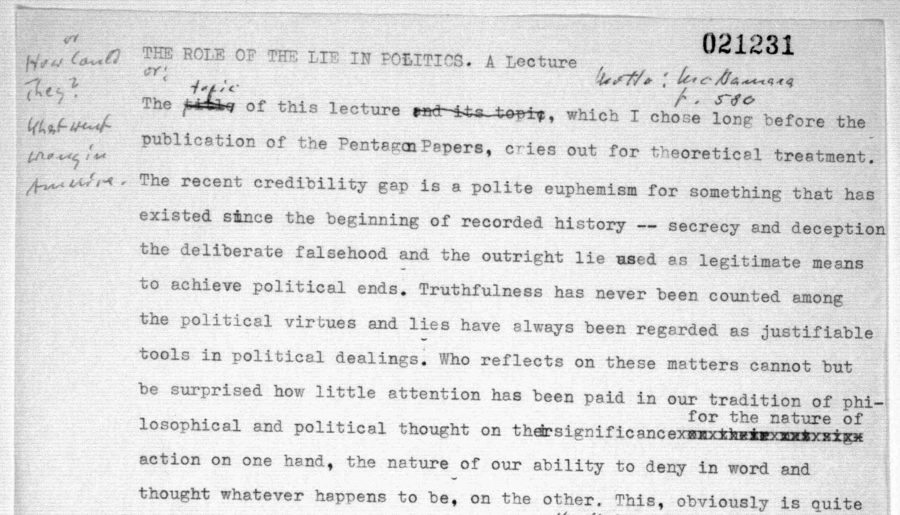
We may turn to essays such as 1971’s “Lying in Pol­i­tics,” writ­ten after the release of the Pen­ta­gon Papers, notes Brain Pick­ings, and “includ­ed in Crises of the Repub­lic—a col­lec­tion of Arendt’s time­less­ly insight­ful and increas­ing­ly time­ly essays on pol­i­tics [and] civ­il dis­obe­di­ence.” As Arendt writes in an ear­li­er lec­ture that pre­ced­ed “Lying in Politics”—with the ear­li­er title “The Role of the Lie in Pol­i­tics” (top)—“Truthfulness has nev­er been count­ed as among the polit­i­cal virtues.” You can view and down­load high-qual­i­ty images of that typed lec­ture here, and see her revise her ideas in cor­rec­tions and mar­gin­al notes.

The polit­i­cal lie, she writes weari­ly, “has exist­ed since the begin­ning of record­ed his­to­ry.” And yet, there is some­thing unique about its use in U.S. pol­i­tics, in which “the only per­son like­ly to be an ide­al vic­tim of com­plete manip­u­la­tion is the Pres­i­dent of the Unit­ed States.” Despite her dis­pas­sion­ate philo­soph­i­cal view, Arendt found the lies of the Viet­nam War-era par­tic­u­lar­ly dis­turb­ing. In the type­script page at the top, you can see a pro­posed sub­ti­tle pen­ciled in at the top left cor­ner: “How Could They? What Went Wrong in Amer­i­ca.”

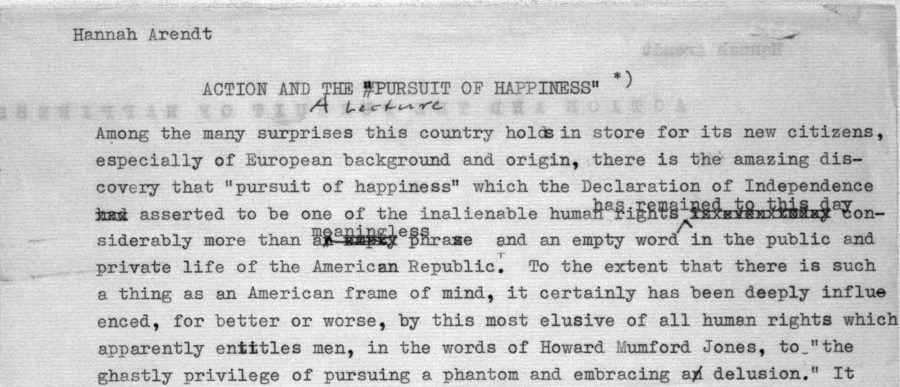
In the typed lec­ture above, “Action and the Pur­suit of Hap­pi­ness,” from 1960, Arendt remarks on the “amaz­ing dis­cov­ery” by the country’s nat­u­ral­ized “new cit­i­zens” that the “pur­suit of hap­pi­ness” remains a “more than mean­ing­less phrase and an emp­ty word in the pub­lic and pri­vate life of the Amer­i­can Repub­lic.” This “most elu­sive of all human rights,” she con­tin­ues, “appar­ent­ly enti­tles men, in the words of Howard Mum­ford Jones, to ‘the ghast­ly priv­i­lege of pur­su­ing a phan­tom and embrac­ing a delu­sion.’”

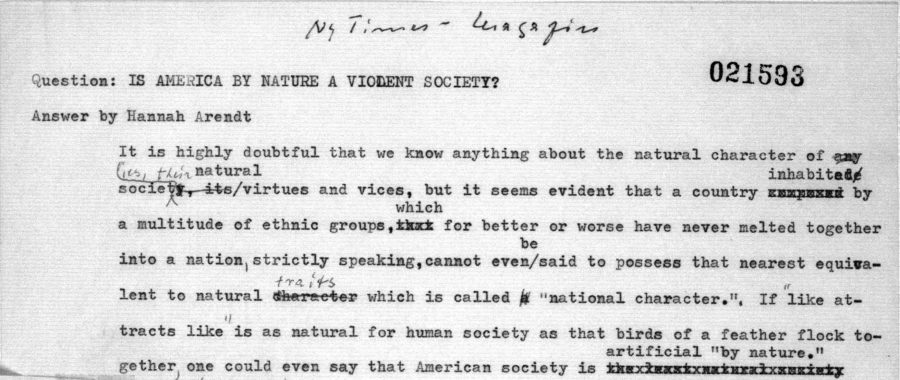
Arendt’s 1968 New York Times edi­to­r­i­al “Is Amer­i­ca By Nature a Vio­lent Soci­ety,” whose type­script you can see in part above, opens with a num­ber of assump­tions about the country’s “nation­al char­ac­ter,” begin­ning with the com­ment that the country’s “mul­ti­tude of eth­nic groups… for bet­ter or worse have nev­er melt­ed togeth­er into a nation.” Per­haps this is too broad a char­ac­ter­i­za­tion. Or per­haps the U.S. as a nation is no more “arti­fi­cial ‘by nature,’” in its com­po­si­tion than many oth­er, much old­er, nations.

Arendt’s obser­va­tions on her adopt­ed land weren’t always so astute, but she did have enough crit­i­cal dis­tance from the coun­try to close­ly observe it dur­ing times of cri­sis and see clear­ly what oth­ers could or would not. You’ll find many more of Arendt’s keen observations—typed in drafts and notes, scrib­bled in mar­gins, and writ­ten in letters—at the Library of Con­gress’ Han­nah Arendt Papers col­lec­tion, (part­ly) online.

Relat­ed Con­tent:

Enter the Han­nah Arendt Archives & Dis­cov­er Rare Audio Lec­tures, Man­u­scripts, Mar­gin­a­lia, Let­ters, Post­cards & More

A Look Inside Han­nah Arendt’s Per­son­al Library: Down­load Mar­gin­a­lia from 90 Books (Hei­deg­ger, Kant, Marx & More)

Han­nah Arendt Explains How Pro­pa­gan­da Uses Lies to Erode All Truth & Moral­i­ty: Insights from The Ori­gins of Total­i­tar­i­an­ism

Josh Jones is a writer and musi­cian based in Durham, NC. Fol­low him at @jdmagness

What the Map of the United States Would Look Like If All 50 States Had Equal Populations

In the U.S., recent elec­toral events with which we’re all quite famil­iar have prompt­ed one par­tic­u­lar rad­i­cal re-eval­u­a­tion of the polit­i­cal sys­tem, among many oth­ers: we find every­one from high-pro­file Con­sti­tu­tion­al schol­ars to anony­mous com­menters engaged in debates about the neces­si­ty, or demo­c­ra­t­ic legit­i­ma­cy, of the Elec­toral Col­lege. While the debate may not be new, it has reached an urgent inten­si­ty, and hap­pens to occur at a time when every­thing seems up for grabs. When Neil Free­man pro­posed redraw­ing state bor­ders on his pre­scient­ly-named design site Fake is the New Real back in 2012, he cre­at­ed the map above (view it in a larg­er for­mat here) to even­ly dis­trib­ute the country’s pop­u­la­tion. He did so with the dis­claimer, “this is an art project, not a seri­ous pro­pos­al.”

The idea might get a more seri­ous recep­tion these days. Nonethe­less, the iner­tia of tra­di­tion has­n’t less­ened any. Not only is it total­ly unlike­ly that states would ever be redrawn and renamed, but the Elec­toral Col­lege is also a found­ing insti­tu­tion, emerg­ing at the first Con­sti­tu­tion­al Con­ven­tion when James Madi­son first pro­posed it in 1787. Since then, PBS’s Kamala Kelkar wrote on Novem­ber 6th, 2016, “the Elec­toral Col­lege sys­tem has cost four can­di­dates the race after they received the pop­u­lar vote.” Two days lat­er that num­ber went up to five.

Still, whether one deems it nec­es­sary, super­flu­ous, or deeply per­ni­cious, it’s hard­ly con­tro­ver­sial to note that this elect­ing body comes from an era so unlike our own as to be unrec­og­niz­able. A time when, as some founders argued, writes Akhil Reed Amar at Time, “ordi­nary Amer­i­cans across a vast con­ti­nent [lacked] suf­fi­cient infor­ma­tion to choose direct­ly and intel­li­gent­ly among lead­ing pres­i­den­tial can­di­dates.” This might still be the case for var­i­ous rea­sons. But putting aside man­u­fac­tured fil­ter bub­bles and vast dis­in­for­ma­tion cam­paigns, most Amer­i­cans now have instant access, if they want it, to more infor­ma­tion than they know what to do with.

When we look at the pri­ma­ry sources, we find the actu­al rea­son for the Elec­toral Col­lege: slav­ery. Madi­son, notes Kelkar, “now known as the ‘Father of the Con­sti­tu­tion,’” was a slave­hold­ing Vir­gin­ian who wor­ried vocal­ly that North­ern states would have a decid­ed advan­tage, since upwards of 40% of the pop­u­la­tion in South­ern states con­sist­ed of enslaved peo­ple, who, of course, would not be cast­ing votes. Madison’s propo­si­tion includ­ed the infa­mous and dehu­man­iz­ing “three-fifths com­pro­mise,” which his­to­ri­an Paul Finkel­man argues enabled Thomas Jef­fer­son to win over John Adams in 1800.

Despite this his­to­ry, most peo­ple are taught that the sys­tem arose sole­ly to “bal­ance the inter­ests,” Amar writes, “of high-pop­u­la­tion and low-pop­u­la­tion states.” This sounds like a polit­i­cal­ly neu­tral inten­tion. But Free­man doesn’t ques­tion the legit­i­ma­cy of the Elec­toral Col­lege, call­ing it “a time-hon­ored, log­i­cal sys­tem” that he thinks should be pre­served. And yet, he writes, “it’s obvi­ous that reforms are need­ed.”

“The fun­da­men­tal prob­lem of the elec­toral col­lege,” Free­man writes, “is that the states of the Unit­ed States are too dis­parate in size and influ­ence. The largest state is 66 times as pop­u­lous as the small­est and has 18 times as many elec­toral votes. This increas­es the chance for Elec­toral Col­lege results that don’t match the pop­u­lar vote.” This is hard­ly the only issue. But is Freeman’s pro­pos­al a more sta­ble solu­tion to major flaws in U.S. nation­al elec­tions than sim­ply scrap­ping the Elec­toral Col­lege alto­geth­er? He makes the fol­low­ing argu­ment, in a series of bul­let-point­ed advan­tages. His map:

  • Pre­serves the his­toric struc­ture and func­tion of the Elec­toral Col­lege.
  • Ends the over-rep­re­sen­ta­tion of small states and under-rep­re­sen­ta­tion of large states in pres­i­den­tial vot­ing and in the US Sen­ate by elim­i­nat­ing small and large states.
  • Polit­i­cal bound­aries more close­ly fol­low eco­nom­ic pat­terns, since many states are more cen­tered on one or two metro areas.
  • Ends vary­ing rep­re­sen­ta­tion in the House. Cur­rent­ly, the pop­u­la­tion of House dis­tricts ranges from 528,000 to 924,000. After this reform, every House seat would rep­re­sent dis­tricts of the same size. (Since the cur­rent size of the House isn’t divis­i­ble by 50, the num­bers of seats should be increased to 450 or 500.)
  • States could be redis­trict­ed after each cen­sus — just like House seats are dis­trib­uted now.

Free­man based the map–featuring new states like “Mesabi,” “Ogal­lala,” “Big Thick­et,” “Chi­nati,” and “King”–on data from the 2010 Cen­sus, which, inci­den­tal­ly, actu­al­ly did change the dis­tri­b­u­tion of elec­tors in 2012. The Cen­sus “records a pop­u­la­tion of 308,745,538 for the Unit­ed States,” he notes, “which this map divides into 50 states, each with a pop­u­la­tion of about 6,175,000.”

He does seem to down­play the dis­ad­van­tages, list­ing only two con­cerns about dupli­cat­ed coun­ty names and a “shift in state laws and pro­ce­dures.” Free­man doesn’t men­tion the high like­li­hood of civ­il war or wide­spread social unrest if such a mas­sive redis­tri­b­u­tion of the country’s state pop­u­la­tions were ever attempt­ed. Giv­en the exam­ples of pitched legal bat­tle fought dai­ly over con­gres­sion­al redis­trict­ing of ger­ry­man­dered states, it’s also prob­a­ble noth­ing like this plan would ever make it through the courts. Con­sid­ered as an “art project” or thought exper­i­ment in civics, how­ev­er, who knows? It just might work….

via Men­tal Floss

Relat­ed Con­tent:

Sal Khan & the Mup­pets’ Grover Explain the Elec­toral Col­lege

Why Socrates Hat­ed Democ­ra­cies: An Ani­mat­ed Case for Why Self-Gov­ern­ment Requires Wis­dom & Edu­ca­tion

The “True Size” Maps Shows You the Real Size of Every Coun­try (and Will Change Your Men­tal Pic­ture of the World)

Josh Jones is a writer and musi­cian based in Durham, NC. Fol­low him at @jdmagness

David Byrne Launches the “Reasons to Be Cheerful” Web Site: A Compendium of News Meant to Remind Us That the World Isn’t Actually Falling Apart

What­ev­er your ide­o­log­i­cal per­sua­sion, our time has no doubt giv­en you more than a few rea­sons to fear for the future of civ­i­liza­tion, not least because bad news sells. Musi­cian, artist, and for­mer Talk­ing Heads front­man David Byrne has cer­tain­ly felt the effects: “It seems like the world is going to Hell. I wake up in the morn­ing, look at the paper, and go, ‘Oh no!’,” he writes. “Often I’m depressed for half the day.” But he writes that on the front page of his new project Rea­sons to Be Cheer­ful, which began as a qua­si-ther­a­peu­tic col­lec­tion of pieces of “good news that remind­ed me, ‘Hey, there’s actu­al­ly some pos­i­tive stuff going on!’ ” and has grown into an online obser­va­to­ry of world improve­ment.

What kind of pos­i­tive stuff has Byrne found? He iden­ti­fies cer­tain com­mon qual­i­ties among the sto­ries that have caught his eye: “Almost all of these ini­tia­tives are local, they come from cities or small regions who have tak­en it upon them­selves to try some­thing that might offer a bet­ter alter­na­tive than what exists.” These adjust­ments to the human con­di­tion tend to devel­op in a “bot­tom up, com­mu­ni­ty and indi­vid­u­al­ly dri­ven” man­ner, they hap­pen all over the world but could poten­tial­ly work in any cul­ture, all “have been tried and proven to be suc­cess­ful” and “can be copied and scaled up” with­out the sin­gu­lar efforts of “one amaz­ing teacher, doc­tor, musi­cian or activist.”

The sto­ries col­lect­ed so far on Rea­sons to Be Cheer­ful fall into sev­er­al dif­fer­ent cat­e­gories. In Civic Engage­ment, for exam­ple, he’s found a vari­ety of effec­tive exam­ples of that prac­tice in his trav­els back and forth across the Unit­ed States. In Health, he writes about efforts to end the war on drugs in places like Van­cou­ver, Col­orado, and Por­tu­gal. As any­one who’s fol­lowed Byrne’s writ­ing and speak­ing about cycling and the infra­struc­ture that sup­ports it might imag­ine, this side also includes a sec­tion called Urban/Transportation, whose first post deals with the glob­al influ­ence of bike share sys­tems like Paris’ Velib and bike-only street-clo­sure days like Bogotá’s Ciclovia.

In Cul­ture, Byrne writes about the rise of a form of music called AfroReg­gae that offers an alter­na­tive to a life of crime for the youth of Brazil’s fave­las, the dis­tinc­tive libraries estab­lished at the end of Bogotá’s rapid bus lines and in poor parts of Medel­lín, and even some of his own work relat­ed to the record­ing and tour design of his own upcom­ing album Amer­i­can UtopiaAmer­i­can Utopia in the year 2018? That might sound awful­ly opti­mistic, but remem­ber that David Byrne is the man who once went on an artis­tic speak­ing tour about his love of Pow­er­point. If he can see the good in that, he can see the good in any­thing.

Vis­it Byrne’s Rea­sons to Be Cheer­ful site here.

Relat­ed Con­tent:

David Byrne’s Grad­u­a­tion Speech Offers Trou­bling and Encour­ag­ing Advice for Stu­dents in the Arts

David Byrne: From Talk­ing Heads Front­man to Lead­ing Urban Cyclist

The Phi­los­o­phy of “Opti­mistic Nihilism,” Or How to Find Pur­pose in a Mean­ing­less Uni­verse

The Pow­er of Pes­simism: Sci­ence Reveals the Hid­den Virtues in Neg­a­tive Think­ing

Based in Seoul, Col­in Mar­shall writes and broad­casts on cities and cul­ture. His projects include the book The State­less City: a Walk through 21st-Cen­tu­ry Los Ange­les and the video series The City in Cin­e­ma. Fol­low him on Twit­ter at @colinmarshall or on Face­book.

A Short Animated Introduction to Karl Marx

Is Karl Marx’s cri­tique of cap­i­tal­ism still rel­e­vant to the 21st cen­tu­ry? Can we ever read him inde­pen­dent­ly of the move­ments that vio­lent­ly seized state pow­er in his name, claim­ing to rep­re­sent the work­ers through the sole will of the Par­ty? These are ques­tions Marx­ists must con­front, as must all seri­ous defend­ers of cap­i­tal­ism, who can­not afford to ignore Marx. He under­stood and artic­u­lat­ed the prob­lems of polit­i­cal econ­o­my bet­ter than any the­o­rist of his day and posed a for­mi­da­ble intel­lec­tu­al chal­lenge to the val­ues lib­er­al democ­ra­cies claim to espouse, and those they actu­al­ly prac­tice through eco­nom­ic exploita­tion, per­pet­u­al rent-seek­ing, and the alien­at­ing com­mod­i­fi­ca­tion of every­thing.

In his School of Life video explain­er above, Alain de Bot­ton sums up the received assess­ment of Com­mu­nist his­to­ry as “dis­as­trous­ly planned economies and nasty dic­ta­tor­ships.” “Nev­er­the­less,” he says, we should view Marx “as a guide, whose diag­no­sis of capitalism’s ills helps us to nav­i­gate toward a more promis­ing future”—the future of a “reformed” cap­i­tal­ism. No Marx­ist would ever make this argu­ment; de Botton’s video appeals to the skep­tic, new to Marx and not whol­ly inoc­u­lat­ed against giv­ing him a hear­ing. His ideas get boiled down to some most­ly uncon­tro­ver­sial state­ments: Mod­ern work is alien­at­ing and inse­cure. The rich get rich­er while wages fall. Such the­ses have attained the sta­tus of self-evi­dent tru­isms.

More inter­est­ing and provoca­tive is Marx’s (and Engels’) notion that cap­i­tal­ism is “bad for cap­i­tal­ists,” in that it pro­duces the repres­sive, patri­ar­chal domin­ion of the nuclear fam­i­ly, “fraught with ten­sion, oppres­sion, and resent­ment.” Addi­tion­al­ly, the impo­si­tion of eco­nom­ic con­sid­er­a­tions into every aspect of life ren­ders rela­tion­ships arti­fi­cial and forms of life sharply con­strained by the demands of the labor mar­ket. Here Marx’s eco­nom­ic cri­tique takes on its sub­tly rad­i­cal fem­i­nist dimen­sion, de Bot­ton says, by claim­ing that “men and women should have the per­ma­nent option to enjoy leisure,” not sim­ply the equal oppor­tu­ni­ty to sell their labor pow­er for equal amounts of inse­cu­ri­ty.

The video won’t sway staunch­ly anti-com­mu­nist minds, but it might make some view­ers curi­ous about what exact­ly it was Marx had to say. Those who turn to his mas­ter­work, Das Kap­i­tal, are like­ly to give up before they reach the twists and turns of the argu­ments de Bot­ton out­lines in broad strokes. The first and most famous vol­ume is hard going with­out a guide, and you’ll find few­er bet­ter than David Har­vey, Pro­fes­sor of Anthro­pol­o­gy and Geog­ra­phy at the City Uni­ver­si­ty of New York’s Grad­u­ate Cen­ter.

Harvey’s Com­pan­ion to Marx’s Cap­i­tal has guid­ed read­ers through the text for years, and his lec­tures on Marx have done so for stu­dents going on four decades. In the video above, see an intro­duc­tion to Harvey’s lec­ture series on vol­ume one of Marx’s Cap­i­tal, and at our pre­vi­ous post, find com­plete videos of his full lec­ture series on Vol­umes One, Two, and part of Vol­ume Three. Har­vey doesn’t claim that a kinder, gen­tler cap­i­tal­ism can be found in Marx. But as to the ques­tion of whether Marx is still rel­e­vant to the vast­ly accel­er­at­ed, tech­no­crat­ic cap­i­tal­ism of the present, he would unequiv­o­cal­ly answer yes.

Relat­ed Con­tent:

David Harvey’s Course on Marx’s Cap­i­tal: Vol­umes 1 & 2 Now Avail­able Free Online

6 Polit­i­cal The­o­rists Intro­duced in Ani­mat­ed “School of Life” Videos: Marx, Smith, Rawls & More

What Makes Us Human?: Chom­sky, Locke & Marx Intro­duced by New Ani­mat­ed Videos from the BBC

Josh Jones is a writer and musi­cian based in Durham, NC. Fol­low him at @jdmagness

How Josephine Baker Went From Homeless Street Performer to International Superstar, French Resistance Fighter & Civil Rights Hero

There has maybe nev­er been a bet­ter time to crit­i­cal­ly exam­ine the grant­i­ng of spe­cial priv­i­leges to peo­ple for their tal­ent, per­son­al­i­ty, or wealth. Yet, for all the harm wrought by fame, there have always been celebri­ties who use the pow­er for good. The twen­ti­eth cen­tu­ry is full of such fig­ures, men and women of con­science like Muhamad Ali, Nina Simone, and Paul Robeson—extraordinary peo­ple who lived extra­or­di­nary lives. Yet no celebri­ty activist, past or present, has lived a life as extra­or­di­nary as Josephine Baker’s.

Born Fre­da Josephine McDon­ald in 1906 to par­ents who worked as enter­tain­ers in St. Louis, Baker’s ear­ly years were marked by extreme pover­ty. “By the time young Fre­da was a teenag­er,” writes Joanne Grif­fith at the BBC, “she was liv­ing on the streets and sur­viv­ing on food scraps from bins.” Like every rags-to-rich­es sto­ry, Baker’s turns on a chance dis­cov­ery. While per­form­ing on the streets at 15, she attract­ed the atten­tion of a tour­ing St. Louis vaude­ville com­pa­ny, and soon found enor­mous suc­cess in New York, in the cho­rus lines of a string of Broad­way hits.

Bak­er became pro­fes­sion­al­ly known, her adopt­ed son Jean-Claude Bak­er writes in his biog­ra­phy, as “the high­est-paid cho­rus girl in vaude­ville.” A great achieve­ment in and of itself, but then she was dis­cov­ered again at age 19 by a Parisian recruiter who offered her a lucra­tive spot in a French all-black revue. “Bak­er head­ed to France and nev­er looked back,” par­lay­ing her near­ly-nude danse sauvage into inter­na­tion­al fame and for­tune. Top­less, or near­ly so, and wear­ing a skirt made from fake bananas, Bak­er used stereo­types to her advantage—by giv­ing audi­ences what they want­ed, she achieved what few oth­er black women of the time ever could: per­son­al auton­o­my and inde­pen­dent wealth, which she con­sis­tent­ly used to aid and empow­er oth­ers.

Through­out the 20s, she remained an arche­typ­al sym­bol of jazz-age art and enter­tain­ment for her Folies Bergère per­for­mances (see her dance the Charleston and make com­ic faces in 1926 in the looped video above). In 1934, Bak­er made her sec­ond film Zouzou (top), and became the first black woman to star in a major motion pic­ture. But her sly per­for­mance of a very Euro­pean idea of African-ness did not go over well in the U.S., and the coun­try she had left to escape racial ani­mus bared its teeth in hos­tile recep­tions and nasty reviews of her star Broad­way per­for­mance in the 1936 Ziegfeld Fol­lies (a crit­ic at Time referred to her as a “Negro wench”). Bak­er turned away from Amer­i­ca and became a French cit­i­zen in 1937.

Amer­i­can racism had no effect on Baker’s sta­tus as an inter­na­tion­al superstar—for a time per­haps the most famous woman of her age and “one of the most pop­u­lar and high­est-paid per­form­ers in Europe.” She inspired mod­ern artists like Picas­so, Hem­ing­way, E.E. Cum­mings, and Alexan­der Calder (who sculpt­ed her in wire). When the war broke out, she has­tened to work for the Red Cross, enter­tain­ing troops in Africa and the Mid­dle East and tour­ing Europe and South Amer­i­ca. Dur­ing this time, she also worked as a spy for the French Resis­tance, trans­mit­ting mes­sages writ­ten in invis­i­ble ink on her sheet music.

Her mas­sive celebri­ty turned out to be the per­fect cov­er, and she often “relayed infor­ma­tion,” the Spy Muse­um writes, “that she gleaned from con­ver­sa­tions she over­heard between Ger­man offi­cers attend­ing her per­for­mances.” She became a lieu­tenant in the Free French Air Force and for her efforts was award­ed the Croix de Guerre and the Medal of the Resis­tance by Charles De Gaulle and laud­ed by George S. Pat­ton. Nonethe­less, many in her home coun­try con­tin­ued to treat her with con­tempt. When she returned to the U.S. in 1951, she enter­tained huge crowds, and dealt with seg­re­ga­tion “head –on,” writes Grif­fith, refus­ing “to per­form in venues that would not allow a racial­ly mixed audi­ence, even in the deeply divid­ed South.” She became the first per­son to deseg­re­gate the Vegas casi­nos.

But she was also “refused admis­sion to a num­ber of hotels and restau­rants.” In 1951, when employ­ees at New York’s Stork Club refused to serve her, she charged the own­er with dis­crim­i­na­tion. The Stork club inci­dent won her the life­long admi­ra­tion and friend­ship of Grace Kel­ly, but the gov­ern­ment decid­ed to revoke her right to per­form in the U.S., and she end­ed up on an FBI watch list as a sus­pect­ed communist—a pejo­ra­tive label applied, as you can see from this declas­si­fied 1960 FBI report, with extreme prej­u­dice and the pre­sump­tion that fight­ing racism was by default “un-Amer­i­can.” Bak­er returned to Europe, where she remained a super­star (see her per­form a med­ley above in 1955).

She also began to assem­ble her infa­mous “Rain­bow Tribe,” twelve chil­dren adopt­ed from all over the world and raised in a 15th-cen­tu­ry chateau in the South of France, an exper­i­ment to prove that racial har­mo­ny was pos­si­ble. She charged tourists mon­ey to watch the chil­dren sing and play, a “lit­tle-known chap­ter in Baker’s life” that is also “an uncom­fort­able one,” Rebec­ca Onion notes at Slate. Her estate func­tioned as a “theme park,” writes schol­ar Matthew Pratt Guterl, a “Dis­ney­land-in-the-Dor­dogne, with its cas­tle in the cen­ter, its mas­sive swim­ming pool built in the shape of a “J” for its own­er, its bath­rooms dec­o­rat­ed like an Arpège per­fume bot­tle, its hotels, its per­for­mances, and its pageantry.” These trap­pings, along with a menagerie of exot­ic pets, make us think of mod­ern celebri­ty pageantry.

But for all its strange excess­es, Guturl main­tains, her “idio­syn­crat­ic project was in lock­step with the main­stream Civ­il Rights Move­ment.” She wouldn’t return to the States until 1963, with the help of Attor­ney Gen­er­al Robert Kennedy, and when she did, it was as a guest of Mar­tin Luther King, Jr. and the orga­niz­ers of the March on Wash­ing­ton, where, in her Free French Air Force uni­form, she became the only woman to address the crowd. The visu­al recount­ing of that moment above comes from a new 600-page graph­ic biog­ra­phy that fol­lows Bak­er’s “tra­jec­to­ry from child ser­vant in St. Louis,” PRI writes, “to her days as a vaude­ville per­former, a major star in France, and lat­er, a mem­ber of the French Resis­tance and an Amer­i­can civ­il rights activist.”

In her speech, she direct­ly con­front­ed the gov­ern­ment who had turned her into an ene­my:

They thought they could smear me, and the best way to do that was to call me a com­mu­nist.  And you know, too, what that meant.  Those were dread­ed words in those days, and I want to tell you also that I was hound­ed by the gov­ern­ment agen­cies in Amer­i­ca, and there was nev­er one ounce of proof that I was a com­mu­nist.  But they were mad.  They were mad because I told the truth.  And the truth was that all I want­ed was a cup of cof­fee.  But I want­ed that cup of cof­fee where I want­ed to drink it, and I had the mon­ey to pay for it, so why shouldn’t I have it where I want­ed it?

Bak­er made no apolo­gies for her wealth and fame, but she also took every oppor­tu­ni­ty, even if mis­guid­ed at times, to use her social and finan­cial cap­i­tal to bet­ter the lives of oth­ers. Her plain-speak­ing demands opened doors not only for per­form­ers, but for ordi­nary peo­ple who could look to her as an exam­ple of courage and grace under pres­sure into the 1970s. She con­tin­ued to per­form until her death in 1975. Just below, you can see rehearsal footage and inter­views from her final per­for­mance, a sold-out ret­ro­spec­tive.

The open­ing night audi­ence includ­ed Sophia Lau­ren, Mick Jag­ger, Shirley Bassey, Diana Ross, and Liza Minel­li. Four days after the show closed, Bak­er was found dead in her bed at age 68, sur­round­ed by rave reviews of her per­for­mance. Her own assess­ment of her five-decade career was dis­tinct­ly mod­est. Ear­li­er that year, Bak­er told Ebony mag­a­zine, “I have nev­er real­ly been a great artist. I have been a human being that has loved art, which is not the same thing. But I have loved and believed in art and the idea of uni­ver­sal broth­er­hood so much, that I have put every­thing I have into them, and I have been blessed.” We might not agree with her crit­i­cal self-eval­u­a­tion, but her life bears out the strength and authen­tic­i­ty of her con­vic­tions.

Relat­ed Con­tent:

Women of Jazz: Stream a Playlist of 91 Record­ings by Great Female Jazz Musi­cians

Watch Nina Simone Sing the Black Pride Anthem, “To Be Young, Gift­ed and Black,” on Sesame Street (1972)

James Bald­win Bests William F. Buck­ley in 1965 Debate at Cam­bridge Uni­ver­si­ty

Josh Jones is a writer and musi­cian based in Durham, NC. Fol­low him at @jdmagness

Research Finds That Intellectual Humility Can Make Us Better Thinkers & People; Good Thing There’s a Free Course on Intellectual Humility

We may have grown used to hear­ing about the impor­tance of crit­i­cal think­ing, and stowed away knowl­edge of log­i­cal fal­lac­i­es and cog­ni­tive bias­es in our argu­men­ta­tive toolk­it. But were we to return to the philo­soph­i­cal sources of infor­mal log­ic, we would find that we only grasped at some of the prin­ci­ples of rea­son. The oth­ers involve ques­tions of what we might call virtue or character—what for the Greeks fell into the cat­e­gories of ethos and pathos. The prin­ci­ple of char­i­ty, for exam­ple, in which we give our oppo­nents a fair hear­ing and respond to the best ver­sion of their argu­ments as we under­stand them. And the prin­ci­ple, exem­pli­fied by Plato’s Socrates, of intel­lec­tu­al humil­i­ty. Or as one punk band put it in their Socrat­ic trib­ute. “All I know is that I don’t know. All I know is that I don’t know noth­ing.”

Intel­lec­tu­al humil­i­ty is not, con­trary to most pop­u­lar appear­ances, reflex­ive­ly accord­ing equal weight to “both sides” of every argu­ment or assum­ing that everyone’s opin­ion is equal­ly valid. These are forms of men­tal lazi­ness and eth­i­cal abdi­ca­tion. It is, how­ev­er, believ­ing in our own fal­li­bil­i­ty and open­ing our­selves up to hear­ing argu­ments with­out imme­di­ate­ly form­ing a judg­ment about them or the peo­ple who make them. We do not aban­don our rea­son and val­ues, we strength­en them, argues Mark Leary, by “not being afraid of being wrong.” Leary, pro­fes­sor of psy­chol­o­gy and neu­ro­science at Duke Uni­ver­si­ty, is the lead author of a new study on intel­lec­tu­al humil­i­ty that found “essen­tial­ly no dif­fer­ence between lib­er­als and con­ser­v­a­tives or between reli­gious and non­re­li­gious peo­ple” when it comes to intel­lec­tu­al humil­i­ty.

The study chal­lenges many ideas that can pre­vent dia­logue. “There are stereo­types about con­ser­v­a­tives and reli­gious­ly con­ser­v­a­tive peo­ple being less intel­lec­tu­al­ly hum­ble about their beliefs,” says Leary. But he and his col­leagues “didn’t find a shred of evi­dence to sup­port that.” This doesn’t nec­es­sar­i­ly mean that such peo­ple have high degrees of intel­lec­tu­al humil­i­ty, only that all of us, per­haps equal­ly, pos­sess fair­ly low lev­els of the trait. I’ll be the first to admit that it is not an easy one to devel­op, espe­cial­ly when we’re on the defen­sive for some seem­ing­ly good reasons—and when we live in a cul­ture that encour­ages us to make deci­sions and take actions on the strength of an image, some min­i­mal text, and a few but­tons that lead us right to our bank accounts. (To quote Oper­a­tion Ivy again, “We get told to decide. Just like as if I’m not gonna change my mind.”)

But in the Duke study, reports Ali­son Jones at Duke Today, “those who dis­played intel­lec­tu­al humil­i­ty did a bet­ter job of eval­u­at­ing the qual­i­ty of evi­dence.” They took their time to make care­ful con­sid­er­a­tions. And they were gen­er­al­ly more char­i­ta­ble and “less like­ly to judge a writer’s char­ac­ter based on his or her views.” By con­trast, “intel­lec­tu­al­ly arro­gant” peo­ple gave writ­ers with whom they dis­agreed “low scores in moral­i­ty, hon­esty, com­pe­tence, and warmth.” As a for­mer teacher of rhetoric, I won­der whether the researchers account­ed for the qual­i­ty and per­sua­sive­ness of the writ­ing itself. Nonethe­less, this obser­va­tion under­scores the prob­lem of con­flat­ing an author’s work with his or her char­ac­ter. Moral judg­ment can inhib­it intel­lec­tu­al curios­i­ty and open-mind­ed­ness. Intel­lec­tu­al­ly arro­gant peo­ple often resort to insults and per­son­al attacks over thought­ful analy­sis.

The enor­mous num­ber of assump­tions we bring to almost every con­ver­sa­tion with peo­ple who dif­fer from us can blind us to our own faults and to oth­er people’s strengths. But intel­lec­tu­al humil­i­ty is not genet­i­cal­ly determined—it is a skill that can be learned, Leary believes. Big Think rec­om­mends a free MOOC from the Uni­ver­si­ty of Edin­burgh on intel­lec­tu­al humil­i­ty (see an intro­duc­tion to the con­cept at the top and a series of lec­tures here). “Faced with dif­fi­cult ques­tions,” explains course lec­tur­er Dr. Ian Church, “peo­ple often tend to dis­miss and mar­gin­al­ize dis­sent…. The world needs more peo­ple who are sen­si­tive to rea­sons both for and against their beliefs, and are will­ing to con­sid­er the pos­si­bil­i­ty that their polit­i­cal, reli­gious and moral beliefs might be mis­tak­en.” The course offers three dif­fer­ent lev­els of engage­ment, from casu­al to quite involved, and three sep­a­rate class sec­tions at Cours­era: The­o­ry, Prac­tice, and Sci­ence.

It’s like­ly that many of us need some seri­ous prepa­ra­tion before we’re will­ing to lis­ten to those who hold cer­tain views. And per­haps cer­tain views don’t actu­al­ly deserve a hear­ing. But in most cas­es, if we can let our guard down, set aside feel­ings of hos­til­i­ty, and become will­ing to learn some­thing even from those with whom we dis­agree, we might be able to do what so many psy­chol­o­gists con­tin­ue to rec­om­mend. As Cindy Lamothe writes at New York Mag­a­zine’s Sci­ence of Us blog, “we have to be will­ing to expose our­selves to oppos­ing per­spec­tives in the first place—which means that, as daunt­ing as it may seem, lis­ten­ing to friends and fam­i­ly with rad­i­cal­ly dif­fer­ent views can be ben­e­fi­cial to our long-term intel­lec­tu­al progress.” The hol­i­days are soon upon us. Let the healing—or at least the char­i­ta­ble tol­er­ance if you can man­age it—begin.

via Big Think

Relat­ed Con­tent:

Stephen Fry Iden­ti­fies the Cog­ni­tive Bias­es That Make Trump Tick       

32 Ani­mat­ed Videos by Wire­less Phi­los­o­phy Teach You the Essen­tials of Crit­i­cal Think­ing

Why We Need to Teach Kids Phi­los­o­phy & Safe­guard Soci­ety from Author­i­tar­i­an Con­trol

Josh Jones is a writer and musi­cian based in Durham, NC. Fol­low him at @jdmagness

Christopher Hitchens Dismisses the Cult of Ayn Rand: There’s No “Need to Have Essays Advocating Selfishness Among Human Beings; It Requires No Reinforcement”

Charges of hypocrisy, con­tra­dic­tion, “flip-flop­ping,” etc. in pol­i­tics are so much mud thrown at the cas­tle walls. Unless the peas­ants gath­er in large enough num­bers to storm the palace and depose their lords, their right­eous­ness avails them noth­ing. What does it mat­ter to the cur­rent par­ty in pow­er, for example—who wears the nation­al flag like a cape and has decid­ed the civ­il reli­gion and its Evan­gel­i­cal vari­ety are one in the same—that its most-admired role mod­el and (alleged) fix­er is a cor­rupt Russ­ian auto­crat who mur­ders jour­nal­ists (or a Con­fed­er­ate gen­er­al who led the armies of a trea­so­nous slave state)?

So it is, on and on, with the polit­i­cal class.

Take Alan Greenspan, chair­man of the Fed­er­al Reserve from 1987 to 2006. Dur­ing these years, he was wide­ly hailed as a major pow­er behind the throne, no mat­ter the poli­cies of those who occu­pied it. He was “oblig­ed to report,” Christo­pher Hitchens wrote in Van­i­ty Fair in 2000, “to Con­gress only twice a year, at for­mal occa­sions where he is received with the def­er­ence that was once accord­ed the Emper­or of Japan.” I well remem­ber the dowdy fris­son accom­pa­ny­ing those appear­ances in the 90s, the Bill Clin­ton bub­ble years. Hitchens only slight­ly exag­ger­ates. But some­how, Greenspan retained this guru-like aura despite the fact that his posi­tion vio­lat­ed his sin­cere­ly-held beliefs as a mem­ber, he him­self told Hitchens, of Ayn Rand’s “inner cir­cle”

As Hitchens notes in the grainy video clip above, “a state Fed­er­al Reserve Bank is not part of the Lib­er­tar­i­an pro­gram, though Mr. Greenspan seems a bit iffy about this self-evi­dent propo­si­tion.” In addi­tion to cham­pi­oning athe­ism and abor­tion rights, Rand, Greenspan’s “intel­lec­tu­al guru,” defined the rigid ide­o­log­i­cal dis­dain for gov­ern­ment med­dling in mar­kets and social spend­ing of any kind. Yet she end­ed her days on the gov­ern­ment dime. But there are no con­tra­dic­tions for pur­vey­ors of theod­i­cies. Ran­di­ans, or “Objec­tivists,” if they pre­fer, must know that to every­one out­side the cir­cle, the phi­los­o­phy looks like eth­i­cal­ly-bank­rupt cult log­ic, wish­ful think­ing eas­i­ly dis­card­ed when incon­ve­nient. Still, adepts will write to tell us that if we only grasped the gnos­tic rea­son­ing of such-and-such argu­ment, then we too could pierce the veil.

Hitchens dis­pens­es with this pre­tense, not as an anar­cho-com­mu­nist rad­i­cal but as a some­time neo­con­ser­v­a­tive hawk and some­time admir­er of Rand (or at least a knowl­edge­able read­er of her work). “I have some respect for the ‘Virtue of Self­ish­ness,’” he goes on to say in his aside on Rand above—which occurred dur­ing a lec­ture called “The Moral Neces­si­ty of Athe­ism” at Sewa­nee Uni­ver­si­ty in 2004. (In his Van­i­ty Fair essay, Hitchens pro­nounced him­self a “Rand buff.”) And yet, the title of Rand’s col­lec­tion of essays pro­vides him with the rhetor­i­cal essence of his cri­tique, one drawn from a dif­fer­ent strain of virtue—of a reli­gious vari­ety, even. After dis­miss­ing Rand on lit­er­ary grounds, he says:

I don’t think there’s any need to have essays advo­cat­ing self­ish­ness among human beings; I don’t know what your impres­sion has been, but some things require no fur­ther rein­force­ment.

The urbane Hitchens goes on to tell an off-col­or anec­dote about Lil­lian Hell­man with a moral­is­tic under­tone, gets a laugh, and piv­ots to a much old­er the­o­log­i­cal con­flict to bring his point home.

So to have a book stren­u­ous­ly rec­om­mend­ing that peo­ple be more self-cen­tered seems to me, as the Angli­can Church used to say in its cri­tique of Catholi­cism, a work of super-arro­ga­tion. It’s too stren­u­ous.

It’s try­ing too hard, that is, to con­vince us, and itself, per­haps, that its super­sti­tions, self-defens­es, and desires are nat­ur­al law. Rand’s belief sys­tem has so lit­tle intel­lec­tu­al cur­ren­cy among thinkers on the left that few peo­ple spend any time both­er­ing to refute it. But Hitchens did the polit­i­cal cen­ter a ser­vice when he took on defend­ers of Ran­di­an­ism in the media, such as he does in the debate below with David Frum, the now infa­mous neo­con­ser­v­a­tive Cana­di­an speech­writer for George W. Bush. Those who think the health­care debate began with the elec­tion of Barack Oba­ma may be sur­prised to see it con­duct­ed in almost the very same terms in 1996.

Frum defends a ver­sion of the lib­er­tar­i­an view, Hitchens a social demo­c­ra­t­ic per­spec­tive. When Rand’s name inevitably comes up near the end of the dis­cus­sion (4:40), Hitchens artic­u­lates the same views: “I always thought it quaint, and rather touch­ing,” he says with dry irony, “that there is in Amer­i­ca a move­ment that thinks peo­ple are not yet self­ish enough…. It’s some­what refresh­ing to meet peo­ple who man­age to get through their day actu­al­ly believ­ing that.” Like many oth­ers, Hitchens embod­ied a num­ber of con­tra­dic­tions. Among them, per­haps, was his staunch, almost Catholic belief—despite his stren­u­ous objec­tion to religion—that self­ish­ness… too much self­ish­ness, a val­oriza­tion of self­ish­ness, a cult of self­ish­ness… is self-evi­dent­ly a rather sin­ful thing.

Relat­ed Con­tent:

When Ayn Rand Col­lect­ed Social Secu­ri­ty & Medicare, After Years of Oppos­ing Ben­e­fit Pro­grams

Christo­pher Hitchens Cre­ates a Revised List of The 10 Com­mand­ments for the 21st Cen­tu­ry

Flan­nery O’Connor: Friends Don’t Let Friends Read Ayn Rand (1960)

Josh Jones is a writer and musi­cian based in Durham, NC. Fol­low him at @jdmagness

MIT Is Digitizing a Huge Archive of Noam Chomsky’s Lectures, Papers and Other Documents & Will Put Them Online

Image by Andrew Rusk, via Wiki­me­dia Com­mons

If you’re a lin­guist, you’ve read Noam Chomsky—no way of get­ting around that. There may be rea­sons to dis­agree with Chomsky’s lin­guis­tic the­o­ries but—as Newton’s the­o­ries do in physics—his break­throughs rep­re­sent a par­a­dig­mat­ic shift in the study of lan­guage, an implic­it or explic­it ref­er­ence point for near­ly every lin­guis­tic analy­sis in the past few decades.

If you’re on the polit­i­cal left, you’ve read Chom­sky, or you should. Even if there are sig­nif­i­cant rea­sons to dis­agree with what­ev­er con­tro­ver­sial stance he’s tak­en over the years, few polit­i­cal the­o­rists have approached their sub­ject with the degree of dogged­ness, intel­lec­tu­al integri­ty, and eru­di­tion as he has. Chom­sky began his sec­ond career as a polit­i­cal activist and philoso­pher in the late six­ties, speak­ing out in oppo­si­tion to the Viet­nam war. Since then, he’s writ­ten major­ly influ­en­tial works on mass media pro­pa­gan­da, Cold War pol­i­tics and inter­ven­tion­ist war, eco­nom­ic impe­ri­al­ism, anar­chism, etc.

Now an emer­i­tus pro­fes­sor from MIT, where he began teach­ing in 1955, and a lau­re­ate pro­fes­sor at the Uni­ver­si­ty of Ari­zona, Chom­sky has reached that stage in every pub­lic intellectual’s career when archivists and cura­tors begin con­sol­i­dat­ing a doc­u­men­tary lega­cy. Librar­i­ans at MIT start­ed doing so a few years ago when, in 2012, the MIT Libraries Insti­tute Archives received over 260 box­es of Chomsky’s per­son­al papers. You can hear the man him­self dis­cuss the archive’s impor­tance in the short inter­view at the top. And at the MIT Library site unBox Chom­sky Archive, you’ll find slideshow pre­views of its con­tents.

Those con­tents include the 1953 paper “Sys­tems of Syn­tac­tic Analy­sis,” which “appears to be Chomsky’s first for­ay in print of what would become trans­for­ma­tion­al gen­er­a­tive gram­mar.” Also archived are notes from a 1984 talk on “Man­u­fac­tur­ing Con­sent” giv­en at Rut­gers Uni­ver­si­ty, out­lin­ing the ideas Chom­sky and Edward S. Her­man would ful­ly explore in the 1988 book of the same name on “the polit­i­cal econ­o­my of the mass media.” And in the cat­e­go­ry of “activism,” we find mate­ri­als like the newslet­ter below, pub­lished by an anti-war orga­ni­za­tion Chom­sky co-found­ed in the 60s called RESIST.

MIT hopes to “dig­i­tize the hun­dreds of thou­sands of pieces” in the col­lec­tion, “to make it acces­si­ble to the pub­lic.” Such a mas­sive under­tak­ing exceeds the library’s bud­get, so they have asked for finan­cial sup­port. At unBox­ing the Chom­sky Archive, you can make a dona­tion, or just peruse the slideshow pre­views and con­sid­er the lega­cy of one of the U.S.’s most for­mi­da­ble liv­ing sci­en­tif­ic and polit­i­cal thinkers.

Relat­ed Con­tent:

An Ani­mat­ed Intro­duc­tion to Noam Chomsky’s Man­u­fac­tur­ing Con­sent and How the Media Cre­ates the Illu­sion of Democ­ra­cy

Noam Chom­sky Explains the Best Way for Ordi­nary Peo­ple to Make Change in the World, Even When It Seems Daunt­ing

Read 9 Free Books By Noam Chom­sky Online

Josh Jones is a writer and musi­cian based in Durham, NC. Fol­low him at @jdmagness

« Go BackMore in this category... »
Quantcast