Say what you will about the tenets of Objectivism—to take a fan favorite line from a little film about bowling and white Russians. At least it’s an ethos. As for Ayn Rand’s attempts to realize her “absurd philosophy” in fiction, we can say that she was rather less successful, in aesthetic terms, than literary philosophers like Albert Camus or Simone de Beauvoir. But that’s a high bar. When it comes to sales figures, her novels are, we might say, competitive.
Atlas Shrugged is sometimes said to be the second best-selling book next to the Bible (with a significant degree of overlap between their readerships). The claim is grossly hyperbolic. With somewhere around 7 million copies sold, Rand’s most popular novel falls behind other capitalist classics like Think and Grow Rich. Still, along with The Fountainhead and her other ostensibly non-fictional works, Rand sold enough books to make her comfortable in life, even if she spent her last years on the dole.
Since her death, Rand’s books have grown in popularity each decade, with a big spike immediately after the 2008 financial crisis. That popularity isn’t particularly hard to explain as an appeal to adolescent selfishness and grandiosity, and it has made her works ripe targets for satire—especially since they almost read like self-parody already. And who better to take on Rand than The Simpsons, reliable pop satirists of great American delusions since 1989?
The show’s take on The Fountainhead, above, has baby Maggie in the role of architect Howard Roark, the book’s genius individualist whose extraordinary talent is stifled by a critic named Ellsworth Toohey (a cardboard caricature of British theorist and politician Harold Laski). In this version, Toohey is a vicious preschool teacher in tweed, who insists on educating his charges in banality (“mediocrity rules!”) and knocks down Maggie’s block cathedral with a snide “welcome to the real world.”
In response to Toohey’s abuse, Maggie delivers a pompous soliloquy about her own greatness, as Rand’s heroes are wont to do. She is again subjected to preschool repression in the clip just above—this time not at the hands of a socialist critic but from the headmistress of the Ayn Rand School for Tots. The domineering disciplinarian tells Marge her aim is to “develop the bottle within” and dissuade her students from becoming “leeches,” a dig at Rand’s tendency—one sadly parroted by her acolytes—to dehumanize recipients of social benefits as parasites.
Readers of Roald Dahl will be reminded of Matilda’s Miss Trunchbull, and the barracks-like daycare, its walls lined with Objectivist slogans, becomes a site for some Great Escape capers. These sly references hint at a deeper critique—suggesting that the libertarian philosophy of hyper-individualism contains the potential for tyranny and terror as brutal as that of the most dogmatically collectivist of utopian schemes.
Take an innocuous statement like, “we should teach children about the life of Helen Keller.” What reasonable, compassionate person would disagree? Hers is a story of triumph over incredible adversity, of perseverance and friendship and love. Now, take a statement like, “we should teach children the political writing of Helen Keller,” and you might see brawls in town halls and school board meetings. This is because Helen Keller was a committed socialist and serious political thinker, who wrote extensively to advocate for economic cooperation over competition and to support the causes of working people. She was an activist for peace and justice who opposed war, imperialism, racism, and poverty, conditions that huge numbers of people seem devoted to maintaining—both in her lifetime and today.
Keller’s moving, persuasive writing is eloquent and uncompromising and should be taught alongside that of other great American rhetoricians. Consider, for example, the passage below from a letter she wrote in 1916 to Oswald Villard, then Vice-President of the NAACP:
Ashamed in my very soul I behold in my own beloved south-land the tears of those who are oppressed, those who must bring up their sons and daughters in bondage to be servants, because others have their fields and vineyards, and on the side of the oppressor is power. I feel with those suffering, toiling millions, I am thwarted with them. Every attempt to keep them down and crush their spirit is a betrayal of my faith that good is stronger than evil, and light stronger than darkness…. My spirit groans with all the deaf and blind of the world, I feel their chains chafing my limbs. I am disenfranchised with every wage-slave. I am overthrown, hurt, oppressed, beaten to the earth by the strong, ruthless ones who have taken away their inheritance. The wrongs of the poor endure ring fiercely in my soul, and I shall never rest until they are lifted into the light, and given their fair share in the blessings of life that God meant for us all alike.
It is difficult to choose any one passage from the letter because the whole is written with such expressive feeling. This is but one document among many hundreds in the new Helen Keller archive at the American Foundation for the Blind (AFB), which has digitized letters, essays, speeches, photographs, and much more from Keller’s long, tireless career as a writer and public speaker. Funded by the National Endowment for the Humanities, the archive includes over 250,000 digital images of her work from the late 19th century to well into the 20th. There are many films of Keller, photos like that of her and her dog Sieglinde at the top, a collection of her correspondence with Mark Twain, and much more.
In addition to Keller’s own published and unpublished work, the archive contains many letters to and about her, press clippings, informative AFB blog posts, and resources for students and teachers. The site aims to be “fully accessible to audiences who are blind, deaf, hard-of-hearing, low vision, or deafblind.” On the whole, this project “presents an opportunity to encounter this renowned historical figure in a new, dynamic, and exciting way,” as AFB writes in a press release. “For example, despite her fame, relatively few people know that Helen Keller wrote 14 books as well as hundreds of essays and articles on a broad array of subjects ranging from animals and atomic energy to Mahatma Gandhi.”
And, of course, she was a lifelong advocate for the blind and deaf, writing and speaking out on disability rights issues for decades. Indeed, it’s difficult to find a subject in which she did not take an interest. The archive’s subject index shows her writing about games, sports, reading, shopping, swimming, travel, architecture and the arts, education, law, government, world religions, royalty, women’s suffrage, and more. There were many in her time who dismissed Keller’s unpopular views, calling her naïve and claiming that she had been duped by nefarious actors. The charge is insulting and false. Her body of work shows her to have been an extraordinarily well-read, wise, cosmopolitan, sensitive, self-aware, and honest critical thinker.
Two years after the NAACP letter, Keller wrote an essay called “Competition,” in which she made the case for “a better social order” against a central conceit of capitalism: that “life would not be worth while without the keen edge of competition,” and that without it “men would lose ambition, and the race would sink into dull sameness.” Keller advances her counterargument with vigorous and incisive reasoning.
This whole argument is a fallacy. Whatever is worth while in our civilization has survived in spite of competition. Under the competitive system the work of the world is badly done. The result is waste and ruin [….] Profit is the aim, and the public good is a secondary consideration. Competition sins against its own pet god efficiency. In spite of all the struggle, toil and fierce effort the result is a depressing state of destitution for the majority of mankind. Competition diverts man’s energies into useless channels and degrades his character. It is immoral as well as inefficient, since its commandment is “Thou shalt compete against thy neighbor.” Such a rule does not foster Truthfulness, honesty, consideration for others. [….] Competitors are indifferent to each other’s welfare. Indeed, they are glad of each other’s failure because they find their advantage in it. Compassion is deadened in them by the necessity they are under of nullifying the efforts of their fellow-competitors.
Keller refused to become cynical in the face of seemingly indefatigable greed, cruelty, and hypocrisy. Though not a member of a mainstream church (she belonged to the obscure Christian sect of Swedenborgianism), she exhorted American Christians to live up to their professions—to follow the example of their founder and the commandments of their sacred text. In an essay written after World War I, she argued movingly for disarmament and “the vital issue of world peace.” While making a number of logical arguments, Keller principally appeals to the common ethos of the nation’s dominant faith.
This is precisely where we have failed, calling ourselves Christians we have fundamentally broken, and taught others to break most patriotically, the commandment of the Lord, “Thou shalt not kill” [….] Let us then try out Christianity upon earth—not lip-service, but the teaching of Him who came upon earth that “all men might have life, and have it more abundantly.” War strikes at the very heart of this teaching.
We can hear Helen Keller’s voice speaking directly to us from the past, diagnosing the ills of her age that look so much like those of our own. “The mythological Helen Keller,” writes Keith Rosenthal, “has aptly been described as a sort of ‘plaster saint;’ a hollow, empty vessel who is little more than an apolitical symbol for perseverance and personal triumph.” Though she embodied those qualities, she also dedicated her entire life to careful observation of the world around her, to writing and speaking out on issues that mattered, and to caring deeply about the welfare of others. Get to know the real Helen Keller, in all her complexity, fierce intelligence, and ferocious compassion, at the American Foundation for the Blind’s exhaustive digital archive of her life and work.
Fascism had been creeping back into European and North American politics for many years before the word regained its currency in mainstream discourse as an alarming description of present trends. In 2004, historian Enzo Traverso wrote of the “unsettling phenomenon” of “the rise of fascist-inspired political movements in the European arena (from France to Italy, from Belgium to Austria).” Many of those far-right movements have come very close to winning power, as in Austria and France’s recent elections, or have done so, as in Italy’s.
And while the sudden rise of the far right came as a shock to many in the US, political commentators frequently point out that the erosion of democratic civil rights and liberties has been a decades-long project, coinciding with the financialization of the economy, the privatization of public goods and services, the rise of the mass surveillance state, and the extraordinary war powers assumed, and never relinquished, by the executive after 9/11, creating a permanent state of exception and weakening checks on presidential power.
This is not even to mention the autocratic regimes of Turkey’s Recep Tayyip Erdoğan and Russia’s Vladimir Putin, which are tied to other anti-democratic movements across the West not only geopolitically but also philosophically, a subject that gets far less press than it deserves. When analysis of the philosophical underpinnings of neo-fascism comes up, it often focuses on Russian academic Alexander Dugin, “who has been called,” notes Salon’s Conor Lynch, “everything from ‘Putin’s brain’ to ‘Putin’s Rasputin.’” (Bloomberg calls Dugin “the one Russian linking Putin, Erdogon and Trump.”)
Dugin’s fusion of Heideggerian postmodernism and apocalyptic mysticism plays a significant role in the ideology of the globalized far right. But Yale historian Timothy Snyder—who has written extensively on both Soviet Russia and Nazi Germany—points to an earlier Russian thinker whom he says exercises considerable influence on the ideology of Vladimir Putin, the fascist philosopher Ivan Ilyin.
Anton Barbashin and Hannah Thoburn called Ilyin “Putin’s philosopher” in a Foreign Affairs profile. Ilyin was “a publicist, a conspiracy theorist, and a Russian nationalist with a core of fascistic leanings.” David Brooks identified Ilyin as one of a trio of nationalist philosophers Putin quotes and recommends. Snyder defines Ilyin’s philosophy as explicitly “Russian Christian fascism,” describing at the New York Review of Booksthe Russian thinker’s prolific writing before and after the Russian Revolution, a hodgepodge of German idealism, psychoanalysis, Italian fascism, and Christianity.
In brief, Ilyin’s theoretical works argued that “the world was corrupt; it needed redemption from a nation capable of total politics; that nation was unsoiled Russia.” Ilyin’s, and Putin’s, Russian nationalism has had a paradoxically global appeal among a wide swath of far right political parties and movements across the West, as Snyder writes in his latest book The Road to Unfreedom: Russia, Europe, America. “What these ways of thinking have in common,” write The Economist in their review of Snyder’s book, “is a quasi-mystical belief in the destiny of nations and rulers, which sets aside the need to observe laws or procedures, or grapple with physical realities.”
Snyder summarizes Ilyin’s ideas in the Big Think video above in ways that make clear how his thought appeals to far right movements across national borders. Ilyin, he says, is “probably the most important example of how old ideas”—the fascism of the 20s, 30s, and 40s—“can be brought back in the 21st century for a postmodern context.” Those ideas can be summarized in three theses, says Snyder, the first having to do with the conservative reification of social hierarchies. “Social advancement was impossible because the political system, the social system, is like a body… you have a place in this body. Freedom means knowing your place.”
“A second idea,” says Snyder, relates to voting as a ratification, rather than election, of the leader. “Democracy is a ritual…. We only vote in order to affirm our collective support for our leader. The leader’s not legitimated by our votes or chosen by our votes.” The leader, instead, emerges “from some other place.… In fascism the leader is some kind of hero, who emerges from myth.” The third idea might immediately remind US readers of Karl Rove’s dismissal of the “reality-based community,” a chilling augur of the fact-free reality of today’s politics.
Ilyin thought that “the factual world doesn’t count. It’s not real.” In a restatement of gnostic theology, he believed that “God created the world but that was a mistake. The world was a kind of aborted process,” because it lacks coherence and unity. The world of observable facts was, to him, “horrifying…. Those facts are disgusting and of no value whatsoever.” These three ideas, Snyder argues, underpin Putin’s rule. They also define American political life under Trump, he concludes in his New York Review of Books essay.
Ilyin “made of lawlessness a virtue so pure as to be invisible,” Snyder writes, “and so absolute as to demand the destruction of the West. He shows us how fragile masculinity generates enemies, how perverted Christianity rejects Jesus, how economic inequality imitates innocence, and how fascist ideas flow into the postmodern. This is no longer just Russian philosophy. It is now American life.” There are more than enough homegrown sources for American authoritarianism and inequality, one can argue. But Snyder makes a compelling case for the obscure Russian thinker as an indirect, and insidious, influence.
What is the role of the writer in times of political turmoil? Professional athletes get told to “shut up and play” when they speak out—as if they had no vested interest in current events or a constitutional right to speak. But it is generally assumed that writers have a central part to play in public discourse, even when they don’t explicitly write about politics. When writers make controversial statements, it sounds a little ridiculous to tell them to “shut up and write.”
On one view, “it is the responsibility of intellectuals to speak the truth and to expose lies,” as Noam Chomsky declares in “The Responsibility of Intellectuals.” Chomsky deplores those who comfortably accept the consensus and deliberately disseminate untruths out of a “failure of skepticism” and blind belief in the purity of their motives. Faced with obvious lies, outrages, and oppression, “intellectuals”— journalists, academics, artists, even clergy—should “follow the path of integrity, wherever it may lead.”
One such intellectual, George Orwell, is often held up across the political spectrum as a paradigm of intellectual integrity. Orwell, as you might expect, had his own thoughts on what he called “the position of the writer in an age of State control.” He expressed his view in a 1948 essay titled “Writers and the Leviathan.” He accords with Chomsky in most respects, yet in the end does not endorse the view that the political responsibilities of writers are greater than anyone else. Yet Orwell also expresses similar wariness about writers becoming cardboard propagandists, and losing their creative, critical, and ethical integrity.
Orwell begins his argument by claiming that writers bear some responsibility for creating the culture that nurtures politics. “WHAT KIND of State rules over us,” he writes, “must depend partly on the prevailing intellectual atmosphere: meaning, in this context, partly on the attitude of writers and artists themselves.” Moreover, he suggests, it is unrealistic to expect writers, or anyone for that matter, not to have strong political opinions. The “special problem of totalitarianism” infects everything, even literature, making “a purely aesthetic attitude,” like that of Oscar Wilde, “impossible.”
This is a political age. War, Fascism, concentration camps, rubber truncheons, atomic bombs, etc are what we daily think about, and therefore to a great extent what we write about, even when we do not name them openly. We cannot help this. When you are on a sinking ship,
your thoughts will be about sinking ships.
Seventy years after Orwell’s essay, we live in no less a “political age,” burdened by daily thoughts of all the above, plus the deadly effects of climate change and other ills Orwell could not foresee.
We also see our age reflected in Orwell’s description of the “orthodoxies and ‘party lines’” that plague the writer. “A modern literary intellectual,” he writes, “lives and writes in constant dread—not, indeed, of public opinion in the wider sense, but of public opinion within his own group…. At any given moment there is a dominant orthodoxy, to offend against which needs a thick skin and sometimes means cutting one’s income in half for years on end.”
But integrity requires unorthodox thinking. Orwell goes on to analyze a number of “unresolved contradictions” on the left that make a wholesale, uncritical embrace of its political orthodoxy tantamount to “mental dishonesty.” He takes pains to note that this phenomenon is inherent to every political ideology: “acceptance of ANY political discipline seems to be incompatible with literary integrity.” Here is a dilemma. Ignoring politics is irresponsible and impossible. But so is committing to a party line.
Well, then what? Do we have to conclude that it is the duty of every writer to “keep out of politics”? Certainly not! In any case, as I have said already, no thinking person can or does genuinely keep out of politics, in an age like the present one. I only suggest that we should draw a sharper distinction than we do at present between our political and our literary loyalties, and should recognise that a willingness to DO certain distasteful but necessary things does not carry with it any obligation to swallow the beliefs that usually go with them. When a writer engages in politics he should do so as a citizen, as a human being, but not AS A WRITER. I do not think that he has the right, merely on the score of his sensibilities, to shirk the ordinary dirty work of politics. Just as much as anyone else, he should be prepared to deliver lectures in draughty halls, to chalk pavements, to canvass voters, to distribute leaflets, even to fight in civil wars if it seems necessary. But whatever else he does in the service of his party, he should never write for it. He should make it clear that his writing is a thing apart. And he should be able to act co-operatively while, if he chooses, completely rejecting the official ideology. He should never turn back from a train of thought because it may lead to a heresy, and he should not mind very much if his unorthodoxy is smelt out, as it probably will be.
It might be objected that Orwell himself wrote an awful lot about politics from a definite point of view (which he defined in “Why I Write” as “against totalitarianism and for democratic socialism”). He even cited “political purpose” as one of four reasons that serious writers have for writing. But before accusing him of hypocrisy, we must read on for more nuance. “There is no reason,” he says, that a writer “should not write in the most crudely political way, if he wishes to. Only he should do so as an individual, an outsider, at the most an unwelcome guerilla on the flank of a regular army.” (His position is reminiscent of James Baldwin’s, a political writer who “excoriated the protest novel.”) And if the writer finds some of that army’s positions untenable, “then the remedy is not to falsify one’s impulses, but to remain silent.”
Orwell’s essay characterizes the “almost inevitable nature of the irruption of politics into culture,” argues Enzo Traverso, “Writers were no longer able to shut themselves up in a universe of aesthetic values, sheltered from the conflicts that were tearing apart the old world.” The kind of compartmentalization he recommends might seem cynical, but it represents for him a pragmatic third way between the “ivory tower” and the “party machine,” a way for the writer to act ethically in the world yet retain a “saner self [who] stands aside, records the things that are done and admits their necessity, but refuses to be deceived as to their true nature” and thus become a party mouthpiece, rather than an artist and critical thinker.
“Omg wow this is rly cool and unique like I never knew the govermnet was wacthing me.”
So wrote an anonymous internet commenter on a Washington Post article about NSA mobile phone tracking, joking, or just emerging from a bunker somewhere off the grid. Everyone knows the government is watching or might be. Or at least we should since the infamous 2013 revelations about the massive scope of NSA domestic surveillance. Reports of domestic spying first appeared in 2005. In 2009, Alex Kingsbury at U.S. News and World Reportdescribed the Agency as “one of the most secretive fiefdoms inside the American government… probably familiar to most people only as the guys who may or may not be listening to your phone calls and reading your E‑mails as they surveil terrorists.”
As is often the case when government overreach, abuse, or corruption become public knowledge, the question is not whether most Americans know, but whether they care. An often-misused Ben Franklin quote pops up frequently in arguments about a necessary balance between “liberty” and “security.” The latter now seems to inevitably entail extra-constitutional spying (as well as torture, indefinite detention, police militarization and other totally normal government operations).
These days, as often as not, government surveillance takes place by proxy, by way of tech monopolies like AT&T, Amazon, and Google (which the NSA helped create). Maybe, when it comes to the government watching, resistance is futile, as a species of outer space cyborg totalitarians likes to say.
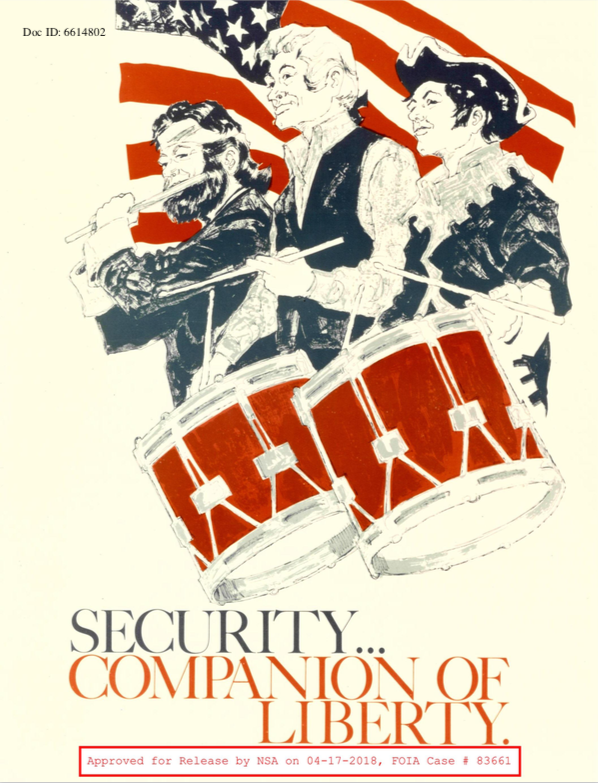
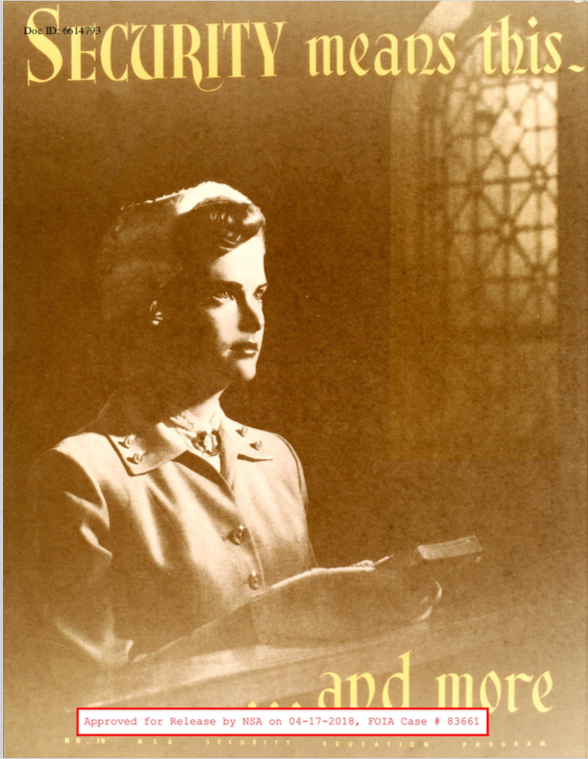
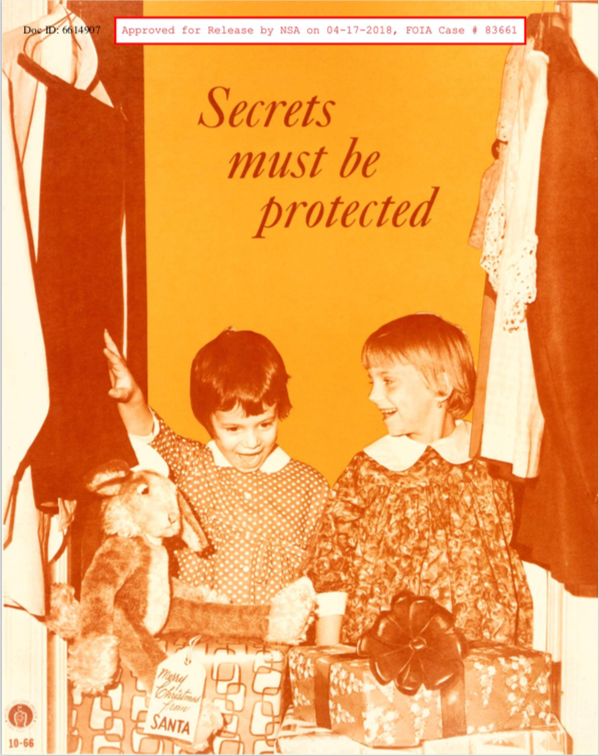
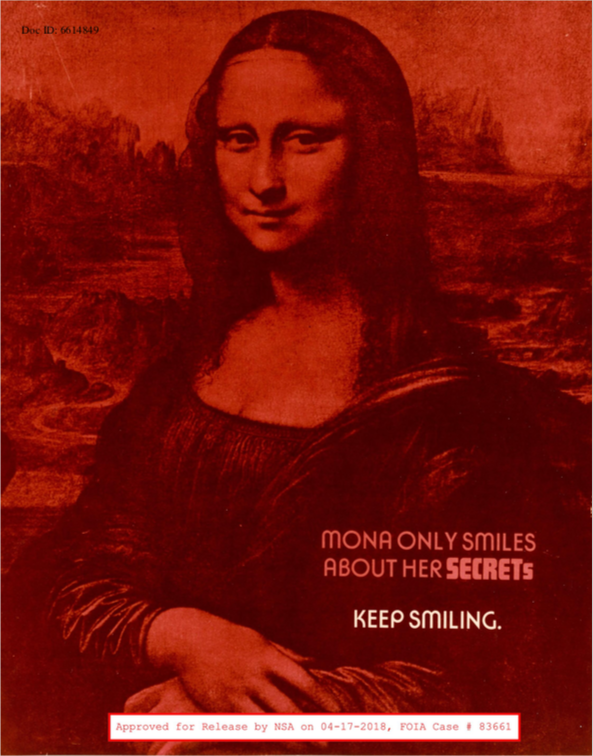
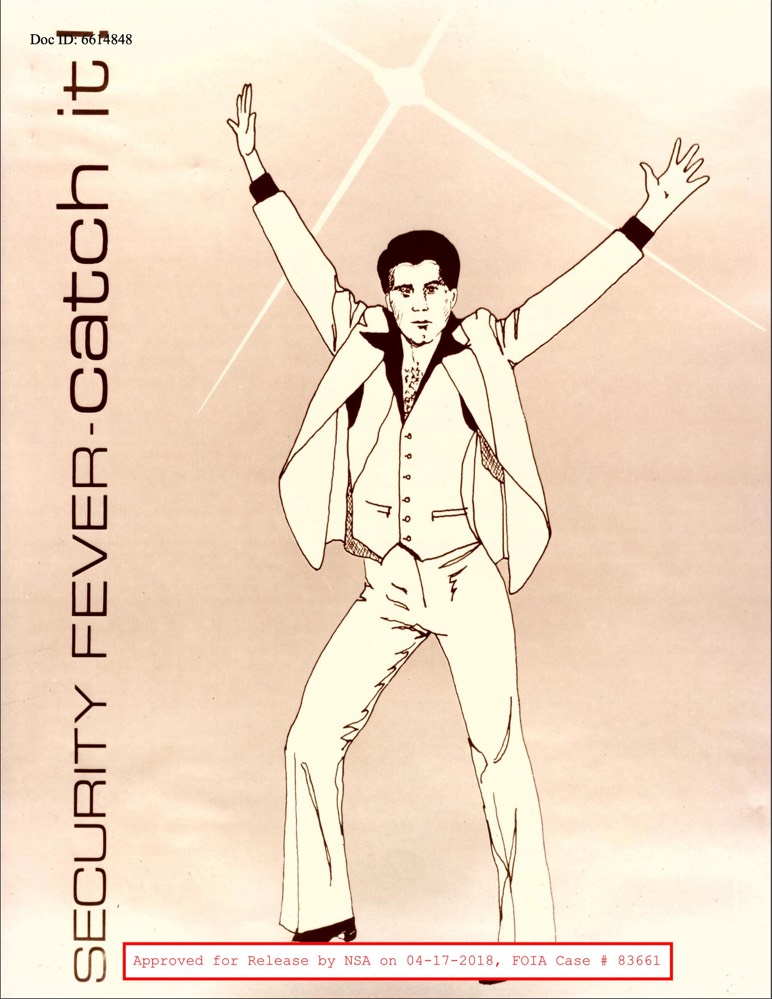
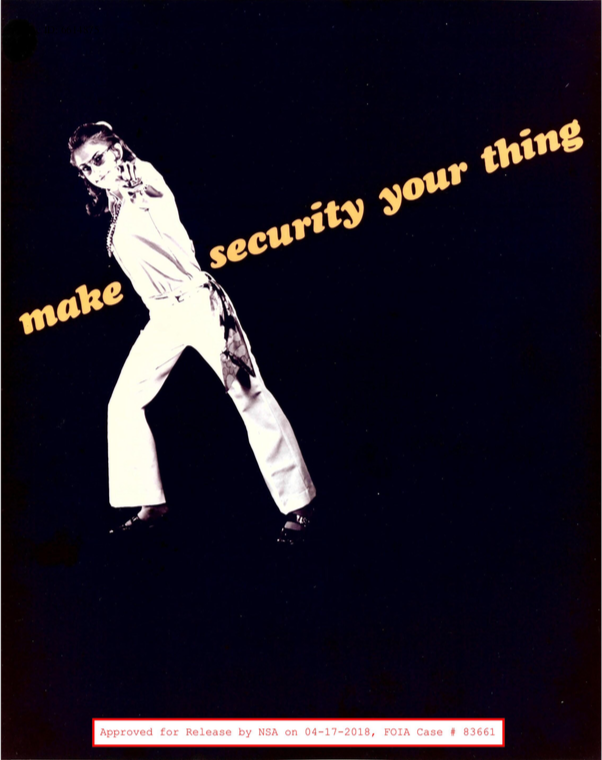
In any case, we might imagine that public debates about civil liberties and privacy are laughable to many a seasoned intelligence agent. A recently declassified trove of propaganda posters aimed at NSA employees, dating from the 50s, 60s, and 70s, shows that in the mind of the Agency, there is no conflict between liberty and security. Without security (or total secrecy), many of these posters suggest, all freedom is lost. They do so in some “super freaky” ways, to quote Jason Kottke, looking like “they were cooked up by Salvador Dali or the Dadaists. Or even Mad Magazine.”
Some of the posters, especially those from the Cold War, look pretty chilling in hindsight, with their theocratic overtones and anti-Communist apocalypticism. Agency employees were to understand that not only might they risk their jobs and clearances if they happened to spill classified info, but that everything they held dear—Christmas, prayer, fishing, freedom of the press—might be destroyed. The posters get progressively groovier as things thawed between the superpowers, and they stop alluding to specific enemies and threats to Christian piety. Still, there’s something a little creepy about an intelligence agency co-opting the Mona Lisa and Saturday Night Fever.
The agency was officially created in 1952 to monitor foreign electronic signals, which at the time meant radio and telephone traffic. The comparatively bronze-age technology available in the decades these posters were printed makes them seem all the more quaint, with their references to carelessly discarded documents and getting too chatty in the car pool. Is the government still warrantlessly spying on Americans? There may have been several recent “inadvertent compliance lapses,” the NSA admits, but surely a secret court and trustworthy Congress will keep everyone honest.
Ah, the 70s… an American president was impeached for criminal activity; a congressman, Wayne Hays, resigned for sleeping with his secretary, after divorcing his wife to marry a different secretary; another congressman, Bud Shuster—who described Hays as “the meanest man in the house”—called for an investigation of Watergate special prosecutor Archibald Cox, after Cox was fired by the soon-to-be impeached president… ‘twas a different time, children, a simpler time….
Well, at any rate, they sure wore funny suits back then, eh? Those lapels…. But just like today, politics mixed freely with sports and entertainment in controversial and televisual ways. Boxers got ratings, singers got ratings, politicians like “meanest man in the house” Wayne Hays got ratings, even before his sex scandal, when he appeared on TV with boxers and singers—appeared, that is, on The Mike Douglas Show in 1974 with Muhammad Ali and Sly Stone. Actor and activist Theodore Bikel was there too, though you might blink and miss him in the fracas just above.
First, Hays offers some banal opinions on the subject of campaign financing, another one of those bygone 70s issues. But when Douglas poses the question to Ali of whether or not he’d ever run for office, things pick up, to say the least. Ali refuses to play the entertainer. He launches flurry after flurry of jabs at white America, and at Hays, who does his best to stay upright under the onslaught. “Ali is unyielding,” writes Dangerous Minds, “intense and brilliant.”
Ali takes on a serious question facing Black nationalists of the 60s and 70s, from the Panthers to the Nation of Islam, whose views Ali embraced at the time, along with, perhaps, some of their ugly anti-Semitism. (The following year he converted to Sunni Islam, and later became a Sufi.) Should Black activists participate in the oppressive systems of the U.S. government? Can anyone do good from inside the halls of imperialist power?
Hays makes an integrationist case, and champions Black leaders like congresswoman Barbara Jordan. Ali is relentlessly combative, calling for reparations. Sly slides in to clarify and pacify, playing mediator and referee. Douglas gets off the applause line, “isn’t it time we all tried to live together.” Ali refuses to gloss over racism and economic inequality. No peace, he says in effect, without justice. Aren’t we glad, forty-four years later, that we’ve ironed all this out? See the full show here for much more heavyweight commentary from Ali and sometimes fuzzy counterpoint from Sly. They go back and forth with Douglas for ten minutes before Hays and Bikel join.
“When do governments deserve our allegiance, and when should they be denied it?” It’s a question that has perhaps crossed your mind lately. And it’s precisely the question that’s at the heart of The Moral Foundations of Political Philosophy, a free course taught by Yale political science professor Ian Shapiro.
In 25 lectures (all available above, on YouTube and iTunes), the course “starts with a survey of major political theories of the Enlightenment—Utilitarianism, Marxism, and the social contract tradition—through classical formulations, historical context, and contemporary debates relating to politics today. It then turns to the rejection of Enlightenment political thinking. Lastly, it deals with the nature of, and justifications for, democratic politics, and their relations to Enlightenment and Anti-Enlightenment political thinking.”
Among the many other 50ths commemorated this year, one will largely go unnoticed by the U.S. press, given that it happened in France, a country we like to ignore as much as possible, and concerned the politics of anarchists and communists, people we like to pretend don’t exist except as caricatures in scare-mongering cartoons. But the French remember May 1968, and not only on its fiftieth. The wildcat strikes, student marches, and barricades in the Latin Quarter haunt French politics. “We’re slightly prisoners of a myth,” laments historian Danielle Tartakowsky.
The international historical events surrounding the strikes and marches are well-known or should be. The founding ethos of the movement, Situationism, perhaps less so. Reading Guy Debord’s Society of the Spectacleand the 1968 movement’s other essential texts can feel like looking into a funhouse mirror.
The 1966 pamphlet manifesto that began the student agitation—“On the Poverty of Student Life”—might sound mighty familiar: it has no kind words for consumerist student radicals who “convert their unconscious contempt into a blind enthusiasm.” Yet they have been attacked, it clarifies, “from the wrong point of view.”
Since we seem to be, in some denatured way, reliving events of fifty years ago, the thinking of that not-so-distant moment illuminates our circumstances. “If there’s one thing in common between 1968 and today,” remarks Antoine Guégan, whose father Gérard staged Paris campus sit-ins, “it’s young people’s despair. But it’s a different kind of despair…. Today’s youth is facing a moment of stagnation, with little to lean on.” Despite the riotous, bloody nature of the times, a global movement then found reason for hope.
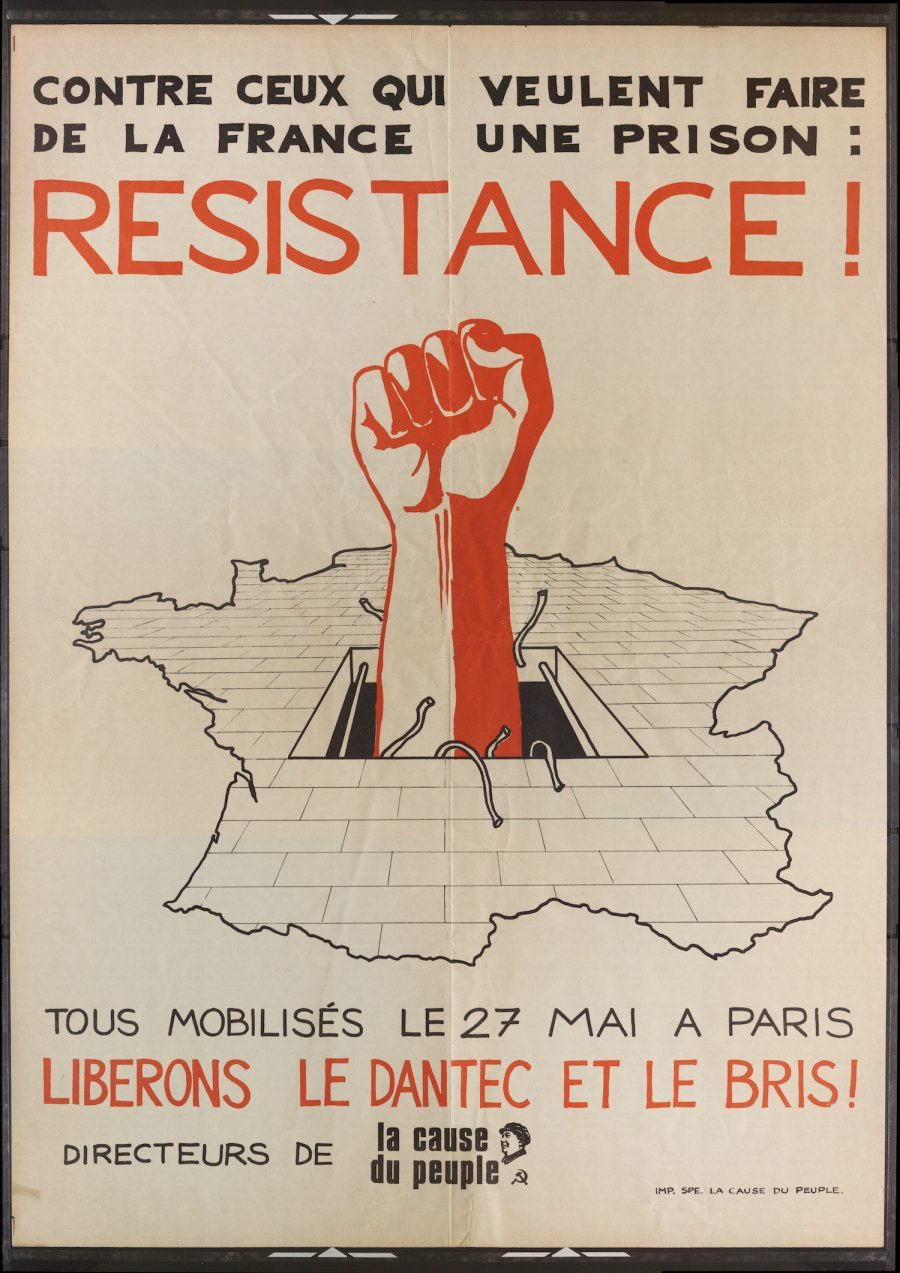
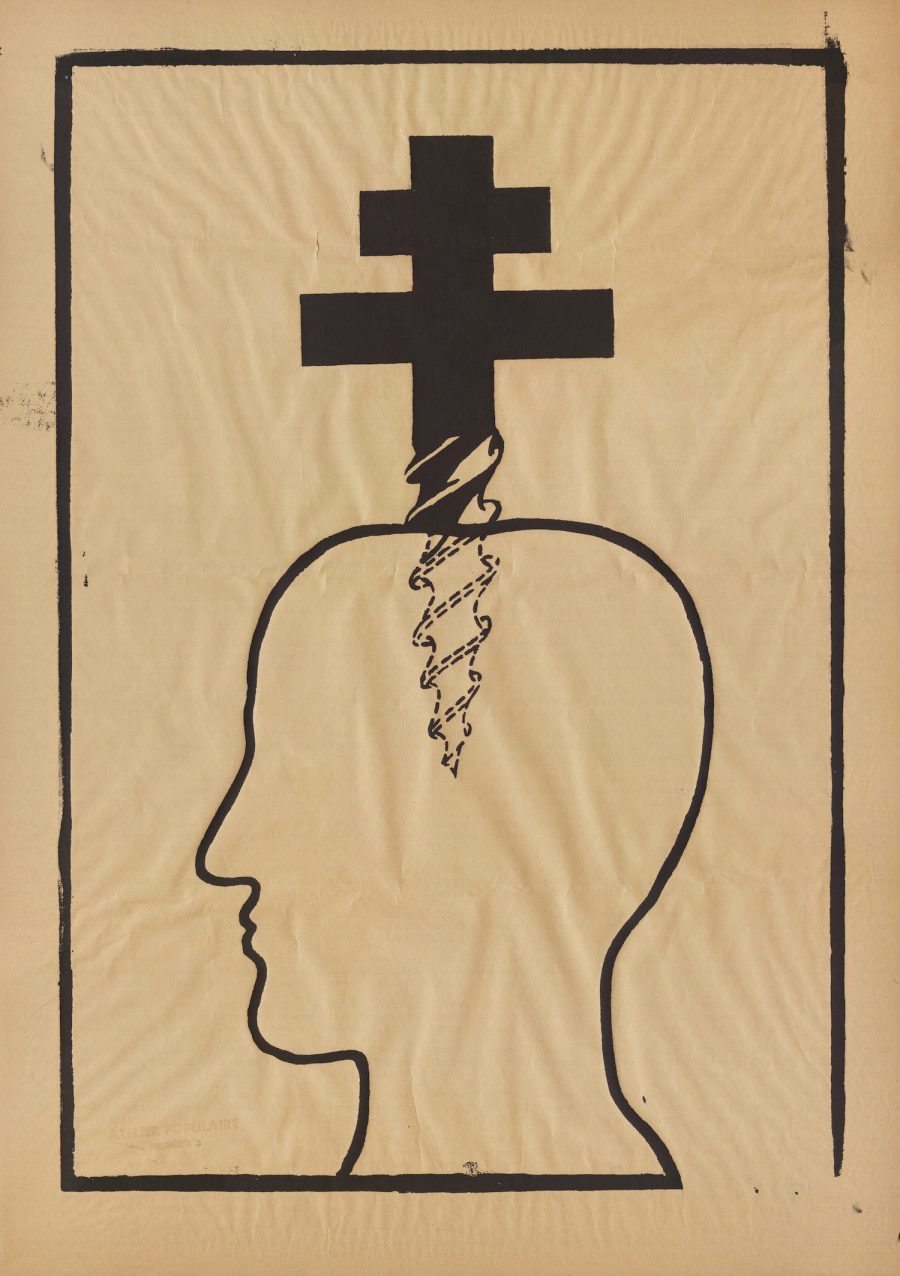
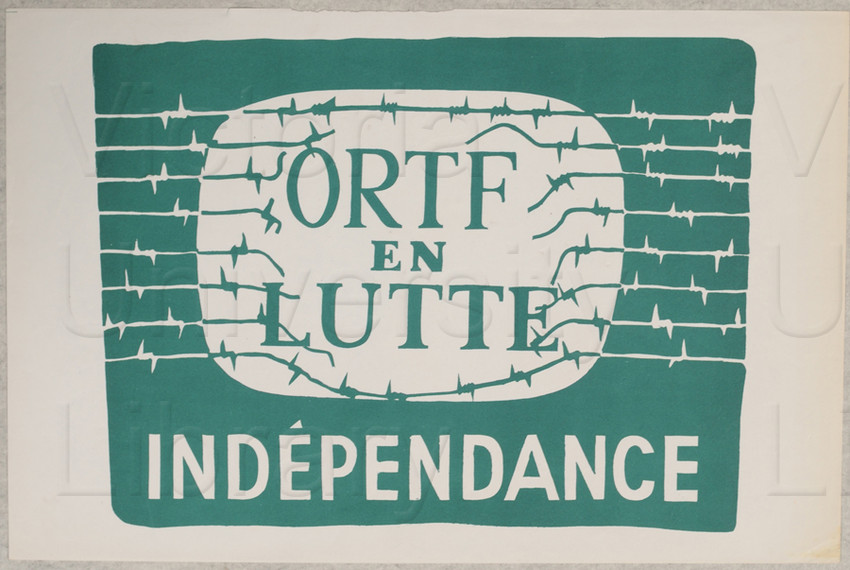
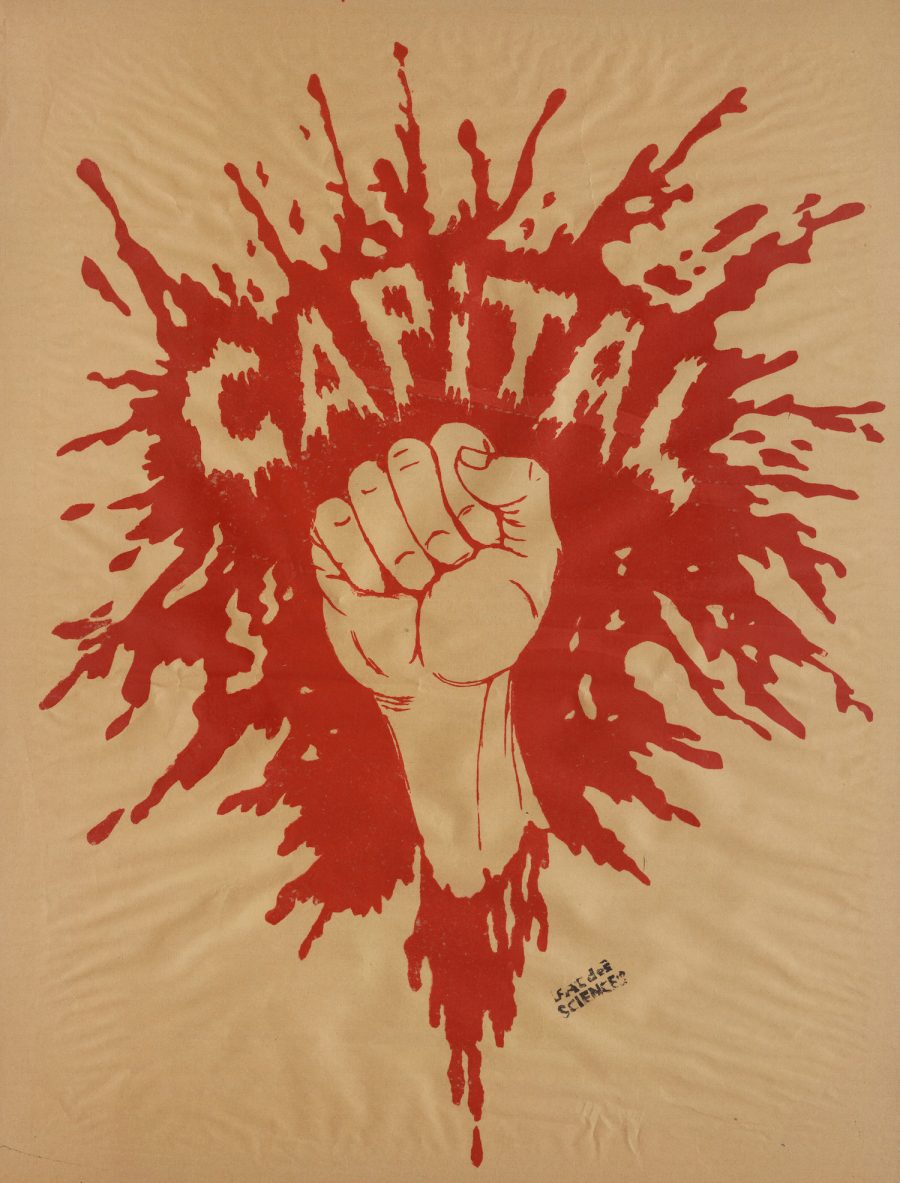
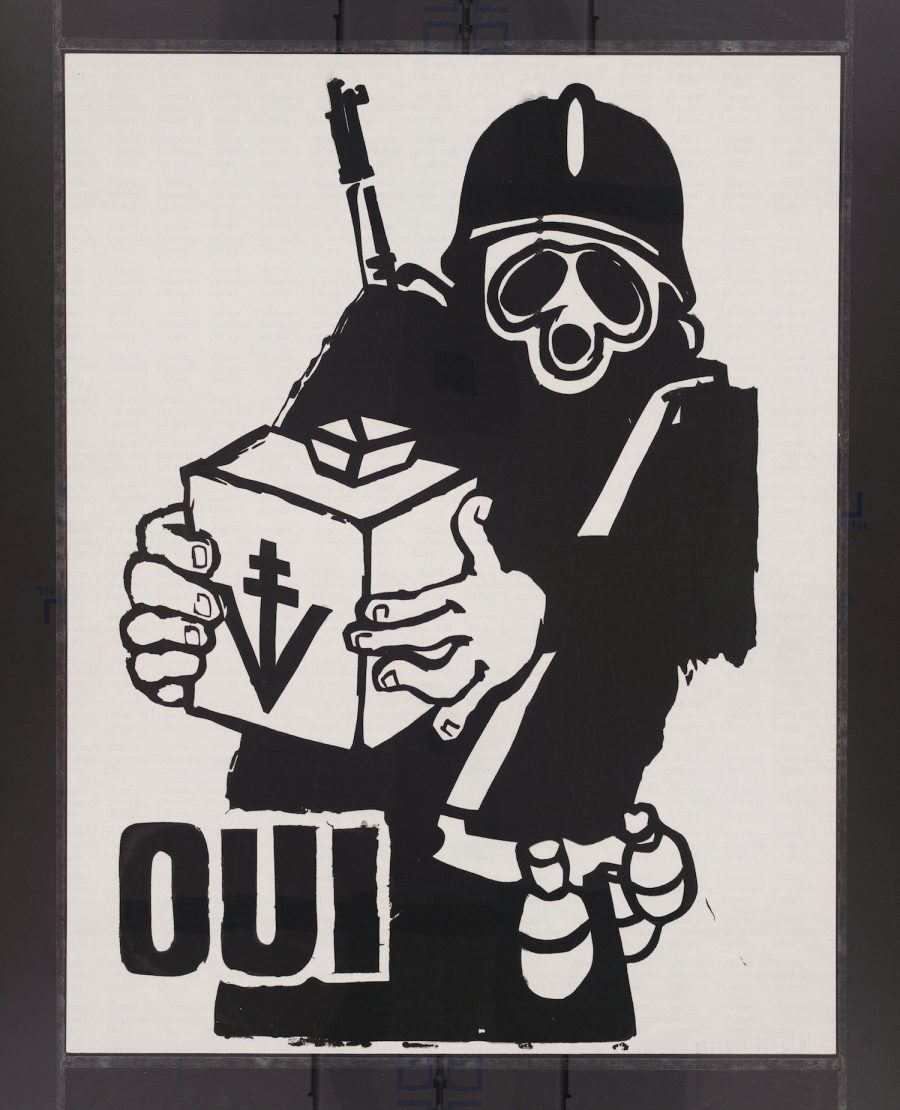
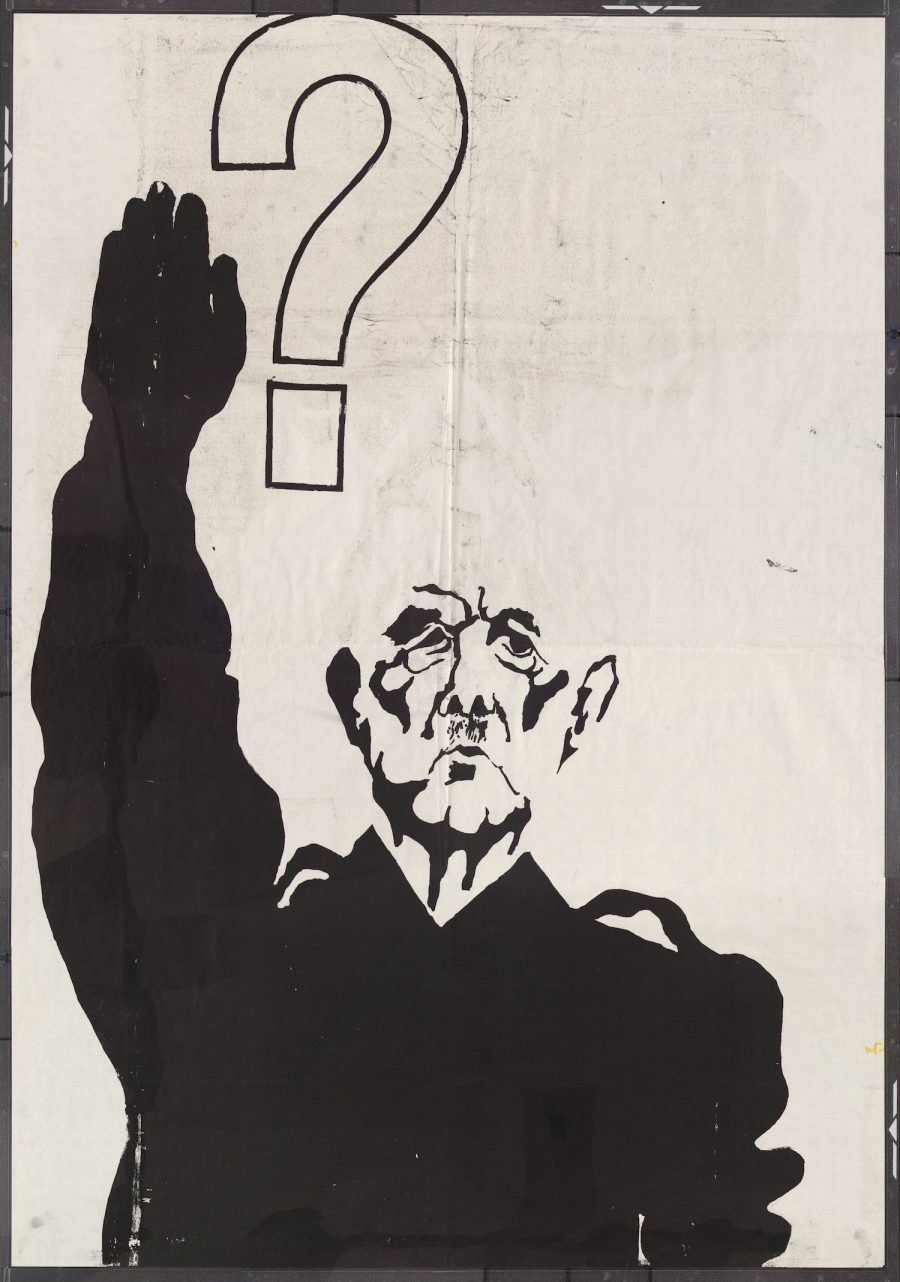
We see it reflected in the defiant art and cinema of the time, from revolutionary work by a 75-year-old Joan Miró to vérité film by 20-year-old wunderkind Philippe Garrel. And we see it, especially, in the huge number of posters printed to advertise the movement, radical graphic designs that illustrate the exhilaration and defiance of the loose collective of Marxists-Leninists, Trotskyites, Maoists, Anarchists, Situationists, and so on who propelled the movement forward.
Last year, we featured a gallery of these arresting images from the Atelier Populaire, a group of artists and students, notes Dangerous Minds, which “occupied the École des Beaux-Arts and dedicated its efforts to producing thousands of silk-screened posters using bold, iconic imagery and slogans as well as explicitly collective/anonymous authorship.” Today, we bring you a huge gallery of more than 300 such images, housed online at Victoria University in the University of Toronto.
Some of the images are downloadable. You can request downloads of others from the university library for private use or publication. These posters represent a movement confronting an oppressive society with its own logic, a society of which Debord wrote just the previous year, “the spectacle is not a collection of images; it is a social relation between people that is mediated by images.” There is no understanding of the events of May 1968 without an understanding of its visual culture as, Debord wrote, “a means of unification.” Enter the gallery of posters and prints here.
We're hoping to rely on loyal readers, rather than erratic ads. Please click the Donate button and support Open Culture. You can use Paypal, Venmo, Patreon, even Crypto! We thank you!
Open Culture scours the web for the best educational media. We find the free courses and audio books you need, the language lessons & educational videos you want, and plenty of enlightenment in between.