Is Karl Marx’s critique of capitalism still relevant to the 21st century? Can we ever read him independently of the movements that violently seized state power in his name, claiming to represent the workers through the sole will of the Party? These are questions Marxists must confront, as must all serious defenders of capitalism, who cannot afford to ignore Marx. He understood and articulated the problems of political economy better than any theorist of his day and posed a formidable intellectual challenge to the values liberal democracies claim to espouse, and those they actually practice through economic exploitation, perpetual rent-seeking, and the alienating commodification of everything.
In his School of Life video explainer above, Alain de Botton sums up the received assessment of Communist history as “disastrously planned economies and nasty dictatorships.” “Nevertheless,” he says, we should view Marx “as a guide, whose diagnosis of capitalism’s ills helps us to navigate toward a more promising future”—the future of a “reformed” capitalism. No Marxist would ever make this argument; de Botton’s video appeals to the skeptic, new to Marx and not wholly inoculated against giving him a hearing. His ideas get boiled down to some mostly uncontroversial statements: Modern work is alienating and insecure. The rich get richer while wages fall. Such theses have attained the status of self-evident truisms.
More interesting and provocative is Marx’s (and Engels’) notion that capitalism is “bad for capitalists,” in that it produces the repressive, patriarchal dominion of the nuclear family, “fraught with tension, oppression, and resentment.” Additionally, the imposition of economic considerations into every aspect of life renders relationships artificial and forms of life sharply constrained by the demands of the labor market. Here Marx’s economic critique takes on its subtly radical feminist dimension, de Botton says, by claiming that “men and women should have the permanent option to enjoy leisure,” not simply the equal opportunity to sell their labor power for equal amounts of insecurity.
The video won’t sway staunchly anti-communist minds, but it might make some viewers curious about what exactly it was Marx had to say. Those who turn to his masterwork, Das Kapital, are likely to give up before they reach the twists and turns of the arguments de Botton outlines in broad strokes. The first and most famous volume is hard going without a guide, and you’ll find fewer better than David Harvey, Professor of Anthropology and Geography at the City University of New York’s Graduate Center.
Harvey’s Companion to Marx’s Capital has guided readers through the text for years, and his lectures on Marx have done so for students going on four decades. In the video above, see an introduction to Harvey’s lecture series on volume one of Marx’s Capital, and at our previous post, find complete videos of his full lecture series on Volumes One, Two, and part of Volume Three. Harvey doesn’t claim that a kinder, gentler capitalism can be found in Marx. But as to the question of whether Marx is still relevant to the vastly accelerated, technocratic capitalism of the present, he would unequivocally answer yes.
There has maybe never been a better time to critically examine the granting of special privileges to people for their talent, personality, or wealth. Yet, for all the harm wrought by fame, there have always been celebrities who use the power for good. The twentieth century is full of such figures, men and women of conscience like Muhamad Ali, Nina Simone, and Paul Robeson—extraordinary people who lived extraordinary lives. Yet no celebrity activist, past or present, has lived a life as extraordinary as Josephine Baker’s.
Born Freda Josephine McDonald in 1906 to parents who worked as entertainers in St. Louis, Baker’s early years were marked by extreme poverty. “By the time young Freda was a teenager,” writes Joanne Griffith at the BBC, “she was living on the streets and surviving on food scraps from bins.” Like every rags-to-riches story, Baker’s turns on a chance discovery. While performing on the streets at 15, she attracted the attention of a touring St. Louis vaudeville company, and soon found enormous success in New York, in the chorus lines of a string of Broadway hits.
Baker became professionally known, her adopted son Jean-Claude Baker writes in his biography, as “the highest-paid chorus girl in vaudeville.” A great achievement in and of itself, but then she was discovered again at age 19 by a Parisian recruiter who offered her a lucrative spot in a French all-black revue. “Baker headed to France and never looked back,” parlaying her nearly-nude danse sauvage into international fame and fortune. Topless, or nearly so, and wearing a skirt made from fake bananas, Baker used stereotypes to her advantage—by giving audiences what they wanted, she achieved what few other black women of the time ever could: personal autonomy and independent wealth, which she consistently used to aid and empower others.
Throughout the 20s, she remained an archetypal symbol of jazz-age art and entertainment for her Folies Bergère performances (see her dance the Charleston and make comic faces in 1926 in the looped video above). In 1934, Baker made her second film Zouzou (top), and became the first black woman to star in a major motion picture. But her sly performance of a very European idea of African-ness did not go over well in the U.S., and the country she had left to escape racial animus bared its teeth in hostile receptions and nasty reviews of her star Broadway performance in the 1936 Ziegfeld Follies (a critic at Time referred to her as a “Negro wench”). Baker turned away from America and became a French citizen in 1937.
American racism had no effect on Baker’s status as an international superstar—for a time perhaps the most famous woman of her age and “one of the most popular and highest-paid performers in Europe.” She inspired modern artists like Picasso, Hemingway, E.E. Cummings, and Alexander Calder (who sculpted her in wire). When the war broke out, she hastened to work for the Red Cross, entertaining troops in Africa and the Middle East and touring Europe and South America. During this time, she also worked as a spy for the French Resistance, transmitting messages written in invisible ink on her sheet music.
Her massive celebrity turned out to be the perfect cover, and she often “relayed information,” the Spy Museum writes, “that she gleaned from conversations she overheard between German officers attending her performances.” She became a lieutenant in the Free French Air Force and for her efforts was awarded the Croix de Guerre and the Medal of the Resistance by Charles De Gaulle and lauded by George S. Patton. Nonetheless, many in her home country continued to treat her with contempt. When she returned to the U.S. in 1951, she entertained huge crowds, and dealt with segregation “head –on,” writes Griffith, refusing “to perform in venues that would not allow a racially mixed audience, even in the deeply divided South.” She became the first person to desegregate the Vegas casinos.
But she was also “refused admission to a number of hotels and restaurants.” In 1951, when employees at New York’s Stork Club refused to serve her, she charged the owner with discrimination. The Stork club incident won her the lifelong admiration and friendship of Grace Kelly, but the government decided to revoke her right to perform in the U.S., and she ended up on an FBI watch list as a suspected communist—a pejorative label applied, as you can see from this declassified 1960 FBI report, with extreme prejudice and the presumption that fighting racism was by default “un-American.” Baker returned to Europe, where she remained a superstar (see her perform a medley above in 1955).
She also began to assemble her infamous “Rainbow Tribe,” twelve children adopted from all over the world and raised in a 15th-century chateau in the South of France, an experiment to prove that racial harmony was possible. She charged tourists money to watch the children sing and play, a “little-known chapter in Baker’s life” that is also “an uncomfortable one,” Rebecca Onion notes at Slate. Her estate functioned as a “theme park,” writes scholar Matthew Pratt Guterl, a “Disneyland-in-the-Dordogne, with its castle in the center, its massive swimming pool built in the shape of a “J” for its owner, its bathrooms decorated like an Arpège perfume bottle, its hotels, its performances, and its pageantry.” These trappings, along with a menagerie of exotic pets, make us think of modern celebrity pageantry.
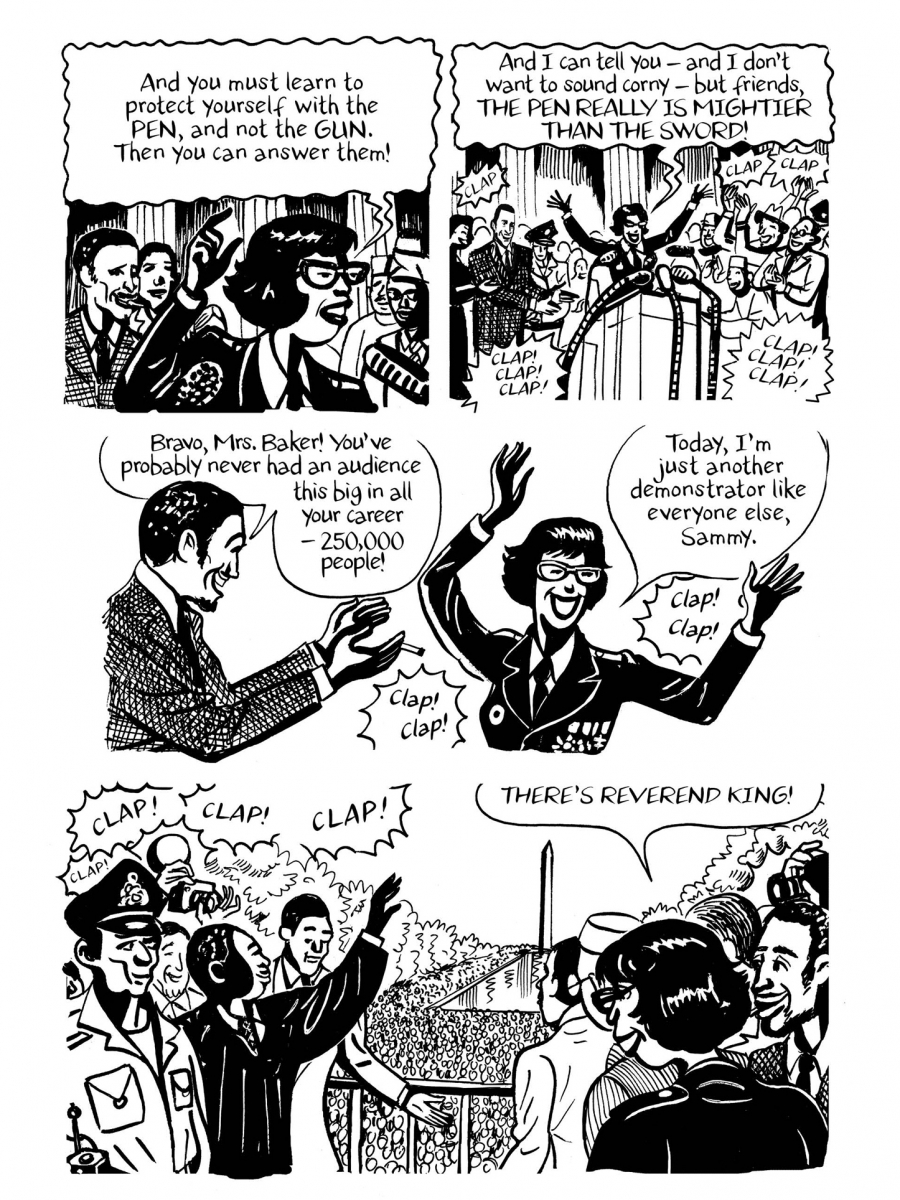
But for all its strange excesses, Guturl maintains, her “idiosyncratic project was in lockstep with the mainstream Civil Rights Movement.” She wouldn’t return to the States until 1963, with the help of Attorney General Robert Kennedy, and when she did, it was as a guest of Martin Luther King, Jr. and the organizers of the March on Washington, where, in her Free French Air Force uniform, she became the only woman to address the crowd. The visual recounting of that moment above comes from a new 600-page graphic biography that follows Baker’s “trajectory from child servant in St. Louis,” PRI writes, “to her days as a vaudeville performer, a major star in France, and later, a member of the French Resistance and an American civil rights activist.”
In her speech, she directly confronted the government who had turned her into an enemy:
They thought they could smear me, and the best way to do that was to call me a communist. And you know, too, what that meant. Those were dreaded words in those days, and I want to tell you also that I was hounded by the government agencies in America, and there was never one ounce of proof that I was a communist. But they were mad. They were mad because I told the truth. And the truth was that all I wanted was a cup of coffee. But I wanted that cup of coffee where I wanted to drink it, and I had the money to pay for it, so why shouldn’t I have it where I wanted it?
Baker made no apologies for her wealth and fame, but she also took every opportunity, even if misguided at times, to use her social and financial capital to better the lives of others. Her plain-speaking demands opened doors not only for performers, but for ordinary people who could look to her as an example of courage and grace under pressure into the 1970s. She continued to perform until her death in 1975. Just below, you can see rehearsal footage and interviews from her final performance, a sold-out retrospective.
The opening night audience included Sophia Lauren, Mick Jagger, Shirley Bassey, Diana Ross, and Liza Minelli. Four days after the show closed, Baker was found dead in her bed at age 68, surrounded by rave reviews of her performance. Her own assessment of her five-decade career was distinctly modest. Earlier that year, Baker told Ebony magazine, “I have never really been a great artist. I have been a human being that has loved art, which is not the same thing. But I have loved and believed in art and the idea of universal brotherhood so much, that I have put everything I have into them, and I have been blessed.” We might not agree with her critical self-evaluation, but her life bears out the strength and authenticity of her convictions.
We may have grown used to hearing about the importance of critical thinking, and stowed away knowledge of logical fallacies and cognitive biases in our argumentative toolkit. But were we to return to the philosophical sources of informal logic, we would find that we only grasped at some of the principles of reason. The others involve questions of what we might call virtue or character—what for the Greeks fell into the categories of ethos and pathos. The principle of charity, for example, in which we give our opponents a fair hearing and respond to the best version of their arguments as we understand them. And the principle, exemplified by Plato’s Socrates, of intellectual humility. Or as one punk band put it in their Socratic tribute. “All I know is that I don’t know. All I know is that I don’t know nothing.”
Intellectual humility is not, contrary to most popular appearances, reflexively according equal weight to “both sides” of every argument or assuming that everyone’s opinion is equally valid. These are forms of mental laziness and ethical abdication. It is, however, believing in our own fallibility and opening ourselves up to hearing arguments without immediately forming a judgment about them or the people who make them. We do not abandon our reason and values, we strengthen them, argues Mark Leary, by “not being afraid of being wrong.” Leary, professor of psychology and neuroscience at Duke University, is the lead author of a new study on intellectual humility that found “essentially no difference between liberals and conservatives or between religious and nonreligious people” when it comes to intellectual humility.
The study challenges many ideas that can prevent dialogue. “There are stereotypes about conservatives and religiously conservative people being less intellectually humble about their beliefs,” says Leary. But he and his colleagues “didn’t find a shred of evidence to support that.” This doesn’t necessarily mean that such people have high degrees of intellectual humility, only that all of us, perhaps equally, possess fairly low levels of the trait. I’ll be the first to admit that it is not an easy one to develop, especially when we’re on the defensive for some seemingly good reasons—and when we live in a culture that encourages us to make decisions and take actions on the strength of an image, some minimal text, and a few buttons that lead us right to our bank accounts. (To quote Operation Ivy again, “We get told to decide. Just like as if I’m not gonna change my mind.”)
But in the Duke study, reports Alison Jones at Duke Today, “those who displayed intellectual humility did a better job of evaluating the quality of evidence.” They took their time to make careful considerations. And they were generally more charitable and “less likely to judge a writer’s character based on his or her views.” By contrast, “intellectually arrogant” people gave writers with whom they disagreed “low scores in morality, honesty, competence, and warmth.” As a former teacher of rhetoric, I wonder whether the researchers accounted for the quality and persuasiveness of the writing itself. Nonetheless, this observation underscores the problem of conflating an author’s work with his or her character. Moral judgment can inhibit intellectual curiosity and open-mindedness. Intellectually arrogant people often resort to insults and personal attacks over thoughtful analysis.
The enormous number of assumptions we bring to almost every conversation with people who differ from us can blind us to our own faults and to other people’s strengths. But intellectual humility is not genetically determined—it is a skill that can be learned, Leary believes. Big Think recommends a free MOOC from the University of Edinburgh on intellectual humility (see an introduction to the concept at the top and a series of lectures here). “Faced with difficult questions,” explains course lecturer Dr. Ian Church, “people often tend to dismiss and marginalize dissent…. The world needs more people who are sensitive to reasons both for and against their beliefs, and are willing to consider the possibility that their political, religious and moral beliefs might be mistaken.” The course offers three different levels of engagement, from casual to quite involved, and three separate class sections at Coursera: Theory, Practice, and Science.
It’s likely that many of us need some serious preparation before we’re willing to listen to those who hold certain views. And perhaps certain views don’t actually deserve a hearing. But in most cases, if we can let our guard down, set aside feelings of hostility, and become willing to learn something even from those with whom we disagree, we might be able to do what so many psychologists continue to recommend. As Cindy Lamothe writes at New York Magazine’s Science of Us blog, “we have to be willing to expose ourselves to opposing perspectives in the first place—which means that, as daunting as it may seem, listening to friends and family with radically different views can be beneficial to our long-term intellectual progress.” The holidays are soon upon us. Let the healing—or at least the charitable tolerance if you can manage it—begin.
Charges of hypocrisy, contradiction, “flip-flopping,” etc. in politics are so much mud thrown at the castle walls. Unless the peasants gather in large enough numbers to storm the palace and depose their lords, their righteousness avails them nothing. What does it matter to the current party in power, for example—who wears the national flag like a cape and has decided the civil religion and its Evangelical variety are one in the same—that its most-admired role model and (alleged) fixer is a corrupt Russian autocrat who murders journalists (or a Confederate general who led the armies of a treasonous slave state)?
So it is, on and on, with the political class.
Take Alan Greenspan, chairman of the Federal Reserve from 1987 to 2006. During these years, he was widely hailed as a major power behind the throne, no matter the policies of those who occupied it. He was “obliged to report,” Christopher Hitchens wrote in Vanity Fair in 2000, “to Congress only twice a year, at formal occasions where he is received with the deference that was once accorded the Emperor of Japan.” I well remember the dowdy frisson accompanying those appearances in the 90s, the Bill Clinton bubble years. Hitchens only slightly exaggerates. But somehow, Greenspan retained this guru-like aura despite the fact that his position violated his sincerely-held beliefs as a member, he himself told Hitchens, of Ayn Rand’s “inner circle”
As Hitchens notes in the grainy video clip above, “a state Federal Reserve Bank is not part of the Libertarian program, though Mr. Greenspan seems a bit iffy about this self-evident proposition.” In addition to championing atheism and abortion rights, Rand, Greenspan’s “intellectual guru,” defined the rigid ideological disdain for government meddling in markets and social spending of any kind. Yet she ended her days on the government dime. But there are no contradictions for purveyors of theodicies. Randians, or “Objectivists,” if they prefer, must know that to everyone outside the circle, the philosophy looks like ethically-bankrupt cult logic, wishful thinking easily discarded when inconvenient. Still, adepts will write to tell us that if we only grasped the gnostic reasoning of such-and-such argument, then we too could pierce the veil.
Hitchens dispenses with this pretense, not as an anarcho-communist radical but as a sometime neoconservative hawk and sometime admirer of Rand (or at least a knowledgeable reader of her work). “I have some respect for the ‘Virtue of Selfishness,’” he goes on to say in his aside on Rand above—which occurred during a lecture called “The Moral Necessity of Atheism” at Sewanee University in 2004. (In his Vanity Fair essay, Hitchens pronounced himself a “Rand buff.”) And yet, the title of Rand’s collection of essays provides him with the rhetorical essence of his critique, one drawn from a different strain of virtue—of a religious variety, even. After dismissing Rand on literary grounds, he says:
I don’t think there’s any need to have essays advocating selfishness among human beings; I don’t know what your impression has been, but some things require no further reinforcement.
The urbane Hitchens goes on to tell an off-color anecdote about Lillian Hellman with a moralistic undertone, gets a laugh, and pivots to a much older theological conflict to bring his point home.
So to have a book strenuously recommending that people be more self-centered seems to me, as the Anglican Church used to say in its critique of Catholicism, a work of super-arrogation. It’s too strenuous.
It’s trying too hard, that is, to convince us, and itself, perhaps, that its superstitions, self-defenses, and desires are natural law. Rand’s belief system has so little intellectual currency among thinkers on the left that few people spend any time bothering to refute it. But Hitchens did the political center a service when he took on defenders of Randianism in the media, such as he does in the debate below with David Frum, the now infamous neoconservative Canadian speechwriter for George W. Bush. Those who think the healthcare debate began with the election of Barack Obama may be surprised to see it conducted in almost the very same terms in 1996.
Frum defends a version of the libertarian view, Hitchens a social democratic perspective. When Rand’s name inevitably comes up near the end of the discussion (4:40), Hitchens articulates the same views: “I always thought it quaint, and rather touching,” he says with dry irony, “that there is in America a movement that thinks people are not yet selfish enough…. It’s somewhat refreshing to meet people who manage to get through their day actually believing that.” Like many others, Hitchens embodied a number of contradictions. Among them, perhaps, was his staunch, almost Catholic belief—despite his strenuous objection to religion—that selfishness… too much selfishness, a valorization of selfishness, a cult of selfishness… is self-evidently a rather sinful thing.
If you’re a linguist, you’ve read Noam Chomsky—no way of getting around that. There may be reasons to disagree with Chomsky’s linguistic theories but—as Newton’s theories do in physics—his breakthroughs represent a paradigmatic shift in the study of language, an implicit or explicit reference point for nearly every linguistic analysis in the past few decades.
If you’re on the political left, you’ve read Chomsky, or you should. Even if there are significant reasons to disagree with whatever controversial stance he’s taken over the years, few political theorists have approached their subject with the degree of doggedness, intellectual integrity, and erudition as he has. Chomsky began his second career as a political activist and philosopher in the late sixties, speaking out in opposition to the Vietnam war. Since then, he’s written majorly influential works on mass media propaganda, Cold War politics and interventionist war, economic imperialism, anarchism, etc.
Now an emeritus professor from MIT, where he began teaching in 1955, and a laureate professor at the University of Arizona, Chomsky has reached that stage in every public intellectual’s career when archivists and curators begin consolidating a documentary legacy. Librarians at MIT started doing so a few years ago when, in 2012, the MIT Libraries Institute Archives received over 260 boxes of Chomsky’s personal papers. You can hear the man himself discuss the archive’s importance in the short interview at the top. And at the MIT Library site unBox Chomsky Archive, you’ll find slideshow previews of its contents.
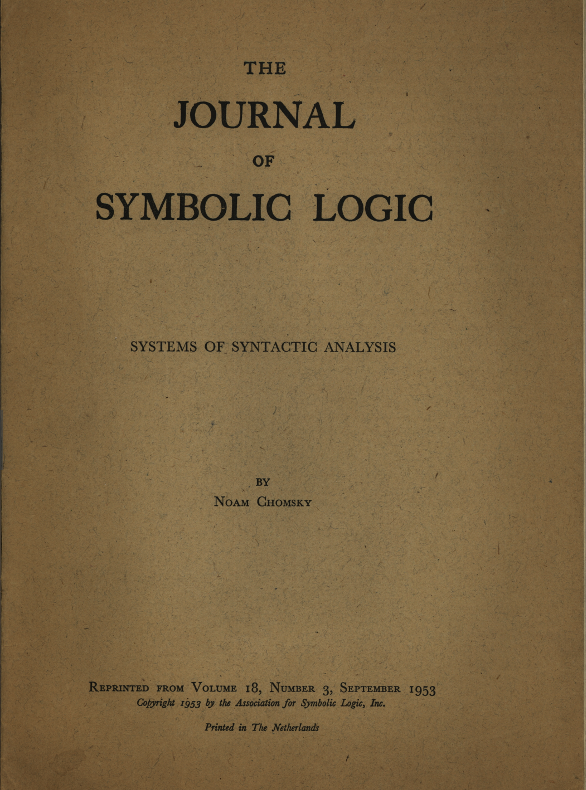
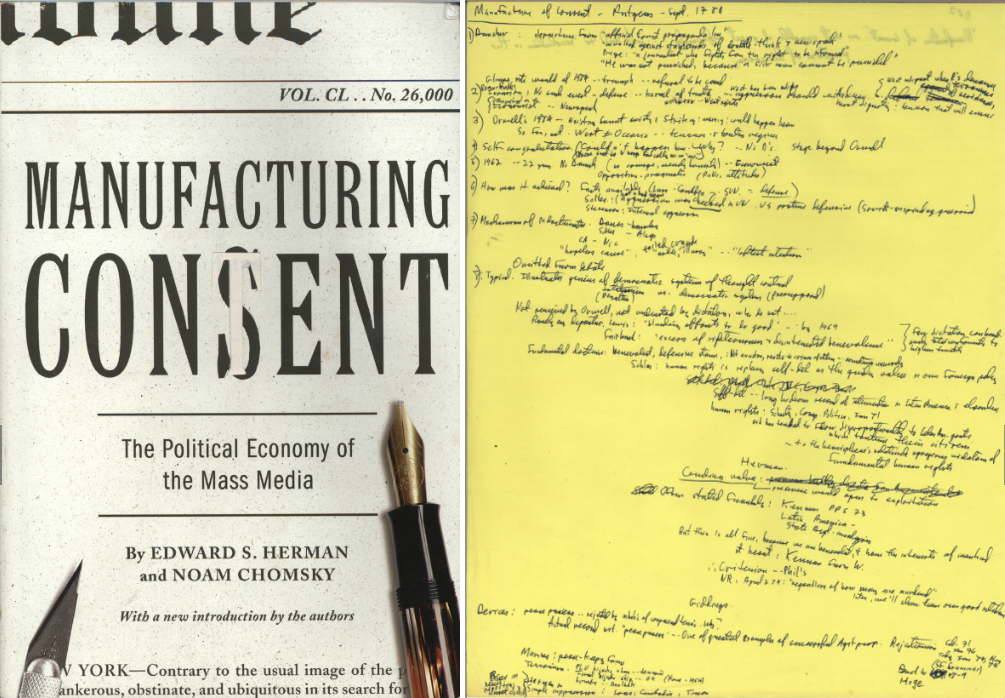
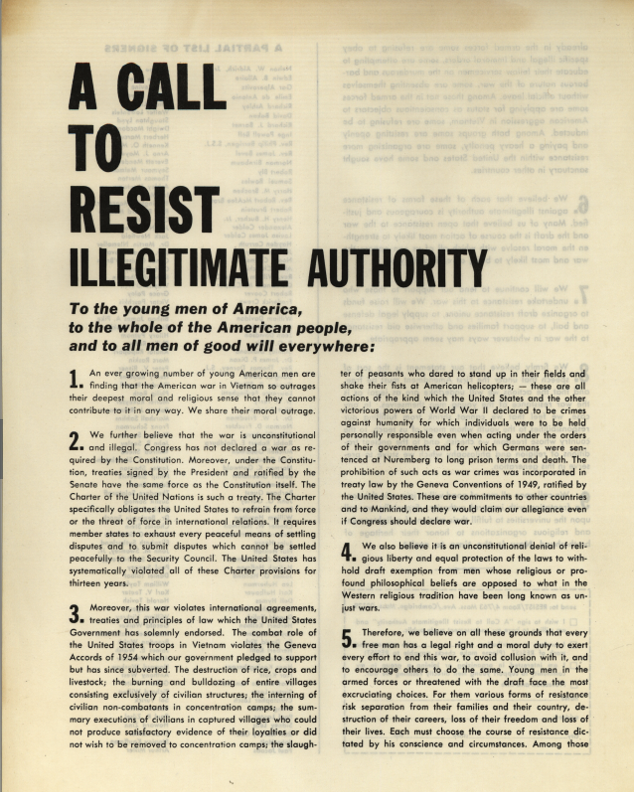
Those contents include the 1953 paper “Systems of Syntactic Analysis,” which “appears to be Chomsky’s first foray in print of what would become transformational generative grammar.” Also archived are notes from a 1984 talk on “Manufacturing Consent” given at Rutgers University, outlining the ideas Chomsky and Edward S. Herman would fully explore in the 1988 book of the same name on “the political economy of the mass media.” And in the category of “activism,” we find materials like the newsletter below, published by an anti-war organization Chomsky co-founded in the 60s called RESIST.
MIT hopes to “digitize the hundreds of thousands of pieces” in the collection, “to make it accessible to the public.” Such a massive undertaking exceeds the library’s budget, so they have asked for financial support. At unBoxing the Chomsky Archive, you can make a donation, or just peruse the slideshow previews and consider the legacy of one of the U.S.’s most formidable living scientific and political thinkers.
Over the course of this tumultuous year, new CIA director Mike Pompeo has repeatedly indicated that he would move the Agency in a “more aggressive direction.” In response, at least one person took on the guise of former Chilean president Salvador Allende and joked, incredulously, “more aggressive”? In 1973, the reactionary forces of General Augusto Pinochet overthrew Allende, the first elected Marxist leader in Latin America. Pinochet then proceeded to institute a brutal 17-year dictatorship characterized by mass torture, imprisonment, and execution. The Agency may not have orchestrated the coup directly but it did at least support it materially and ideologically under the orders of President Richard Nixon, on a day known to many, post-2001, as “the other 9/11.”
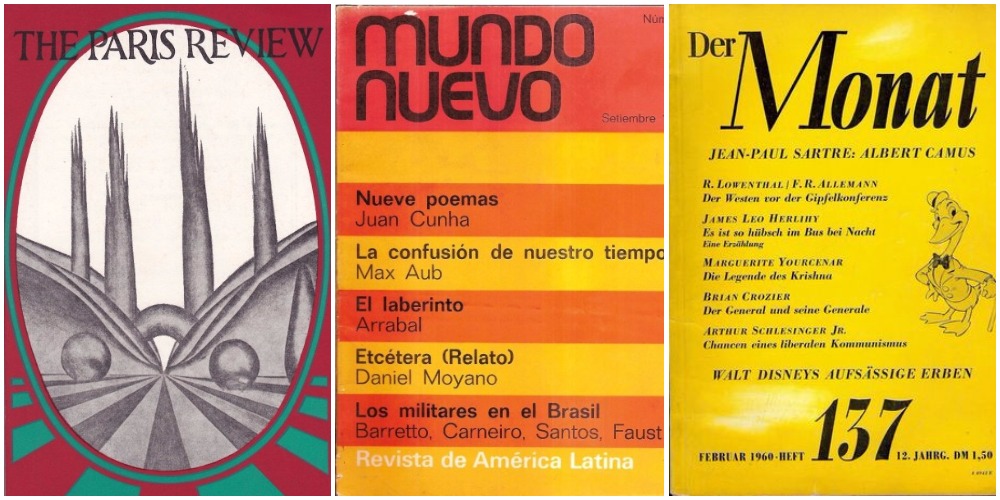
The Chilean coup is one of many CIA interventions into the affairs of Latin America and the former European colonies in Africa and Asia after World War II. It is by now well known that the Agency “occasionally undermined democracies for the sake of fighting communism,” as Mary von Aue writes at Vice, throughout the Cold War years. But years before some of its most aggressive initiatives, the CIA “developed several guises to throw money at young, burgeoning writers, creating a cultural propaganda strategy with literary outposts around the world, from Lebanon to Uganda, India to Latin America.” The Agency didn’t invent the post-war literary movements that first spread through the pages of magazines like The Partisan Reviewand The Paris Reviewin the 1950s. But it funded, organized, and curated them, with the full knowledge of editors like Paris Review co-founder Peter Matthiessen, himself a CIA agent.
The Agency waged a cold culture war against international Communism using many of the people who might seem most sympathetic to it. Revealed in 1967 by former agent Tom Bradenin the pages of the Saturday Evening Post, the strategy involved secretly diverting funds to what the Agency called “civil society” groups. The focal point of the strategy was the CCF, or “Congress for Cultural Freedom,” which recruited liberal and leftist writers and editors, oftentimes unwittingly, to “guarantee that anti-Communist ideas were not voiced only by reactionary speakers,” writes Patrick Iber at The Awl. As Braden contended in his exposé, in “much of Europe in the 1950s, socialists, people who called themselves ‘left’—the very people whom many Americans thought no better than Communists—were about the only people who gave a damn about fighting Communism.”
No doubt some literary scholars would find this claim tendentious, but it became agency doctrine not only because the CIA saw funding and promoting writers like James Baldwin, Gabriel Garcia Márquez, Richard Wright, and Ernest Hemingway as a convenient means to an end, but also because many of the program’s founders were themselves literary scholars. The CIA began as a World War II spy agency called the Office of Strategic Services (OSS). After the war, says Guernica magazine editor Joel Whitney in an interview with Bomb, “some of the OSS guys became professors at Ivy League Universities,” where they recruited people like Matthiessen.
The more liberal guys who were part of the brain trust that formed the CIA saw that the Soviets in Berlin were getting masses of people from other sectors to come over for their symphonies and films. They saw that culture itself was becoming a weapon, and they wanted a kind of Ministry of Culture too. They felt the only way they could get this paid for was through the CIA’s black budget.
McCarthy-ism reigned at the time, and “the less sophisticated reactionaries,” says Whitney, “who represented small states, small towns, and so on, were very suspicious of culture, of the avant-garde, the little intellectual magazines, and of intellectuals themselves.” But Ivy League agents who fancied themselves tastemakers saw things very differently.
Whitney’s book, Finks: How the CIA Tricked the World’s Best Writers, documents the Agency’s whirlwind of activity behind literary magazines like the London-based Encounter, French Preuves, Italian Tempo Presente, Austrian Forum, Australian Quadrant, Japanese Jiyu, and Latin American Cuadernos and Mundo Nuevo. Many of the CCF’s founders and participants conceived of the enterprise as “an altruistic funding of culture,” Whitney tells von Aue. “But it was actually a control of journalism, a control of the fourth estate. It was a control of how intellectuals thought about the US.”
While we often look at post-war literature as a bastion of anti-colonial, anti-establishment sentiment, the pose, we learn from researchers like Iber and Whitney, was often carefully cultivated by a number of intermediaries. Does this mean we can no longer enjoy this literature as the artistic creation of singular geniuses? “You want to know the truth about the writers and publications you love,” says Whitney, “but that shouldn’t mean they’re ruined.” Indeed, the Agency’s cultural operations went far beyond the little magazines. The Congress of Cultural Freedoms used jazz musicians like Louie Armstrong, Dave Brubeck, and Dizzy Gillespie as “goodwill ambassadors” in concerts all over the world, and funded exhibitions of Abstract Expressionists like Mark Rothko, Jackson Pollack, and Willem de Kooning.
The motives behind funding and promoting modern art might mystify us unless we include the context in which such cultural warfare developed. After the Cuban Revolution and subsequent Communist fervor in former European colonies, the Agency found that “soft liners,” as Whitney puts it, had more anti-Communist reach than “hard liners.” Additionally, Communist propagandists could easily point to the U.S.‘s socio-political backwardness and lack of freedom under Jim Crow. So the CIA co-opted anti-racist writers at home, and could silence artists abroad, as it did in the mid-60s when Louis Armstrong went behind the Iron Curtain and refused to criticize the South, despite his previous strong civil rights statements. The post-war world saw thriving free presses and arts and literary cultures filled with bold experimentalism and philosophical and political debate. Knowing who really controlled these conversations offers us an entirely new way to view the directions they inevitably seemed to take.
“Mr. Hefner’s magazine is most widely known for its total exposure of the human female,” says William F. Buckley, introducing the guest on this 1966 broadcast of his talk show Firing Line. “Though of course other things happen in its pages.” Not long before, publisher and pleasure empire-builder Hugh Hefner’s Playboy magazine ran a series of articles on “the Playboy philosophy,” a set of observations of and propositions about human sexuality that provided these men fodder for their televised debate. Hefner stands against religiously mandated, chastity-centered codes of sexual morality; Buckley demands to know how Hefner earned the qualifications to issue new codes of his own. Describing the Playboy philosophy as “sort of a hedonistic utilitarianism,” Buckley tries simultaneously to understand and demolish these 20th-century revisions of the rules of sex.
“The Playboy founder is no match for the Catholic who snipes him at will with ‘moral’ bullets,” writes the poster of the video. “The acerbic, dry Buckley is on attack mode with a conservative audience, in moral panic, behind him. The Catholic had the era of conservatism behind him. [ … ] In the 21st century though, Buckley would have a harder time defending morality with Hefner.” One wonders how Buckley and Hefner, were they still alive today, might revisit this debate in 2017. (Buckley died in 2008, and Hefner passed away yesterday at the age of 91.) Times have certainly changed, but I suspect Buckley would raise the same core objection to Hefner’s argument that loosening the old strictures on sex leads, perhaps counterintuitively, to more satisfied, more monogamous pairings: “How in the hell do you know?” Though this and certain other of Buckley’s questions occasionally wrong-foot Hefner, the faithful can rest assured that he keeps enough cool to fire up his signature pipe on camera.
Note: This post first appeared on our site back in 2012. We brought it back today for obvious reasons, and updated it to reflect Hefner’s passing. Since 2012, a huge archive of “Firing Line” episodes have been put online. Get more on that here.
The concept of one-world government has long been a staple of violent apocalyptic prophecy and conspiracy theories involving various popes, the UN, FEMA, the Illuminati, and lizard people. In the real world, one-world government has been a goal of the global Comintern and many of the corporate oligarchs who triumphed over the Soviets in the Cold War. For good reason, perhaps—with the exception of sci-fi utopias like Gene Roddenberry’s Star Trek—we generally tend to think of global government as a threatening idea. But that has not always been the case, or least it wasn’t for Albert Einstein who proposed global governance after the dropping of atomic bombs on Hiroshima and Nagasaki.
Einstein’s role in the development of those weapons may have been minimal, according to the physicist himself (the truth is a little more complicated). But he later expressed regret, or at least a total rethinking of the issue, in his many interviews, letters, and speeches. In 1952, for example, Einstein wrote a short essay called “On My Participation in the Atom Bomb Project” in which he recommended that all nations “abolish war by common action” and referred to the pacifist example of Gandhi, “the greatest political genius of our time.”
Five years earlier, we find Einstein in a less than hopeful mood. In a 1947 open letter to the General Assembly of the United Nations, he laments that “since the victory over the Axis powers… no appreciable progress has been made either toward the prevention of war or toward agreement in specific fields such as control of atomic energy and economic cooperation.” The solution as he saw it required a “modification of the traditional concept of national sovereignty.” It’s a clause that might have launched a thousand militia manifestoes. Einstein elaborates:
For as long as atomic energy and armaments are considered a vital part of national security no nation will give more than lip service to international treaties. Security is indivisible. It can be reached only when necessary guarantees of law and enforcement obtain everywhere, so that military security is no longer the problem of any single state. There is no compromise possible between preparation for war, on the one hand, and preparation of a world society based on law and order on the other.
So far this sounds not simply like a one-world government but like a one-world police state. But Einstein’s proposal gets a much more comprehensive treatment in an earlier Atlantic Monthly editorial published in 1945. Here, he admits that many of his ideas are “abstractions” and lays out a scheme to ostensibly protect against global totalitarianism.
Membership in a supranational security system should not, in my opinion, be based on any arbitrary democratic standards. The one requirement from all should be that the representatives to supranational organization—assembly and council—must be elected by the people in each member country through a secret ballot. These representatives must represent the people rather than any government—which would enhance the pacific nature of the organization.
The greatest obstacle to a global government was not, Einstein thought, U.S. mistrust, but Russian unwillingness. After making every effort to induce the Soviets to join, he writes in his UN letter, other nations should band together to form a “partial world Government… comprising at least two-thirds of the major industrial and economic areas of the world.” This body “should make it clear from the beginning that its doors remain wide open to any non-member.”
Einstein corresponded with many people on the issue of one-world government, recommending in one letter that a “permanent world court” be established to “constrain the executive branch of world government from overstepping its mandate which, in the beginning, should be limited to the prevention of war and war-provoking developments.” He does not foresee the problem of an executive who seizes power through nefarious means and ignores institutional checks on power and privilege. As for the not-insignificant matter of the economy, he writes that “the freedom of each country to develop economic, political and cultural institutions of its own choice must be guaranteed at the outset.”
Ideological conflicts over economics seemed to him “quite irrational,” as he wrote in his Atlantic editorial. “Whether the economic life of America should be dominated by relatively few individuals, as it is, or these individuals should be controlled by the state, may be important, but it is not important enough to justify all the feelings that are stirred up over it.” Like any honest intellectual, Einstein reserved the right to change his mind. By 1949 he had come to see socialism as a necessary antidote to the “grave evils of capitalism”—the gravest of which, he wrote, is “an oligarchy of private capital the enormous power of which cannot be effectively checked even by a democratically organized political society”—even one, presumably, with global legislative reach.
We're hoping to rely on loyal readers, rather than erratic ads. Please click the Donate button and support Open Culture. You can use Paypal, Venmo, Patreon, even Crypto! We thank you!
Open Culture scours the web for the best educational media. We find the free courses and audio books you need, the language lessons & educational videos you want, and plenty of enlightenment in between.