The problem is there are no Nixons around at the moment. That’s what we need — we need a real good Nixon to give something for other people to get their teeth into, to really … loathe him, to become themselves more effective as opposition leaders.
Alas, his prayers have been answered.
Steadman, who has brought his inky sensibilities to bear on such works as Animal Farm andAlice in Wonderland, has a new American president to add to the collection he discussed several years ago, in the video above.
Steadman’s pen was the sword that rendered Gerald Ford as a scarecrow, Ronald Reagan as a vampire, and George W. Bush as a monkey in a cage of his own making.
Barack Obama, one of the candidates in that comparatively bland 2012 election, is depicted as a tenacious, slender vine, straining ever upward.
Jimmy Carter, somewhat less benignly, is a puppy eagerly fetching a stick with which to pardon Nixon, the Welsh cartoonist’s dark muse, first encountered when he accompanied Thompson on the road trip that yielded Fear and Loathing: On the Campaign Trail ’72.
And now…
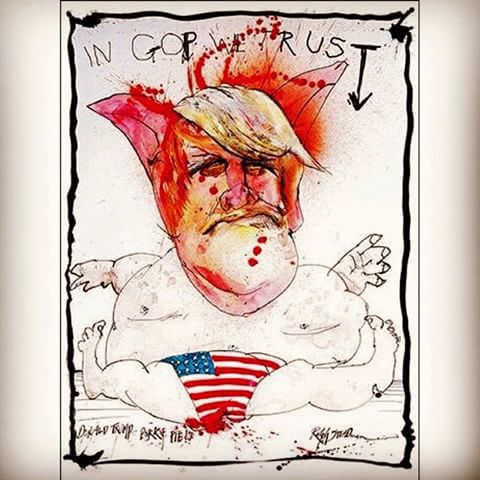
Donald Trump has given Steadman reason to come out fighting. With luck, he’ll stay out as long as his services are required. The above portrait, titled “Porky Pie,” was sent, unsolicited, to Gerry Brakus, an editor of the New Statesman, who published it on December 17, 2015.
At the time, Steadman had no reason to believe the man he’d anthropomorphized as a human pig hybrid, squeezed into bloody flag-print underpants, would become the 45th president:
Trump is unthinkable. A thug and a molester. Who wants him?
The portrait’s hideousness speaks volumes, but it’s also worth looking beyond the obvious-seeming inspiration for the title to a reference few Americans would get. “Pork pie”—or porky—is Cockney rhyming slang for “a lie.”
See a gallery of Steadman’s portraits of American presidents on his website.
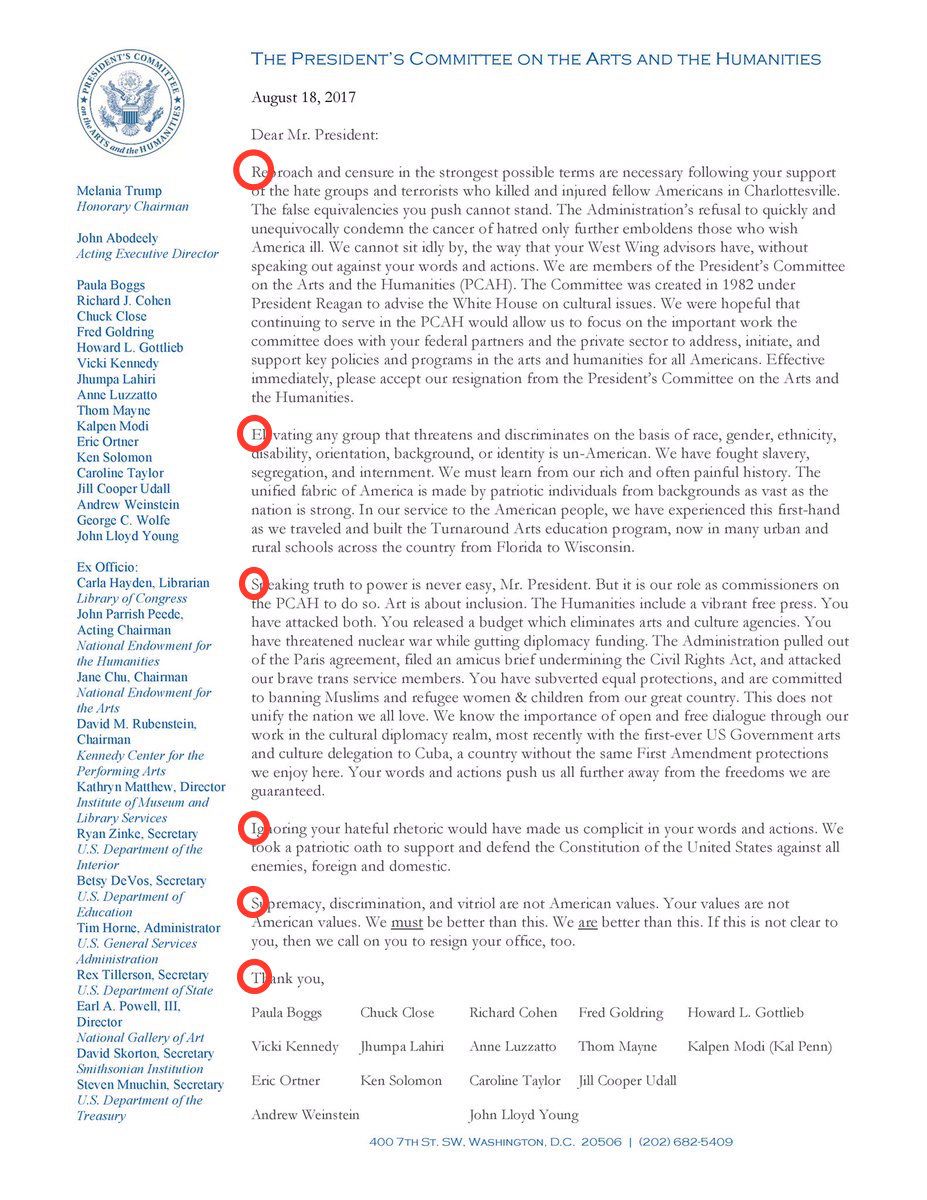
It wasn’t the most high profile mass resignation of last week. (The CEOs on Trump’s business advisory councils got that distinction.) But it was arguably the most creative one. Last Friday, “all 16 of the prominent artists, authors, performers and architects on the President’s Committee on the Arts and the Humanities resigned,” reports The New York Times. And while their resignation letter didn’t mince words (read it online here), it did take the added step of encoding in its text a short message for POTUS. Circle the first letter of each paragraph and what do you get? RESIST, the mantra of 2017.
In other related news, the administration announced that Trump will skip the annual Kennedy Center Honors this year–just the fourth time that a president has missed this annual national celebration of the arts. This year’s honorees include Gloria Estefan, LL COOL J, Norman Lear, Lionel Richie, and Carmen de Lavallade.
The threat of widespread violence and unrest descends upon the country, thanks again to a collection of actors viciously opposed to civil rights, and in many cases, to the very existence of people who are different from them. They have been given aid and comfort by very powerful enablers. Veteran activists swing into action. Young people on college campuses turn out by the hundreds week after week. But for many ordinary people with jobs, kids, mortgages, etc. the cost of participating in constant protests and civil actions may seem too great to bear. Yet, given many awful examples in recent history, the cost of inaction may be also.
What can be done? Not all of us are Rosa Parks or Howard Zinn or Martin Luther King, Jr. or Thich Nat Hanh or Cesar Chavez or Dolores Huerta, after all. Few of us are revolutionaries and few may wish to be. Not everyone is brave enough or talented enough or knowledgeable enough or committed enough or, whatever.
The problem with this kind of thinking is a problem with so much thinking about politics. We look to leaders—men and women we think of as superior beings—to do everything for us. This can mean delegating all the work of democracy to sometimes very flawed individuals. It can also mean we fundamentally misunderstand how democratic movements work.
In the video above, Noam Chomsky addresses the question of what ordinary people can do in the face of seemingly insurmountable injustice. (The clip comes from the 1992 documentary Manufacturing Consent.) “The way things change,” he says, “is because lots of people are working all the time, and they’re working in their communities or their workplace or wherever they happen to be, and they’re building up the basis for popular movements.”
In the history books, there’s a couple of leaders, you know, George Washington or Martin Luther King, or whatever, and I don’t want to say that those people are unimportant. Martin Luther King was certainly important, but he was not the Civil Rights Movement. Martin Luther King can appear in the history books ‘cause lots of people whose names you will never know, and whose names are all forgotten and who may have been killed and so on were working down in the South.
King himself often said as much. For example, in the Preface of his Stride Toward Freedom he wrote—referring to the 50,000 mostly ordinary, anonymous people who made the Montgomery Bus Boycott happen—“While the nature of this account causes me to make frequent use of the pronoun ‘I,’ in every important part of the story it should be ‘we.’ This is not a drama with only one actor.”
As for public intellectuals like himself engaged in political struggle, Chomsky says, “people like me can appear, and we can appear to be prominent… only because somebody else is doing the work.” He defines his own work as “helping people develop courses of intellectual self-defense” against propaganda and misinformation. For King, the issue came down to love in action. Responding in a 1963 interview above to a critical question about his methods, he counters the suggestion that nonviolence means sitting on the sidelines.
I think of love as something strong and that organizes itself into powerful, direct action…. We are not engaged in a struggle that means we sit down and do nothing. There’s a great deal of difference between nonresistance to evil and nonviolent resistance. Nonresistance leaves you in a state of stagnant passivity and deadening complacency, whereas nonviolent resistance means that you do resist in a very strong and determined manner.
Both Chomsky, King, and every other voice for justice and human rights would agree that the people need to act instead of relying on movement leaders. Whatever actions one can take—whether it’s engaging in informed debate with family, friends, or coworkers, writing letters, making donations to activists and organizations, documenting injustice, or taking to the streets in protest or acts of civil disobedience—makes a difference. These are the small individual actions that, when practiced diligently and coordinated together in the thousands, make every powerful social movement possible.
It’s difficult to appraise the complicated legacy of Franklin D. Roosevelt. His New Deal policies are credited for lifting millions out of destitution, and they created opportunities for struggling artists and writers, many of whom went on to become some of the country’s most celebrated. But Roosevelt also compromised with racist southern senators like Mississippi’s Theodore Bilbo, and underwrote housing segregation, job and pay discrimination, and exclusions in his economic recovery aimed most squarely at African-Americans. He is lauded as a wartime leader in the fight against Nazism. But he built concentration camps on U.S. soil when he interned over 100,000 Japanese Americans after Pearl Harbor. His commitment to isolationism before the war and his “moral failure—or indifference” to the plight of European Jews, thousands of whom were denied entry to the U.S., has come under justifiable scrutiny from historians.
Both blame and praise are well warranted, and not his alone to bear. Yet, for all his serious lapses and wartime crimes, FDR consistently had an astute and idealistic economic vision for the country. In his 1944 State of the Union address, he denounced war profiteers and “selfish and partisan interests,” saying, “if ever there was a time to subordinate individual or group selfishness to the national good, that time is now.”
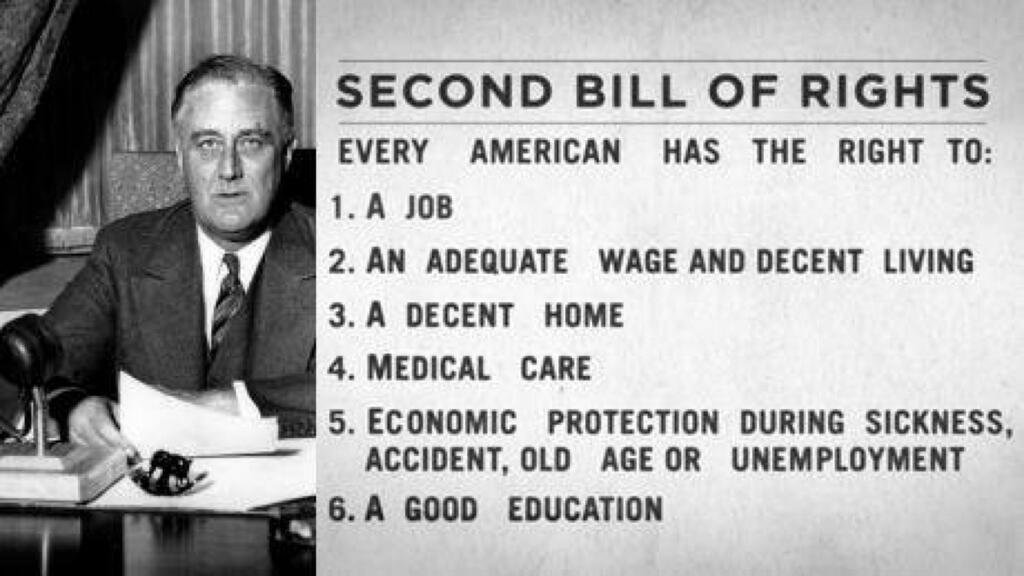
He went on to enumerate a series of proposals “to maintain a fair and stable economy at home” while the war still raged abroad. These include taxing “all unreasonable profits, both individual and corporate” and enacting regulations on food prices. The speech is most extraordinary, however, for the turn it takes at the end, when the president proposes and clearly articulates a “second Bill of Rights,” arguing that the first one had “proved inadequate to assure us equality in the pursuit of happiness.”
Roosevelt did not take the value of equality for granted or merely invoke it as a slogan. Though its role in his early policies was sorely lacking, he showed in 1941 that he could be moved on civil rights issues when, in response to a march on Washington planned by Bayard Rustin, A. Philip Randolph, and other activists, he desegregated federal hiring and the military. In his 1944 speech, Roosevelt strongly suggests that economic inequality is a precursor to Fascism, and he offers a progressive political theory as a hedge against Soviet Communism.
“We have come to a clear realization,” he says, “of the fact that true individual freedom cannot exist without economic security. ‘Necessitous men are not free men.’ People who are hungry and out of a job are the stuff of which dictatorships are made. In our day these economic truths have become accepted as self-evident.” In the footage at the top of the post, you can see Roosevelt himself read his new Bill of Rights. Read the transcript yourself just below:
We have accepted, so to speak, a second Bill of Rights under which a new basis of security and prosperity can be established for all regardless of station, race, or creed.
Among these are:
The right to a useful and remunerative job in the industries or shops or farms or mines of the Nation;
The right to earn enough to provide adequate food and clothing and recreation;
The right of every farmer to raise and sell his products at a return which will give him and his family a decent living;
The right of every businessman, large and small, to trade in an atmosphere of freedom from unfair competition and domination by monopolies at home or abroad;
The right of every family to a decent home;
The right to adequate medical care and the opportunity to achieve and enjoy good health;
The right to adequate protection from the economic fears of old age, sickness, accident, and unemployment;
The right to a good education.
All of these rights spell security. And after this war is won we must be prepared to move forward, in the implementation of these rights, to new goals of human happiness and well-being.
Roosevelt died in office before the war ended. His successor tried to carry forward his economic and civil rights initiatives with the “Fair Deal,” but congress blocked nearly all of Truman’s proposed legislation. We might imagine an alternate history in which Roosevelt lived and found a way through force of will to enact his “second Bill of Rights,” honoring his promise to every “station, race” and “creed.” Yet in any case, his fourth term was nearly at an end, and he would hardly have been elected to a fifth.
But FDR’s progressive vision has endured. Many seeking to chart a course for the country that tacks away from political extremism and toward economic justice draw directly from Roosevelt’s vision of freedom and security. His new bill of rights is striking for its political boldness. Its proposals may have had their clearest articulation three years earlier in the famous “Four Freedoms” speech. In it he says, “the basic things expected by our people of their political and economic systems are simple. They are:
Equality of opportunity for youth and for others.
Jobs for those who can work.
Security for those who need it.
The ending of special privilege for the few.
The preservation of civil liberties for all.
The enjoyment of the fruits of scientific progress in a wider and constantly rising standard of living.
These are the simple, the basic things that must never be lost sight of in the turmoil and unbelievable complexity of our modern world. The inner and abiding strength of our economic and political systems is dependent upon the degree to which they fulfill these expectations.
Guaranteeing jobs, if not income, for all and a “constantly rising standard of living” may be impossible in the face of automation and environmental degradation. Yet, most of Roosevelt’s principles may not only be realizable, but perhaps, as he argued, essential to preventing the rise of oppressive, authoritarian states.
Apocalypses have always been popular as mass belief and entertainment. Maybe it’s a collective desire for retribution or redemption, or a kind of vertigo humans experience when staring into the abyss of the unknown. Better to end it all than live in neurotic uncertainty. Maybe we find it impossible to think of a future world existing hundreds, thousands, millions of years after our deaths. As Rebecca Solnit observes in Hope in the Dark: Untold Histories, Wild Possibilities, “people have always been good at imagining the end of the world, which is much easier to picture than the strange sidelong paths of change in a world without end.” What if the world never ends, but goes on forever, changing and evolving in unimaginable ways?
This is the bailiwick of science fiction, but also the domain of history, a hindsight view of centuries past when wars, tyrannical conquests, famines, and diseases nearly wiped out entire populations—when it seemed to them a near certainty that nothing would or could survive the present horror. And yet it did.
This may be no consolation to the victims of violence and plague, but the world has gone on for the living, people have adapted and survived, even under the current, very real threats of nuclear war and catastrophic climate change. And throughout history, both small and large groups of people have changed the world for the better, though it hardly seemed possible at the time. Solnit’s book chronicles these histories, and last year, she released a playlist as a companion for the book.
Hope in the Dark makes good on its title through a collection of essays about “everything,” writes Alice Gregory at The New York Times, “from the Zapatistas to weather forecasting to the fall of the Berlin Wall.” The book is “part history of progressive success stories, part extended argument for hope as a catalyst for action.” Solnit wrote the book in 2004, during the reelection of George W. Bush—a time when progressives despaired of ever seeing the end of chickenhawk sabre-rattling, wars for profit, privatization of the public sphere, environmental degradation, theocratic political projects, curtailing of civil rights, or the disaster capitalism the administration wholeheartedly embraced (as Naomi Klein’s The Shock Doctrine detailed). Plus ça change.…
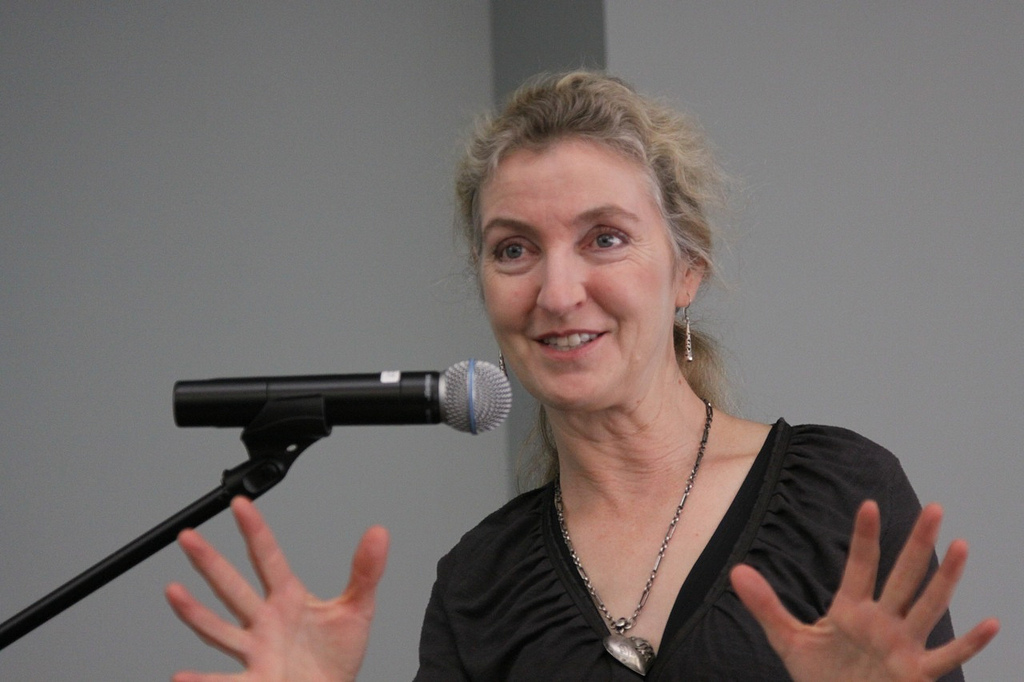
In March of last year, Haymarket Books reissued Hope in the Dark, and on November 10th, Solnit posted a link to a free download of the book on Facebook. It was downloaded over 30,000 times in one week. Along with other progressive intellectuals like Klein and Richard Rorty, Solnit—who became internationally known for the term “mansplaining” in her essay, then book, Men Explain Things to Me—has now been cast as a “Cassandra figure of the left,” Gregory writes. But she rejects the disastrous futility inherent in that analogy:
If you think of a kind of ecology of ideas, there are more than enough people telling us how horrific and terrible and bad everything is, and I don’t really need to join that project. There’s a whole other project of trying to counterbalance that — sometimes we do win and this is how it worked in the past. Change is often unpredictable and indirect. We don’t know the future. We’ve changed the world many times, and remembering that, that history, is really a source of power to continue and it doesn’t get talked about nearly enough.
If we don’t hear enough talk about hope, maybe we need to hear more hopeful music, Solnit suggests in her Hope in the Dark playlist. Thirteen songs long, it moves between Beyoncé and The Clash, Iggy Pop and Stevie Nicks, Black Flag and Big Freedia.
While the selections speak for themselves, she offers brief commentary on each of her choices in a post at Powell’s. Beyoncé’s “Formation,” Solnit writes, “reformulates, digging deep into the past of sorrow and suffering and injustice and pulling us all with her into a future that could be different.” Patti Smith’s anthem “People Have the Power” feels like hope, Solnit says: “it’s right about the power we have, which obliges us to act, and which many duck by pretending we’re helpless.” Maybe that’s what apocalypses are all about—making us feel small and powerless in the face of impending doom. But there are other kinds of religion, like that of Lee Williams’ “Steal My Joy.” It’s a “gorgeous gospel song,” writes Solnit. “Joystealers are everywhere. Never surrender to them.” That sounds like an ideal exhortation to imagine and fight for a better future.
Contrary to Aristotle, the eminent logician, philosopher, and activist Bertrand Russell believed that virtue and morality play little part in political life. Rather, what most drives us to action, he argued, is selfish desire. Russell’s political philosophy could seem almost Machiavellian, most notably in his Nobel Prize speech 1950, in which he proclaims that “all human activity is prompted by desire.” (Hear Russell read an excerpt above.)
There is a wholly fallacious theory advanced by some earnest moralists to the effect that it is possible to resist desire in the interests of duty and moral principle. I say this is fallacious, not because no man ever acts from a sense of duty, but because duty has no hold on him unless he desires to be dutiful. If you wish to know what men will do, you must know not only, or principally, their material circumstances, but rather the whole system of their desires with their relative strengths.
Russell’s argument about desire admits “there is no limit to the efforts that men will make, or to the violence that they will display” in the face of perceived scarcity, and his observations recall not only the realpolitik of Machiavelli, but the insights of that most prominent theorist of desire, Sigmund Freud.
Man differs from other animals in one very important respect, and that is that he has some desires which are, so to speak, infinite, which can never be fully gratified, and which would keep him restless even in Paradise. The boa constrictor, when he has had an adequate meal, goes to sleep, and does not wake until he needs another meal. Human beings, for the most part, are not like this.
Rather than libidinous instincts, however, Russell names four main political desires that cannot be satisfied: Acquisitiveness (“the wish to possess as much as possible), Rivalry (“a much stronger motive”), Vanity (“a motive of immense potency”), and Love of Power (“which outweighs them all”). We may note the tremendous degree to which all four desires seem actively at work in shaping our current world. All four of these qualities greet us every morning on our smartphones and never let up, day after day. But it has always been so to one degree or another, Russell argues. The important thing is to be clearsighted on the matter. Although selfish political desires can and largely are destructive, they need not always be so.
Political desires like the love of power may “have other sides which are more desirable.” Scholarly and scientific endeavors may be “mainly actuated by a love of power.…. In politics, also, a reformer may have just as strong a love of power as a despot. It would be a complete mistake to decry love of power altogether as a motive.” “Russell,” writes Maria Popova, is “a thinker of exceptional sensitivity to nuance and to the dualities of which life is woven.” He cautions that we cannot simply dismiss our most powerful motive as “a wholesale negative driver.”
The real problem, as Russell sees it, lies in “circumstances in which populations will fall below selfishness, if selfishness is interpreted as enlightened self-interest.” The phenomenon we observe of people “voting against their interests” is for Russell an occasion “on which they are convinced that they are acting from idealistic motives.”
Much that passes as idealism is disguised hatred or disguised love of power. When you see large masses of men swayed by what appear to be noble motives, it is as well to look below the surface and ask yourself what it is that makes these motives effective. It is partly because it is so easy to be taken in by a facade of nobility that a psychological inquiry, such as I have been attempting, is worth making.
Rather than virtue or morality, politics most requires “intelligence,” Russell concludes, “a thing that can be fostered by known methods of education.” These are not the forms of education we generally receive: “Schools are out to teach patriotism,” he says, “newspapers are out to stir up excitement; and politicians are out to get re-elected. None of the three, therefore, can do anything towards saving the human race from reciprocal suicide.”
The Cold War threat of nuclear annihilation hangs heavy over Russell’s speech. As long as humans are gripped by hatred and fear of others and held in thrall to political delusions, he suggests, the possibility of mutually assured destruction remains. On the other hand, if we were honest about our desires, and “if men were actuated by self-interest,” Russell writes, “which they are not.… if men desired their own happiness as ardently as they desired the misery of their neighbors.… the whole human race would cooperate.” Read the full text of Russell’s Nobel speech here.
If Senator Al Franken won’t run for President in 2020, perhaps he’d temper fans’ disappointment with a repeat of his early 80’s turn as Mick Jagger, above.
The performance took place at Stockton State, a public university conveniently located in New Jersey–what the late Tom Davis, Franken’s long time Saturday Night Live writing partner and Keith Richards to his Jagger called “the Blair Witch scrub forests twenty-five miles north of Atlantic City.”
Franken’s performance is an immersive triumph, especially for those who remember his best known SNL character, the lispingly upbeat Stuart Smalley.
His Jagger is the opposite of Stuart–butch, preening, athletic … a less than sober student fan in the Stockton State crowd might have drunkenly wondered if he or she had accidentally bought tickets to the Tattoo You tour. Those lips are pretty convincing.
The costuming is dead on too, and Franken did not take the route Chris Farley would later take, lampooning the male strippers of Chippendales. He may not be Jagger-rangy, but he’s certainly fit in an outfit that leaves no room to hide.
As we started “Under My Thumb,” Franken came running out as Mick Jagger, wearing yellow football pants and Capezios and was so good, it was scary. Unfortunately, Franken and Davis at Stockton State never sold very well… maybe it would be re-released if one of us became president, or shot a president.
Knowing that Davis, who died five years ago, would likely never have predicted the outcome of the recent election, and that Senator Franken, outspoken as he is, is in no position to joke about the second option, we suggest truffling up a used copy, if you’d like to see more.
And for comparison’s sake, here are the originals performing to an arena-sized crowd in Arizona in 1981:
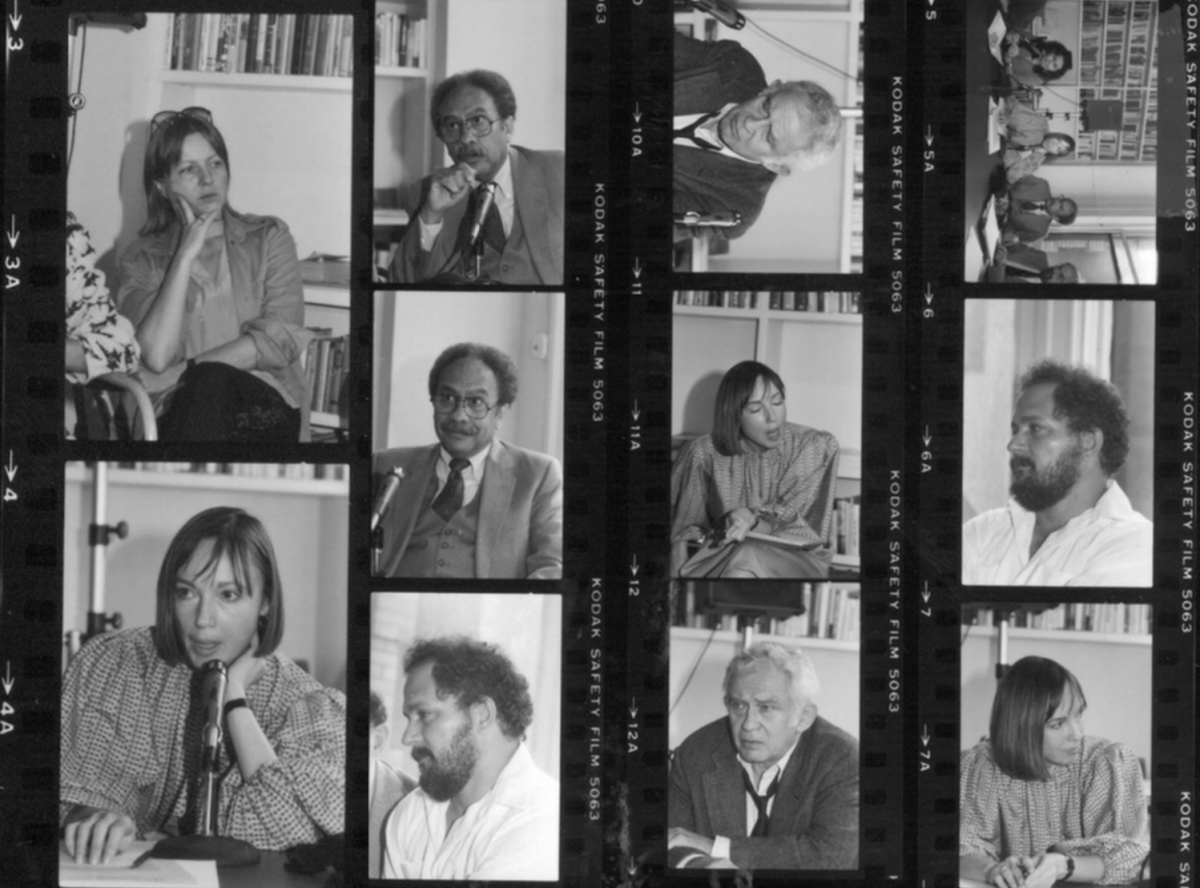
The recently launched PEN America Digital Archive is an Aladdin’s cave of literary treasures. An incredible amount of cultural programming has grown up around the organization’s commitment to championing writers’ civil liberties–over 1,500 hours worth of audio and visual files.
Delve into this free, searchable archive for previously inaccessible lectures, readings, and discussions featuring the leading writers, intellectuals, and artists of the last 50 years. Many of these New York City-based events were planned in response to the oppression and hardship suffered by fellow writers around the world.
We are lucky that Nobel Prize-winner Morrison, a vigorous cultural observer and critic, still walks among us. Also, that the archive affords us a chance to spend quality time with so many great literary eminences who no longer do:
We're hoping to rely on loyal readers, rather than erratic ads. Please click the Donate button and support Open Culture. You can use Paypal, Venmo, Patreon, even Crypto! We thank you!
Open Culture scours the web for the best educational media. We find the free courses and audio books you need, the language lessons & educational videos you want, and plenty of enlightenment in between.