Taught by professor Steven B. Smith, this course from Yale University offers an Introduction to Political Philosophy, and covers the following ground:
This course is intended as an introduction to political philosophy as seen through an examination of some of the major texts and thinkers of the Western political tradition. Three broad themes that are central to understanding political life are focused upon: the polis experience (Plato, Aristotle), the sovereign state (Machiavelli, Hobbes), constitutional government (Locke), and democracy (Rousseau, Tocqueville). The way in which different political philosophies have given expression to various forms of political institutions and our ways of life are examined throughout the course.
You can watch the 24 lectures from the course above, or find them on YouTube. To get more information on the course, including the syllabus, visit this Yale website.
The main texts used in this course include the following. You can find them in our collection of Free eBooks.
If you would like to sign up for Open Culture’s free email newsletter, please find it here. It’s a great way to see our new posts, all bundled in one email, each day.
If you would like to support the mission of Open Culture, consider making a donation to our site. It’s hard to rely 100% on ads, and your contributions will help us continue providing the best free cultural and educational materials to learners everywhere. You can contribute through PayPal, Patreon, and Venmo (@openculture). Thanks!
Unsettling historical parallels between the newly-developing world order and the terrors that scourged Europe in the 1930s and 40s now seem undeniable to most informed observers of contemporary geopolitics. Europeans have their own political crises to weather, but all eyes currently seem trained on the military behemoth that is my own country. “These are not normal times,” admits Jane Chong at Lawfare. Though she critiques Nazi comparisons as needlessly alarmist, she “sees no reason for optimism.” While references to history’s greatest villain abound, we’ve also seen Australian scientist Alan Finkel compare the U.S. leader to Joseph Stalin for the suppression and censorship of environmental data.
The devastation Hitler and Stalin visited upon Western and Eastern Europe can hardly be overstated—and we still find it nearly impossible to comprehend. But not soon after the end of World War II, one of the 20th century’s most probing analysts of political thought attempted to do just that.
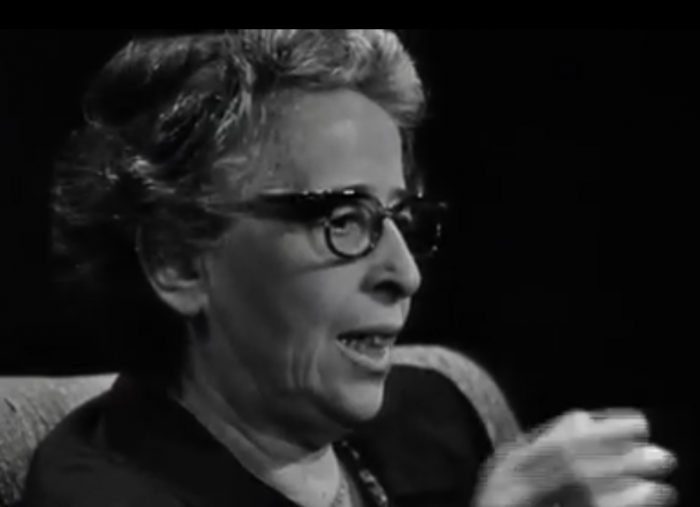
Arendt’s renewed relevance recently prompted Melvyn Bragg, host of the excellent BBC Radio program In Our Time, to bring three guest philosophy professors—Robert Eaglestone, Frisbee Sheffield, and Lyndsey Stonebridge—on air to discuss her ideas and influence. Bragg begins with a brief outline of Arendt’s biography, then turns to Sheffield, a lecturer at Girton College, Cambridge, for elaboration. They immediately address one of the most controversial aspects of Arendt’s young life, her affair with her mentor, Martin Heidegger, who joined the Nazi party and remained a true believer in its ideology.
But the conversation quickly moves on from there to encompass Arendt’s multi-dimensional thought. “There’s a great range to her writings,” says Sheffield. A trained classicist, Arendt wrote her dissertation on the idea of love in St. Augustine. Her most philosophical work, The Human Condition, drew on classical concepts to rank human activity into a hierarchy of labor, work, and action. She “wrote on a great range of topics,” Sheffield notes, though “there is a consistent interest in politics and political themes throughout her work.”
Yet Arendt rejected the label of political philosopher and is herself “hard to pin down” politically. Her 1963 book On Revolution, critiqued leftist and Marxist thought and praised the American Revolution for its constitutionalism. She was skeptical of the notion of universal human rights, and her essay On Violence made the argument that violence appears only in the absence of political power, not its ascendency. As we learn from listening to Bragg’s assembled panel of guests, Arendt consistently emphasized two classical concepts: the value of a civic and political order and the importance of the “life of the mind,” also the title of a two-volume work published posthumously in 1978.
When I was growing up, protest music meant Public Enemy, Rage Against the Machine, and—for some few Americans and very many Brits—Billy Bragg: an artist “at home with both socialist politics and heartbreak,” writes Allmusic, “styled on the solo attack of early Dylan and the passion of the Clash.” Known for his pro-labor, anti-Thatcher, anti-war, pro “Sexuality” stances, Bragg has been a stalwart campaigner for peace and justice since the 1980s.
A veteran activist who made appearances at Occupy Wall Street and the recent Women’s March in London, Bragg lately lamented the state of protest music. “Look at what’s happening in the world,” he told The Guardian in 2011, “When I was first plying my trade, people were willing to talk about these issues. Now they’d rather write about getting blasted than changing the world.”
Much has changed since 2011, I don’t need to tell you. And the protest song has returned, from Anohni’s beautiful, haunting 2016 album Hopeless (see “Drone Bomb Me” above) to Pussy Riot’s frighteningly prescient “Make America Great Again,” released just before the election. We’ve heard it said that “protest songs are pointless,” but they’ve carried many a movement through many a seemingly hopeless moment. Bragg himself, still plying his trade, rewrote the lyrics to Bob Dylan’s classic “The Times They Are A‑Changing” as “The Times They Are A‑Changing Back” (at the top), just thirty minutes after the inaugural speech, and “with apologies” to Dylan.
Bragg clearly has deep roots in the genre, but are Anohni and Pussy Riot’s melodic provocations protest music? What about the empowering anthems of Beyoncé or the poetic ruminations of Solange? Just what makes a protest song? Every generation will have their own criteria, and their own pantheon of political artists. Whether you look back to the wry folk songs of Woody Guthrie, to the Golden Age of Dylan, Odetta, Joan Baez, and Pete Seeger; to the Beatles or Neil Young; or to punk rock, hip-hop, reggae, or the funk soul of Marvin Gaye, you will find a few favorites on the Spotify playlist above. It features 58 tracks and runs about 4 hours and 15 minutes. If you want a direct link to the playlist, click here. If you need Spotify’s software, please download it here.
– A piece of music that is a great song in its own right. Good words and fine sentiments are not enough. The music must move us.
– A song that has a purpose. A song that doesn’t confine itself to commenting on or bemoaning the ills of the world, but seeks in some small way to change things. It may do this by calling directly for something to happen – “free Nelson Mandela”, by informing us, by appealing to our hearts and our emotions, or by challenging commonly held ideas.
– It follows from this that a true protest song should address a specific issue or issues that are current. Songs about wars and revolutions in days long gone are not included here.
– Finally the song should provoke the listener : shock us, unsettle us, amaze us, inspire us, make us angry, make us sad or make us optimistic. If it doesn’t do any of these things, it hardly deserves to be called a protest song. So be warned : there’s a lot of anger and a lot of emotion in these songs.
I’ll admit, I take issue with some of these criteria—I’d argue, for example, that Black Sabbath’s “War Pigs” is a timeless protest song that doesn’t reference any specific event or offer a solution (except “judgment day”). But you are free to disagree. Some of the songs on our playlist came from reader suggestions. We’d love to hear some others. What would you add to the list? And how do you define a “protest song”? Feel free to add your thoughts and suggestions in the comments section below.
When totalitarian regimes around the world are in power, writing that tells the truth—whether literary, journalistic, scientific, or legal—effectively serves as counter-propaganda. To write honestly is to expose: to uncover what is hidden, stand apart from it, and observe. These actions are anathema to dictatorships. But they are integral to resistance movements, which must develop their own press in order to disseminate ideas other than official state dogma.
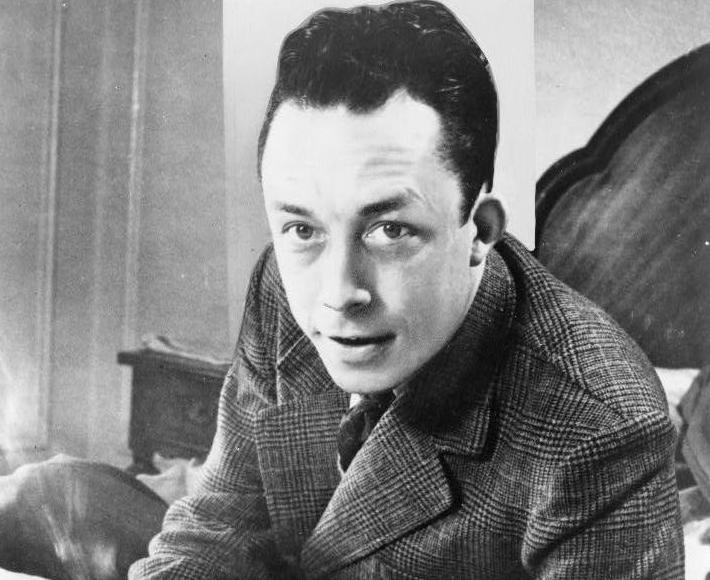
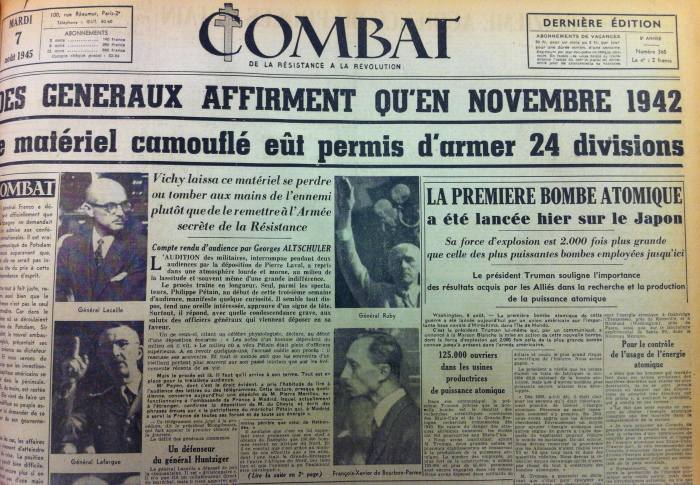
For the French Resistance during World War II, one such publication that served the purpose came from a cell called “Combat,” which gave its name to the underground newspaper to which Jean-Paul Sartre and Albert Camus both contributed during and after the war. Camus became Combat’s editor and editorial writer between 1944 and 1947. During his tenure, he “was suspicious,” writes Michael McDonald, and he urged his readers to “be suspicious of those who speak the loudest in defense of democratic ideals and absolutes but whose goal is to instill fear in opponents and to silence dissent.”
Camus witnessed and recorded the liberation of France from the Nazi occupation in moving passages like this one:
Paris is firing all its ammunition into the August night. Against a vast backdrop of water and stone, on both sides of a river awash with history, freedom’s barricades are once again being erected. Once again justice must be redeemed with men’s blood.
After the previously unthinkable event that ended the war in the Pacific, the 1945 bombings of Hiroshima and Nagasaki, Camus explicitly critiqued the “formidable concert” of opinion impressed with fact that “any average city can be wiped out by a bomb the size of a football.” Against these “eloquent essays,” he wrote darkly,
We can sum it up in one sentence: our technical civilization has just reached its greatest level of savagery. We will have to choose, in the more or less near future, between collective suicide and the intelligent use of our scientific conquests.
Camus heavily documented the early post-war years in France, as the country slowly reconstituted itself, and as coalitions formerly united in resistance collapsed into competing factions. He was alarmed by not only by the fascists on the right, but by the many French socialists seduced by Stalinism. The very next month after the liberation of Paris, Camus began addressing the “problem of government” in an essay titled “To Make Democracy.” Government, writes Camus, “is, to a great extent our problem, as it is indeed the problem of everyone,” but he prefaced his own position with, “we do not believe in politics without clear language.”
By December of 1944, a few months before the fall of Berlin, Camus had grown deeply reflective, expressing attitudes found in many eyewitness accounts. “France has lived through many tragedies,” he wrote, and “will live through many more.” The tragedy of the war, he wrote, was “the tragedy of separation.”
Who would dare speak the word “happiness” in these tortured times? Yet millions today continue to seek happiness. These years have been for them only a prolonged postponement, at the end of which they hope to find that the possibility for happiness has been renewed. Who could blame them? … We entered this war not because of any love of conquest, but to defend a certain notion of happiness. Our desire for happiness was so fierce and pure that it seemed to justify all the years of unhappiness. Let us retain the memory of this happiness and of those who have lost it.
These lucid, passionate essays “include little that is obsolete,” wrote Stanley Hoffman at Foreign Affairs in 2006. “Indeed it is shocking to find how current Camus’ fears, exhortations, and aspirations still are.” Hoffman particularly found Camus’ demand “for morality in politics” compelling. Though “deemed naïve… [by] many other philosophers and writers of his time,” Camus’ insistence on clarity of thought and ethical choice made for what he called “a modest political philosophy… free of all messianic elements and devoid of any nostalgia for an earthly paradise.” How sobering those words sound in our current moment.
“In March 1845, the United States acquired a new president – James K. Polk – a forceful, aggressive political outsider intent on strengthening his country and asserting its pre-eminence in front of other world powers, especially Mexico and Great Britain,” says The Book of Life. “Within a year of his inauguration, he had declared full-scale war on Mexico because of squabbles over the Texan border, and was soon rattling his saber at Britain over the ownership of Oregon. To complete the picture, Polk was a vigorous defender of slavery, who dismissed the arguments of abolitionists as naive and sentimental.” How did Americans who disagreed with this vicious-sounding character endure his term?
Though Polk did enjoy popular support, “a sizeable minority of the citizenry disliked him intensely,” especially a certain citizen by the name of Henry David Thoreau. The author of Walden; or, Life in the Woodsbelieved that “true patriots were not those who blindly followed their administration” but “those who followed their own consciences and in particular, the principles of reason,” even when it meant publicly standing against not just the man in office but the many who agree with him, or even when it meant running afoul of the laws of the land. He elucidated the principles behind this position in the 1849 essay “Civil Disobedience,” which Josh Jones wrote about here last November.
The animated video above from Alain de Botton’s School of Life, also the producer of The Book of Life, places Thoreau’s ideas on the role of the individual versus the state in the context of Thoreau’s life — one he lived without fear of, say, getting thrown into jail for refusing to pay taxes to what he saw as an immoral state. “Under a government which imprisons any unjustly,” the transcendentalist figurehead declares in “Civil Disobedience,” “the true place for a just man is a prison.” Well over a century and half on, Thoreau still reminds us that political systems, no matter how long they last, remain ever subject to breakdown, adjustment, and even dismantling and rebuilding at the hands of the rulers and the ruled alike. Politics, as history occasionally and forcefully reminds us, is negotiation without end, and sometimes negotiations have to get ugly.
When Eichmann in Jerusalem—Hannah Arendt’s book about Nazi officer Adolf Eichmann’s trial—came out in 1963, it contributed one of the most famous of post-war ideas to the discourse, the “banality of evil.” And the concept at first caused a critical furor. “Enormous controversy centered on what Arendt had written about the conduct of the trial, her depiction of Eichmann, and her discussion of the role of the Jewish Councils,” writes Michael Ezra at Dissent magazine “Eichmann, she claimed, was not a ‘monster’; instead, she suspected, he was a ‘clown.’”
Arendt blamed victims who were forced to collaborate, critics charged, and made the Nazi officer seem ordinary and unremarkable, relieving him of the extreme moral weight of his responsibility. She answered these charges in an essay titled “Personal Responsibility Under Dictatorship,” published in 1964. Here, she aims to clarify the question in her title by arguing that if Eichmann were allowed to represent a monstrous and inhuman system, rather than shockingly ordinary human beings, his conviction would make him a scapegoat and let others off the hook. Instead, she believes that everyone who worked for the regime, whatever their motives, is complicit and morally culpable.
But although most people are culpable of great moral crimes, those who collaborated were not, in fact, criminals. On the contrary, they chose to follow the rules in a demonstrably criminal regime. It’s a nuance that becomes a stark moral challenge. Arendt points out that everyone who served the regime agreed to degrees of violence when they had other options, even if those might be fatal. Quoting Mary McCarthy, she writes, “If somebody points a gun at you and says, ‘Kill your friend or I will kill you,’ he is tempting you, that is all.”
While this circumstance may provide a “legal excuse,” for killing, Arendt seeks to define a “moral issue,” a Socratic principle she had “taken for granted” that we all believed: “It is better to suffer than do wrong,” even when doing wrong is the law. People like Eichmann were not criminals and psychopaths, Arendt argued, but rule-followers protected by social privilege. “It was precisely the members of respectable society,” she writes, “who had not been touched by the intellectual and moral upheaval in the early stages of the Nazi period, who were the first to yield. They simply exchanged one system of values against another,” without reflecting on the morality of the entire new system.
Those who refused, on the other hand, who even “chose to die,” rather than kill, did not have “highly developed intelligence or sophistication in moral matters.” But they were critical thinkers practicing what Socrates called a “silent dialogue between me and myself,” and they refused to face a future where they would have to live with themselves after committing or enabling atrocities. We must remember, Arendt writes, that “whatever else happens, as long as we live we shall have to live together with ourselves.”
Such refusals to participate might be small and private and seemingly ineffectual, but in large enough numbers, they would matter. “All governments,” Arendt writes, quoting James Madison, “rest on consent,” rather than abject obedience. Without the consent of government and corporate employees, the “leader… would be helpless.” Arendt admits the unlikely effectiveness of active opposition to a one-party authoritarian state. And yet when people feel most powerless, most under duress, she writes, an honest “admission of one’s own impotence” can give us “a last remnant of strength” to refuse.
We have only for a moment to imagine what would happen to any of these forms of government if enough people would act “irresponsibly” and refuse support, even without active resistance and rebellion, to see how effective a weapon this could be. It is in fact one of the many variations of nonviolent action and resistance—for instance the power that is potential in civil disobedience.
We have example after example of these kinds of refusals to participate in a murderous system or further its aims. Arendt was aware these actions can come at great cost. The alternatives, she argues, may be far worse.
At least when I was in grade school, we learned the very basics of how the Third Reich came to power in the early 1930s. Paramilitary gangs terrorizing the opposition, the incompetence and opportunism of German conservatives, the Reichstag Fire. And we learned about the critical importance of propaganda, the deliberate misinforming of the public in order to sway opinions en masse and achieve popular support (or at least the appearance of it). While Minister of Propaganda Joseph Goebbels purged Jewish and leftist artists and writers, he built a massive media infrastructure that played, writes PBS, “probably the most important role in creating an atmosphere in Germany that made it possible for the Nazis to commit terrible atrocities against Jews, homosexuals, and other minorities.”
How did the minority party of Hitler and Goebbels take over and break the will of the German people so thoroughly that they would allow and participate in mass murder? Post-war scholars of totalitarianism like Theodor Adorno and Hannah Arendt asked that question over and over, for several decades afterward. Their earliest studies on the subject looked at two sides of the equation. Adorno contributed to a massive volume of social psychology called The Authoritarian Personality, which studied individuals predisposed to the appeals of totalitarianism. He invented what he called the F‑Scale (“F” for “fascism”), one of several measures he used to theorize the Authoritarian Personality Type.
Arendt, on the other hand, looked closely at the regimes of Hitler and Stalin and their functionaries, at the ideology of scientific racism, and at the mechanism of propaganda in fostering “a curiously varying mixture of gullibility and cynicism with which each member… is expected to react to the changing lying statements of the leaders.” So she wrote in her 1951 Origins of Totalitarianism, going on to elaborate that this “mixture of gullibility and cynicism… is prevalent in all ranks of totalitarian movements”:
In an ever-changing, incomprehensible world the masses had reached the point where they would, at the same time, believe everything and nothing, think that everything was possible and nothing was true… The totalitarian mass leaders based their propaganda on the correct psychological assumption that, under such conditions, one could make people believe the most fantastic statements one day, and trust that if the next day they were given irrefutable proof of their falsehood, they would take refuge in cynicism; instead of deserting the leaders who had lied to them, they would protest that they had known all along that the statement was a lie and would admire the leaders for their superior tactical cleverness.
Why the constant, often blatant lying? For one thing, it functioned as a means of fully dominating subordinates, who would have to cast aside all their integrity to repeat outrageous falsehoods and would then be bound to the leader by shame and complicity. “The great analysts of truth and language in politics”—writes McGill University political philosophy professor Jacob T. Levy—including “George Orwell, Hannah Arendt, Vaclav Havel—can help us recognize this kind of lie for what it is.… Saying something obviously untrue, and making your subordinates repeat it with a straight face in their own voice, is a particularly startling display of power over them. It’s something that was endemic to totalitarianism.”
Arendt and others recognized, writes Levy, that “being made to repeat an obvious lie makes it clear that you’re powerless.” She also recognized the function of an avalanche of lies to render a populace powerless to resist, the phenomenon we now refer to as “gaslighting”:
The result of a consistent and total substitution of lies for factual truth is not that the lie will now be accepted as truth and truth be defamed as a lie, but that the sense by which we take our bearings in the real world—and the category of truth versus falsehood is among the mental means to this end—is being destroyed.
The epistemological ground thus pulled out from under them, most would depend on whatever the leader said, no matter its relation to truth. “The essential conviction shared by all ranks,” Arendt concluded, “from fellow traveler to leader, is that politics is a game of cheating and that the ‘first commandment’ of the movement: ‘The Fuehrer is always right,’ is as necessary for the purposes of world politics, i.e., world-wide cheating, as the rules of military discipline are for the purposes of war.”
“We too,” writes Jeffrey Isaacs at The Washington Post, “live in dark times”—an allusion to another of Arendt’s sobering analyses—“even if they are different and perhaps less dark.” Arendt wrote Origins of Totalitarianism from research and observations gathered during the 1940s, a very specific historical period. Nonetheless the book, Isaacs remarks, “raises a set of fundamental questions about how tyranny can arise and the dangerous forms of inhumanity to which it can lead.” Arendt’s analysis of propaganda and the function of lies seems particularly relevant at this moment. The kinds of blatant lies she wrote of might become so commonplace as to become banal. We might begin to think they are an irrelevant sideshow. This, she suggests, would be a mistake.
But the real stars of this show are the female trailblazers who fought (and continue to fight) for access to safe and affordable reproductive care for all women, regardless of age, race, or ability to pay.
In the words of founder Margaret Sanger, a controversial figure who seems to share quite a few traits with Dunham, from her deft leverage of her celebrity on behalf of her chosen cause to her capacity for alienating fans with some of her less savory views and statements:
No woman can call herself free who does not own and control her body. No woman can call herself free until she can choose consciously whether she will or will not be a mother.
Women like Rosie Jimenez, a single mother who died from complications of a back alley abortion following the passage of the Hyde Amendment, were victimized by laws regarding reproductive choice.
Others, like Estelle Griswold, executive director of the Planned Parenthood League of Connecticut, flouted the laws to bring about change.
More recently Faye Wattleton, Planned Parenthood’s first African American president and its current president, Cecile Richards, have worked to promote awareness of both the public’s rights and any impending dangers to those rights.
Ayun Halliday is an author, illustrator, theater maker and Chief Primatologist of the East Village Inky zine. Her play Zamboni Godot is opening in New York City in March 2017. Follow her @AyunHalliday.
We're hoping to rely on loyal readers, rather than erratic ads. Please click the Donate button and support Open Culture. You can use Paypal, Venmo, Patreon, even Crypto! We thank you!
Open Culture scours the web for the best educational media. We find the free courses and audio books you need, the language lessons & educational videos you want, and plenty of enlightenment in between.