“In March 1845, the United States acquired a new president – James K. Polk – a forceful, aggressive political outsider intent on strengthening his country and asserting its pre-eminence in front of other world powers, especially Mexico and Great Britain,” says The Book of Life. “Within a year of his inauguration, he had declared full-scale war on Mexico because of squabbles over the Texan border, and was soon rattling his saber at Britain over the ownership of Oregon. To complete the picture, Polk was a vigorous defender of slavery, who dismissed the arguments of abolitionists as naive and sentimental.” How did Americans who disagreed with this vicious-sounding character endure his term?
Though Polk did enjoy popular support, “a sizeable minority of the citizenry disliked him intensely,” especially a certain citizen by the name of Henry David Thoreau. The author of Walden; or, Life in the Woodsbelieved that “true patriots were not those who blindly followed their administration” but “those who followed their own consciences and in particular, the principles of reason,” even when it meant publicly standing against not just the man in office but the many who agree with him, or even when it meant running afoul of the laws of the land. He elucidated the principles behind this position in the 1849 essay “Civil Disobedience,” which Josh Jones wrote about here last November.
The animated video above from Alain de Botton’s School of Life, also the producer of The Book of Life, places Thoreau’s ideas on the role of the individual versus the state in the context of Thoreau’s life — one he lived without fear of, say, getting thrown into jail for refusing to pay taxes to what he saw as an immoral state. “Under a government which imprisons any unjustly,” the transcendentalist figurehead declares in “Civil Disobedience,” “the true place for a just man is a prison.” Well over a century and half on, Thoreau still reminds us that political systems, no matter how long they last, remain ever subject to breakdown, adjustment, and even dismantling and rebuilding at the hands of the rulers and the ruled alike. Politics, as history occasionally and forcefully reminds us, is negotiation without end, and sometimes negotiations have to get ugly.
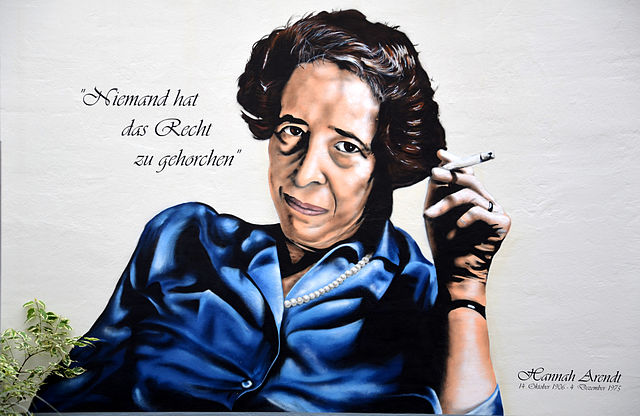
When Eichmann in Jerusalem—Hannah Arendt’s book about Nazi officer Adolf Eichmann’s trial—came out in 1963, it contributed one of the most famous of post-war ideas to the discourse, the “banality of evil.” And the concept at first caused a critical furor. “Enormous controversy centered on what Arendt had written about the conduct of the trial, her depiction of Eichmann, and her discussion of the role of the Jewish Councils,” writes Michael Ezra at Dissent magazine “Eichmann, she claimed, was not a ‘monster’; instead, she suspected, he was a ‘clown.’”
Arendt blamed victims who were forced to collaborate, critics charged, and made the Nazi officer seem ordinary and unremarkable, relieving him of the extreme moral weight of his responsibility. She answered these charges in an essay titled “Personal Responsibility Under Dictatorship,” published in 1964. Here, she aims to clarify the question in her title by arguing that if Eichmann were allowed to represent a monstrous and inhuman system, rather than shockingly ordinary human beings, his conviction would make him a scapegoat and let others off the hook. Instead, she believes that everyone who worked for the regime, whatever their motives, is complicit and morally culpable.
But although most people are culpable of great moral crimes, those who collaborated were not, in fact, criminals. On the contrary, they chose to follow the rules in a demonstrably criminal regime. It’s a nuance that becomes a stark moral challenge. Arendt points out that everyone who served the regime agreed to degrees of violence when they had other options, even if those might be fatal. Quoting Mary McCarthy, she writes, “If somebody points a gun at you and says, ‘Kill your friend or I will kill you,’ he is tempting you, that is all.”
While this circumstance may provide a “legal excuse,” for killing, Arendt seeks to define a “moral issue,” a Socratic principle she had “taken for granted” that we all believed: “It is better to suffer than do wrong,” even when doing wrong is the law. People like Eichmann were not criminals and psychopaths, Arendt argued, but rule-followers protected by social privilege. “It was precisely the members of respectable society,” she writes, “who had not been touched by the intellectual and moral upheaval in the early stages of the Nazi period, who were the first to yield. They simply exchanged one system of values against another,” without reflecting on the morality of the entire new system.
Those who refused, on the other hand, who even “chose to die,” rather than kill, did not have “highly developed intelligence or sophistication in moral matters.” But they were critical thinkers practicing what Socrates called a “silent dialogue between me and myself,” and they refused to face a future where they would have to live with themselves after committing or enabling atrocities. We must remember, Arendt writes, that “whatever else happens, as long as we live we shall have to live together with ourselves.”
Such refusals to participate might be small and private and seemingly ineffectual, but in large enough numbers, they would matter. “All governments,” Arendt writes, quoting James Madison, “rest on consent,” rather than abject obedience. Without the consent of government and corporate employees, the “leader… would be helpless.” Arendt admits the unlikely effectiveness of active opposition to a one-party authoritarian state. And yet when people feel most powerless, most under duress, she writes, an honest “admission of one’s own impotence” can give us “a last remnant of strength” to refuse.
We have only for a moment to imagine what would happen to any of these forms of government if enough people would act “irresponsibly” and refuse support, even without active resistance and rebellion, to see how effective a weapon this could be. It is in fact one of the many variations of nonviolent action and resistance—for instance the power that is potential in civil disobedience.
We have example after example of these kinds of refusals to participate in a murderous system or further its aims. Arendt was aware these actions can come at great cost. The alternatives, she argues, may be far worse.
But the real stars of this show are the female trailblazers who fought (and continue to fight) for access to safe and affordable reproductive care for all women, regardless of age, race, or ability to pay.
In the words of founder Margaret Sanger, a controversial figure who seems to share quite a few traits with Dunham, from her deft leverage of her celebrity on behalf of her chosen cause to her capacity for alienating fans with some of her less savory views and statements:
No woman can call herself free who does not own and control her body. No woman can call herself free until she can choose consciously whether she will or will not be a mother.
Women like Rosie Jimenez, a single mother who died from complications of a back alley abortion following the passage of the Hyde Amendment, were victimized by laws regarding reproductive choice.
Others, like Estelle Griswold, executive director of the Planned Parenthood League of Connecticut, flouted the laws to bring about change.
More recently Faye Wattleton, Planned Parenthood’s first African American president and its current president, Cecile Richards, have worked to promote awareness of both the public’s rights and any impending dangers to those rights.
Ayun Halliday is an author, illustrator, theater maker and Chief Primatologist of the East Village Inky zine. Her play Zamboni Godot is opening in New York City in March 2017. Follow her @AyunHalliday.
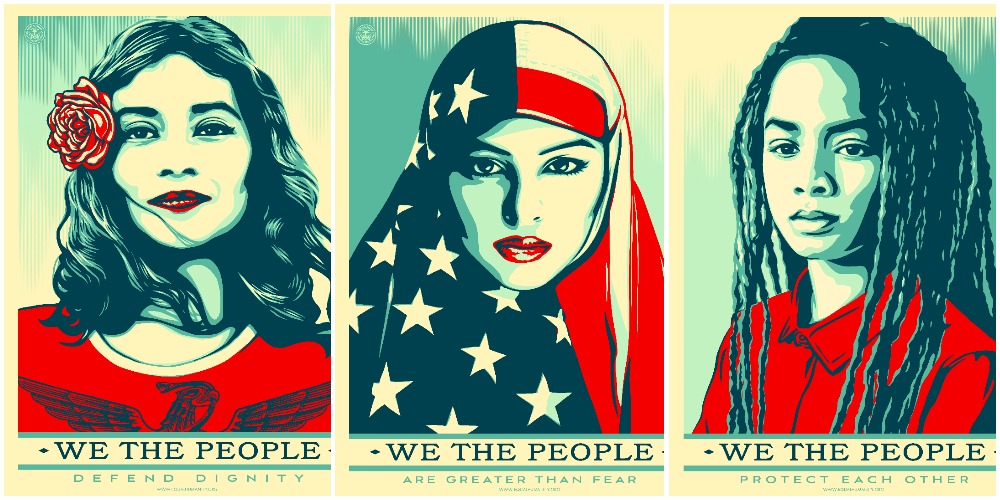
Shepard Fairey probably first crossed your radar when he drew the iconic “Hope” poster so associated with Barack Obama’s 2008 campaign. Now, he returns with another set of posters to help protest the inauguration of one Donald J. Trump. If you head over to the Amplifier Foundation web site, you can download and print a series of posters (shown above) by Fairey. The same applies to a number of posters designed by other artists, including Jessica Sabogal and Ernesto Yerena.
The images capture the “shared humanity of our diverse America” and condemn the exclusionary policies of the incoming administration. And thanks to the $1.3 million raised through a successful Kickstarter campaign, these posters will figure into a larger Inauguration Day plan. Here’s how it will work:
Much of Washington will be locked down on Inauguration Day, and in some areas there will be severe restrictions on signs and banners. But we’ve figured out a hack. It’s called the newspaper! On January 20th, if this campaign succeeds, we’re going to take out full-page ads in the Washington Post with these images, so that people across the capitol and across the country will be able to carry them into the streets, hang them in windows, or paste them on walls.
You’re welcome to print and post these posters around your town–wherever it’s legally permitted to do so. To download the posters, click here.
If you would like to support the mission of Open Culture, consider making a donation to our site. It’s hard to rely 100% on ads, and your contributions will help us continue providing the best free cultural and educational materials to learners everywhere. You can contribute through PayPal, Patreon, and Venmo (@openculture). Thanks!
“Should we allow celebrities to discuss politics?” goes one variation on an evergreen headline and supposedly legitimate public debate. No amount of public disapproval could have stopped some of the most outspoken public figures, and we’d be the worse off for it in many cases. Muhammad Ali, John Lennon, Nina Simone, George Carlin, Roger Waters, Margaret Cho, and, yes, Meryl Streep—millions of people have been very grateful (and many not) for these artists’ political commentary. When it comes to scientists, however, we tend to see more baseless accusations of political speech than overwhelming evidence of it.
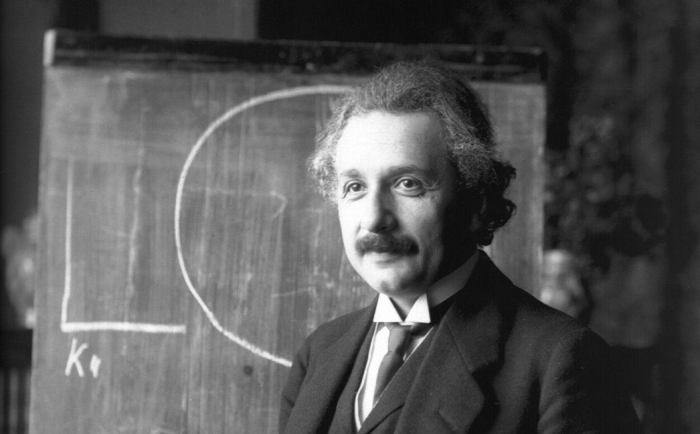
But there have been those few scientists and philosophers who were also celebrities, and who made their political views well-known without reservation. Bertrand Russell was such a person, as was Albert Einstein, who took up the causes of world peace and of racial justice in the post-war years. As we’ve previously noted, Einstein’s commitments were both philanthropic and activist, and he formed close friendships with Paul Robeson, W.E.B. Du Bois, Marian Anderson, and other prominent black leaders.
Einstein also co-chaired an anti-lynching campaign and issued a scathing condemnation of racism during a speech he gave in 1946 at the alma mater of Langston Hughes and Thurgood Marshall in which he called racism “a disease of white people.” That same year, notes On Being’s executive editor Trent Gilliss, Einstein “penned one of his most articulate and eloquent essays advocating for the civil rights of black people in America.” Titled “The Negro Question” and published in the January 1946 edition of Pageant magazine, the essay, writes Gilliss, “was intended to address a primarily white readership.”
Einstein begins by answering the inevitable objection, “What right has he to speak about things which concern us alone, and which no newcomer should touch?” To this, the famed physicist answers, “I do not think such a standpoint is justified.” Einstein believed he had a unique perspective: “One who has grown up in an environment takes much for granted. On the other hand, one who has come to this country as a mature person may have a keen eye for everything peculiar and characteristic.” Speaking freely about his observations, Einstein felt “he may perhaps prove himself useful.”
Then, after praising the country’s “democratic trait” and its citizens’ “healthy self-confidence and natural respect for the dignity of one’s fellow-man,” he plainly observes that this “sense of equality and human dignity is mainly limited to men of white skins.” Anticipating a casually racist defense of “natural” differences, Einstein replies:
I am firmly convinced that whoever believes this suffers from a fatal misconception. Your ancestors dragged these black people from their homes by force; and in the white man’s quest for wealth and an easy life they have been ruthlessly suppressed and exploited, degraded into slavery. The modern prejudice against Negroes is the result of the desire to maintain this unworthy condition.
The ancient Greeks also had slaves. They were not Negroes but white men who had been taken captive in war. There could be no talk of racial differences. And yet Aristotle, one of the great Greek philosophers, declared slaves inferior beings who were justly subdued and deprived of their liberty. It is clear that he was enmeshed in a traditional prejudice from which, despite his extraordinary intellect, he could not free himself.
Like the ancient Greeks, Americans’ prejudices are “conditioned by opinions and emotions which we unconsciously absorb as children from our environment.” And racist attitudes are both causes and effects of economic exploitation, learned behaviors that emerge from historical circumstances, yet we “rarely reflect” how powerful the influence of tradition is “upon our conduct and convictions.” The situation can be remedied, Einstein believed, though not “quickly healed.” The “man of good will,” he wrote, “must have the courage to set an example by word and deed, and must watch lest his children become influenced by this racial bias.”
In 1968, both Robert F. Kennedy and Martin Luther King, Jr. were assassinated, and U.S. cities erupted in riots; anti-war demonstrators chanted “the whole world is watching” as police beat and tear-gassed them in Chicago outside the Democratic convention. George Wallace led a popular political movement of Klan sympathizers and White Citizens Councils in a vicious backlash against the gains of the Civil Rights movement; and the vengeful, paranoid Richard Nixon was elected president and began to intensify the war in Vietnam and pursue his program of harassment and imprisonment of black Americans and anti-war activists through Hoover’s FBI (and later the bogus “war on drugs”).
Good times, and given several pertinent similarities to our current moment, it seems like a year to revisit if we want to see recent examples of organized, determined resistance by a very beleaguered Left. We might look to the Black Panthers, the Yippies, or Students for a Democratic Society, to name a few prominent and occasionally affiliated groups. But we can also revisit a near-revolution across the ocean, when French students and workers took to the Paris streets and almost provoked a civil war against the government of authoritarian president Charles de Gaulle. The events often referred to simply as Mai 68 have haunted French conservatives ever since, such that president Nicolas Sarkozy forty years later claimed their memory “must be liquidated.”
May 1968, wrote Steven Erlanger on the 40th anniversary, was “a holy moment of liberation for many, when youth coalesced, the workers listened and the semi-royal French government of de Gaulle took fright.” As loose coalitions in the U.S. pushed back against their government on multiple fronts, the Paris uprising (“revolution” or “riot,” depending on who writes the history) brought together several groups in common purpose who would have otherwise never have broken bread: “a crazy array of leftist groups,” students, and ordinary working people, writes Peter Steinfels, including “revisionist socialists, Trotskyists, Maoists, anarchists, surrealists and Marxists. They were anticommunist as much as anticapitalist. Some appeared anti-industrial, anti-institutional, even anti-rational.”
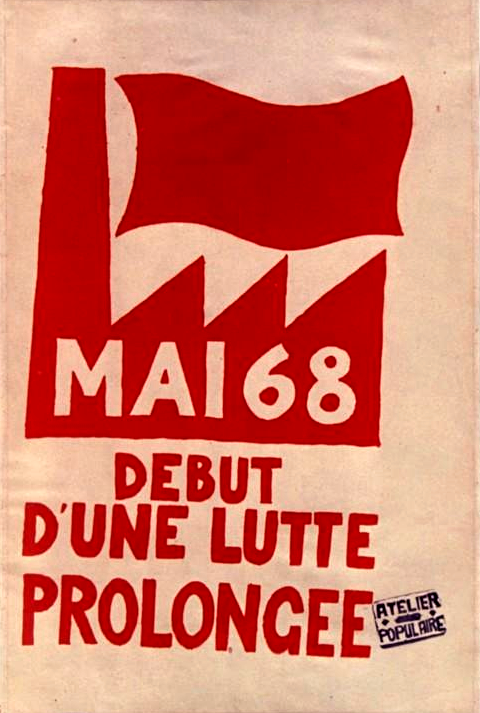
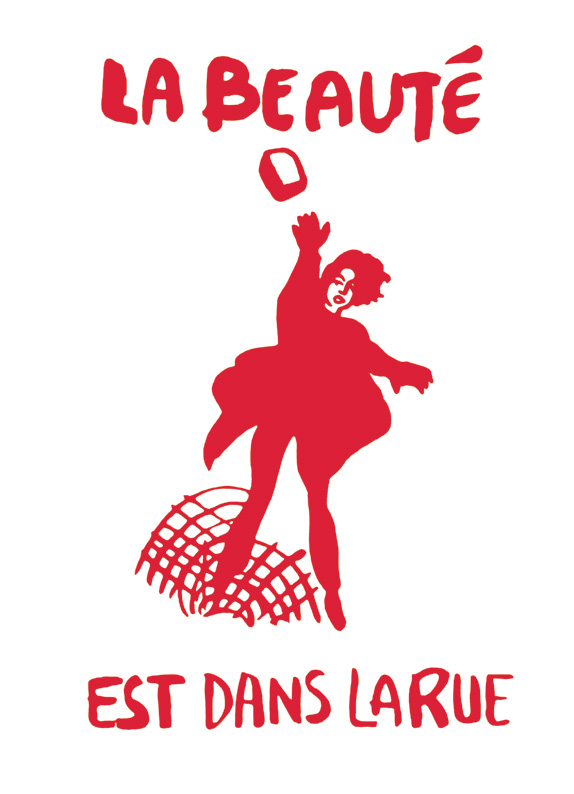
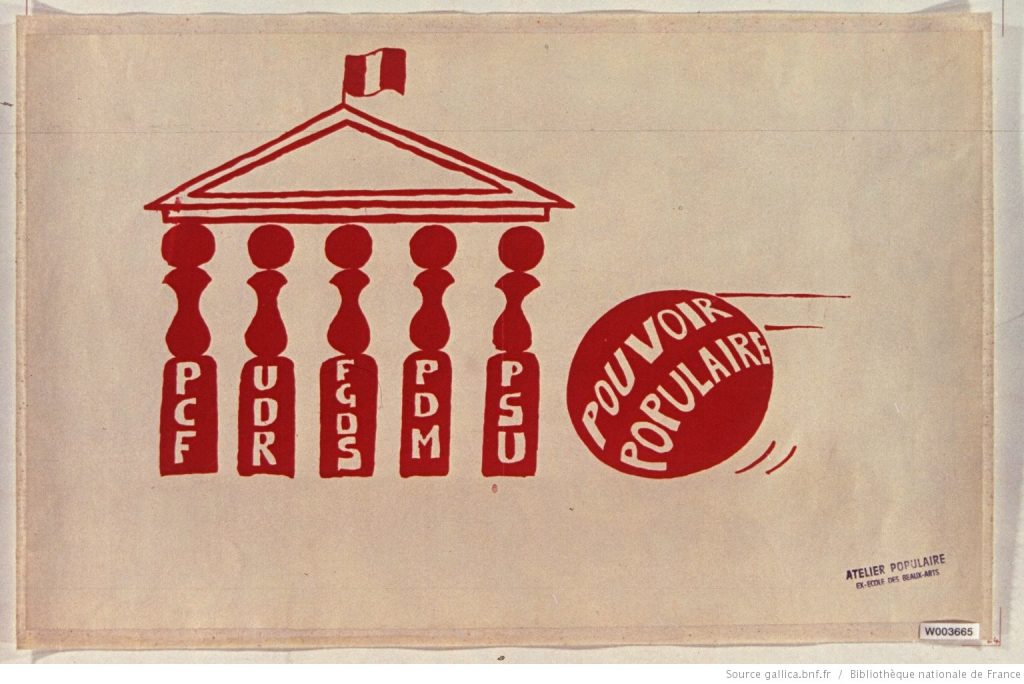
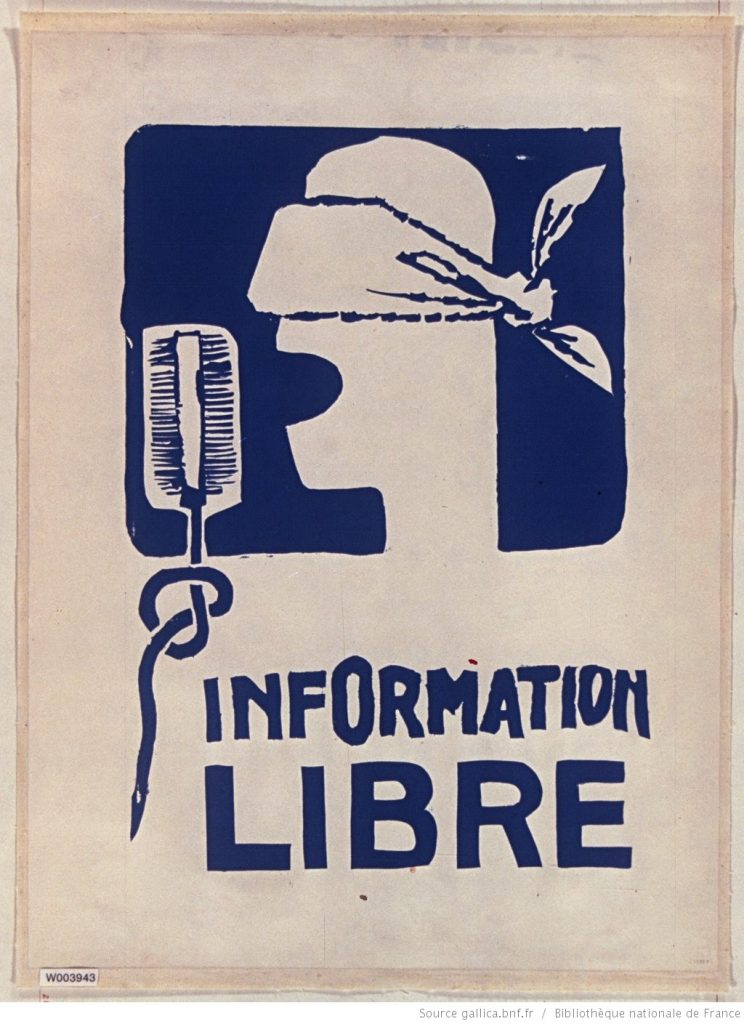
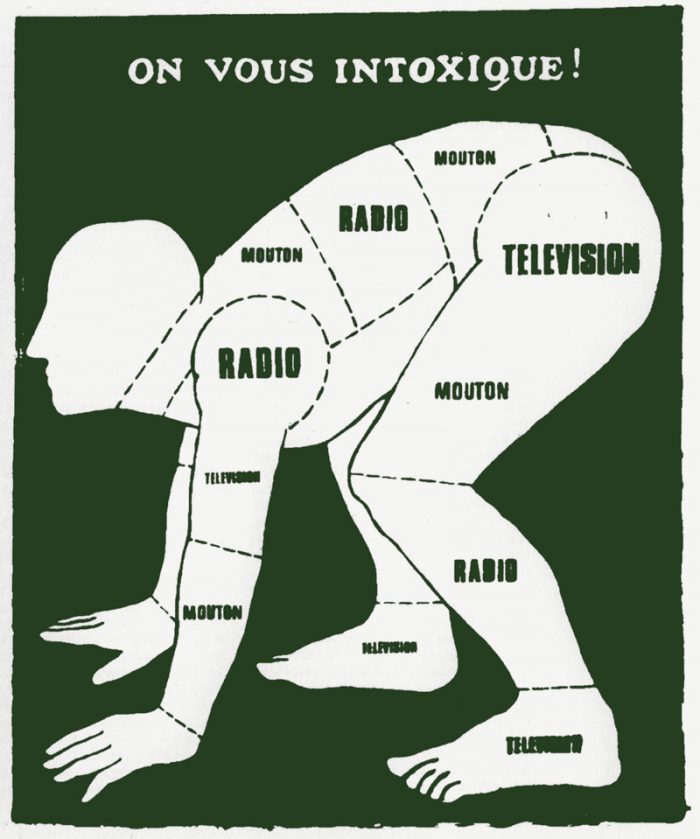
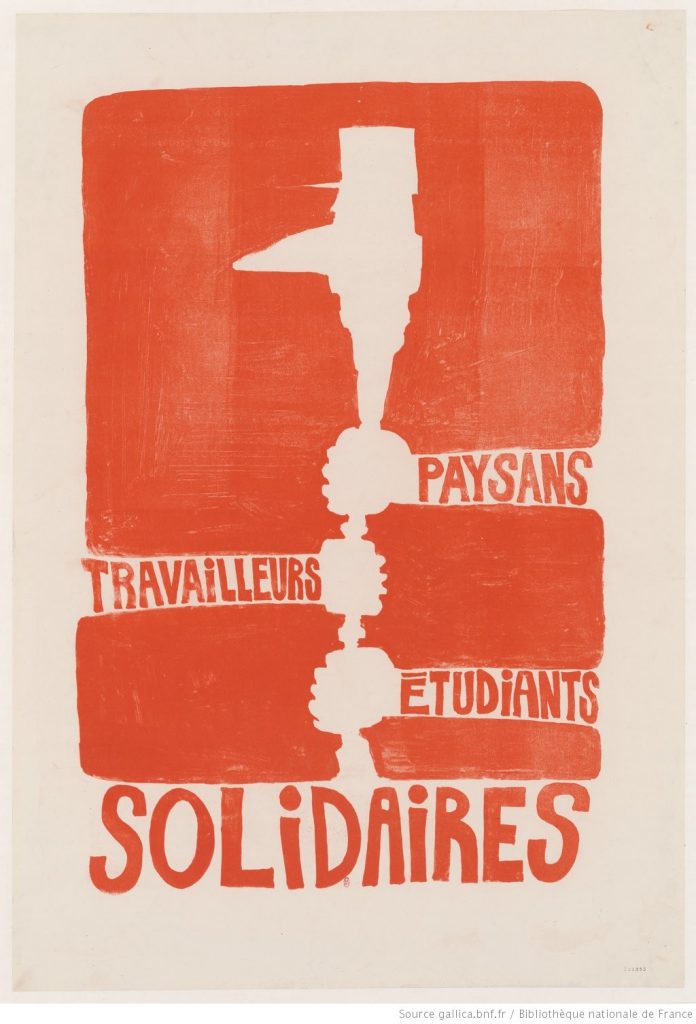
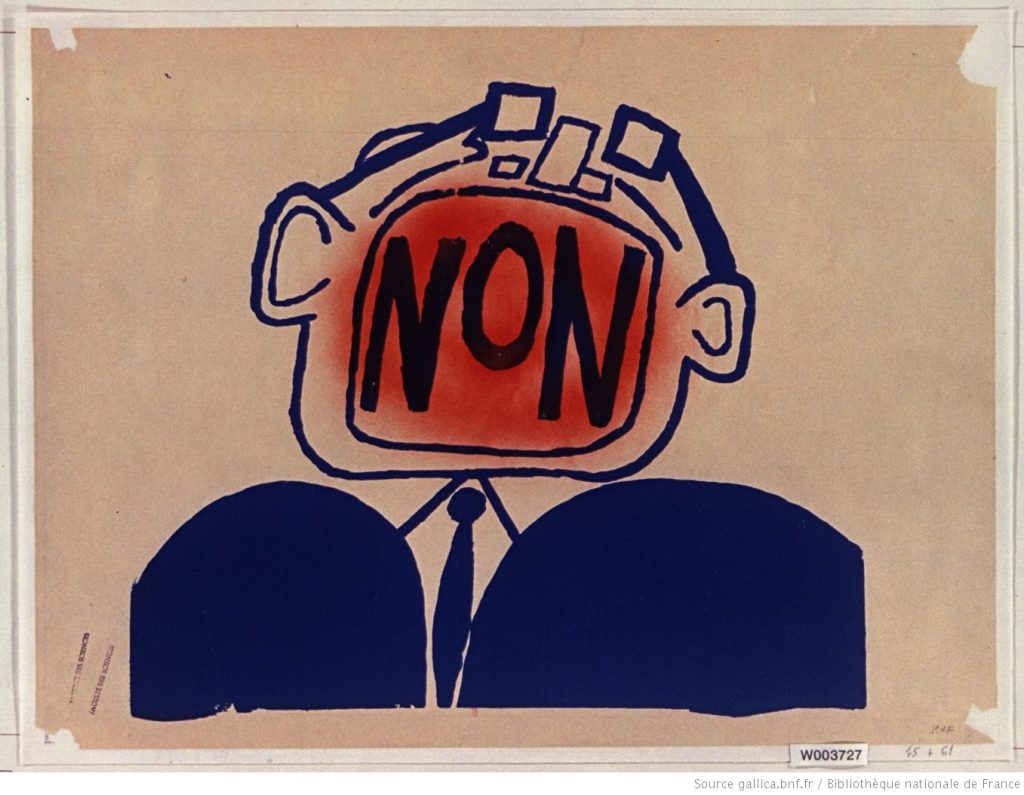
“Be realistic: Demand the impossible!” was one of the May movement’s slogans. A great many more slogans and icons appeared on “extremely fine examples of polemical poster art” like those you see here. These come to us via Dangerous Minds, who explain:
The Atelier Populaire, run by Marxist artists and art students, occupied the École des Beaux-Arts and dedicated its efforts to producing thousands of silk-screened posters using bold, iconic imagery and slogans as well as explicitly collective/anonymous authorship. Most of the posters were printed on newssheet using a single color with basic icons such as the factory to represent labor and a fist to stand for resistance.
The Paris uprisings began with university students, protesting same-sex dorms and demanding educational reform, “the release of arrested students and the reopening of the Nanterre campus of the University of Paris,” notes the Global Nonviolent Action Database. But in the following weeks the “protests escalated and gained more popular support, because of continuing police brutality.” Among the accumulating democratic demands and labor protests, writes Steinfels, was “one great fear… that contemporary capitalism was capable of absorbing any and all critical ideas or movements and bending them to its own advantage. Hence, the need for provocative shock tactics.”
This fear was dramatized by Situationists, who—like Yippies in the States—generally preferred absurdist street theater to earnest political action. And it provided the thesis of one of the most radical texts to come out of the tumultuous times, Guy Debord’s The Society of the Spectacle. In a historical irony that would have Debord “spinning in his grave,” the Situationist theorist has himself been co-opted, recognized as a “national treasure” by the French government, writes Andrew Gallix, and yet, “no one—not even his sworn ideological enemies—can deny Debord’s importance.”
The same could be said for Michel Foucault, who found the events of May ’68 transformational. Foucault pronounced himself “tremendously impressed” with students willing to be beaten and jailed, and his “turn to political militancy within a post-1968 horizon was the chief catalyst for halting and then redirecting his theoretical work,” argues professor of philosophy Bernard Gendron, eventually “leading to the publication of Discipline and Punish,” his groundbreaking “genealogy” of imprisonment and surveillance.
Many more prominent theorists and intellectuals took part and found inspiration in the movement, including André Glucksmann, who recalled May 1968 as “a moment, either sublime or detested, that we want to commemorate or bury.… a ‘cadaver,’ from which everyone wants to rob a piece.” His comments sum up the general cynicism and ambivalence of many on the French left when it comes to May ’68: “The hope was to change the world,” he says, “but it was inevitably incomplete, and the institutions of the state are untouched.” Both student and labor groups still managed to push through several significant reforms and win many government concessions before police and de Gaulle supporters rose up in the thousands and quelled the uprising (further evidence, Anne-Elisabeth Moutet argued this month, that “authoritarianism is the norm in France”).
The iconic posters here represent what Steinfels calls the movement’s “utopian impulse,” one however that “did not aim at human perfectibility but only at imagining that life could really be different and a whole lot better.” These images were collected in 2008 for a London exhibition titled “May 68: street Posters from the Paris Rebellion,” and they’ve been published in book form in Beauty is in the Street: A Visual Record of the May ’68 Paris Uprising. (You can also find and download many posters in the digital collection hosted by the Bibliotheque nationale de France.)
Perhaps the co-option Debord predicted was as inevitable as he feared. But like many radical U.S. movements in the sixties, the coordinated mobilization of huge numbers of people from every strata of French society during those exhilarating and dangerous few weeks opened a window on the possible. Despite its short-lived nature, May 1968 irrevocably altered French civil society and intellectual culture. As Jean-Paul Sartre said of the movement, “What’s important is that the action took place, when everybody believed it to be unthinkable. If it took place this time, it can happen again.”
Several friends and relatives of mine teach philosophy, writing, and critical thinking to undergraduate college students. And many of those people have confessed their dismay in recent months. Threats and McCarthyite attacks on higher educators have increased (and in places like Turkey escalated to full-on war against academics). Many educators are also filled with doubt about the meaning of their profession. How can they stand in the pulpits of higher learning, many wonder, extolling the virtues of clear expression, logic, reason and evidence, ethics, etc., when the world outside the classroom seems to be telling their students none of these things matter?
But then there are some with a more optimistic bent, who see more reason than ever to extol said virtues, with even more rigor and urgency. Philosophy improves our mental and emotional lives in every possible situation. While millions of people in supposedly democratic countries have decided to put their trust in autocratic, authoritarian leaders, millions more have determined to resist the curtailing of civil liberties, democratic rights, and social progress. Educators see the tools of language and critical thinking as integral to those of political action and civil disobedience. And not only do college students need these tools, argue the executives of UK’s Philosophy Foundation, but children do as well, and for many of the same reasons.
Created in 2007 to conduct “philosophical enquiry in schools, communities, and workplaces,” the Foundation works with both children and adults. In the Aeon Magazine video above, COO and CEO Emma and Peter Worley explain the special appeal of philosophy for kids, making the case for teaching “thinking well” at a young age. Rather than lecturing on the history of ideas or presenting a thesis, their approach involves getting children “thinking about things together, working together collaboratively, coming up with counter-examples… really doing philosophy in the true sense.” Young students see problems for themselves and apply their own philosophical solutions, using the nascent reasoning faculties most of us can access as soon as we’ve reached school age.
The Foundation has shown that the teaching of philosophy to children “has an impact on affective skills and also on cognitive skills.” In other words, kids become more emotionally intelligent as they become better thinkers, developing what Socrates called “the silent dialogue” with themselves. These benefits are goods in their own right, argues Emma Worley, and as valuable as the arts in our lives. “We need philosophy because it’s a human thing to do,” she says, “to think, to reason, to reflect.” But there is a decided social utility as well. Philosophy can “safeguard against the ways in which education might sometimes be used to control people,” says Peter Worley: “If we have something like philosophy within the system, something that steps outside that system and asks questions about it, then we have something to protect us” against authoritarian means of thought and language control.
He started writing it in the late ’80s, churning out dozens of verses as he pondered the impact of the fall of the Berlin Wall and the Tiananmen Square protests.
The press kit for the album on which the song originally appeared stated:
These are the final days, this is the darkness, this is the flood. What is the appropriate behavior in a catastrophe, in a flood? You know, while you’re cleaning out your orange crate in the torrent and you pass somebody else hanging on to a spar of wood. What do you declare yourself? “left wing” “right wing” “pro-abortion” “against abortion”? All these things are luxuries which you can no longer afford. What is the proper behavior in a flood?
Gaiman fans will no doubt thrill to hear that unmistakable accent gamely tackling such lyrics as “the homicidal bitchin’ that goes down in every kitchen,” but for my money, the most memorable phrase is the description of this country as “the cradle of the best and of the worst.”
Ayun Halliday is an author, illustrator, theater maker and Chief Primatologist of the East Village Inky zine. Her play Zamboni Godot is opening in New York City in March 2017. Follow her @AyunHalliday.
We're hoping to rely on loyal readers, rather than erratic ads. Please click the Donate button and support Open Culture. You can use Paypal, Venmo, Patreon, even Crypto! We thank you!
Open Culture scours the web for the best educational media. We find the free courses and audio books you need, the language lessons & educational videos you want, and plenty of enlightenment in between.