24 Common Cognitive Biases: A Visual List of the Psychological Systems Errors That Keep Us From Thinking Rationally

There’s been a lot of talk about the Dun­ning-Kruger effect, the cog­ni­tive bias that makes peo­ple wild­ly over­con­fi­dent, unable to know how igno­rant they are because they don’t have the basic skills to grasp what com­pe­tence means. Once pop­u­lar­ized, the effect became weaponized. Peo­ple made arm­chair diag­noses, gloat­ed and point­ed at the obliv­i­ous­ly stu­pid. But if those fin­ger-point­ers could take the beam out of their own eye, they might see four fin­gers point­ing back at them, or what­ev­er folk wis­dom to this effect you care to mash up.

What we now call cog­ni­tive bias­es have been known by many oth­er names over the course of mil­len­nia. Per­haps nev­er have the many vari­eties of self-decep­tion been so spe­cif­ic. Wikipedia lists 185 cog­ni­tive bias­es, 185 dif­fer­ent ways of being irra­tional and delud­ed. Sure­ly, it’s pos­si­ble that every sin­gle time we—maybe accurately—point out some­one else’s delu­sions, we’re hoard­ing a col­lec­tion of our own. Accord­ing to much of the research by psy­chol­o­gists and behav­ioral econ­o­mists, this may be inevitable and almost impos­si­ble to rem­e­dy.


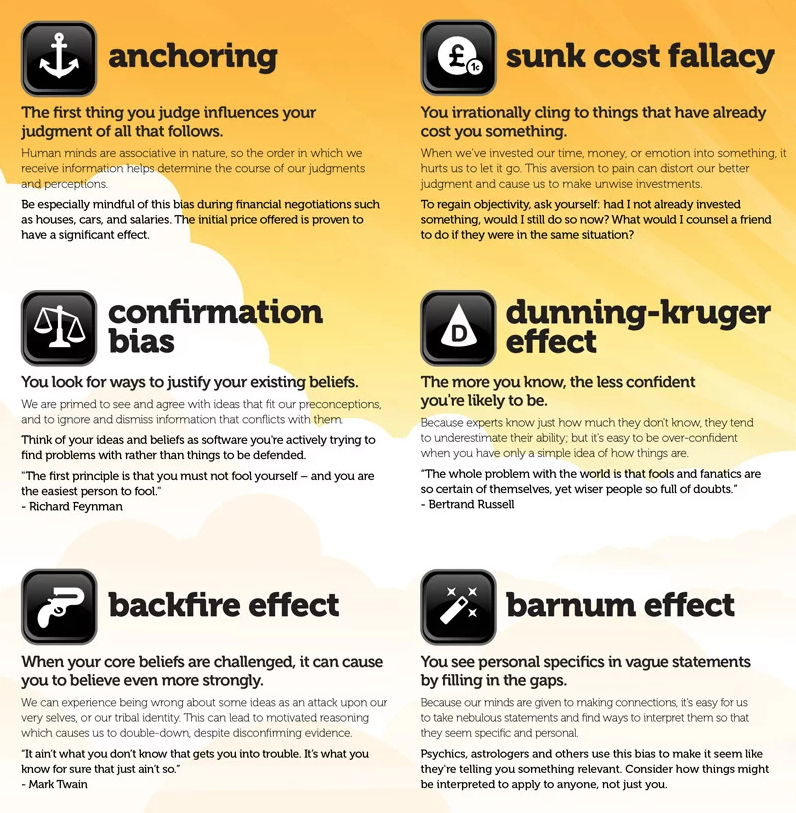
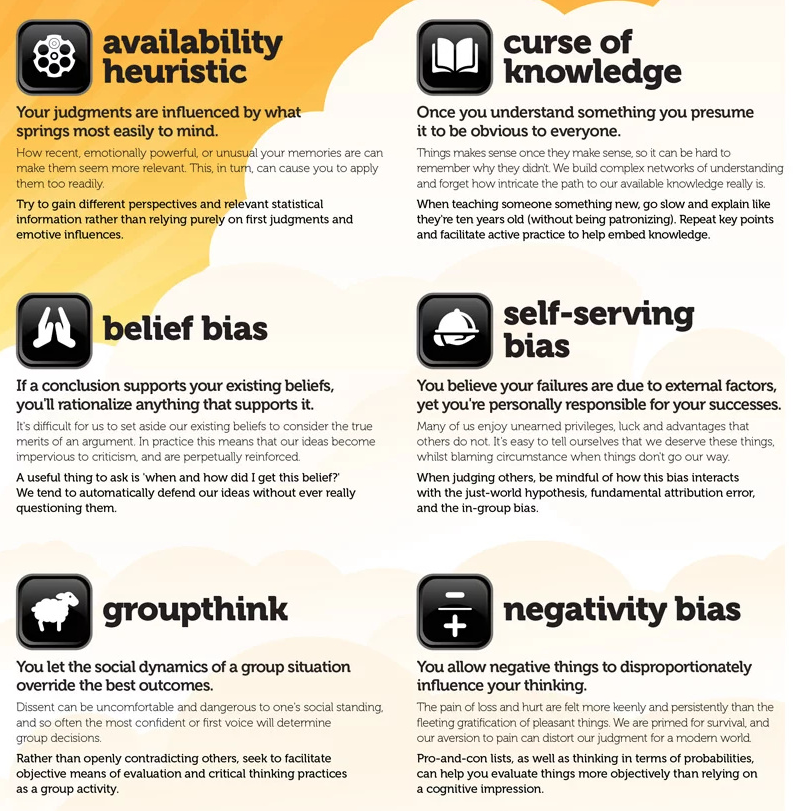
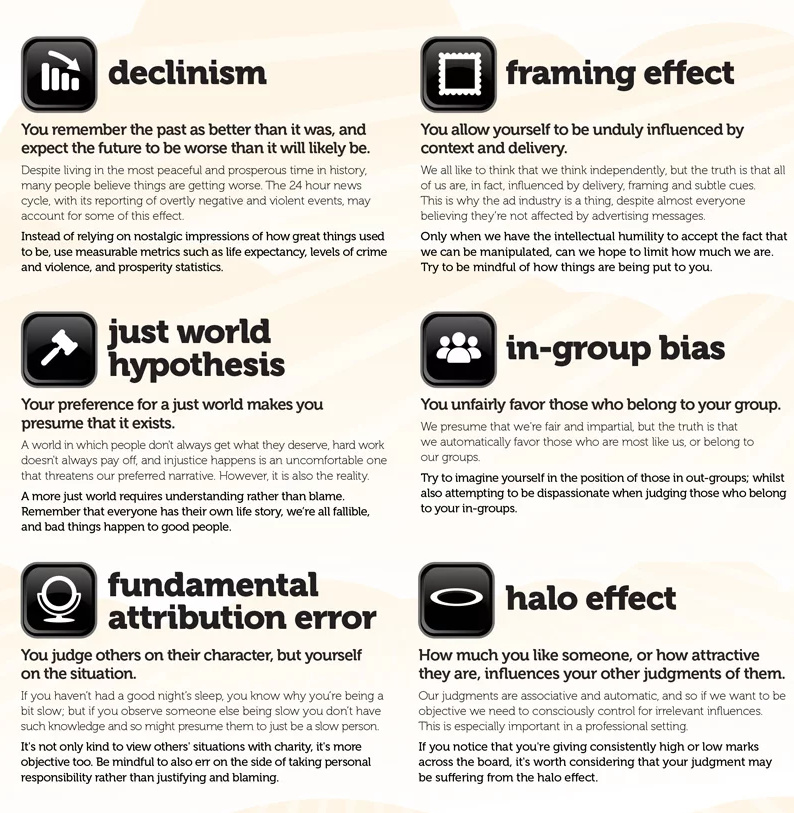
Want to bet­ter under­stand your own cog­ni­tive bias­es and maybe try to move beyond them if you can? See a list of 24 com­mon cog­ni­tive bias­es in an info­graph­ic poster at yourbias.is, the site of the non­prof­it School of Thought. (The two gen­tle­men pop­ping up behind brainy Jeho­vah in the poster, notes Visu­al Cap­i­tal­ist, “hap­pen to rep­re­sent Daniel Kah­ne­man and Amos Tver­sky, two of the lead­ing social sci­en­tists known for their con­tri­bu­tions to this field. Not only did they pio­neer work around cog­ni­tive bias­es start­ing in the late 1960s, but their part­ner­ship also result­ed in a Nobel Prize in Eco­nom­ics in 2002.”)

Grant­ed, a Wikipedia list is a crowd-sourced cre­ation with lots of redun­dan­cy and quite a few “dubi­ous or triv­ial” entries, writes Ben Yago­da at The Atlantic. “The IKEA effect, for instance, is defined as ‘the ten­den­cy for peo­ple to place a dis­pro­por­tion­ate­ly high val­ue on objects they par­tial­ly assem­bled them­selves.’” Much of the val­ue I’ve per­son­al­ly placed on IKEA fur­ni­ture has to do with nev­er want­i­ng to assem­ble IKEA fur­ni­ture again. “But a sol­id group of 100 or so bias­es has been repeat­ed­ly shown to exist, and can make a hash of our lives.”

These are the tricks of the mind that keep gam­blers gam­bling, even when they’re los­ing every­thing. They include not only the “gambler’s fal­la­cy” but con­fir­ma­tion bias and the fal­la­cy of sunk cost, the ten­den­cy to pur­sue a bad out­come because you’ve already made a sig­nif­i­cant invest­ment and you don’t want it to have been for noth­ing. It may seem iron­ic that the study of cog­ni­tive bias­es devel­oped pri­mar­i­ly in the field of eco­nom­ics, the only social sci­ence, per­haps, that still assumes humans are autonomous indi­vid­u­als who freely make ratio­nal choic­es.

But then, econ­o­mists must con­stant­ly con­tend with the counter-evidence—rationality is not a thing most humans do well. (Evo­lu­tion­ar­i­ly speak­ing, this may have been no great dis­ad­van­tage until we got our hands on weapons of mass destruc­tion and the tools of cli­mate col­lapse.) When we act ratio­nal­ly in some areas, we tend to fool our­selves in oth­ers. Is it pos­si­ble to over­come bias? That depends on what we mean. Polit­i­cal and per­son­al prejudices—against eth­nic­i­ties, nation­al­i­ties, gen­ders, and sexualities—are usu­al­ly but­tressed by the sys­tems errors known as cog­ni­tive bias­es, but they are not caused by them. They are learned ideas that can be unlearned.

What researchers and aca­d­e­mics mean when they talk about bias does not relate to spe­cif­ic con­tent of beliefs, but rather to the ways in which our minds warp log­ic to serve some psy­cho­log­i­cal or emo­tion­al need or to help reg­u­late and sta­bi­lize our per­cep­tions in a man­age­able way. “Some of these bias­es are relat­ed to mem­o­ry,” writes Kendra Cher­ry at Very Well Mind, oth­ers “might be relat­ed to prob­lems with atten­tion. Since atten­tion is a lim­it­ed resource, peo­ple have to be selec­tive about what they pay atten­tion to in the world around them.”

We’re con­stant­ly miss­ing what’s right in front of us, in oth­er words, because we’re try­ing to pay atten­tion to oth­er peo­ple too. It’s exhaust­ing, which might be why we need eight hours or so of sleep each night if we want our brains to func­tion half decent­ly. Go to yourbias.is for this list of 24 com­mon cog­ni­tive bias­es, also avail­able on a nifty poster you can order and hang on the wall. You’ll also find there an illus­trat­ed col­lec­tion of log­i­cal fal­lac­i­es and a set of “crit­i­cal think­ing cards” fea­tur­ing both kinds of rea­son­ing errors. Once you’ve iden­ti­fied and defeat­ed all your own cog­ni­tive biases—all 24, or 100, or 185 or so—then you’ll be ready to set out and fix every­one else’s.

via Visu­al Cap­i­tal­ist

Relat­ed Con­tent:

Research Finds That Intel­lec­tu­al Humil­i­ty Can Make Us Bet­ter Thinkers & Peo­ple; Good Thing There’s a Free Course on Intel­lec­tu­al Humil­i­ty

Why Incom­pe­tent Peo­ple Think They’re Amaz­ing: An Ani­mat­ed Les­son from David Dun­ning (of the Famous “Dun­ning-Kruger Effect”)

The Pow­er of Empa­thy: A Quick Ani­mat­ed Les­son That Can Make You a Bet­ter Per­son

Josh Jones is a writer and musi­cian based in Durham, NC. Fol­low him at @jdmagness

How Does the Rorschach Inkblot Test Work?: An Animated Primer

A fright­en­ing mon­ster?

Two friend­ly bears?

Say what!?

As any­body with half a brain and the gift of sight knows, the black and red inkblot below resem­bles noth­ing so much as a pair of gnomes, gavot­ting so hard their knees bleed.

…or per­haps it’s open to inter­pre­ta­tion.

Back in 2013, when Open Cul­ture cel­e­brat­ed psy­chol­o­gist Her­mann Rorschach’s birth­day by post­ing the ten blots that form the basis of his famous per­son­al­i­ty test, read­ers report­ed see­ing all sorts of things in Card 2:

A uterus

Lungs

Kiss­ing pup­pies

A paint­ed face

Lit­tle calfs

Tin­ker­bell check­ing her butt out in the mir­ror

Two oui­ja board enthu­si­asts, sum­mon­ing demons

Angels

And yes, high-fiv­ing bears

As Ror­shach biog­ra­ph­er Damion Searls explains in an ani­mat­ed Ted-ED les­son on how the Rorschach Test can help us under­stand the pat­terns of our per­cep­tions, our answers depend on how we as indi­vid­u­als reg­is­ter and trans­form sen­so­ry input.

Ror­shach chose the blots that gar­nered the most nuanced respons­es, and devel­oped a clas­si­fi­ca­tion sys­tem to help ana­lyze the result­ing data, but for much of the test’s his­to­ry, this code was a high­ly guard­ed pro­fes­sion­al secret.

And when Ror­shach died, a year after pub­lish­ing the images, oth­ers began admin­is­ter­ing the test in ser­vice of their own spec­u­la­tive goals—anthropologists, poten­tial employ­ers, researchers try­ing to fig­ure out what made Nazis tick, come­di­ans…

The range of inter­pre­ta­tive approach­es earned the test a rep­u­ta­tion as pseu­do-sci­ence, but a 2013 review of Rorshach’s volu­mi­nous research went a long way toward restor­ing its cred­i­bil­i­ty.

Whether or not you believe there’s some­thing to it, it’s still fun to con­sid­er the things we bring to the table when exam­in­ing these cards.

Do we see the image as fixed or some­thing more akin to a freeze frame?

What part of the image do we focus on?

Our records show that Open Cul­ture read­ers over­whelm­ing­ly focus on the hands, at least as far as Card 2 goes, which is to say the por­tion of the blot that appears to be high-fiv­ing itself.

Nev­er mind that the high five, as a ges­ture, is rumored to have come into exis­tence some­time in the late 1970s. (Rorschach died in 1922.) That’s what the major­i­ty of Open Cul­ture read­ers saw six years ago, though there was some vari­ety of per­cep­tion as to who was slap­ping that skin:

young ele­phants

despon­dent humans

monks

lawn gnomes

Dis­ney dwarves

red­head­ed women in Japan­ese attire

chim­panzees with traf­fic cones on their heads

(In full dis­clo­sure, it’s most­ly bears.)

Maybe it’s time for a do over?

Read­ers, what do you see now?

Image 1: Bat, but­ter­fly, moth

Rorschach_blot_01

Image 2: Two humans

Rorschach_blot_02

Image 3: Two humans

800px-Rorschach_blot_03

Image 4: Ani­mal hide, skin, rug

Rorschach_blot_04

Image 5: Bat, but­ter­fly, moth

Rorschach_blot_05

Image 6: Ani­mal hide, skin, rug

Rorschach_blot_06

Image 7: Human heads or faces

Rorschach_blot_07

Image 8: Ani­mal; not cat or dog

689px-Rorschach_blot_08

Image 9: Human

647px-Rorschach_blot_09

Image 10: Crab, lob­ster, spi­der,

751px-Rorschach_blot_10

View Searls’ full TED-Ed les­son here.

Relat­ed Con­tent:

Her­mann Rorschach’s Orig­i­nal Rorschach Test: What Do You See? (1921)

The Psy­cho­log­i­cal & Neu­ro­log­i­cal Dis­or­ders Expe­ri­enced by Char­ac­ters in Alice in Won­der­land: A Neu­ro­science Read­ing of Lewis Carroll’s Clas­sic Tale

Intro­duc­tion to Psy­chol­o­gy: A Free Course from Yale Uni­ver­si­ty

Ayun Hal­l­i­day is an author, illus­tra­tor, the­ater mak­er and Chief Pri­ma­tol­o­gist of the East Vil­lage Inky zine.  Join her in New York City for the next install­ment of her book-based vari­ety show, Necro­mancers of the Pub­lic Domain, this April. Fol­low her @AyunHalliday.

A Brief Animated Introduction to Noam Chomsky’s Linguistic Theory, Narrated by The X‑Files’ Gillian Anderson

How is it that chil­dren just enter­ing tod­dler­hood pick up the struc­ture of their respec­tive lan­guages with ease? They are not for­mal­ly taught to use speech; they have lim­it­ed cog­ni­tive abil­i­ties and a “pover­ty of stim­u­lus,” giv­en their high­ly cir­cum­scribed envi­ron­ments. And yet, they learn the func­tion and order of sub­jects, verbs, and objects, and learn to rec­og­nize improp­er usage. Chil­dren might make rou­tine mis­takes, but they under­stand and can be under­stood from a very ear­ly age, and for the most part with­out very much dif­fi­cul­ty. How?

These are the ques­tions that con­front­ed Noam Chom­sky in the ear­ly years of his career in lin­guis­tics. His answers pro­duced a the­o­ry of Uni­ver­sal Gram­mar in the 1960s, and for decades, it has been the reign­ing the­o­ry in the field to beat, ini­ti­at­ing what is often referred to as the “Chom­skyan Era,” a phrase the man him­self dis­likes but which nonethe­less sums up the kinds of issues that have been at stake in lin­guis­tics for over fifty years.

Ques­tions about lan­guage acqui­si­tion have always been the sub­ject of intense philo­soph­i­cal spec­u­la­tion. They were fold­ed into gen­er­al the­o­ries of epis­te­mol­o­gy, like Plato’s the­o­ry of forms or John Locke’s so-called “blank slate” hypoth­e­sis. Vari­a­tions on these posi­tions sur­face in dif­fer­ent forms through­out West­ern intel­lec­tu­al his­to­ry. Descartes picks up Plato’s dual­ism, argu­ing that humans speak and ani­mals don’t because of the exis­tence of an immor­tal “ratio­nal soul.” Behav­ior­ist B.F. Skin­ner sug­gests that oper­ant con­di­tion­ing writes lan­guage onto a total­ly impres­sion­able mind. (“Give me a child,” said Skin­ner, “and I will shape him into any­thing.”)

Chom­sky “gave a twist” to this age-old debate over the exis­tence of innate ideas, as Gillian Ander­son tells us in the ani­mat­ed video above from BBC 4’s His­to­ry of Ideas series. Chomsky’s the­o­ry is biolin­guis­tic: it sit­u­ates lan­guage acqui­si­tion in the struc­tures of the brain. Not being him­self a neu­ro­bi­ol­o­gist, he talks of those the­o­ret­i­cal struc­tures, respon­si­ble for repro­duc­ing accu­rate syn­tax, as a metaphor­i­cal “lan­guage acqui­si­tion device” (LAD), a hard­wired fac­ul­ty that sep­a­rates the human brain from that of a dog or cat.

Chomsky’s the­o­ry has lit­tle to do with the con­tent of lan­guage, but rather with its struc­ture, which he says is uni­ver­sal­ly encod­ed in our neur­al archi­tec­ture. Chil­dren, he writes, “devel­op lan­guage because they’re pre-pro­grammed to do this.” Syn­tax is pri­or to and inde­pen­dent of spe­cif­ic mean­ing, a point he demon­strat­ed with the poet­ic sen­tence “Col­or­less green ideas sleep furi­ous­ly.” Every Eng­lish speak­er can rec­og­nize the sen­tence as gram­mat­i­cal, even very small chil­dren, though it refers to no real objects and would nev­er occur in con­ver­sa­tion.

Con­verse­ly, we rec­og­nize “Furi­ous­ly sleep ideas green col­or­less” as ungram­mat­i­cal, though it means no more nor less than the first sen­tence. The region­al vari­a­tions on word order only under­line his point since, in every case, chil­dren quick­ly under­stand how to use the ver­sion they’re pre­sent­ed with at rough­ly the same devel­op­men­tal age and in the same way. The exis­tence of a the­o­ret­i­cal Lan­guage Acqui­si­tion Device solves the chick­en-egg prob­lem of how chil­dren with no under­stand­ing of and only a very lim­it­ed expo­sure to lan­guage, can learn to speak just by lis­ten­ing to lan­guage.

Chomsky’s the­o­ry was rev­o­lu­tion­ary in large part because it was testable, and researchers at the professor’s long­time employ­er, MIT, recent­ly pub­lished evi­dence of a “lan­guage uni­ver­sal” they dis­cov­ered in a com­par­a­tive study of 37 lan­guages. It’s com­pelling research that just might antic­i­pate the dis­cov­ery of a phys­i­cal Lan­guage Acqui­si­tion Device, or its neu­ro­bi­o­log­i­cal equiv­a­lent, in every human brain.

Relat­ed Con­tent:

Watch Michel Gondry Ani­mate Philoso­pher, Lin­guist & Activist Noam Chom­sky

The Ideas of Noam Chom­sky: An Intro­duc­tion to His The­o­ries on Lan­guage & Knowl­edge (1977)

Noam Chom­sky Defines What It Means to Be a Tru­ly Edu­cat­ed Per­son

5 Ani­ma­tions Intro­duce the Media The­o­ry of Noam Chom­sky, Roland Barthes, Mar­shall McLuhan, Edward Said & Stu­art Hall

Josh Jones is a writer and musi­cian based in Durham, NC. Fol­low him at @jdmagness

An Interactive Map of the 2,000+ Sounds Humans Use to Communicate Without Words: Grunts, Sobs, Sighs, Laughs & More

When did lan­guage begin? The ques­tion is not an easy one to answer. There are no records of the event. “Lan­guages don’t leave fos­sils,” notes the Lin­guis­tic Soci­ety of Amer­i­ca, “and fos­sil skulls only tell us the over­all shape and size of hominid brains, not what the brains could do.” The scant evi­dence from evo­lu­tion­ary biol­o­gy does not tell us when ear­ly humans first began to use lan­guage, only that they could 100,000 years or so ago.

How­ev­er, the ques­tion also depends on what we mean by lan­guage. Before the lin­guis­tic tech­nolo­gies of gram­mar and syn­tax, hominids, like oth­er mam­mals today and a good num­ber of non-mam­mals too, had a word­less lan­guage that com­mu­ni­cat­ed more direct­ly, and more hon­est­ly, than any of the thou­sands of ways to string syl­la­bles into sen­tences.

That lan­guage still exists, of course, and those who under­stand it know when some­one is afraid, relieved, frus­trat­ed, angry, con­fused, sur­prised, embar­rassed, or awed, no mat­ter what that some­one says. It is a lan­guage of feeling—of sighs, grunts, rum­bles, moans, whis­tles, sniffs, laughs, sobs, and so forth. Researchers call them “vocal bursts” and as any long-suf­fer­ing mar­ried cou­ple can tell you, they com­mu­ni­cate a whole range of spe­cif­ic feel­ings.

“Emo­tion­al expres­sions,” says UC Berke­ley psy­chol­o­gy grad­u­ate stu­dent Alan Cowen, “col­or our social inter­ac­tions with spir­it­ed dec­la­ra­tions of our inner feel­ing that are dif­fi­cult to fake, and that our friends, co-work­ers and loved ones rely on to deci­pher our true com­mit­ments.“ Cowen and his col­leagues devised a study to test the range of emo­tion vocal bursts can car­ry.

The researchers asked 56 peo­ple, reports Dis­cov­er mag­a­zine, “some pro­fes­sion­al actors and some not, to react to dif­fer­ent emo­tion­al sce­nar­ios” in record­ings. Next, they played the record­ings for over a 1,000 peo­ple, who rat­ed “the vocal­iza­tions based on the emo­tions and tone (pos­i­tive or neg­a­tive) they thought the clips con­veyed.”

The researchers found that “vocal bursts con­vey at least 24 dis­tinct kinds of emo­tions.” They plot­ted those feel­ings on a col­or­ful inter­ac­tive map, pub­licly avail­able online. “The team says it could be use­ful in help­ing robot­ic devices bet­ter pin down human emo­tions,” Dis­cov­er writes. “It could also be handy in clin­i­cal set­tings, help­ing patients who strug­gle with emo­tion­al pro­cess­ing.” The study only record­ed vocal­iza­tions from Eng­lish speak­ers, and “the results would undoubt­ed­ly vary if peo­ple from oth­er coun­tries or who spoke oth­er lan­guages were sur­veyed.”

But this lim­i­ta­tion does not under­mine anoth­er impli­ca­tion of the study: that human lan­guage con­sists of far more than just words, and that vocal bursts, which we like­ly share with a wide swath of the ani­mal king­dom, are not only, per­haps, an orig­i­nal lan­guage but also one that con­tin­ues to com­mu­ni­cate the things we can’t or won’t say to each oth­er. Read the study here and see the inter­ac­tive vocal burst map here.

via MetaFil­ter

Relat­ed Con­tent:

Where Did the Eng­lish Lan­guage Come From?: An Ani­mat­ed Intro­duc­tion

Why We Say “OK”: The His­to­ry of the Most Wide­ly Spo­ken Word in the World

The His­to­ry of the Eng­lish Lan­guage in Ten Ani­mat­ed Min­utes

Josh Jones is a writer and musi­cian based in Durham, NC. Fol­low him at @jdmagness

The Strange Dancing Plague of 1518: When Hundreds of People in France Could Not Stop Dancing for Months

If you find your­self think­ing you aren’t a vic­tim of fash­ion, maybe take anoth­er look. Yes, we can con­scious­ly train our­selves to resist trends through force of habit. We can declare our pref­er­ences and stand on prin­ci­ple. But we aren’t con­scious­ly aware of what’s hap­pen­ing in the hid­den turn­ings of our brains. Maybe what we call the uncon­scious has more con­trol over us than we would like to think.

Inex­plic­a­ble episodes of mass obses­sion and com­pul­sion serve as dis­qui­et­ing exam­ples. Mass pan­ics and delu­sions tend to occur, argues author John Waller, “in peo­ple who are under extreme psy­cho­log­i­cal dis­tress, and who believe in the pos­si­bil­i­ty of spir­it pos­ses­sion. All of these con­di­tions were sat­is­fied in Stras­bourg in 1518,” the year the Danc­ing Plague came to the town in Alsace—an invol­un­tary com­mu­nal dance fes­ti­val with dead­ly out­comes.

The event began with one per­son, as you’ll learn in the almost jaun­ty ani­mat­ed BBC video below, a woman known as Frau Trof­fea. One day she began danc­ing in the street. Peo­ple came out of their hous­es and gawked, laughed, and clapped. Then she didn’t stop. She “con­tin­ued to dance, with­out rest­ing, morn­ing, after­noon, and night for six whole days.” Then her neigh­bors joined in. With­in a month, 400 peo­ple were “danc­ing relent­less­ly with­out music or song.”

We might expect that town lead­ers in this late-Medieval peri­od would have declared it a mass pos­ses­sion event and com­menced with exor­cisms or witch burn­ings. Instead, it was said to be a nat­ur­al phe­nom­e­non. Draw­ing on humoral the­o­ry, “local physi­cians blamed it on ‘hot blood,’” History.com’s Evan Andrews writes. They “sug­gest­ed the afflict­ed sim­ply gyrate the fever away. A stage was con­struct­ed and pro­fes­sion­al dancers were brought in. The town even hired a band to pro­vide back­ing music.”

Soon, how­ev­er, bloody and exhaust­ed, peo­ple began dying from strokes and heart attacks. The danc­ing went on for months. It was not a fad. No one was enjoy­ing them­selves. On the con­trary, Waller writes, “con­tem­po­raries were cer­tain that the afflict­ed did not want to dance and the dancers them­selves, when they could, expressed their mis­ery and need for help.” This con­tra­dicts sug­ges­tions they were will­ing mem­bers of a cult, and paints an even dark­er pic­ture of the event.

Cer­tain psy­cho­nauts might see in the 1518 Danc­ing Plague a shared uncon­scious, work­ing some­thing out while drag­ging the poor Stras­bour­gians along behind it. Oth­er, more or less plau­si­ble expla­na­tions have includ­ed ergo­tism, or poi­son­ing “from a psy­chotrop­ic mould that grows on stalks of rye.” How­ev­er, Waller points out, ergot “typ­i­cal­ly cuts off blood sup­ply to the extrem­i­ties mak­ing coor­di­nat­ed move­ment very dif­fi­cult.”

He sug­gests the danc­ing mania came about through the meet­ing of two pri­or con­di­tions: “The city’s poor were suf­fer­ing from severe famine and dis­ease,” and many peo­ple in the region believed they could obtain good health by danc­ing before a stat­ue of Saint Vitus. They also believed, he writes, that “St. Vitus… had the pow­er to take over their minds and inflict a ter­ri­ble, com­pul­sive dance. Once these high­ly vul­ner­a­ble peo­ple began to antic­i­pate the St. Vitus curse they increased the like­li­hood that they’d enter the trance state.”

The mys­tery can­not be defin­i­tive­ly solved, but it does seem that what Waller calls “fer­vent super­nat­u­ral­ism” played a key role, as it has in many mass hys­te­rias, includ­ing “ten such con­ta­gions which had bro­ken out along the Rhine and Moselle rivers since 1374,” as the Pub­lic Domain Review notes. Fur­ther up, see a 1642 engrav­ing based on a 1564 draw­ing by Peter Breughel of anoth­er danc­ing epi­dem­ic which occurred that year in Molen­beek. The 17th cen­tu­ry Ger­man engrav­ing above of a danc­ing epi­dem­ic in a church­yard fea­tures a man hold­ing a sev­ered arm.

We see mass pan­ics and delu­sions around the world, for rea­sons that are rarely clear to schol­ars, psy­chi­a­trists, his­to­ri­ans, anthro­pol­o­gists, and physi­cians dur­ing or after the fact. What is med­ical­ly known as Saint Vitus dance, or Sydenham’s Chorea, has rec­og­nized phys­i­cal caus­es like rheumat­ic fever and occurs in a spe­cif­ic sub­set of the pop­u­la­tion. The his­tor­i­cal Saint Vitus Dance, or Danc­ing Plague, how­ev­er, affect­ed peo­ple indis­crim­i­nate­ly and seems to have been a phe­nom­e­non of mass sug­ges­tion, like many oth­er social-psy­cho­log­i­cal events around the world.

Episodes of epi­dem­ic manias relat­ed to out­mod­ed super­nat­ur­al beliefs can seem espe­cial­ly bizarre, but the mass psy­chol­o­gy of 21st cen­tu­ry west­ern cul­ture includes many episodes of social con­ta­gion and com­pul­sion no less strange, and per­haps no less wide­spread or dead­ly, espe­cial­ly dur­ing times of extreme stress.

via Pub­lic Domain Review

Relat­ed Con­tent:

Oliv­er Sacks Explains the Biol­o­gy of Hal­lu­ci­na­tions: “We See with the Eyes, But with the Brain as Well”

Behold the Mys­te­ri­ous Voyn­ich Man­u­script: The 15th-Cen­tu­ry Text That Lin­guists & Code-Break­ers Can’t Under­stand

A Free Yale Course on Medieval His­to­ry: 700 Years in 22 Lec­tures

Josh Jones is a writer and musi­cian based in Durham, NC. Fol­low him at @jdmagness

How Music Can Awaken Patients with Alzheimer’s and Dementia

In the late 1950’s, pio­neer­ing free jazz band­leader Sun Ra played a gig at a Chica­go men­tal hos­pi­tal, booked there by his man­ag­er Alton Abra­ham, who had an inter­est in alter­na­tive med­i­cine. The exper­i­ment in musi­cal ther­a­py worked won­ders. One patient who had not moved or spo­ken in years report­ed­ly got up, walked over to the piano, and yelled out, “you call that music!”

The anec­dote illus­trates just one expe­ri­ence among untold mil­lions in which a per­son suf­fer­ing from a debil­i­tat­ing neu­ro­log­i­cal con­di­tion responds pos­i­tive­ly, even mirac­u­lous­ly, it seems, to music.

As famed neu­rol­o­gist and writer Oliv­er Sacks puts it in his book Musi­cophil­ia, “musi­cal per­cep­tion, musi­cal sen­si­bil­i­ty, musi­cal emo­tion and musi­cal mem­o­ry can sur­vive long after oth­er forms of mem­o­ry have dis­ap­peared.”

This med­ical fact makes musi­cal ther­a­py an ide­al inter­ven­tion for patients suf­fer­ing from Alzheimer’s dis­ease and demen­tia. In the short video above, Sacks describes his vis­its to patients in var­i­ous old age homes. “Some of them are con­fused, some are agi­tat­ed, some are lethar­gic, some have almost lost lan­guage,” he says, “but all of them, with­out excep­tion, respond to music.”

We can see just such a response in the clip at the top, in which the bare­ly respon­sive Hen­ry Dry­er, a 92-year-old nurs­ing home res­i­dent with demen­tia, trans­forms when he hears music. “The philoso­pher Kant called music ‘the quick­en­ing art,’ and Henry’s being quick­ened,” says Sacks says of the dra­mat­ic change, “he’s being brought to life.” Sud­den­ly lucid and hap­py, Hen­ry looks up and says, “I’m crazy about music. Beau­ti­ful sounds.”

The clip comes from a doc­u­men­tary called Alive Inside, win­ner of a 2014 Sun­dance Audi­ence Award (see the trail­er above), a film that shows us sev­er­al musi­cal “quick­en­ings” like Henry’s. “Before Dry­er start­ed using his iPod,” notes The Week, “he could only answer yes-or-no questions—and some­times he sat silent­ly and still for hours at a time.” Now, he sings, car­ries on con­ver­sa­tions and can “even recall things from years ago.”

Sacks com­ments that “music imprints itself on the brain deep­er than any oth­er human expe­ri­ence,” evok­ing emo­tions in ways that noth­ing else can. A 2010 Boston Uni­ver­si­ty study showed that Alzheimer’s patients “learned more lyrics when they were set to music rather than just spo­ken.” Like­wise, researchers at the Uni­ver­si­ty of Utah found music to be “an alter­na­tive route for com­mu­ni­cat­ing with patients.”

As senior author of the Utah study, Dr. Nor­man Fos­ter, says, “lan­guage and visu­al mem­o­ry path­ways are dam­aged ear­ly as the dis­ease pro­gress­es, but per­son­al­ized music pro­grams can acti­vate the brain, espe­cial­ly for patients who are los­ing con­tact with their envi­ron­ment.” See the effects for your­self in this extra­or­di­nary film, and learn more about Sacks’ adven­tures with music and the brain in the 2007 dis­cus­sion of Musi­cophil­ia, just above.

Relat­ed Con­tent:

Sun Ra Plays a Music Ther­a­py Gig at a Men­tal Hos­pi­tal; Inspires Patient to Talk for the First Time in Years

Dis­cov­er the Retire­ment Home for Elder­ly Musi­cians Cre­at­ed by Giuseppe Ver­di: Cre­at­ed in 1899, It Still Lives On Today

The French Vil­lage Designed to Pro­mote the Well-Being of Alzheimer’s Patients: A Visu­al Intro­duc­tion to the Pio­neer­ing Exper­i­ment

In Touch­ing Video, Peo­ple with Alzheimer’s Tell Us Which Mem­o­ries They Nev­er Want to For­get

Josh Jones is a writer and musi­cian based in Durham, NC. Fol­low him at @jdmagness

Psilocybin Could Soon Be a Legal Treatment for Depression: Johns Hopkins Professor, Roland Griffiths, Explains How Psilocybin Can Relieve Suffering

Much of the recent sci­en­tif­ic research into psy­che­delics has picked up where researchers left off in the mid-20th cen­tu­ry, before LSD, psilo­cy­bin, and oth­er psy­choac­tive drugs became coun­ter­cul­tur­al means of con­scious­ness expan­sion, and then banned, ille­gal sub­stances the gov­ern­ment sought to con­trol. Sci­en­tists from sev­er­al fields stud­ied psy­che­delics as treat­ments for addic­tion, depres­sion, and anx­i­ety, and end-of-life care. These appli­ca­tions were con­ceived and test­ed sev­er­al decades ago.

Now, thanks to some seri­ous invest­ment from high-pro­file insti­tu­tions like Johns Hop­kins Uni­ver­si­ty, and thanks to chang­ing gov­ern­ment atti­tudes toward psy­choac­tive drugs, it may be pos­si­ble for psilo­cy­bin, the active ingre­di­ent in “mag­ic mush­rooms,” to get legal approval for ther­a­py in a clin­i­cal set­ting by 2021. “For the first time in U.S. his­to­ry,” Shel­by Hart­man reports at Rolling Stone, “a psy­che­del­ic drug is on the fast track to get­ting approved for treat­ing depres­sion by the fed­er­al gov­ern­ment.”

As Michael Pol­lan has detailed in his lat­est book, How to Change Your Mind, the pos­si­bil­i­ties for psilo­cy­bin and oth­er such drugs are vast. “But before the Food and Drug Admin­is­tra­tion can be peti­tioned to reclas­si­fy it,” Brit­tany Shoot notes at For­tune, the drug “first has to clear phase III clin­i­cal tri­als. The entire process is expect­ed to take about five years.” In the TEDMED video above, you can see Roland R. Grif­fiths, Pro­fes­sor of Psy­chi­a­try and Behav­ioral Sci­ences at Johns Hop­kins, dis­cuss the ways in which psilo­cy­bin, “under sup­port­ed con­di­tions, can occa­sion mys­ti­cal-type expe­ri­ences asso­ci­at­ed with endur­ing pos­i­tive changes in atti­tudes and behav­ior.”

The impli­ca­tions of this research span the fields of ethics and med­i­cine, psy­chol­o­gy and reli­gion, and it’s fit­ting that Dr. Grif­fiths leads off with a state­ment about the com­pat­i­bil­i­ty of spir­i­tu­al­i­ty and sci­ence, sup­port­ed by a quote from Ein­stein, who said “the most beau­ti­ful and pro­found emo­tion we can expe­ri­ence is the sen­sa­tion of the mys­ti­cal. It’s the source of all true sci­ence.” But the work Grif­fiths and oth­ers have been engaged in is pri­mar­i­ly prac­ti­cal in nature—though it does not at all exclude the mystical—like find­ing effec­tive means to treat depres­sion in can­cer patients, for exam­ple.

“Six­teen mil­lion Amer­i­cans suf­fer from depres­sion and approx­i­mate­ly one-third of them are treat­ment resis­tant,” Hart­man writes. “Depres­sion is also an epi­dem­ic world­wide, affect­ing 300 mil­lion peo­ple around the world.” Psy­chotrop­ic drugs like psilo­cy­bin, LSD, and MDMA (which is not clas­si­fied as a psy­che­del­ic), have been shown for a long time to work for many peo­ple suf­fer­ing from severe men­tal ill­ness and addic­tions.

Although such drugs present some poten­tial for abuse, they are not high­ly addic­tive, espe­cial­ly rel­a­tive to the flood of opi­oids on the legal mar­ket that are cur­rent­ly dev­as­tat­ing whole com­mu­ni­ties as peo­ple use them to self-med­icate. It seems that what has most pre­vent­ed psy­che­delics from being researched and pre­scribed has as much or more to do with long-stand­ing prej­u­dice and fear as it does with a gen­uine con­cern for pub­lic health. (And that’s not even to men­tion the finan­cial inter­ests who exert tremen­dous pres­sure on drug pol­i­cy.)

But now, Hart­man writes, “it appears [researchers] have come too far to go back—and the fed­er­al gov­ern­ment is final­ly rec­og­niz­ing it, too.” Find out why this research mat­ters in Dr. Grif­fiths’ talk, Pollan’s book, the Mul­ti­dis­ci­pli­nary Asso­ci­a­tion for Psy­che­del­ic Stud­ies, and some of the posts we’ve linked to below.

Relat­ed Con­tent:

How to Use Psy­che­del­ic Drugs to Improve Men­tal Health: Michael Pollan’s New Book, How to Change Your Mind, Makes the Case

New LSD Research Pro­vides the First Images of the Brain on Acid, and Hints at Its Poten­tial to Pro­mote Cre­ativ­i­ty

Artist Draws 9 Por­traits While on LSD: Inside the 1950s Exper­i­ments to Turn LSD into a “Cre­ativ­i­ty Pill”

When Aldous Hux­ley, Dying of Can­cer, Left This World Trip­ping on LSD, Expe­ri­enc­ing “the Most Serene, the Most Beau­ti­ful Death” (1963)

Josh Jones is a writer and musi­cian based in Durham, NC. Fol­low him at @jdmagness

How to Practice Effectively: Lessons from Neuroscience Can Help Us Master Skills in Music, Sports & Beyond

Prac­tice makes per­fect, so the cliché says, although like many clichés, it has also spawned cor­rec­tive vari­ants. “Prac­tice makes per­ma­nent,” a com­mon one of them goes, and what it lacks in catch­i­ness it may well make up for in neu­ro­sci­en­tif­ic truth. We’ve all rec­og­nized that, when we do things a cer­tain way, we tend to keep doing them in that cer­tain way; in fact, the more we’ve done them that way before, the more like­ly we’ll do them that way next time. What holds true for sim­ple habits, formed over long peri­ods of time and often inad­ver­tent­ly, also holds true for delib­er­ate­ly per­fect­ed — or any­way, per­ma­nent-ified — tasks. But what hap­pens in our brains to cause it?

“Prac­tice is the rep­e­ti­tion of an action with the goal of improve­ment, and it helps us per­form with more ease, speed, and con­fi­dence,” says the nar­ra­tor of “How to Prac­tice Effec­tive­ly… for Just About Any­thing,” edu­ca­tors Annie Bosler and Don Greene’s TED Ed video above. It then goes on to explain our two kinds of neur­al tis­sue, grey mat­ter and white mat­ter. The for­mer “process­es infor­ma­tion in the brain, direct­ing sig­nals and sen­so­ry stim­uli to nerve cells,” and the lat­ter “is most­ly made up of fat­ty tis­sue and nerve fibers.” When we move, “infor­ma­tion needs to trav­el from the brain’s grey mat­ter, down the spinal cord, through a chain of nerve fibers called axons to our mus­cles,” and those axons in the white mat­ter “are wrapped with a fat­ty sub­stance called myelin.”

Myelin, and the sheath it forms, is key: “sim­i­lar to insu­la­tion on elec­tri­cal cables,” it “pre­vents ener­gy loss from elec­tri­cal sig­nals that the brain uses, mov­ing them more effi­cient­ly along neur­al path­ways.” (You’ve prob­a­bly read about the weak­en­ing of myelin sheaths as a fac­tor in ALS and oth­er move­ment-relat­ed neu­ro­log­i­cal dis­or­ders.) Recent stud­ies per­formed on mice sug­gest that repeat­ing a motion builds up the lay­ers of those axon-insu­lat­ing myelin sheaths, “and the more lay­ers, the greater the insu­la­tion around the axon chains; form­ing a sort of super­high­way for infor­ma­tion con­nect­ing your brain to your mus­cles.” This, though it has no direct effect on our mus­cles, may be what we’re build­ing when we say we’re build­ing “mus­cle mem­o­ry.”

All inter­est­ing facts, to be sure, but how can they help us in or own prac­tice ses­sions, what­ev­er those ses­sions may find us prac­tic­ing? Bosler and Greene pro­vide a series of tips, each quite sim­ple but all in align­ment with cur­rent neu­ro­sci­en­tif­ic knowl­edge. They include:

  • Focus on the task at hand. “Min­i­mize poten­tial dis­trac­tions by turn­ing off the com­put­er or TV and putting your cell phone on air­plane mode.”
  • Go slow. “Coor­di­na­tion is built with rep­e­ti­tions, whether cor­rect or incor­rect. If you grad­u­al­ly increase the speed of the qual­i­ty rep­e­ti­tions, you have a bet­ter chance of doing them cor­rect­ly.”
  • Fre­quent rep­e­ti­tions with allot­ted breaks. “Stud­ies have shown that many top ath­letes, musi­cians, and dancers spend 50–60 hours per week on activ­i­ties relat­ed to their craft. Many divide their time used for effec­tive prac­tice into mul­ti­ple dai­ly prac­tice ses­sions of lim­it­ed dura­tion.”
  • Prac­tice in your imag­i­na­tion. “In one study, 144 bas­ket­ball play­ers were divid­ed into two groups. Group A phys­i­cal­ly prac­ticed one-hand­ed free throws while Group B only men­tal­ly prac­ticed them. When they were test­ed at the end of the two week exper­i­ment, the inter­me­di­ate and expe­ri­enced play­ers in both groups had improved by near­ly the same amount.”

If you’d like more sug­ges­tions on how to prac­tice effec­tive­ly, have a look at the list of twelve tips from Wyn­ton Marsalis we fea­tured here on Open Cul­ture last year. He takes a more expan­sive approach, encour­ag­ing those who prac­tice — not just music but sports, art, or any­thing else besides — to adopt strate­gies like writ­ing out a sched­ule, avoid­ing show­ing off, and stay­ing opti­mistic. We must also stay real­is­tic: opti­mism, even opti­mism backed by sci­ence, can’t make our skills per­fect. None of our skills are per­fect — not even Wyn­ton Marsalis’ — but with the right tech­niques, we can at least give them some degree of per­ma­nence.

Relat­ed Con­tent:

Play­ing an Instru­ment Is a Great Work­out For Your Brain: New Ani­ma­tion Explains Why

Wyn­ton Marsalis Gives 12 Tips on How to Prac­tice: For Musi­cians, Ath­letes, or Any­one Who Wants to Learn Some­thing New

What Are the Most Effec­tive Strate­gies for Learn­ing a For­eign Lan­guage?: Six TED Talks Pro­vide the Answers

How Bud­dhism & Neu­ro­science Can Help You Change How Your Mind Works: A New Course by Best­selling Author Robert Wright

Based in Seoul, Col­in Mar­shall writes and broad­casts on cities, lan­guage, and cul­ture. His projects include the book The State­less City: a Walk through 21st-Cen­tu­ry Los Ange­les and the video series The City in Cin­e­ma. Fol­low him on Twit­ter at @colinmarshall or on Face­book.

« Go BackMore in this category... »
Quantcast