Patrick Adelman is a student at the University of Rochester pursuing degrees in mathematics and political science. He’s also, according to his LinkedIn profile, a member of the Chamber Boys, the university’s radio comedy group. And, oh yes, a production intern at the Howard Stern show. That’s probably all the set up you need to see what happened in Dr. Benjamin Hafensteiner’s Chemistry 131 class last week. Enjoy the rest of the weekend.
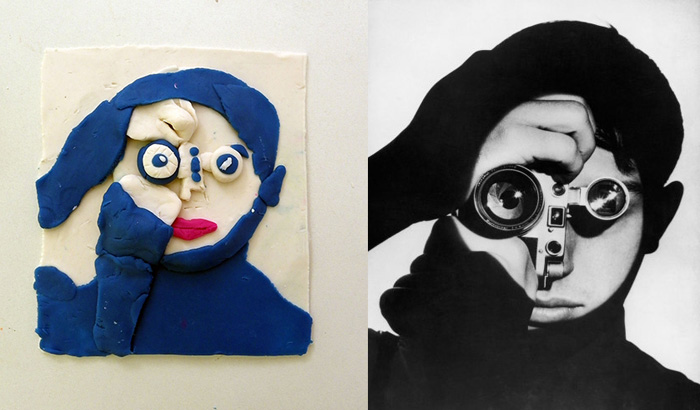
Points for creativity go to Eleanor Macnair, who recently launched the “Photographs rendered in Play-Doh” Tumblr. Given the name of the Tumblr, I probably don’t have to explain the concept. I think you get it. Above we have “Photographer Dennis Stock holds a camera in front of his face, 1955” — the original by Andreas Feininger (right), and the recreation by Ms. Macnair (left). Also on the Tumblr you’ll find, among others:
“Nan and Brian in Bed, New York City, 1983” by Nan Goldin (original — play doh)
“Dovima with elephants, evening dress by Dior, Cirque d’Hiver, August 1955” by Richard Avedon (original — play doh)
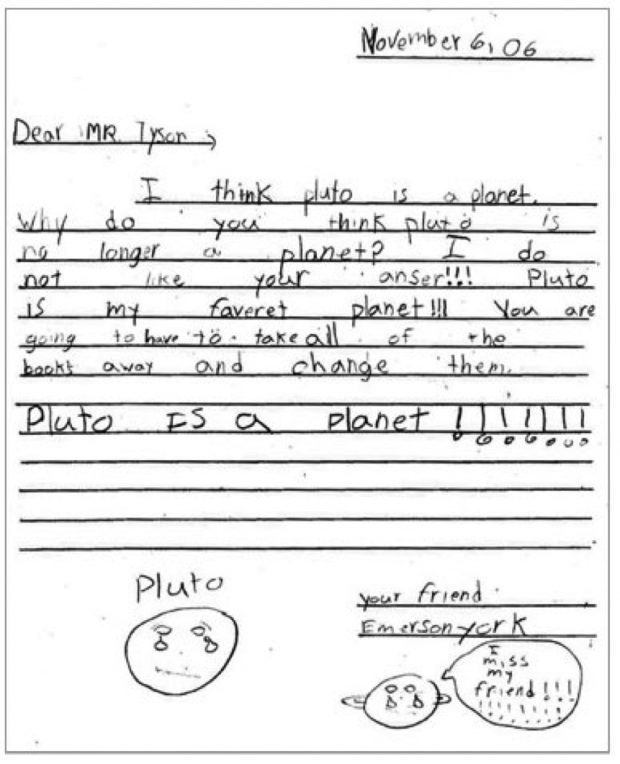
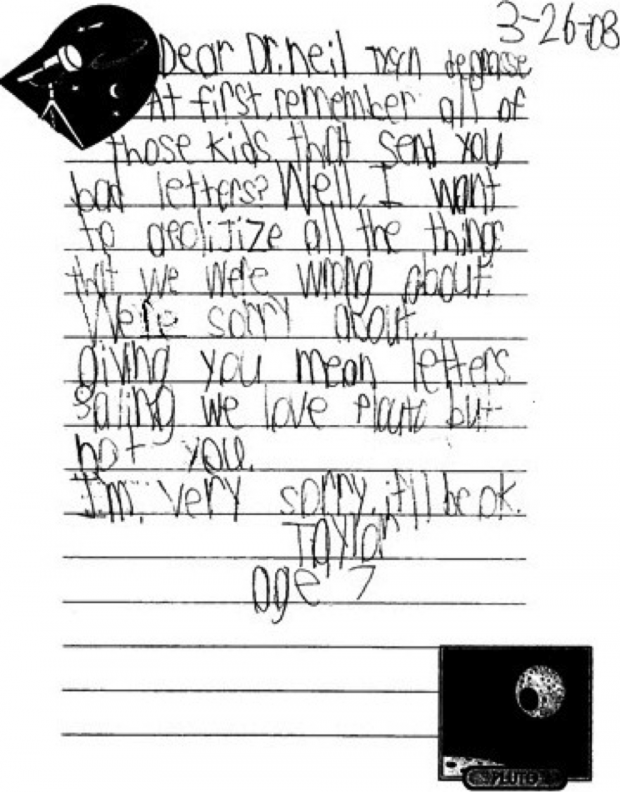
In the late 1990s, Neil deGrasse Tyson and his colleagues redesigned the Hayden Planetarium and, without much comment, they created a model of the solar system that banished Pluto from the list of planets. During the following year, no one said very much. But then The New York Times published an article (January 22, 2001) called “Pluto’s Not a Planet? Only in New York,” and all hell broke loose, particularly in the elementary schools. School kids were incensed, and the letters of complaint rolled in. You can find one such example from “Emerson” above. Five other letters can be found over at Mental Floss.
I’m usually pretty dialed into this stuff, but somehow this one slipped by me last fall. During the Gangnam Style craze, MIT shot a parody video where Noam Chomsky, the father of modern linguistics, made a cameo appearance. Maybe it slipped by me because the appearance is brief. About 5 seconds, starting at the 3:20 mark. We were on the ball enough, however, to spot another parody by Ai Weiwei and then we had Slavoj Žižek demystifying the whole Gangnam Style phenomenon, complete with wild hand gesticulations and frantic rubs of the nose. Anyway, one day this will make for some good archival footage — public intellectual meets international pop culture craze — so we’re adding it to the trove.
Reading James Joyce’s Ulysses is no walk in the park. Why else would so many people falsely claim to have read it. (See our post from last week, 20 Books People Pretend to Read.) But Finnegans Wake is a whole ‘nother deal. Joyce’s final work is considered one of the most difficult works of fiction ever written, and contrary to Ulysses, the novel “has some claim to be the least read major work of Western literature,” according to Joyce scholar Lee Spink. Put simply, people don’t even bother reading … or pretending to read … Finnegans Wake (unless, of course, they live in China, where the novel reached the #2 position on a Shanghai bestseller list earlier this year.)
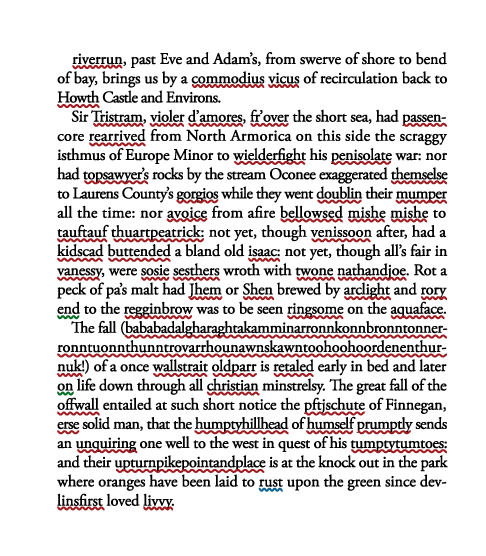
But I digress: why don’t readers even give Finnegans Wake a shot? The illustration above perhaps says it all. The web site stammpunct.com has created a visual showing what happens when you run a page of the novel through a spell checker. It yields a lot of red, and then some more red. A framable print of this visual can be purchased at stammpunct for $35.
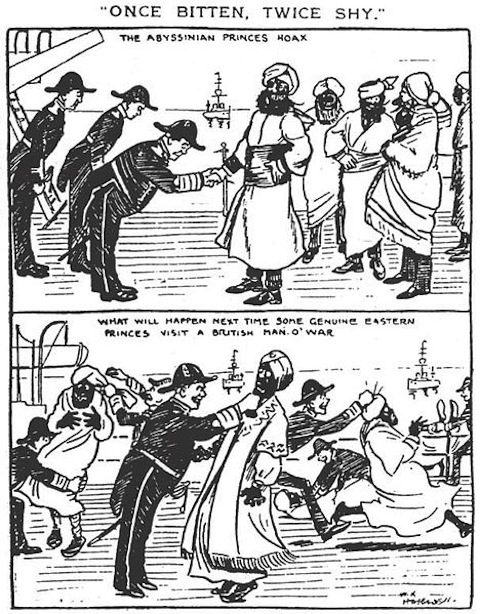
On February 7th, 1910, Virginia Woolf (then Virginia Stephen) and five of her Bloomsbury companions—painter Duncan Grant, Woolf’s brother Adrian, Anthony Buxton, Guy Ridley, and Horace de Vere Cole—boarded the pride of the British Royal Navy, the HMS Dreadnought, dressed in blackface and outlandish stage costumes. (In the photo above, from left to right.) In what became known as “The Dreadnought Hoax,” the six convinced the Dreadnought’s officers that they were the “Emperor of Abyssinia” (now Ethiopia) and his entourage, and they were received with high honors.
The hoax, masterminded by Cole, began when he sent a telegram to the ship telling the crew to expect a visit from some North African dignitaries. Once on board, the group spoke in accented Latin (quoting the Aeneid) and gibberish. Woolf kept quiet so as to disguise her gender. One of the officers on the ship was a cousin of Virginia and Adrian, but he failed to recognize them. It wasn’t a flawless performance on either side: at one point, Buxton sneezed and almost lost his mustache, and the Navy, unable to find an Abyssinian flag, flew the flag of Zanzibar instead.
The “princes” asked for prayer mats, presented the officers with fake military honors, and exclaimed “bunga, bunga!” each time they were shown some marvel of the ship. The Dreadnought was then, in the words of Woolf’s nephew and biographer, Quentin Bell, “the flagship of the Home Fleet, the most formidable, the most modern, and the most secret man o’ war then afloat.” (This incident is said to be the origin of the ludicrous phrase “bunga, bunga,” most associated with the exploits of the recently convicted Silvio Berlusconi.) The next day, Cole anonymously sent the photograph at the top to The Daily Mirror, revealing the hoax. According to Woolf scholar Mairead Case—who sees the incident as a precursor to Woolf’s gender-bending novel Orlando—the Mirror described the “Abyssinians” thus:
All the princes wore vari-coloured silk sashes as turbans, set off with diamond aigrettes, white gibbah tunics, over which were cast rich flowing robes and round their necks were suspended gold chains and jeweled necklaces … They also all wore patent leather boots which, Oriental fashion, tapered to a point, the ends projecting fully six inches beyond the toes. White gloves covered the princes’ hands, and over the gloved fingers, they wore gold wedding rings – heavy, plain circlets, which looked very impressive.
In a recently discovered letter, Cole wrote to a friend that the hoax was “glorious” and “shriekingly funny.” The group intended to mock what they saw as an outmoded Victorian imperialism, and they succeeded, at least in the popular press. The Mirror published the cartoon above and the Royal Navy was a laughingstock for weeks afterward. None of this pseudo-racist pranksterism (which reflected just as badly on the officers) struck the actual Emperor of Ethiopia—Menelik II—as particularly funny. When he visited England later that year, he was taunted in the streets by children shouting “Bunga! Bunga!” and denied permission to inspect the navy’s fleet for fear that his visit might cause further embarrassment.
You are? Wow! What luck! Apparently Recreational Mathemusician Vi Hart had the exact same kind of morning recently, and used it as the springboard for addressing the 12-Tone Technique originally devised by Arnold Schoenberg. Uninitiated philistines may want to double down on the caffeinated beverage of their choice, as this stuff is dense, and Hart talks the way a hummingbird flies.
But as she notes at the 15 minute mark, “Creativity means fearlessly embracing things that seem odd, even random, knowing that if you keep your brain open you’ll eventually find the connections.”
Ergo, those of us whose reference level (or, it must be said, interest) is no match for a 30 minute treatise on the history and logic of ordering the twelve pitch-classes of the chromatic scale into numerically designated sets should find something to chew on, too: copyright and Fair Use Law, for starters; the constraint-bound experimental fiction of French literary group Oulipo, not to mention Borges’ “Library of Babel” and the organized randomness of Rorschach blots and constellations; zombies… John Cage…
(Easy to imagine the sort of jacked-up, explanation-crazed, bed-resistant child she must have been.)
As ever, her sharpie-on-spiral stop-motion visuals add dimension, especially now that she seems to be experimenting with giving her on-the-fly stick figures a certain Hyperbole-and-a-Half exuberance.
In 1973, Dale Irby, a teacher at Prestonwood Elementary in Dallas, decided to wear a polyester shirt and coffee-colored sweater for school-picture day. Without realizing it, he wore the same outfit the following year. According to the Dallas News, Dale’s wife noticed the emerging trend and dared him to do it a third year. And then they figured, ‘Why stop?’ The tradition continued 40 years in total, until Dale and his outfit retired this year.
We're hoping to rely on loyal readers, rather than erratic ads. Please click the Donate button and support Open Culture. You can use Paypal, Venmo, Patreon, even Crypto! We thank you!
Open Culture scours the web for the best educational media. We find the free courses and audio books you need, the language lessons & educational videos you want, and plenty of enlightenment in between.