Courtesy of Wired’s Blog, here are 10 videos displaying some rather cool chemistry experiments at work. Below, we’ve posted one video that will let you answer a question that you’ve almost certainly pondered for ages — can liquid nitrogen neutralize molten iron? (For more videos along these lines, check out this site.)

The Christian Darwin You Don’t Know
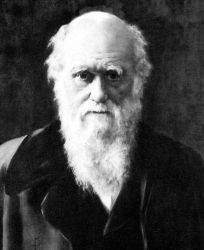 At least in America, Charles Darwin has become the favorite whipping boy for many fundamentalists on the right. In one neat package, you get in Darwin all things deplorable. A godless “secular humanist” who denied the sanctity of humanity, God’s providence, and the integrity of the Bible. What more could you love to hate?
Somewhere lost in today’s culture wars is the real Charles Darwin. Aired first in October, this program, produced by American Public Media’s Speaking of Faith (MP3 — iTunes — Feed — Web Site), revisits Darwin’s life & thought with James Moore, a Cambridge University scholar who has written Darwin: The Life of a Tormented Evolutionist. And here’s the picture that we get. Like many important scientists who came before him — Galileo, Copernicus and Newton — Darwin believed that science could help explain the laws of nature created by God. Further, he saw his Origin of Species as describing the forms of life that owed their existence to God’s law — a law that expressed itself in natural selection. Readers will find that Darwin’s text is littered with references to creation. And Darwin, himself, was noted for saying that when he wrote the book, his faith in God was as strong as that of a bishop, although his faith did wane latter in life. Simply put, Darwin was hardly the enemy of religion that many consider him today.
Again, you can access this program with the following links: (MP3 — iTunes — Feed — Web Site). Additionally, you can access a free e‑text of On the Origin of Species here, along with a free audiobook version here.
You may also want to check out a related program by Speaking of Faith: Einstein and the Mind of God

What Does 47 Billion Light Years (in Radius) Look Like?
That’s one estimate of the size of our universe, and this video (added to our YouTube Playlist), using pictures from the Hubble Space Telescope, tries to put it in perspective. For more amazing photos from the Hubble, see this collection.
Psychedelics Revisited
On Friday, we mentioned the BBC production called “What on Earth is Wrong with Gravity.” Below is another video by the same producers called “Psychedelic Science,” which surveys the past and present of psychedelic drugs, and the new era of scientists exploring ways to use these drugs again for therapeutic purposes (i.e., the treatment of schizophrenia and addiction).
via Boing Boing

Turn On, Tune In, Drop Out
Speaking of psychedelics, we’ve posted a documentary below (yet another BBC production) that takes a not entirely flattering look at the life of Timothy Leary, the Harvard psychology professor who went counterculture in 1960s and advocated the therapeutic and spiritual benefits of LSD. I remember seeing him years later when I was in college. My memory of the man: Spunky and about as nonlinear as you could get.
From Our “Inner Chimp” to our “Inner Fish”
Earlier this week, we highlighted a great conversation about whether we inherited morality from our primate ancestors. It raised the question whether our “inner chimp” tells us what is right or wrong.
Now, to switch gears just a bit, we bring you an interview with Neil Shubin that delves into your “inner fish” (MP3 — iTunes — Feed — Web Site). Shubin is the author of Your Inner Fish: A Journey into the 3.5‑Billion-Year History of the Human Body, and here he talks about how various parts of the human body (our hands and head, for example) evolved from the anatomy of ancient fish and other long extinct creatures. What this goes to show is that “our humanity, … which makes us so unique … is really built by bits and pieces shared with everything we call worms, jellyfish, sponges, and so forth.” “The utterly unique and beautiful can be made from something very common.” And there’s something aesthetically beautiful about that.
Shubin, I should mention, made headlines in 2006 when he and a team of scientists revealed the discovery of Tiktaalik roseae, a 375 million year old fossil that captures the moment when sea creatures made their transition to land. Good stuff.

How Evolution Happens (in 5 Minutes, 48 Seconds)
This video was apparently developed with scenes taken from the BBC series Walking with Monsters. (But don’t completely quote me on that.)
For more smart videos, see our YouTube Playlist.
Is Morality Hardwired in Us?
Is morality a sixth sense that’s in all of us, and is it perhaps a product of our biological evolution? Writing recently in The New York Times Magazine, Harvard psychology professor Steven Pinker suggests that morality may well be hardwired. And he points to fascinating new research that backs up this belief. Pinker’s article covers pretty much the same ground as does this engaging Radio Lab podcast (MP3 — iTunes — Feed — Web Site). Taking an hour-long look at the “science of morality,” the program gets into some fascinating stuff. It gets into the great Trolley moral dilemma, into what brain scans (MRI’s) reveal when human brains grapple with moral questions, and into how scientists think that we inherited moral instincts from our primate ancestors. You’ll learn all about how morality is our “inner chimp.” If this is not enough, you can also listen to Pinker’s interview yesterday on NPR’s Talk of the Nation. Get it here.
See our collection of Science Podcasts and Subscribe to Our Feed
Support Us
We're hoping to rely on loyal readers, rather than erratic ads. Please click the Donate button and support Open Culture. You can use Paypal, Venmo, Patreon, even Crypto! We thank you!

About Us

Open Culture scours the web for the best educational media. We find the free courses and audio books you need, the language lessons & educational videos you want, and plenty of enlightenment in between.
Advertise With Us

