Blank on Blank returned this week with the latest episode in “The Experimenters,” a miniseries highlighting the icons of STEM. This new animation brings to life a 1983 interview featuring one trailblazer, Gloria Steinem, talking with another, Sally Ride, a physicist who became the first American woman in space, and endured a lot of gender stereotyping along the way. Other episodes in “The Experimenters” series have focused on Buckminster Fuller, Richard Feynman, and Jane Goodall.
Note: Gloria Steinem recently published a new memoir called My Life on the Road. You can download it as a free audiobook if you head over to Audible.com and register for a 30-day free trial. The trial lets you download two audiobooks for free. Then, when the trial is over, you can continue your subscription, or cancel it, and still keep the audio books. The choice is yours. Get more info here.
If you would like to support the mission of Open Culture, consider making a donation to our site. It’s hard to rely 100% on ads, and your contributions will help us continue providing the best free cultural and educational materials to learners everywhere. You can contribute through PayPal, Patreon, and Venmo (@openculture). Thanks!
What’s it like inside the mind of theoretical physicist Stephen Hawking? Is it an electro-cosmic dance party narrated by Carl Sagan? I would like to think so. So would director Will Studd of Aardman Studios who created the hip promo video above, which also includes audio clips from Hawking himself and fellow physicists Brian Cox and Andrew Strominger, with music by Max Halstead. Pretty cool, but what’s it for?
Ask Hawking—or rather, read his paper (or one of the layfolk summaries), “Soft Hair on Black Holes,” which he posted a couple of weeks ago on Cornell University’s arXiv, an open access database of physics, mathematics, and other scientific research. Of Hawking and other physicists’ theory, Tia Ghose at Live Science writes, “black holes may sport a luxurious head of ‘hair’ made up of ghostly, zero-energy particles.” These “hairs” may store quantum information that would otherwise be lost forever. In the second part of his lecture, Hawking will expand on his theory of black hole radiation. Get a brief summary of that theory in the video clip above, and watch this space for Hawking’s sure-to-be-enlightening black hole lectures.
Some of our favorite, and most popular, posts at Open Culture focus on book illustration. From fine art to graphic design, from the sublime to the ridiculous to the purely technical, the art used to visualize beloved works of literature and scientific texts captivates us. Perhaps that’s in part because we encounter illustration so rarely these days, what with the triumph of photography and, now, the proliferation of digital images, which are so easy to create and reproduce that too few give sufficient consideration to aesthetic essentials. Graphic novels and comics aside, the carefully hand-illustrated book or periodical has become something of a novelty.
But when we reach back to the mid-19th century, it was photography that was novel and graphic art the norm. So what was the subject of the first book to use photographic illustration? Monuments? Landscapes? Celebrities? No: algae.
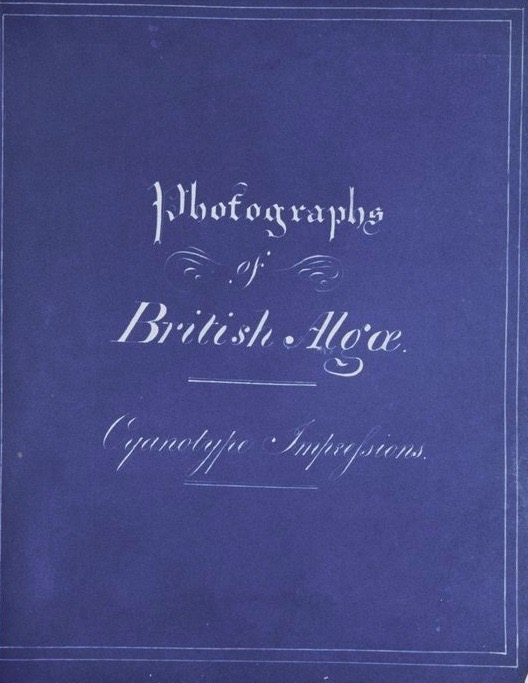
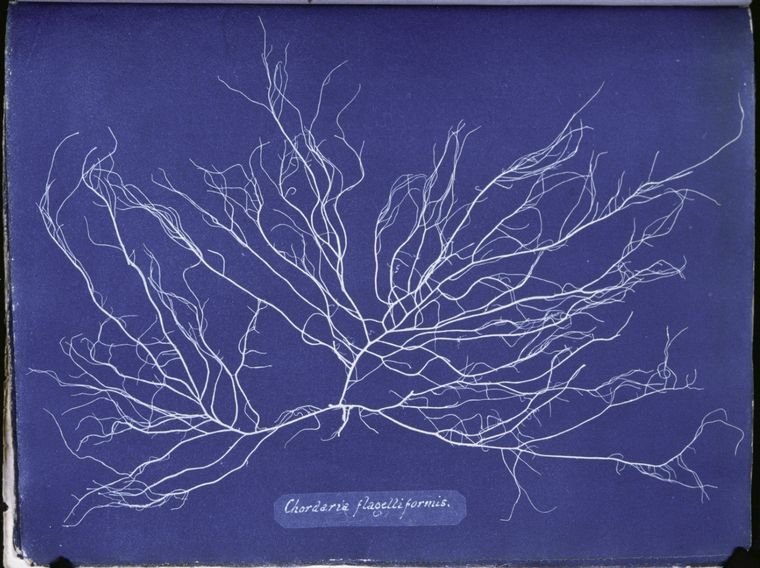
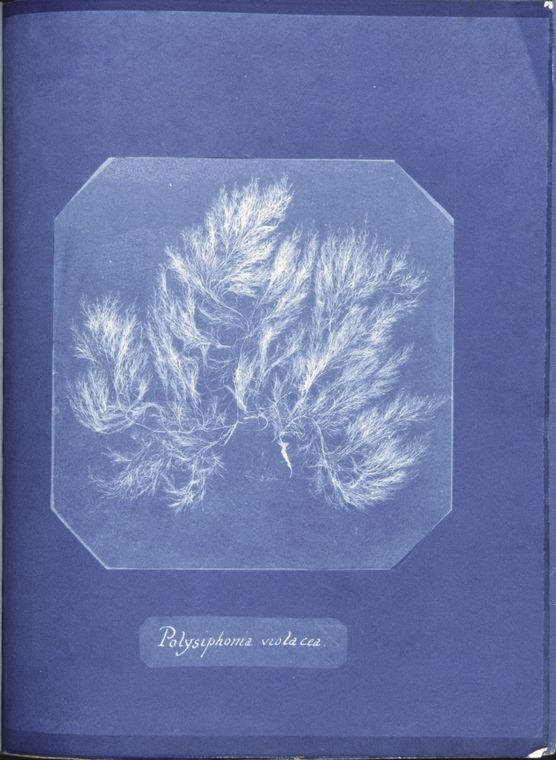
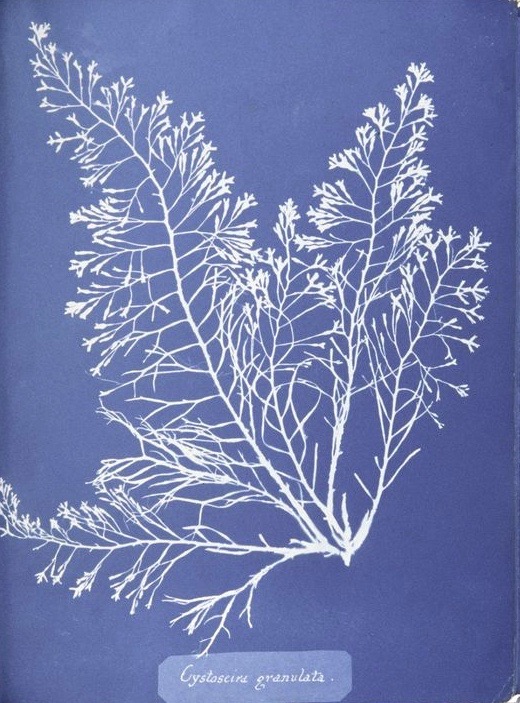
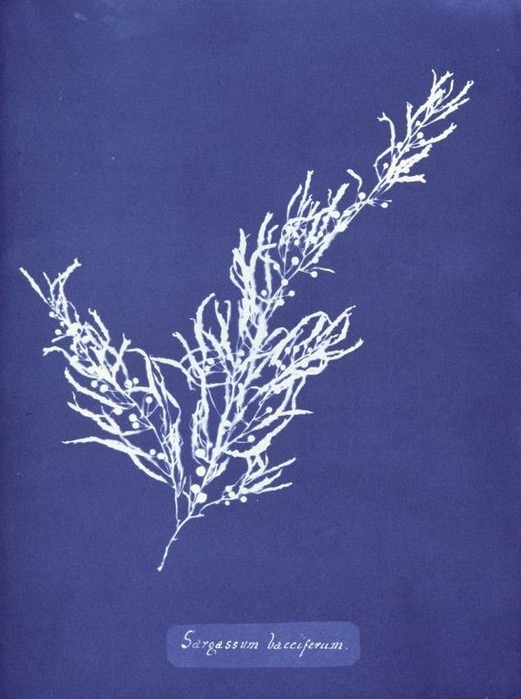
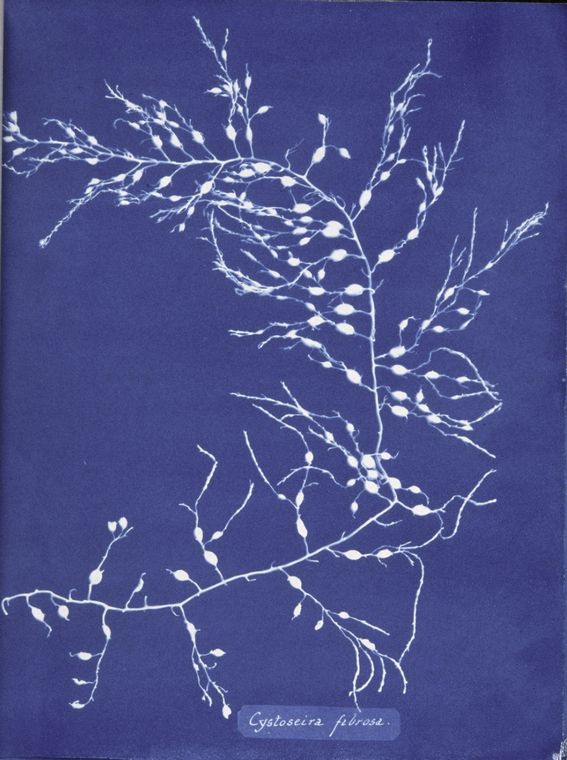
English botanist Anna Atkins—who is not only credited as the first person to make a book illustrated with photographs, but as the first woman to make a photograph—created her handmade Photographs of British Algae: Cyanotype Impressions in 1843. And though the subject may be less than thrilling, the images themselves are austerely beautiful.
The subtitle of the book refers to the process Atkins used to make the images, a technique developed by Sir John Herschel. “Early photographers,” writes Phil Edwards at Vox, “couldn’t easily develop their pictures.” The techniques available proved expensive, dangerous, and unstable. “Herschel came up with a solution,” Edwards tells us, “using an iron pigment called ‘Prussian Blue,’ he laid objects of photographic negatives onto chemically treated paper, exposed them to sunlight for around 15 minutes, and then washed the paper. The remaining image revealed pale blue objects on a dark blue background.” The process, Jonathan Gibbs informs us at The Independent, “had previously been used to reproduce architectural drawings and designs,” and is, in fact, the origin of the word “blueprint.”
Though “a capable artist,” Edwards writes, Atkins realized that Herschel’s cyanotypes “were a better way to capture the intricacies of plant life and avoid the tedium—and error—involved with drawing.” British Algae, the BBC tells us, was Atkins’ “most valuable work” as a naturalist. As the daughter of a scientist and Royal Society Fellow, Atkins had frequent contact with the most well-respected scientists of the day, including Hershel and photographic pioneer William Henry Fox Talbot. Her “first contribution to science was her engravings of shells, used to illustrate her father’s translation of Lamarck’s Genera of Shells” in 1823. Afterward, she became interested in botany, and algae in particular, and in the emerging technology of photography as a means of preserving her observations.
Astrophysicist Neil deGrasse Tyson, the most prominent public defender of science education and funding, frequently comes in for some good-natured ribbing for his genial pedantry, ascension to Carl Sagan’s unofficial spokesmanship, and downgrading of the beloved Pluto from planet status. But he takes it all in stride. As another science communicator, Phil Plate the “Bad Astronomer,” has written, “The man is brilliant, charming, a pillar of science education, and a glutton for punishment. But I think he secretly revels in it.” If you follow Tyson’s Twitter account and watch him engage with cranks, or if you’ve seen him in any of the hundreds of public debates and panels he attends, it seems he more than revels in it; he’s totally in his element, so to speak, publicly modeling the mix of confidence, humility, and curiosity that drives science forward.
In the video above, Tyson dares to try and fill the shoes of another great communicator—and no, I don’t mean Ronald Reagan, but the president whose most famous speech Charles Sumner called “a monumental act.” And though Abraham Lincoln was not nearly as comfortable in front of an audience as Tyson is, Lincoln’s Gettysburg Address set the bar for how to get a point across with the maximum amount of eloquence and minimum of redundancy and rambling. Can Tyson deliver the goods like Lincoln did with only 272 words to work with? Is the attempt to “reply” to the “Gettysburg Address” an act of hubris or the ultimate tribute? Decide for yourself as you listen to Tyson’s April, 2015 acceptance speech at the National Academy of Science for the Public Welfare Medal, the Academy’s “most prestigious award.”
Tyson’s speech has been enhanced with a dramatic animation and sound effects for a technological impact Lincoln never could have achieved, though by most accounts he didn’t need it. Not a solemn occasion like Gettysburg, the awards ceremony nonetheless called for at least a little pomp, as well as some history. Tyson points out that “during the bloody year of his Gettysburg Address, President Lincoln chartered the National Academy of Sciences.” For more of that story, see the short video above, where you’ll learn, among other things, that Lincoln was the first and only American president to hold a patent on a scientific invention.
The end of 2015 has been dominated by crises. At times, amidst the daily barrage of fearful spectacle, it can be difficult to conceive of the years around the corner in ways that don’t resemble the next crop of blow-em-up action movies, nearly every one of which depicts some variation on the seemingly inexhaustible theme of the end-of-the-world. There’s no doubt many of our current challenges are unprecedented, but in the midst of anxieties of all kinds it’s worth remembering that—as Steven Pinker has thoroughly demonstrated—“violence has declined by dramatic degrees all over the world.”
In other words, as bad as things can seem, they were much worse for most of human history. It’s a long view cultural historian Otto Friedrich took in a grim survey called The End of the World: A History. Written near the end of the Cold War, Friedrich’s book documents some 2000 years of European catastrophe, during which one generation after another genuinely believed the end was nigh. And yet, certain far-seeing individuals have always imagined a thriving human future, especially during the profoundly destructive 20th century.
In 1900, engineer John Elfreth Watkins made a survey of the scientific minds of his day. As we noted in a previous post, some of those predictions of the year 2000 seem prescient, some preposterous; all boldly extrapolated contemporary trends and foresaw a radically different human world. At the height of the Cold War in 1964, Isaac Asimov partly described our present in his 50 year forecast. In 1926, and again 1935, no less a visionary than Nikola Tesla looked into the 21st century to envision a world both like and unlike our own.
1. Steam power, already on the wane, will rapidly disappear: “In the year 2011 such railway trains as survive will be driven at incredible speed by electricity (which will also be the motive force of all the world’s machinery).”
2. “[T]he traveler of the future… will fly through the air, swifter than any swallow, at a speed of two hundred miles an hour, in colossal machines, which will enable him to breakfast in London, transact business in Paris and eat his luncheon in Cheapside.”
3. “The house of the next century will be furnished from basement to attic with steel… a steel so light that it will be as easy to move a sideboard as it is today to lift a drawing room chair. The baby of the twenty-first century will be rocked in a steel cradle; his father will sit in a steel chair at a steel dining table, and his mother’s boudoir will be sumptuously equipped with steel furnishings….”
4. Edison also predicted that steel reinforced concrete would replace bricks: “A reinforced concrete building will stand practically forever.” By 1941, he told Cosmopolitan, “all constructions will be of reinforced concrete, from the finest mansions to the tallest skyscrapers.”
5. Like many futurists of the previous century, and some few today, Edison foresaw a world where tech would eradicate poverty: “Poverty was for a world that used only its hands,” he said; “Now that men have begun to use their brains, poverty is decreasing…. [T]here will be no poverty in the world a hundred years from now.”
6. Anticipating agribusiness, Edison predicted, “the coming farmer will be a man on a seat beside a push-button and some levers.” Farming would experience a “great shake-up” as science, tech, and big business overtook its methods.
7. “Books of the coming century will all be printed leaves of nickel, so light to hold that the reader can enjoy a small library in a single volume. A book two inches thick will contain forty thousand pages, the equivalent of a hundred volumes.”
8. Machines, Edison told Cosmopolitan, “will make the parts of things and put them together, instead of merely making the parts of things for human hands to put together. The day of the seamstress, wearily running her seam, is almost ended.”
9. Telephones, Edison confidently predicted, “will shout out proper names, or whisper the quotations from the drug market.”
10. Anticipating the logic of the Cold War arms race, though underestimating the mass destruction to precede it, Edison believed the “piling up of armaments” would “bring universal revolution or universal peace before there can be more than one great war.”
11. Edison “sounds the death knell of gold as a precious metal. ‘Gold,’ he says, ‘has even now but a few years to live. They day is near when bars of it will be as common and as cheap as bars of iron or blocks of steel.’”
He then went on, astonishingly, to echo the pre-scientific alchemists of several hundred years earlier: “’We are already on the verge of discovering the secret of transmuting metals, which are all substantially the same matter, though combined in different proportions.’”
Excited by the future abundance of gold, the Miami Metropolis piece on Edison’s predictions breathlessly concludes, “In the magical days to come there is no reason why our great liners should not be of solid gold from stem to stern; why we should not ride in golden taxicabs, or substituted gold for steel in our drawing rooms.”
In reading over the predictions from shrewd thinkers of the past, one is struck as much by what they got right as by what they got often terribly wrong. (Matt Novak’s Paleofuture, which brings us the Miami Metropolis article, has chronicled the checkered, hit-and-miss history of futurism for several years now.) Edison’s tone is more strident than most of his peers, but his accuracy was about on par, further suggesting that neither the most confident of techno-futurists, nor the most baleful of doomsayers knows quite what the future holds: their clearest forecasts obscured by the biases, technical limitations, and philosophical categories of their present.
“Over half a century, Mary Leakey labored under the hot African sun, scratching in the dirt for clues to early human physical and cultural evolution. Scientists in her field said she set the standards for documentation and excavation in paleolithic archeology. They spoke of hers as a life of enviable achievement.” That’s how The New York Times started its 1996 obituary for Mary Leakey, “matriarch of the famous fossil-hunting family in Africa whose own reputation in paleoanthropology soared with discoveries of bones, stone tools and the footprints of early human ancestors.”
Above, you can watch the Times’ newly-released cutout animation, celebrating her life and paleoanthropology work in eastern Africa. The endearing seven-minute film covers her discovery of Proconsul africanusin 1948, Zinjanthropus boiseiin 1959, Homo habilis in 1960, and the trail of early human footprints found at Laetoli in the mid-1970s. The film also features something you’ll likely never see elsewhere — people throwing elephant dung frisbees! Enjoy.
We’ve seen some pretty creative things done on a Möbius strip – like watching a Bach canon get played forwards, then back. But how about this? Above, watch Andy Marmery show a superconductor levitating on a Möbius strip made with over 2,000 magnets. The magic is in the superconducting material, Yttrium barium copper oxide, which lets the superconductor whiz along, seemingly floating both above and below the track. This video comes from a video series called “Tales from the Prep Room,” created by The Royal Institution, “a 200 year old charity based in London dedicated to connecting people with the world of science through events, education, and [its] Christmas Lectures.”
Follow Open Culture on Facebook and Twitter and share intelligent media with your friends. Or better yet, sign up for our daily email and get a daily dose of Open Culture in your inbox. And if you want to make sure that our posts definitely appear in your Facebook newsfeed, just follow these simple steps.
Physicist Stephen Hawking may trump them all, though his famously recognizable voice is not organic. The one we all associate with him has been computer generated since worsening Amyotrophic lateral sclerosis, aka Lou Gehrig’s disease, led to a tracheotomy in 1985.
Without the use of his hands, Hawking controls the Assistive Context-Aware Toolkit software with a sensor attached to one of his cheek muscles.
Recently, Intel has made the software and its user guide available for free download on the code sharing site, Github. It requires a computer running Windows XP or above to use, and also a webcam that will track the visual cues of the user’s facial expressions.
The multi-user program allows users to type in MS Word and browse the Internet, in addition to assisting them to “speak” aloud in English.
The software release is intended to help researchers aiding sufferers of motor neuron diseases, not pranksters seeking to borrow the famed physicist’s voice for their doorbells and cookie jar lids. To that end, the free version comes with a default voice, not Professor Hawking’s.
Ayun Halliday is an author, illustrator, and Chief Primatologist of the East Village Inky zine. Her play, Fawnbook, is currently playing in New York City. Follow her @AyunHalliday
We're hoping to rely on loyal readers, rather than erratic ads. Please click the Donate button and support Open Culture. You can use Paypal, Venmo, Patreon, even Crypto! We thank you!
Open Culture scours the web for the best educational media. We find the free courses and audio books you need, the language lessons & educational videos you want, and plenty of enlightenment in between.