Produced at the Vancouver Film School, this split-screen animation tells the story of Earth’ s origins from a creationist and Darwinist/evolutionist point of view. To make things more interesting (spoiler: stop reading now if you want to maintain the element of surprise), the scientific story is told using religious language, whereas the Biblical version is told as if it were the scientific one. The slightly confusing conclusion (its’ a zinger) shows how the language we use to present ideas influences their perception. And the ironic use of infographics tops off this visual and linguistic experiment.
On the homepage of the project, you can watch the videos separately and download them. Also, the YouTube channel of Vancouver Film School is always worth a visit.
By profession, Matthias Rascher teaches English and History at a High School in northern Bavaria, Germany. In his free time he scours the web for good links and posts the best finds on Twitter.
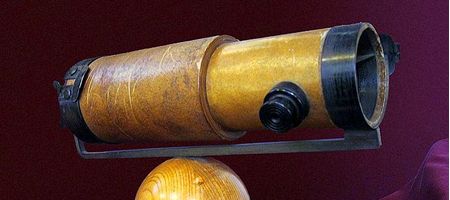
60,000 peer-reviewed papers, including the first peer-reviewed scientific research journal in the world, are now available free online. The Royal Society has opened its historical archives to the public. Among the cool stuff you’ll find here: Issac Newton’s first published research paper and Ben Franklin’s write-up about that famous kite experiment. Good luck getting anything accomplished today. Or ever again. —
When two teams of scientists announced in 1998 that the expansion of the Universe was not slowing down due to gravity but was in fact accelerating, the worldwide scientific community was shocked. The discovery turned many of the prevailing assumptions about the universe upside down. Looking back, perhaps the only thing that wasn’t a surprise was that the Nobel Prize Committee should take notice.
Last Tuesday the Swedish Academy of Sciences announced that the 2011 Nobel Prize in Physics would go to three American-born scientists from two rival teams: physicist Saul Permutter, head of the Supernova Cosmology Project at Lawrence Berkeley National Laboratory and the University of California, Berkeley, would receive half of the prize, while Brian P. Schmidt, head of the High‑z Supernova Search Team and an astronomer at the Research School of Astronomy and Astrophysics at the Australian National University, Weston Creek, would share the other half with a colleague who wrote the original paper announcing the team’s findings in 1998, astronomer Adam G. Riess of Johns Hopkins University and the Space Telescope Science Institute.
Despite popular belief, the two teams did not “discover” dark energy. As Perlmutter points out in the short film above, “People are using the term ‘dark energy’ basically as a place holder to describe any explanation for why it is that we seem to be seeing the universe’s expansion getting faster and faster.” What is actually known is that the universe has been expanding for as far back as we can observe, and about 7 billion years ago–roughly half the estimated age of the universe–the expansion began to accelerate.
“Why is it speeding up?” Perlmutter asked during a press conference on the morning his Nobel Prize was announced. “It could be that most of the universe is dominated by a dark energy that pervades all of space and is causing this acceleration. It could be, perhaps even more surprising, that Einstein’s Theory of General Relativity needs a little bit of a tweak, perhaps acting slightly differently on these very large scales of the universe. But at this moment I would say that the question is wide open.”
All we can say is bless Don Pettit. While working on the International Space Station in 2008, the NASA astronaut shot videos that are literally and figuratively out of this world: The Aurora Borealis Viewed from Orbit and What It Feels Like to Fly Over Planet Earth. And then we discover that Pettit invented a “zero‑g coffee cup” that lets you drink coffee in outer space without using a straw. That’s one small step for man; one giant leap for mankind.…
After dismissing the popular notion that scientists are unable to truly appreciate beauty in nature, physicist Richard Feynman (1918 — 1988) explains what a scientist really is and does. Here are some of the most memorable lines from this beautiful mix of Feynman quotes and (mostly) BBC and NASA footage:
People say to me, Are you looking for the ultimate laws of physics? — No, I’m not. I’m just looking to find out more about the world.
When we’re going to investigate [nature], we shouldn’t predecide what it is we’re trying to do, except to find out more about it.
I can live with doubt and uncertainty and not knowing. I think it’s much more interesting to live not knowing than to have answers that might be wrong. (…) I don’t feel frightened by not knowing things, by being lost in the mysterious universe without having any purpose.
When you doubt and ask, it gets a little harder to believe.
By profession, Matthias Rascher teaches English and History at a High School in northern Bavaria, Germany. In his free time he scours the web for good links and posts the best finds on Twitter.
This is what you’d call efficient. In two minutes, we watch our planet take form. 600 million years of geological history whizzes by in a snap. Then we see what the next 100 million years may have in store for us. If you don’t have the patience to watch 700 million years unfold in 180 seconds (seriously?), then we’ll give you this spoiler: Coastal real estate is not a long-term buy…
If you would like to support the mission of Open Culture, consider making a donation to our site. It’s hard to rely 100% on ads, and your contributions will help us continue providing the best free cultural and educational materials to learners everywhere. You can contribute through PayPal, Patreon, and Venmo (@openculture). Thanks!
Long before anyone started talking about “green” or “sustainability,” Jack Nicholson put his money and star power behind a new alternative energy — solar-powered hydrogen. The year was 1978, and solar hydrogen, a limitless resource, promised to lower energy costs and pollution levels, all at once. Fast forward 30+ years, and we know one thing: hydrogen Chevys never saw the light of day … until 2007.
This clip has been added to our collection of 275 Cultural Icons, where you’ll find great artists and thinkers speaking in their own words, mostly on video. The collection includes footage of Tolstoy and Twain and, of course, more contemporary figures.
Get more cultural nuggets daily by following us on Facebook and Twitter.
We told you about the book earlier this year, and now it’s just about here. Set for release on October 4th, The Magic of Realitywill be unlike any book written by Richard Dawkins before. It is illustrated for starters, and largely geared toward young and old readers alike. Perfect, he says, for anyone 12 and up. When it comes to the structure and gist of the book, Dawkins does a pretty good job of explaining things. So let’s let the video roll…
Note: If you’re willing to tweet about the book, you can view the first 24 pages of The Magic of Reality here.
We're hoping to rely on loyal readers, rather than erratic ads. Please click the Donate button and support Open Culture. You can use Paypal, Venmo, Patreon, even Crypto! We thank you!
Open Culture scours the web for the best educational media. We find the free courses and audio books you need, the language lessons & educational videos you want, and plenty of enlightenment in between.