The dream of flight fired the imagination of Leonard da Vinci in the early sixteenth century. In designing his famous flying machines, the painter, sculptor, architect, mathematician, engineer, inventor, anatomist — ah heck, let’s just call him a Renaissance man — closely studied the mechanics of birds in flight, noting the elegant ways in which they turn and glide. Centuries later the Wright Brothers got us off the ground, but never with equal grace. It has taken a long time, but finally engineers at the German company, Festo, have found a way to mechanically reproduce the beauty of birds in flight. They call their robot the SmartBird, and they showed it off last year at TED.
190 Thinkers Answer the Question: “What is Your Favorite Deep, Elegant, or Beautiful Explanation?”

It’s a new year, which means it’s time for the Edge.org to pose its annual question to some of the world’s finest minds. The 2012 edition asks the question, “What is Your Favorite Deep, Elegant, or Beautiful Explanation?” And the replies — 190 in total — feature thoughts by Sherry Turkle, Robert Sapolsky, Steven Pinker, and Daniel Dennett, plus the ones excerpted below. If you’re willing to venture down the rabbit hole, you can access the complete collection of responses here.
Where did we come from? I find the explanation that we were made in stars [that we are all stardust] to be deep, elegant, and beautiful. This explanation says that every atom in each of our bodies was built up out of smaller particles produced in the furnaces of long-gone stars. We are the byproducts of nuclear fusion. The intense pressures and temperatures of these giant stoves thickened collapsing clouds of tiny elemental bits into heavier bits, which once fused, were blown out into space as the furnace died. The heaviest atoms in our bones may have required more than one cycle in the star furnaces to fatten up. Uncountable numbers of built-up atoms congealed into a planet, and a strange disequilibrium called life swept up a subset of those atoms into our mortal shells. We are all collected stardust. And by a most elegant and remarkable transformation, our starstuff is capable of looking into the night sky to perceive other stars shining. They seem remote and distant, but we are really very close to them no matter how many lightyears away. All that we see of each other was born in a star. How beautiful is that?
Kevin Kelly, Wired co-founderhere and don’t miss Susskind’s complete physics lectures here].
Leonard Susskind, Physics Professor, Stanford.
[T]here is one elegant and deep statement (which, alas, is not quite an “explanation”) … that I find very useful as well as beautifully simple.
I refer to the well-known lines Lord Acton wrote in a letter from Naples in 1887 to the effect that: “Power tends to corrupt, and absolute power corrupts absolutely.” At least one philosopher of science has written that on this sentence an entire science of human beings could be built.
I find that the sentence offers the basis for explaining how a failed painter like Adolph Hitler and a failed seminarian like Joseph Stalin could end up with the blood of millions on their hands; or how the Chinese emperors, the Roman popes, or the French aristocracy failed to resist the allure of power. When a religion or ideology becomes dominant, the lack of controls will result in widening spirals of license leading to degradation and corruption. [More here].
Mihaly Csikszentmihalyi; Psychologist
You can dive into the full collection at Edge.org. The photo above was taken by Marco Bellucci.
Harvard Thinks Green: Big Ideas from 6 All-Star Environment Profs
On December 8th, six “all-star environmental professors” came together at an event called “Harvard Thinks Green” and presented short, TED-style talks about the environment and strategies for reversing climate change. The event started with James McCarthy (Professor of Biological Oceanography) asking the question (see above), “Is it too late to avoid serious impacts of climate change?” A good question to ask given that 2010 witnessed the biggest annual jump in global carbon emissions—5.9%. This set the stage for Richard Lazarus (Professor of Law) to discuss ways that our political system could become more responsive to the crisis. (Did you know that Barack Obama only mentioned climate change once in public last year? Just once?) And then Rebecca Henderson (Co-Director of the Business and Environment Initiative) tries to make the difficult case that money-making and saving the world can go hand-in-hand — that capitalism can become environmentally sustainable. You can watch the remaining talks online here, or on iTunes here.
Related Content:
Why is the U.S. F’ed Up? 8 Lectures from Occupy Harvard Teach-In Provide Answers
Harvard Presents Free Courses with the Open Learning Initiative
Neil deGrasse Tyson on the Decline of Scientific Research in America
Scientific discovery is an engine of economic and military power, and America has long prided itself on its leadership in research. But as astrophysicist Neil deGrasse Tyson points out in this video, there are some dark clouds on the horizon.
When you look at the trendline, Tyson says, scientific research in America is clearly in a state of decline compared to other regions, like Asia and Western Europe. “As everyone else understands the value of innovative investments in science and technology in ways that we do not,” says Tyson, “we slowly fade.”
The maps Tyson uses are from Worldmapper.org. The one that he says represents change from “2000 to 2010” actually depicts growth in scientific research from 1990 to 2001. Danny Dorling, professor of Human Geography at the University of Sheffield and part of the team that created Worldmapper, confirmed Tyson’s error but said, “I think Neil’s got it roughly right. He should just have said ‘this is the trend to 2001 and it is not just likely it has continued, but it has probably accelerated.’ ”
Tyson’s comments are from a talk he gave in May at the University of Washington entitled, “Adventures of an Astrophysicist.” For a closer look at the maps he uses, see below.
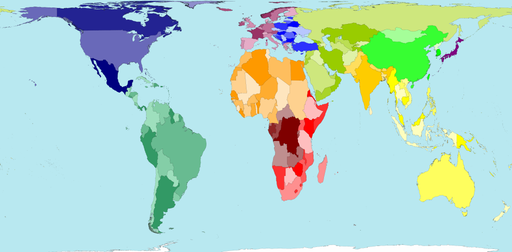
The color-coded world map above can be used for reference when studying the maps below.
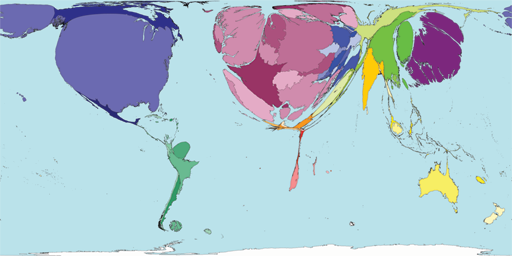
The map above represents territory sizes in proportion to the number of papers published in 2001 that were written by scientists living there. The number of scientific papers published by researchers living in America was more than three times greater than the number published in the second-highest-publishing country, Japan. For more information, including per capita data, see Worldmapper’s PDF poster.
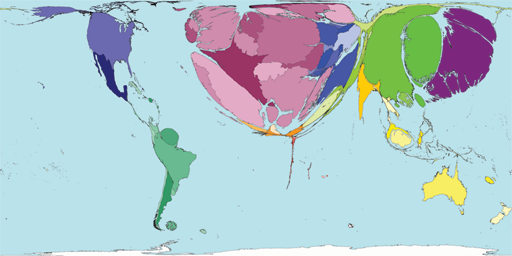
The map above represents the growth in scientific research between 1990 and 2001. Territory sizes are proportional to the increase in scientific papers by authors working in those countries in 2001 compared to 1990. If there was no increase during that period, the country has no area on the map.
Despite the fact that the United States had the most published research in 2001 and a net increase in research betwen 1990 and 2001, its size is smaller on the map because of a significantly greater growth rate by countries like Japan, the Republic of Korea, Singapore, China and Germany. Although the data behind the maps are now a decade old, Dorling suggests that a current map might look similar. “If I had to guess,” he said, “it would look worse for the USA given the massive cuts in funding in California to some of the major state Universities there.”
You can find more on this map, including a printable PDF poster with per capita data by country, along with information on the sources and methodology behind its creation, by visiting Worldmapper.
Maps © Copyright SASI Group (University of Sheffield) and Mark Newman (University of Michigan)
Sir Isaac Newton’s Papers & Annotated Principia Go Digital
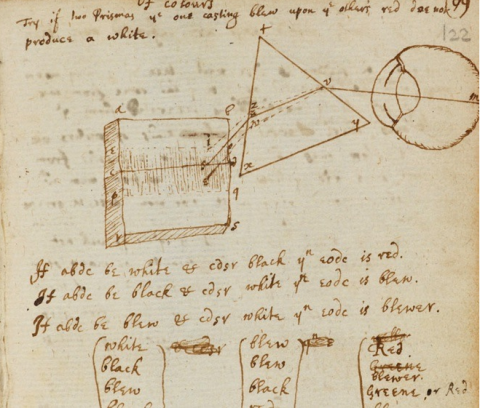 Cambridge University has had many famous graduates, but perhaps none is more famous than Isaac Newton (class of 1665). This week, Cambridge continues to honor Newton by opening a digital archive of Newton’s personal papers, which includes an annotated copy of the Principia, the landmark work where the physicist developed his laws of motion and gravity. The initial archive features 4,000 pages of scanned materials (roughly 20% of the complete Newton archive), and eventually Cambridge will add material from Charles Darwin, another famous alum, and other scientific figures.
In October, The Royal Society opened its historical archives to the public, bringing 60,000 peer-reviewed papers to the web, including Isaac Newton’s first published research paper. You can dive into this parallel digital archive here.
Bonus: If you’re looking to bone up on Physics, you can find many free physics courses in our big collection of Free Online Courses. Leonard Susskind’s class on Classical Mechanics may be of particular interest here.
via The Guardian / ht @eugenephoto
Stephen Fry Introduces the Strange New World of Nanoscience
What is nano? And how will nanoscience (the study of phenomena and manipulation of materials at the nanoscale) shape our future, from the way we build houses to how we cure diseases? It’s all explained in a snappy 17 minute video narrated by Stephen Fry (British writer, actor and director). Produced in partnership with Cambridge University, NANO YOU was named the best short film at the Scinema Science Film Festival in 2010.
If you would like to support the mission of Open Culture, consider making a donation to our site. It’s hard to rely 100% on ads, and your contributions will help us continue providing the best free cultural and educational materials to learners everywhere. You can contribute through PayPal, Patreon, and Venmo (@openculture). Thanks!
Related Content:
Stephen Fry & Friends Pay Tribute to Christopher Hitchens
Stephen Fry on Philosophy and Unbelief
Stephen Fry Gets Animated about Language
Animated Video Shows Curiosity, NASA’s Mars Rover, in Dramatic Action
In late November, NASA’s Curiosity, the world’s biggest extraterrestrial rover, began rocketing toward Mars (see photos of the launch here) in search of any hint that the red planet might have provided a home for microscopic life. The Curiosity will eventually reach Mars in August after covering 345 million miles. Earlier this year, an artist released a rather dramatic animation depicting key moments in the mission — the voyage, the landing (don’t miss this part!), the exploration, and all of the rest. It’s another candidate for our collection of Great Science Videos.
via Coudal.com
This is Your Brain on Sex and Religion: Experiments in Neuroscience
If you attended the recent Society for Neuroscience conference, you had the chance to see some unprecedented 3D imaging of the brain — images that showed the exact order in which women’s brain regions (80 in total) are activated in the sequence leading to an orgasm. For Barry Komisaruk (professor of psychology at Rutgers University), this imaging isn’t gratuitous. The whole point is to demystify how the brain experiences pleasure, something that could eventually inform our understanding of addiction and depression. Komisaruk said:
It’s a beautiful system in which to study the brain’s connectivity. We expect that this movie [above], a dynamic representation of the gradual buildup of brain activity to a climax, followed by resolution, will facilitate our understanding of pathological conditions such as anorgasmia by emphasizing where in the brain the sequential process breaks down.
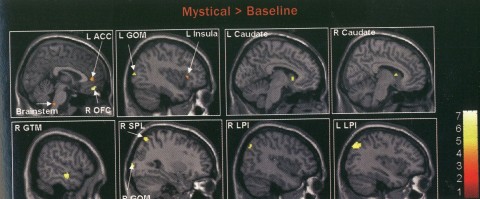
Meanwhile, back at the neuroscience ranch, researchers are also using imaging technology to observe the human brain in another state, the state where people experience mystical awakenings during prayer and meditation or other spiritual epiphanies. Scientific American took a fairly deep look at this cutting-edge field several years ago (read the full piece here), and now NPR has produced a multimedia glimpse into the evolving science of spirituality. The presentation (click here or the image above) combines audio, video, articles, book excerpts, etc. and delves into the fundamental question: Is God a delusion created by brain chemistry, or is brain chemistry a necessary conduit for people to reach God?
If you want to learn more about the brain and neuroscience, don’t miss the courses listed in the Psychology/Neuroscience section of our big collection of Free Online Courses.
Time and The Guardian have more on the first story above here and here.
Support Us
We're hoping to rely on loyal readers, rather than erratic ads. Please click the Donate button and support Open Culture. You can use Paypal, Venmo, Patreon, even Crypto! We thank you!

About Us

Open Culture scours the web for the best educational media. We find the free courses and audio books you need, the language lessons & educational videos you want, and plenty of enlightenment in between.
Advertise With Us

