The Big Bang gave birth to our universe. But what will bring it to an absolute end? In 21 minutes, a mere mega blip of time, this episode of Cosmic Journeys offers an impressive visual account of this big enchilada question, taking you across trillions of years. The sun will die but make the earth uninhabitable well beforehand. A similar process of decay will play itself out across the universe and we will enter the “degenerate era.” Dark energy, dead stars, and black holes will reign supreme. But what will happen in the very, very end, when the cosmic clock strikes a number known as a “googol” or some time thereafter? A lot of that will get sorted out by the work physicists are now doing with the Large Hadron Collider, the giant particle accelerator located near Geneva, Switzerland. Give the video a little bit of time. The second half gives you the goods.
Hat tip to Wilter for sending this video our way.
The tech/internet billionaires of the 1990s were never known for their largesse. They built their massive yachts. They bought their sports teams. They didn’t give much back to the public domain, as the Rockefellers, Mellons and the Gettys once did (despite their many other flaws).
There are some exceptions, of course. Bill Gates finally found religion and got involved in philanthropy in a big way. Then, on a lesser scale, there’s Jay Walker, the founder of Priceline and Walker Digital. He plowed many of his millions into creating The Walker Library of Human Imagination. As Wired magazine has put it, the library is a kind of intellectual Disneyland, a 3600 square foot room that displays great works of human imagination in an imaginative setting. Artifacts on display include: a complete Bible handwritten on sheepskin from 1240 AD, the first illustrated medical book from 1499, a 1699 atlas containing the first maps that put the sun at the center of the universe, the napkin on which FDR sketched his plan to win WWII, and an original 1957 Russian Sputnik satellite. You can get a full list of cultural curiosities here, watch the recently produced video tour of the library above, and spend a few minutes watching Walker talk about his library at TED.
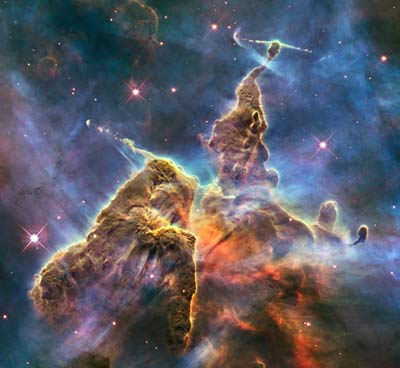
20 years ago (April 24, 1990) the Hubble Space Telescope was launched, beginning a long period of discovery. Today, NASA is celebrating the Hubble’s 20th anniversary by releasing one of the many brilliant photos taken by the space telescope. The image shows us a small portion of one of the largest star-birth regions in the galaxy, the Carina Nebula. As NASA goes on to describe it:
“Towers of cool hydrogen laced with dust rise from the wall of the nebula. The scene is reminiscent of Hubble’s classic “Pillars of Creation” photo from 1995, but is even more striking in appearance. The image captures the top of a three-light-year-tall pillar of gas and dust that is being eaten away by the brilliant light from nearby bright stars. The pillar is also being pushed apart from within, as infant stars buried inside it fire off jets of gas that can be seen streaming from towering peaks like arrows sailing through the air.”
Discovery Channel’s Life series has been receiving a lot of rave reviews for its stunning footage of plants and animals. This excerpt showing creeper plants climbing trees lives up to the hype. Leave it to a little time-lapse video–not to mention a voice-over by Oprah Winfrey–to blur the line between plant and animal.
UPDATE: A reader in Europe informed me that this video is apparently being blocked outside of the US. It’s extremely rare that this happens with YouTube videos (I’ve only seen it happen with full movies), but for some reason, it happened here. My apologies. [Dan]
Wes Alwan lives in Boston, Massachusetts, where he works as a writer and researcher and attends the Institute for the Study of Psychoanalysis and Culture. He also participates in The Partially Examined Life, a podcast consisting of informal discussions about philosophical texts by three philosophy graduate school dropouts.
That mettlesome Icelandic volcano (watch it spew) has grounded thousands of planes and passengers worldwide. But why exactly? Here, an aerospace expert explains why volcanoes and airplane engines aren’t a good mix. In a quick five minutes, you get it. Better grounded than sorry. Gary and Nats, hang in there in Tokyo…
What’s the likelihood that we’ll ever find extraterrestrial life? Many scientists would argue that the chances are slim. When you get down to basic essentials, you need water and moderate temperatures for life to take off. And it’s unlikely that these conditions exist beyond our planet. That’s the basic argument. But now Dr Alan Tunnacliffe, an award-winning researcher at Cambridge University’s Institute of Biotechnology, steps in and tells you about rotifers, tiny animals that can withstand extreme temperatures and survive in almost waterless conditions. It’s an intriguing five minutes of video that will get you thinking about the possibilities.
As part of a special multimedia project, Ericsson (the telecom company) asked 20 thinkers to “share their view on the drivers of the future and how connectivity/broadband is changing the world.” What will life be like in 2020? How will the world evolve? What habits and needs will people have? What kinds of technologies will they use to make life easier? New talks are being added to the collection each week (find them all here), and above, we’re featuring one such talk by Don Tapscott, the author of Wikinomics and Grown Up Digital. He sees the next generation of leaders changing the world, and for the better. They have grown up on the web. They think differently because their brains are wired differently. They’re smarter. And they’re ready to initiate sweeping changes in the way we do things. It’s a rather hopeful talk (a rarity these days). If you’re having problems watching the Tapscott video, you can also watch it here.
Simon Singh is a man who refuses to be silenced. In 2008, the British science writer published an article in The Guardian calling attention to some of the wilder claims of the chiropractic industry. A short time later he found himself sifting through 35 pages of legal documents from a libel suit brought by the British Chiropractic Association. The lawsuit specifically named Singh, and not the newspaper. As he told The Times of Londonrecently, the experience was “scary.”
Singh decided to fight back. Two years later, the British Chiropractic Association has received a great deal more public scrutiny than it bargained for, while Singh and his predicament have become the cause célèbre of a rapidly growing movement to reform England’s notorious libel law. London’s status as “Libel Capital of the World “ has begun to teeter.
The chain of events began April 19, 2008, on the “Comment and Debate” page of The Guardian: “This is Chiropractic Awareness Week,” wrote Singh. “So let’s be aware. How about some awareness that may prevent harm and help you make truly informed choices?” From there Singh went on to report that the founder of chiropractic therapy, Daniel David Palmer, had claimed that “99% of all diseases are caused by displaced vertebrae.” Even now, Singh wrote, modern chiropractors still hold some “quite wacky ideas.” The lawsuit revolves around a particular passage, quoted last week in a court document:
“The British Chiropractic Association claims that their members can help treat children with colic, sleeping and feeding problems, frequent ear infections, asthma and prolonged crying, even though there is not a jot of evidence. This organization is the respectable face of the chiropractic profession and yet it happily promotes bogus treatments.”
When the BCA objected, The Guardian offered to make space available for a rebuttal — if there was “a jot of evidence,” the BCA could present it. Instead, the organization declined the offer and sued the writer.
At the time, Singh was promoting his new book, Trick or Treatment: Alternative Medicine on Trial, which he co-wrote with Edzard Ernst. Several of his earlier books were international bestsellers, including Big Bang: The Origin of the Universe, and Fermat’s Last Theorem, which was published in America as Fermat’s Enigma: The Epic Quest to Solve the World’s Greatest Mathematical Problem. The commercial success of Singh’s books enabled him to absorb the enormous expense of fighting a case in the British libel courts.
Singh was dealt a serious setback in a preliminary hearing last May, when a judge ruled that the writer’s phrase “happily promotes bogus treatments” amounted to a factual claim that the BCA was intentionally dishonest – an interpretation of meaning which Singh flatly denied. Singh appealed the decision, and last Thursday, in a ruling that may prove to be a watershed, not only in Singh’s case but in the larger struggle for libel reform, the England and Wales Court of Appeal reversed the lower court judge’s decision and cleared the way for Singh to use a “fair comment” clause in his defense.
In the written decision, Lord Chief Justice Igor Judge commented on the societal impact of the BCA’s action. “It is now nearly two years since the publication of the offending article,” Lord Judge wrote. “It seems unlikely that anyone would dare repeat the opinions expressed by Dr. Singh for fear of a writ. Accordingly this litigation has almost certainly had a chilling effect on public debate which might otherwise have assisted potential patients to make informed choices about the possible use of chiropractic.”
In the days following last week’s landmark decision, we talked with Singh by email.
OPEN CULTURE: Congratulations on your victory in the Court of Appeal. How do you feel?
SIMON SINGH: I am delighted that the Court of Appeal has backed my interpretation of my own article, namely that the British Chiropractic Association is reckless, but not dishonest. I will still have to defend my article at trial, but I will be defending something I meant to write, as opposed to an extreme accusation that never existed in the first place. Although this is a big step forward for me, there is still a long way to go on libel reform in the UK. English libel laws are the worst in the free world, and they need radical reform so that other scientists and journalists do not find themselves in my position next year.
OPEN CULTURE: What happens next?
SIMON SINGH: I think the British Chiropractic Association is in a difficult position, but it has three choices. First, it could take the case to trial, which is fine by me because I would relish the opportunity to discuss my article in a courtroom. Second, it could appeal last week’s decision and go to the Supreme Court, but again this is fine by me because I would relish the opportunity to discuss my article in such an elevated forum. Third, it could abandon the case, but the BCA would have to pay my costs before being allowed to walk away.
OPEN CULTURE: Those costs have been considerable, haven’t they?
SIMON SINGH: I estimate that in my case both parties have run up bills of over £300,000, of which £200,000 has been spent establishing the meaning.
OPEN CULTURE: The Appeal Court ruling quotes Milton on the imprisonment of Galileo, and warns that under current law the court is invited to become “an Orwellian ministry of truth.” Do you think the tide is turning in favor of libel reform?
SIMON SINGH: I think the Appeal Court judges were sending a clear message that they are unhappy with libel law, which should encourage politicians to act radically on libel reform. All the main parties seem keen to reform our libel laws, but this is not yet in the manifestos of the two main parties. I think the pressure from campaigners, the public and the legal profession will ultimately encourage the next government to reform libel, but we have to maintain the pressure.
OPEN CULTURE: What makes English libel law so onerous?
SIMON SINGH: There is so much wrong with English libel law that it is hard to know where to start. It is horrendously expensive, which forces writers to back down even if they are right, because they cannot afford to defend their writing. It has been estimated that an English libel trial can easily cost over £1 million, and this is over 100 times more than the cost of an average libel case in mainland Europe. Second, there is the problem that large corporations can sue lone scientists, journalists and bloggers, which again forces them to back down because they are up against such powerful and rich organizations. Third, the burden of proof is uneven, because writers are assumed to be guilty until proven innocent. Fourth, there is no so-called robust public interest defense, namely something that would protect writers commenting on important issues. The law should encourage such debate, not silence it. Finally, there is a problem of libel tourism, whereby overseas companies sue overseas writers in London because they know that English libel law is hostile to journalists.
OPEN CULTURE: Why should this concern someone living away from the British Isles?
SIMON SINGH: The issue of libel tourism means that everyone in the world should be scared of the English libel law. If you write anywhere in the world about a billionaire, then the London court can probably claim jurisdiction because the material can probably be read in England over the internet and billionaires typically have business interests in England so they can claim to have a reputation in England. There are many cases of libel tourism, such as Saudi billionaires suing an American journalist, a U.S. company suing a Danish researcher, an Israeli technology company threatening to sue a paper written by a Swedish professor, a Tunisian man suing a German newspaper, an Icelandic bank suing a Danish newspaper, and so on – all these cases ended up in London, the libel capital of the world.
OPEN CULTURE: Libel law affects all forms of journalism and free expression, but the British scientific community has been especially outspoken on this issue. Richard Dawkins for example gave a high-profile speech on the problem. Why are scientists, in particular, so up in arms?
SIMON SINGH: I think scientists are at the forefront of the campaign for libel reform because science can only progress through open discussion and robust debate and criticism. I think the public accepts that libel is important for protecting the reputation of individuals, but they now realize that there must be a problem when libel blocks scientific discussion. In addition to my case, in the last year we have seen the science journalist Ben Goldacre, the cardiologist Peter Wilmshurst, the Swedish linguist Professor Lacerda and the Danish medical researcher Henrik Thomsen all being sued for libel in London. The libel laws block our right to discuss scientific ideas, but they also block the public’s right to hear these ideas.
OPEN CULTURE: With everything that has happened, have you been able to carry on with your work as a writer? Are you writing a new book?
SIMON SINGH: As well as the legal costs, I have also lost out because my income has been seriously damaged by my inability to write. I should be writing a new book now, but I cannot even submit a book proposal because I don’t know if I would ever be able to deliver it. Right now I am spending the majority of my time on my own legal case, and devoting any spare time to the campaign for libel reform.
OPEN CULTURE: Are you working with any organizations to bring about reform?
SIMON SINGH: I am working closely with three charities (Sense About Science, English PEN and Index on Censorship), who have formed the Libel Reform Coalition. We have a petition for libel reform and we welcome signatories from around the world, because English libel law affects writers all over the globe. I hope that readers will add their names to the petition at www.libelreform.org/sign — I have spent over a million minutes of my life defending my article and my right to free speech, so I hope readers will take one minute to show their support.
This article was contributed by Mike Springer, a journalist in Cambridge, Massachusetts.
We're hoping to rely on loyal readers, rather than erratic ads. Please click the Donate button and support Open Culture. You can use Paypal, Venmo, Patreon, even Crypto! We thank you!
Open Culture scours the web for the best educational media. We find the free courses and audio books you need, the language lessons & educational videos you want, and plenty of enlightenment in between.