The folks at the Cornell Creative Machines Lab are “interested in robots that create and are creative.” Here’s one such example of robots getting creative. Above, the lab lets two chatbots (essentially computer programs designed to simulate an intelligent conversation) start chatting with one another. They start by exchanging pleasantries. Then things get deeply philosophical, fairly quickly. It’s fun to watch it play out.
A friend once told me of his older cousin who, for the freakish act of installing a computer in his college dorm room, found himself immediately and irrevocably dubbed “computer Jon.” This happened in the early 1980s, and boy, have times changed. They’d even changed by the late 1980s, by which time Apple’s college marketing efforts had become sufficiently advanced to require the talents of Matt Groening, best known as the man who created The Simpsons. But that prime-time animated sitcom wouldn’t begin its record-breaking run (still without an end in sight) until Christmas 1989, while the Groening-illustrated Who Needs a Computer Anyway? (which you can flip through above) appeared earlier that year. Back then, readers might well have known him first and foremost as the creator of the satirical alternative-weekly comic strip Life inHell, which had debuted in 1977. One of its stars, the hapless but good-hearted young one-eared rabbit Bongo, even made his way to Apple brochure’s cover. Though computers themselves had long since come to dominate America’s campuses by the time I entered college, he and Groening’s other now-lesser-known characters did do their part to prepare me for academia.
I refer, of course, to School is Hell, his 1987 Life in Hell book offering sardonic primers on each and every phase of modern education from kindergarten to grad school (“when you haven’t had enough punishment”). Groening’s pages in Who Needs a Computer Anyway? read like a less sharp-edged version of those cartoons, following Life in Hell’s signature “The 9 Types of…” format to present the reader with their nine types of future college classmates, from “the stressed” to “the technoid” to “the unemployed.” Between these, you can read Apple’s pitch for why you’ll find a piece of equipment still somewhat outlandish and expensive so essential to every aspect of your college career. Though dated technically — the text mentions nothing of the internet, for instance, which this generation of college students would sooner drop out than do without — it nevertheless underscores the design virtues of Apple computers — an intuitive interface, application interoperability, “everything you need in one small, transportable case” — that remain design virtues today. It also displays an impressive prescience of the personal computer’s coming indispensability, a confident prediction that, if not for the slacker’s levity lent by Groening’s hand, might, at the time, actually have sounded implausible.
Mike Judge’s 1998 movie Office Space struck a nerve with just about anyone who ever wound up in a thankless low-end white collar job. Few movies before or since have been able to articulate the petty indignities, the inanities and the general soul gnawing awfulness of such gigs. Though the film is far from perfect, its abundance of painfully funny jokes along with some eminently quotable lines — “Ummm I’m gonna need you to go ahead and come in tomorrow” — have enshrined Office Space into the canon of cult movies.
Sixteen years later, Mike Judge has a new sitcom that aims its satirical sites on another white-collar ecosystem – Silicon Valley (the home of Open Culture). The series centers on nebbish programmer Richard who unwittingly develops a new revolutionary way to compress files. Soon he finds himself in a bidding war between two of the tech world’s biggest entrepreneurs. Like Office Space, the fun of the show is its wry, acerbic observations about the rarified culture of the valley.
Just like some apps that offer themselves for free before making you pay, the creators of Silicon Valley are offering the first episode of the HBO series for free on YouTube. Check it out above. Now if only they would do the same thing for season four of Game of Thrones.
Jonathan Crow is a Los Angeles-based writer and filmmaker whose work has appeared in Yahoo!, The Hollywood Reporter, and other publications. You can follow him at @jonccrow.
When I was a kid, my father brought home from I know not where an enormous collection of National Geographic magazines spanning the years 1917 to 1985. I found, tucked in almost every issue, one of the magazine’s gorgeous maps—of the Moon, St. Petersburg, the Himalayas, Eastern Europe’s ever-shifting boundaries. I became a cartography enthusiast and geographical sponge, poring over them for years just for the sheer enjoyment of it, a pleasure that remains with me today. Whether you’re like me and simply love the imaginative exercise of tracing a map’s lines and contours and absorbing information, or you love to do that and you get paid for it, you’ll find innumerable ways to spend your time on the new Open Access Maps project at the New York Public Library. The NYPL announces the release with the explanation below:
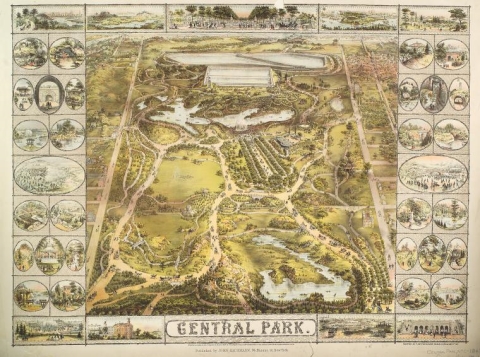
What does this mean? Simply put, “it means you can have the maps, all of them if you want, for free, in high resolution.” Maps like that above, of New York’s Central Park, issued in 1863, ten years before Frederick Law Olmsted and Calvert Vaux completed their historic re-design.
Can you—as I did with my neatly folded, yellowing archive—have all the maps in full-color print? Well, no, unless you’re prepared to bear the cost in ink and paper and have some specialized printing equipment that can render each map in its original dimensions. But you can access something worlds away from what I could have imagined—a digital enhancement technology called “warping,” also known as “georectification.”
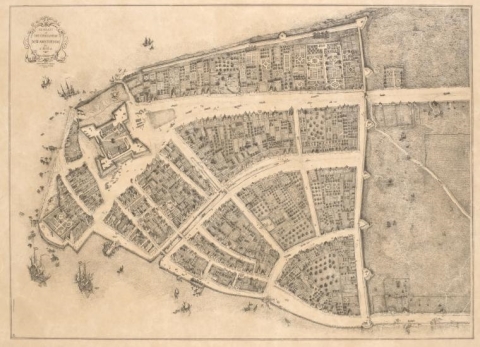
This, explains the NYPL, “is the process where digital images of maps are stretched, placing the maps themselves into their geographic context, rendered either on the website or with tools such as Google Earth.” For example, below see a “warping” of the 1916 Redraft of the 1660 “Castello Plan” for then-New Amsterdam over a current-day Google Earth image of lower Manhattan (and note how much the island has been expanded past its 17th century shores). The “warping” technology is open access, meaning that “anybody with a computer can create an account, log in, and begin warping and tracing maps.” User contributions remain, “a la Wikipedia,” and add “one more piece to this new historical geographic data model.”
The “warper” is a special feature that helps place historical maps in a modern visual field, but it in no way ruins the enjoyment of those maps as archival pieces or art objects. You can see cartographer John Wolcott Adams original 1916 Castello Plan redraft below, and visit NYPL’s Digital Collections for a high resolution image, fully zoomable and, yes, printable. For more on the incredible warping technology NYPL makes available to us, see this extended blog post, “Unbinding the Atlas: Working with Digital Maps.” Over ten thousand of the collection’s maps are of New York and New Jersey, dating from 1852 to 1922, including property, zoning, and topographic maps. In addition, over one thousand of the maps depict Mid-Atlantic cities from the 16th to the 19th centuries, and over 700 are topographic maps of the Austro-Hungarian Empire between 1877 and 1914. That should be enough to keep any amateur or professional map-lover busy for a good long while. Start digging into the maps here.
At the beginning of last year, we wrote about CS50, Harvard’s Introductory Computer Science course, taught by Professor David Malan. Today, we bring you the updated version of the class, filmed throughout the past semester at Harvard. Why revisit an updated version of the same class a year later? For one thing, the material has been updated. And, as you can tell by the rousing reception Malan receives from the audience at the start of the first lecture (above), Malan is kind of a big deal. From his opening boom of “This is CS50,” Malan immediately comes off as an unusually charismatic professor. He offers what might just be the most engaging online class you’ve ever seen.
So what does this charismatic computer scientist cover over three months? An impressively large amount of information about coding. Malan builds the course from the ground up, and begins by describing how transistors are employed to transmit information within computers. From then on, he outlines a vast amount of computer science in highly accessible language. This will almost undoubtedly be the clearest presentation of topics like “command-line arguments,” “cryptography,” and “dynamic memory allocation” that you’re likely to hear.
San Quentin State Prison, California’s only male-inmate death row, has a reputation for having contained some of the most fearsome murderers to make headlines, up to and including Charles Manson. But some non-serial-killing cultural figures have also passed through it gates: country singer-songwriter Merle Haggard, for car theft and armed robbery in his youth; actor Danny Trejo, who did a few years in the sixties; jazz saxophonist Art Pepper, who served two sentences there in that decade; and Neal Cassady, the inspiration for Dean Moriarty in Jack Kerouac’s On the Road, locked up for marijuana possession in 1958. The following year would see the construction, up north at the University of Oregon, of the very first full-sphere “continuous tension-discontinuous compression” geodesic dome. What on Earth could link these these two structures, one brutally utilitarian with a name that spooks even hardened outlaws, and the other a technologically forward-thinking, utopian attempt at architecturally bringing about a better world?
The connection comes in the form of Buckminster Fuller himself, the architect, inventor, writer, and much else besides responsible for the design of the geodesic dome. (He also invented the Dymaxion Car, Dymaxion House, Dymaxion Map… and the list goes on.) He came to San Quentin that same year, not as an inmate — one imagines him as far too busy spinning off new theories or keeping the Dymaxion Chronofile to so much as consider committing a crime — but as a lecturer. Described as “a talk given to inmates on general semantics,” Fuller’s address, which you can hear above, starting around the 20:30 minute mark, takes on an even more general breadth of subjects than that, including his own biography and the experiences that originated the ideas that drove him to live his life as “an experiment to find what a single individual can contribute to changing the world and benefiting all humanity.” Through that concern with humanity, he could relate to prisoners just as well as he could to anyone else. “There are no throw-away resources,” he says at one point, “and no throw-away people.” At over three hours long, the lecture gets into some detail, but if you want a still more thorough look into Fuller’s mind, consider following it up with the 42-hour Everything I Know.
Why have cinephiles, from the era of Laserdiscs through that of DVDs and now Blu-rays, so consistently respected The Criterion Collection? Speaking as one such cinephile, I could point to a number of factors: their curatorial bent toward important films, their production of rich supplementary features, their always impressive pieces of cover art. But Criterion has become increasingly known for the considerable work they put in not at the end of the process, when they package a classic or potentially classic motion picture for maximum aesthetic and intellectual appeal (and your purchase), but at the beginning, when they track down the actual celluloid film in the first place, often aged or damaged, and engage in the often painstaking task of returning it to the prime of visual and sonic life.
In the short Gizmodo video at the top, Criterion director Lee Kline and his team talk about the work they did to restore Alfred Hitchcock’s 1940 Foreign Correspondent, which included acquiring the negative from the Library of Congress, scanning the whole thing at high resolution over two days to a week, doing the research necessary to figure out how the film “should have looked,” clean up scratches and film damage, and filter out the clicks and pops on the soundtrack. (And yes, we get some insight into its “snazzy” cover design as well.) The Kline-narrated video just above offers a demonstration of Criterion’s restoration process on another piece of classic Hitchcock, the first, 1934-made version of The Man Who Knew Too Much, a picture with no known negative still in existence. A formidable challenge, but if we film geeks entrust that job to anyone, we entrust it to Criterion.
“I like to claim that I bought the second Macintosh computer ever sold in Europe,” writes actor, comedian, writer, wit, and die-hard Apple enthusiast Stephen Fry in a Telegraph essay marking the Macintosh computer’s 30th anniversary. “My friend and hero Douglas Adams was in the queue ahead of me. For all I know someone somewhere had bought one ten minutes earlier, but these were the first two that the only shop selling them in London had in stock on the 24th January 1984, so I’m sticking to my story.”
Fry had found the only computer that made him want to write; “I couldn’t wait to get to it every morning,” he remembers. He didn’t even need convincing from “1984,” Ridley Scott’s “legendary commercial” above, which he didn’t see “until it crept onto English television screens way past its dramatic Super Bowl debut.”
Now that we’ve come upon the 30th anniversary of that dramatic Super Bowl debut, why not get a little insight from the man who directed it? In the clip just above, Scott, who by that time already had the rich and troubling futuristic visions Alien and Blade Runner under his belt, talks about his experience bringing the storyboards — audacious by the television commercial standard of the era, let alone for personal computers — onto the screen. He discusses looking to the past for his “slightly decadent-looking” future, hanging jet engines on the set as an act of “good dramatic bullshit,” putting out a “frightening” casting call for a background full of skinheads, getting the totalitarian text for Big Brother to intone, and finding a young lady who could swing a hammer. And what would he have done with an even bigger budget? “Not very much. I think we nailed it.” As, Fry and his fellow user-enthusiasts agree, did Apple.
We're hoping to rely on loyal readers, rather than erratic ads. Please click the Donate button and support Open Culture. You can use Paypal, Venmo, Patreon, even Crypto! We thank you!
Open Culture scours the web for the best educational media. We find the free courses and audio books you need, the language lessons & educational videos you want, and plenty of enlightenment in between.