The Earth is losing life forms at a disturbing rate. The biologist Edward O. Wilson has estimated that at least 27,000 species per year are disappearing from our planet. That’s an average of 74 species a day, or three every hour. Researchers warn that if we stay on this track, the Earth will enter its sixth mass extinction–the first since the one that killed off the dinosaurs.
With animal and plant habitats being crowded out by a human population that has passed the 7 billion mark and is growing at a rate of 70 million people per year, scientists attempting to stem the tide of extinction have their work cut out for them. The vast majority of efforts, of course, are aimed at preserving endangered species and making sure more species do not become endangered. But one man is spearheading a bold project to actually bring back species we have already lost.
Stewart Brand first came to notoriety in the 1960s, as one of Ken Kesey’s Merry Pranksters and as the creator of the Whole Earth Catalog. In 1996 he co-founded the Long Now Foundation, dedicated to fostering long-term thinking in our accelerating culture, with its “pathologically short attention span.” One of Brand’s pet projects at Long Now is Revive & Restore, a program to coordinate genetic research into bringing back presently extinct species. Brand spoke about the project (see above) on February 27 at a TED conference in Long Beach, California.
Revive & Restore’s first project is to bring back the passenger pigeon, a bird that died off in 1914 but was once so abundant that migratory flocks in North America would darken the sky. The passenger pigeon was chosen as the initial project because it is better-known than many extinct species and because the bird’s DNA (taken from museum specimens) has already been sequenced. But Brand promises that the passenger pigeon is only the beginning. “The fact is,” he says, “humans have made a huge hole in nature in the last 10,000 years. We have the ability now, and maybe the moral obligation, to repair some of the damage.”
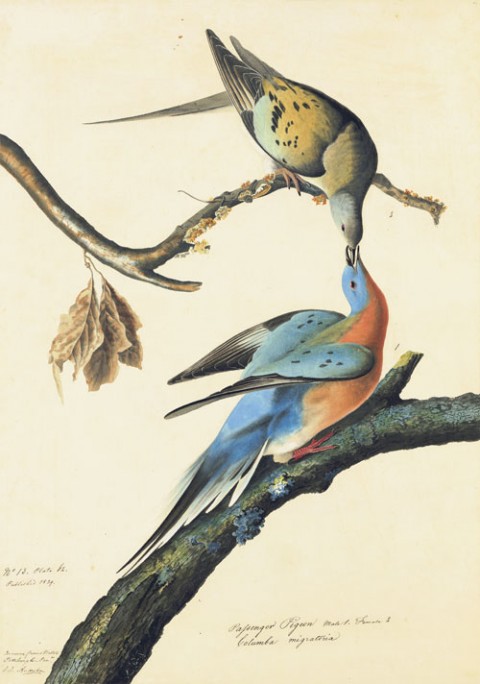
Passenger Pigeon (Ectopistes migratorius) by John James Audubon, 1824. Watercolor, pastel, graphite, gouache, black chalk and black ink on paper. The image depicts a behavior known as “billing,” in which one bird shares food by regurgitating it into the bill of another. The male, with it’s more colorful plumage, is shown standing on the lower branch, with the female up above.




