Back in the 1980s, Canada Trust installed a bunch of ATM machines and began convincing customers that banker’s hours were a thing of the past. Now customers could get money 24 hours a day, 7 days a week. And who better to tell customers how they could conveniently tap their cash than Johnny Cash. Enter the Johnny Cash Machine. Don’t believe me? Here are two 1985 commercials to prove it.
If you would like to support the mission of Open Culture, consider making a donation to our site. It’s hard to rely 100% on ads, and your contributions will help us continue providing the best free cultural and educational materials to learners everywhere. You can contribute through PayPal, Patreon, and Venmo (@openculture). Thanks!
Eight years after it aired, the final scene of the final episode of The Sopranos still has people guessing: What happened when the screen suddenly went black? Did Tony Soprano get whacked? Or did he live to see another quasi-ordinary day? Could he really die as Journey sings, “Don’t Stop Believing?”
In a new interview appearing on The Directors Guild of America web site, David Chase, creator of The Sopranos, revisits the making of the final scene. Chase doesn’t directly answer the questions about Tony’s fate. But he does give us some insight into the deeper philosophical questions raised in the scene (watch it above) and how much they’re bound up in the lyrics of Journey’s soundtrack. There’s some deeper meaning in the small town girl and the city boy taking “the midnight train goin’ anywhere”:
I love the timing of the lyric when Carmela enters: ‘Just a small town girl livin’ in a lonely world, she took the midnight train goin’ anywhere.’ Then it talks about Tony: ‘Just a city boy,’ and we had to dim down the music so you didn’t hear the line, ‘born and raised in South Detroit.’ The music cuts out a little bit there, and they’re speaking over it. ‘He took the midnight train goin’ anywhere.’ And that to me was [everything]. I felt that those two characters had taken the midnight train a long time ago. That is their life. It means that these people are looking for something inevitable. Something they couldn’t find. I mean, they didn’t become missionaries in Africa or go to college together or do anything like that. They took the midnight train going anywhere. And the midnight train, you know, is the dark train.
And there’s meaning packed in the idea of “Strangers waiting up and down the boulevard.”
Cutting to Meadow parking was my way of building up the tension and building up the suspense, but more than that I wanted to demonstrate the lyrics of the song, which is streetlights, people walking up and down the boulevard, because that’s what the song is saying. ‘Strangers waiting.’ I wanted you to remember that is out there. That there are streetlights and people out there and strangers moving up and down. It’s the stream of life, but not only that, it’s the stream of life at night. There’s that picture called History Is Made at Night [from 1937]. I love that title. And that kind of echoes in my head all the time.
But if you’re looking for the philosophical essence of the scene, then look no further than the mantra, “Don’t stop believin.’ ” That’s what it’s all about:
I thought the ending would be somewhat jarring, sure. But not to the extent it was, and not a subject of such discussion. I really had no idea about that. I never considered the black a shot. I just thought what we see is black. The ceiling I was going for at that point, the biggest feeling I was going for, honestly, was don’t stop believing. It was very simple and much more on the nose than people think. That’s what I wanted people to believe. That life ends and death comes, but don’t stop believing. There are attachments we make in life, even though it’s all going to come to an end, that are worth so much, and we’re so lucky to have been able to experience them. Life is short. Either it ends here for Tony or some other time. But in spite of that, it’s really worth it. So don’t stop believing.
The good people over at the New York Public Library compiled a list of books read by the characters of Mad Men, which just started the last half of its seventh and final season. Over the course of the series, the show’s characters drank several swimming pools worth of cocktails, engaged in a host of ill-advised illicit affairs and, on occasion, dreamed up a brilliant advertising campaign or two. As it turns out, they also read quite a bit.
All the books seem to say something about the inner life of each character. The show’s enigmatic main character, Don Draper, favored works like Dante’s Inferno and William Faulkner’s The Sound and the Fury – books that point towards Draper’s series-long downward spiral. The whiny, insecure Pete Campbell read Thomas Pynchon’s paranoid classic The Crying of Lot 49. And Bert Cooper, the aristocratic bow-tie sporting patriarch of Sterling Cooper is apparently an Ayn Rand fan; he’s seen reading Atlas Shrugged early in the series. You can see the full reading list below or here in a beautiful PDF designed by the NYPL.
Jonathan Crow is a Los Angeles-based writer and filmmaker whose work has appeared in Yahoo!, The Hollywood Reporter, and other publications. You can follow him at @jonccrow. And check out his blog Veeptopus, featuring lots of pictures of badgers and even more pictures of vice presidents with octopuses on their heads. The Veeptopus store is here.
Serena Bramble, the mastermind behind this supercut writes, “Sterling Archer, the modern take-down of James Bond on Adam Reed’s cult animated show Archer, is many things,” including a book nerd, “but that last detail has always been a quirk in the show, with literary references spouted out almost as often as jokes about oral sex.” If you’ve watched the show, you may have caught the references to Chekhov, Tolkien and Orwell, just to name a few. But, in case you didn’t, Bramble’s supercut gathers them together and shows proof that Archer’s creator indeed had a “tenure as a frustrated English major.” Check it out.
Back in 2012, President Obama, already on record as being a fan of The Wire, was asked by ESPN to name his favorite character on the show, to which he replied “It’s got to be Omar, right? I mean, that guy is unbelievable, right?” Fast forward to 2015, and we find Mr. Obama hosting David Simon (the creator of The Wire) at the White House, and having a frank conversation about the TV show and the war on drugs, and what lessons we’ve learned along the way. Of course, the conversation doesn’t end without Omar getting a mention … or without us getting to see Obama as TV host. A sign of what’s to come after 2016?
Twin Peaks is, of course, a seminal cult TV series, a surrealist soap opera spun out of the mind of David Lynch. When it came out in the late 80s, America was seized with the show’s central mystery – who killed Laura Palmer? A tortured blonde beauty queen who wound up dead, wrapped in plastic. Its first season (US viewers can watch it on Hulu) was easily one of the best ever on television with great characters, inside jokes and just enough Lynchian weirdness to unnerve a mainstream audience without totally freaking them out. Too bad, then, that the quality of the show’s second season went off a cliff.
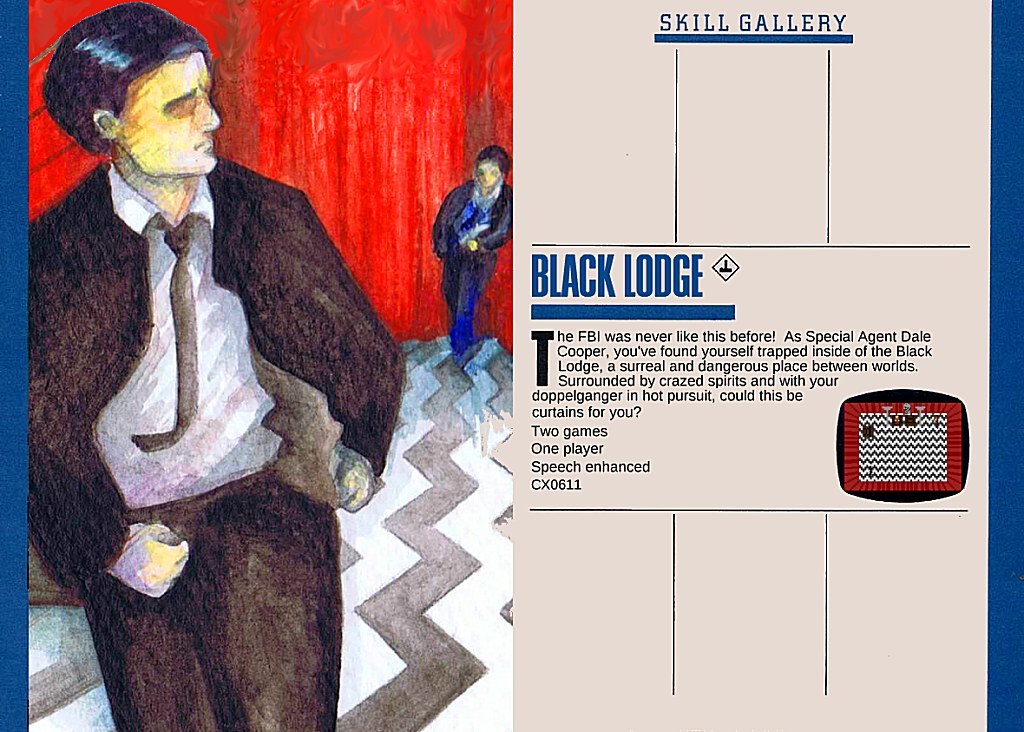
You would expect a video game about the series to be about the search for Laura Palmer’s killer, but no. Instead, the game, an Atari 2600-style work called Black Lodge 2600, is a riff on the show’s final angry episode. In that episode, FBI agent Dale Cooper delves into the otherworldly Black Lodge, which, in spite of its name, is decorated primarily in red curtains. There, Cooper is confronted by his doppelganger. Lynch’s Jungian obsessions have never been as bald as in that episode.
Basically, if you felt like your well-worn copy of Pitfall was strangely lacking in busts of Venus De Milo and a pervading sense of the Unheimliche, then this video game might be for you. The game’s manual, which has way too many exclamation points, sets the stage:
A day in the FBI was never like this before! You are Special Agent Dale Cooper and you’ve found yourself trapped inside the Black Lodge, a surreal and dangerous place between worlds. Try as you might, you can’t seem to find anything but the same room and hallway no matter which way you turn. Worse yet, your doppelganger is in hot pursuit! You have no choice but to keep running through the room and hallway (or is it more than one?) and above all else, don’t let your doppelganger touch you!
[…]
You’ll find quickly that you’re not alone in the Black Lodge, though your friends are few and far between. Not only that, the Lodge itself seems to be actively trying to trip you up at all times! You’ll be dodging chairs and crazed Lodge residents all while trying to keep your own sanity. How long can this go on?
Based on this description, I can’t tell if this game is compelling or if it will merely evoke the same feeling of existential futility I feel every time I call Time Warner Cable. Watch a video of the game below and judge for yourself. Or start downloading the game and the manual here.
Note: If you have problems getting the game going on a Mac, then follow these Black Lodge troubleshooting instructions: Go to “System Preferences”, open “Security & Privacy”, click the padlock to allow changes, then click the “Anywhere” option under “Allow applications downloaded from.”
Jonathan Crow is a Los Angeles-based writer and filmmaker whose work has appeared in Yahoo!, The Hollywood Reporter, and other publications. You can follow him at @jonccrow. And check out his blog Veeptopus, featuring lots of pictures of badgers and even more pictures of vice presidents with octopuses on their heads. The Veeptopus store is here.
Meryl Streep, frequently hailed as one of our Greatest Living Actresses — she claims there’s no such thing — commands a near-encyclopedic mastery of accents.
Others may prepare for their roles by working with a dialect coach or listening to tapes of native speakers, but Streep pushes to the limit, as indicated in the conversation with author Andre Dubus III, below.
She not only learned Polish in order to play a troubled Holocaust survivor in Sophie’s Choice,she thought deeply about the way gender roles and period inform vocal presentation.
Her commitment to her craft is inadvertently to blame for popularizing the phrase “dingo’s got my baby.”
How refreshing that this versatile and accomplished actor is not precious about her skills. She gamely trotted them out for the comedian Ellen DeGeneres’ parlor game, above. Looks like fun, provided one’s not an introvert. Each player draws a card labelled with an accent, sticks it to the brim of a silly hat, then tried to guess the accent, based on her partner’s impromptu performance.
“Brooklyn?” Streep giggles when the Louisiana-born DeGeneres has a go at Boston.
Her stab at the Bronx shows off her improv chops far better than the most recent stunt DeGeneres roped her into.
Josh Weltman, a 25 year veteran of the advertising business, has been a part of Mad Men since the show’s first season. He has worked closely, he tells us on his web site, “with Matthew Weiner and the show’s writers and producers to help ensure that Mad Men accurately depicts the process of creating ads and servicing clients, and that the show’s advertising and business stories play true to life, true to character and true to period. He also creates most of the original ads seen on the show.”
On his Vimeo channel, you can find just one video. But it’s an essential one — a short quick primer on how to draw Don Draper. Start practicing. The final season of Mad Men kicks off on Sunday, April 5, at 10 p.m. on AMC.
Follow us on Facebook, Twitter and Google Plus and share intelligent media with your friends. Or better yet, sign up for our daily email and get a daily dose of Open Culture in your inbox. Also, if you know of any great media we should share with your fellow readers, please send it our way.
We're hoping to rely on loyal readers, rather than erratic ads. Please click the Donate button and support Open Culture. You can use Paypal, Venmo, Patreon, even Crypto! We thank you!
Open Culture scours the web for the best educational media. We find the free courses and audio books you need, the language lessons & educational videos you want, and plenty of enlightenment in between.