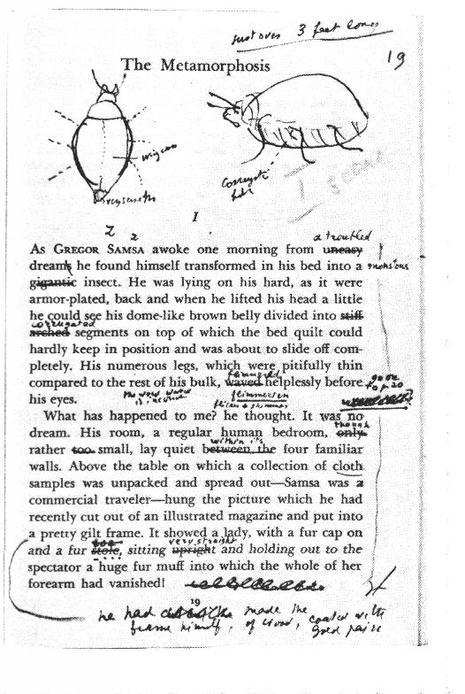
Vladimir Nabokov admired Franz Kafka’s novella, The Metamorphosis. Hence the lecture that Nabokov dedicated to the work here. But he also saw some small ways to wordsmith the story, or at least the English translation of it. Above, we have some edits — the nips and tucks — that Nabokov scribbled on his personal copy of Kafka’s most famous work.
In 1989, Nabokov’s lecture on The Metamorphosis was actually turned into a television production starring Christopher Plummer. You can watch The Metamorphosis — A Study: Nabokov on Kafka online. It runs 30 minutes. Of course, you can also download your own copy of Kafka’s near perfect work of poetic imagination, to borrow a phrase from Elias Canetti. Visit our collections of Free eBooks and Free Audio Books.
If you would like to support the mission of Open Culture, consider making a donation to our site. It’s hard to rely 100% on ads, and your contributions will help us continue providing the best free cultural and educational materials to learners everywhere. You can contribute through PayPal, Patreon, and Venmo (@openculture). Thanks!
Today is the 150th anniversary of the birth of the short story writer O. Henry. He was born William Sydney Porter in Greensboro North Carolina on September 11, 1862, and his life was not easy. He chose the pen name “O. Henry” while he was in the penitentiary.
Trained as a pharmacist, Porter came down with tuberculosis in his early twenties and moved to the drier climate of Texas, where he worked as a ranch hand, a draftsman for the Texas Land Office, and a clerk at the First National Bank of Austin before striking out on his own as a writer and launching a humor magazine called The Rolling Stone. When the magazine folded the following year, Porter took a job as a reporter, columnist and cartoonist at the Houston Post. Meanwhile, though, Federal investigators were looking into shortages in Porter’s accounts from his days at the bank in Austin, and in February of 1896, when he was 33 years old and had a wife and a young daughter to support, Porter was arrested and charged with embezzlement.
While being brought to Austin for trial, Porter managed to elude his captors and hop a train to New Orleans, where he arranged passage on a freighter bound for Honduras. Despite the appearance of guilt Porter would always maintain his innocence, saying that his flight from justice was brought on by panic. He compared himself to the protagonist of one of Joseph Conrad’s classic novels, a sailor who abandoned a fully loaded passenger ship that he thought was sinking. “I am like Lord Jim,” he said, “because we both made one fateful mistake at the supreme crisis of our lives, a mistake from which we could not recover.”
When Porter got to Central America he began making plans for his family to join him there, but soon learned that his wife was dying of tuberculosis. He returned to Texas and was with his wife when she died. A few months later he was sentenced to five years in a federal penitentiary in Ohio. While behind bars, Porter began writing short stories in earnest. To disguise his identity he used a series of pen names, eventually settling on “O. Henry.”
Porter was released from prison in 1901, two years early for good behavior. He moved to New York to write stories under his new name for magazines. From there he skyrocketed to success. Between 1904 and his death in 1910, he published some 300 stories and ten books. “O. Henry worked at whirlwind speed,” writes Victoria Blake in the Barnes & Noble Classics edition of Selected Stories of O. Henry, “producing more over a shorter period than any other writer of his time and cultivating a literary demand unmatched by anyone, anywhere in the history of American letters.”
Some of the very same elements that made O. Henry’s stories so popular in his lifetime–the sentimentality, the “twist” endings–have caused them to age poorly since his death. A few of his stories, like “The Gift of the Magi,” are still widely read, but his reputation has been surpassed by more modern writers like Ernest Hemingway, James Joyce and Sherwood Anderson. A little of his former prestige is revived every year with the awarding of the O. Henry Prize for the best short fiction.
For his 150th birthday we bring you what is said to be a rare recording of O. Henry’s voice. Although the date and authenticity are an open question, the recording was apparently made on an Edison cylinder sometime between 1905 and the writer’s death in 1910. It was included in the vinyl record The Golden Age of Opera: Great Personalities, 1888–1940. Here is a transcript:
This is William Sydney Porter speaking, better known to you, no doubt, as O. Henry. I’m going to let you in on a few of my secrets in writing a short story. The most important thing, at least in my humble opinion, is to use characters you’ve crossed in your lifetime. Truth is indeed stranger than fiction. All of my stories are actual experiences that I have come across during my travels. My characters are facsimilies of actual people I’ve known. Most authors spend hours, I’m told even days, laboring over outlines of stories that they have in their minds. But not I. In my way of thinking that’s a waste of good time. I just sit down and let my pencil do the rest. Many people ask me how I manage to get that final little twist in my stories. I always tell them that the unusual is the ordinary rather than the unexpected. And if you people listening to me now start thinking about your own lives, I’m sure you’ll discover just as many odd experiences as I’ve had. I hope this little talk will be heard long after I’m gone. I want you all to continue reading my stories then too. Goodbye, folks.
If you’re anything like me, you yearn to become a good writer, a better writer, an inspiring writer, even, by learning from the writers you admire. But you neither have the time nor the money for an MFA program or expensive retreats and workshops with famous names. So you read W.H. Auden’s essays and Paris Review interviews with your favorite authors (or at least PR’s Twitter feed); you obsessively trawl the archives of The New York Times’ “Writers on Writing” series, and you relish every Youtube clip, no matter how lo-fi or truncated, of your literary heroes, speaking from beyond the grave, or from behind a podium at the 92nd Street Y.
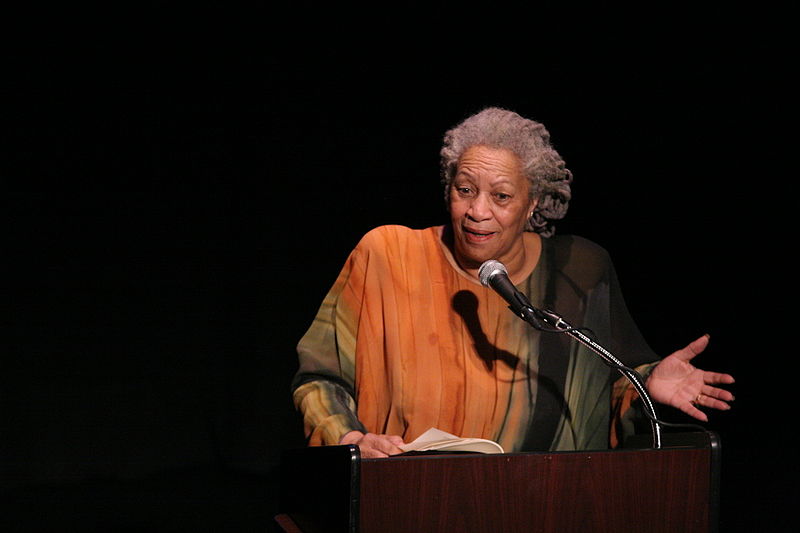
Well, friend, you are in luck (okay, I’m still talking about me here, but maybe about you, too). The Washington, DC-based non-profit Academy of Achievement—whose mission is to “bring students face-to-face” with leaders in the arts, business, politics, science, and sports—has archived a series of talks from an incredibly diverse pool of poets and writers. They call this collection “Creative Writing: A Master Class,” and you can subscribe to it right now on iTunes and begin downloading free video and audio podcasts from Nora Ephron, John Updike, Toni Morrison, Carlos Fuentes, Norman Mailer, Wallace Stegner, and, well, you know how the list goes.
The Academy of Achievement’s website also features lengthy profiles–with text and downloadable audio and video–of several of the same writers from their “Master Class” series. For example, an interview with former U.S. poet-laureate Rita Dove is illuminating, both for writers and for teachers of writing. Dove talks about the aversion that many people have for poetry as a kind of fear inculcated by clumsy teachers. She explains:
At some point in their life, they’ve been given a poem to interpret and told, “That was the wrong answer.” You know. I think we’ve all gone through that. I went through that. And it’s unfortunate that sometimes in schools — this need to have things quantified and graded — we end up doing this kind of multiple choice approach to something that should be as ambiguous and ever-changing as life itself. So I try to ask them, “Have you ever heard a good joke?” If you’ve ever heard someone tell a joke just right, with the right pacing, then you’re already on the way to the poetry. Because it’s really about using words in very precise ways and also using gesture as it goes through language, not the gesture of your hands, but how language creates a mood. And you know, who can resist a good joke? When they get that far, then they can realize that poetry can also be fun.
Dove’s thoughts on her own life, her work, and the craft of poetry and teaching are well worth reading/watching in full. Another particularly notable interview from the Academy is with another former laureate, poet W.S. Merwin.
Merwin, a two-time Pulitzer Prize winner, discusses poetry as originating with language, and its loss as tantamount to extinction:
When we talk about the extinction of species, I think the endangered species of the arts and of language and all these things are related. I don’t think there is any doubt about that. I think poetry goes back to the invention of language itself. I think one of the big differences between poetry and prose is that prose is about something, it’s got a subject… poetry is about what can’t be said. Why do people turn to poetry when all of a sudden the Twin Towers get hit, or when their marriage breaks up, or when the person they love most in the world drops dead in the same room? Because they can’t say it. They can’t say it at all, and they want something that addresses what can’t be said.
If you’re anything like me, you find these two perspectives on poetry—as akin to jokes, as saying the unsayable—fascinating. These kinds of observations (not mechanical how-to’s, but original thoughts on the process and practice of writing itself) are the reason I pore over interviews and seminars with writers I admire. I found more than enough in this archive to keep me satisfied for months.
We’ve added “Creative Writing: A Master Class” to our ever-growing collection of Free Online Courses.
Image via Angela Radulescu
Josh Jones is a doctoral candidate in English at Fordham University and a co-founder and former managing editor of Guernica / A Magazine of Arts and Politics.
E.M. Forster’s later years are something of a riddle. After publishing five novels, including the classics A Passage to India and Howards End, Forster stopped writing fiction at the age of 45. He lived quietly for another 46 years and continued to write essays, short biographies and literary journalism — but no more novels.
The issues behind it are complicated, says Forster in this excerpt from a 1958 BBC interview. “But I think one of the reasons why I stopped writing novels,” he says, “is that the social aspect of the world changed so very much. I’d been accustomed to write about the old vanished world with its homes and its family life and its comparative peace. All of that went. And though I can think about it I cannot put it into fiction form.”
At the time of the interview Forster was an honorary fellow at King’s College, Cambridge, where he lived the final 24 years of his life. He speaks of his life at Cambridge, and of his own limitations as a writer, with a sincerity and humanity that readers will recognize from his books.
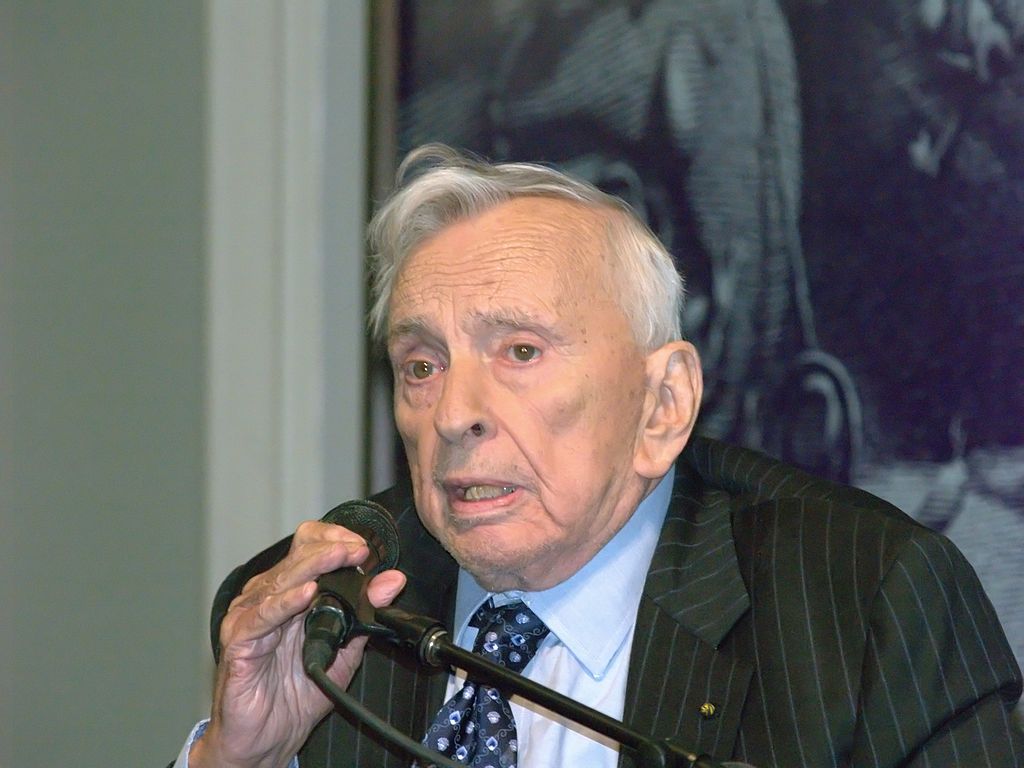
Next to “celebrated” (or “celebrity”) the description I’ve most seen applied to the late Gore Vidal is “acerbic,” or some such synonym—“scathing,” “disdainful”… I’m sure he would relish the compliment. One of the most fitting adjectives, perhaps, is “Wilde-like” (as in Oscar Wilde), deployed by Hilton Als in the New Yorker. The adjective fits especially well considering one of Vidal’s most-tweeted quotes from his treasury of Wilde-like aphorisms: “Write something, even if it’s just a suicide note.” It’s clever and morbid and naughty and devil-may-care, and almost entirely fatuous. Unlike several writers recently featured here—Margaret Atwood, Ray Bradbury, Henry Miller, George Orwell, et al.—who helpfully compiled numbered lists of writing advice, Vidal’s pronouncements on his craft were rather unsystematic. But, like many of those named above, what Vidal did leave in the form of advice was sometimes facetious, and sometimes profound. Despite his evident contempt for neat little lists, one writer in the UK has helpfully compiled one anyway. The “suicide note” quote above is number 4:
Each writer is born with a repertory company in his head.
Write what you know will always be excellent advice for those who ought not to write at all. Write what you think, what you imagine, what you suspect!
I sometimes think it is because they are so bad at expressing themselves verbally that writers take to pen and paper in the first place.
Write something, even if it’s just a suicide note.
How marvelous books are, crossing worlds and centuries, defeating ignorance and, finally, cruel time itself.
Southerners make good novelists: they have so many stories because they have so much family.
You can’t really succeed with a novel anyway; they’re too big. It’s like city planning. You can’t plan a perfect city because there’s too much going on that you can’t take into account. You can, however, write a perfect sentence now and then. I have.
Today’s public figures can no longer write their own speeches or books, and there is some evidence that they can’t read them either.
I suspect that one of the reasons we create fiction is to make sex exciting.
Writer’s Digest gives us ten additional quotes of Gore Vidal on writing (unnumbered this time):
“You can improve your talent, but your talent is a given, a mysterious constant. You must make it the best of its kind.”
“I’ve always said, ‘I have nothing to say, only to add.’ And it’s with each addition that the writing gets done. The first draft of anything is really just a track.”
“The reason my early books are so bad is because I never had the time or the money to afford constant revisions.”
“That famous writer’s block is a myth as far as I’m concerned. I think bad writers must have a great difficulty writing. They don’t want to do it. They have become writers out of reasons of ambition. It must be a great strain to them to make marks on a page when they really have nothing much to say, and don’t enjoy doing it. I’m not so sure what I have to say but I certainly enjoy making sentences.”
“Constant work, constant writing and constant revision. The real writer learns nothing from life. He is more like an oyster or a sponge. What he takes in he takes in normally the way any person takes in experience. But it is what is done with it in his mind, if he is a real writer, that makes his art.”
“I’ll tell you exactly what I would do if I were 20 and wanted to be a good writer. I would study maintenance, preferably plumbing. … So that I could command my own hours and make a good living on my own time.”
“If a writer has any sense of what journalism is all about he does not get into the minds of the characters he is writing about. That is something, shall we say, Capote-esque—who thought he had discovered a new art form but, as I pointed out, all he had discovered was lying.”
“A book exists on many different levels. Half the work of a book is done by the reader—the more he can bring to it the better the book will be for him, the better it will be in its own terms.”
[When asked which genre he enjoys the most, and which genre comes easiest:]
“Are you happier eating a potato than a bowl of rice? I don’t know. It’s all the same. … Writing is writing. Writing is order in sentences and order in sentences is always the same in that it is always different, which is why it is so interesting to do it. I never get bored with writing sentences, and you never master it and it is always a surprise—you never know what’s going to come next.”
[When asked how he would like to be remembered:]
“I suppose as the person who wrote the best sentences in his time.”
A series of snippets of Gore Vidal’s wit from Esquire provides the biting (for its non-sequitur jab at rival Norman Mailer): “For a writer, memory is everything. But then you have to test it; how good is it, really? Whether it’s wrong or not, I’m beyond caring. It is what it is. As Norman Mailer would say, “It’s existential.” He went to his grave without knowing what that word meant.”
Vidal returns to the theme of memory in a 1974 interview with The Paris Review, in which he admits to placing the ultimate faith in his memory: “I am not a camera… I don’t consciously watch anything and I don’t take notes, though I briefly kept a diary. What I remember I remember—by no means the same thing as remembering what you would like to.”
While Vidal is memorialized this week as a celebrity and Wilde-like provocateur, it’s also worth noting that he had quite a lot to say about the work of writing itself, some of it witty but useless, some of it well worth remembering.
“If it sounds like writing,” says Elmore Leonard, “I rewrite it.”
Leonard’s writing sounds the way people talk. It rings true. In novels like Get Shorty, Rum Punch and Out of Sight, Leonard has established himself as a master stylist, and while his characters may be lowlifes, his books are received and admired in the highest circles. In 1998 Martin Amis recalled visiting Saul Bellow and seeing Leonard’s books on the old man’s shelves. “Bellow and I agreed,” said Amis, “that for an absolutely reliable and unstinting infusion of narrative pleasure in a prose miraculously purged of all false qualities, there was no one quite like Elmore Leonard.”
In 2006 Leonard appeared on BBC Two’s The Culture Show to talk about the craft of writing and give some advice to aspiring authors. In the program, shown above, Leonard talks about his deep appreciation of Ernest Hemingway’s work in general, and about his particular debt to the 1970 crime novel The Friends of Eddie Coyle, by George V. Higgins. While explaining his approach, Leonard jots down three tips:
“You have to listen to your characters.”
“Don’t worry about what your mother thinks of your language.”
“Try to get a rhythm.”
“I always refer to style as sound,” says Leonard. “The sound of the writing.” Some of Leonard’s suggestions appeared in a 2001 New York Times article that became the basis of his 2007 book, Elmore Leonard’s 10 Rules of Writing. Here are those rules in outline form:
Never open a book with the weather.
Avoid prologues.
Never use a verb other than “said” to carry dialogue.
Never use an adverb to modify the verb “said.”
Keep your exclamation points under control!
Never use the words “suddenly” or “all hell broke loose.”
Use regional dialect, patois, sparingly.
Avoid detailed descriptions of characters.
Same for places and things.
Leave out the parts readers tend to skip.
You can read more from Leonard on his rules in the 2001 Times article. And you can read his new short story, “Ice Man,” in The Atlantic.
Story of a Writer shows all the contradictions the late Ray Bradbury embodied: An unstoppably curious admirer of science and technology who some called a “mechanical moron,” a non-driver in midcentury Los Angeles, an imaginer of the future who worked in a basement crowded with paper files and tribal masks. We watch the classic IBM motto “THINK” catch the 43-year-old writer’s eye, yet we notice another sign posted above his typewriter: “DON’T THINK!” This half-hour television documentary captures that most instinctual of craftsmen in the rational genre of science fiction in all sorts of activities grounded in his time, place, and profession: telling stories and performing magic for his daughters, offering guidance to younger writers, “workshopping” a piece with a circle of associates in his living room, bicycling through town to get ideas, and touring a fallout shelter showground.
Produced by David L. Wolper, best known for programs like Roots, The Thorn Birds, and This is Elvis, Story of a Writer interweaves with these scenes from Bradbury’s daily life a jaggedly cinematic adaptation of his short story “Dial Double Zero.” In it, a man receives a series of unwanted phone calls from what eventually starts to sound like the phone system itself, which has, for unexplained reasons, spontaneously developed intelligence. In Bradbury’s imagination, technology may do troubling things, but rarely malevolent ones. “I’ve always been in favor of science that can prolong and beautify our lives,” he says in voiceover. The broadcast even includes one of Bradbury’s many plainspoken but enthusiastic lectures about the craft of writing, which has much in common with his similarly themed 2001 speech previously featured on Open Culture. As he sums up his recommendations to aspirants concerned about the quality of their work: “It doesn’t have to be the greatest. It does have to be you.”
Kurt Vonnegut had many endearing qualities, one being that he liked to travel to universities where he delivered a talk called “How To Get A Job Like Mine.” The substance, however, was always different, and the conversation often didn’t focus on the writing life, or anything like it. The talk was really a vessel for whatever happened to be on Vonnegut’s mind, and it probably wasn’t uncommon for him to meander through his talk, as he did here, then pause and say, “Now, let’s see what the hell else I’ve got here. Where did I even start? I don’t know.”
The talk will give you a glimpse into the quirky personality that was Vonnegut’s, some non sequiturs on sex & gender, anecdotes about his uncle Alex, and then a few heartfelt thoughts on the life worth living. Eventually, we finally get to writing, or something remotely approaching it. Vonnegut was known for giving a humorous spiel on the “shape” or “blueprint” of the story, explaining what Kafka’s Metamorphosis, Shakespeare’s Hamlet and Cinderella all have in common. If you want to zero in on that famous bit, feel free to jump ahead. But be warned that you’ll be missing a lot of sweet randomness and good fun.
We're hoping to rely on loyal readers, rather than erratic ads. Please click the Donate button and support Open Culture. You can use Paypal, Venmo, Patreon, even Crypto! We thank you!
Open Culture scours the web for the best educational media. We find the free courses and audio books you need, the language lessons & educational videos you want, and plenty of enlightenment in between.