The Polygraph: The Proto-Photocopy Machine Machine Invented in 1803 That Changed Thomas Jefferson’s Life

Today we asso­ciate the word poly­graph main­ly with the devices we call “lie detec­tors.” The unhid­den Greek terms from which it orig­i­nates sim­ply mean “mul­ti­ple writ­ing,” which seems apt enough in light of all those movie inter­ro­ga­tion scenes with their jud­der­ing par­al­lel nee­dles. But the first “poly­graph machine” mer­it­ing the name long pre­dates such cin­e­mat­ic clichés, and indeed cin­e­ma itself. Patent­ed in 1803 by an Eng­lish­man named John Isaac Hawkins, it con­sist­ed essen­tial­ly of twin pens, mount­ed side-by-side and con­nect­ed by means of levers and springs so as always to move in uni­son. The result, in the­o­ry, was that it would make an iden­ti­cal copy of a let­ter even as the writer wrote it.

“The poly­graph was push­ing tech­nol­o­gy to the absolute lim­it,” but for years “it was near­ly impos­si­ble to make it work cor­rect­ly.” So says Charles Mor­rill, a guide at Thomas Jef­fer­son­’s estate Mon­ti­cel­lo, in the video above.

Despite the pro­longed tech­ni­cal dif­fi­cul­ties, the third pres­i­dent of the Unit­ed States of Amer­i­ca fell in love with the poly­graph, “a device to dupli­cate let­ters, just the thing if you’re car­ry­ing on mul­ti­ple con­ver­sa­tions with dif­fer­ent peo­ple all over the world. You want to keep a copy of the let­ter to catch your­self up, to see what you had writ­ten to cause a response” — and, of spe­cial con­cern to a nation­al politi­cian, to check on the exact degree to which the press was mis­quot­ing you.

Image by the Smith­son­ian, via Wiki­me­dia Com­mons

Jef­fer­son wrote near­ly 20,000 let­ters, one of them a com­plaint to John Adams about suf­fer­ing “under the per­se­cu­tion of Let­ters,” a con­di­tion ensur­ing that “from sun-rise to one or two o’clock, I am drudg­ing at the writ­ing table.” That the poly­graph reduced this drudgery some­what made it, in Jef­fer­son­’s words, “the finest inven­tion of the present age.” Like tech­no­log­i­cal ear­ly adopters today, Jef­fer­son acquired each new mod­el as it came out, the device hav­ing been con­tin­u­al­ly retooled by Amer­i­can rights-hold­er Charles Will­son Peale. By 1809 Peale had improved the poly­graph to the point that Jef­fer­son could write that it “has spoiled me for the old copy­ing press the copies of which are hard­ly ever leg­i­ble … I could not, now there­fore, live with­out the Poly­graph.” Imag­ine how he would’ve felt had Mon­ti­cel­lo been wired for e‑mail.

Relat­ed Con­tent:

Dis­cov­er Thomas Jefferson’s Cut-and-Paste Ver­sion of the Bible, and Read the Curi­ous Edi­tion Online

Thomas Jefferson’s Great-Great-Great-Great-Great-Great Grand­son Pos­es for a Pres­i­den­tial Por­trait

Thomas Jefferson’s Hand­writ­ten Vanil­la Ice Cream Recipe

Dis­cov­er Friedrich Nietzsche’s Curi­ous Type­writer, the “Malling-Hansen Writ­ing Ball” (Cir­ca 1881)

The First Music Stream­ing Ser­vice Was Invent­ed in 1881: Dis­cov­er the Théâtro­phone

Based in Seoul, Col­in Mar­shall writes and broad­casts on cities, lan­guage, and cul­ture. His projects include the Sub­stack newslet­ter Books on Cities, the book The State­less City: a Walk through 21st-Cen­tu­ry Los Ange­les and the video series The City in Cin­e­ma. Fol­low him on Twit­ter at @colinmarshall, on Face­book, or on Insta­gram.

The Craft of Writing Effectively: Essential Lessons from the Longtime Director of UChicago’s Writing Program

Aca­d­e­m­ic writ­ing has a bad rep­u­ta­tion. “When a scholar’s vanity/insecurity leads him to write pri­mar­i­ly to com­mu­ni­cate and rein­force his own sta­tus as an Intel­lec­tu­al,” as David Fos­ter Wal­lace diag­nosed the prob­lem near­ly two decades ago, “his Eng­lish is deformed by pleonasm and pre­ten­tious dic­tion (whose func­tion is to sig­nal the writer’s eru­di­tion) and by opaque abstrac­tion (whose func­tion is to keep any­body from pin­ning the writer down to a def­i­nite asser­tion that can maybe be refut­ed or shown to be sil­ly).” Indeed. But the dis­or­ders behind the kind of prose that inspires provo­ca­tions like Phi­los­o­phy and Lit­er­a­ture’s “Bad Writ­ing Con­test” are, if you believe Uni­ver­si­ty of Chica­go Writ­ing Pro­grams direc­tor Lar­ry McEner­ney, even more basic than that.

“You think that writ­ing is com­mu­ni­cat­ing your ideas to your read­ers,” McEner­ney declares to a room­ful of aca­d­e­mics in the video above. “It is not.” In this 80-minute talk, titled “The Craft of Writ­ing Effec­tive­ly,” he iden­ti­fies the core mis­con­cep­tions that cause aca­d­e­m­ic writ­ing to be bad — or more to the point, unin­ter­est­ing, unin­flu­en­tial, unread. Most all of us grow up learn­ing to write in school, where we need not give much con­sid­er­a­tion to our audi­ence: a teacher, or in col­lege per­haps a teach­ing assis­tant, who’s paid to read what we’ve writ­ten. But when nobody’s next meal is com­ing from read­ing our papers any­more, we come face to face with an essen­tial mis­match between our assumed goals as a writer and the desires of an unpaid read­er.

“I got no prob­lem with some­body writ­ing an essay because they want to think,” says McEner­ney. “What I have a prob­lem with is when they come to my office and say, ‘My read­ers don’t appre­ci­ate me.’ ” But “they don’t owe you their appre­ci­a­tion,” nor even their atten­tion — not if you neglect your core task as a writer, “to change the way your read­ers think.” This has lit­tle to do with the task of writ­ing back in school, which involved the pre­sen­ta­tion of your ideas and knowl­edge in exchange for a grade. To pro­duce “clear, orga­nized, per­sua­sive, and valu­able” writ­ing, to McEner­ney’s mind, you must “iden­ti­fy the peo­ple with pow­er in your com­mu­ni­ty and give them what they want,” which neces­si­tates mas­ter­ing the “code” of that com­mu­ni­ty.

This does­n’t sim­ply mean suck­ing up to the high­er-ups. While you should, of course, demon­strate famil­iar­i­ty with the work already accom­plished in your field, you’ve also got to tell those high­er-ups — who, like most any­one else, read to have their ideas changed — that some­thing they know is wrong. This requires sav­ing the expla­na­tion of your sub­ject for lat­er, after first set­ting up a prob­lem with the lan­guage of insta­bil­i­ty (words like “but,” “how­ev­er,” “incon­sis­tent,” and “anom­aly”), then offer­ing your own solu­tion. You can see these and oth­er tech­niques in use, as well as exam­ples of what not to do, in the lec­ture’s PDF hand­out. Are there valid objec­tions to McEner­ney’s view of writ­ing?  He acknowl­edges that there are, such as as the moral cri­tique mount­ed by crit­i­cal the­o­rist Homi K. Bhab­ha, then a pro­fes­sor at the Uni­ver­si­ty of Chica­go — and also, as it hap­pens, a sec­ond-plac­er in the Bad Writ­ing Con­test.

Relat­ed Con­tent:

How to Speak: Watch the Lec­ture on Effec­tive Com­mu­ni­ca­tion That Became an MIT Tra­di­tion for Over 40 Years

10 Writ­ing Tips from Leg­endary Writ­ing Teacher William Zinss­er

Umber­to Eco’s How To Write a The­sis: A Wit­ty, Irrev­er­ent & High­ly Prac­ti­cal Guide Now Out in Eng­lish

Steven Pinker Uses The­o­ries from Evo­lu­tion­ary Biol­o­gy to Explain Why Aca­d­e­m­ic Writ­ing is So Bad

Mar­tin Amis Explains His Method for Writ­ing Great Sen­tences

Why the Uni­ver­si­ty of Chica­go Reject­ed Kurt Vonnegut’s Master’s The­sis (and How a Nov­el Got Him His Degree 27 Years Lat­er)

Based in Seoul, Col­in Mar­shall writes and broad­casts on cities, lan­guage, and cul­ture. His projects include the Sub­stack newslet­ter Books on Cities, the book The State­less City: a Walk through 21st-Cen­tu­ry Los Ange­les and the video series The City in Cin­e­ma. Fol­low him on Twit­ter at @colinmarshall, on Face­book, or on Insta­gram.

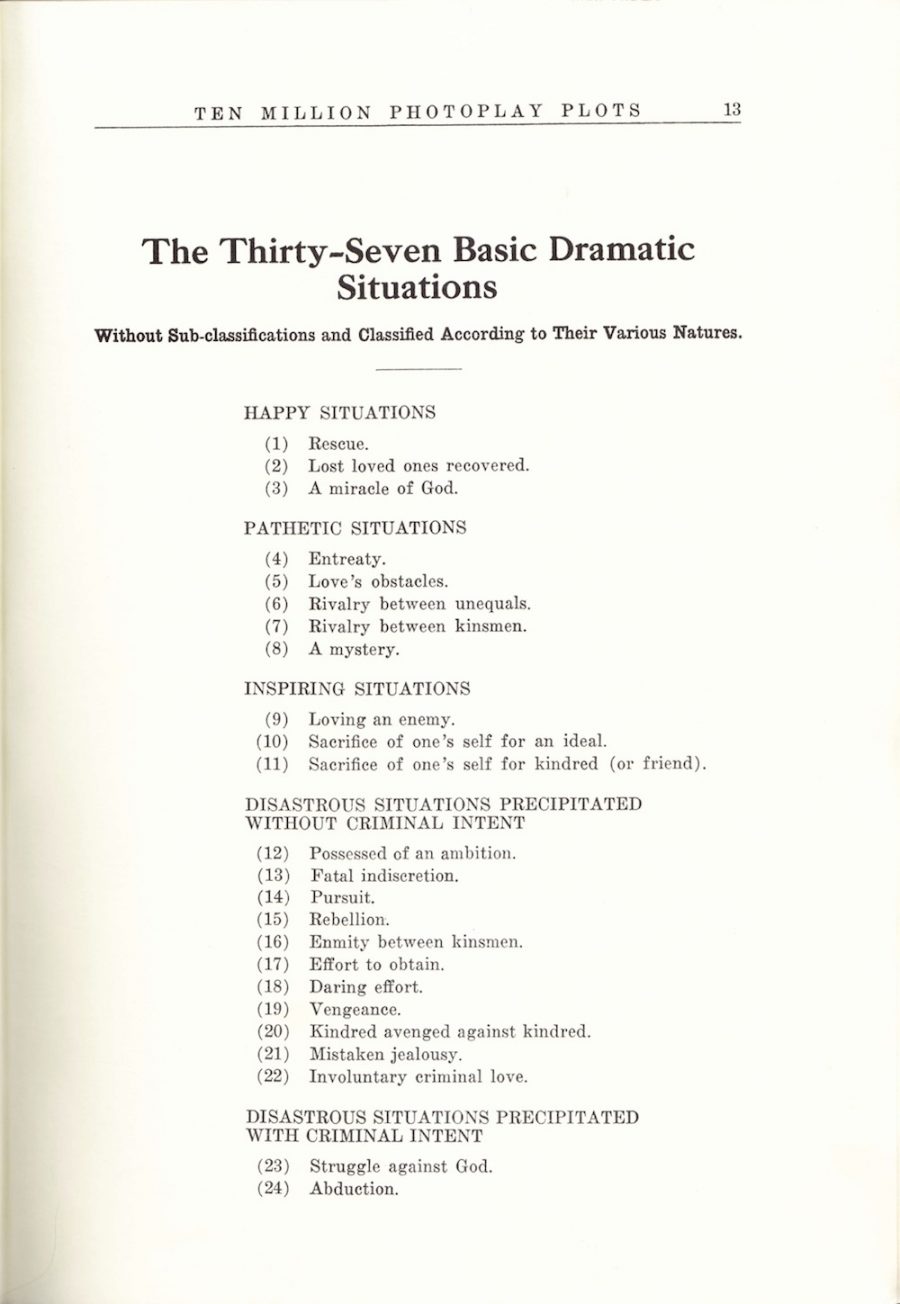
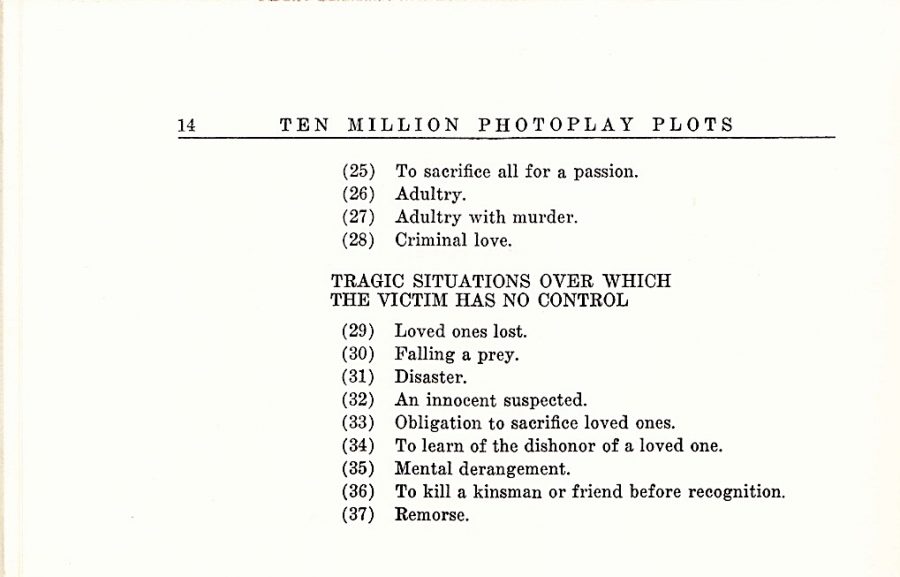
There Are Only 37 Possible Stories, According to This 1919 Manual for Screenwriters

“Great lit­er­a­ture is one of two sto­ries,” we often quote Leo Tol­stoy as say­ing: “a man goes on a jour­ney or a stranger comes to town.” That’s all well and good for the author of War and Peace, but what about the thou­sands of screen­writ­ers strug­gling to come up with the next hit movie, the next hit tele­vi­sion series, the next hit plat­form-spe­cif­ic web and/or mobile series? Some, of course, have found in that apho­rism a fruit­ful start­ing point, but oth­ers opt for dif­fer­ent premis­es that num­ber the basic plots at three (William Fos­ter-Har­ris), six (researchers at the Uni­ver­si­ty of Vermont’s Com­pu­ta­tion­al Sto­ry Lab), twen­ty (Ronald Tobias), 36 (George Polti) — or, as some strug­gling screen­writ­ers of a cen­tu­ry ago read, 37.

The year was 1919. Amer­i­ca’s biggest block­busters includ­ed D.W. Grif­fith’s Bro­ken Blos­soms, Cecil B. DeMille’s Male and Female, and The Mir­a­cle Man, which made Lon Chaney into a sil­ver-screen icon. The many aspi­rants look­ing to write their way into the ever more cel­e­brat­ed and lucra­tive movie busi­ness could turn to a new­ly pub­lished man­u­al called Ten Mil­lion Pho­to­play Plots by Wycliff Aber Hill. “Hill, who pub­lished more than one aid to strug­gling ‘sce­nar­ists,’ posi­tioned him­self as an author­i­ty on the types of sto­ries that would work well onscreen,” writes Slate’s Rebec­ca Onion. In this book he pro­vides a “tax­on­o­my of pos­si­ble types of dra­mat­ic ‘sit­u­a­tions,’ first run­ning them down in out­line form, then describ­ing each more com­plete­ly and offer­ing pos­si­ble vari­a­tions.”

Hill’s 37 basic dra­mat­ic sit­u­a­tions include such “hap­py sit­u­a­tions” as “res­cue,” “loved ones lost and recov­ered,” and “a mir­a­cle of God”; such “pathet­ic sit­u­a­tions” as “love’s obsta­cles,” “rival­ry between unequals,” and “a mys­tery”; and such “dis­as­trous sit­u­a­tions pre­cip­i­tat­ed with­out crim­i­nal intent” as “pos­sessed of an ambi­tion,” “enmi­ty between kins­men,” and “vengeance.” (Nat­u­ral­ly, Hill also includes a sep­a­rate cat­e­go­ry involv­ing crim­i­nal intent.) These dra­mat­ic con­cepts then break down into more spe­cif­ic sce­nar­ios like “res­cue by strangers who are grate­ful for favors giv­en them by the unfor­tu­nate one,” “an appeal for refuge by the ship­wrecked,” “the sac­ri­fice of hap­pi­ness for the sake of a loved one where the sac­ri­fice is caused by unjust laws,” and “con­ge­nial rela­tions between hus­band and wife made impos­si­ble by the par­ents-in-law.”

Already more than a few films new and old come to mind whose sto­ries pro­ceed from such dra­mat­ic con­cepts. Indeed, one could think of exam­ples from not just cin­e­ma but lit­er­a­ture, tele­vi­sion, the­ater, comics, and oth­er forms of nar­ra­tive art besides. Sit­u­a­tions we all know from real life may also fol­low sim­i­lar con­tours, which plays no small part in giv­ing them their impact when prop­er­ly trans­lat­ed to the screen. Clear­ly aim­ing for time­less­ness, Hill enu­mer­ates plots that could have been employed in sto­ries cen­turies before his time, and will con­tin­ue to be long after ours. But what, exact­ly, is the rela­tion­ship between plot and sto­ry? We now quote E.M. Forster on the mat­ter, specif­i­cal­ly a line from his Aspects of the Nov­el — a book for which Ten Mil­lion Pho­to­play Plots’ first read­ers would have to wait eight more years.

Relat­ed Con­tent:

Kurt Von­negut Dia­grams the Shape of All Sto­ries in a Master’s The­sis Reject­ed by U. Chica­go

Decod­ing the Screen­plays of The Shin­ing, Moon­rise King­dom & The Dark Knight: Watch Lessons from the Screen­play

10 Tips on How to Write a Great Screen­play from Bil­ly Wilder: Pearls of Wis­dom from the Direc­tor of Sun­set Boule­vard, Some Like It Hot, Dou­ble Indem­ni­ty & More

Ray­mond Chan­dler: There’s No Art of the Screen­play in Hol­ly­wood

Aaron Sorkin, Cre­ator of The West Wing & The Social Net­work, Teach­es Screen­writ­ing in an Online Class

Based in Seoul, Col­in Mar­shall writes and broad­casts on cities, lan­guage, and cul­ture. His projects include the book The State­less City: a Walk through 21st-Cen­tu­ry Los Ange­les and the video series The City in Cin­e­ma. Fol­low him on Twit­ter at @colinmarshall, on Face­book, or on Insta­gram.

Winston Churchill Praises the Virtue of “Brevity” in Memos to His Staff: Concise Writing Leads to Clearer Thinking

George Orwell and Win­ston Churchill didn’t agree on much. For exam­ple, while Orwell wrote with deep sym­pa­thy about coal min­ers in The Road to Wigan Pier, Churchill, as home sec­re­tary, bru­tal­ly crushed a miner’s strike in Wales. Orwell’s ear­ly years as “an appa­ratchik in the last days of the empire… left him with a hatred of author­i­ty and impe­ri­al­ism,” writes Richard Eil­ers. Churchill was a com­mit­ted impe­ri­al­ist all his life, instru­men­tal in pro­long­ing a famine in British India that killed “at least three mil­lion peo­ple.”

Impor­tant­ly for history’s sake, they agreed on the need to con­front, rather than appease, the Nazis, against both the British left and right of the 1930s. “At a time not unlike today,” says jour­nal­ist Tom Ricks, “when peo­ple were won­der­ing whether democ­ra­cy was sus­tain­able, when a lot of peo­ple thought you need­ed author­i­tar­i­an rule, either from the right or the left, Orwell and Churchill, from their very dif­fer­ent per­spec­tives, come togeth­er on a key point. We don’t have to have author­i­tar­i­an gov­ern­ment.”

Maybe some­what less important—but stren­u­ous­ly agreed upon nonethe­less by these two figures—was the need for clear, con­cise prose that avoids obfus­ca­tion. In Pol­i­tics and the Eng­lish Lan­guage—an essay rou­tine­ly taught in col­lege com­po­si­tion classes—Orwell describes polit­i­cal­ly mis­lead­ing writ­ing as over­stuffed with “pre­ten­tious dic­tion” and “mean­ing­less words.” These are, he writes, signs of a “deca­dent… civ­i­liza­tion.” Churchill has had at least as much influ­ence as Orwell on a cer­tain kind of polit­i­cal writ­ing, though not the kind most of us read often.

In 1940, Churchill issued a memo to his staff titled “Brevi­ty.” He did not express con­cerns about creep­ing fas­cism in bureau­crat­ic com­mu­niques, but decried the prob­lem of wast­ed time, “while ener­gy has to be spent in look­ing for the essen­tial points.” He ends up, how­ev­er, say­ing some of the same things as Orwell, in few­er words.

I ask my col­leagues and their staffs to see to it that their Reports are short­er.

  1. The aim should be Reports which set out the main points in a series of short, crisp para­graphs.
  2. If a Report relies on detailed analy­sis of some com­pli­cat­ed fac­tors, or on sta­tis­tics, these should be set out in an Appen­dix.
  3. Often the occa­sion is best met by sub­mit­ting not a full-dress Report, but an Aide-mem­oire con­sist­ing of head­ings only, which can be expand­ed oral­ly if need­ed.
  4. Let us have an end of such phras­es as these: “It is also of impor­tance to bear in mind the fol­low­ing con­sid­er­a­tions…,” or “Con­sid­er­a­tion should be giv­en to the pos­si­bil­i­ty of car­ry­ing into effect….” Most of these wool­ly phras­es are mere padding, which can be left out alto­geth­er, or replaced by a sin­gle word. Let us not shrink from using the short expres­sive phrase, even if it is con­ver­sa­tion­al.

Reports drawn up on the lines I pro­pose may at first seem rough as com­pared with the flat sur­face of offi­cialese jar­gon. But the sav­ing in time will be great, while the dis­ci­pline of set­ting out the real points con­cise­ly will prove an aid to clear­er think­ing.

The mes­sage “cas­cad­ed through the civ­il ser­vice,” writes Lau­ra Cowdry at the UK Nation­al Archives. A 1940 arti­cle in the Times picked up the sto­ry. But the prob­lem per­sist­ed, as it does today and maybe will till the end of time (or until machines start to do all our writ­ing for us). Frus­trat­ed, Churchill issued anoth­er admo­ni­tion, short­er even than the first, in 1951.

Offi­cial papers are too long and too dif­fuse. In 1940 I called for brevi­ty. Evi­dent­ly I must do so again. I ask my col­leagues to read what I wrote then… and to make my wish­es known to their staffs.

These mem­os, Cowdry notes, “may shed some light onto gov­ern­ment com­mu­ni­ca­tions work of the past,” and on the Churchillian style that may have tak­en hold for decades in gov­ern­ment doc­u­ments, as well as—of course—far beyond them. His emphat­ic state­ments also artic­u­late “key ele­ments of good com­mu­ni­ca­tion that would res­onate with the think­ing of any mod­ern com­mu­ni­ca­tor,” whether Orwell, Kurt Von­negut, or Cor­mac McCarthy, who has become a sought-after sci­en­tif­ic edi­tor for his strict min­i­mal­ism.

Churchill did not seem over­ly con­cerned with wordi­ness as a polit­i­cal prob­lem. Orwell did not approach the prob­lem philo­soph­i­cal­ly. That task fell to the Log­i­cal Pos­i­tivists of the ear­ly 20th cen­tu­ry. In his attempt to explain the wordi­ness of both under­grad­u­ates and world-renowned thinkers, “neo-Pos­i­tivist” philoso­pher David Stove goes so far as to ascribe over­writ­ing to “defects of char­ac­ter… such things as an inabil­i­ty to shut up; deter­mi­na­tion to be thought deep; hunger for pow­er; fear, espe­cial­ly the fear of an indif­fer­ent uni­verse….”

Some­thing to con­sid­er, maybe, when you’re look­ing at your next draft email, Face­book com­ment, or Slack mes­sage, and won­der­ing whether it actu­al­ly needs to be an essay….

via Bob Rae

Relat­ed Com­ment:

George Orwell’s Six Rules for Writ­ing Clear and Tight Prose

Nov­el­ist Cor­mac McCarthy Gives Writ­ing Advice to Sci­en­tists … and Any­one Who Wants to Write Clear, Com­pelling Prose

Kurt Von­negut Explains “How to Write With Style”

Josh Jones is a writer and musi­cian based in Durham, NC. Fol­low him at @jdmagness

Roald Dahl Gives a Tour of the Small Backyard Hut Where He Wrote All of His Beloved Children’s Books

Char­lie and the Choco­late Fac­to­ryThe BFGThe Witch­esMatil­da: Roald Dahl wrote these and all his oth­er beloved chil­dren’s books in a hut. Just fif­teen feet long and ten feet wide, it served him for 35 years as an office in which no meet­ings were held and no calls tak­en. For four hours a day, bro­ken into two-hour morn­ing and after­noon ses­sions, it was just Dahl in there — Dahl and his paper, his pen­cils, his sharp­en­er, his cof­fee, his cig­a­rettes, his increas­ing­ly eccen­tric col­lec­tion of arti­facts from his own life, and here and there the occa­sion­al spi­der web and goat drop­ping. It was all part of an effort, explains Dahl’s biog­ra­ph­er Jere­my Tre­glown, “not only to recre­ate his own ear­ly child­hood but to improve on it.”

“As a boy in the 1920s,” Tre­glown writes, “Roald used to hide up in a tree in order to write his diary.” But the hut, con­struct­ed right behind his Buck­ing­hamshire home, “was a more sub­stan­tial place to work, where he could com­mem­o­rate, and fan­ta­size about, his past.”

On his side were items like “his father’s sil­ver and tor­toise­shell paper knife,” a “tablet frag­ment with a cuneiform inscrip­tion found in Baby­lon” — a sou­venir from his time in the King’s African Rifles — and, “saved from oper­a­tions,” pieces of his own femur and spine. In his hut, Dahl wrote “sur­round­ed by these fetish­es, snug­ly wrapped in a sleep­ing bag, sit­ting in an old arm­chair, his feet on a trunk which was filled with blocks and tied to a leg of the chair, to pre­vent it from slip­ping.”

“I could­n’t pos­si­bly work in the house, espe­cial­ly when there used to be a lot of chil­dren around,” says Dahl in the 1982 clip at the top of the post as he approach­es his hut. “Even when there aren’t chil­dren, there are vac­u­um clean­ers and peo­ple bustling about.” He then goes in to demon­strate his writ­ing rou­tine, which involves the pour­ing of cof­fee, sharp­en­ing of pre­cise­ly six pen­cils “to a fierce point” (a step that had its own pro­cras­ti­na­tion val­ue), the brush­ing away of the pre­vi­ous day’s eras­er dust (onto the floor, where it has remained ever since), and the sit­u­a­tion with the arm­chair and sleep­ing bag. “Final­ly you get set­tled, you get into a sort of nest, you get real­ly com­fort­able,” Dahl says. “And then you’re away.”

The footage also includes views of Dahl’s much more tra­di­tion­al­ly well-appoint­ed main house, includ­ing its bil­liards table around which he and his local friends would gath­er for a twice-week­ly ses­sion. The game had its influ­ence on Dahl’s writ­ing life, and indeed his writ­ing hut. Among his “snook­er pals” was builder Wal­ly Saun­ders, whom Dahl hired to put it up in the first place (and whose for­mi­da­ble stature and ear size would, near­ly thir­ty lat­er, inspire the title char­ac­ter of The BFG). As he explains on the British Chil­dren’s pro­gram Going Live, he even cov­ered his hand­made wood­en writ­ing sur­faces, which he placed across the arm­rests of his chair, with green baize, a mate­r­i­al he found easy on the eyes.

When Dahl died in 1990, his writ­ing hut went untouched for two decades. But even­tu­al­ly, as explained in this ITV News clip, the sim­ple build­ing could­n’t with­stand fur­ther expo­sure to the ele­ments. So began the project to move the inte­ri­or of the hut, eras­er dust and all, to the Roald Dahl Muse­um and Sto­ry Cen­tre in Buck­ing­hamshire. Luck­i­ly for Wes Ander­son, this hap­pened after he came to Dahl’s home to seek per­mis­sion to adapt The Fan­tas­tic Mr. Fox from the writer’s wid­ow Felic­i­ty. So com­pelling did she find Ander­son­’s vision that she even allowed him into the “hal­lowed writ­ing hut,” the ide­al space in which to com­mune with Dahl’s spir­it. The hut may now no longer be whole, but that same spir­it con­tin­ues to course through the imag­i­na­tions of gen­er­a­tion after gen­er­a­tion of young read­ers.

Relat­ed Con­tent:

Read a Nev­er Pub­lished, “Sub­ver­sive” Chap­ter from Roald Dahl’s Char­lie and the Choco­late Fac­to­ry

When Roald Dahl Host­ed His Own Creepy TV Show Way Out, a Com­pan­ion to Rod Serling’s Twi­light Zone (1961)

The Recipes of Icon­ic Authors: Jane Austen, Sylvia Plath, Roald Dahl, the Mar­quis de Sade & More

Roald Dahl, Who Lost His Daugh­ter to Measles, Writes a Heart­break­ing Let­ter about Vac­ci­na­tions: “It Is Almost a Crime to Allow Your Child to Go Unim­mu­nised”

The Dai­ly Habits of Famous Writ­ers: Franz Kaf­ka, Haru­ki Muraka­mi, Stephen King & More

Based in Seoul, Col­in Mar­shall writes and broad­casts on cities, lan­guage, and cul­ture. His projects include the book The State­less City: a Walk through 21st-Cen­tu­ry Los Ange­les and the video series The City in Cin­e­ma. Fol­low him on Twit­ter at @colinmarshall, on Face­book, or on Insta­gram.

Behold Octavia Butler’s Motivational Notes to Self

Hand­writ­ten notes on the inside cov­er of one of Octavia E. Butler’s com­mon­place books, 1988

I was attract­ed to sci­ence fic­tion because it was so wide open. I was able to do any­thing and there were no walls to hem you in and there was no human con­di­tion that you were stopped from exam­in­ing. —Octavia E. But­ler

Like many authors, the late Octavia E. But­ler took up writ­ing at a young age.

At 11, she was churn­ing out tales about hors­es and romance.

At 12, she saw Dev­il Girl from Mars, and fig­ured (cor­rect­ly) she could tell a bet­ter sto­ry than that, using 2 fin­gers to peck out sto­ries on the Rem­ing­ton type­writer her moth­er bought at her request.

At 13, she found a copy of The Writer mag­a­zine aban­doned on a bus seat, and learned that it was pos­si­ble to sub­mit her work for pub­li­ca­tion.

After a decade’s worth of rejec­tion slips, she sold her first two sto­ries, thanks in part to her asso­ci­a­tion with the Clar­i­on Sci­ence Fic­tion Writ­ing Work­shop, which she became involved with on the rec­om­men­da­tion of her men­tor, sci­ence fic­tion writer Har­lan Elli­son.

She went on to become the first sci­ence fic­tion writer to receive a pres­ti­gious MacArthur “genius” award, gar­ner­ing mul­ti­ple Hugo and Neb­u­la awards for her work.

An aster­oid is named after her, as is a moun­tain on Pluto’s moon.

Hailed as the Moth­er of Afro Futur­ism, she won the PEN Amer­i­can Cen­ter life­time achieve­ment award in writ­ing.

But pro­fes­sion­al suc­cess nev­er cloud­ed her view of her­self as the 10-year-old writer who was unsure if library-lov­ing black kids like her would be allowed inside a book­store.

Iden­ti­fy­ing as a writer helped her move beyond her crip­pling shy­ness and dyslex­ia. As she wrote in an auto­bi­o­graph­i­cal essay, “Pos­i­tive Obses­sion”:

I believed I was ugly and stu­pid, clum­sy, and social­ly hope­less. I also thought that every­one would notice these faults if I drew atten­tion to myself. I want­ed to dis­ap­pear. Instead, I grew to be six feet tall. Boys in par­tic­u­lar seemed to assume that I had done this grow­ing delib­er­ate­ly and that I should be ridiculed for it as often as pos­si­ble.

I hid out in a big pink notebook—one that would hold a whole ream of paper. I made myself a uni­verse in it. There I could be a mag­ic horse, a Mar­t­ian, a telepath….There I could be any­where but here, any time but now, with any peo­ple but these.

She devel­oped a life­long habit of cheer­ing her­self on with moti­va­tion­al notes, writ­ing them in her jour­nals, on lined note­book paper, in day plan­ners and on repur­posed pages of an old wall cal­en­dar.

She held her­self account­able by writ­ing out demand­ing sched­ules to accom­pa­ny her lofty, doc­u­ment­ed goals.

And though she wea­ried of the con­stant invi­ta­tions to serve on lit­er­ary pan­els devot­ed to sci­ence fic­tion writ­ers of col­or, at which she’d be asked the same ques­tions she’d answered dozens of times before, she was res­olute about pro­vid­ing oppor­tu­ni­ties for young black writ­ers … and read­ers, who found reflec­tions of them­selves in her char­ac­ters. As she remarked in an inter­view with The New York Times

When I began writ­ing sci­ence fic­tion, when I began read­ing, heck, I wasn’t in any of this stuff I read. The only black peo­ple you found were occa­sion­al char­ac­ters or char­ac­ters who were so fee­ble-wit­ted that they couldn’t man­age any­thing, any­way. I wrote myself in, since I’m me and I’m here and I’m writ­ing.

Her brand of sci­ence fic­tiona label she often tried to duck, iden­ti­fy­ing her­self on her busi­ness card sim­ply as “writer”serves as a lens for con­sid­er­ing con­tem­po­rary issues: sex­u­al vio­lence, gun vio­lence, cli­mate change, gen­der stereo­types, the prob­lems of late-stage cap­i­tal­ism, the plight of undoc­u­ment­ed immi­grants, and, not least, racism.

She side­stepped utopi­an sci­ence fic­tion, believ­ing that imper­fect humans are inca­pable of  form­ing a per­fect soci­ety. “Nobody is per­fect,” she told Vibe:

One of the things I’ve dis­cov­ered even with teach­ers using my books is that peo­ple tend to look for ‘good guys’ and ‘bad guys,’ which always annoys the hell out of me. I’d be bored to death writ­ing that way. But because that’s the only pat­tern they have, they try to fit my work into it.

Learn more about the life and work of Octavia E. But­ler (1947–2006) here.

I shall be a best­selling writer. After Ima­go, each of my books will be on the best­seller lists of LAT, NYT, PW, WP, etc. My nov­els will go onto the above lists whether pub­lish­ers push them hard or not, whether I’m paid a high advance or not, whether I ever win anoth­er award or not.

This is my life. I write best­selling nov­els. My nov­els go onto the best­seller lists on or short­ly after pub­li­ca­tion. My nov­els each trav­el up to the top of the best­seller lists and they reach the top and they stay on top for months . Each of my nov­els does this.

So be it! I will find the way to do this. See to it! So be it! See to it!

My books will be read by mil­lions of peo­ple!

I will buy a beau­ti­ful home in an excel­lent neigh­bor­hood

I will send poor black young­sters to Clar­i­on or oth­er writer’s work­shops

I will help poor black young­sters broad­en their hori­zons

I will help poor black young­sters go to col­lege

I will get the best of health care for my moth­er and myself

I will hire a car when­ev­er I want or need to.

I will trav­el when­ev­er and wher­ev­er in the world that I choose

My books will be read by mil­lions of peo­ple!

So be it! See to it!

via Austin Kleon

Relat­ed Con­tent: 

Why Should We Read Pio­neer­ing Sci-Fi Writer Octavia But­ler? An Ani­mat­ed Video Makes the Case

Octavia Butler’s 1998 Dystopi­an Nov­el Fea­tures a Fascis­tic Pres­i­den­tial Can­di­date Who Promis­es to “Make Amer­i­ca Great Again”

Watch a 5‑Part Ani­mat­ed Primer on Afro­fu­tur­ism, the Black Sci-Fi Phe­nom­e­non Inspired by Sun Ra

Ayun Hal­l­i­day is an author, illus­tra­tor, the­ater mak­er and Chief Pri­ma­tol­o­gist of the East Vil­lage Inky zine. Fol­low her @AyunHalliday.


Martin Amis Explains His Method for Writing Great Sentences

Why does Mar­tin Amis writes sen­tences well? As a nov­el­ist, he nat­u­ral­ly has a high degree of pro­fes­sion­al inter­est in the mat­ter. But why does he write sen­tences so well? One might put forth the influ­ence of his father Kings­ley Amis, author of Lucky Jim, an endur­ing con­tender for the title of the fun­ni­est nov­el in the Eng­lish lan­guage. But giv­en how sel­dom one acclaimed nov­el­ist sires anoth­er — an event, in fact, near­ly unheard of — the her­i­tabil­i­ty of lit­er­ary tal­ent remains unknow­able. As for the direct influ­ence of Amis père on Amis fils, we can almost entire­ly rule it out: not only did Kings­ley nev­er encour­age Mar­tin to fol­low in his foot­steps, only once did he offer any kind of writer­ly advice.

“We sat in high-bour­geois splen­dor, my father and I,” writes the younger Amis in his mem­oir Expe­ri­ence, “hav­ing a pre-lunch drink and talk­ing about his first pub­lished sto­ry, ‘The Sacred Rhi­no of Ugan­da’ (1932: he was ten).” The father-son dia­logue runs as fol­lows:

— It was awful in all the usu­al ways. And full of false quan­ti­ties. Things like: ‘Rag­ing and curs­ing in the blaz­ing heat …’

— What’s wrong with that? I mean I can see it’s old fash­ioned …

— You can’t have three ings like that.

— Can’t you?

— No. It would have to be: ‘Rag­ing and curs­ing in the … intol­er­a­ble heat.’

You couldn’t have three ings like that. And some­times you couldn’t even have two. The same went for -ics, -ives, -lys and -tions. And the same went for all pre­fix­es too.

43 years lat­er, Mar­tin Amis would find him­self in the role of lit­er­ary advice-giv­er, deliv­er­ing his father’s prin­ci­ple of writ­ing onstage at the Chica­go Human­i­ties Fes­ti­val. The process of imbu­ing every sen­tence with “min­i­mum ele­gance and eupho­ny,” he says in the clip above (drawn from a longer inter­view view­able here) involves “say­ing the sen­tence, sub­vo­cal­iz­ing it in your head until there’s noth­ing wrong with it. This means not repeat­ing in the same sen­tence suf­fix­es and pre­fix. If you’ve got a con­found, you can’t have a con­form. If you’ve got invi­ta­tion, you can’t have exe­cu­tion. You can’t repeat those, or an -ing, or a -ness: all that has to be one per sen­tence. I think the prose will give a sort of plea­sure with­out you being able to tell why.”

Clear­ly writ­ing a sen­tence that has “noth­ing wrong with it” goes well beyond adher­ing to the rules of spelling and gram­mar. And even after you’ve elim­i­nat­ed all ungain­ly rep­e­ti­tion, you may still have con­sid­er­able work to do before the sen­tence ris­es to a stan­dard worth uphold­ing. There are oth­er ques­tions to ask: do you, for exam­ple, tru­ly pos­sess each and every one of the words you’ve used, not just in mean­ing but sound and rhythm? In order to do so, Amis rec­om­mends acquaint­ing your­self more inti­mate­ly with the dic­tio­nary and the­saurus. If all this makes the task of the aspir­ing writer sound need­less­ly daunt­ing, fol­low instead the much sim­pler advice Amis pro­vides in the clip just above: “Get to the end of the nov­el, then wor­ry, because you’ve got some­thing in front of you that you can work on. Save the anx­i­ety for the end.”

Relat­ed Con­tent:

Mar­tin Amis Explains How to Use a The­saurus to Actu­al­ly Improve Your Writ­ing

Nor­man Mail­er & Mar­tin Amis, No Strangers to Con­tro­ver­sy, Talk in 1991

Writ­ing Tips by Hen­ry Miller, Elmore Leonard, Mar­garet Atwood, Neil Gaiman & George Orwell

V.S. Naipaul Cre­ates a List of 7 Rules for Begin­ning Writ­ers

Nietzsche’s 10 Rules for Writ­ing with Style (1882)

5 Won­der­ful­ly Long Lit­er­ary Sen­tences by Samuel Beck­ett, Vir­ginia Woolf, F. Scott Fitzger­ald & Oth­er Mas­ters of the Run-On

Based in Seoul, Col­in Mar­shall writes and broad­casts on cities, lan­guage, and cul­ture. His projects include the book The State­less City: a Walk through 21st-Cen­tu­ry Los Ange­les and the video series The City in Cin­e­ma. Fol­low him on Twit­ter at @colinmarshall, on Face­book, or on Insta­gram.

Write Only 500 Words Per Day and Publish 50+ Books: Graham Greene’s Writing Method

Image via Wiki­me­dia Com­mons

Nobody can write a book. That is, nobody can write a book at a stroke — unless aid­ed by aggres­sive­ly mind-invig­o­rat­ing sub­stances, and even then they sel­dom pull it off. As pro­fes­sion­al writ­ers know all too well, com­pos­ing just one pass­able chap­ter at a sit­ting demands a Stakhanovite for­ti­tude (or more com­mon­ly, a threat­en­ing­ly close dead­line). Books are writ­ten less one chap­ter at a time than one sec­tion at a time, less one sec­tion at a time than one para­graph at a time, less one para­graph at a time than one sen­tence at a time, and less one sen­tence at a time than one word at a time. Gra­ham Greene wrote his for­mi­da­ble body of work, more than 50 books, includ­ing nov­els, poet­ry and short fic­tion col­lec­tions, mem­oirs, and chil­dren’s sto­ries, 500 words at a time.

In one of his most beloved nov­els, 1951’s The End of the Affair, Greene has his writer pro­tag­o­nist Mau­rice Ben­drix describe a work­ing method much like his own:

Over twen­ty years I have prob­a­bly aver­aged five hun­dred words a day for five days a week. I can pro­duce a nov­el in a year, and that allows time for revi­sion and the cor­rec­tion of the type­script. I have always been very method­i­cal, and when my quo­ta of work is done I break off, even in the mid­dle of a scene. Every now and then dur­ing the morning’s work I count what I have done and mark off the hun­dreds on my man­u­script. No print­er need make a care­ful cast-off of my work, for there on the front page is marked the fig­ure — 83,764.

In his youth, Ben­drix notes, “not even a love affair would alter my sched­ule,” nor could one inter­rupt the night­ly phase of his process: “How­ev­er late I might be in get­ting to bed — as long as I slept in my own bed — I would read the morning’s work over and sleep on it.”

Much of a nov­el­ist’s writ­ing, he believes, “takes place in the uncon­scious; in those depths the last word is writ­ten before the first word appears on paper. We remem­ber the details of our sto­ry, we do not invent them.” Greene, too, set enough store by the uncon­scious to keep a dream jour­nal. A few year after The End of the Affair, writesThe New York­er’s Maria Kon­niko­va, “he faced a cre­ative ‘block­age,’ as he called it, that pre­vent­ed him from see­ing the devel­op­ment of a sto­ry or even, at times, its start. The dream jour­nal proved to be his sav­ior.”

All of us who write, what­ev­er we write, can learn from Greene’s meth­ods; Michael Kor­da got to wit­ness them first-hand. In the sum­mer of 1950 he was invit­ed by his uncle, the film pro­duc­er Alexan­der Kor­da, to come along on a French-Riv­iera cruise with a vari­ety of major indus­try fig­ures, Greene includ­ed. By that point Greene had already writ­ten a fair few screen­plays, includ­ing adap­ta­tions of his own nov­els Brighton Rock and The Third Man. But each morn­ing on the yacht he worked on a more per­son­al project, as the six­teen-year-old Kor­da watched:

An ear­ly ris­er, he appeared on deck at first light, found a seat in the shade of an awning, and took from his pock­et a small black leather note­book and a black foun­tain pen, the top of which he unscrewed care­ful­ly. Slow­ly, word by word, with­out cross­ing out any­thing, and in neat, square hand­writ­ing, the let­ters so tiny and cramped that it looked as if he were attempt­ing to write the Lord’s Prayer on the head of a pin, Gra­ham wrote, over the next hour or so, exact­ly five hun­dred words. He count­ed each word accord­ing to some arcane sys­tem of his own, and then screwed the cap back onto his pen, stood up and stretched, and, turn­ing to me, said, “That’s it, then. Shall we have break­fast?” I did not, of course, know that he was com­plet­ing The End of the Affair.

This work­ing rit­u­al, a Kor­da describes it, suits the sen­si­bil­i­ties of the writer, a con­vert to Catholi­cism who dealt with themes of reli­gious prac­tice in his work:

Greene’s self-dis­ci­pline was such that, no mat­ter what, he always stopped at five hun­dred words, even if it left him in the mid­dle of a sen­tence. It was as if he brought to writ­ing the pre­ci­sion of a watch­mak­er, or per­haps it was that in a life full of moral uncer­tain­ties and con­fu­sion he sim­ply need­ed one area in which the rules, even if self-imposed, were absolute. What­ev­er else was going on, his dai­ly writ­ing, like a reli­gious devo­tion, was sacred and com­plete. Once the dai­ly penance of five hun­dred words was achieved, he put the note­book away and did­n’t think about it again until the next morn­ing.

Just as Greene’s adher­ence to Catholi­cism lost some of its rig­or in his lat­er years (he claimed to have been con­vert­ed by argu­ments, then for­got­ten the argu­ments), his dai­ly word count decreased. “In the old days, at the begin­ning of a book, I’d set myself 500 words a day, but now I’d put the mark to about 300 words,” a 66-year-old Greene told the New York Times in 1971. But such are the wages of the nov­el­ist’s art, in which Greene felt a demand to “know — even if I’m not writ­ing it — where my char­ac­ter’s sit­ting, what his move­ments are. It’s this focus­ing, even though it’s not focus­ing on the page, that strains my eyes, as though I were watch­ing some­thing too close.”

Greene was­n’t alone in writ­ing a cer­tain num­ber of words each day. Accord­ing to a post at Word Counter, Ernest Hem­ing­way got start­ed on his own 500 dai­ly words at first light. Ian McE­wan says he aims “for about six hun­dred words a day and hope for at least a thou­sand when I’m on a roll.” For the more pro­lif­ic J.G. Bal­lard, a thou­sand was the min­i­mum, “even if I’ve got a hang­over. You’ve got to dis­ci­pline your­self if you’re pro­fes­sion­al. There’s no oth­er way.” The near-inhu­man­ly pro­lif­ic Stephen King dou­bles that: “I like to get ten pages a day, which amounts to 2,000 words,” he says in his mem­oir On Writ­ing. “On some days those ten pages come eas­i­ly; I’m up and out and doing errands by eleven-thir­ty in the morn­ing, perky as a rat in liv­er­wurst. More fre­quent­ly, as I grow old­er, I find myself eat­ing lunch at my desk and fin­ish­ing the day’s work around one-thir­ty in the after­noon.”

John Updike, no slouch when it came to pro­duc­tiv­i­ty, rec­om­mend­ed writ­ing for a length of time rather than to a num­ber of words. “Even though you have a busy life, try to reserve an hour, say — or more — a day to write,” he says in an inter­view clip pre­vi­ous­ly fea­tured here on Open Cul­ture. “Some very good things have been writ­ten on an hour a day.” At The Guardian, nov­el­ist Neil Grif­fiths dis­cuss­es his apos­ta­sy from the thou­sand-words-a-day method: “I’m writ­ing a nov­el — an artis­tic enter­prise, one hopes — but I was mea­sur­ing my work­ing day by a num­ber.” Switch­ing to the “fin­ish the bit you’re work­ing on” method, he writes, means he does­n’t have “half an eye on what is going to hap­pen in the next bit because with­out it I’ll nev­er make the day’s 1000. My sole con­cern is the words before me, how­ev­er many or few they are, and get­ting them right before mov­ing on.” And so, it seems, those of us try­ing to get our life’s work writ­ten have two options: do what Gra­ham Greene did, or do the oppo­site.

Relat­ed Con­tent:

John Updike’s Advice to Young Writ­ers: ‘Reserve an Hour a Day’

David Sedaris Breaks Down His Writ­ing Process: Keep a Diary, Car­ry a Note­book, Read Out Loud, Aban­don Hope

Ursu­la K. Le Guin’s Dai­ly Rou­tine: The Dis­ci­pline That Fueled Her Imag­i­na­tion

The Dai­ly Rou­tines of Famous Cre­ative Peo­ple, Pre­sent­ed in an Inter­ac­tive Info­graph­ic

Stephen King’s 20 Rules for Writ­ers

The Sev­en Road-Test­ed Habits of Effec­tive Artists

Based in Seoul, Col­in Mar­shall writes and broad­casts on cities, lan­guage, and cul­ture. His projects include the book The State­less City: a Walk through 21st-Cen­tu­ry Los Ange­les and the video series The City in Cin­e­ma. Fol­low him on Twit­ter at @colinmarshall, on Face­book, or on Insta­gram.

« Go BackMore in this category... »
Quantcast