Once again, we’re heading back to 1971. Yesterday we had Dick Cavett’s 1971 interview with George Harrison. Today, it’s the clash of two intellectual titans, Noam Chomsky and Michel Foucault. In ’71, at the height of the Vietnam War, the American linguist and French historian/social theorist appeared on Dutch TV to debate a fundamental question: Is there such a thing as innate human nature? Or are we shaped by experiences and the power of cultural and social institutions around us?
40 years later, you can find the classic debate on YouTube. If you need subtitles, make sure you turn on the captions function at the bottom of the video.
All we can say is bless Don Pettit. While working on the International Space Station in 2008, the NASA astronaut shot videos that are literally and figuratively out of this world: The Aurora Borealis Viewed from Orbit and What It Feels Like to Fly Over Planet Earth. And then we discover that Pettit invented a “zero‑g coffee cup” that lets you drink coffee in outer space without using a straw. That’s one small step for man; one giant leap for mankind.…
With a series of three films, director Kirby Ferguson has been gradually making the case that “Everything is a Remix.” In doing what they do, artists collect material, combine and transform it, and eventually mold it into something unique, though not entirely new. Ferguson has traced this idea through literature and music, filmmaking, and technology/computing. And while we wait for the fourth and final installment in the series, we get a little treat to tide us over — a six minute look at the cinematic origins of the 1999 sci-fi action film, The Matrix. Made by Robert Wilson and with the help of some crowdsourcing, this fun video identifies 24 films that influenced The Matrix. They’re are all listed below the jump. Consider watching the clip in a wider format here.
Yesterday was the 42nd anniversary of the first broadcast of Monty Python’s Flying Circus. The original BBC show aired for only five years, but its impact on popular culture has been lasting. To celebrate, we bring you the 1982 film, Monty Python Live at the Hollywood Bowl. The image quality isn’t the best here, but the humor shines through. The movie combines live sketches, filmed in 1980, with excerpts from a two-part 1972 German television special, Monty Python’s Fliegender Zirkus. Highlights include: “The Ministry of Silly Walks,” “Nudge Nudge,” “The Lumberjack Song,” “Silly Olympics” (featuring the “100 Yards For People With No Sense Of Direction” and the “200-Meter Freestyle For Non-Swimmers”) as well as one of our favorites, “The Philosophers’ Football Match.” Monty Python Live at the Hollywood Bowl has been added to our growing collection of Free Movies Online.
We originally posted this video back in 2009, and it seems like the right time to bring it back. It captures the first of many times that Steve Jobs thrilled audiences with the promise of what technology could deliver. The video takes you back to January 1984, when Jobs demoed the first Macintosh. (The event was famously promoted by Ridley Scott’s commercial during the Super Bowl. See below) A young Jobs, sporting a bow tie and a fuller head of hair, could barely hold back his smile and some tears, and the crowd simply couldn’t contain its enthusiasm, giving Jobs a five-minute standing ovation. That’s where the video ends, fading happily and suitably to black. We’ll miss you Steve. Read the New York Times obit here.
For another great Steve Jobs moment, don’t miss his inspiring Stanford 2005 graduation talk where he discussed his approach to living and urged the young graduates to “Stay Hungry, Stay Foolish.” So far as commencement speeches go, it’s hard to beat this one.
Both video mentioned above appear in our Cultural Icons collection — a media collection that features great artists and thinkers speaking in their own words.
It’s a good time to be a fan of Haruki Murakami. Last month, his short story, “Town of Cats,” was published in The New Yorker. Later in October, his new book 1Q84 hits the stands in the US. (Watch the book trailer above.) And, right now, the British bookmaker Ladbrokes is giving Murakami 7‑to‑1 odds of winning the Nobel Prize in Literature, to be named tomorrow morning. They’re strong odds. But the Syrian poet Adonis (read three poems here) is the actual favorite right now with 4‑to‑1 odds. Stay tuned. We’ll know more soon …
After dismissing the popular notion that scientists are unable to truly appreciate beauty in nature, physicist Richard Feynman (1918 — 1988) explains what a scientist really is and does. Here are some of the most memorable lines from this beautiful mix of Feynman quotes and (mostly) BBC and NASA footage:
People say to me, Are you looking for the ultimate laws of physics? — No, I’m not. I’m just looking to find out more about the world.
When we’re going to investigate [nature], we shouldn’t predecide what it is we’re trying to do, except to find out more about it.
I can live with doubt and uncertainty and not knowing. I think it’s much more interesting to live not knowing than to have answers that might be wrong. (…) I don’t feel frightened by not knowing things, by being lost in the mysterious universe without having any purpose.
When you doubt and ask, it gets a little harder to believe.
By profession, Matthias Rascher teaches English and History at a High School in northern Bavaria, Germany. In his free time he scours the web for good links and posts the best finds on Twitter.
Just a quick reminder, Martin Scorsese’s two-part documentary on George Harrison airs tonight and tomorrow night on HBO. After making films about Bob Dylan and The Rolling Stones, the legendary filmmaker now turns somewhat unexpectedly to the silent Beatle, and you have to wonder why. Why George? So Scorsese recalls when things originally clicked, the first moment when he realized the “picture had to be made.”
We all know where books come from: a human and a muse meet, fall in love, and two months to twenty years later, a book is born. Then, as with other varieties of babies, the sleepless nights start as a writer searches for a home for the book, collecting rejections like badges of honor, testaments to determination.
Well, that was the old-fashioned way. We’ve all heard how the internet has leveled the playing field, allowing anybody to publish work and find an audience. However, this easier path to publication hasn’t necessarily solved an even older writer’s conundrum: How to pay for it.
That is, how to make enough money to sustain yourself as you write (day jobs aside). And so writers must become even wilier. Though you may make money from the sale of a book, how do you fund yourself before the book?
Seth Harwood, the author of three books, is at the front of the movement to find alternate and creative ways of not only reaching audiences, but pursuing the writing life. Since graduating from the Iowa Writers Workshop in 2002, Harwood has built up a loyal fan base—his “Palms Mamas and Palms Daddies” (named for one of his protagonists, Jack Palms)—through social media and free podcasting. Harwood is sustaining a writing life along a path that is likely to be more and more common for writers.
After offering his first novel, Jack Wakes Up, as a free audiobook, Harwood published it in paperback with Breakneck Books in 2008. The Amazon sales, pushed by Palms Mamas and Palms Daddies, landed the book in #1 in Crime/Mystery and #45 overall, bringing the attention of Random House, who re-published the book one year later.
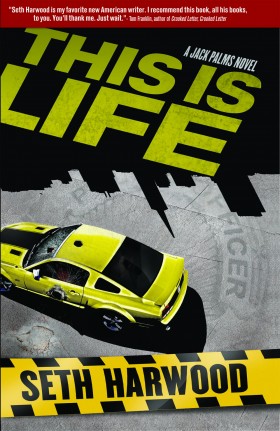
Looking outside mainstream avenues, Harwood secured funding for publication of his next venture, Young Junius, with Tyrus Books by preselling signed copies through Paypal—before the books existed in physical form. And now he is one of the early adopters of using Kickstarter to pay for the gestation and birth of not one book—but five previously-written works in the next six months–as he puts it, “raising the fixed costs of bringing these books to the marketplace.” His Kickstarter campaign based around This Is Life, the sequel to Jack Wakes Up was—impressively—fully funded within 25 hours—and with a few days still left to go, it has exceeded the original goal by over $2000.
What can a writer offer besides an autographed copy of the to-be-written book, or a mention in the acknowledgements? For Harwood’s project, the pledges range from a dollar to $999, with thank-yous spanning from the aforementioned to—at the $999 end—an original novella written according to the donor’s wishes and published as a one-off hardcover.
Indeed, now more than ever, it seems essential for authors to meet readers at least half-way. Harwood considers himself an “author-preneur,” developing new business models as he publishes his books. As he sees it, innovation comes much more easily to an author acting alone, than to a large publishing company or big corporation. He aims for the new models as he sees them developing, knowing he’s got to go out and find readers himself. As Coelho declares, “The ivory tower does not exist anymore.”
This post was contributed by Shawna Yang Ryan. Her novel Water Ghosts was a finalist for the 2010 Asian American Literary Award. In 2012, she will be the Distinguished Writer in Residence at the University of Hawai’i at Manoa.
In 1941, director Dave Fleischer and Paramount Pictures animators Steve Muffati and George Germanetti produced Superman: The Mechanical Monsters — a big-budget animated adaptation of the popular Superman comics of that period, in which a mad scientist unleashes robots to rob banks and loot museums, and Superman, naturally, saves the day. It was one of seventeen films that raised the bar for theatrical shorts and are even considered by some to have given rise to the entire Anime genre.
More than a mere treat of vintage animation, the film captures the era’s characteristic ambivalence in reconciling the need for progress with the fear of technology in a culture on the brink of incredible technological innovation. It was the dawn of the techno-paranoia that persisted through the 1970s, famously captured in the TV series Future Shock narrated by Orson Welles, and even through today. Take for example books like Nicholas Carr’s The Shallows and Sherry Turkle’s Alone Together: Why We Expect More from Technology and Less from Each Other.
Superman: The Mechanical Monsters is available for download on The Internet Archive, and Toonami Digital Arsenal has the complete series of all seventeen films. Find more vintage animation in Open Culture’s collection of Free Movies Online.
Maria Popova is the founder and editor in chief of Brain Pickings, a curated inventory of cross-disciplinary interestingness. She writes for Wired UK, The Atlantic and DesignObserver, and spends a great deal of time on Twitter.
We're hoping to rely on loyal readers, rather than erratic ads. Please click the Donate button and support Open Culture. You can use Paypal, Venmo, Patreon, even Crypto! We thank you!
Open Culture scours the web for the best educational media. We find the free courses and audio books you need, the language lessons & educational videos you want, and plenty of enlightenment in between.