The San Francisco Museum of Modern Art–otherwise simply known as SFMOMA–has 34,678 artworks in its collections, only 5% of which it can put on display at any given time. That creates an accessibility problem. So the museum asked itself: “How can we provide a more comprehensive experience of our collection?” And they developed Send Me SFMOMA in response.
Send Me SFMOMA is “an SMS service that provides an approachable, personal, and creative method of sharing the breadth of SFMOMA’s collection with the public.” Here’s how it works:
Text 572–51 with the words “send me” followed by a keyword, a color, or even an emoji and you’ll receive a related artwork image and caption via text message. For example “send me the ocean” might get you Pirkle Jones’ Breaking Wave, Golden Gate; “send me something blue” could result in Éponge (SE180) by Yves Klein; and “send me 💐” might return Yasumasa Morimura’s An Inner Dialogue with Frida Kahlo (Collar of Thorns). Each text message triggers a query to the SFMOMA collection API, which then responds with an artwork matching your request.
Give it a spin. See what piece of the SFMOMA collection you get.
If you would like to support the mission of Open Culture, consider making a donation to our site. It’s hard to rely 100% on ads, and your contributions will help us continue providing the best free cultural and educational materials to learners everywhere. You can contribute through PayPal, Patreon, and Venmo (@openculture). Thanks!
Film has played an integral part in almost all of our cultural lives for decades and decades, but when did we invent it? “We have evidence of man experimenting with moving images from a time when we still lived in caves,” says the narrator of the video series One Hundred Years of Cinema. “Pictures of animals painted on cave walls seemed to dance and move in the flickering firelight.” From there the study of cinema jumps ahead to the work of stop-motion photography pioneer Eadweard Muybridge, Louis Le Prince’s building of the first single-lens movie camera, the invention of the kinetoscope, and the Lumière brothers’ first projection of a motion picture before an audience.
The birth of cinema, historians generally agree, happened when these events did, around the last decade of the nineteenth century and the first decade of the twentieth, and so the first episode of 100 Years of Cinema covers the years 1888 through 1914. But then, in 1915, comes D.W. Griffith’s groundbreaking and still deeply controversial feature The Birth of a Nation, which the narrator calls “one of the most important films in cinema history.”
100 Years of Cinema thus gives The Birth of a Nation its own episode, and in each subsequent episode it moves forward one year but adheres to the same format, picking out one particular movie through which to tell that chapter of the story of film.
The series, which began last April, has recently put out about one new episode per month. Its most recent video covers Scarface — not Brian de Palma’s tale of drug-dealing in 1980s Miami whose poster still adorns dorm-room walls today, but the 1932 Howard Hawks picture it remade. Here the original Scarface gets credited as one of the works that defined the American gangster film, leading not just to the version starring Al Pacino and his machine gun but to the likes of The Godfather, Boyz N the Hood, and Reservoir Dogs as well. Cinephiles, place your bets now as to whether 100 Years of Cinema will select any of those films for 1972, 1991, or 1992 — and start considering what each of them might teach us about the development of the cinema we enjoy today.
You can view all of the existing episodes, moving from 1915 through 1931, below. And support 100 Years of Cinema over at this Patreon page.
I well remember learning that Dr. Seuss’s real name was Theodor Geisel, mostly because I found Theodor Geisel was just as much fun to say as “Dr. Seuss.” Both names rolled around in the mouth, did somersaults and backflips off the tongue like the author’s multitude of strangely rubbery characters. With his Rube Goldberg machines, miniscule Whos, enormous Hortons, and mountains of comic absurdity, Seuss is like Swift for kids, his stories full of fantastic satire alongside much good clean common sense. Books like Horton Hears a Who and The Grinch Who Stole Christmas are chock full of “positive messages,” writes Amy Chyao at the Harvard Political Review, as well as trenchant social critique for five-year-olds.
Among the many lessons, “embracing diversity is perhaps the single most salient one embedded in many of Dr. Seuss’s books.” Geisel did not always espouse this value. There are those who read Horton’s refrain, “a person’s a person no matter how small,” as penance for work he did as a political cartoonist during World War II, when he drew what Jonathan Crow described in a previous post as “breathtakingly racist” depictions of the Japanese, promoting the bigotry that led to violence and the internment of Japanese Americans, an action he vigorously supported.
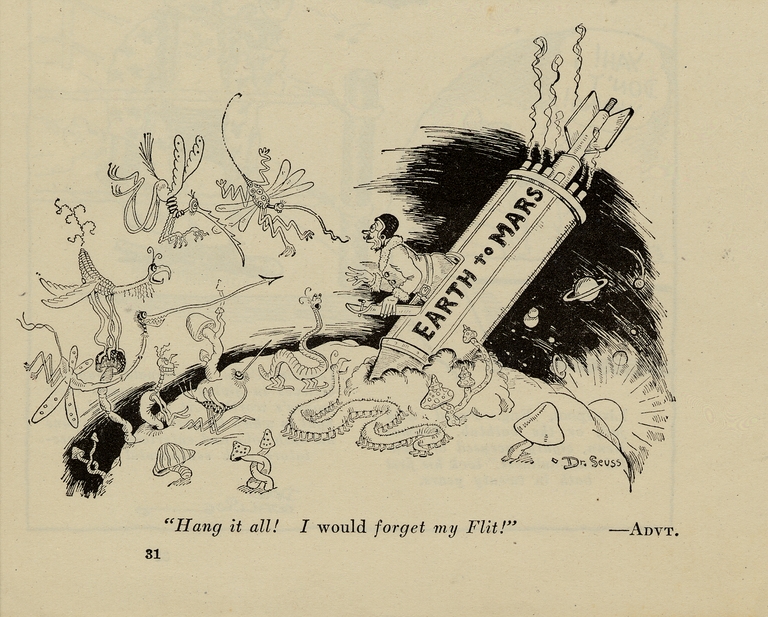
You can see many of his political cartoons at UC San Diego’s digital library, “Dr. Seuss Went to War.” UCSD also hosts an online archive of Geisel’s advertising work, which sustained him throughout much of the 30s and 40s, and not all of which has aged well either.
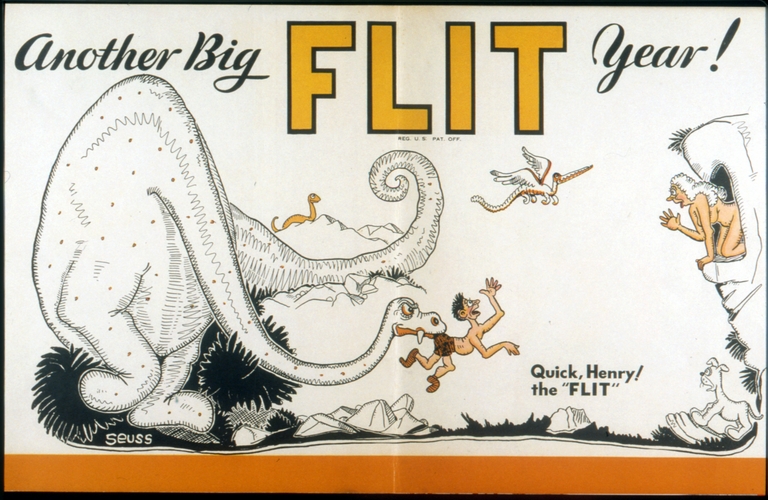
You will find some of these ads in the USCD archive; Geisel did truck in some blatantly inflammatory images. But he mostly drew innocuous, yet visually exciting, cartoons like the one at the top, one of the dozens of ads he drew during a 17-year campaign for Flit, an insect repellant made by Standard Oil.
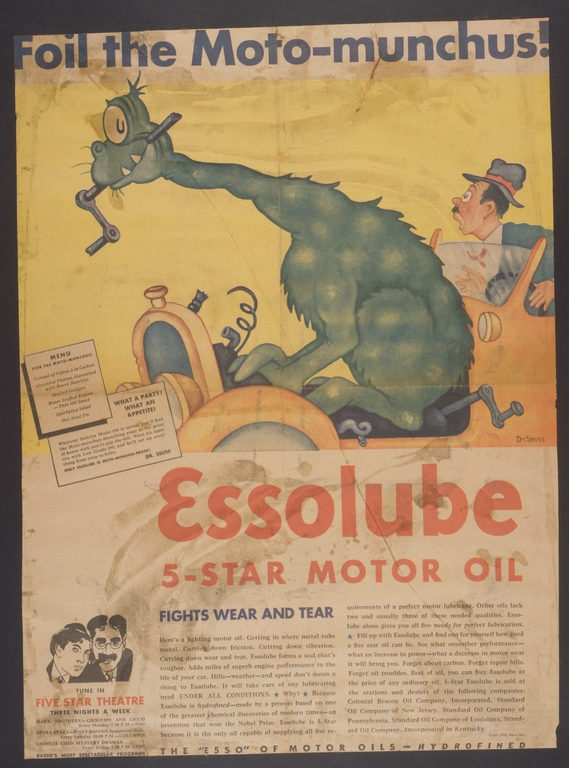
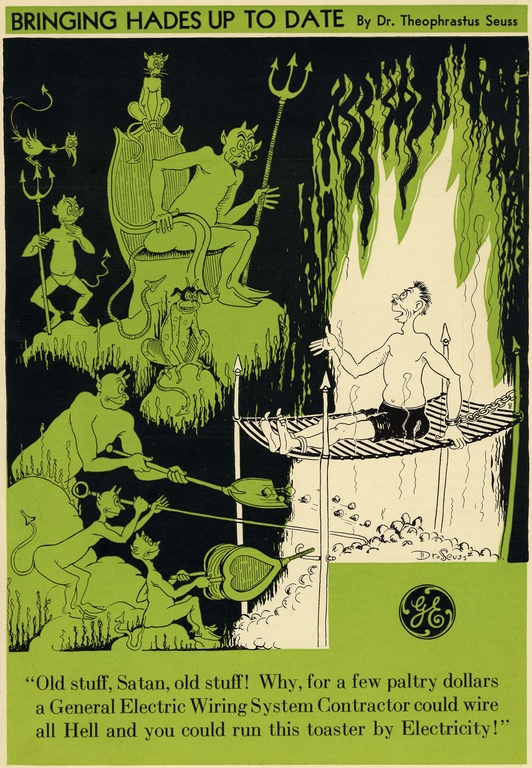
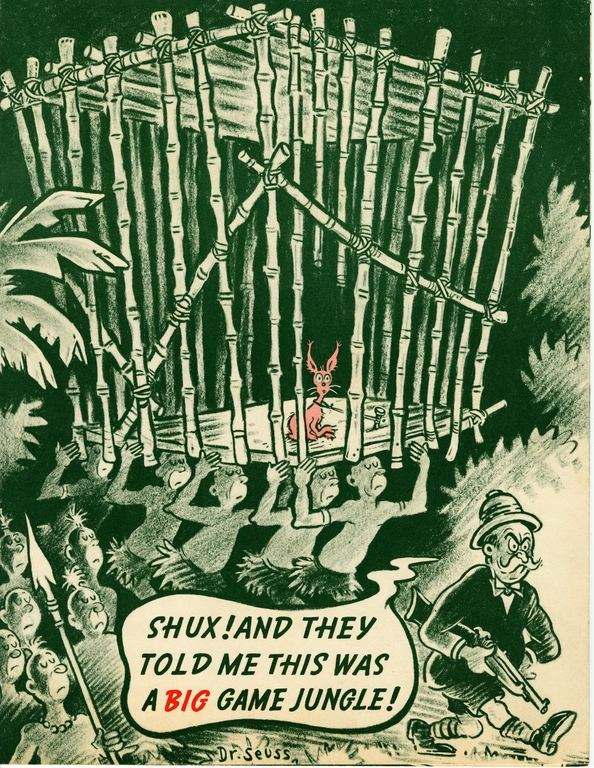
Geisel did ads for Standard Oil’s main product, promoting Essolube motor oil, further up, with the kind of creature that would later inhabit his children’s books. He got irreverently high concept with a GE ad set in hell, published explicitly under the pen name Dr. Theophrastus Seuss. And just above, in a brochure for the National Broadcasting Company, he introduces the visual aesthetic of Horton’s jungle, with a troupe of stereotypical grass-skirted Africans that might have come from one of Hergé’s offensive colonialist Tintin comics. (Both Seuss’s and Hergé’s early work are testaments to the common co-existence of progressive politics with often contemptuous or condescending treatment of nonwhite people in the early twentieth century.)
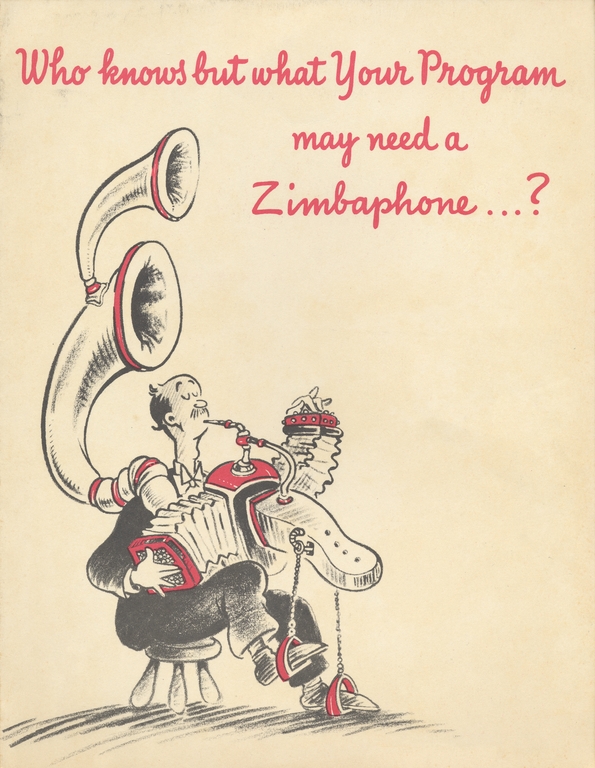
The Seuss advertisements archive shows us the artist’s development from visual puns and quirks to the fully-fledged mechanical surrealism of his mature style, as in the National Broadcasting Company brochure above, with its musical contraption the “Zimbaphone,” a precursor to the many cacophonous, overcomplicated instruments to come. It is when he is at his most inventive that Geisel is at his best. When he abandoned lazy, mean-spirited stereotypes, his work embraced a world of joyous possibility and weirdness.
An explosion in recent years of so-called “ruin porn” photography has sparked an inevitable backlash for its supposed fetishization of urban decay and economic devastation. Documenting, as theorist Brian McHale writes, the “ruin in the wake of the deindustrialization of North American ‘Rust Belt’ cities” like Detroit, “ruin porn” shows us a world that only a few decades ago, thrived in a post-war economic boom that seemed like it might go on forever. Our morbid fascination with images from the death of American manufacturing offers a rich field for sociological inquiry. But when scientists look over what has happened to so much of the architecture from the early to mid-twentieth century, they’ve mostly had one very pressing question:
What is going on with the concrete?
Or more specifically, why do structures built only a few years ago look like they’ve been weathering the elements for centuries, when buildings thousands of years old, like many parts of the Pantheon or Trajan’s Markets in Rome, look like they’re only a few years old? The concrete structures of the Roman Empire, writes Nicole Davis at The Guardian, “are still standing more than 1,500 years after the last centurion snuffed it.” Roman concrete was a phenomenal feat of ancient engineering that until recently had stumped scientists who studied its durability. The Romans themselves “were aware of the virtues of their concrete, with Pliny the Elder waxing lyrical in his Natural History that it is ‘impregnable to the waves and every day stronger.”
The mystery of the Roman concrete recipe has finally been revealed. Researchers at the University of Utah have just published a study in American Mineralogist showing how the compound of “volcanic ash, lime (calcium oxide), seawater and lumps of volcanic rock” actually did, as Pliny claimed, become stronger over time, through the very action of those waves. “Seawater that seeped through the concrete,” notes Davis, “dissolved the volcanic crystals and glasses, with aluminous tobermorite and phillipsite crystalizing in their place.” These new crystals reinforce the concrete, making it more impervious to the elements. Modern concrete, “by contrast… is not supposed to change after it hardens—meaning any reactions with the material cause damage.” (The short video above explains the process in brief.)
The recent study builds on previous work conducted by lead author, University of Utah geologist Marie Jackson. In 2014, Jackson, then at the University of California, recreated the Roman concrete recipe and discovered one of the minerals within it that makes it superior to the modern stuff. But it took a couple more years before she and her colleagues figured out the role of seawater on forming the rare crystals. Now, they are recommending that builders begin using Roman concrete in the near future for seawalls and other marine structures. The research “opens up a completely new perspective for how concrete can be made,” says Jackson. “What we consider corrosion processes can actually produce extremely beneficial mineral cement and lead to continued resilience, in fact, enhanced perhaps resilience over time.”
As we increasingly turn our postmodern gaze toward the failures of postwar industrialization–toward not only crumbling cities but crumbling dams and bridges–one secret for building infrastructure that can last for centuries comes to us not from an algorithm or an AI but from an ancient recipe combining the primeval forces of volcanoes and ocean waves.
The ever more critically acclaimed, ever more resolutely Austin-based auteur Richard Linklater grounds each of his movies in a particular place, but even more so in a particular time. His second feature Slacker, which broke him into the world of American independent film in 1991, takes place not just in Austin, but in a single day in Austin. Its much bigger-budget but also Austin-set follow-up Dazed and Confused takes place on May 28, 1976, the last day before graduation for its high-school-age characters. 1995’s Before Sunrise began a trilogy of films released every nine years, each of which continues the story of the central couple by following them in near-real time around a different place: first in Vienna, then in Paris, then in Greece.
Linklater has maintained his penchant for temporal specificity, setting last year’s Everybody Wants Some!!in southeast Texas in 1980, specifically on the day before the beginning of college for its characters. Before that, his low-key epic Boyhoodmade cinema history by having been shot over a period of twelve years, demonstrating definitively that the director’s interest in time goes well beyond simply evoking periods or replicating the real flow of events.
“It’s a big element, isn’t it, of our medium?” he asks in “On Cinema & Time,” the video essay made by “kogonada” for the British Film Institute at the top of the post. “The manipulation of time, the perception of time, the control of time — kind of the building blocks of cinema.”
“What I’ll say is, like, ‘Carve out something of real time,’ you know?” says Linklater, with his characteristic delivery of artistic insight in a highly casual, Texas-inflected locution, in the Film Radar video essay “Richard Linklater and Time” (not viewable in all regions). “Some kind of hyperreality, you know? Trying to make sense of the world in a movie way, of just how people live or think or interact.” But would his time-carving, expertly though he does it, strike us as powerfully without he and his collaborators’ equally high skill at crafting images (whether live-action or, occasionally, in animation, as in the rotoscoping of the philosophical dialogue-driven Waking Life, orhis Philip K. Dick adaptation A Scanner Darkly, examined in Siobhan Cavanagh’s “Form and Function”)?
You can see that skill on display in the video essays “Cinematography in the films of Richard Linklater” and “Silent Connections” just above. In the latter, frequent Linklater collaborator Ethan Hawke quotes the director: “I’ve never been in a gunfight. I’ve never been involved in espionage. I’ve never been involved in a helicopter crash. And yet I feel like my life has been full of drama, and the most dramatic thing that’s ever happened to me is, really, connecting with another human being. When you really connect, you feel like your life is different, and I want to make a movie about that connection.” In a sense, Linklater has spent most of his career taking different approaches to making that movie, always drawing on his vast breadth of film knowledge; the video essay “Real Time and New Wave Heritage” just above looks at just a few of the parallels between his work and that of his predecessors in cinema.
“It’s funny, the way memory works,” Linklater says in a ten-minute Independent Film Channel featurette on the making of Boyhood. “I’m kind of obsessed with that.” You can see a younger Linklater speak about his life as a filmmaker, then only just beginning, in the 1991 Austin public-access television clip just above. “I don’t get work,” he says. “For me, filmmaking’s not even a job, it’s not a career, it’s just something I’m doing. For the first time it looks like I should be making money at it, but we’ll see.” Now we’ve seen what Linklater can do, though he’ll surely surprise and impress us for decades to come with the ways he can dig, cinematically, into his obsessions — and the obsessions his films have let us share. To quote a 23-year-old Hawke in Before Sunrise, quoting Dylan Thomas reading W.H. Auden: “ ‘All the clocks in the city began to whirr and chime. Oh, let not time deceive you; you cannot conquer time. In headaches and in worry, vaguely life leaks away, and time will have its fancy tomorrow or today.’ Somethin’ like that.”
The history of the violin can be traced back to 1530, when a violin-like instrument first appeared in Gaudenzio Ferrari’s painting, “Madonna of the Orange Tree.” By the 1550s, Andrea Amati and his descendants began to craft priceless violins, in the form we know them today. And then followed other families closely associated with the golden age of these stringed instruments–the Bergonzi, the Guarneri, the Stradivari.
Shot by Baptiste Buob, the wordless documentary walks you through the making of a violin, from start to finish. A process that takes a luthier 3–4 weeks, working full-time, gets covered in 33 elegant minutes. Savor each and every one of them.
Bonus: Below, watch another film by Baptiste Buob–this one a 28-minute film detailing how French bow maker Roch Petitdemange practices his craft, again from beginning to end. A perfect complement.
If you would like to support the mission of Open Culture, consider making a donation to our site. It’s hard to rely 100% on ads, and your contributions will help us continue providing the best free cultural and educational materials to learners everywhere. You can contribute through PayPal, Patreon, and Venmo (@openculture). Thanks!
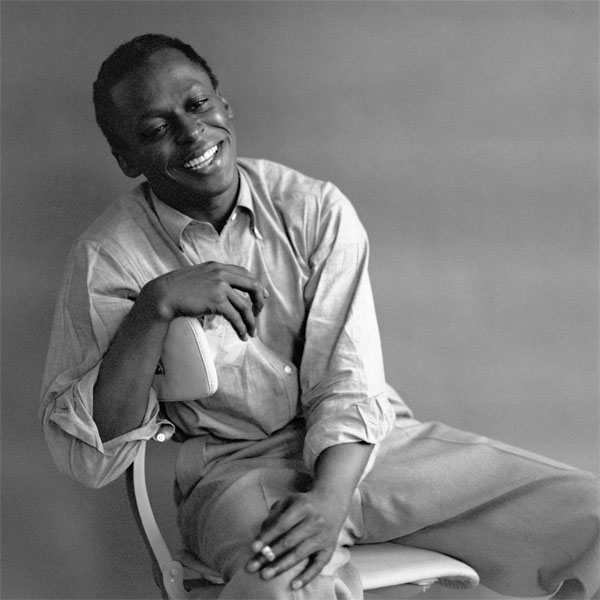
The wandering bards of old disappeared when the printing press came to town. So too have the great bandleaders largely vanished in the age of the super producer and jet-setting DJ. But for a time in the jazz and rock worlds, Olympian figures like Frank Zappa and Miles Davis played several important roles: finding and mentoring the best musicians; mastering old forms and making them new again; serving as curators, arbiters, and contrarians… issuing loud pronouncements on anything and everything as unsparing cultural critics.
Do we need tongues as sharp as Zappa and Davis’s in contemporary pop culture? Maybe, maybe not. They didn’t seem to enjoy much of anything they weren’t directly involved in creating. But man, was it fun to watch them dispense with the niceties and speak their brutal truths. We’ve heard from Zappa on everything from his loathing of the Velvet Underground to the fascism of the PMRC to the morbidity of the entire music industry. Davis’ observations were equally cutting. “His fascinating autobiography,” writes Kirk Hamilton at Kotaku, “is loaded with shit-talking, dismissals, and general acerbic jerkiness. It is fantastic.”
But you needn’t pick up Miles’ book to get an earful of his acid-tongued judgments. We need only revisit the series of “blindfold tests” he did for Downbeat magazine in the fifties and sixties. These experiments had famous musicians listen to new music, “try to pick out who is playing,” then offer their off-the-cuff takes. Davis’ first session, in 1955, began charitably enough, though not without some sweeping criticisms. He dismissed all of the soloists on Clifford Brown’s “Falling in Love with Love,” for example, except for a Swedish pianist whose name escaped him. But he gave the record four stars all the same. “The arrangement was pretty good.”
In 1958, Davis sat for his second blindfold test, with mixed results. He nearly obliterated Tiny Grimes and Coleman Hawkins’ “A Smooth One,” giving it “half a star just because… Hawkins is on it.” But in an effusive moment, he gushes over John Lewis’ “Waremeland (Dear Old Stockholm)” with a ten star rating. “All the stars are for John,” he says. By 1964, little evidence of that rare enthusiasm remained in the third blindfold test. Davis was at that moment, writes Richard Brody, “torn apart.” In a particularly irritable state of mind he “flung insults at Eric Dolphy,” Sonny Rollins, Cecil Taylor, and a few more greats. His commentary “perfectly captures his general distaste,” writes Hamilton, “for, well, everything.”
Of Dolphy’s “Miss Ann” (above), he says, “nobody else could sound that bad!” Of the Jazz Crusaders’ “All Blues”: “What’s that supposed to be? That ain’t nothin’.” Of Duke Ellington, Max Roach and Charles Mingus’ “Caravan”: “What am I supposed to say to that? That’s ridiculous. You see the way they can fuck up music?” Like another infamous trash-talker who currently dominates every conversation with his unbelievable egomania, Davis tosses out the condescending adjective “sad” at every opportunity. Clark Terry’s “Cielito Lindo” is a “sad record.” Dolphy is “a sad motherfucker.” Cecil Taylor’s “Lena” is “some sad shit, man.”
It’s not all bad. Miles loves Stan Getz and Joao Gilberto’s “Desafinando,” giving the record five stars and its two star players the highest of praise. Four years later, his typical mood had not improved. In 1968, Davis sat for his last blindfold test. He tore into Ornette Coleman, mistaking him for Archie Shepp on “Funeral.” Of Freddie Hubbard’s “On the Que-Tee,” he says, “I wouldn’t even put that shit on a record.” Sun Ra’s “Brainville” gets a serious slam: “They must be joking—the Florida A&M band sounds better than that. They should record them, rather than this shit.” It ain’t all pure cattiness. Davis tends to like music that stays out of his musical lane, like The Electric Flag’s “Over Lovin’ You,”—a “nice record,” he says. “It’s a pleasure to get a record like that.” Likewise, the prologue from the Fifth Dimension’s Magic Garden gets a thumbs up.
When Downbeat’sLeonard Feather visited the irascible trumpet player in his hotel room for the last test, the critic “seemed shocked to find records by the Byrds, James Brown, Dionne Warwick, Aretha Franklin, Tony Bennett, and the Fifth Dimension scattered around his room,” notes Davis biographer John Szwed. “Miles seemed to have lost all interest in what was then considered jazz.” No doubt about it, no musician then or now would want to be on the receiving end of his critical barbs. Perhaps the only jazz player he never put down was the “young savant drummer” Tony Williams. Otherwise, “at some point or another,” writes Hamilton, “Davis lays low just about every other luminary in the history of jazz.” But behind the vitriol lay true genius. No one was as competitive—or as demanding of himself as he was of others—as Miles Davis.
Many connoisseurs of architecture are enthralled by the modernist philosophy of Le Corbusier, Frank Lloyd Wright, and I M Pei, who shared a belief that form follows function, or, as Wright had it, that form and function are one.
Others of us delight in gas stations shaped like teapots and restaurants shaped like fish or doughnuts. If there’s a philosophy behind these insistently playful visions, it likely has something to do with joy…and pulling in tourists.
Art historian John Margolies (1940–2016), responding to the beauty of such quirky visions, scrambled to preserve the evidence, transforming into a respected, self-taught photographer in the process. A Guggenheim Foundation grant and the financial support of architect Philip Johnson allowed him to log over four decades worth of trips on America’s blue highways, hoping to capture his quarry before it disappeared for good.
Despite Johnson’s patronage, and his own stints as an Architectural Record editor and Architectural League of New York program director, he seemed to welcome the ruffled minimalist feathers his enthusiasm for mini golf courses, theme motels, and eye-catching roadside attractions occasioned.
On the other hand, he resented when his passions were labelled as “kitsch,” a point that came across in a 1987 interview with the Canadian Globe and Mail:
People generally have thought that what’s important are the large, unique architectural monuments. They think Toronto’s City Hall is important, but not those wonderful gnome’s‑castle gas stations in Toronto, a Detroit influence that crept across the border and polluted your wonderfully conservative environment.
As Margolies foresaw, the type of commercial vernacular architecture he’d loved since boyhood–the type that screams, “Look at me! Look at me”–has become very nearly extinct.
And that is a maximal shame.
Your children may not be able to visit an orange juice stand shaped like an orange or the Leaning Tower of Pizza, but thanks to the Library of Congress, these locales can be pitstops on any virtual family vacation you might undertake this July.
(Or eschew your computer entirely–go on a real road trip, and continue Margolies’ work!)
Whatever you decide to do with them, the archive’s homepage has tips for how to best search the 11,710 color slides contained therein. Library staffers have supplemented Margolies’ notes on each image with subject and geographical headings.
Video games have long attempted, to an ever more impressive degree of realism, to conjure up their own virtual realities. But then, so have filmmakers, for a much longer period of time and — at least so far — with more effective results. The most respected directors fully realize “virtual reality” with each film they make, and Stanley Kubrick stands as one of the best-known examples. During his almost fifty-year career, he immersed his audience in such distinctive cinematic worlds as those of Lolita, 2001: A Space Odyssey, A Clockwork Orange, and Full Metal Jacket, leaving us in 1999 with the final, much puzzled-over feature Eyes Wide Shut.
The atmospherically uneasy story of a doctor who spends a night in New York City wandering into ever stranger and more erotically charged situations, Eyes Wide Shut both adapted material not well known in America, the Austrian writer Arthur Schnitzler’s 1926 novella “Dream Story,” and starred two of the biggest celebrities of the day, the then-married couple Tom Cruise and Nicole Kidman playing the married couple Bill and and Alice Harford. Kubrick made use of these qualities and many others to deal with such traditional subjects as love, sex, infidelity, and secret cults while, in the words of Evan Puschak, better known as the video essayist Nerdwriter, “making our engagement with these things one-of-a-kind.”
“Reviewers complained that the Harfords were ciphers, uncomplicated and dull,” writes Tim Kreider in “Introducing Sociology,” his much-cited breakdown of Eyes Wide Shut. “These reactions recall the befuddlement of critics who complained that the computer in 2001 was more human than the astronauts, but could only attribute it (just four years after the unforgettable performances of Dr. Strangelove) to human error.” He argues that “to understand a film by this most thoughtful and painstaking of filmmakers, we should assume that this characterization is deliberate — that their shallowness and repression is the point.”
Puschak’s video essay “Eyes Wide Shut: The Game” names those qualities, especially as they manifest in Cruise’s protagonist, as among the techniques Kubrick uses to make the movie a kind of virtual reality experience for the viewer. “You’re experiencing the night from the perspective of Bill, but not from a position of empathy — or even sympathy for that matter. Instead, the viewer engages in what philosopher Alessandro Giovannelli calls ‘experiential identification,’ in which the result of occupying Bill’s perspective while not empathizing with him is that the perspective becomes your own.”
What Kreider sees as ultimately part of Eyes Wide Shut’s indictment of “the capital of the global American empire at the end of the American Century,” Puschak interprets as Kubrick’s “systematic effort to swap you in for the protagonist” in service of “an ode to the experience, to the raw impression, of seeing something marvelous.” But both viewers would surely agree that Kubrick, to a greater extent than perhaps any other filmmaker, made something more than movies. One might say he crafted experiences for his audience, and in the truest sense of the word: like experiences in real life, and unlike the experiences of so many video games, they allow for an infinitude of valid interpretations.
There are guitar players, who can play a handful of songs and pick out some pleasing riffs, and there are guitarists: players who’ve mastered several styles, have a back pocket full of standards, and tour and record for a living. And then there are guitar gods, goddesses, heroes, or whatever… men and women like St. Vincent, Joe Satriani, Jeff Beck, Nancy Wilson, Steve Vai, Stevie Ray Vaughn, Merle Travis, Jimi Hendrix, and Joe Bonamassa, electric blues wunderkind who, in a way, is a successor to some the past masters. Many guitar heroes are child prodigies, and many of them had the opportunity to learn from genius musicians in their youth. Bonamassa is no exception in either case, as you can see in the video up top, in which a 12-year-old “Smokin’ Joe Bonamassa” opens for B.B. King.
Bonamassa started playing at 4 and studied under the late, great Washington, DC guitarist Danny Gatton at 11, perhaps the most unsung, most naturally gifted guitarist of all time. In 1989, he had the opportunity to tour with King, playing over 20 shows, after he had already made a name for himself in “places like Buffalo and Scranton, PA,” writes Forgotten Guitar.
In the video above, you can see Bonamassa, 12 years old, destroy on Gatton’s signature butterscotch Telecaster. It takes him and the band a couple minutes to get going, and the skeptical audience begins to shuffle their feet impatiently. Then he proceeds to blow their minds, just as he blew the minds of television audiences who saw the news segment below on Bonamassa that same year.
At thirteen, Bonamassa attracted the national attention of a program called Real Life, hosted by Jane Pauley. In the clip below, we have the pleasure of seeing the awkward middle schooler in his other element, the locker-lined hallways and the libraries at his day job. But the live footage of Bonamassa removes any doubt about how extraordinary his abilities are.
An early childhood affinity for the instrument and parental urging has had a lot to do with Bonamassa’s phenomenal skill, but as he often acknowledges, so has his tutelage under some of the greatest guitar heroes to ever live. (See him pay tribute to B.B. King below.) And as everyone who plays guitar will acknowledge, what often distinguishes guitar players from guitarists and guitar heroes is an awful lot of practice. Read Bonamassa’s top 5 practice tips for guitarists here.
Fascination with the theremin, the otherworldly electronic musical instrument developed in the late 1910s and early 1920s out of Soviet research into proximity sensors, may never cease. Some of that has to do with the unusual nature of its touchless interface, consisting of twin antennas that the player moves their hands around in order to control the tone. More of it has to do with what the few who have dared to master the theremin have achieved with it, and no discussion of the masters of the theremin can be complete without the name Clara Rockmore.
“Born in Russia, March 9, 1911, Clara inherited the family trait of perfect pitch and could pick out melodies on the piano at age two,” says the Nadia Reisberg and Clara Rockmore Foundation’s biography. Accepted into the prestigious St. Petersburg Imperial Conservatory as a violin student at the unprecedentedly young age of four, it seemed like she’d already found her path to musical stardom — until the Russian Revolution got in the way.
The family fled to America, with Clara and her pianist sister Nadia giving concerts to make money throughout the arduous journey. They arrived in New York in December 1921, but before Clara could continue her studies there, “she developed an arthritic problem with her bow arm, and had to give up the violin.”
But all was not lost: she met Leon Theremin, inventor and namesake of the theremin (previously featured here), and found herself “fascinated by the aesthetic part of it, the visual beauty, the idea of playing in the air.” Soon developing “her own finger technique, allowing her infinitely greater control of pitch and phrasing” and later suggesting modifications to the instrument to improve its range and sensitivity, she could within years play classical pieces on the theremin, making sounds no classical composer could have imagined. Her performances, sometimes accompanied by Nadia and sometimes as a part of an orchestra, led to the release of her first album (recorded by Robert Moog, whose name also echoes down the halls of electronic music), The Art of the Theremin in 1977. (Stream it on Spotify below.)
Rockmore passed away in 1998, having been brought back into the public eye a few years earlier, at least to an extent, by Steve M. Martin’s documentary Theremin: an Electronic Odyssey. Just last year, countless many more of us learned not just the word theremin but the name Clara Rockmore when Google’s front-page “doodle” celebrated her 105 birthday. Those who clicked on it could receive a brief, game-like theremin lesson from an animated version of Rockmore herself, all while hearing sounds precisely engineered to replicate her distinctive playing style. You can see the real Rockmore playing Saint-Saëns’ “The Swan” at the top of the post. Anyone who’s heard the theremin knows that no other instrument sounds quite like it — and anyone who’s heard Rockmore playing the theremin knows no other theremin has ever sounded quite like hers.
We're hoping to rely on loyal readers, rather than erratic ads. Please click the Donate button and support Open Culture. You can use Paypal, Venmo, Patreon, even Crypto! We thank you!
Open Culture scours the web for the best educational media. We find the free courses and audio books you need, the language lessons & educational videos you want, and plenty of enlightenment in between.