We all know the rules of art museums: look, but don’t touch. This doesn’t bother most of us most of the time, but for art-lovers who happen to be blind and thus use feeling as a substitute for seeing, it presents a problem indeed — but it also opens up an artistic opportunity. “Cantor Fine Art, a just-launched gallery by father and son team Larry and Sam Cantor, offers a story of a different kind of physical interaction with art in their project, Please Touch the Art,” writes The Creator’s Project’s Gabrielle Bruney. “They partnered with artist Andrew Myers to create a tactile painting that is appreciable by both sighted and blind art lovers.”
In the five-minute video above, you can see — or if visually impaired, hear — Myers discussing the beginnings of his “screw pieces,” images made by driving countless screws into a piece of wood, each one ultimately acting as a kind of physical, three-dimensional pixel. Though Myers didn’t begin these works with the blind in mind, one such gallery-goer’s visit to his show, and the “huge smile on his face” when he put his hand to the screw pieces, got him thinking of the possibilities in that direction. Thanks to his art, “there was a blind man who could almost see for a second.”
We also meet the blind woodworker George Wurtzel, currently at work on “converting an old grape crushing barn into a Tactile Art Center” which combines a woodworking shop with a “tactile gallery space where the visually impaired can experience and sell artwork.” Discovering their shared passion for tactile art, Myers decides to make a surprise for Wurtzel, “the first portrait of himself he can actually feel,” the first new piece for his tactile art gallery. The video captures the big reveal, which converts Wurtzel from his skepticism about the screw-piece form. Still, even as he runs his fingers over his own metallicized features, he has his objections: “My nose is not that big. I’m sorry. I like the beard, though. The beard is good. The beard is really good.”
From the figureheads of ships to cigar store statues to the caricature mascots of various sports teams…. Unfortunate or denigrating images of Native American peoples have persisted in popular culture, folk symbols of what Elisabeth W. Russell refers to in her history of the cigar store Indian as “The Vanishing American.” The phrase comes from the title of a Zane Grey novel, which then became a 1925 silent film dealing, wrote the New York Times that year, “with the passing of the American Indian.” Although both the novel and film attempt to protest the treatment of Native people by the U.S. government, both underwrite a common, troubling assumption—that Native Americans, like the Buffalo and the wild Mustang, were a threatened (and threatening) separate species, whose “vanishing” from the picaresque West (as they had “vanished” from the East) was a lamentable, but perhaps unavoidable, side effect of the march of Euro-American progress.
Each symbolic memorializing of Native Americans in U.S. iconography, however solemn or offensively cartoonish, gestures toward some meager recognition of a tragic loss, while erasing the circumstances that occasioned it. Of course Native Americans didn’t vanish, but were slowly killed or hounded into poverty and dispossession, and out of sight of white America—their dress, religions, and cultures made to disappear through forced assimilation, only to reappear in romanticized images of tragically conquered, but admirably warlike, primitives.
Those images proliferated during the mid-to-late 19th century, the period of intense Western settlement and expansion and the so-called Indian Wars. “It is a given today,” writes historian Brian Dipple, “that the idea of the American Indian has been historically significant. It shaped the attitudes of those in the nineteenth century who shaped Indian policy. Indian policy—be it removal of the Eastern tribes in the 1830s, reservation isolationism beginning in the 1850s, or allotment of reservation lands and assimilation in the 1880s—cannot be understood without an awareness of the ideas behind it. Literature and the visual arts provide revealing guides to nineteenth century assumptions about the Indian.”
Native historian Vine Deloria describes the cultural situation with more incisive wit in his “Indian Manifesto,” Custer Died for Your Sins: “The American public feels most comfortable with the mythical Indians of stereotype-land who were always THERE. These Indians are fierce, they wear feathers and grunt. Most of us don’t fit this idealized figure since we grunt only when overeating, which is seldom.” By the early 20th century, “mythical Indians” had become firmly embedded in popular culture, thanks to art and entertainment like the presumably serious attempts of Zane Grey and Frederic Remington, and J.M. Barrie’s deeply unserious Peter Pan. It is in this cultural atmosphere that photographer Edward Sheriff Curtis’ huge, 20-volume ethnographic project, The North American Indian emerged.
Beginning in 1904, and with the eventual backing of J.P. Morgan, writes Mashable, Curtis “spent more than 20 years crisscrossing North America, creating over 40,000 images of more than 80 different tribes. He made thousands of wax cylinder recordings of native songs and language, and wrote down oral histories, legends and biographies.” You can view and download more than 1,000 of these photographs at the Library of Congress. Curtis thought of his work as documenting “what he saw as a vanishing way of life.” Motivated by assumptions about Native people as semi-mythic remnants from the past, the photographer “sometimes meddled with the documentary authenticity of his images. He posed his subjects in romanticized settings stripped of Western civilization, more representative of an imagined pre-Colombian existence than the subjects’ actual lives in the present.”
The photographs are beautiful, their subjects ennobled by the dramatic lighting and stylized poses, and the breadth and scope of the entire project is nothing less than breathtaking. It set the stage for the significant work of later photographers and ethnographers like Walker Evans, Dorothea Lange, and the Lomaxes. Curtis has even been credited with producing the first documentary film. The images, histories, traditions, and biographies Curtis preserved constitute an invaluable historical record. That said, we should bear in mind that The North American Indian comes to us framed by Curtis’ assumptions about Native American cultures, formed by a climate in which myth vied with, and usually supplanted, fact. What do we see in these staged images, and what do we not see?
One of Curtis’ enthusiastic early backers, Theodore Roosevelt—who authored the introduction to Volume One—was, “like many of Curtis’ eventual supporters,” writes Valerie Daniels, “more interested in obtaining a record of vanishing Native American cultures as a testament to the superiority of his own civilization than out of any concern over their situation or recognition of his own role in the process.” Though Curtis did not necessarily share these views, and later became “radical in his admonition of government policies toward Native Americans,” he also had to please his financiers and his audience, most of whom would have felt the way Roosevelt did. We should bear this cultural context in mind as we take in Curtis’ work, and ask how it shaped the creation and reception of this truly impressive record of both American history and American myth. Enter the archive of images here.
“What do you do when you change how the world thinks of cinema? What’s next? Do you keep making the same kind of film? If you’re a person like Rossellini, you try something experimental. You push further. Not experimental for experiment’s sake, but you push the boundaries further.” With these words, Martin Scorsese describes the situation of Roberto Rossellini, one of his predecessors in filmmaking he most admires, after completing Paisan in 1946. Where to take the movement “Italian neorealism” from there?
Scorsese discusses Rossellini’s next three major films, Stromboli, Europe ’51, and Journey to Italy in this Conversations Inside the Criterion Collection interview clip from Vice. Given his possession of an enthusiasm for cinema as strong as his mastery of the craft of cinema (making him a predecessor of such younger American indie-rooted cinephile-auteurs as Quentin Tarantino and Wes Anderson), it makes sense that Scorsese would want to engage with the Criterion Collection, whose painstakingly-produced video releases of respected films have for decades constituted a kind of film school, informal yet rich and rigorous.
When Criterion, whose catalog includes Scorsese’s own The Last Temptation of Christ, asked the director to name his ten favorite films in the Collection, he began with a paean to Paisan. (Note: You can watch Paisan for free if you start a free trial with Hulu. Also watch Fellini’s 8 1/2–listed below–free on Hulu here.) “I saw it for the first time on television with my grandparents, and their overwhelming reaction to what had happened to their homeland since they left at the turn of the century was just as present and vivid for me as the images and the characters,” he said. “I was experiencing the power of cinema itself, in this case made far beyond Hollywood, under extremely tough conditions and with inferior equipment. And I was also seeing that cinema wasn’t just about the movie itself but the relationship between the movie and its audience.”
Here are Scorsese’s nine other Criterion selections:
The Red Shoes(Michael Powell and Emeric Pressburger) “There’s no other picture that dramatizes and visualizes the overwhelming obsession of art, the way it can take over your life. But on a deeper level, in the movement and energy of the filmmaking itself, is a deep and abiding love of art, a belief in art as a genuinely transcendent state.”
The River(Jean Renoir) “This was Jean Renoir’s first picture after his American period, his first in color, and he used Rumer Godden’s autobiographical novel to create a film that is, really, about life, a film without a real story that is all about the rhythm of existence, the cycles of birth and death and regeneration, and the transitory beauty of the world.”
Ugetsu(Kenji Mizoguchi) “The boat slowly materializing from out of the mist and coming toward us… Genjuro collapsing on the grass in ecstasy and being smothered by Lady Wakasa… the final crane up from the son making an offering at his mother’s grave to the fields beyond. Just to think of these moments now fills me with awe and wonder.”
Ashes and Diamonds (Andrzej Wada) “I saw Ashes and Diamonds for the first time in 1961. And even back then, during that period when we expected to be astonished at the movies, when things were happening all over the world, it shocked me. It had to do with the look, both immediate and haunted, like a nightmare that won’t stop unfolding.”
L’avventura(Michelangelo Antonioni) “It’s difficult to think of a film that has a more powerful understanding of the way that people are bound to the world around them, by what they see and touch and taste and hear. I realize that L’avventura is supposed to be about characters who are ‘alienated’ from their surroundings, but that word has been used so often to describe this film and Antonioni’s films in general that it more or less shuts down thought.”
Salvatore Giuliano(Francesco Rosi) “On one level, it’s an extremely complex film: there’s no central protagonist (Giuliano himself is not a character but a figure around which the action pivots), and it shifts between time frames and points of view. But it’s also a picture made from the inside, from a profound and lasting love and understanding of Sicily and its people and the treachery and corruption they’ve had to endure.”
8 1/2(Federico Fellini) “8½ has always been a touchstone for me, in so many ways—the freedom, the sense of invention, the underlying rigor and the deep core of longing, the bewitching, physical pull of the camera movements and the compositions (another great black-and-white film: every image gleams like a pearl — again, shot by Gianni Di Venanzo). But it also offers an uncanny portrait of being the artist of the moment, trying to tune out all the pressure and the criticism and the adulation and the requests and the advice, and find the space and the calm to simply listen to oneself.”
Contempt(Jean-Luc Godard) “It’s a shattering portrait of a marriage going wrong, and it cuts very deep, especially during the lengthy and justifiably famous scene between Piccoli and Bardot in their apartment: even if you don’t know that Godard’s own marriage to Anna Karina was coming apart at the time, you can feel it in the action, the movement of the scenes, the interactions that stretch out so painfully but majestically, like a piece of tragic music.”
The Leopard (Luchino Visconti) “Time itself is the protagonist of The Leopard: the cosmic scale of time, of centuries and epochs, on which the prince muses; Sicilian time, in which days and nights stretch to infinity; and aristocratic time, in which nothing is ever rushed and everything happens just as it should happen, as it has always happened.”
For Scorsese’s full commentary on all ten of these pictures, see the article on Criterion’s site. The directors of his favorite Criterion Collection films all changed how the world thinks of cinema in one way or another, at different times, in different places, and in different ways. Scorsese, too, has changed how the world thinks of cinema, arguably more than once in his career — and given his penchant for trying new things, avoiding that treadmill where you “keep making the same film,” he may well make another movie that changes it again. And if he does, here’s another important question: what special features will Criterion include when they put out their deluxe edition?
Last year, Colin Marshall highlighted for you the music of Xiu Xiu, the experimental post-punk band, which has traveled the world, playing their own interpretation of the music Angelo Badalamenti wrote for David Lynch’s early 1990s series, Twin Peaks. Our original post featured some of those live performances, and now comes a studio recording of those Twin Peaks interpretations.
If you would like to sign up for Open Culture’s free email newsletter, please find it here. It’s a great way to see our new posts, all bundled in one email, each day.
If you would like to support the mission of Open Culture, consider making a donation to our site. It’s hard to rely 100% on ads, and your contributions will help us continue providing the best free cultural and educational materials to learners everywhere. You can contribute through PayPal, Patreon, and Venmo (@openculture). Thanks!
Robert Frost has the dubious honor of being known the world over as the poet of a seize-the-day cliché. His poem “The Road Not Taken” (read by Frost above) appears on coffee mugs, autumnal motivational posters, upbeat email signatures, and in advertisements and television shows, all meant to inspire confident decision-making in uncertain times: unintentionally ironic, populist appeals to diverge from the herd.
If this is Frost’s legacy in the wider culture, it’s a fate most poets wouldn’t wish on their bitterest rival. The typical interpretation of this poem is an unfortunate misrepresentation of Frost’s work in general. Indeed, “The Road Not Taken” may be “the most misread poem in America,” as David Orr argues at The Paris Review.
Frost’s poetry does not often inspire confidence or motivation, but rather doubt, uncomfortable reflection, fear, and sometimes a kind of dreadful awe. Like Faulkner was in his day, Frost was, and still is, mistaken for a quaint, colorful regionalist. But rather than a poet of New England folk simplicity, he is a poet of New England skepticism and a kind of hard-headed sublime. Anyone who reads “The Road Not Taken” closely, for example, will note the speaker’s ambiguous tone in the final stanza, and final three lines—oft-quoted as a triumphant dénouement.
I shall be telling this with a sigh
Somewhere ages and ages hence:
Two roads diverged in a wood, and I—
I took the one less traveled by,
And that has made all the difference.
The traveler does not tell us what “difference” the choice will have made, nor why he should tell of this crossroads “ages and ages hence… with a sigh.” Implied in these lines, however, is at least the suggestion of unavoidable future regret, and a reckoning with irrevocable fate. The earlier line, “Oh, I kept the first for another day!” sounds more like an exclamation of rue than the celebration of a choice well-made.
And as Orr points out, the speaker’s initial encounter presents him with two paths that “equally lay / in leaves.”; the two roads are equally travelled—or untravelled as the case may be—and the traveller chooses one arbitrarily. In these final lines, he announces his intention to tell a different, perhaps self-congratulatory story about his decision. “The poem isn’t a salute to can-do individualism,” Orr writes, “it’s a commentary on the self-deception we practice when constructing the story of our own lives.”
One can hear even darker notes in another famous poem, “Mending Wall,” in which a nameless, unfeeling “Something” goes about its work of dismantling the speaker’s best efforts, and all human work generally. It’s a theme in much of Frost’s poetry that can, if fully appreciated, inspire a dread as potent as that in the most baroque and florid of H.P. Lovecraft’s weird tales. Frost developed his theme of cosmic indifference early, in “Stars,” from his first published collection, A Boy’s Will. He introduces the poem in the table of contents with this succinct description: “There is no oversight in human affairs,” a matter-of-fact statement that scarcely prepares us for the unnerving images to follow:
How countlessly they congregate
O’er our tumultuous snow,
Which flows in shapes as tall as trees
When wintry winds do blow!—
As if with keenness for our fate,
Our faltering few steps on
To white rest, and a place of rest
Invisible at dawn,—
And yet with neither love nor hate,
Those stars like some snow-white
Minerva’s snow-white marble eyes
Without the gift of sight.
In three short, devastating stanzas, Frost undercuts ancient, comforting pretentions about the stars’ (or gods’) sentient benevolence, with images and diction that recall Thomas Hardy’s bleak lament “In Tenebris” and anticipate Wallace Stevens’ impersonal and chilling “The Snow Man.” The snow and ice in Frost’s poems are not part of the pretty scenery, but metonymic figures of oblivion.
In short, the kindly old Robert Frost we think we know from the trivial misreading of “The Road Not Taken” is not the poet Robert Frost at all. Frost is a prickly, challenging, even somewhat devious character whose pleasingly musical lines and quaint, pastoral images lure readers into poems that harbor much less cheerful attitudes than they expect to find, and much more complex and mature ideas. The young Frost once described himself as “not undesigning,” and in his later, 1939 essay “The Figure a Poem Makes,” he famously declared that a poem “begins in delight and ends in wisdom.”
In the two Spotify playlists above (download Spotify’s free software here), you can hear Frost read some of his most famous poems, including “The Road Not Taken,” “Mending Wall,” “Nothing Gold Can Stay,” “After Apple Picking,” “Death of a Hired Man,” and several more. Not represented here, unfortunately, are poems from the wonderful debut A Boy’s Will, but you can read that full collection online here, and you should. Get to know the real Frost, if you haven’t already, and you’ll appreciate all the more why he’s one of the most celebrated poets in the American canon.
If you’re a fan of science fiction or the films of David Lynch, you’ve surely seen the 1984 film adaptation of Frank Herbert’s cult classic sci-fi novel, Dune (though Lynch himself may prefer that you didn’t). And indeed, it’s very likely that, by now, you’ve heard the incredible story of what Dune might have been, had it been directed ten years earlier by psychedelic Chilean filmmaker, writer, composer, and psychotherapist Alejandro Jodorowsky. Perhaps you even caught Jonathan Crow’s post on this site featuring Jodorowsky’s proposed storyboards—drawn by French artist Moebius—for what would most certainly would have been “a mind-bogglingly grand epic” of a movie. Alas, Jodorowsky’s Dune never came about, though it did later lead to the documentary Jodorowsky’s Dune, which Matt Zoller Seitz pronounced “a call to arms for dreamers everywhere.”
That description applies not only to the film about a film that could have been, but also to the entirety of Jodorowsky’s work, including his—thoroughly bizarre and captivating—early features, El Topo and The Holy Mountain, and the creation of a comic book universe like no other. Called “The Jodoverse,” the world of his comic books is, as writer Warren Ellis says, “astonishingly beautiful and totally mad”—again, a succinct description of Jodorowsky’s every artistic endeavor. Witness below, for example, the stunning trailer for his most recent feature film, 2014’s The Dance of Reality. You may find the visual excesses so overwhelming that you only half-hear the narration.
Listen (or read) carefully, however. Jodorowsky has as much to tell us with his cryptically poetic pronouncements as he does with his visionary imagery. Do you find his epigrams platitudinous, sententious, Pollyannaish, or naïve? Jodorowsky doesn’t mind. He calls, remember, to the dreamers, not the hard-bitten, cynical realists. And if you’re one of the dreamers who hears that call, you’ll find much to love in the list below of Jodorowsky’s 82 Commandments for living. But so too, I think, will the realists. These come from Jodorowsky’s memoir The Spiritual Journey of Alejandro Jodorowsky, and the list comes via Dangerous Minds, who adapted it from “the better part of three pages” of text.
As Jodorowsky frames these maxims in his book, they originated with influential Russian mystic George Gurdjieff, and were told to him by Gurdjieff’s daughter, Reyna d’Assia. Perhaps that’s so. But you’ll note, if you know Jodorowsky’s writing—or simply took a couple minutes time to watch the trailer above—that they sound enough like the author’s own words to have been brought forth from his personal storehouse of accumulated wisdom. In any case, Jodorowsky has always been quick to acknowledge his spiritual teachers, and whether these are his second-hand accounts of Gurdjieff or his own inventions has no bearing on the substance therein.
Often sounding very much like Biblical proverbs or Buddhist precepts, the commandments are intended, d’Assia says in Jodorowsky’s account, to help us “change [our] habits, conquer laziness, and become… morally sound human being[s].” As she remarks in the book, before she delivers the below in a lengthy monologue, “to be strong in the great things, we must also be strong in the small ones.” Therefore…
Ground your attention on yourself. Be conscious at every moment of what you are thinking, sensing, feeling, desiring, and doing.
Always finish what you have begun.
Whatever you are doing, do it as well as possible.
Do not become attached to anything that can destroy you in the course of time.
Develop your generosity ‒ but secretly.
Treat everyone as if he or she was a close relative.
Organize what you have disorganized.
Learn to receive and give thanks for every gift.
Stop defining yourself.
Do not lie or steal, for you lie to yourself and steal from yourself.
Help your neighbor, but do not make him dependent.
Do not encourage others to imitate you.
Make work plans and accomplish them.
Do not take up too much space.
Make no useless movements or sounds.
If you lack faith, pretend to have it.
Do not allow yourself to be impressed by strong personalities.
Do not regard anyone or anything as your possession.
Share fairly.
Do not seduce.
Sleep and eat only as much as necessary.
Do not speak of your personal problems.
Do not express judgment or criticism when you are ignorant of most of the factors involved.
Do not establish useless friendships.
Do not follow fashions.
Do not sell yourself.
Respect contracts you have signed.
Be on time.
Never envy the luck or success of anyone.
Say no more than necessary.
Do not think of the profits your work will engender.
Never threaten anyone.
Keep your promises.
In any discussion, put yourself in the other person’s place.
Admit that someone else may be superior to you.
Do not eliminate, but transmute.
Conquer your fears, for each of them represents a camouflaged desire.
Help others to help themselves.
Conquer your aversions and come closer to those who inspire rejection in you.
Do not react to what others say about you, whether praise or blame.
Transform your pride into dignity.
Transform your anger into creativity.
Transform your greed into respect for beauty.
Transform your envy into admiration for the values of the other.
Transform your hate into charity.
Neither praise nor insult yourself.
Regard what does not belong to you as if it did belong to you.
Do not complain.
Develop your imagination.
Never give orders to gain the satisfaction of being obeyed.
Pay for services performed for you.
Do not proselytize your work or ideas.
Do not try to make others feel for you emotions such as pity, admiration, sympathy, or complicity.
Do not try to distinguish yourself by your appearance.
Never contradict; instead, be silent.
Do not contract debts; acquire and pay immediately.
If you offend someone, ask his or her pardon; if you have offended a person publicly, apologize publicly.
When you realize you have said something that is mistaken, do not persist in error through pride; instead, immediately retract it.
Never defend your old ideas simply because you are the one who expressed them.
Do not keep useless objects.
Do not adorn yourself with exotic ideas.
Do not have your photograph taken with famous people.
Justify yourself to no one, and keep your own counsel.
Never define yourself by what you possess.
Never speak of yourself without considering that you might change.
Accept that nothing belongs to you.
When someone asks your opinion about something or someone, speak only of his or her qualities.
When you become ill, regard your illness as your teacher, not as something to be hated.
Look directly, and do not hide yourself.
Do not forget your dead, but accord them a limited place and do not allow them to invade your life.
Wherever you live, always find a space that you devote to the sacred.
When you perform a service, make your effort inconspicuous.
If you decide to work to help others, do it with pleasure.
If you are hesitating between doing and not doing, take the risk of doing.
Do not try to be everything to your spouse; accept that there are things that you cannot give him or her but which others can.
When someone is speaking to an interested audience, do not contradict that person and steal his or her audience.
Live on money you have earned.
Never brag about amorous adventures.
Never glorify your weaknesses.
Never visit someone only to pass the time.
Obtain things in order to share them.
If you are meditating and a devil appears, make the devil meditate too.
Writing, casting, shooting — all important parts of the filmmaking process, but the real making of a movie happens, so they say, in the editing room. Though often film editors themselves, “they” have a point: even moviegoers unfamiliar with the mechanics of editing can sense that, when something feels right onscreen, and even more so when something feels wrong, it has to do less with the pieces themselves than how those pieces have been put together.
“There’s an inbuilt relationship between the story itself, how to tell the story, and the rhythm with which you tell it,” says famed editor Walter Murch, known for his work with Francis Ford Coppola on the Godfather trilogy and Apocalypse Now, “and editing is seventy percent about rhythm.” Twenty years ago, in his book In the Blink of an Eye, Murch shed light on how an editor works. Now, cinema video essayist Tony Zhou has continued that mission with a new episode of his series Every Frame a Painting, “How Does an Editor Think and Feel?”
Zhou’s chosen medium places him well to address the question, since each video essay must require at least as much time spent editing as thinking about film in the first place. Still, asked by a friend how he knows where to cut, he can come up with only this unsatisfying answer: “Like a lot of editors, I cut based on instinct.” As to what exactly constitutes that editor’s instinct, Zhou spends the bulk of this ten-minute essay searching for answers himself, examining the cuts in pictures like Hannah and Her Sisters, In the Mood for Love, The Empire Strikes Back, Tampopo, Only Angels Have Wings, Pierrot le Fou, and All That Jazz.
He also turns to the words of editors with decades of experience in the game, including frequent Steven Spielberg collaborator Michael Kahn, frequent Martin Scorsese collaborator Thelma Schoonmaker, and even Murch himself. But ultimately, no matter how much wisdom about timing, emotions, tension, and rhythm you collect, you’ve got to sit down in the editing suite and go it alone. “If you watch anything over and over again,” Zhou says, “you eventually feel the moment when the shot wants you to cut.” If this seems like an overwhelming task, especially given hundreds of thousands of hours of footage an editor will work through in a career, do keep Kahn’s simple words in mind: “I see all that film up there — it doesn’t matter. I’m doing one piece at a time. One scene at a time. One cut at a time.”
In 1900, Thomas Edison traveled to Paris to document the many wonders of the Exposition Universelle, and the city itself. Among the sights captured with his kinetoscope cameras were the Expo’s moving sidewalks, the Champs-Élysées, and the previous Exposition Universelle’s crown jewel, the Eiffel Tower, now eleven years old.
It wasn’t all so high-minded. Edison and his kinetoscope also caught a performance by former Moulin Rouge star, Joseph Pujol, aka Le Pétomane, above. This elegantly attired gentlemen achieved fame and fortune with a series of impressions, carried out by a rather eccentric orifice. He was not so much artiste as fartiste, a title he wore with pride.
Pujol claimed to have discovered his unusual talent as a child, and soon set about achieving different effects by using his abdominal muscles to expel not gas, but odorless air. By varying the pressure, he was able to play simple tunes. By the time he turned 30, his act had expanded to include impersonations of celebrities, musical instruments, birds, a thunderstorm and such stock characters as a nervous bride. His grand finale included such feats as blowing out candles, smoking cigarettes and playing an ocarina (below), all with the aid of a rubber hose inserted into his anus via a modest trouser slit.
What a tragedy that Edison’s short film is silent! No live piano accompaniment could do justice to this magical artistic fruit, and if there were other recordings of Pujol, they’ve been lost to history.
He lives on in the imaginations of artists who followed him.
Actor Ugo Tognazzi, below, assumed the title role in a 1983 Italian language feature.
Sadly, Pujol was left on the cutting room floor of director Baz Luhrmann’s Moulin Rouge, but all is not lost. Reportedly, Johnny Depp has indicated interest in bringing this historic figure back to life. (Gentlemen, start your screenplays…)
Then there is the half hour biopic, below, directed by Monty Python alum Ian McNaughton and starring Leonard Rossiter as Pujol. Prepare to hear the opening session of the Congress of Vienna, a toad, and a four-part harmony.
A little more than a year ago, Sheryl Sandberg’s 47-year-old husband, Dave Goldberg, died unexpectedly. The ultimate cause, heart disease. Sandberg has since endured many dark days. And now, for the first time, she’s talking publicly about the whole experience, and particularly about what death has taught her about life.
Sandberg picked the appropriate venue to speak out–the commencement ceremonies at UC-Berkeley this past weekend. Graduation speeches traditionally ask accomplished figures to give life advice to young graduates, and, painful as it might have been, that’s what Sandberg offered. One day or another, you’ll experience howling losses of your own, and what can get you through these experiences–Sandberg wants you to know–is resilience. She remarked:
And when the challenges come, I hope you remember that anchored deep within you is the ability to learn and grow. You are not born with a fixed amount of resilience. Like a muscle, you can build it up, draw on it when you need it. In that process you will figure out who you really are—and you just might become the very best version of yourself.
Class of 2016, as you leave Berkeley, build resilience.
Build resilience in yourselves. When tragedy or disappointment strikes, know that you have the ability to get through absolutely anything. I promise you do. As the saying goes, we are more vulnerable than we ever thought, but we are stronger than we ever imagined.
If you would like to sign up for Open Culture’s free email newsletter, please find it here. It’s a great way to see our new posts, all bundled in one email, each day.
If you would like to support the mission of Open Culture, consider making a donation to our site. It’s hard to rely 100% on ads, and your contributions will help us continue providing the best free cultural and educational materials to learners everywhere. You can contribute through PayPal, Patreon, and Venmo (@openculture). Thanks!
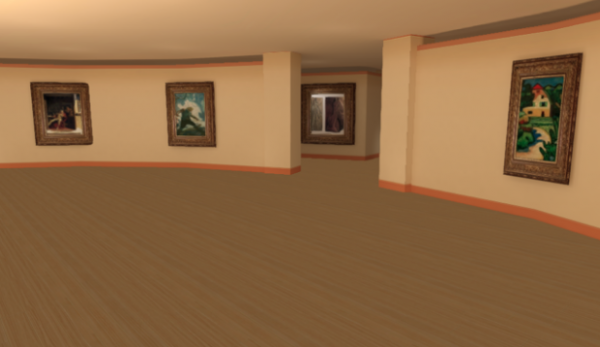
Since the first stirrings of the internet, artists and curators have puzzled over what the fluidity of online space would do to the experience of viewing works of art. At a conference on the subject in 2001, Susan Hazan of the Israel Museum wondered whether there is “space for enchantment in a technological world?” She referred to Walter Benjamin’s ruminations on the “potentially liberating phenomenon” of technologically reproduced art, yet also noted that “what was forfeited in this process were the ‘aura’ and the authority of the object containing within it the values of cultural heritage and tradition.” Evaluating a number of online galleries of the time, Hazan found that “the speed with which we are able to access remote museums and pull them up side by side on the screen is alarmingly immediate.” Perhaps the “accelerated mobility” of the internet, she worried, “causes objects to become disposable and to decline in significance.”
Fifteen years after her essay, the number of museums that have made their collections available online whole, or in part, has grown exponentially and shows no signs of slowing. We may not need to fear losing museums and libraries—important spaces that Michel Foucault called “heterotopias,” where linear, mundane time is interrupted. These spaces will likely always exist. Yet increasingly we need never visit them in person to view most of their contents. Students and academics can conduct nearly all of their research through the internet, never having to travel to the Bodleian, the Beinecke, or the British Library. And lovers of art must no longer shell out for plane tickets and hotels to see the precious contents of the Getty, the Guggenheim, or the Rijksmuseum. For all that may be lost, online galleries have long been “making works of art widely available, introducing new forms of perception in film and photography and allowing art to move from private to public, from the elite to the masses.”
Even more so than when Hazan wrote those words, the online world offers possibilities for “the emergence of new cultural phenomena, the virtual aura.” Over the years we have featured dozens of databases, archives, and online galleries through which you might virtually experience art the world over, an experience once solely reserved for only the very wealthy. And as artists and curators adapt to a digital environment, they find new ways to make virtual galleries enchanting. The vast collections in the virtual galleries listed below await your visit, with close to 2,000,000 paintings, sculptures, photographs, books, and more. See the Rosetta Stone at the British Museum (top), courtesy of the Google Cultural Institute. See Van Gogh’s many self-portraits and vivid, swirling landscapes at The Van Gogh Museum. Visit the Asian art collection at the Smithsonian’s Freer and Sackler Galleries. Or see Vassily Kandinsky’s dazzling abstract compositions at the Guggenheim.
And below the list of galleries, find links to online collections of several hundred art books to read online or download. Continue to watch this space: We’ll add to both of these lists as more and more collections come online.
I’m sure I speak for many when I say that Ursula K. Le Guin’s novels and stories changed what I thought science fiction could be and do. Raised on H.G. Wells, Isaac Asimov, Robert Heinlein, and other mostly-white-male-centered classic sci-fi, I found Le Guin’s literary thought experiments startling and refreshing. Now it seems like almost a matter of course that science fiction and fantasy narratives come from a diversity of peoples and perspectives. But Le Guin remains the first to wake me from a dogmatic slumber about the potential of speculative fiction to imagine not only future technologies, but also expansive future identities.
Novels like The Left Hand of Darkness,The Dispossessed, and The Lathe of Heaven reflect Le Guin’s very broad range of interests in politics and the humanities and social sciences. She began her career as an academic studying Renaissance French and Italian literature, and her fiction synthesizes years of careful reading in anthropology, psychology, sociology, history, and Eastern and Western philosophy. Likewise, though she has been much influenced by traditional hard science fiction, Le Guin’s literary loves are wide and deep. All that’s to say she’s as admirable and interesting a reader as she is a writer. When she praises a book, I pay attention. Thanks to her genial, loquacious online presence for many years, her fans have had ample opportunity to find out what she’s reading and why.
Le Guin recently made a few lists of books she likes, and made sure to preface each one with a disclaimer: “This list is not ‘my favorite books.’ It’s just a list of books I’ve read or re-read, recently, that I liked and wanted to tell people about.” She leaps from genre to genre, writing mini-reviews of each book and linking each one to Powell’s, the independent bookstore in her beloved city of Portland, Oregon. Below, we’ve excerpted some of Le Guin’s “Books I’ve Liked” from each list, along with her commentary. Click on each date heading to see her complete lists of recommendations.
Seeing, by José Saramago. A sequel to his amazing novel Blindness. Saramago is not easy to read. He punctuates mostly with commas, doesn’t pararaph often, doesn’t set off conversation in quotes —; mannerisms I wouldn’t endure in a lesser writer; but Saramago is worth it. More than worth it. Transcendently worth it. Blindness scared me to death when I started it, but it rises wonderfully out of darkness into the light. Seeing goes the other way and is a very frightening book.
Changing Ones, by Will Roscoe. An examination of how gender has been constructed in Native American societies. Responsibly researched, very well written, generous in spirit, never oversimplifying a complex subject, this is a wonderfully enlightening book.
Age of Bronze: The Story of the Trojan War.I: A Thousand Ships, and II: Sacrifice by Eric Shanower. A graphic novel —; the first two volumes of a projected series. The drawing is excellent, the language lively, and the research awesome. Shanower goes back to the very origins of the war to follow the early careers of the various heroes —; Agamemnon and Menelaus, Achilles, Odysseus, Hector, Paris, Aeneas, and their families, parents, wives, lovers, children… Thus, by the end of Book Two, the actual siege of Troy, which the Iliad tells one part of, is yet to begin. I see a looming problem: the battles (of which there have been a good many already) are visually all alike, and there’s endlessly more to come —; battle scenes in Homer are brutally monotonous and interminable (as war is). But these two volumes are visually and narratively varied, and give a fascinating backgrounding and interpretation to the great stories.
Some young adult books I like — I had to read a lot of them this spring, and these stood out:
The Higher Power of Lucky by Susan Patron. This one has already won the Newbery Award and gone to Kiddilit Booksellers Heaven forever, so it doesn’t need my endorsement… but it’s a lovely, funny, sweet book, set in a truly godforsaken desert town in California.
Weedflower by Cynthia Kadohata. A novel that goes with its young heroine to one of the prison camps where our government sent all our citizens of Japanese ancestry in 1942 after Pearl Harbor. It’s a beautiful book, understated and strong and tender. If you read it you won’t forget it.
Charles Mann, 1491. A brilliant survey of what we know about the human populations of the Americas before the arrival of the Europeans, and a brief, often scathing history of how we’ve handled our knowledge. The author is not an archeologist or anthropologist, but he has done his homework, and is a fine reporter and summarizer, writing with clarity and flair, easy to read but never talking down. Discussing intensely controversial subjects such as dates of settlement and population sizes, he lets you know where he stands, but presents both sides fairly. A fascinating, mind-expanding book.
Michael Pollan, The Omnivore’s Dilemma. I have never eaten an Idaho potato since I read Pollan’s article about what potato fields are “treated” with, in his earlier book The Botany of Desire. This one is scary in a different way. It probably won’t stop you from eating anything, indeed it is a real celebration of (real) food; but the first section is as fine a description of the blind, incalculable power of Growth Capitalism as I ever read. (Did you know that cattle can’t digest corn, and have to be chemically poisoned in order to produce “cornfed beef”? So, there being lots and lots of grass, why feed them corn? Read the book!) There are some depressing bits in the section on “organic” food, too, but the last section, where he hunts and gathers his dinner, is funny and often touching.
Barbara Ehrenreich, Nickel and Dimed. Ehrenreich tries to get by on minimum wage, in three different towns, working as a waitress, a house cleaner, in a Wal-Mart… Yes, it came out eight years ago, and yes, it’s just as true now, if not truer. (I just read in my hometown paper that 47% of working people in Portland have to rely on food stamps. Not “welfare queens” — people with jobs, working people.) She writes her story with tremendous verve and exactness. It reads like a novel, and leaves you all shook up.
[Le Guin devoted this list to “Some Graphic Novels,” and wrote about her difficulty finding good “grown-up stuff.” Though most of it was not to her taste (“gross-out violence, or horror, or twee, or sexist, or otherwise not down my alley”), she kept “hoping, because the form seems to me such a hugely promising and adventurous one.” Below are two graphic novels she did like. Another, Age of Bronze, she mentioned above in her 2006 list.]
Marjane Satrapi’s Persepolis I and II, and her other books. (The movie of Persepolis was charming but it really didn’t add much to the book.) I admire her drawing, which is deceptively simple but very subtly designed, using the pure contrast-power of black-and-white. The drawings and the text combine so seamlessly that I’m not aware of looking back and forth between them, I’m just taking it all in at once — Which I think is pretty much my ideal for a graphic narrative?
Joann Sfar’s The Rabbi’s Cat I and II. Three connected stories in each volume. The first two stories in the first volume are pure delight. They are funny and wise and show you a world you almost certainly never knew existed. The rabbi is a dear, the rabbi’s daughter is a dear, and the rabbi’s cat is all cat, all through, all the way down. (I wondered why Sfar drew him so strangely, until I looked at the photograph of Sfar’s cat on the cover.) The second volume isn’t quite as great, but the first story in it is awfully funny and well drawn, with the most irresistible lion, and it’s all enjoyable. Sfar’s imagination and color are wonderful. His publisher should be pilloried in Times Square for printing the art in Vol II so small that you literally need a magnifying glass to read some of the continuity. — I gather that Sfar and Satrapi are friends. Are we on the way to having a great school of graphic novels by Foreigners Living in Paris?
We're hoping to rely on loyal readers, rather than erratic ads. Please click the Donate button and support Open Culture. You can use Paypal, Venmo, Patreon, even Crypto! We thank you!
Open Culture scours the web for the best educational media. We find the free courses and audio books you need, the language lessons & educational videos you want, and plenty of enlightenment in between.