Recently deceased artist Chris Burden had a long history of working with automobiles in his art. In his early days he crucified himself to the top of a VW Beetle (a piece called Trans Fixed). He set about designing and building a 100 mph and 100 mpg automobile based on intuition called the B‑Car. In Big Wheel he used a motorcycle to power…a big wheel. And in Porsche with Meteorite he suspended the two objects above the museum floor on each end of a gigantic scale.
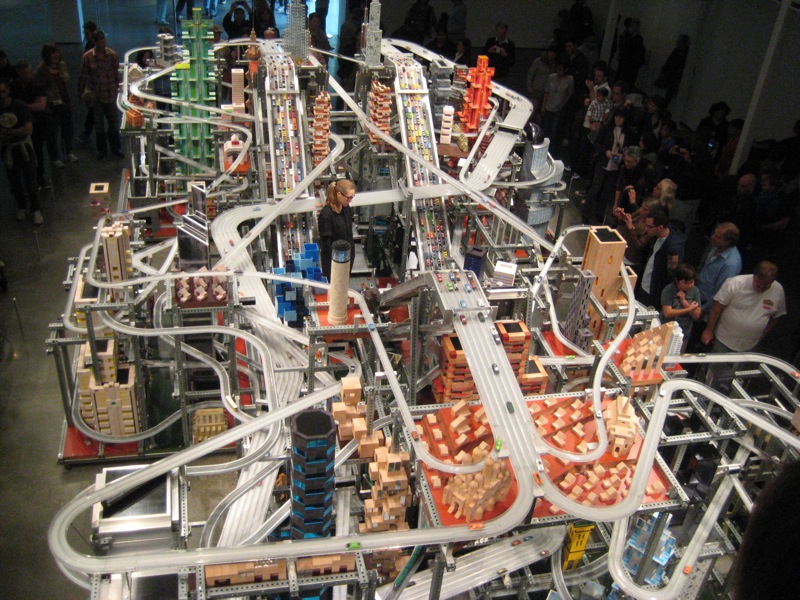
But his massive kinetic sculpture Metropolis II is something else: a child’s fever dream of a Hot Wheels-scale city, with 1,100 cars driving endlessly on 18 roadways, with two ramps that are 12 feet high and three conveyor systems that feed the cars back into the loop. The metal and the electricity needed to run the sculpture means that the thing is not just a sight to behold, but it’s staggeringly loud.
The title of the kinetic sculpture gives away its reference, that of Fritz Lang’s 1927 Metropolis (watch it online) and its imaginary city scapes of elevated freeways and train tracks and people movers and planes that fly in between:
Burden’s work has its own structures too, some of which are made from building blocks, Lego, and Lincoln Logs, turned into houses and skyscrapers. Don’t expect sensible urban planning in this city: seen from above, Metropolis II is a chaos of roads, and closed systems from which there is no escape.
There was a trial run of the sculpture called Metropolis I, a smaller version that was soon sold to a Japanese collector and taken out of the public view.
For the sequel, Burden went bigger, enlisting eight people full time for five and a half years to build the piece. Said the artist:
“We wanted to expand it and make it truly overwhelming — the noise and level of activity are both mesmerizing and anxiety provoking.”
But instead of a nightmare commentary, Burden wanted the piece to be utopian. The cars are moving at 240 mph, according to scale, and there’s no gridlock. He was looking ahead to a future of driverless cars, as he shared a hatred like many Angelenos of endless traffic jams.
The 30 foot wide sculpture was bought for an undisclosed sum by billionaire businessman Nicholas Berggreun, who also sits on LACMA’s board. He’s loaned it to the museum until 2022 and it is currently now situated in a special wing where visitors can see it both at ground level and from above. It takes one assistant to keep it free of hiccups and it only runs for a few hours at a time, and only on weekends.
However, LACMA’s entryway is also home to a Burden piece one can see 24/7, the iconic Urban Light.
Ted Mills is a freelance writer on the arts who currently hosts the FunkZone Podcast. You can also follow him on Twitter at @tedmills, read his other arts writing at tedmills.com and/or watch his films here.
Last week we highlighted for you a beautiful Tree of Languages infographic, created by Minna Sundberg using data from ethnologue.com. This week, we present another visualization of world languages, this one produced by Alberto Lucas Lopéz, on behalf of the South China Morning Post. And, once again, the underlying data comes from ethnologue.com, a research project that catalogues all of the world’s known living languages.
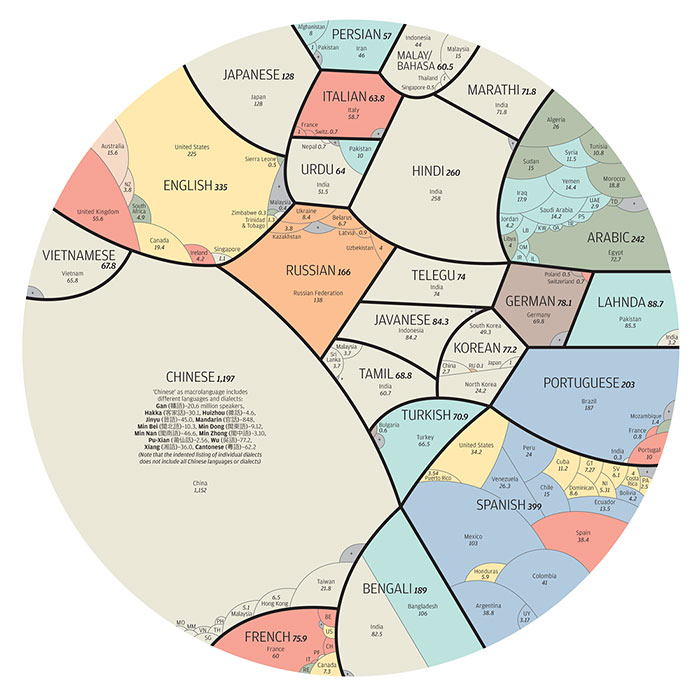
Today’s graphic — click here to view it in a large format — takes the world’s 23 most popular languages, and then gives you a visual sense of how many people actually speak those languages overall, and where geographically those languages are spoken. The more a language is spoken, the more space it gets in the visual.
When you view the original graphic, you’ll note that Chinese speakers outnumber English speakers by a factor of four. And yet English is spoken in 110 countries, as compared to 33 for Chinese. And the number of people learning English worldwide dwarfs the number learning Mandarin.
As you look through Lopéz’s visual, you’ll want to keep one thing in mind: Although the 23 languages visualized above are collectively spoken by 4.1 billion people, there are at least another 6700 known languages alive in the world today. Someone has to cook up a proportional visualization of those. Any takers?
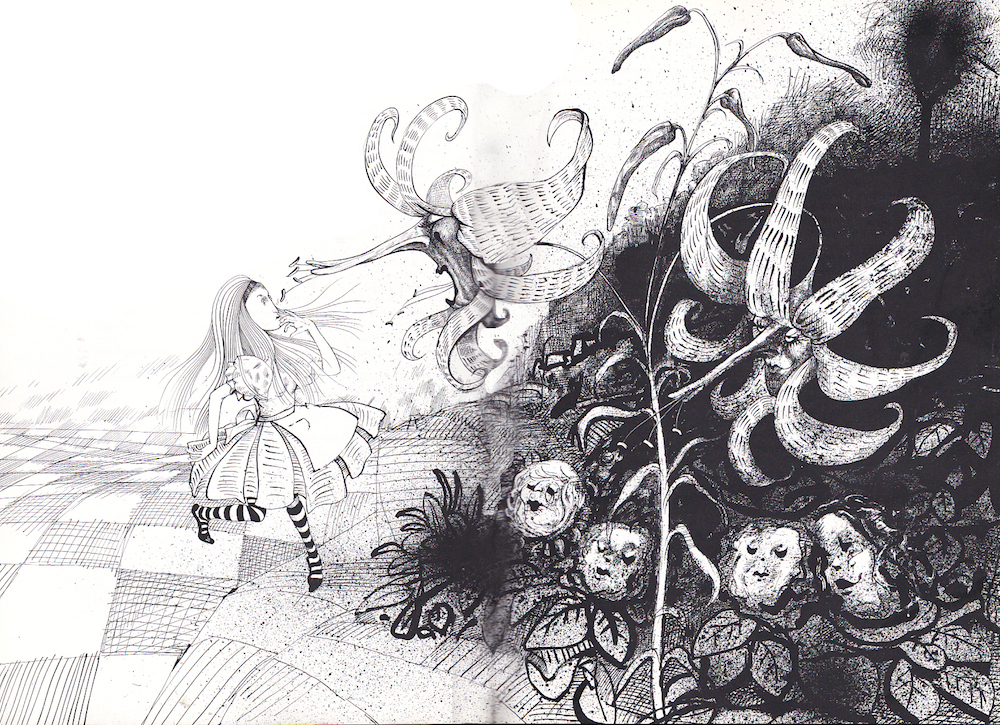
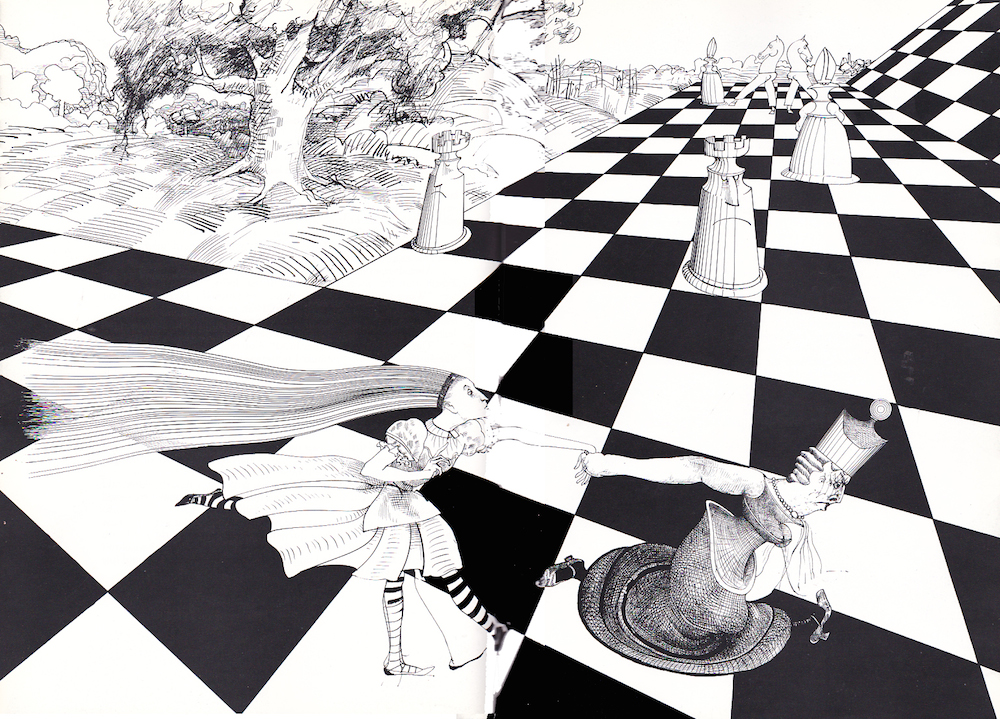
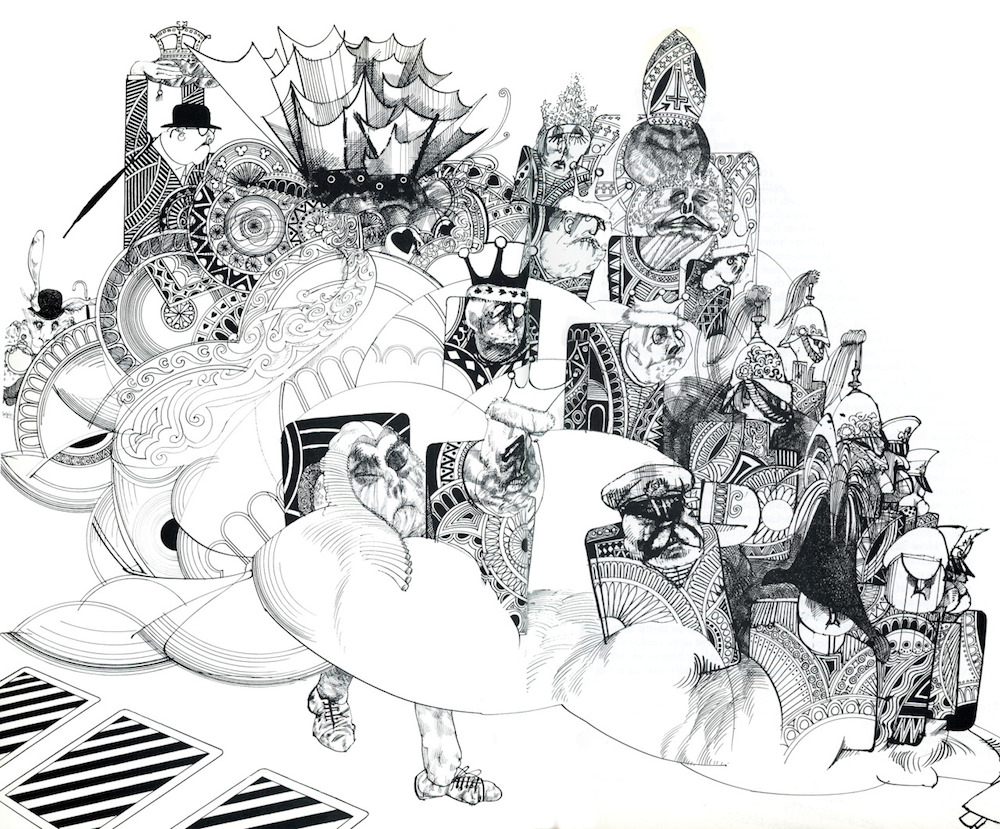
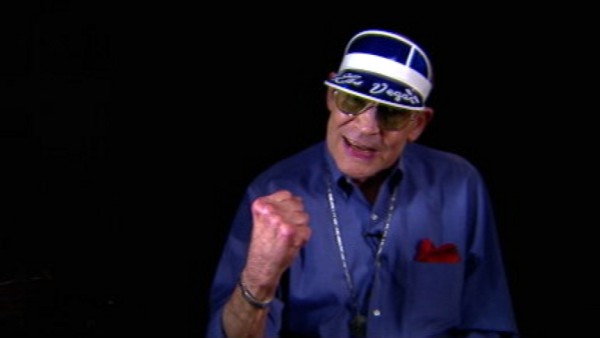
We all know that Alice’s dreamlike journey begins in earnest when she drinks from a bottle labeled “DRINK ME” and eats a cake labeled “EAT ME.” See what metaphors you will, but to my mind, this alone makes the story obvious Steadman material: many of us discover his art through its appearance in Hunter S. Thompson’s Fear and Loathing in Las Vegas, a collaboration that qualifies Steadman as no stranger at all to visualizing unreal circumstances heightened, or induced, by one ingested substance or another.
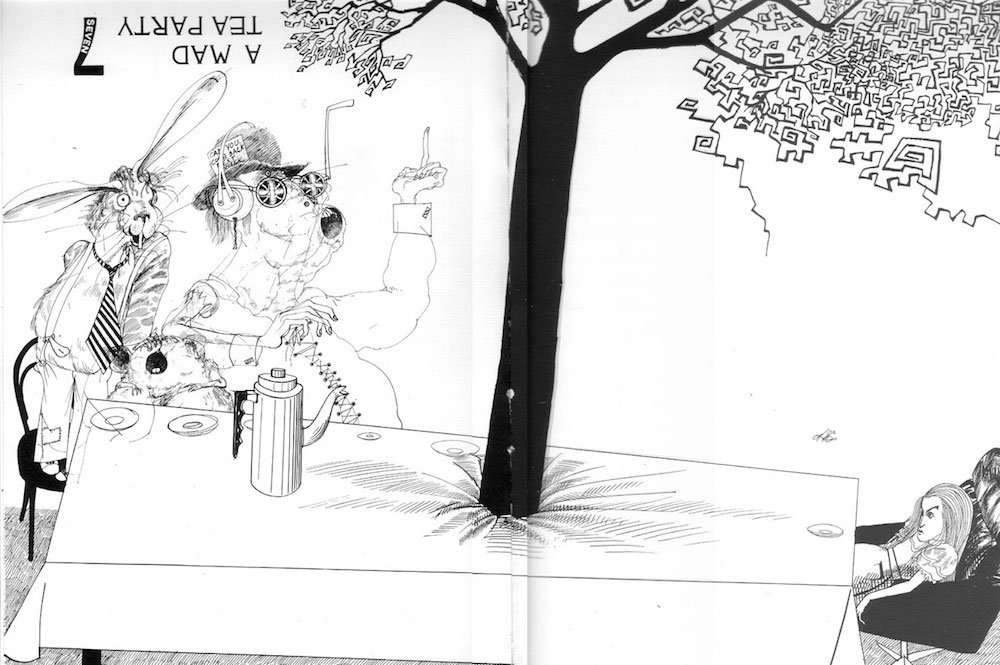
His version, writes io9’s Cyriaque Lamar, “has gone through various print runs throughout the decades, and he modeled several of the characters on decidedly modern personalities. For example, the Cheshire Cat is a television talking head, the Caterpillar is a grass-smoking pedant, the Mad Hatter is a barking quizmaster, and the King and Queen of Hearts are a melting mass of political authority.”
See more of Steadman’spieces by picking up your own copy of the book, or visit Brain Pickings, where Maria Popova describes them as bringing “to Carroll’s classic the perfect kind of semi-sensical visual genius, blending the irreverent with the sublime.” Though by all available evidence thoroughly sane himself, Steadman’s illustrations have, over his fifty-year career, lent just the right notes of English insanity to a variety of subjects, from wine to dogs to psychogeography. Only natural, then, to see them accompany the insanity — which, sentence by sentence and page by page, comes to seem like sanity by other means — of a classic English tale like Alice’s Adventures in Wonderland.
In 1971, Stanford psychology professor Philip Zimbardo undertook a study to determine whether situations determine behavior or whether a person’s disposition leads to behavior regardless of their situation. As seen in the above trailer for the Stanford Prison Experiment, a new film adaptation of Zimbardo’s controversial study, it was explained thusly: people acted like prisoners–lashing out at authority, angry, maladjusted–purely by dint of being put in prisons. And people abused their authority when put in the position of authority. The hypothesis had its basis in the past: the action of Nazi guards at the concentration camps. The results have ramifications through to the present: witness the confessions of the guards who tortured inmates in Abu Ghraib.
The trailer plays like a psychological thriller, but so far it looks true to the record. Prof. Zimbardo–having just earned tenure at Stanford (and played in the film by Billy Crudup)–chose 24 healthy student subjects and randomly assigned them either the role of guard or of prisoner. The Psychology Department’s basement was turned into a mock prison, with holding cells, guard rooms, solitary confinement, and an exercise yard. Cameras recorded all that went on, observed by Zimbardo and his crew. The “guards” could come and go according to shifts, but the “prisoners” could not. While the “guards” could not use physical force on the “prisoners,” they could use as many psychological tactics as possible to break the will of their fellow students. However, the “prisoners” were not told exactly what would happen to them. When, on the first day, the “prisoners” were “arrested” in the morning, stripped, searched, shaved and deloused, they were already in a state of shock. An early documentary exists on the experiment and its results here:
Suffice it to say (and you may have seen this coming) the student guards really got into their roles, and the “prisoners” rebelled. All the while Prof. Zimbardo wanted to keep going for the planned one to two weeks. Only because of the objections of Christina Maslach, a graduate student and Prof. Zimbardo’s girlfriend, did the group abandon the study after six increasingly frightening days. (Proving as well that Prof. Zimbardo was affected by the experiment in ways similar to his subjects, as he was unable to initially stop something out of control.)
“I was guilty of the sin of omission — the evil of inaction — of not providing adequate oversight and surveillance when it was required… the findings came at the expense of human suffering. I am sorry for that and to this day apologize for contributing to this inhumanity.”
The experiment is now used in psychology textbooks as an example of the “psychology of imprisonment.” Prof. Zimbardo turned his science to helping people, looking at promoting heroism in daily life, helping veterans normalize into social life, working with shy people, and, coming full circle, testifying during the court martial of Sgt. Ivan “Chip” Frederick, who was charged with crimes during his time at Abu Ghraib. Zimbardo has since retired and recently advised on the upcoming film. Christina Maslach later married Prof. Zimbardo and is currently Vice Provost for Undergraduate Education at the University of California, Berkeley.
However, there’s some interesting differences. For one, the “victims” of Milgram’s experiment were acting the electric shocks they supposedly received. Despite that level of fakery, Milgram was denied tenure at Harvard. The City University of New York Graduate Center, on the other hand, knew a psychology superstar when they saw one and gave him tenure.
Ted Mills is a freelance writer on the arts who currently hosts the FunkZone Podcast. You can also follow him on Twitter at @tedmills, read his other arts writing at tedmills.com and/or watch his films here.
Many of us in the West live in some of the most fragmented religious landscapes in the world, but in the midst of deepening levels of conflict over policies of birth and death, these two issues that divide us also join us together. More than at any time in history, people live in expectation of similar spans of life; we all lament the loss of loved ones who die at any age; and most of us live with some fear of death, or at least violent, untimely death like the kind Alan Watts describes above.
Watts, English Zen guru of sorts (though he would not like the label) lectured more on death than perhaps any other philosophical or religious teacher since the Buddha, but he did so in a way that illuminates our ideas about the inevitable end, even if it should come upon us all of the sudden.
You heard a bomb coming at you, you could hear it whistle and you knew it was right above you and heading straight at you, and that you were finished.
This is no abstract thought experiment, of course, but the historical experience of millions of people, from Dresden to Iraq. But despite the terrifying example, Watts describes achieving in that moment absolute clarity and universality. The dreaded bomb whistles toward you, “and you accepted it,” he says.
How exactly does one achieve that acceptance? Without dogmatizing or mysticism, Watts offers some wisdom in another excerpt from a lecture above. This video’s use of melodramatic film clips and cinematic music may be a little schmaltzy, but his matter of fact talk isn’t lessened by it. Though not everyone passes on their genes to a next generation, an example he discusses in both excerpts, we do all leave the planet to make room for new people, wherever they come from, and this, he says, “is an honorable thing…. It’s a far more amusing arrangement for nature to continue the process of life through different individuals than it is through the same individual.”
Watts was not at all doctrinaire about death, particularly in his later years. In a conversation with Aldous Huxley’s wife Laura in 1968, he called dying “an art,” though not quite like Sylvia Plath did: “It is also,” he said, “an adventure.” He considered Aldous Huxley’s unorthodox death—on an LSD trip while Laura read to him from the Tibetan Bardo Thodol—a “highly intelligent form of dying.” Nonetheless, Watts, an Episcopal priest become an explainer of Zen Buddhism in America, also had a great deal to say about more formal religious ideas of death.
In the lecture above, from a 1959 American television program, Watts explains a particular Buddhist concept of reincarnation and rebirth through various realms. It’s a picture as fantastic and picturesque as Dante’s, and like his creative act, one that can be read with some literal and much profoundly philosophical significance. These conceptions help demonstrate that far from fearful, our puzzling over the inevitability and mystery of death can be, as it was for Watts, “one of the most creative thoughts I ever thought in my life.”
Last Friday, after we marked the passing of Christopher Lee by featuring his reading of Edgar Allan Poe’s 1845 narrative poem “The Raven,” we stumbled, by chance, upon Lee’s reading of another Poe classic–“The Tell-Tale Heart.” Operating with the theory that there’s no such thing as too much Edgar Allan Poe, and certainly no such thing as too much Christopher Lee reading Edgar Allan Poe, we’ve featured that second reading above. It’ll be added to our collection of Free Audio Books…
If you would like to support the mission of Open Culture, consider making a donation to our site. It’s hard to rely 100% on ads, and your contributions will help us continue providing the best free cultural and educational materials to learners everywhere. You can contribute through PayPal, Patreon, and Venmo (@openculture). Thanks!
I recently talked with a friend who’s planning to schedule a screening of Blade Runner at her film festival. We discussed the important decision that anyone who wants to show Ridley Scott’s Philip K. Dick-adapting masterpiece faces: which Blade Runner? Seven different official cuts exist: many would instinctively choose the 2007 “final cut,” some might prefer the 1992 “director’s cut,” and a curious minority might even like to see the cut originally released in U.S. theaters in 1982, featuring the Harrison Ford voiceover and happy ending that fans now consider ruinous.
But now we have yet another cut of Blade Runner, perhaps the most unusual of them all: a “new” version made out of shots that, even if you’ve seen every official cut of the film, you may never have seen before. “Some enterprising souls have compiled a B‑roll cut of the film, using all of the excised footage that was not incorporated in the previous cuts,” writes Nerdist’s Joseph McCabe. “There’s so much here that most Blade Runner fans have not seen before that it’s absolutely required viewing. I found it worth watching all forty-five minutes just to hear Edward James Olmos’ gruff Gaff hilariously exclaim, ‘I spit on metaphysics!’ ” Not to mention all the new views of the picture’s still-striking production design.
That running time, over an hour shorter than every other cut, effectively condenses Blade Runner into a short film. It doesn’t play quite like any of the widely seen versions of the film, even though it retains the hated narration and incongruous Hollywood ending of the American theatrical cut. But the elements that feel clunky, over-explanatory, and audience-distrusting in a two-hour Blade Runner somehow work better in this briefer rendition. (Certainly Ford’s voiceover, awkward though it always sounds, helps this trimmed-down story cohere.) You haven’t really seen Blade Runner, so many who love the movie feel,until you’ve seen every Blade Runner — but even now, I don’t think we’ve seen the last of them.
Akira Kurosawa’s Seven Samurai (1954) might be over three hours long but you never feel bored. The action scenes never fail to thrill and the characters are so well developed that you genuinely grieve when they die. The epic is so brilliantly realized that it’s no surprise that filmmakers everywhere took note. In The Magnificent Seven(1960), a direct remake of Seven Samurai, Hollywood swapped out katanas for six-shooters and recast the movie as a Western. Other films from The Guns of Navarro to the Bollywood blockbuster Sholay to even Pixar’s A Bug’s Life have drawn heavily from Kurosawa’s masterpiece.
Add to this list Toshifumi Takizawa’s 26-episode animated TV series Samurai 7. The set up is identical to the original — masterless samurais are hired to protect a village from a ruthless gang of bandits — and many of the characters in the animated series have the same names as characters in the original film. But the total running time of the TV show is three times longer than that of Kurosawa’s film, so Takizawa took a few liberties.
The show’s opening scene, for instance, features a massive interstellar battle involving lasers and spaceships. There’s a rusting, elephantine megalopolis straight out of Blade Runner. And also there are robots. The bandits, as it turns out, are more metallic than human, and Kikuchiyo, who was played brilliantly as a drunken wild man by Toshiro Mifune, is in this iteration a grumpy, poorly-constructed cyborg who wields a chainsaw-like sword. The series even has Kirara, a cow-eyed teenaged priestess who sports a midriff-baring kimono.
Either the story elements above sound completely preposterous or totally awesome. If you’re in the former category, you can watch the trailer for Kurosawa’s film below. If you’re in the latter category – and the show is a lot of fun – then you can watch episode 1 above, and catch the rest on Youtube.
Jonathan Crow is a Los Angeles-based writer and filmmaker whose work has appeared in Yahoo!, The Hollywood Reporter, and other publications. You can follow him at @jonccrow. And check out his blog Veeptopus, featuring lots of pictures of vice presidents with octopuses on their heads. The Veeptopus store is here.
The University of the Arts’ most recent grads are lucky ducks to have had a speaker as engaging as cartoonist and educator Lynda Barry delivering their commencement’s keynote address.
Barry kept things lively by mixing in some tried and true material from other public appearances, including her Filipino grandmother’s belief in the aswang, a poem set to music (here “Cotton Song” by Harlem Renaissance poet, Jean Toomer) and the story of the collaborative cartoon, “Chicken Attack by Jack.”
This last anecdote contains a strong indictment of contemporary society’s screen addiction, and it is heartening to see the graduates—members of the last generation to pre-date the Internet—listening so attentively, no one texting or tweeting as the camera pans the crowd.
When Barry exhorted them to shout out the names of their three most inspiring teachers on the count of three, most did!
For me, this was the most thrilling moment, though I also appreciated the advice on the best time to schedule oral surgery, and a blissful untruth about Evergreen State College’s application process circa the mid-70s.
Not your typical commencement speech… those lucky, lucky ducks!
Readers, we invite you to get in the spirit and celebrate the Class of 2015 by “shouting” the names of your most inspirational teachers in the comment section below.
Isaac Asimov, one of the most prolific creators in science-fiction history, wrote or edited more than 500 books in his lifetime, including the high-profile ones we all recognize like I, Robot and the Foundation series (hear a version dramatized here). But which piece of this massive body of work did Asimov himself consider his favorite? Always a fan of clarity, the man didn’t leave that issue shrouded in mystery: the honor belongs to “The Last Question,” which first appeared in the November 1956 issue of Science Fiction Quarterly. It’s now available inIsaac Asimov: The Complete Stories, Vol. 1.
“Why is it my favorite?” Asimov later wrote. “For one thing I got the idea all at once and didn’t have to fiddle with it; and I wrote it in white-heat and scarcely had to change a word. This sort of thing endears any story to any writer.” But it also had, and continues to have, “the strangest effect on my readers. Frequently someone writes to ask me if I can give them the name of a story, which they ‘think’ I may have written, and tell them where to find it. They don’t remember the title but when they describe the story it is invariably ‘The Last Question.’ ”
You certainly won’t forget who wrote the story if you can hear it read by Leonard Nimoy, surely the most distinctive sci-fi narrator of our time, in the video just above. Nimoy first read “The Last Question” aloud for an adaptation staged at Michigan State University’s Abrams Planetarium in 1966, a production that first moved Asimov himself to consider ranking its source material among his best works. Of course, the story would have received none of this retrospective attention, from its author or others, if not for its intellectual content, which comes through vividly no matter how you take it in.
Look past the more entertainingly dated elements — expressions like “for Pete’s sake,” enormous central computers that print all their output on paper slips, an early reference to “highballs” — and you find plenty of elements that qualify as eternal: the ever more rapid expansion of humanity, the ever more rapid progress of technology, and the seemingly ever-faltering ability of the former to maintain dominance over the latter. Within the story’s nine pages, Asimov even digs into scientific concepts like entropy and the heat death of the universe as well as philosophical concepts like the true nature of “forever” and the origin of life, the universe, and everything. If you read only one of Asimov’s stories, he’d surely approve if you made it “The Last Question.” (And if you read two, why not “The Last Answer”?). Find these readings added to our collection, 1,000 Free Audio Books: Download Great Books for Free.
Looking for free, professionally-read audio books from Audible.com, including ones written by Isaac Asimov? Here’s a great, no-strings-attached deal. If you start a 30 day free trial with Audible.com, you can download two free audio books of your choice. Get more details on the offer here.
At 24, some five years before publishing his breakout book, Hell’s Angels, and nearly a decade before branding himself a “gonzo journalist,” the young Hunter S. Thompson was an anonymous freelancer looking to make a name for himself. The year was 1962. Fidel Castro had marched into Havana three years earlier, and the story of the decade — the expanding frontier of the Cold War — was playing out in Latin America. It occurred to Thompson that a hungry cub reporter could build a reputation covering it.
Thompson’s epiphany coincided with the launch of the National Observer, a mildly experimental weekly newspaper published by the Dow Jones Company. Thompson sent a letter introducing himself, said he was headed to South America, and got an invite to submit any stories he wrote along the way. He arrived in Colombia in May of 1962 and, over the course of the next year, traveled through Ecuador, Peru, Bolivia, Paraguay, Argentina, Uruguay, and Brazil. The Observer published some 20 of his stories from or about South America, most of which focused on the continent’s culture and politics, and on how these were affected by a Cold War–era U.S. foreign policy centered around aid and containment.
Six of Thompson’s South America pieces were anthologized in his 1979 collection The Great Shark Hunt(some in a slightly altered form); the rest have been essentially lost for more than 50 years, readable only in a few libraries’ microform collections of the Observer, which folded in 1977. I dug up the whole series while researching my book, The Footloose American: Following the Hunter S. Thompson Trail Across South America(get a copy here). From the outset, I intended to post the articles online somewhere following the book’s publication, so that other readers and researchers can easily access them — and now that the book’s been on shelves for a year, it seemed like time to make good.
As I write in the book — and as I’ve described in The Atlantic and elsewhere — Thompson’s South American reportage offers a glimpse at his emerging style. This is sharp, witty participatory journalism with a keen eye for the absurdities of South American life in the 1960s . The pieces are a mix of straightforward news reporting and more narrative, feature-style articles. The depth of insight into Cold War foreign policy is impressive, and the stories contain some memorable prose: the taxis in Quito, Ecuador, “rolled back and forth like animals looking for meat.” Asuncion, Paraguay, is “an O. Henry kind of place … about as lively as Atlantis, and nearly as isolated.” La Paz, Bolivia, meanwhile, offers “steep hills and high prices, sunny days and cold nights, demonstrations by wild-eyed opposition groups, drunken Indians reeling and shouting through the streets at night — a manic atmosphere.”
We're hoping to rely on loyal readers, rather than erratic ads. Please click the Donate button and support Open Culture. You can use Paypal, Venmo, Patreon, even Crypto! We thank you!
Open Culture scours the web for the best educational media. We find the free courses and audio books you need, the language lessons & educational videos you want, and plenty of enlightenment in between.