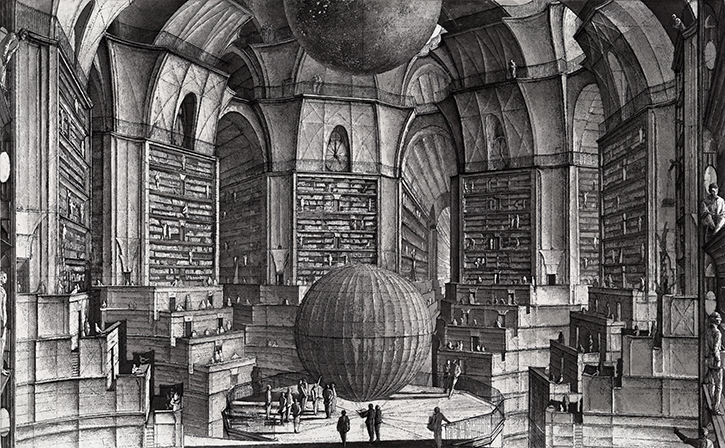
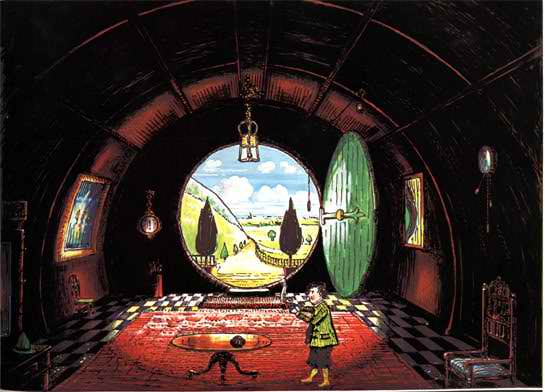
New York-based artist Brian Dettmer cuts into old books with X‑ACTO knives and turns them into remixed works of art. Speaking at TED Youth last November, he told the audience, “I think of my work as sort of a remix .… because I’m working with somebody else’s material in the same way that a D.J. might be working with somebody else’s music.” “I carve into the surface of the book,and I’m not moving or adding anything.I’m just carving around whatever I find interesting.So everything you see within the finished pieceis exactly where it was in the book before I began.”
Dettmer puts on display his pretty fantastic creations, all while explaining how he sees the book — as a body, a technology, a tool, a machine, a landscape, a case study in archaeology. The talk runs six minutes and delivers more than the average TED Talk does in 17.
The recent “adjunct walk out day” has reminded people outside academia—at least those who paid any attention—of the decaying state of American higher education, a condition driven in part by a searing undercurrent of anti-intellectualism in U.S. political culture. It’s a trend historian Richard Hofstadter identified last century in his Pulitzer Prize-winning 1963 study Anti-Intellectualism in American Life. But not long after Hofstadter’s book appeared, another, more vital current took hold in the 60s and 70s, one brought on by the broadening possibilities for those previously denied access to elite universities, and by reciprocal relationships between radicals and scholars. Academics like Timothy Leary became figureheads of the counterculture, revolutionaries like Huey Newton earned Ph.D.s, and activist professors like Angela Davis held the line between the worlds of higher ed and popular dissent. The universities became not only sites of student protest, but also matrices of revolutionary theory.
Into this fomenting intellectual culture stepped French theorist Michel Foucault, who first lectured in the U.S. in 1975 after the publication of his History of Sexuality. Foucault was a true product of the French university system and an academic superstar of sorts, as well as a gadfly of revolutionary movements from Paris in ’68, to Iran in ’79, to Berkeley in the 80s. His work as a philosopher and political dissident prompted one biographer to refer to him as a “militant intellectual,” though his politics could sometimes be as obscure as his prose. By 1981, he had risen to such cultural prominence in the States that Time magazine published a profile of him and his “growing cult.” One of Foucault’s American acolytes, Simeon Wade, befriended the philosopher in the mid-seventies and wrote an unpublished, 121-page account of Foucault’s alleged 1975 LSD trip in Death Valley (referred to in James Miller’s The Passion of Michel Foucault). Wade, along with a number of other University of California students, also interviewed Foucault the following year.
In 1978, Wade published the interview in what may be the most populist of mediums—the fanzine. Titled Chez Foucault, with a dedication “for Michael Stoneman,” the mimeographed document looks on its face like a typical handmade self-publication from the period, with its murky lettering and generally haphazard design. But inside, Chez Foucault is far denser than any chapbook or rock ‘zine. In his preface, Wade describes Chez Foucault as “a workbook I tinkered together for teachers and students in the humanities, social sciences and natural sciences.” Accordingly, in addition to the interview, he includes a synopsis of Foucault’s Discourse on Language, a “transcription” of his Discipline and Punish, a sketch of “The Early Foucault,” and a bibliography, glossary, reading and film list, and veritable course outline. It’s a very rich text that provides a thorough introduction to many of Foucault’s major works. Of principle interest, however, is the interview, seemingly unpublished anywhere else. In it, Foucault elaborates on several of his key concepts, such as the relationship between discourse and power:
I do not want to try to find behind the discourse something which would be the power and which would be the source of the discourse […]. We start from the discourse as it is! […] The kind of analysis I make does not deal with the problem of the speaking subject, but looks at the ways in which the discourse plays a role inside the strategical system in which the power is involved, for which power is working. So power won’t be something outside the discourse. Power won’t be something like a source or the origin of discourse. Power will be something which is working through the discourse.
This concise explanation offers a key to Foucault’s method. Disavowing the labels of both philosopher and historian (he calls himself a “journalist”), Foucault defines his program as “an analysis of discourse, but not with the perspective of ‘point of view.’” (If the distinction is confusing, a reading of his essay “What is an Author?” may help clarify things.) Foucault discusses the biopolitics of power, calling the human body “a productive force,” which “exists in and through a political system.” He also talks about the “political use” of a critical theory such as his, and the possibility of revolutionary philosophy:
I do not think there is such a thing as a conservative philosophy or a revolutionary philosophy. Revolution is a political process; it is an economic process. Revolution is not a philosophical ideology. And that’s important. That’s the reason why something like Hegelian philosophy has been both a revolutionary ideology, a revolutionary method, a revolutionary tool, but also a conservative one. Look at Nietzsche. Nietzsche brought forth wonderful ideas, or tools if you like. He was used by the Nazi Party. Now a lot of Leftist thinkers use him. So we cannot be sure if what we are saying is revolutionary or not.
In honor of Errol Morris’ 67th birthday, which just passed on February 9, Grantland.com is celebrating with a full week of new documentaries shot for ESPN by the filmmaker. Frequently named one of the most important documentary filmmakers of our times, he rose to fame with 1978’s pet cemetery doc Gates of Heaven, then cemented it with The Thin Blue Line, which helped save a man from the electric chair. (It also started his long collaboration with composer Philip Glass.) Morris has been a private investigator, a journalist, and a maker of commercials, all of which provide the mental fuel (and funding) for his filmmaking. He invented the “Interrotron” a variation on the teleprompter, which allowed his subjects to talk straight into the camera while he interviewed them. It added an unsettling jolt to his two conversations with the men voted most likely to be war criminals, Robert McNamara and Donald Rumsfeld. But as Morris says in a Grantland interview, he is not here to accuse or prosecute.
When I was interviewing killers years ago, I enjoyed talking to them. I enjoyed being with them. I wasn’t there to moralize with them or temporize with them, I was there to talk to them. And I think that’s still true. Rumsfeld pushed it, I have to say.
It’s been two years since his last film, the Rumsfeld interview The Unknown Known, and, while we wait for his next feature and possibly a third book, Morris has given us six short docs that range between 10 and 20 minutes. The Subterranean Stadium (at the top of this post) delves into the sub-culture of tabletop electronic football games that have been around since the 1940s, and the grown-ups who still play them.
The Heist examines, with diagrams and suspenseful music, the four college students who stole Michael Jordan’s jersey from the vaulted heights of a stadium.
The Streaker profiles Mark Roberts, the affable Liverpudlian who has streaked at “every major sporting event in the world.”
There are three more videos waiting to be doled out. (Find them here.) One is on A.J. Mass, a writer for ESPN; another about sports collectibles; and the other about horse racing. The constant theme is the particular madness of sports fans, obsession being a major theme of Morris’ work.
The other link in all these films is the sound of Morris, who chooses not to edit out his offscreen voice. It’s the sound of a man clearly having a good time. However:
“I’m sick of interviewing,” he says. “I am really sick of it. I’m not gonna say I do it better than anybody else, but I do it differently than anybody else. I am good at it, for whatever reason. There are a lot of different reasons, but if that’s all I’m going to do for the rest of my life is stick a camera in front of people and say to them, “I don’t have a first question, what’s your first answer?” I think I would be very sad.”
So let’s celebrate Morris before he changes his mind.
Ted Mills is a freelance writer on the arts who currently hosts the FunkZone Podcast. You can also follow him on Twitter at @tedmills and/or watch his films here.
On Monday, the Dutch volunteer organization called Stichting Ambulance Wens Nederland (roughly translated as Ambulance Wish Foundation Netherlands) took three terminally ill patients to see The Late Rembrandt Exhibition currently being held at the Rijksmuseum in Amsterdam. The exhibit features over 100 paintings, drawings and prints that Rembrandt produced during the final phase of his life. And the patients, nearing the end of their lives, wanted to see the exhibit and experience the artistry of the great Dutch painter one last time.
Staffed by 200 medically-trained volunteers, the organization has fulfilled thousands of wishes since its creation in 2007, and they didn’t disappoint this time. As visually documented on its Twitter account, the nonprofit took the guests to the exhibit, each in an ambulance. The museum-goers were then treated to a one-hour private tour of the collection. Some poignant pictures capture the bittersweet moment.
If you would like to sign up for Open Culture’s free email newsletter, please find it here. It’s a great way to see our new posts, all bundled in one email, each day.
If you would like to support the mission of Open Culture, consider making a donation to our site. It’s hard to rely 100% on ads, and your contributions will help us continue providing the best free cultural and educational materials to learners everywhere. You can contribute through PayPal, Patreon, and Venmo (@openculture). Thanks!
Kagonada, the video-essayist behind the cinematic supercuts of Kubrick’s “One-Point Perspective” and Ozu’s “Passageways” returns with a look at mirrors in the films of Ingmar Bergman, set to a plaintive Vivaldi work for two mandolins, and a reading of Sylvia Plath’s “Mirror.”
Mirrors and reflections turn up right in the beginning of Bergman’s films as a motif, when Jenny, the middle-aged protagonist of Crisis exclaims to her image, “You can’t see from the outside, but beneath this face … oh, my God!” Mirrors show their viewers a true face behind the mask in his films, mortality, failure, duplicity–everything fake stripped away. It’s a time to take stock and a time to break down.
It’s quite lovely, this cut, with Plath’s description of her wall “pink, with speckles” matching the color shot from Fanny & Alexander; or “Faces and darkness separate us over and over” as Nine-Christine Jönsson draws a frowny face and writes “lonely” on her reflection from Port of Call. The video is also a tribute to Bergman’s favorite actresses, from Harriet Andersson to Liv Ullmann.
Incidentally, Sylvia Plath was not just a fan of the filmmaker, she based her poem “Three Women” on Bergman’s film So Close to Life (aka Brink of Life) which she had seen in a London cinema in either 1961 or 1962.
If you would like to sign up for Open Culture’s free email newsletter, please find it here. It’s a great way to see our new posts, all bundled in one email, each day.
If you would like to support the mission of Open Culture, consider making a donation to our site. It’s hard to rely 100% on ads, and your contributions will help us continue providing the best free cultural and educational materials to learners everywhere. You can contribute through PayPal, Patreon, and Venmo (@openculture). Thanks!
Ted Mills is a freelance writer on the arts who currently hosts the FunkZone Podcast. You can also follow him on Twitter at @tedmills and/or watch his films here.
In January, we featured series of short animations from BBC Radio 4 addressing the question “How Did Everything Begin?” In February, we featured its follow-up on an equally eternal question, “What Makes Us Human?” Both came scripted by Philosophy Bites co-creator Nigel Warburton and narrated by X‑Files co-star Gillian Anderson (in full British mode). Now that March has come, so has the next installment of these brief, crisp, curiosity-fueled productions: “Has Technology Changed Us?”
In a word: yes. But then, everything we do has always changed us, thanks to the property of the brain we now call “plasticity.” This we learn from the video, “Rewiring the Brain” (right below), which, balancing its heartening neuroscientific evidence with the proverbial old dog’s ability to learn new tricks, also tells of the “attention disorders, screen addictions, and poor social skills” that may have already begun plaguing the younger generation.
The video actually spells out McLuhan’s own explanation of that much-quoted line: “What has been communicated has been less important than the particular medium through which people communicate.” Whether you buy that notion or not, the whole range of proclamations McLuhan had on the subject will certainly get you thinking — in his own words, “You don’t like these ideas? I got others.”
The other two videos in this series, despite their short length, get into other intriguing related concepts: “The Fourth Revolution” that comes as a result of life in a “mass age of information and data,” and the workings of “The Antikythera Mechanism,” the first computer ever built. Our personal technology has certainly come a long way, but we shouldn’t fall into complacency about it, lest, as Anderson says in this series, it all wrecks our attention spans and “education will all have to be delivered in two-minute animations.”
Beer, that favorite beverage of football fans, frat boys, and other macho stereotypes—at least according to the advertisers—actually has a very long, distinguished heritage. It’s older, in fact, than wine, older than whiskey, older perhaps even than bread (or so some scholars have thought). As soon as humans settled down and learned to cultivate grains, some 13,000 years ago, the possibility for fermentation—a naturally occurring phenomenon—presented itself. But it isn’t until the 5th century, B.C. that we have sources documenting the deliberate production of ale in ancient Sumeria. Nonetheless, beer has been described as the “midwife of civilization” due to its central role in agriculture, trade, urbanization, and medicine.
Beer became so important to ancient Mesopotamian culture that the Sumerians created a goddess of brewing and beer, Ninkasi, and one anonymous poet, smitten with her powers, penned a hymn to her in 1800 B.C.. A daughter of the powerful creator Enki and Ninti, “queen of the sacred lake,” Ninkasi is all the more poignant a deity given the role of women in ancient culture as respected brewers. The “Hymn to Ninkasi,” which you can read below, not only provides insight into the importance of this custom in Sumerian mythology, but it also gives us a recipe for brewing ancient Sumerian beer—the oldest beer recipe we have.
Translated from two clay tablets by Miguel Civil, Professor of Sumerology at the University of Chicago, the poem contains instructions precise enough that Fritz Maytag, founder of the Anchor Brewing Company in San Francisco, took it upon himself to try them. He presented the results at the annual meeting of the American Association of Micro Brewers in 1991. The brewers, writes Civil, “were able to taste ‘Ninkasi Beer,’ sipping it from large jugs with drinking straws as they did four millennia ago. The beer had an alcohol concentration of 3.5%, very similar to modern beers, and had a ‘dry taste lacking in bitterness,’ ‘similar to hard apple cider.’” A challenge to all you home brewers out there.
Unfortunately, Maytag was unable to bottle and retail the recreation, since ancient Mesopotamian beer “was brewed for immediate consumption” and “did not keep very well.” But what Civil learned from the experiment was that his translation—in the hands of a master brewer “who saw through the difficult terminology and poetic metaphors”—produced results. Below, see the first part of the “Hymn to Ninkasi,” which describes “in poetic terms the step-by-step process of Sumerian beer brewing.” A second part of the hymn “celebrates the containers in which the beer is brewed and served” and “includes the toasts usual in tavern and drinking songs.” You can read that joyful text—which includes the line “With joy in the heat [and] a happy liver”—on page 4 of Professor Civil’s article on the Hymn.
Hymn to Ninkasi (Part I)
Borne of the flowing water,
Tenderly cared for by the Ninhursag,
Borne of the flowing water,
Tenderly cared for by the Ninhursag,
Having founded your town by the sacred lake,
She finished its great walls for you,
Ninkasi, having founded your town by the sacred lake,
She finished it’s walls for you,
Your father is Enki, Lord Nidimmud,
Your mother is Ninti, the queen of the sacred lake.
Ninkasi, your father is Enki, Lord Nidimmud,
Your mother is Ninti, the queen of the sacred lake.
You are the one who handles the dough [and] with a big shovel,
Mixing in a pit, the bappir with sweet aromatics,
Ninkasi, you are the one who handles the dough [and] with a big shovel,
Mixing in a pit, the bappir with [date] — honey,
You are the one who bakes the bappir in the big oven,
Puts in order the piles of hulled grains,
Ninkasi, you are the one who bakes the bappir in the big oven,
Puts in order the piles of hulled grains,
You are the one who waters the malt set on the ground,
The noble dogs keep away even the potentates,
Ninkasi, you are the one who waters the malt set on the ground,
The noble dogs keep away even the potentates,
You are the one who soaks the malt in a jar,
The waves rise, the waves fall.
Ninkasi, you are the one who soaks the malt in a jar,
The waves rise, the waves fall.
You are the one who spreads the cooked mash on large reed mats,
Coolness overcomes,
Ninkasi, you are the one who spreads the cooked mash on large reed mats,
Coolness overcomes,
You are the one who holds with both hands the great sweet wort,
Brewing [it] with honey [and] wine
(You the sweet wort to the vessel)
Ninkasi, (…)(You the sweet wort to the vessel)
The filtering vat, which makes a pleasant sound,
You place appropriately on a large collector vat.
Ninkasi, the filtering vat, which makes a pleasant sound,
You place appropriately on a large collector vat.
When you pour out the filtered beer of the collector vat,
It is [like] the onrush of Tigris and Euphrates.
Ninkasi, you are the one who pours out the filtered beer of the collector vat,
It is [like] the onrush of Tigris and Euphrates.
Humorist James Thurber never tired of subjecting puny male milquetoasts to powerful female bullies.
In his view, members of the fairer sex were never femme fatales or fussy matrons, but rather battle-loving warriors in simple Wilma Flintstone-esque frocks. They are immune to the traditionally feminine concerns of the period—hair, children, the living room drapes… they get their pleasure dominating Walter Mitty and his ilk.
(Was he terrified of Woman? Resentful of her? The story he stuck to was that he’d conceived of his comic portrayal for the sole purpose of “egging her on.”)
There is one memorable instance where the little guy was allowed to come out on top. “The Unicorn in the Garden” is a story first published in The New Yorker on October 31, 1939. No spoilers, but there’s a close resemblance to Harvey, Mary Chase’s much-produced play about a mild-mannered gent whose devotion to a 6’ tall invisible rabbit drives his domineering sister around the bend.
The 1953 cartoon adaptation above brought Thurber’s drawings to life, whilst preserving the dialogue of the original in its entirety. The original story was published with only a single illustration, but director William T. Hurtz’s had hundreds of New Yorker cartoons to draw upon. Legend has it that Hurtz purposefully assigned some of United Productions of America’s least gifted animators to the project, hoping to duplicate Thurber’s ”nice, lumpy look.” The plan was for “The Unicorn in the Garden” to be part of a full-length Thurber feature,but alas, the studio pulled the plug on Men, Women and Dogs before it could be completed. Moral: Don’t count your boobies until they are hatched.
If you know of Victor Hugo, you most likely know him as the man of letters who wrote books like Les Misérables and Notre-Dame de Paris (better known in English as The Hunchback of Notre-Dame). If you know something else about him, it probably has to do with his politics: King Louis-Philippe granted him peerage in 1841, and he became a member of the French Parliament in 1848. This position gave him something of a pulpit from which to speak on his pet causes: abolition of the death penalty, freedom of the press, universal suffrage and education, and — lest anyone call the ambitions of his secondary career minor — the end of poverty.
But this sensibility made Hugo no friend of Napoleon III, who took power in 1851, and so the writer went into political exile in Guernsey. That year marked the end of a period, beginning with his election to Parliament, during which Hugo put writing aside in order to devote himself fully to politics — well, almost fully. Even as he laid down his writing pen, he picked up his drawing pen, producing the images you see here and many, many more.
Hugo, writes The Paris Review’s Dan Piepenbring, “made some four thousand drawings over the course of his life. He was an adept draftsman, even an experimental one: he sometimes drew with his nondominant hand or when looking away from the page. If pen and ink were not available, he had recourse to soot, coal dust, and coffee grounds.” The Tate’s Christopher Turner writes of rumors “that he used blood pricked from his own veins in his many drawings.” Whatever liquid substance he used, in the drawing at the top we can see “a giant, menacing octopus, fashioned from a single stain [that] contorts its suckered limbs into the initials VH.”
A bold signature indeed, but then, Hugo hardly played the shrinking violet in any domain. And yet, so as not to distract from the rest of his career, he seldom showed his drawings to anyone but family and friends, coming no closer to publishing anything any of his art than the hand-drawn calling cards he handed visitors in his period of exile. No less a painter than Eugène Delacroix, when he saw these drawings, thought that if Hugo hadn’t become a writer, he could have become one of the 19th century’s greatest artists instead. I’d certainly like to see what Andrew Lloyd Webber would have adapted that octopus into.
Matt Zoller Seitz is easily one of the finest film critics working today. Over the years, he has done quite a lot of work unpacking the dense visual world of filmmaker Wes Anderson, culminating in a gorgeous coffee table book called, aptly, The Wes Anderson Collection. Today you can explore a series of video essays that delve into the filmmaker’s work. Zoller Seitz argues that Anderson’s distinctive look is not merely empty aesthetics. Instead, he asserts that there is substance to Anderson’s style.
The first video outlines three of Anderson’s biggest cinematic influences. The filmmaker’s love of virtuous camera moves and preoccupation with fallen geniuses can be traced right back to Orson Welles. His focus on young people struggling to find peace in the adult world is influenced by Francois Truffaut, particularly his masterpiece 400 Blows. And the third, and perhaps most surprising, influence is Charles Schulz’s comic strip Peanuts.
While the previous videos come close to hagiography, the third video compares Anderson with another obvious influence Hal Ashby. It’s just about impossible to imagine Anderson’s delightfully twee world and deadpan humor without Ashby’s Harold and Maude. Like Anderson, Ashby too slipped effortlessly between different tones and different genres. But Anderson’s movies focus exclusively on upper class white people, something that he has been frequently criticized for. Ashby’s movies, on the other hand, cast a much wider socio-economic net. After watching this video, you get the sense that Ashby might be the better filmmaker.
The fourth video lays out how Anderson’s tendency of defining characters through their wardrobe goes right back to writer J.D. Salinger.
And with the fifth and final video, Zoller Seitz pulls together all of his arguments by annotating the prologue to arguably Anderson’s best and most influential movie, The Royal Tenenbaums.
Jonathan Crow is a Los Angeles-based writer and filmmaker whose work has appeared in Yahoo!, The Hollywood Reporter, and other publications. You can follow him at @jonccrow. And check out his blog Veeptopus, featuring lots of pictures of badgers and even more pictures of vice presidents with octopuses on their heads. The Veeptopus store is here.
If you have toured the home of a famed writer, seen the desk at which they worked, or visited their grave, you are a literary pilgrim, partaking in a form of tourism first popular in the Victorian era. In our free e‑book for March, Freud’s Couch, Scott’s Buttocks, Brontë’s Grave, Simon Goldhill makes a pilgrimage to Sir Walter Scott’s baronial mansion, Wordsworth’s cottage in the Lake District, the Brontë parsonage, Shakespeare’s birthplace, and Freud’s office in Hampstead. He gamely negotiates distractions ranging from broken bicycles to a flock of giggling Japanese schoolgirls, as he tries to discern what our forebears were looking for at these sites, as well as what they have to say to the modern pilgrim. Take your literary pilgrimage in our free e‑book, Freud’s Couch, Scott’s Buttocks, Brontë’s Grave.
If you would like to sign up for Open Culture’s free email newsletter, please find it here. It’s a great way to see our new posts, all bundled in one email, each day.
If you would like to support the mission of Open Culture, consider making a donation to our site. It’s hard to rely 100% on ads, and your contributions will help us continue providing the best free cultural and educational materials to learners everywhere. You can contribute through PayPal, Patreon, and Venmo (@openculture). Thanks!
We're hoping to rely on loyal readers, rather than erratic ads. Please click the Donate button and support Open Culture. You can use Paypal, Venmo, Patreon, even Crypto! We thank you!
Open Culture scours the web for the best educational media. We find the free courses and audio books you need, the language lessons & educational videos you want, and plenty of enlightenment in between.