Europeans do weird things with American folk music. Sometimes they do horrible things, like the 1994 techno rendition of traditional country song “Cotton-Eyed Joe” by a Swedish act who called themselves “Rednex” and who dressed up like cartoonish hillbillies in a parody only slightly less offensive than their music. In the video above, we have three continents colliding for another Scandinavian appropriation of Appalachian tropes, by way of a cover of “Thunderstruck” by Aussies AC/DC. The Finnish bluegrass band Steve ‘N’ Seagulls has achieved viral notoriety with their most recent release, which features banjo, mandolin, upright bass, accordion, a drummer who plays the spoons, and an anvil. Oh, and of course a wardrobe of overalls and suspenders without shirts. And the accordion player arrives on the scene on a riding mower.
Offensive? I don’t know—where Rednex was clearly minstrelsy, this has the feel of a fond tribute to a culture whose musical traditions Steve ‘N’ Seagulls clearly adores, though their wearing of Native headdress (below) would not sit well with certain music festival organizers.
As for their take on AC/DC; I almost prefer it to the original, though one Metafilter user pointed out that being able to hear the lyrics with such clarity does confirm one’s suspicion that they’re completely inane. And lest you think Steve ‘N’ Seagulls is some one-cover-hit wonder, check out their covers of Iron Maiden’s “The Trooper” above and Dio’s “Holy Diver” below.
If you read the novels and stories of Ursula K. LeGuin and J.G. Ballard, you drop yourself into invented realities both overwhelmingly alien and unsettlingly familiar. And if you heard them on the radio — That Most Intimate of All Media, so they say — wouldn’t those qualities take on a new intensity? Thanks to CBC Radio’s Vanishing Point, a science-fiction anthology series which ran from the mid-1980s to the early 90s, you can do just that and find out for yourself what it feels like to have them piped more or less directly into your mind’s eye. Fans of both LeGuin and Ballard may take exception to the straight labeling of them as “science fiction” authors, and rightly so. The former’s work belongs as much to the tradition of fantasy as to that of sci-fi, and in both modes does a lot of detailed sociological world-building; the latter’s dark psychological dimension and near-nonfictional use of the modern world always prevented easy categorization. Still, I suspect that the makers of Vanishing Point not just knew all this, but understood its appeal.
They must also have realized that neither LeGuin nor Ballard had grown famous for their adaptability. LeGuin’s The Lathe of Heaven got made twice for television, to varying opinions; opinions varied even more when her Earthsea books more recently became a Sci Fi Channel miniseries and a film from Hayao Miyazaki’s animation studio. Ballard’s novel of auto-wreck-eroticism Crash became a cult favorite in the hands of David Cronenberg, but usually his work crosses into other media in a more bizarre fashion (such as the television short of Crash we featured last year). But radio can handle pretty much anything such imaginative writers can throw at it, as you’ll hear in Vanishing Point’s six-part adaptation of LeGuin’s The Dispossessed at the top of the post, or in the Internet Archive playlist of its six adapted Ballard stories just above. History, alas, hasn’t recorded the reaction that LeGuin, always outspoken about others’ treatments of her worlds, had to these CBC dramas. When Rick McGrath of jgballard.ca sent Ballard himself CDs of all the productions in 2004, he received “a great note from him explaining he’d love to listen to them, but he has yet to buy a CD player.” And if I had to make a guess, I’d say that visionary of our alienated, fragmented technological future never got around to picking one up.
Find more sci-fi radio dramatizations in the relateds below.
Rookie’s never less than worthy “Ask a Grown Man” series provides a forum for mature males like actor Jon Hamm and radio personality Ira Glass to offer thoughtful, straightforward advice and explanations, born of personal experience, to teenage girls (and other interested parties).
The most recent edition adds depth, and could just as accurately be titled “Ask a Level-Headed 50-Year-Old Father of Three, Who’s Been Happily Married to His Children’s Mother for Years.”
Lurking just beneath Stephen Colbert’s hawkish Colbert Report persona is a fair-minded, serious fellow, who’s unembarrassed to weigh in in favor of parental authority when a 19-year-old fan complains of her dad’s opposition to sleepovers at her boyfriend’s place while she’s still living at home. Perhaps she should’ve asked a grown man whom experience hadn’t equipped to see things from the other side of the fence, as Colbert foresees that his answer won’t “go over great with everyone.”
Perhaps this segment should be called “Ask a Grown Man Whose Unequivocating Moral Compass Is Inconveniently Close to Your Dad’s, But Whose Position Allows Him to Offer Insights Without Losing His Temper or Going Off Message.”
Colbert’s children’s extremely low profile in the media’s line up of celebrity offspring reflects well on those charged with their upbringing. Were his 18-year-old daughter to take issue with the old man’s musings on Twitter or Snapchat, she’d have the luxury of doing so in the way of the average Rookie reader, rather than some obsessively observed nearly-grown baby bump.
As to how to tell whether a boy—or anyone—likes you, Colbert says “they want to hear your stories.”
As one viewer noted, “ask a grown-up, get grown-up answers.” Word.
My first reaction upon learning about Bob Dylan’s brief conversion to Evangelical Christianity may have been something like “What in the hell?” It wasn’t a religious Dylan that surprised me; it was Dylan embracing a faith that can often seem doggedly literal and, well, just a little inflexible. What with his love of ambiguity, of occult symbolism and symbolist poetry, and his resolute contempt for convention, Dylan has always struck me as more of an ancient Gnostic than a modern Bible thumper. While Dylan’s immersion in the Christian world may have been brief, it was deep, and it was confusing—enough so that Andy Greene in Rolling Stone comments that his proselytizing from the stage “took audience provocation to the next level.”
In his gospel shows of 1979/80, Dylan presented “a night of music devoted exclusively to selections from his new gospel records, often pausing for long, rambling sermons about Christ’s imminent return and the wickedness of man.” Hear one of those sermons at the top, a seven-minute theological disquisition, before Dylan and band launch into a powerful performance of “Solid Rock.” Just above, in another sermon from 1979, Dylan holds forth on the “spirit of the Antichrist” before an unsympathetic crowd in Tempe, Arizona. That same year, he gave an interview to Bruce Heiman of KMGX Radio in Tucson on the subject of his conversion (below).
In a certain way, a Dylan obsessed with divine judgment and the book of Revelation jibes with his pursuit of the arcane and the mystical, with his consistently apocalyptic vision, prophetic mumblings, and tendency to moralize. But the preaching is just…. well, kinda weird. I mean, not even Dylan’s friend, the deeply devout Johnny Cash, used his musical platform to harangue audiences about the Bible. Was it a stunt or a genuine, if perhaps overzealous, expression of deeply held beliefs? That question could be asked of almost every move Dylan has ever made. This brief period of very public religiosity may seem anomalous, but Dylan’s interest in religion is not. Google his name and any faith term, and you’ll see suggestions for “Dylan and Islam,” “Dylan and Buddhism,” “Dylan and Catholicism,” and, of course, “Dylan and Judaism,” the religion of his birth. Some contend that Dylan still keeps faith with Jesus, and that it doesn’t mutually exclude his Jewishness.
And yet, how Dylan’s Christian preaching could line up with his later commitment to Chabad—an Orthodox Hasidic movement that isn’t exactly warm to the idea of the Christian messiah, to put it mildly—is beyond my ken. But logical consistency does not rank highly on any list of virtues I’m familiar with. Dylan seemed to be reconnecting with Judaism when he explicitly expressed solidarity with Israel in 1983 in his Zionist anthem “Neighborhood Bully” from Infidels, in other respects, a wholly secular record.
Three years later, Dylan appeared on the Chabad telethon (above), accompanying his son-in-law Peter Himmelman on harmonica in a rendition of “Hava Nagila,” along with, of all people, Harry Dean Stanton (whose chilling turn as polygamous Mormon sect leader in HBO’s Big Love you may well recall). By this time, at least according to Jewish Journal, “Chabad rabbis had helped Dylan return to Judaism after the musician embraced Christianity for a time.” The mid-90s saw Dylan worshipping with Brooklyn Lubavitchers, and in 2007, he was sighted in Atlanta at Yom Kippur services at the Chabad-Lubavitch of Georgia, saying the “blessings in Hebrew without stumbling, like a pro.”
So is Bob Dylan a firebreathing Christian or an Orthodox Jew? Or, somehow… both? Only Dylan knows, and frankly, only Dylan needs to. His beliefs are his business, but his public expressions of faith have given his fans much to puzzle over, reading the lyrical tea leaves for evidence of a solid rock center amidst the shifting sands of Dylanology. Let ‘em sift. Some people obsess over Dylan’s religious commitments, others over his “secret” wife and daughter, his corporate sellouts, or his sometimes inscrutable personal politics. It’s all part of the business of fame. What I find fascinating about the many layers of Bob Dylan is not how much they tell me about the man, who has the right to change his mind, or not, as often as he likes, but how much they reveal about his strange lyrical themes. After all, Dylan’s seemingly contradictory allegiances and ambivalent identities as an artist may in in fact make him all the more the archetypal American songwriter he’s always said to be.
Sophocles and Aeschylus may be spinning in their graves. Or, who knows, they may be taking some delight in this bizarre twist on the Oedipus myth. Running 8 minutes, Jason Wishnow’s 2004 film puts vegetables in the starring roles. One of the first stop-motion films shot with a digital still camera, Oedipus took two years to make with a volunteer staff of 100. But the hard work paid off.
The film has since been screened at 70+ film festivals and was eventually acquired by the Sundance Channel. Separate videos show you the behind-the-scenes making of the film (middle), plus the storyboards used during production (bottom). This video first appeared on our site in 2011, and, stellar as it is, we’re delighted to bring it back for readers who have joined us since. Hope you enjoy.
Most everyone who comments on the phenomenon of the supergroup will feel the need to point out that such bands rarely transcend the sum of their parts, and this is mostly true. But it does seem that for a certain period of time in the late sixties, many of the best bands were supergroups, or had at least two or more “super” members. Take the Yardbirds, for example, which contained, though not all at once, Jimmy Page, Jeff Beck, and Eric Clapton. Or Cream, with Clapton, Jack Bruce, and Ginger Baker. Or Blind Faith—with Clapton, Baker, and Steve Winwood…. Maybe it’s fair to say that every band Clapton played in was “super,” including, for a brief time, John Lennon and Yoko Ono’s Plastic Ono Band.
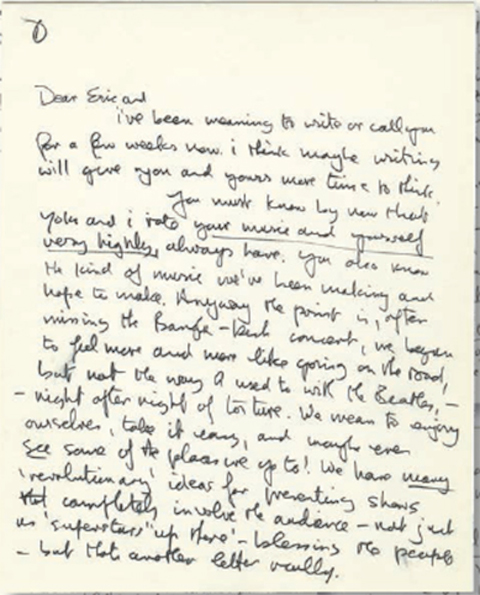
It started with the one-off performance above in Toronto, which led to an undated eight-page letter Lennon wrote Clapton, either in 1969, according to Booktryst, or 1971, according to Michael Schumacher’s Clapton bio Crossroads. The letter we have–well over a thousand words–is a draft. Lennon’s revised copy has not surfaced, and, writes Booktryst, “the content of the final version is unknown.” In this copy (first page at top), Lennon praises Clapton’s work and details his and Yoko’s plans for a “revolutionary” project quite unlike Lennon’s former band. As he puts it, “we began to feel more and more like going on the road, but not the way I used to with the Beatles—night after night of torture. We mean to enjoy ourselves, take it easy, and maybe even see some of the places we go to!”
Lennon explicitly states that he does not want the band to be a supergroup, even as he recruits super members like Clapton and Phil Spector: “We have many ‘revolutionary’ ideas for presenting shows that completely involve the audience—not just as ‘Superstars’ up there—blessing the people.” While Lennon and Ono don’t expect their recruits to “ratify everything we believe politically,” they do state their intention for “’revolutionizing’ the world thru music.” “We’d love to ‘do’ Russia, China, Hungary, Poland, etc.,” writes Lennon. Later in the missive, he explains his detailed plan for the Plastic Ono Band tour he had in mind—involving a cruise ship, film crew, and the band’s “families, children whatever”:
How about a kind of ‘Easy Rider’ at sea. I mean we get EMI or some film co., to finance a big ship with 30 people aboard (including crew)—we take 8 track recording equipment with us (mine probably) movie equipment—and we rehearse on the way over—record if we want, play anywhere we fancy—say we film from L.A. to Tahiti […] The whole trip could take 3–4‑5–6 months, depending how we all felt.
It sounds like an outlandish proposal, but if you’re John Lennon, I imagine nothing of this sort seems beyond reach—though how he expected to get to Eastern Europe from the Pacific Rim on his ship isn’t quite clear. The problem for Clapton, biographer Michael Schumacher speculates, would have had nothing to do with the music and everything to do with his addiction: “after all his problems with securing drugs in the biggest city in the United States, Clapton couldn’t begin to entertain the notion of spending lengthy periods at sea and trying to obtain heroin in foreign countries.” In any case, “in the end, Lennon’s proposal, like so many of his improbable but compelling ideas, fell through.” This may have had some relation to the fact that Lennon had a heroin problem of his own at the time.
The clip of Clapton performing with the band comes from Sweet Toronto, a 1971 film made by D.A. Pennebaker of the band’s performance at the 1969 Toronto Rock and Roll Revival Festival (see the full film above). That event had a wholly improbable lineup of ‘50s stars like Chuck Berry, Little Richard, Jerry Lee Lewis, and Bo Diddley alongside bands like Alice Cooper, Chicago, and The Doors. As the title opening of the film states, “John could at last introduce Yoko to the heroes of his childhood.” Pennebaker gives us snippets of the performance from each of Lennon’s heroes—opening with Diddley, then Lewis, Berry, and Little Richard—before the Plastic Ono Band with Clapton appear at 16:43. (This performance also produced their first album.) The Beatles Bible has a full rundown of the festival and the band’s somewhat shambolic, bluesy—and with Yoko, screechy—show.
Read the full transcript and see more scans of Lennon’s draft letter to Clapton over at Booktryst, who also explain the cryptic references to “Eric and,” “you both,” and “you and yours”—part of the “soap opera” affair involving Clapton, George Harrison’s (and later Clapton’s) wife Pattie Boyd, and her 17-year-old sister Paula.
Is it possible for a short film made during the Nixon administration to perfectly describe America’s current, completely screwed up political situation? Sure, Lee Mishkin’s Oscar-winning animated short Is It Always Right to Be Right? (1970) might date itself through oblique references to hippies, the Vietnam war and the Civil Rights movement, not to mention the movie’s groovy animation style, but the message of the movie feels surprisingly relevant today. You can watch the movie above.
The short, which is narrated by none other than Orson Welles, describes a land where everyone believed themselves to be right, and where indecisiveness and complexity were considered utterly weak. “When differences arose between the people of this land,” intones Welles at one point, “they looked not for truth but for confirmation for what they already believed.”
Wow, that sounds just like cable news. As the divisions grew and deepened, the land eventually ground to a halt. “Everyone was right, of course. And they knew it. And were proud of it. And the gap grew wider until the day came when all activity stopped. Each group stood in its solitary rightness, glaring with proud eyes at those too blind to see their truth, determined to maintain their position at all costs. This is the responsibility of being right.” Wow, that sounds like Congress.
Then someone tried to temper this stark black-and-white world by saying things like “I might be wrong,” which starts a cascade of introspection and tolerance. Ah, the 70s – that innocent time before the 24-hour news cycle. A time before network execs realized that bloviating morons preaching the rightness of their own position just plain makes good TV.
A year later, you might be interested to know, Orson Welles narrated another animated parable. Watch Freedom River here.
Jonathan Crow is a Los Angeles-based writer and filmmaker whose work has appeared in Yahoo!, The Hollywood Reporter, and other publications. You can follow him at @jonccrow. And check out his blog Veeptopus, featuring one new drawing of a vice president with an octopus on his head daily.
Michel Foucault’s time in the United States in the last years of his life, particularly his time as a lecturer at UC Berkeley, proved to be extraordinarily productive in the development of his theoretical understanding of what he saw as the central question facing the contemporary West: the question of the self. In his 1983 Berkeley lectures in English on “The Culture of the Self,” Foucault stated and restated the question in a variety of ways—“What are we in our actuality?,” “What are we today?”—and his investigations amount to “an alternative to the traditional philosophical questions: What is the world? What is man? What is truth? What is knowledge? How can we know something? And so on.” So write the editors of the posthumously published 1988 essay collection Technologies of the Self, titled after a lecture Foucault delivered at the University of Vermont in 1982.
In that talk, Foucault notes that “the hermeneutics of the self has been confused with theologies of the soul—concupiscence, sin, and the fall from grace.” The technique of confession, central even to secular psychoanalysis, informs a subjectivity that, for Foucault, always develops under the ever-watchful eyes of normalizing institutions. But in “The Culture of the Self,” Foucault reaches back to ancient Greek conceptions of “care of the self” (epimelieia beautou) to locate a subjectivity derived from a different tradition—a counterpoint to religious confessional and Freudian subjectivities and one he has discussed in terms of the technique of “self writing.” (The Care of the Self also happens to be the subtitle of the third volume of Foucault’s History of Sexuality, and “The Culture of the Self” the title of its second chapter.)
The notion that one is granted selfhood through the ministrations of others comes in for ridicule in the first few minutes of his “Culture of the Self” lecture above. Foucault relates a story by second century Greek satirist Lucian to illustrate a humorous point about “those guys who nowadays regularly visit a kind of master who takes their money from them in order to teach them how to take care of themselves.” He identifies the ancient version of this dubious authority as the philosopher, but it seems that he intends in modern times to refer more broadly to psychiatrists, psychologists, and all manner of religious figures and self-help gurus.
Foucault sets up the joke to introduce his first entrée into the pursuit of “the historical ontology of ourselves,” a consideration of Kant’s essay “What is Enlightenment?” In that work, the most prominent German Enlightenment philosopher describes “man’s emergence from his self-imposed nonage,” a term he defines as “the inability to use one’s own understanding without another’s guidance.” From there, Foucault opens up his investigation to an analysis of “three sets of relations: our relations to truth, our relations to obligation, our relations to ourselves and to the others.” You’ll have to listen to the full set of lectures, above in all five parts, to follow Foucault’s inquiry through its many passages and divergences and learn how he arrives at this conclusion: “The self is not so much something hidden and therefore something to be excavated but as a correlate of the technologies of self that it co-evolves with over millennium.”
The Q&A session, above, was held on a different day and is also well worth a listen. Foucault addresses several queries about his own methodology, issues of disciplinary boundaries, and other clarifying (or not) concerns related to his main lecture. See this site for a transcript of the questions from the audiences and Foucault’s insightful, and sometimes quite funny, answers.
Think back, if you will to the dawn of the 60’s, or failing that, the third season of Mad Men, when Broadway musicals could still be considered legitimate adult entertainment and Bye Bye Birdie was the hottest ticket in town.
The showcase also afforded the American viewing public their first glimpse of the man who would outlast Sullivan as a fixture in their living rooms, Hollywood’s most outrageous Square, Paul Lynde.
Lynde had his camp and ate it too in the role of a solidly Midwestern father of two who, by virtue of his association with his teenage daughter, finds himself appearing on none other than… The Ed Sullivan Show! It’s a truly meta moment. The studio audience seems to enjoy the joke, and Sullivan appears pleased too, when he wanders on after “Hymn for a Sunday Evening” as the song is properly called. According to his biography, Always on Sunday, his response upon first hearing was less enthusiastic. When the merry Broadway crowd turned to check Sullivan’s response to Lynde’s gulping final admission, (“I love you, Ed!”), Sullivan reported that he wanted the floor to open up and swallow both him and his wife.
Way to get with the joke, Ed!
Later in the episode, there’s some graceful Van Dyke footwork on “Put on a Happy Face,” a song that even the most seasoned theatergoers tend to forget originated with this show, probably because it does nothing to advance the plot.
Lynde and Van Dyke reprised their roles in the 1962 film, but in a typical tale of stage-to-screen heartbreak, Susan Watson, Lynde’s original Birdie daughter, was replaced by 22-year-old bombshell, Ann-Margret. (The deliciously bitchy remark Maureen Stapleton made about her at the wrap party turns out to be apocryphal, or at least intended more kindly than it would seem.) See what she brings to “Hymn for a Sunday Evening” below.
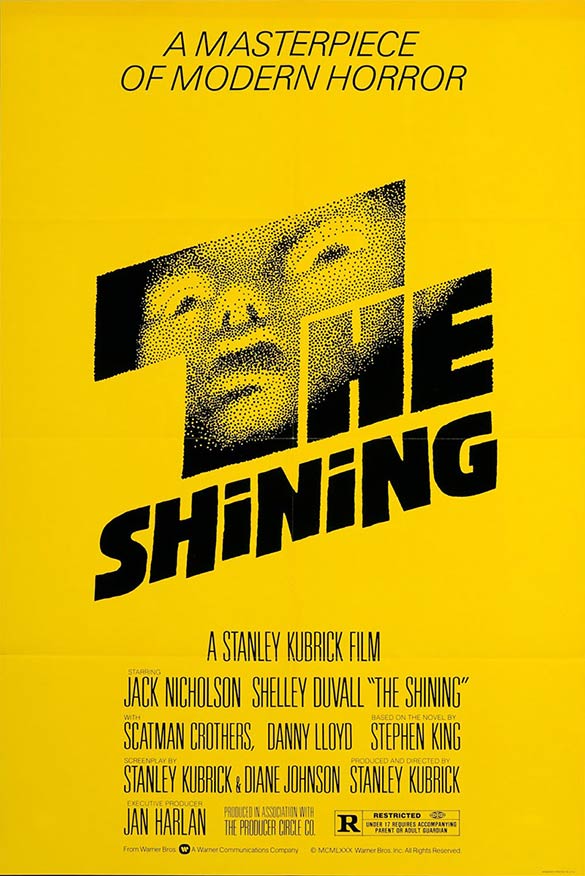
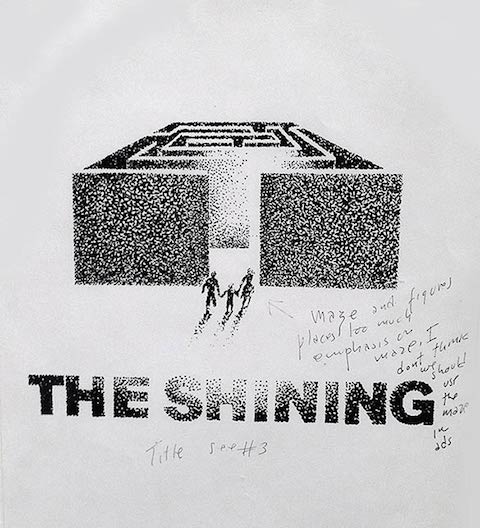
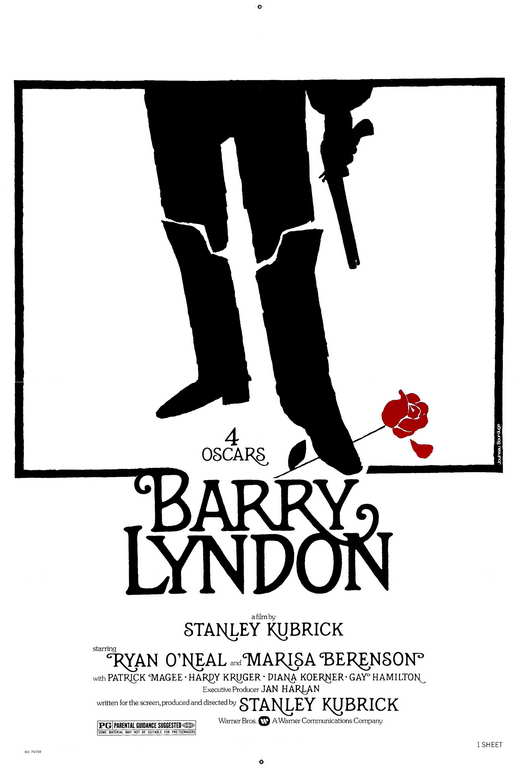
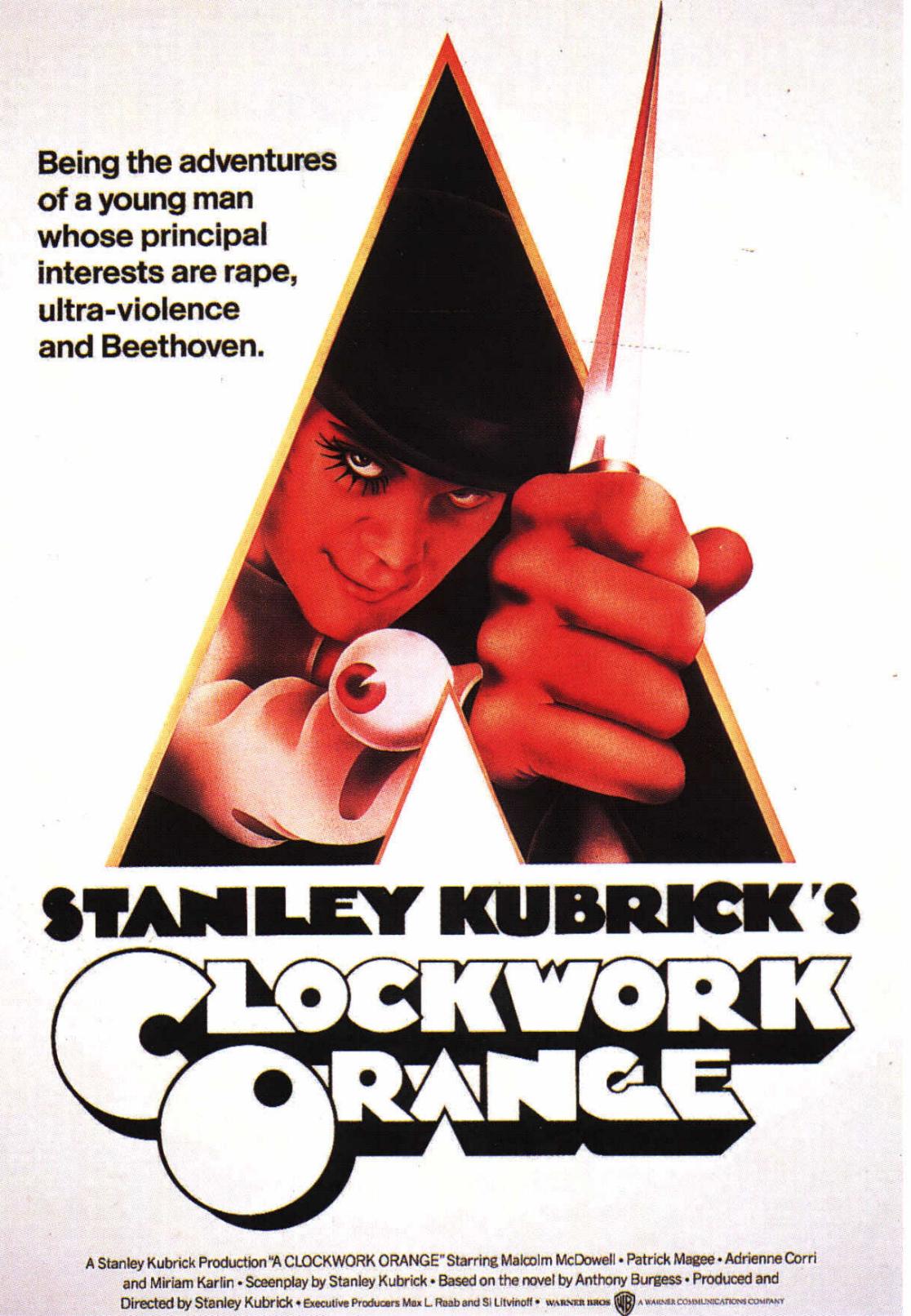
Stanley Kubrick’s perfectionism extended well beyond his films themselves. He even took pains to ensure the promotion of his projects with posters as memorable as the actual experience of watching them. The poster for Barry Lyndonremains perhaps the most elegant of all time, and who could forget the first time A Clockwork Orange’s promised audiences (or threatened audiences with the promise of) “the adventures of a young man whose principal interests are rape, ultra-violence, and Beethoven”? Though less often seen today, the bright yellow original poster for The Shining, with that unidentified pointillist face and its expression of shock, may well unsettle you more than even the film itself.
It came from the office of famous graphic designer Saul Bass, known not just for storyboarding Kubrick’s Spartacus but for creating the title sequences for movies like Otto Preminger’s The Man with the Golden Arm and Alfred Hitchcock’s Vertigo (whose poster Bass also designed), North by Northwest, and Psycho (whose immortal “shower scene” Bass may also have come up with). Kubrick rightly figured Bass had what it took to deliver the considerable impact of his psychological horror picture in graphic form.
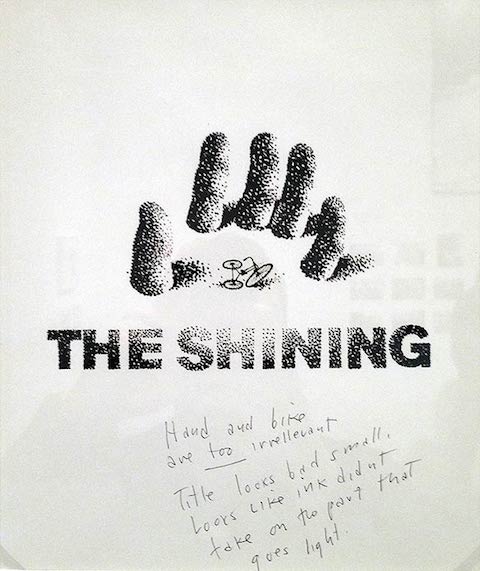
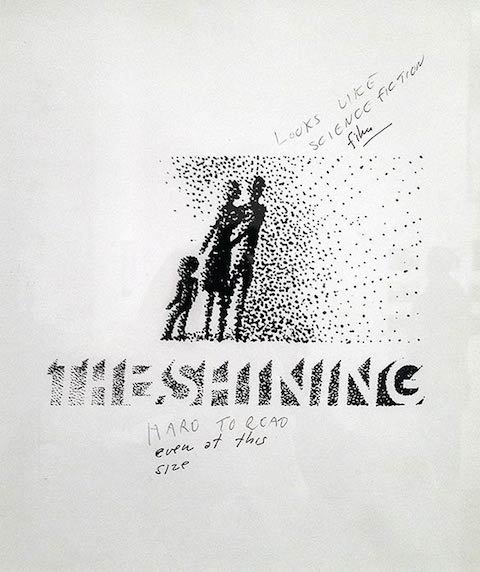
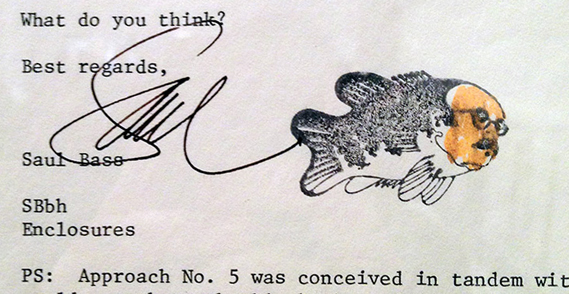
“This poster design wasn’t a ‘design and done’ deal however,” writes Derek Kimball in a DesignBuddy post on the evolution of the image. “Many of Bass’ concepts were rejected by Kubrick before settling on the final design.” You can see three of them here in this post, and the rest there. Each one includes Kubrick’s handwritten notes of objection: “hand and bike are too irrelevant,” “title looks bad small,” “too much emphasis on maze,” “looks like science fiction film,” “hotel looks peculiar.” You’ve got to admit that the man has a point in every case, although I suspect Bass knew in advance which design the auteur would, once through the wringer of revisions, have the least trouble with. “I am excited about all of them,” Bass writes, “and I could give you many reasons why I think they would be strong and effective identifiers for the film,” but one in particular, “provocative, scary, and emotional,” “promises a picture I haven’t seen before.”
You have to appreciate that kind of confidence in his team’s work when dealing with such a famously exacting client — and, looking at the letter itself, you really have to have to appreciate the kind of confidence it takes to sign your name with a caricature of your own face on the body of your namesake fish.
Orson Welles once claimed that Gregg Toland, cinematographer for Citizen Kane, taught him everything he needed to know about shooting movies in a half hour. Director Robert Rodriguez — who started off as the poster boy for ‘90s indie cinema and is currently making a healthy living turning out movies like Sin City: A Dame to Kill For– claims that he can reduce that time by a third. In 10 Minute Film School, which you can watch above, Rodriguez quickly hits on some of the key points of movie making while espousing the same rebel DIY spirit that made him a success. Remember, this is a guy who made a feature film, El Mariachi, for $7000.
Rodriguez’s basic philosophy doesn’t dwell on learning the fine points of Aristotelian act structure or the technical nuances of the Red camera. He just wants you to start shooting stuff. “Don’t dream about being a filmmaker,” he proclaims in the video, which looks like it was shot some time during the Clinton administration. “You are a filmmaker. Now let’s get down to business.”
He tells aspiring filmmakers to become technical — learn the tools of the trade. If you don’t, you might become overly reliant on the techies who may or may not be interested in realizing your vision. He also doesn’t put too much stock in screenwriting books like Save the Cat. “Anyone know how to write?” he asks the audience. “No? Good. Everyone else writes the same way. Start writing your way. That makes you unique.”
He also advises against storyboards. “Make a blank screen for yourself and sit there and watch your movie. Imagine your movie, shot for shot, cut for cut…Write down the shots you see and then go get those shots.”
The video shows its age when Rodriguez starts to talk about equipment. No aspiring filmmaker aside from a celluloid fetishist is going to shoot a first feature on 16mm when cheaper, easier digital cameras are available. Yet the core of his message is still valid. “You don’t want anything too fancy,” he states over and over. Fancy equipment makes for lifeless, dull films, lacking in that reckless, adventurous spirit of the newbie moviemaker.
Essentially, Rodriguez wants to keep the “independent” in independent filmmaking. Just as he tells his charges to get technical, Rodriguez also tells them to keep their budgets low. The more money a studio sinks into a production, the more they can dictate how that money is spent. Rodriguez had a guitar case, a turtle and a small Texan town at his disposal when he was starting out, and, with that, he strung together the story of El Mariachi. In the 20 plus years since, Rodriguez has maintained creative control over just about all of his movies.
One final note. “Don’t bother going to film school,” he says. As someone with an overpriced MFA in film, I have to say that he’s probably right.
Jonathan Crow is a Los Angeles-based writer and filmmaker whose work has appeared in Yahoo!, The Hollywood Reporter, and other publications. You can follow him at @jonccrow. And check out his blog Veeptopus, featuring one new picture of a vice president with an octopus on his head daily.
We're hoping to rely on loyal readers, rather than erratic ads. Please click the Donate button and support Open Culture. You can use Paypal, Venmo, Patreon, even Crypto! We thank you!
Open Culture scours the web for the best educational media. We find the free courses and audio books you need, the language lessons & educational videos you want, and plenty of enlightenment in between.