David Bowie’s Top 100 Books

Image by Avro, via Wikimedia Commons
“David Bowie Is,” the extensive retrospective exhibit of the artist and his fabulous costumes, hit Toronto last Friday (see our post from earlier today), and as many people have reported, in addition to those costumes—and photos, instruments, set designs, lyric sheets, etc.—the show includes a list of Bowie’s favorite books. Described as a “voracious reader” by curator Geoffrey Marsh, Bowie’s top 100 book list spans decades, from Richard Wright’s raw 1945 memoir Black Boy to Susan Jacoby’s 2008 analysis of U.S. anti-intellectualism in The Age of American Unreason.
Bowie’s always had a complicated relationship with the U.S., but his list shows a lot of love to American writers, from the aforementioned to Truman Capote, Hubert Selby, Jr., Saul Bellow, Junot Diaz, Jack Kerouac and many more. He’s also very fond of fellow Brits George Orwell, Ian McEwan, and Julian Barnes and loves Mishima and Bulgakov. You can read the full list below or over at Open Book Toronto, who urges you to “grab one of these titles and settle in to read — and just think, somewhere, at some point, David Bowie (or, to be more accurate, the man behind David Bowie, David Jones) was doing the exact same thing.” If that sort of thing inspires you to pick up a good book, go for it. You could also peruse the list, then puzzle over the literate Bowie’s lyrics to “I Can’t Read.” You can also explore a new related book–Bowie’s Bookshelf: The Hundred Books that Changed David Bowie’s Life.
- Interviews With Francis Bacon by David Sylvester
- Billy Liar by Keith Waterhouse
- Room At The Top by John Braine
- On Having No Head by Douglass Harding
- Kafka Was The Rage by Anatole Broyard
- A Clockwork Orange by Anthony Burgess
- City Of Night by John Rechy
- The Brief Wondrous Life Of Oscar Wao by Junot Diaz
- Madame Bovary by Gustave Flaubert
- Iliad by Homer
- As I Lay Dying by William Faulkner
- Tadanori Yokoo by Tadanori Yokoo
- Berlin Alexanderplatz by Alfred Döblin
- Inside The Whale And Other Essays by George Orwell
- Mr. Norris Changes Trains by Christopher Isherwood
- Halls Dictionary Of Subjects And Symbols In Art by James A. Hall
- David Bomberg by Richard Cork
- Blast by Wyndham Lewis
- Passing by Nella Larson
- Beyond The Brillo Box by Arthur C. Danto
- The Origin Of Consciousness In The Breakdown Of The Bicameral Mind by Julian Jaynes
- In Bluebeard’s Castle by George Steiner
- Hawksmoor by Peter Ackroyd
- The Divided Self by R. D. Laing
- The Stranger by Albert Camus
- Infants Of The Spring by Wallace Thurman
- The Quest For Christa T by Christa Wolf
- The Songlines by Bruce Chatwin
- Nights At The Circus by Angela Carter
- The Master And Margarita by Mikhail Bulgakov
- The Prime Of Miss Jean Brodie by Muriel Spark
- Lolita by Vladimir Nabokov
- Herzog by Saul Bellow
- Puckoon by Spike Milligan
- Black Boy by Richard Wright
- The Great Gatsby by F. Scott Fitzgerald
- The Sailor Who Fell From Grace With The Sea by Yukio Mishima
- Darkness At Noon by Arthur Koestler
- The Waste Land by T.S. Elliot
- McTeague by Frank Norris
- Money by Martin Amis
- The Outsider by Colin Wilson
- Strange People by Frank Edwards
- English Journey by J.B. Priestley
- A Confederacy Of Dunces by John Kennedy Toole
- The Day Of The Locust by Nathanael West
- 1984 by George Orwell
- The Life And Times Of Little Richard by Charles White
- Awopbopaloobop Alopbamboom: The Golden Age of Rock by Nik Cohn
- Mystery Train by Greil Marcus
- Beano (comic, ’50s)
- Raw (comic, ’80s)
- White Noise by Don DeLillo
- Sweet Soul Music: Rhythm And Blues And The Southern Dream Of Freedom by Peter Guralnick
- Silence: Lectures And Writing by John Cage
- Writers At Work: The Paris Review Interviews edited by Malcolm Cowley
- The Sound Of The City: The Rise Of Rock And Roll by Charlie Gillette
- Octobriana And The Russian Underground by Peter Sadecky
- The Street by Ann Petry
- Wonder Boys by Michael Chabon
- Last Exit To Brooklyn By Hubert Selby, Jr.
- A People’s History Of The United States by Howard Zinn
- The Age Of American Unreason by Susan Jacoby
- Metropolitan Life by Fran Lebowitz
- The Coast Of Utopia by Tom Stoppard
- The Bridge by Hart Crane
- All The Emperor’s Horses by David Kidd
- Fingersmith by Sarah Waters
- Earthly Powers by Anthony Burgess
- The 42nd Parallel by John Dos Passos
- Tales Of Beatnik Glory by Ed Saunders
- The Bird Artist by Howard Norman
- Nowhere To Run The Story Of Soul Music by Gerri Hirshey
- Before The Deluge by Otto Friedrich
- Sexual Personae: Art And Decadence From Nefertiti To Emily Dickinson by Camille Paglia
- The American Way Of Death by Jessica Mitford
- In Cold Blood by Truman Capote
- Lady Chatterly’s Lover by D.H. Lawrence
- Teenage by Jon Savage
- Vile Bodies by Evelyn Waugh
- The Hidden Persuaders by Vance Packard
- The Fire Next Time by James Baldwin
- Viz (comic, early ’80s)
- Private Eye (satirical magazine, ’60s – ’80s)
- Selected Poems by Frank O’Hara
- The Trial Of Henry Kissinger by Christopher Hitchens
- Flaubert’s Parrot by Julian Barnes
- Maldoror by Comte de Lautréamont
- On The Road by Jack Kerouac
- Mr. Wilson’s Cabinet of Wonder by Lawrence Weschler
- Zanoni by Edward Bulwer-Lytton
- Transcendental Magic, Its Doctrine and Ritual by Eliphas Lévi
- The Gnostic Gospels by Elaine Pagels
- The Leopard by Giuseppe Di Lampedusa
- Inferno by Dante Alighieri
- A Grave For A Dolphin by Alberto Denti di Pirajno
- The Insult by Rupert Thomson
- In Between The Sheets by Ian McEwan
- A People’s Tragedy by Orlando Figes
- Journey Into The Whirlwind by Eugenia Ginzburg
If you would like to support the mission of Open Culture, consider making a donation to our site. It’s hard to rely 100% on ads, and your contributions will help us continue providing the best free cultural and educational materials to learners everywhere. You can contribute through PayPal, Patreon, and Venmo (@openculture). Thanks!
Related Content:
Bowie’s Bookshelf: A New Essay Collection on The 100 Books That Changed David Bowie’s Life
David Bowie Releases Vintage Videos of His Greatest Hits from the 1970s and 1980s
David Bowie Recalls the Strange Experience of Inventing the Character Ziggy Stardust (1977)
Josh Jones is a writer and musician based in Durham, NC. Follow him at @jdmagness
Read More...Slavoj Žižek’s Pervert’s Guide to Ideology Decodes The Dark Knight and They Live
Do we have a more energetic commentator on popular culture than Slavoj Žižek, the Slovenian philosophy professor who has risen to the role the Chronicle of Higher Education calls “the Elvis of cultural theory”? In the 2006 essay film The Pervert’s Guide to Cinema, Žižek offered psychoanalytic readings of such pictures as The Red Shoes, Alien, and The Matrix. (See him take on Vertigo in a clip featured here before.) Now he returns with a sequel, The Pervert’s Guide to Ideology. At the top, you can see him expound upon the role of ideology in They Live, John Carpenter’s 1988 science-fiction semi-comedy in which wrestler “Rowdy” Roddy Piper happens upon a pair of sunglasses that, when worn, reveal a host of sinister alien commandments behind advertising and the media. “These glasses function like critique-of-ideology glasses,” Žižek asserts.“We live, so we are told, in a post-ideological society. We are addressed by social authority not as subjects who should do their duty, but subjects of pleasures: ‘Realize your true potential,’ ‘Be yourself,’ ‘Lead a satisfying life.’ When you put the glasses on, you see dictatorship in democracy.”
Just above, Žižek looks into the ideology of The Dark Knight, Christopher Nolan’s second Batman movie. “Who is Joker?” he asks. “Which is the lie he is opposing? The truly disturbing thing about The Dark Knight is that it elevates a lie into a general social principle: the principle of organization of our social, political life, as if our societies can remain stable, can function, only if based on a lie, as if the truth — and this telling the truth is embodied in Joker — means destruction.” Last year at the Toronto International Film festival, Žižek participated in an on-stage conversation about the project (introduction, part one, two), “explaining” in his inimitably roundabout fashion some of the thinking behind these cinematic cultural analyses. The Pervert’s Guide to Ideology also uses other big-name movies like Taxi Driver, Titanic, West Side Story (and Jaws, some of which you can see him comment briefly upon in the trailer) as jumping off points for extended monologues on the unseen forces that he finds shape our beliefs and behavior. Unseen, of course, unless you’ve got those superpowered sunglasses — or unless, even more unconventionally, you’ve got a mind like Slavoj Žižek’s.
via Metafilter
Related Content:
Žižek!: 2005 Documentary Reveals the “Academic Rock Star” and “Monster” of a Man
Good Capitalist Karma: Zizek Animated
Slavoj Žižek: How the Marx Brothers Embody Freud’s Id, Ego & Super-Ego
A Shirtless Slavoj Žižek Explains the Purpose of Philosophy from the Comfort of His Bed
After a Tour of Slavoj Žižek’s Pad, You’ll Never See Interior Design in the Same Way
Colin Marshall hosts and produces Notebook on Cities and Culture and writes essays on literature, film, cities, Asia, and aesthetics. He’s at work on a book about Los Angeles, A Los Angeles Primer. Follow him on Twitter at @colinmarshall.
Read More...Hergé Draws Tintin in Vintage Footage (and What Explains the Character’s Enduring Appeal)
“Tintin addicts are a mixed bunch,” writes New Yorker critic Anthony Lane, profiling the beloved plus fours-clad, quiff-topped adventurer and thereby revealing himself as one of the afflicted. “Steven Spielberg and Peter Jackson [have] a three-picture deal to bring Tintin to the big screen. I once heard Hugh Grant declare on a radio program that if he could take only one book to a desert island it would be King Ottokar’s Sceptre (1939). [ … ] General de Gaulle declared that Tintin was his only international rival — he was envious, perhaps, not just of Tintin’s fame but of the defiantly positive attitude that he came to represent.” Despite coming from America, one of the few countries never to have taken wholeheartedly to the character, I too have read and re-read the 23 full-length comic books (or as we call them nowadays, graphic novels) in which he stars, and I too envy his qualities, especially the useful amorphousness of his identity: neither man nor boy; neither traditional nor modern; presumably Belgian, though for practical purposes stateless and apolitical; ostensibly a reporter, but no apparent need ever to file a story.
The late Harry Thompson surely ranks as a top Tintin addict. A radio and television producer, comedy writer, novelist, and creator of Have I Got News for You, he also greatly advanced the widespread avocation of English-language Tintinology with his book Tintin: Hergé and his Creation, published in 1991. Three years later, he would star in this episode of London Weekend Television’s documentary series Opening Shot on Tintin and his creator (part one at the top, click for two and three). His analysis swiftly assures any adult reader just how and why they should go about picking up and appreciating the truly painstaking craftsmanship of these comics they so relished in their youth. The broadcast also features commentary from Tintin’s English translators and, through archival footage, from Georges “Hergé” Remi himself (seen drawing Tintin just above, and his companion Captain Haddock below). Finally, we hear from more typical Tintin readers in man-on-the-street interviews — or rather, precocious-British-child-in-the-bookstore interviews: “My favorite character is Snowy, because he says really rude things.” “My favorite book is Tintin in America, because I like red Indians.” How many of these kids, nearly two decades on, can have resisted the siren song of Tintinology themselves?
Related Content:
The Inscrutable Imagination of the Late Comic Artist Mœbius
Colin Marshall hosts and produces Notebook on Cities and Culture and writes essays on literature, film, cities, Asia, and aesthetics. He’s at work on a book about Los Angeles, A Los Angeles Primer. Follow him on Twitter at @colinmarshall.
Read More...Sci-Fi Writer Robert Heinlein Imagines the Year 2000 in 1949, and Gets it Mostly Wrong
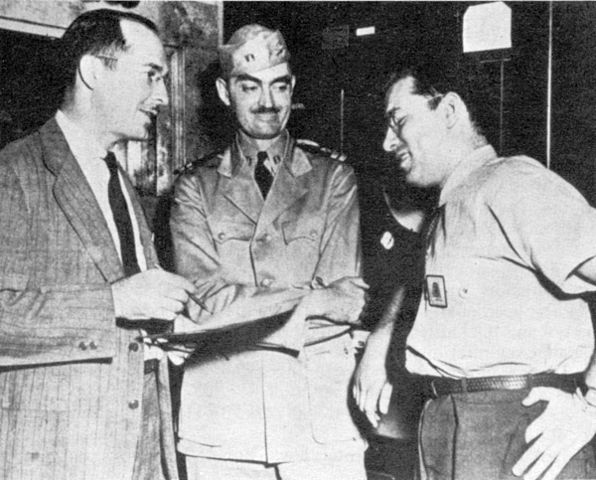
Image via Wikimedia Commons
Two giants of 20th century science fiction: Robert Heinlein and Isaac Asimov (see them together above, with L. Sprague de Camp in-between). Like every young sci-fi geek, I read them both assiduously, got lost in their dizzying universes that stretched across novels and significant teenage milestones. Even as an awkward kid, I could clearly identify an essential difference in tone between their forecasts of the future. Heinlein, the Navy man forcibly retired from service by tuberculosis, had the darker vision, in which the brute force of mass militarism continued to thrive and heroic men of action carried the day. Asimov, the practicing scientist—whose “Norby” series of kids books might be the cutest introduction to sci-fi ever written by an American—favored a future that, if still quite dangerous, was managed by robots and their creators, the technocrats.
As we can plainly see, we are no less a bellicose species than when these two authors wrote of the future, but Asimov seems to have had it right. The technocrats came out on top; too many battles are fought not by massed battalions but by deadly flying robots making (so we’re told) “surgical” strikes. A few weeks ago, we brought you a series of technocratic predictions of the year 2014 from Asimov, many of them surprisingly accurate. Today, we have a list of predictions from Heinlein, this time of the year 2000, and written in 1949 and published in 1952 in Galaxy magazine. How does his predictive ability stack up against his contemporary? Well, I’d say that 2 (stripped of some exaggeration), 8, and 11 either hit the mark or come pretty damn close. 19 is self-evidently true, and 15 is arguably not terribly far away, though it may not have seemed so in 2000. 4 is painfully ironic. The rest? Eh, not so much. Take a look and try to imagine yourself in Heinlein’s shoes in 1949. Not an easy task? Try to imagine what the world will look like in 2063. Which version of IOS will you be running then?
1. Interplanetary travel is waiting at your front door — C.O.D. It’s yours when you pay for it.
2. Contraception and control of disease is revising relations between the sexes to an extent that will change our entire social and economic structure.
3. The most important military fact of this century is that there is no way to repel an attack from outer space.
4. It is utterly impossible that the United States will start a “preventive war.” We will fight when attacked, either directly or in a territory we have guaranteed to defend.
5. In fifteen years the housing shortage will be solved by a “breakthrough” into new technologies which will make every house now standing as obsolete as privies.
6. We’ll all be getting a little hungry by and by.
7. The cult of the phony in art will disappear. So-called “modern art” will be discussed only by psychiatrists.
8. Freud will be classed as a pre-scientific, intuitive pioneer and psychoanalysis will be replaced by a growing, changing “operational psychology” based on measurement and prediction.
9. Cancer, the common cold, and tooth decay will all be conquered; the revolutionary new problem in medical research will be to accomplish “regeneration,” i.e., to enable a man to grow a new leg, rather than fit him with an artificial limb.
10. By the end of this century mankind will have explored this solar system, and the first ship intended to reach the nearest star will be a‑building.
11. Your personal telephone will be small enough to carry in your handbag. Your house telephone will record messages, answer simple inquiries, and transmit vision.
12. Intelligent life will be found on Mars.
13. A thousand miles an hour at a cent a mile will be commonplace; short hauls will be made in evacuated subways at extreme speed.
14. A major objective of applied physics will be to control gravity.
15. We will not achieve a “World State” in the predictable future. Nevertheless, Communism will vanish from this planet.
16. Increasing mobility will disenfranchise a majority of the population. About 1990 a constitutional amendment will do away with state lines while retaining the semblance.
17. All aircraft will be controlled by a giant radar net run on a continent-wide basis by a multiple electronic “brain.”
18. Fish and yeast will become our principal sources of proteins. Beef will be a luxury; lamb and mutton will disappear.
19. Mankind will not destroy itself, nor will “Civilization” be destroyed.
Here are things we won’t get soon, if ever:
– Travel through time
– Travel faster than the speed of light
– “Radio” transmission of matter.
– Manlike robots with manlike reactions
– Laboratory creation of life
– Real understanding of what “thought” is and how it is related to matter.
– Scientific proof of personal survival after death.
– Nor a permanent end to war.
Curiously, neither Heinlein nor Asimov foresaw that most terribly banal and ubiquitous phenomenon of reality TV, but really, what kind of monster could have imagined such a thing?
via Lists of Note/i09
Related Content:
Arthur C. Clarke Predicts the Future in 1964 … And Kind of Nails It
Walter Cronkite Imagines the Home of the 21st Century … Back in 1967
Marshall McLuhan Announces That The World is a Global Village
Josh Jones is a writer and musician based in Durham, NC. Follow him at @jdmagness
Read More...The Art of Handwriting as Practiced by Famous Artists: Georgia O’Keeffe, Jackson Pollock, Marcel Duchamp, Willem de Kooning & More

Click each image for a larger version
Didn’t we used to hear all sorts of grumbling about the disappearance of the handwritten letter? What a relief those complaints seem now to have subsided, leaving us in peace to efficiently type to one another about how we find pieces of longhand correspondence fascinating purely as artifacts of our favorite historical figures. If you share that fascination, have a look at The Art of Handwriting, an exhibit from the Smithsonian’s Archives of American Art now on display through October 27 at Washington D.C.‘s Lawrence A. Fleischman gallery, which showcases not only the artistic aspects of handwriting, but the handwriting of actual artists. “An artist might put pen to paper just as he or she would apply a line to a drawing,” says the exhibition’s site. “For each artist, a leading authority interprets how the pressure of line and sense of rhythm speak to that artist’s signature style. And questions of biography arise: does the handwriting confirm assumptions about the artist, or does it suggest a new understanding?” Plus, we have here the ideal test of those handwriting analysis booths at county fairs — could they detect these artistic personalities?

Just above, we have a page of abstract expressionist painter Willem de Kooning’s missive in light-blue ink of March 28, 1966 to friend and fellow abstract expressionist Michael Loew. (They’ve even included the envelope.) At the top of the post, you’ll find a page another painter, the famously blossom-focused Georgia O’Keeffe, wrote to New Mexico modernist Cady Wells in 1939. The subject of the letter? “O’Keeffe worries that Wells doesn’t like a painting she has bought and suggests replacements; and describes an argument she had with a friend.” That description comes from the Smithsonian’s catalog, as does this one: “[Jackson] Pollock writes with descriptions of his new home in Springs, on Long Island, and discusses his work and that of other artists.” You can also view both pages of that evidently unscandalous piece of communication on the site. They’ve even got letters composed by hand in other languages, such as Marcel Duchamp writing to his sister Suzanne (below) on January 15, 1916. Don’t worry if you can’t read French, or if you think you can’t contextualize the personal content of any of the letters at all; focus on, as the Archives of American Art suggests, how “every message brims with the personality of the writer at the moment of interplay between hand, eye, mind, pen, and paper.” That, and the that hope schoolchildren won’t have to endure cursive lessons many generations longer.

Related Content:
Virginia Woolf’s Handwritten Suicide Note: A Painful and Poignant Farewell (1941)
Francis Ford Coppola’s Handwritten Casting Notes for The Godfather
Colin Marshall hosts and produces Notebook on Cities and Culture and writes essays on literature, film, cities, Asia, and aesthetics. He’s at work on a book about Los Angeles, A Los Angeles Primer. Follow him on Twitter at @colinmarshall.
Read More...What Shakespeare’s Handwriting Looked Like
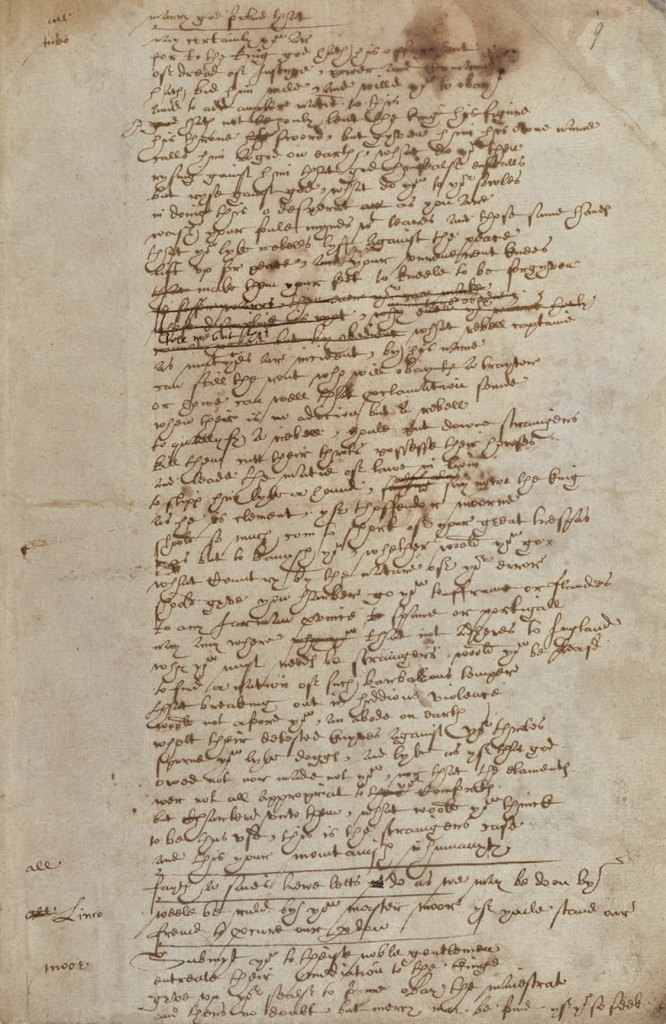
Last week, we posted on how scholars have tried to recover the original pronunciations of Shakespeare’s plays and poems when performed on the stage. Today, we bring you the bard’s original handwriting. Shakespeare’s handwriting has recently become the focus of a new article by Professor Douglas Bruster at UT Austin, who is using an analysis of the playwright’s quirky spellings and penmanship to solve a very old question of authorship. The page of handwriting you see above is a fragment of a lost play called Sir Thomas More and it goes by the name of “Hand D” (click the image above, and then the image that appears — for a much larger version).
Bruster’s short essay, published this month in the Oxford journal Notes & Queries, is far too inside baseball for anyone but hardcore textual scholars to make much sense of, but this New York Times article does a good job of distilling the finer points. Suffice it to say that thanks to Bruster’s painstaking analysis of Shakespeare’s distinctive handwriting, we can be fairly certain that a 1602 revision of Thomas Kyd’s enormously popular Renaissance play The Spanish Tragedy—in the words of Shakespeare scholar Eric Rasmussen—has the bard’s “fingerprints all over it.”
Related Content:
A Survey of Shakespeare’s Plays (Free Course)
Pink Floyd’s David Gilmour Sings Shakespeare’s Sonnet 18
Shakespeare’s Satirical Sonnet 130, As Read By Stephen Fry
Josh Jones is a writer and musician based in Durham, NC. Follow him at @jdmagness
Read More...A Planetary Perspective: Trillions of Pictures of the Earth Available Through Google Earth Engine
In 1972 the Earth Resources Technology Satellite, or Landsat, launched into space with a mission to circle the planet every 16 days and take pictures of the Earth. For more than forty years, the Landsat program has created the longest ever continuous record of Earth’s surface.
Now those images are available to everyone. And thanks to Google Earth Engine, it’s possible to download and analyze them.
Five years ago NASA and the U.S. Geological Survey rewrote their protocols and made the images available for free, trillions of them, a ridiculously massive collection of pictures taken from more than 400 miles away, some of them unrecognizable.
Is that green patch in the Amazon basin a forest or a pasture?
But with a little help from Google’s cloud, this data has amazing power. It used to be that only a big institution, like a university or a country, had the processing power to download the data. With a single CPU it would take months to suck down the images. Now, it only takes a few hours. With that freedom, small environmental watchdog agencies and monitoring groups have access to the same data that the big guys have had for years. All they need to do is write the algorithms to help interpret what they’re seeing.
And best of all, we can all see the results.
Watch Las Vegas grow from a dusty casino town into suburban sprawl.
See the Palm Islands bloom into being off the coast of Dubai between 1984 and 2012.
One of the most devastating is to watch the herringbone of roads develop in the Amazon over just 28 years.
Download GoogleEarth’s free plugin to view precomputed datasets, like this one rendering the few remaining places on the Earth that are more than a kilometer from the nearest road.
Related Content:
Hiroshima Atomic Bombing Remembered with Google Earth
Google Presents an Interactive Visualization of 100,000 Stars
Cutting-Edge Technology Reconstructs the Battle of Gettysburg 150 Years Later
Kate Rix writes about education and digital media. Visit her website and follow her on Twitter.
Read More...Jacques Lacan’s Confrontation with a Young Rebel: Classic Moment, 1972
This is fascinating to watch.
On October 13, 1972, the charismatic and controversial French theorist and psychoanalyst Jacques Lacan is giving a lecture at the Catholic University of Louvain, Belgium, when a young man with long hair and a chip on his shoulder walks up to the front of the lecture hall and begins making trouble. He spills water and what appears to be flour all over Lacan’s lecture notes and then stammers his way into a strange speech that sounds as if it were taken straight out of Guy Debord’s The Society of the Spectacle:
“The composite body which up to fifty years ago could be called ‘culture’– that is, people expressing in fragmented ways what they feel — is now a lie, and can only be called a ‘spectacle,’ the backdrop of which is tied to, and serves as, a link between all alienated individual activities. If all the people here now were to join together and, freely and authentically, wanted to communicate, it’d be on a different basis, with a different perspective. Of course this can’t be expected of students who by definition will one day become the managers of our system, with their justifications, and who are also the public who with a guilty conscience will pick up the remains of the avant-garde and the decaying ‘spectacle.’ ”
The 71-year-old Lacan never loses his composure. (His cigar appears bent out of shape, but it was that way from the beginning.) The audience, too, retains a certain Gallic nonchalance. Dangerous Minds sums it up in the headline “The Single Most ‘French’ Moment in all of 1972: Jacques Lacan Accosted, But No One Stops Smoking.” The scene is from Jacques Lacan Speaks, a one-hour documentary by Belgian filmmaker Françoise Wolff. You can watch the complete film, which includes Lacan’s extended and rather cryptic response to the incident and other excerpts from the lecture, followed by Wolff’s interview with Lacan the following day, in our post: “Charismatic Psychoanalyst Jacques Lacan Gives Public Lecture (1972).”
If you would like to support the mission of Open Culture, consider making a donation to our site. It’s hard to rely 100% on ads, and your contributions will help us continue providing the best free cultural and educational materials to learners everywhere. You can contribute through PayPal, Patreon, and Venmo (@openculture). Thanks!
via Literary Kicks
Related Content:
Free Online Philosophy Courses
Michel Foucault: Free Lectures on Truth, Discourse & The Self
John Searle on Foucault and the Obscurantism in French Philosophy
Derrida: A 2002 Documentary on the Abstract Philosopher and the Everyday Man
Read More...Philosopher Portraits: Famous Philosophers Painted in the Style of Influential Artists
Ludwig Wittgenstein/Piet Mondrian:

What do the Austrian-British philosopher Ludwig Wittgenstein and the Dutch painter Piet Mondrian have in common? For philosopher and artist Renée Jorgensen Bolinger, the two have similar beliefs about the logic of space.
“Many of Mondrian’s pieces explore the relationships between adjacent spaces,” says Bolinger “and in particular the formative role of each on the boundaries and possibilities of the other. I based this painting [see above] off of Wittgenstein’s Tractatus, in which he develops a theory of meaning grounded in the idea that propositions have meaning only insofar as they constrain the ways the world could be; a meaningful proposition is thus very like one of Mondrian’s color squares, forming a boundary and limiting the possible configurations of the adjacent spaces.”
A second-year PhD student in the philosophy program at the University of Southern California, Bolinger studied painting a Biola University before making philosophy her second major. “I actually came to philosophy quite late in my college career,” Bolinger says, “only adding the major in my junior year. I was fortunate to have two particularly excellent and philosophic art teachers, Jonathan Puls and Jonathan Anderson, who convinced me that my two passions were not mutually exclusive, and encouraged me to pursue both as I began my graduate education.”
Bolinger now works primarily on the philosophy of language, with side interests in logic, epistemology, mind and political philosophy. She continues to paint. We asked her how she reconciles her two passions, which seem to occupy opposite sides of the mind. “I do work in analytic philosophy,” she says, “but it’s only half true that philosophy and painting engage opposite sides of the mind. The sort of realist drawing and painting that I do is all about analyzing the relationships between the lines, shapes and color tones, and so still very left-brain. Nevertheless, it engages the mind in a different way than do the syllogisms of analytic philosophy. I find that the two types of mental exertion complement each other well, each serving as a productive break from the other.”
Bolinger has created a series of philosopher portraits, each one pairing a philosopher with an artist, or art style, in an intriguing way. In addition to Wittgenstein, she painted ten philosophers in her first series, many of them by request. They can all be seen on her Web site, where high quality prints can be ordered.
G.E.M. Anscombe/Jackson Pollock:
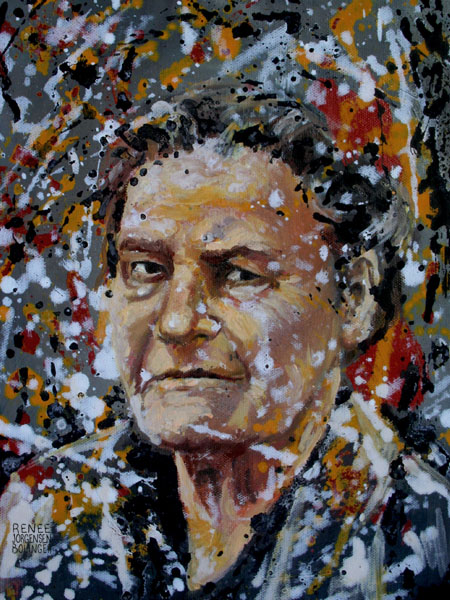
Bolinger says she paired the British analytic philosopher Elizabeth Anscombe with the American abstract painter Jackson Pollock for two reasons: “First, the loose style of Pollock’s action painting fits the argumentative (and organizational) style of Wittgenstein’s Philosophical Investigations, which Anscombe helped to edit and was instrumental in publishing. Second, her primary field of work, in which she wrote a seminal text, is philosophy of action, which has obvious connections to the themes present in any of Pollock’s action paintings.”
Gottlob Frege/Vincent Van Gogh:
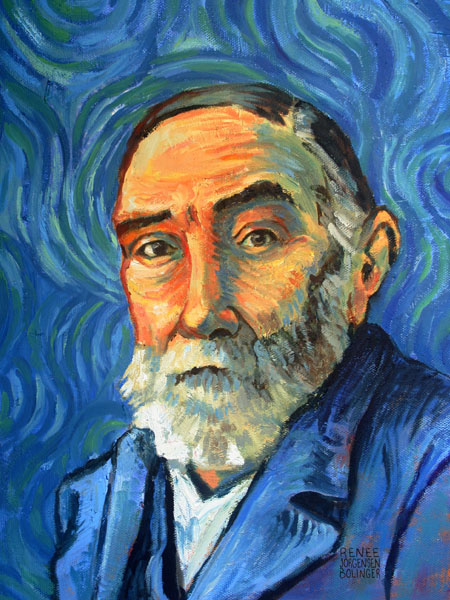
Bolinger paired the German logician, mathematician and philosopher Gottlob Frege with the Dutch painter Vincent Van Gogh as a tongue-in-cheek reference to Van Gogh’s famous painting The Starry Night and Frege’s puzzle concerning identity statements such as “Hesperus is Phosphorus,” or “the evening star is identical to the morning star.”
Bertrand Russell/Art Deco:

Bolinger painted the British logician and philosopher Bertrand Russell in the Art Deco style. “This pairing is a bit more about the gestalt, and a bit harder to articulate,” says Bolinger. “The simplification of form and reduction to angled planes that takes place in the background of this Art Deco piece are meant to cohere with Russell’s locial atomism (the reduction of complex logical propositions to their fundamental logical ‘atoms’).”
Kurt Gödel/Art Nouveau:
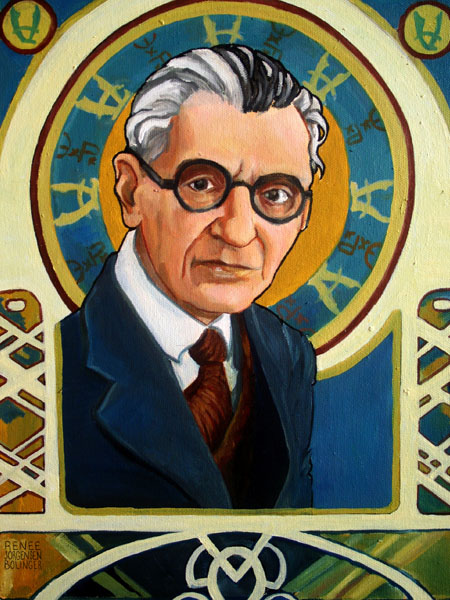
Bolinger paired the Austrian logician Kurt Gödel with Art Nouveau. “The Art Nouveau movement developed around the theme of mechanization and the repetition of forms,” says Bolinger, “and centrally involves a delicate balance between organic shapes — typically a figure that dominates the portrait — and schematized or abstracted patterns, often derived from organic shapes, but made uniform and repetitive (often seen in the flower motifs that ornament most Art Nouveau portraits). I paired this style with Kurt Gödel because his work was dedicated to defining computability in terms of recursive functions, and using the notion to prove the Completeness and Incompleteness theorems.”
To see more of Renée Jorgensen Bolinger’s philosopher portraits, click here to visit her site. And if you like them all, the PhilPortraits Calendar might be perfect for you.
via Leiter Reports
Related Content:
10 Famous Philosophers in Words and Images
Photography of Ludwig Wittgenstein Released by Archives at Cambridge
Read More...John Searle Makes A Forceful Case for Studying Consciousness, Where Everything Else Begins
Consciousness is the single most important aspect of our lives, says philosopher John Searle. Why? “It’s a necessary condition on anything being important in our lives,” he says. “If you care about science, philosophy, music, art — whatever — it’s no good if you are a zombie or in a coma.”
Searle is one of today’s preeminent philosophers of mind. Author of the famous “Chinese Room” argument against the possibility of true artificial intelligence, Searle has been a persistent thorn in the side of those who would reduce consciousness to computation, or conflate it with behavior. Despite its intrinsically subjective nature, consciousness is an irreducible biological phenomenon, he says, “as much subject to scientific analysis as any other phenomenon in biology, or for that matter the rest of science.”
Searle made his remarks at the May 3 TEDx conference at CERN — the European Organization for Nuclear Research — near Geneva, Switzerland. The video above gives a thought-provoking overview of his basic conclusions about consciousness, but to delve deeper into Searle’s philosophy of mind — and also his philosophy of language and society — see our earlier post about his online Berkeley lectures: “Philosophy with John Searle: Three Free Courses.”
Related content:
John Searle on Foucault and the Obscurantism in French Philosophy
What Do Most Philosophers Believe? A Wide-Ranging Survey Project Gives Us Some Idea
Download 90 Free Philosophy Courses and Start Living the Examined Life
Read More...Support Us
We're hoping to rely on loyal readers, rather than erratic ads. Please click the Donate button and support Open Culture. You can use Paypal, Venmo, Patreon, even Crypto! We thank you!

About Us

Open Culture scours the web for the best educational media. We find the free courses and audio books you need, the language lessons & educational videos you want, and plenty of enlightenment in between.
Advertise With Us
FREE UPDATES!
GET OUR DAILY EMAIL
Get the best cultural and educational resources on the web curated for you in a daily email. We never spam. Unsubscribe at any time.
FOLLOW ON SOCIAL MEDIA
Open Culture editor Dan Colman scours the web for the best educational media. He finds the free courses and audio books you need, the language lessons & movies you want, and plenty of enlightenment in between.
Advertise With Us



