Enjoy a Philosophy Brain Teaser; Play the Free Mind Boggler App from the University of Liverpool

Can you beat the Mind Boggler, the world’s “most fiendish philosophical brain-teaser” brought to you by Philosophy in the City, a project created out of the Department of Philosophy at the University of Liverpool? Wanting to bring philosophy into “the real world,” Philosophy in the City created a free app that presents a new puzzle each week, in the form of a “jumbled-up philosophical quote.” All you have to do is correctly re-order the puzzle to unlock further reading, including information about the philosopher in the spotlight that particular week, plus exclusive commentary and analysis provided by scholars from the University of Liverpool. You can play the game in “easy mode” or “hard mode,” and also against the clock, just to add a bit of pressure. Right now, the app is only available on the Apple platform. Hopefully Android is around the corner.
Enjoy the app, and if you find yourself wanting to go deeper, then check out the almost 100 philosophy courses in our collection of 750 Free Online Courses.
Related Content:
Take First-Class Philosophy Lectures Anywhere with Free Oxford Podcasts
Download 90 Free Philosophy Courses and Start Living the Examined Life
Listen to the Podcast: The History of Philosophy … Without Any Gaps
Read More...Learn to Sing the Harmonies of Famous Beatles Songs with Master Harmonist Galeazzo Frudua
A recent Metafilter post introduces us to Galeazzo Frudua, a musician from Bologna, Italy who, “possesses an uncannily good ear for harmony, and has produced a series of videos that painstakingly and expertly analyze and demonstrate for you the vocal harmonies employed in various Beatles songs.” These detailed tutorials, writes the Metafilter poster, are made all the more watchable by Frudua’s “perceptive commentary, capable singing voice, unassuming manner, impressive video editing skills and, hey, his charming Italian accent.”
In his first tutorial, for “Nowhere Man” (above), Frudua begins by introducing “Lennon voice”: “Lennon voice is very simple, and it goes like this.” And, handily, flawlessly, it does. Frudua, who seems to be recording in the back of a restaurant, matches the tone of Lennon, McCartney, and Harrison’s harmonies separately and together impressively. He particularly favors Rubber Soul. Hear his “In My Life” below. He calls it “one of the best performances ever of John Lennon in the Beatles” as well as “a fantastic campus on learning how to sing.”
Anecdotally, having worked with choir singers, opera singers, and a capella singers, I can say that Frudua’s ability is not particularly rare but is the effect of constant practice. One Metafilter poster puts it well: “It’s not hard if you have a bit of an ear, and some experience.… Harmonies are a kind of language. Spend some time learning the grammar and a few phrases and it can open up quickly.” Frudua’s not only a master of vocal harmony, he’s also an expert luthier and builds custom guitars for dozens of Italian artists. In his breakdown below of “You Never Give Me Your Money,” the intro to the Abbey Road medley, Frudua takes on a particularly difficult harmony, as he explains in great detail in his careful introduction to the song’s harmonic grammar. He tells us we can use this tutorial “as a guide for your Beatles’ tribute band or reproduce them in your home recording.” You may do those things if you wish. Or you could watch Frudua do them better. See his full series here.
Related Content:
Hear the Isolated Vocal Tracks for The Beatles’ Climactic 16-Minute Medley on Abbey Road
John Lennon’s Raw, Soul-Baring Vocals From the Beatles’ ‘Don’t Let Me Down’ (1969)
Deconstructing The Master Track of The Beatles’ “Sgt. Pepper’s Lonely Hearts Club Band”
Josh Jones is a writer and musician based in Durham, NC. Follow him at @jdmagness.
Read More...The Haircut: A Student Film Starring the Great John Cassavetes (1982)
Given the length of the average haircut, it surprises me that I don’t see more short films built around them. Tamar Simon Hoffs knew the advantages of the haircut-based short film, and she put them to use in 1982, during her time in the American Film Institute’s Directing Workshops for Women program. The Haircut’s script has a busy record executive on his way to an important lunch appointment. With only fifteen minutes to spare, he drops into Russo’s barber shop for a trim. Little does he expect that, within those fifteen minutes, he’ll not only get his hair cut, but enjoy a shave, a massage, a glass of wine, several musical numbers, romance real or imagined, and something close to a psychoanalytic session. He goes through quite a few facets of the human experience right there in the chair — minus the time-consuming “hot towel treatment” — and Russo and his colorful, efficient crew still get him out of the door on time. Hoffs knew the perfect actor for the starring role: John Cassavetes. What’s more, she knew him personally.
The connection came through her friend Elizabeth Gazzara, daughter of a certain Ben Gazzara, star of the The Killing of a Chinese Bookie, my own favorite Cassavetes-directed film. After reading the script, Cassavetes agreed to perform, “his only stipulation being that his co-stars must be entirely rehearsed and ready to go, so he could just come in and perform as if he really was the customer,” writes British Film Institute DVD producer James Blackford. “Even in a little film such as this, Cassavetes was still searching for those perfect moments that come from the spontaneity of early takes.” You’ll even laugh at a few lines, spoken by Cassavetes as his character begins to enjoy himself, that must surely have come out of his beloved improvisational methods. And we can credit the film’s surprising end to an even more personal connection of Hoffs’: to her daughter Susanna, frontwoman of The Bangles, then known as The Bangs. You can watch The Haircut on the BFI’s new DVD/Blu-Ray release of The Killing of a Chinese Bookie, or you can watch it above.
Related Content:
Wes Anderson’s First Short Film: The Black-and-White, Jazz-Scored Bottle Rocket (1992)
The Surreal Short Films of Louis C.K., 1993–1999
Portrait Werner Herzog: The Director’s Autobiographical Short Film from 1986
Colin Marshall hosts and produces Notebook on Cities and Culture and writes essays on literature, film, cities, Asia, and aesthetics. He’s at work on a book about Los Angeles, A Los Angeles Primer. Follow him on Twitter at @colinmarshall.
Read More...The Very First Reviews of James Joyce’s Ulysses: “A Work of High Genius” (1922)
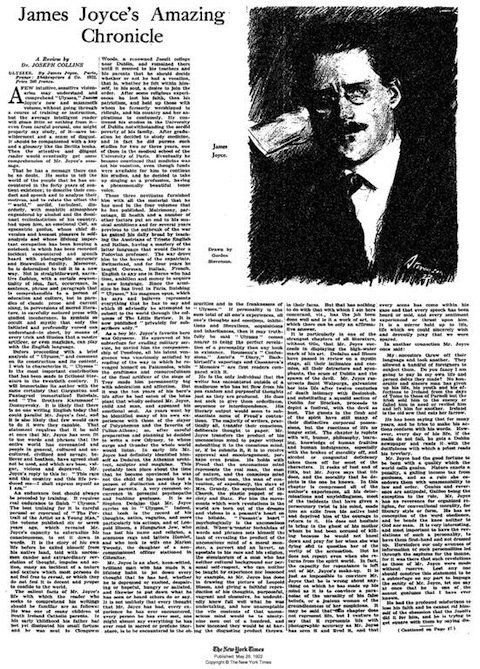
We’ve recently discussed the reactions of James Joyce’s literary contemporaries to the 1922 publication of Ulysses. T.S. Eliot was floored, and told all of his friends, including Virginia Woolf. Woolf wrestled with the book and either found it too dull or too overwhelming to finish. Whatever the reaction, Joyce’s peers took notice. But what did people who weren’t soon to be the subject of thousands of dissertations think? Of the few non-modernist masters who read Joyce, his first professional critics offer evidence. Take the review of Dr. Joseph Collins in The New York Times (above—see the full text here). Collins begins with a very prescient statement, one most readers of Joyce will likely agree with in some part:
Few intuitive, sensitive visionaries may understand and comprehend “Ulysses,” James Joyce’s new and mammoth volume, without going through a course of training or instruction, but the average intelligent reader will glean little or nothing from it- even from careful perusal, one might properly say study, of it- save bewilderment and a sense of disgust. It should be companioned with a key and a glossary like the Berlitz books. Then the attentive and diligent reader would eventually get some comprehension of Mr. Joyce’s message.
Collins then goes on to praise Joyce’s greatness in no uncertain terms:
Before proceeding with a brief analysis of “Ulysses,” and a comment on its construction and content, I wish to characterize it. “Ulysses” is the most important contribution that has been made to fictional literature in the twentieth century. It will immortalize its author with the same certainty that Gargantua and Pantagruel immortalized Rabelais, and “The Brothers Karamazof” Dostoyevsky. It is likely that there is no one writing English today that could parallel Joyce’s feat.
Such incredibly high praise it sounds like flattery, especially since Joyce’s book had not even weathered a few weeks among the reading public. For a more sober and careful assessment, see the great literary critic Edmund Wilson’s July, 1922 review in the New Republic. In Wilson’s ambivalent assessment: “The thing that makes Ulysses imposing is, in fact, not the theme but the scale upon which it is developed. It has taken Mr. Joyce seven years to write Ulysses and he has done it in seven hundred and thirty pages which are probably the most completely “written” pages to be seen in any novel since Flaubert.” If this seems like faint praise, it sets up some of Wilson’s “complaints” to come. And yet, “for all its appalling longueurs,” he writes, “Ulysses is a work of high genius. [It] has the effect at once of making everything else look brassy.”
Of course there were those who hated the book, like Harvard’s Irving Babbitt, who said it could only have been written “in an advanced stage of psychic disintegration.” And there were the puritans and philistines who found the novel’s scatological humor, frank depictions of sex, and near constant erotic charge a scandal. Yet it was the opinions, however qualified, of Joyce’s peers and most of his critics that moved U.S. Judge John Monro Woolsey eleven years later to rule that the book was not obscene and could be legally sold in America. Wrote Woolsey in his decision, “The reputation of ‘Ulysses’ in the literary world… warranted my taking such time as was necessary… In ‘Ulysses,’ in spite of its unusual frankness, I do not detect anywhere the leer of the sensualist.” Good thing Woolsey didn’t read Joyce’s letters to his wife.
Related Content:
James Joyce Read From his Epic Ulysses, 1924
James Joyce, With His Eyesight Failing, Draws a Sketch of Leopold Bloom (1926)
James Joyce’s “Dirty Letters” to His Wife (1909)
James Joyce’s Ulysses: Download the Free Audio Book
Josh Jones is a writer and musician based in Durham, NC. Follow him at @jdmagness
Read More...Vice Meets Up with Superstar Communist Cultural Theorist Slavoj Žižek
I can pop open a copy of Slavoj Žižek’s Interrogating the Real to a random page and I am suddenly ping-ponging from critique of Kant, to a high-five for the “vulgar sentimental” literary kitsch of today, to “the tradition of amour courtois,” to “a completely unreadable” novel called Indecent Obsession, all within the space of four sentences. I may not have any earthly idea what to make of this connect-the-dots, but I want to know what it means. I can look over at the shelf and see on it a volume called The Monstrosity of Christ, a respectful yet tenacious dialogue-slash-debate on Christianity between dialectical materialist Žižek and “radical orthodox” theologian John Milbank. Just in this casual, cursory glance, I might conclude: this is no cranky village atheist (or Marxist as the case may be). This is a psychoanalytic Marxist theorist of breadth. And I haven’t even touched on his extensive engagement with Hollywood film.
It is this magnanimous, playful, and hyper-engaged side of Žižek—that and his unflagging sense of humor and highly visible public persona—that makes him seem approachable. Even if, as the interviewer in the Vice encounter with Žižek above says, “most of [his books] remain impenetrable” to many readers, he is undoubtedly “the most broadly popular anti-capitalist philosopher working today.” The occasion for the interview: a 2012 documentary film starring Žižek called The Pervert’s Guide to Ideology, which opens November 1st in the U.S.. Directed by Sophie Fiennes and a follow-up to 2006’s The Pervert’s Guide to Cinema, the film has Žižek deploy his rapid-fire referencing ability to “explain why the bulk of us remain enslaved to capitalist power structures.” His material, as with The Pervert’s Guide to Cinema, is once again classic Hollywood films like Full Metal Jacket, The Searchers, Taxi Driver, The Sound of Music, and The Last Temptation of Christ. Žižek even takes on such recent, less classic, blockbusters as I Am Legend and The Dark Knight. (Something covered in our recent post.) In the interview above, staged in Žižek’s cozy Slovenian flat, see the philosopher in typically animated style poke fun at himself as he discusses the newest film’s intentions, expands on his revolutionary analyses, and gestures maniacally about the apartment while offering his guest a “f*cking fruit juice.”
Related Content:
Slavoj Žižek’s Pervert’s Guide to Ideology Decodes The Dark Knight and They Live
A Shirtless Slavoj Žižek Explains the Purpose of Philosophy from the Comfort of His Bed
Žižek!: 2005 Documentary Reveals the “Academic Rock Star” and “Monster” of a Man
Josh Jones is a writer and musician based in Durham, NC. Follow him at @jdmagness
Read More...Take a Free Course on the Financial Markets with Robert Shiller, Winner of the Nobel Prize in Economics
This morning, the Nobel Prize in Economic Science went to three American professors — Eugene F. Fama (U. Chicago), Lars Peter Hansen (U. Chicago) and Robert J. Shiller (Yale) — “for their empirical analysis of asset prices.” In his own way, each economist has demonstrated that “stock and bond prices move unpredictably in the short term but with greater predictability over longer periods,” and that markets are “moved by a mix of rational calculus and human behavior,” writes The New York Times.
Of the three economists, Robert Shiller is perhaps the most household name. In March 2000, Shiller published Irrational Exuberance, a book that warned that the long-running bull market was a bubble, that stock prices were being driven by human psychology, not real values. Weeks later, the market cracked and people began to pay attention to what Shiller had to say. Fast forward a few years, and Shiller released a second edition of the same book, this time arguing that the housing market was the latest and greatest bubble. We all know how that prediction played out.
Shiller’s thinking about the financial markets isn’t a mystery. It’s all on display in his Yale course simply called Financial Markets. Available for free on YouTube, iTunes Video, and Yale’s web site, the 23 lecture-course provides an introduction to “behavioral finance principles” necessary to understand the functioning of the securities, insurance, and banking industries. Recorded in 2011, the course is otherwise listed in the Economics section of our collection of 1200 Free Online Courses. You can watch all of the lectures above, starting with Lecture 1. By following these links, you can find the course syllabus, an outline of the weekly sessions, and a book list.
Personal Note: About 10 years ago, I worked with Prof. Shiller on developing an online course. Two things I recall about him. First, he struck me as being a very down-to-earth and unassuming guy. A pleasure to work with. Second, we had some time to kill one day, and so I asked him (circa 2005) whether it was crazy to buy a house. I mean, I had the guru sitting in front of me, in a chatty mood. What did I get? Bupkis: “You know, it just depends…” It wasn’t a bullish sign. So I took it to mean “Stay on the sidelines, kid.” In 2007, it seemed like sound advice.
If you would like to support the mission of Open Culture, consider making a donation to our site. It’s hard to rely 100% on ads, and your contributions will help us continue providing the best free cultural and educational materials to learners everywhere. You can contribute through PayPal, Patreon, and Venmo (@openculture). Thanks!
Related Content:
Marginal Revolution University Launches, Bringing Free Courses in Economics to the Web
John Maynard Keynes Explains Cure to High Unemployment in His Own Voice (1939)
Read More...Žižek Blames the US Government Shutdown on Ayn Rand’s Acolytes Who Caused the 2008 Collapse
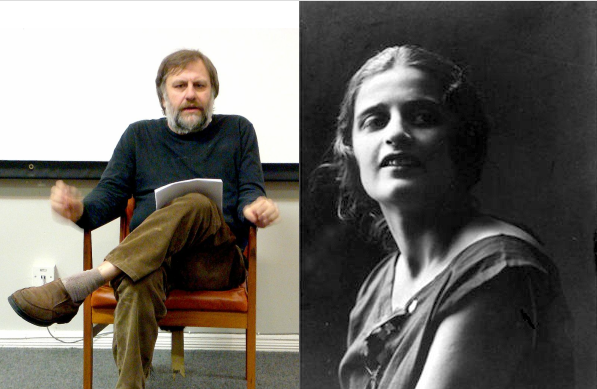
Images via Wikimedia Commons
The government shutdown and the raising of the debt ceiling — such things are not usually grist for our cultural mill. But all of that changes when a cultural theorist pins the blame for Washington’s dysfunction on the acolytes of a pseudo-philosopher. Writing in The Guardian last Friday, in simple, straightforward prose, Slovenia’s favorite theorist Slavoj Žižek asks and answers a question in the title of his op-ed: “Who is responsible for the US shutdown? The same idiots responsible for the 2008 meltdown”. And who are those “idiots,” you might wonder? Let me spare you the suspense and jump you down to the last two paragraphs of his piece:
One of the weird consequences of the 2008 financial meltdown and the measures taken to counteract it (enormous sums of money to help banks) was the revival of the work of Ayn Rand, the closest one can get to an ideologist of the “greed is good” radical capitalism. The sales of her opus Atlas Shrugged exploded. According to some reports, there are already signs that the scenario described in Atlas Shrugged – the creative capitalists themselves going on strike – is coming to pass in the form of a populist right. However, this misreads the situation: what is effectively taking place today is almost the exact opposite. Most of the bailout money is going precisely to the Randian “titans”, the bankers who failed in their “creative” schemes and thereby brought about the financial meltdown. It is not the “creative geniuses” who are now helping ordinary people, it is the ordinary people who are helping the failed “creative geniuses”.
John Galt, the central character in Atlas Shrugged, is not named until near the end of the novel. Before his identity is revealed, the question is repeatedly asked, “Who is John Galt”. Now we know precisely who he is: John Galt is the idiot responsible for the 2008 financial meltdown, and for the ongoing federal government shutdown in the US.
We’re not saying it’s the most trenchant analysis, but we do like to take note of intellectual dustups. Speaking of, did you miss the Chomsky-Žižek spat from the summer? It went four rounds. Round 1. Round 2. Round 3. Round 4. And ended in a draw.
Related Content:
Ayn Rand Adamantly Defends Her Atheism on The Phil Donahue Show (Circa 1979)
William F. Buckley Flogged Himself to Get Through Atlas Shrugged
Mike Wallace Interviews Ayn Rand (1959)
Read More...Joseph Stalin, a Lifelong Editor, Wielded a Big, Blue, Dangerous Pencil
It seems only natural that Joseph Stalin, who presided over perhaps the most staggeringly vast erasure of human beings, their property, their documents and histories, should have also been a meticulous editor. Whether we know it or not, the invisible hand of an editor intrudes between us and nearly everything we read (even if it’s the writer as editor), making esoteric decisions, creating alternate outcomes and deleting the past. In Stalin’s day, and still in many editorial departments today, the editor wielded a colored pencil instead of a keyboard, and hovered over manuscripts, noting addenda, correcting minutia, slashing through sentences, and scribbling indecipherable comments in the margins. Stalin’s pencil was blue, a color that was not visible when photographed.
This color becomes a metaphor for Stalin’s invisibility in a fascinating article on Stalin as editor by Holly Case, associate professor of history at Cornell University. Before Stalin was Stalin, he was Joseph Djugashvili, revolutionary bolshevik and seminary dropout, “a ruthless person, and a serious editor.” Stalin rejected 47 of Lenin’s articles to Pravda (and suppressed Lenin’s warnings about his protégée after the former’s death). And once he assumed power as head of the Soviet state in the mid-twenties, Stalin continued in this capacity, heavily rewriting documents and manuscripts, and scrawling notes and revisions over hundreds of official party documents. “For Stalin,” Case writes, “editing was a passion that extended well beyond the realm of published texts.” She comments on the paradox of the dictator’s inescapable public presence and his intrusive, yet invisible, editorial tendencies:
Stalin always seemed to have a blue pencil on hand, and many of the ways he used it stand in direct contrast to common assumptions about his person and thoughts. He edited ideology out or played it down, cut references to himself and his achievements, and even exhibited flexibility of mind, reversing some of his own prior edits.
So while Stalin’s voice rang in every ear, his portrait hung in every office and factory, and bobbed in every choreographed parade, the Stalin behind the blue pencil remained invisible. What’s more, he allowed very few details of his private life to become public knowledge, leading the Stalin biographer Robert Service to comment on the remarkable “austerity” of the “Stalin cult.”
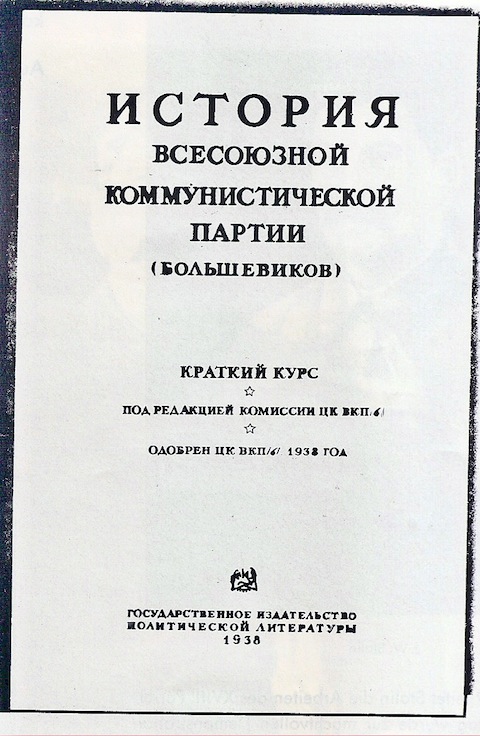
We should not mistake Stalin’s “self-effacement,” Case writes, for modesty. She quotes the enigmatic street artist Banksy to make the point: “invisibility is a superpower.” Stalin applied the power of his pencil to thousands of official documents and pieces of propaganda, even completely rewriting the 1938 Soviet bible, The Short Course on the History of the All-Union Communist Party (Bolsheviks). Commissioned for a team of authors in 12 chapters, Stalin found it necessary to “fundamentally revise 11 of them” (see the first edition title page above).
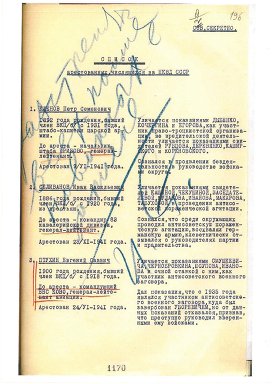
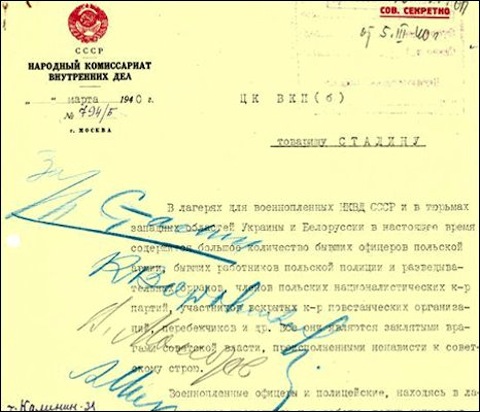
Stalin’s blue pencil also intervened in more direct, and chilling ways. The document at left shows a list of people held by the NKVD, forerunners to the KGB. The blue handwriting scrawled over the list is Stalin’s. It reads “Execute everyone.”
We have another execution order below, this time in the form of a 1940 letter written by Stalin’s secret police chief Beria and recommending “execution by shooting” for around 20,000 prisoners, most of them Polish officers, at a camp in Katyn, a massacre the Soviets blamed on the Nazis. Beria’s letter (below) bears the signatures, in blue pencil, of Stalin and several Politburo members.
In addition to heavily editing propaganda and signing mass death warrants, Stalin used his pencil to deface drawings by 19th century Russian painters, scrawling “crude and ominous captions” beneath them in red or blue. He left his mark on 19 pictures, all of them nudes, most of them male. He slashed through their torsos and other body parts with the pencil (below) and wrote on one of the drawings, “Radek, you ginger bastard, if you hadn’t pissed into the wind, if you hadn’t been so bad, you’d still be alive.” Karl Radeck was a revolutionary activist in the 20s that historians believe Stalin had killed in 1939. Historian Nikita Petrov—who believes Stalin defaced the drawings between 1939 and 1946—says of them: “These captions show Stalin wasn’t just malicious and primitive, but that he was also very dangerous.” It is indeed deeply unsettling for an editor to see Stalin’s ruthless hand move freely from the violence of his slash-and-burn textual changes to that of his mass execution orders and crude, “loutish” debasement of human forms.
Related Content:
History Declassified: New Archive Reveals Once-Secret Documents from World Governments
Leon Trotsky: Love, Death and Exile in Mexico
Learn Russian from our List of Free Language Lessons
Josh Jones is a writer and musician based in Durham, NC. Follow him at @jdmagness
Read More...Famous Philosophers Imagined as Action Figures: Plunderous Plato, Dangerous Descartes & More
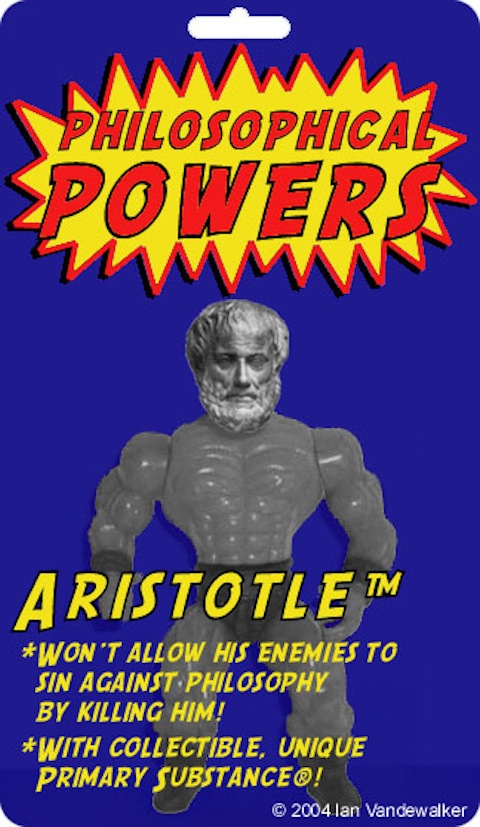
Americans do not live in a culture that values philosophy. I could go on about the deep veins of anti-intellectualism that run under the country like fault lines or natural gas deposits, but I won’t. Let’s just say that we favor more obvious displays of prowess: feats of strength, agility, and physical violence, for example, of the superhero variety. With this fact in mind, first-year graduate student Ian Vandewalker decided he “wanted to do something that would bring a discipline that is often seen as difficult, esoteric, and even irrelevant, into new light—especially in the eyes of young people.” Remembering a poster he once saw of “an action figure of Adam Smith with Invisible Hand action,” Vandewalker decided he would combine his own love of toys and philosophy into a philosopher action figure series he called “Philosophical Powers!” Here are just a few of Vandewalker’s creations, designed somewhat like professional wrestlers, with their various leagues and range of epithets.
He begins at the traditional beginning, with figures of “Plunderous Plato” and “Arrogant Aristotle” (above), “The Angry Ancients.” Aristotle, known as the “peripatetic” philosopher, has only one power: “walking.” His quality is attested by a rather circular syllogism: “All Philosophical Powers figures are totally awesome. This toy is a Philosophical Powers figure. Therefore, this toy is totally awesome.” Like much of Aristotle’s deductive reasoning, the argument is airtight, provided one accept the truth of its premises.
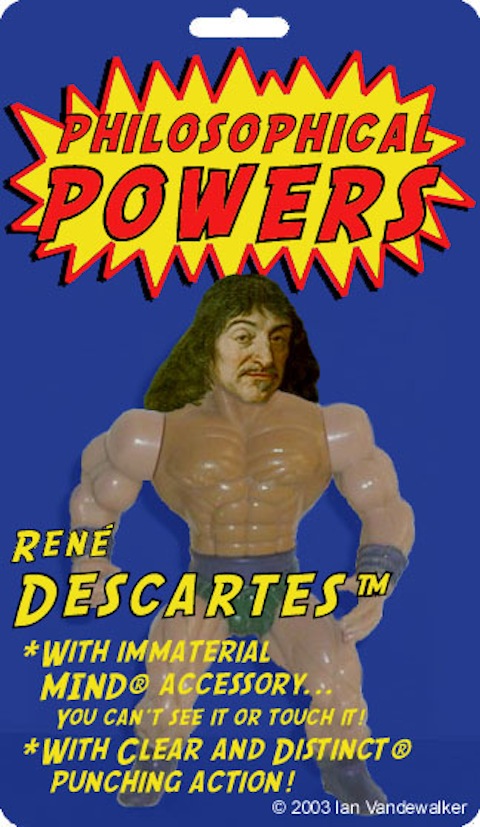
In the category of “Contumelious Continental Rationalists,” who began the revolt against those Aristotelian “Merciless Medievals,” we have “Dangerous Descartes.” René Decartes may have claimed to doubt everything—every principle that Aristotle took for granted—but he fell prey to his own errors, hence his action figure’s weakness, the “Cartesian circle.” Decartes’ method of doubt produced its own brand of dualistic certainty about his own existence as a “thinking thing,” and the existence of God, hence “certainty” is one of his action figure’s strengths.
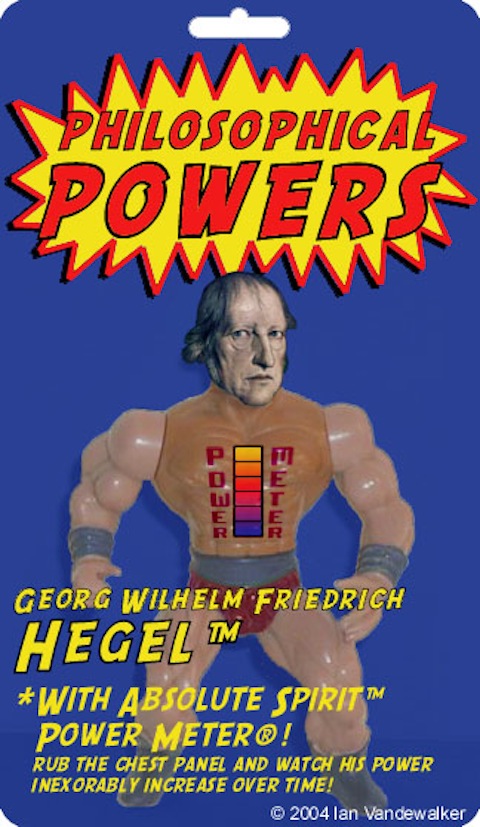
Skipping ahead over a century, we have the lone figure in “The Abominable Absolute Idealist” series, “Hateful Hegel.” Hegel is the ultimate systematizer whose embrace of contradiction can seem maddeningly incoherent, unless we believe his metaphysic of “Absolute Spirit.” Given his dialectic of everything, Hegel’s power is that “he is infinite.” His weakness? “He is finite,” of course. Given Hegel’s teleological theory of history, people who purchase his action figure “can expect them to become more and more valuable as time passes.”
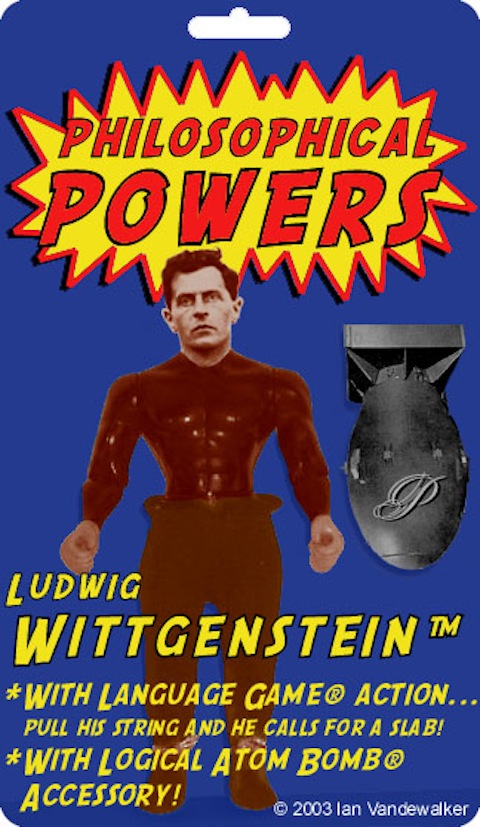
The most amusing of “The Antagonistic Analytic Philosophers” is Ludwig Wittgenstein, who was himself an amusingly eccentric individual. Known for his terrible temper, which would often drive him to verbally abuse and strike those poor students who couldn’t grasp his abstruse concepts, “Vindictive Wittgenstein” has the power of “poker wielding ability.” His weakness, naturally, is his “teaching ability.” I particularly like the “notes” section of the figure’s description:
Wittgenstein figures come in two variations: the early model’s recorded messages include nonsense about language being a “picture” of the world, while the later model’s messages include nonsense about games and their “family resemblances” to one another. It’s fun to communicate! (Doll does not actually communicate. Children who claim that Wittgenstein figures talk to them with their own “private language” are mistaken or lying and should be severely beaten by their teachers.)
You can see the whole set at the Philosophical Powers site. It is problematic that we only get dead white men represented, but this is not solely the fault of Vandewalker but also a problem of history and the traditional academic history of ideas. One would hope that the concept is clever enough that it might make philosophy appealing to people who find it dull or unapproachable. That may be too lofty a goal, but these figures are sure to amuse the already philosophically-inclined, and perhaps spur them on to learn more.
Related Content:
10th Graders Draw Pictures Imagining Philosophers at Work
The Daily Habits of Highly Productive Philosophers: Nietzsche, Marx & Immanuel Kant
What Do Most Philosophers Believe? A Wide-Ranging Survey Project Gives Us Some Idea
Philosopher Portraits: Famous Philosophers Painted in the Style of Influential Artists
Download 90 Free Philosophy Courses and Start Living the Examined Life
Josh Jones is a writer and musician based in Durham, NC. Follow him at @jdmagness
Read More...The Curious Score for John Cage’s “Silent” Zen Composition 4′33″
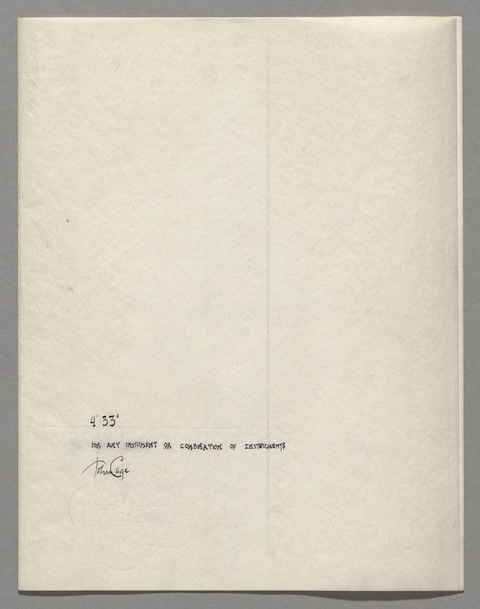
In most of the performances of John Cage’s famously silent composition 4’33”, the performer sits in front of what appears to be sheet music (as in the performance below). The audience, generally prepared for what will follow, namely nothing, may sometimes wonder what could be printed on those pages. Probably also nothing? Now we have a chance to see what Cage envisioned on the page as he composed this piece. Starting on October of this month, New York’s Museum of Modern Art will exhibit Cage’s 1952 score “4’33” (In Proportional Notation).” You can see the first page above.
As you might imagine, subsequent pages (viewable here) look nothing like a typical score, but they are not blank, nor do they contain blank staves; instead they are traversed by carefully hand-drawn vertical lines that seem to denote the units of time as units of space. In fact, this is exactly what Cage did (hence proportional notation). On the fourth page of the score, Cage writes the following formula: “1 page=7 inches=56 seconds.” Artist Irwin Kremen, to whom Cage dedicated the piece, has this to say about the unusual score:
In this score, John made exact, rather than relative, duration, the only musical characteristic. In effect, real time is here the fundamental dimension of music, its very ground. And where time is primary, change, process itself, defines the nature of things. That aptly describes the silent piece — an unfixed flux of sound through time, a flux from performance to performance.
Interpreters of Cage have frequently taken his “silent” piece as a playful bit of conceptual performance art. For example, philosopher Julian Dodd emphatically declares that 4’33” is not music, a distinction he takes to mean that it is instead analytical, “a work about music…,” that it is “a witty, profound work… of conceptual art.” Thinking of Cage’s piece as a kind of meta-analysis of music seems to miss the point, however. Kremen and many others, including Cage himself, call this notion into question. In the interview below, for example, Cage does make an important distinction between “music” and “sound.” He favors the latter for its chance, impersonal qualities, but also, importantly, because it is neither analytical nor emotional. Sound, says Cage, does not critique, interpret, or elaborate—it does not “talk.” It simply is. But the distinction between music and not-music soon collapses, and Cage cites Emmanuel Kant in saying that music “doesn’t have to mean anything,” any more than the chance occurrences of sound.
Cage’s rejection of meaning in music may have played out in a rejection of traditional forms, but it seems mistaken to think of 4’33” as a high concept joke or intellectual exercise. Perhaps it makes more sense to think of the piece as a Zen exercise, carefully designed to awaken what Suzuki Roshi called “the true dragon.” In a 1968 lecture, the Zen master tells the following story:
In China there was a man named Seko, who loved dragons. All his scrolls were dragons, he designed his house like a dragon-house, and he had many pictures of dragons. So the real dragon thought, “If I appear in his house, he will be very pleased.” So one day the real dragon appeared in his room and Seko was very scared of it. He almost drew his sword and killed the real dragon. The dragon cried, “Oh my!” and hurriedly escaped from Seko’s room. Dogen Zenji says, “Don’t be like that.”
The subject of Suzuki’s lecture is zazen, or Zen meditation, a practice that very much influenced Cage through his study of another Zen interpreter, D.T. Suzuki. Instead of practicing zazen, however, Cage practiced what he called his “proper discipline.” He describes this himself in a quotation from a biography by Kay Larsen:
[R]ather than taking the path that is prescribed in the formal practice of Zen Buddhism itself, namely, sitting cross-legged and breathing and such things, I decided that my proper discipline was the one to which I was already committed, namely, the making of music. And that I would do it with a means that was as strict as sitting cross-legged, namely, the use of chance operations, and the shifting of my responsibility from the making of choices to that of asking questions.
Cage, who loved Zen parables and was himself a storyteller, would appreciate Suzuki Roshi’s telling of Zenji’s true dragon story. While much of his compositional work seems to skirt the edges of music, focusing on the negative space around it, for Cage, this space is no less important that what we think of as music. As Suzuki interprets the story: “For people who cannot be satisfied with some form or color, the true dragon is an imaginary animal which does not exist. For them something which does not take some particular form or color is not a true being. But for Buddhists, reality can be understood in two ways: with form and color, and without form and color.” Read against this backdrop, Cage’s “silent” piece is as much a way of understanding reality—as much a true being—as a musical composition expressly designed produce specific formal effects. And while his published collection of lectures and writings is titled Silence, as Cage himself said of 4’33”, in a remark that provides the title for the MoMA’s exhibit, “there will never be silence.” In the absence of formalized music, 4′33″ asks us to hear the true dragon of sound.
Related Content:
Hear Joey Ramone Sing a Piece by John Cage Adapted from James Joyce’s Finnegans Wake
Watch a Surprisingly Moving Performance of John Cage’s 1948 “Suite for Toy Piano”
Woody Guthrie’s Fan Letter To John Cage and Alan Hovhaness (1947)
Josh Jones is a writer and musician based in Durham, NC. Follow him at @jdmagness
Read More...Support Us
We're hoping to rely on loyal readers, rather than erratic ads. Please click the Donate button and support Open Culture. You can use Paypal, Venmo, Patreon, even Crypto! We thank you!

About Us

Open Culture scours the web for the best educational media. We find the free courses and audio books you need, the language lessons & educational videos you want, and plenty of enlightenment in between.
Advertise With Us
FREE UPDATES!
GET OUR DAILY EMAIL
Get the best cultural and educational resources on the web curated for you in a daily email. We never spam. Unsubscribe at any time.
FOLLOW ON SOCIAL MEDIA
Open Culture editor Dan Colman scours the web for the best educational media. He finds the free courses and audio books you need, the language lessons & movies you want, and plenty of enlightenment in between.
Advertise With Us


