Hear Michel Foucault Deliver His Lecture on “Truth and Subjectivity” at UC Berkeley, In English (1980)
Michel Foucault first arrived at the University of California, Berkeley in 1975. By this time, he was already a celebrity in France. He had just published his enormously influential history and critique of the penal system, Discipline and Punish, and he occupied a position at the prestigious Collège de France as chair in the “history of systems of thought,” a position he created for himself. But when he arrived on the West Coast, writes Marcus Wohlsen, “few at Berkeley had heard of Michel Foucault.” Leo Bersani, then chairman of the French department, even had to call philosophy professor Hubert Dreyfus to help “come and fill out the ranks” for Foucault’s lectures.
After the publication of volume one of The History of Sexuality, Foucault would return to Berkeley in the fall of 1979, then again in 1980. By then, the scene had changed dramatically. Foucault was invited to deliver the Howison Lecture that year, a distinguished invitation previously extended to such thinkers as John Dewey, Willard V.O. Quine and, the year previous, John Rawls. By this time, Wohlsen writes, Foucault was, reluctantly, “an international academic superstar.” Filling the hall for his lectures would not be an issue. In fact, Wohlsen tells us,
Crowds crammed the 2,000-seat Zellerbach Hall so quickly that police had to bar the doors. Foucault fans milled around restlessly outside until [philosophy professor Hans] Sluga arranged for a live broadcast of the letures to Wheeler Hall. Its 760 seats filled almost immediately.
According to Sluga, Foucault, increasingly wary of his fame, intentionally titled his lecture—“Truth and Subjectivity: the Stoic Practice of Self Examination”—to sound “learned, abstract, remote” in order to deter a large crowd. That ploy clearly failed.
In the first part of the lecture (at top), the presenter who introduces Foucault begins by gesturing to the philosopher’s fame, then comments that Foucault’s prominent post at the Collège de France was “very paradoxical, since Michel Foucault, although prestigious, is not a typical kind of academic. He is suspicious of all titles and claims to disinterested truth that has been [sic] associated with academia.” After mentioning Foucault’s fierce criticism of every historical assumption and methodology (he was a guest of the History and French Departments), he breaks off his remarks to note that “there’s a mob of people all around, trying to get in.”
Foucault begins his lecture in French (at 8:08), then switches to English for the remainder (at 9:18). He quotes from a historical French psychiatrist’s account of a “cure” involving an “interrogation” and a coerced confession of madness. Foucault calls this one among many examples of “truth therapies,” and it serves—as do such vividly specific archival examples in his books—as a harrowing introduction to the policing of capital‑T Truth that is the essence of the humanist enterprise.
Despite the often profoundly unsettling nature of his investigations, and his attempt to scare off the crowd, Foucault is not dour or boring, nor does he seem at all unapproachable or forbidding. He is patient and self-deprecatingly funny: in a cutting, rueful reference to the growing dominance of analytic philosophy in British and American universities, he says, “I confess, with the appropriate chagrin, that I am not an analytical philosopher. Nobody is perfect.” Then he sums up his project succinctly: “I have tried to explore another direction. I have tried to get from a philosophy of subjectivity to a genealogy of the subject.”
Foucault is a very charming speaker, sprinkling his lecture with little jokes like “It goes without saying… but it goes better with saying…” and dropping in Americanisms like “Monday morning quarterbacking,” to the amusement of the crowd. He shows himself to be very much aware of his audience—these are deeply serious lectures, without a doubt, but Foucault never forgets that he’s facing living human beings, with their own domains of knowledge and subjectivities—and he seeks to reach them where they are while reporting on his disturbing discoveries as an archaeologist of Western humanist discourse.
Foucault returned to Berkeley again as a visiting professor in 1981 and again 1983, the year before his death. Alain Beaulieu, who has catalogued Foucault’s Berkeley archives, described his time in California as happy and productive, “while he remain[ed] critical of some features associated with the ‘Californian cult of the self.’” In fact, “Cult of the Self” was the title of three lectures Foucault delivered at Berkeley in 1983 (listen here), along with six lectures on “Discourse and Truth.” During his time at Berkeley in 1980, when he delivered the lecture above, graduate student Michael Bess interviewed the philosopher. Foucault spoke plainly and passionately about the impetus for his relentless critiques of institutional power and knowledge:
In a sense, I am a moralist, insofar as I believe that one of the tasks, one of the meanings of human existence—the source of human freedom—is never to accept anything as definitive, untouchable, obvious, or immobile. No aspect of reality should be allowed to become a definitive and inhuman law for us.
We have to rise up against all forms of power—but not just power in the narrow sense of the word, referring to the power of a government or of one social group over another: these are only a few particular instances of power.
Power is anything that tends to render immobile and untouchable those things that are offered to us as real, as true, as good.
Read the complete interview, first published in the November 10, 1980 Daily Californian, here.
Related Content:
Clash of the Titans: Noam Chomsky & Michel Foucault Debate Human Nature & Power on Dutch TV, 1971
Download Free Courses from Famous Philosophers: From Bertrand Russell to Michel Foucault
Michel Foucault: Free Lectures on Truth, Discourse & The Self
90 Free Philosophy Courses in our Collection of 800 Free Courses Online
Josh Jones is a writer and musician based in Durham, NC. Follow him at @jdmagness
Read More...Watch Michel Gondry Animate Philosopher, Linguist & Activist Noam Chomsky
As an arts major who doodled my way through every required science course in high school and college, I am deeply gratified by filmmaker Michel Gondry’s approach to documenting the ideas of Noam Chomsky. Having filmed about three hours worth of interviews with the activist, philosopher, and father of modern linguistics in a sterile MIT conference room, Gondry headed back to his charmingly analog Brooklyn digs to spend three years animating the conversations. It’s nice to see a filmmaker of his stature using books to jerry-rig his camera set up. At one point, he huddles on the floor, puzzling over some sequential drawings on 3‑hole punch paper. Seems like the kind of thing most people in his field would tackle with an iPad and an assistant.
Gondry may have felt intellectually dwarfed by his subject, but there’s a kind of genius afoot in his work too. Describing the stop-motion technique he used for Is the Man Who Is Tall Happy?, he told Amy Goodman of Democracy Now, “I have a lightbox, and I put paper on it, and I animate with Sharpies, color Sharpies. And I have a 16-millimeter camera that is set up on a tripod and looks down, and I take a picture. I do a drawing and take a picture.”
A pretty apt summation—watch him in action above—but the curiosity and humanity so evident in such features as Eternal Sunshine of the Spotless Mind and The Science of Sleep is a magical ingredient here, too. He attributes biological properties to his Sharpie markers, and takes a break from some of Chomsky’s more complex thoughts to ask about his feelings when his wife passed away. He doesn’t seem to mind that he might seem a bit of a schoolboy in comparison, one whose talents lie beyond this particular professor’s scope.
As Chomsky himself remarks in the trailer, below, “Learning comes from asking why do things work like that, why not some other way?”
Is the Man Who Is Tall Happy? is available on iTunes.
H/T @kirstinbutler
Related Content:
Filmmaker Michel Gondry Presents an Animated Conversation with Noam Chomsky
Noam Chomsky Schools 9/11 Truther; Explains the Science of Making Credible Claims
Ayun Halliday puts her lifelong penchant for doodling to good use in her award-winning, handwritten, illustrated zine, The East Village Inky. Follow her @AyunHalliday
Read More...View Bill Gates’ Mobile Library: The Books & Courses That Help Him Change The World
Stepping down as Microsoft’s chief executive officer in 2000 had given Bill Gates some extra time, which the autodidact immediately expended by attempting to learn… well, everything. Perhaps Gates threw himself at learning to make up for abandoning college for greater pursuits—he attended Harvard but left after two years’ study to pursue his passion for computers. Whatever his reasons, Gates has begun to assiduously learn all he can about the world, and is recording his education process for posterity on his website, The Gates Notes. As the video above explains, Microsoft’s founder has listened to hundreds of hours of university lectures from The Teaching Company; he got hooked after listening to Robert Whaples’ Modern Economic Issues and breezing through Timothy Taylor’s America and the New Global Economy. His number one pick? Big History which is taught by David Christian and, Gates says, “is still my favorite course of all. The course is so broad that it synthesizes the history of everything including the sciences into one framework.”
Wherever Gates travels, he is also eternally accompanied by his reading bag. Surprised that the herald of the digital age is packing paperbacks? Don’t be. “I’m still pretty much an old-school print guy,” Gates writes, “because I like to jot notes in the margins, but I assume I’ll move over to ebooks when annotation features get better.”
Last week, Gates showed WIRED the contents of his decidedly 20th century mobile library. The books, which Gates replenishes at an impressive rate, encompass an admirable breadth of topics. As befitting the overseer of the Bill and Melinda Gates Foundation, the majority of Gates’ reading consists of non-fiction (only Gary Shteyngart’s recent novel made the fiction cut this round). History, psychology, science, sound business counsel, sociology, economics, and history all make up the dizzying array of Gates’ everyday reading. Here is a selection from WIRED’s partial list, including Gates’ own comments on the importance of each choice:
-Feynman’s Tips on Physics by Richard Feynman– A short companion book to Richard Feynman’s classic Lectures on Physics. Always worthwhile to return to the feet of the master.
-Super Sad True Love Story: A Novel by Gary Shteyngart– I don’t read a lot of fiction, but I thought this was an interesting study of the moral implications of technology. Will technology contribute to everyone’s well-being or just make people more narcissistic?
-The Cartoon Introduction to Statistics by Grady Klein– Bought this to use with one of my kids. Helpful in explaining a complicated subject to a teenager.
-The Path Between the Seas: The Creation of the Panama Canal by David McCullough – I read this to prepare for a family vacation to Panama. It’s pure McCullough: epic drama, political intrigue, heartbreaking defeats, and eventual triumph.
-The Better Angels of Our Nature: Why Violence Has Declined by Steven Pinker– One of the most important books I’ve read. Steven Pinker demonstrates how the world evolved to be far less violent. Counterintuitive, if you watch the news, but true.
We’ve also used the trusty Control + Scroll function to zoom in and name a few additional titles:
An Uncertain Glory: India and its Contradictions by Jean Drèze and Amartya Sen
Engineers of Victory: The Problem Solvers Who Turned The Tide in The Second World War by Paul Kennedy
The Price of Inequality: How Today’s Divided Society Endangers Our Future by Joseph Stiglitz
Why Does College Cost So Much? By Robert Archibald and David Feldman
Mondo Agnelli: Fiat, Chrysler, and the Power of a Dynasty by Jennifer Clark
How Children Succeed: Grit, Curiosity, and the Hidden Power of Character by Paul Tough
The One World Schoolhouse: Education Reimagined by Salman Khan
Far From The Tree by Andrew Solomon
For the original list, head over to WIRED. For more of Gates’ commentary, check out his site, The Gates Notes, here. You can also continue your self-education by visiting our lists of Free Online Courses, Free eBooks, Free Audio Books, Free Language Lessons, Free Textbooks, and Free MOOCs.
Ilia Blinderman is a Montreal-based culture and science writer. Follow him at @iliablinderman.
Read More...Did Leonardo da Vinci Paint a First Mona Lisa Before The Mona Lisa?
Leonardo da Vinci’s Mona Lisa has been called “the best known, the most visited, the most written about, the most sung about, the most parodied work of art in the world.” (Did you catch the Lego Mona Lisa that made the rounds on the web last week?) Completed in the early 16th century, the painting offers a portrait of Lisa Gherardini, wife of a Florentine cloth merchant named Francesco del Giocond. (Hence why the painting is sometimes called La Gioconda or La Joconde.) Today, the Renaissance masterpiece hangs in the Louvre in Paris, where it’s visited by an estimated six million people each year.
There’s no shortage of debates surrounding the Mona Lisa. Was it completed in 1506? Or is 1517 a more accurate date? Does the portrait actually feature Lisa Gherardini? (Most art historians think so, but scholars have speculated about other figures, including Leonardo’s own mother, Caterina.) And then there’s this bigger question. Was da Vinci’s Mona Lisa his first Mona Lisa? That debate starts with a tantalizing piece of text written by the artist/art historian Giorgio Vasari in his 16th century book, The Lives of the Most Excellent Painters, Sculptors, and Architects. In a section called “Life of Leonardo da Vinci: Painter and Sculptor of Florence,” Vasari wrote: “Leonardo undertook to execute, for Francesco del Giocondo, the portrait of Monna Lisa, his wife; and after toiling over it for four years, he left it unfinished.…” And then Vasari attributed to the portrait some characteristics that don’t quite line up with the famous painting hanging in the Louvre today — “rosy and pearly tints,” eyes that had a “lustre and watery sheen which are always seen in life,” a nose “with its beautiful nostrils, rosy and tender,” etc. All of this left some to wonder: Was Vasari talking about another painting? Perhaps an earlier, unfinished version of the Mona Lisa?
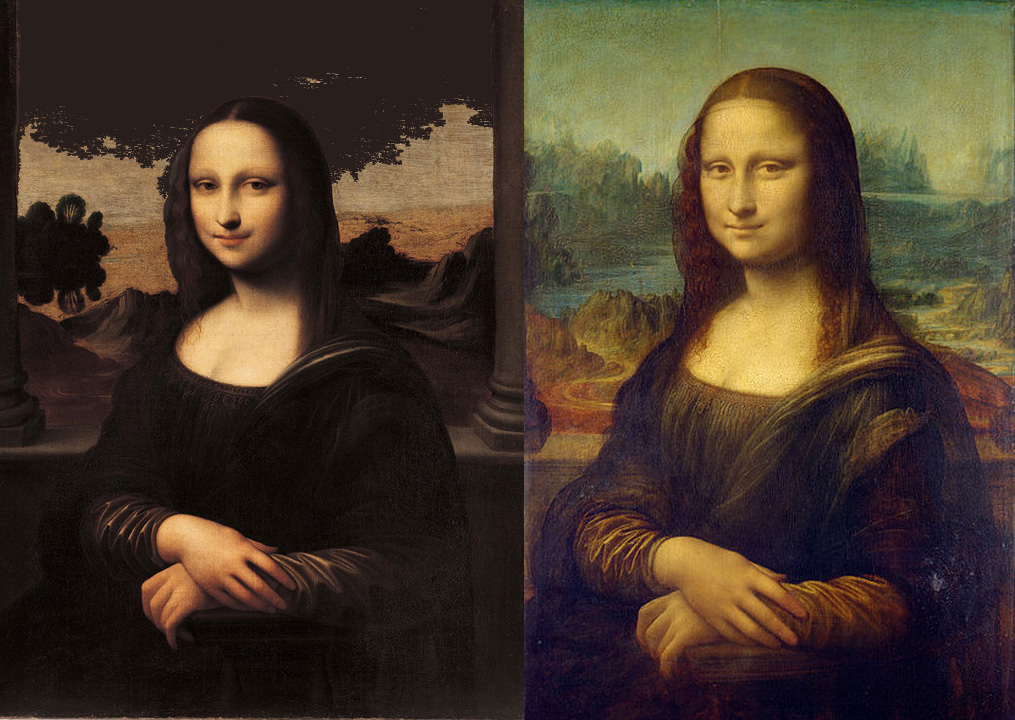
Enter The Mona Lisa Foundation, a non-profit based in Switzerland, that claims they’ve perhaps found an earlier Mona Lisa. In an essay appearing on their website, and in a 20 minute video (top), the Foundation makes the case that “Isleworth Mona Lisa” (right above) was probably painted by da Vinci around 1505, though never completed. Centuries later the portrait ended up in the hands of an English collector Hugh Blaker, only to be then locked away in a Swiss vault for 40 years. It was finally brought out, and made available to the public for the first time, in 2012.
Skeptics have been quick to point out problems with the “Isleworth Mona Lisa.” Some note that it was painted on canvas, whereas Leonardo typically painted on wood. Others claim that x‑rays of the painting call its authenticity into doubt. And then others suggest that the “Isleworth Mona Lisa” is merely a late 16th century copy of the painting now hanging in the Louvre. (The Mona Lisa Foundation web site documents the skeptical claims and offers a rebuttal for reach.)
To be sure, the Isleworth Mona Lisa has its critics, but it also has some supporters. In September 2012, the Swiss Federal Institute of Technology in Zurich carried out carbon-dating tests on the canvas and confirmed that it was likely manufactured between 1410 and 1455, which helped refute claims that the painting was a late 16th century copy. Meanwhile, John Asmus, a UCSD physics professor who “introduced the use of holography, lasers, ultrasonic imaging, digital image processing, and nuclear magnetic resonance to art-conservation practice,” carried out a brushstroke analysis and concluded that “the same construction principles” were used in the design of both Mona Lisas, increasing the likelihood that they were created by the same artist. And finally, Joe Mullins, a forensic specialist trained at the FBI, “age regressed” the original Mona Lisa to see what she would have looked like at an earlier point in time. His conclusion? “Everything lined up perfectly.” “This is Mona Lisa, two different images at two different times in her life.”
But still, skeptics certainly remain.
via Metafilter
Related Content:
NASA Sends Image of the Mona Lisa to the Moon and Back
The Anatomical Drawings of Renaissance Man, Leonardo da Vinci
What Leonardo da Vinci Really Looked Like
Read More...Filmmaker Michel Gondry Presents an Animated Conversation with Noam Chomsky
Even if you regularly read Open Culture, where we make a point of highlighting unusual intersections of cultural currents, you probably never expected a collaboration between the likes of Michel Gondry and Noam Chomsky. Gondry we’ve known as an imaginative filmmaker behind features like Eternal Sunshine of the Spotless Mind and Be Kind Rewind (as well as music videos for artists like Beck, Kanye West, and the White Stripes), one driven to pursue a Continental whimsy tempered by a dedication to elaborate, difficult-looking hand craft and an apparent interest in American culture.
Chomsky we’ve known, depending on our interests, as either a noted linguist or a controversial writer and speaker on politics, society, and the media. Gondry’s new documentary Is the Man Who Is Tall Happy?, the project that brings them together at least, showcases both the less-seen purely philosophical side of Chomsky, and the also rarely acknowledged inquisitive, conversational side of Gondry. In the New York Times “Anatomy of a Scene” clip at the top, the director explains his process.
Naturally, Gondry went through a fairly unusual process to make the film, given that he based the whole thing on nothing more elaborate than a long-form in-office conversation with the MIT-based professor and activist. To get the footage he needed of Chomsky talking, he brought in — naturally — his vintage wind-up Bolex 16-millimeter film camera. He then wove those shots in with his also highly analog hand-drawn animation, which illustrates Chomsky’s ideas as he describes them — and as Gondry prods him for more. “The camera is very loud,” Gondry explains over a deliberately shaky frame, “and that’s why I have to draw it each time you hear it.” Just above, you can watch the film’s trailer, which offers Chomsky’s voice as well as Gondry’s. “Why should we take it to be obvious that if I let go of a ball,” we hear the interviewee ask, “it goes down and not up?” We also hear the interviewer admit that he “felt a bit stupid here,” but these two men’s considerable differences — in generation, in nationality, in sensibility, in their concerns, in the forms of their work — provide all the more reason to listen when they talk. And if you find the intellectual trip not to your taste, just behold the visual one.
Related Content:
Noam Chomsky & Michel Foucault Debate Human Nature & Power (1971)
Noam Chomsky vs. William F. Buckley, 1969
Colin Marshall hosts and produces Notebook on Cities and Culture and writes essays on literature, film, cities, Asia, and aesthetics. He’s at work on a book about Los Angeles, A Los Angeles Primer. Follow him on Twitter at @colinmarshall.
Read More...The 10 Hidden Cuts in Rope (1948), Alfred Hitchcock’s Famous “One-Shot” Feature Film
Among his many accomplishments at the intersection of showmanship and pure cinema, Alfred Hitchcock managed, in 1948, to make a feature film without any cuts — or rather, more impressively, he made a feature film people believed had no cuts. Though cinephiles will know several fine examples of no-cut or few-cut movies from recent years (I’ve enjoyed Mike Figgis’ four-screen Time Code since it came out in the nineties, and I often recommend Il-gon Song’s more recent but rarer one-cut Magicians), they’ll also know that, due to physical limitations in the film technology of Hitchcock’s day, nobody — not even Hitchcock — could possibly have made a film longer than ten minutes out of a single, unbroken shot.
So how did Rope, one of Hitchcock’s lesser-celebrated but still thoroughly fascinating projects, convincingly fake its own form? Editor Vashi Nedomansky shows us in the three-minute video above. “On further examination,” Nedomansky writes on his blog, “Hitchcock’s gem actually contains ten edits. Five of them are hidden as the camera lens is filled by foreground objects. The other five edits are regular hard cuts that not many people either realize or acknowledge.”
Nofilmschool offers a post that goes into greater depth on Rope and editing: “Even though there is editing, it’s often described as a film that plays out in real time. Why? Probably because it’s such an immersive piece of filmmaking; the hidden edits and use of handheld cameras follow and track its characters, allowing audiences to experience and react to each situation at the same moment the actors do — right in the thick of the action.” You can find a more theoretical take from Peter J. Dellolio at Flickhead, who describes Rope as a picture exploring “some of the fundamental characteristics of the cinematic abstraction of time and space by using the mobile camera as an agent that gives plastic reality to subjective material” whose “synthesis of real time and filmic space forces the viewer to absorb narrative information on multiple, often distastefully ironic levels.” For a different framing, presentation, and analysis of Rope’s cuts, see also the short video essay “Skipping Rope.” Hitchcock may not have had the ability to really make the movie in one shot, but he certainly had the ability to keep us all taking about it these 65 years.
Related Content:
21 Free Hitchcock Movies Online
Hitchcock’s Seven-Minute Editing Master Class
Colin Marshall hosts and produces Notebook on Cities and Culture and writes essays on literature, film, cities, Asia, and aesthetics. He’s at work on a book about Los Angeles, A Los Angeles Primer. Follow him on Twitter at @colinmarshall.
Read More...Stephen Fry Explains Cloud Computing in a Short Animated Video
Just the other day, I did the unthinkable: I actually watched a pre-video advertisement. The spot, for a major bank, spent its first few minutes explaining the mechanics of credit rating. Promising useful knowledge, this bank received my attention in return — for about two thirds of the commercial, anyway. The video above, commissioned by a company called Databarracks, does much the same by offering an explanation of “cloud computing,” a concept you’ve surely heard much thrown around over the past several years. Sweetening the deal, it uses for its visuals a drawn-as-you-watch style of educational animation you may have encountered here before, and it employs as its narrator writer, comedian, and man-about-internet Stephen Fry, from whom I’ve always enjoyed a good explanation. “Today,” he begins, “we are in the middle of a revolution in business computing.”
In service of this thesis, he then goes back to 2700 BC, when the Sumerians invented the abacus, continuing on through Leonardo da Vinci’s plans for a mechanical calculator, Charles Babbage’s difference engine, Alan Turing and Tommy Flowers’ forward-looking separation of hardware from software, and Tim Berners-Lee’s realization that computers could operate on something like a neural network — something like this very World Wide Web. We then see and hear an analogy made between computing and electricity. Where once firms wanting to use electricity had to build and maintain their own burdensome power plants, now they have electricity as a utility, paying only for what they need at the time. And while firms have mainly, up to this point, purchased and operated their own stores of computing power, doing it cloud-style will free them all to pay for that, too, as a utility. A bold pitch, perhaps, but everything sounds reasonable — inevitable, even — coming from Stephen Fry.
Related Content:
Stephen Fry: What I Wish I Knew When I Was 18
Stephen Fry Introduces the Strange New World of Nanoscience
Colin Marshall hosts and produces Notebook on Cities and Culture and writes essays on literature, film, cities, Asia, and aesthetics. He’s at work on a book about Los Angeles, A Los Angeles Primer. Follow him on Twitter at @colinmarshall.
Read More...Everything You Wanted to Know About the L.A. Aqueduct That Made Roman Polanski’s Chinatown Famous: A New UCLA Archive
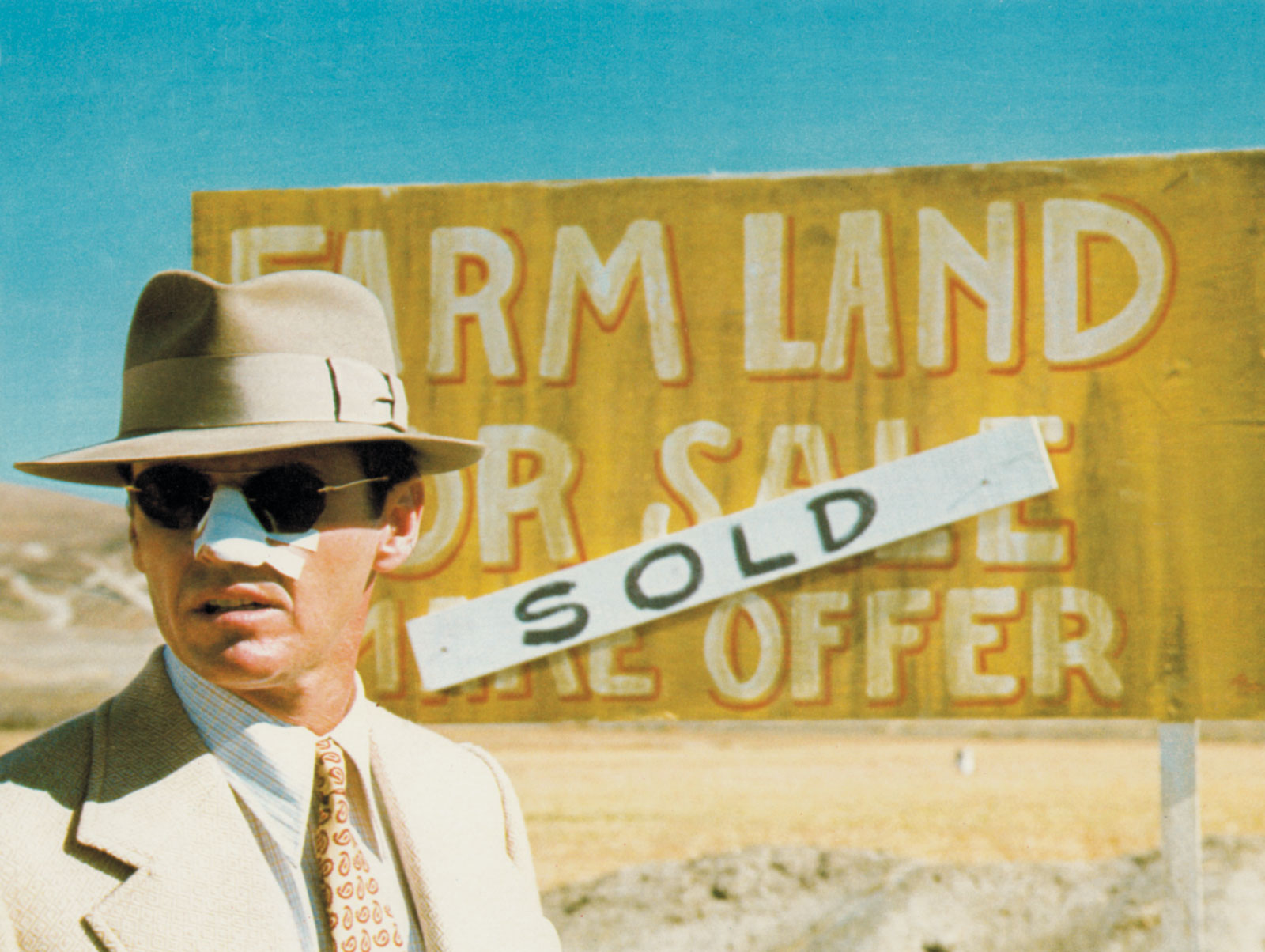
Next year marks the 40th anniversary of a modern classic, Roman Polanski’s Chinatown. And surely no other film has even come close to making the construction of an aqueduct so thrilling.
For sure, the sizable servings of incest, corruption, and greed help carry Robert Towne’s brilliant screenplay. But under Towne’s script are the bones of another story, the story of an engineering feat that eclipsed the Panama Canal. Yes we’re talking about the building of the great Los Angeles aqueduct starting in 1908.
In the preface to the script Towne wrote this, “the great crimes in California have been committed against the land—and against the people who own it and future generations. It was only natural that the script should evolve into the story of a man who raped the land and his own daughter.”
Towne didn’t worry about sticking to the facts (he set the action of Chinatown in the 1930s—an inherently more glamorous period, especially in Los Angeles). Some even argue that the film creates an entirely different (and wrong) history of the project that is remembered as fact.
UCLA has created the Los Angeles Aqueduct Digital Platform, a collection of articles, maps, images and general history of the project and time that sets the record straight. Among its greatest resources are those about the film that made Southern California’s water issues famous. In fact, there is an abundance of information about the film itself, even if it wasn’t historically accurate.
There are links to, among other resources, a conversation with Robert Towne where he discusses his inspiration for the screenplay.
Kate Rix writes about digital media and education. Follow her on Twitter.
Read More...In His Latest Film, Slavoj Žižek Claims “The Only Way to Be an Atheist is Through Christianity”
For some time now, Slavoj Žižek has been showing up as an author and editor of theology texts alongside orthodox thinkers whose ideas he thoroughly naturalizes and reads through his Marxist lens. Take, for example, an essay titled, after the Catholic G.K. Chesterton, “The ‘Thrilling Romance of Orthodoxy’ ” in the 2005 volume, partly edited by Žižek, Theology and the Political: The New Debate. In Chesterton’s defense of Christian orthodoxy, Žižek sees “the elementary matrix of the Hegelian dialectical process.” While “the pseudo-revolutionary critics of religion” eventually sacrifice their very freedom for “the atheist radical universe, deprived of religious reference… the gray universe of egalitarian terror and tyranny,” the same paradox holds for the fundamentalists. Those “fanatical defenders of religion started with ferociously attacking the contemporary secular culture and ended up forsaking religion itself (losing any meaningful religious experience).”
For Žižek, a middle way between these two extremes emerges, but it is not Chesterton’s way. Through his method of teasing paradox and allegory from the cultural artifacts produced by Western religious and secular ideologies—supplementing dry Marxist analysis with the juicy voyeurism of psychoanalysis—Žižek finds that Christianity subverts the very theology its interpreters espouse. He draws a conclusion that is very Chestertonian in its ironical reversal: “The only way to be an atheist is through Christianity.” This is the argument Žižek makes in his latest film, The Pervert’s Guide to Ideology. In the clip above, over footage from Scorsese’s The Last Temptation of Christ, Žižek claims:
Christianity is much more atheist than the usual atheism, which can claim there is no God and so on, but nonetheless it retains a certain trust into the Big Other. This Big Other can be called natural necessity, evolution, or whatever. We humans are nonetheless reduced to a position within the harmonious whole of evolution, whatever, but the difficult thing to accept is again that there is no Big Other, no point of reference which guarantees meaning.
The charge that Christianity is a kind of atheism is not new, of course. It was levied against the early members of the sect by Romans, who also used the word as a term of abuse for Jews and others who did not believe their pagan pantheon. But Žižek means something entirely different. Rather than using atheism as a term of abuse or making a deliberate attempt to shock or inflame, Žižek attempts to show how Christianity differs from Judaism in its rejection of “the big other God” who hides his true desires and intentions, causing immense anxiety among his followers (illustrated, says Žižek, by the book of Job). This is then resolved by Christianity in an act of love, a “resolution of radical anxiety.”
And yet, says Žižek, this act—the crucifixion—does not reinstate the metaphysical certainties of ethical monotheism or populist paganism. “The death of Christ,” says Žižek, “is not any kind of redemption… it’s simply the disintegration of the God which guarantees the meaning of our lives.” It’s a provocative, if not particularly original, argument that many post-Nietzschean theologians have arrived at by other means. Žižek’s reading of Christianity in The Pervert’s Guide to Ideology—alongside his copious writing and lecturing on the subject—constitutes a challenge not only to traditional theistic orthodoxies but also to secular humanism, with its quasi-religious faith in progress and empirical science. Of course, his critique of the vulgar certainties of orthodoxy should also apply to orthodox Marxism, something Žižek’s critics are always quick to point out. Whether or not he’s sufficiently critical of his communist vision of reality, or has anything coherent to say at all, is a point I leave you to debate.
via Biblioklept
Related Content:
Slavoj Žižek’s Pervert’s Guide to Ideology Decodes The Dark Knight and They Live
Noam Chomsky Slams Žižek and Lacan: Empty ‘Posturing’
A Shirtless Slavoj Žižek Explains the Purpose of Philosophy from the Comfort of His Bed
Josh Jones is a writer and musician based in Durham, NC. Follow him at @jdmagness
Read More...Vintage Film Shows How the Oxford English Dictionary Was Made in 1925
There was lots of money to be made at the end of the 19th century and Dudley Docker made his share of it. He was what they called a “baron of industry” at a time when manufacturing was exploding in Britain. Docker made his fortune in paint, motorcycles, arms manufacturing, railways, and banking. He was an industrial booster, acting as one of the three major financiers behind Ernest Shackleton’s Trans-Antarctic Expedition. In 1916, he founded a major association of British industry to promote business interests.
A charming result of that work is a recently digitized film made in 1925 to demonstrate the work inside Oxford University Press. For book arts lovers, this is a fascinating peek into the early days of mechanized printing.
Above we watch a worker use a mould to make lead type, hundreds of them, by pouring the molten lead in at the top, making a quick upward motion and releasing the quickly dried type. A separate team of workers then sets up monotype composing machines, and we watch as men demonstrate their use.
The film follows the process of printing a run of Oxford English Dictionaries. Books were bound by gender-divided teams: A room of women labored in the “girls” bindery section while men bound books in their own separate room. We see the sewing, cutting and the fascinating process of gilding the page edges.
In our digital age, the old analog processes take on a new, deeper significance. This film presents a terrific 18-minute tutorial on one of the greatest achievements of the modern age: printing mass quantities of bound books.
Related Content:
The Making of a Steinway Grand Piano, From Start to Finish
How Walt Disney Cartoons Are Made (1939)
Spike Jonze Presents a Stop Motion Film for Book Lovers
The History of the English Language in Ten Animated Minutes
Kate Rix writes about education and digital media. Follow her on Twitter.
Read More...Support Us
We're hoping to rely on loyal readers, rather than erratic ads. Please click the Donate button and support Open Culture. You can use Paypal, Venmo, Patreon, even Crypto! We thank you!

About Us

Open Culture scours the web for the best educational media. We find the free courses and audio books you need, the language lessons & educational videos you want, and plenty of enlightenment in between.
Advertise With Us
FREE UPDATES!
GET OUR DAILY EMAIL
Get the best cultural and educational resources on the web curated for you in a daily email. We never spam. Unsubscribe at any time.
FOLLOW ON SOCIAL MEDIA
Open Culture editor Dan Colman scours the web for the best educational media. He finds the free courses and audio books you need, the language lessons & movies you want, and plenty of enlightenment in between.
Advertise With Us


