Enter the Hannah Arendt Archives & Discover Rare Audio Lectures, Manuscripts, Marginalia, Letters, Postcards & More
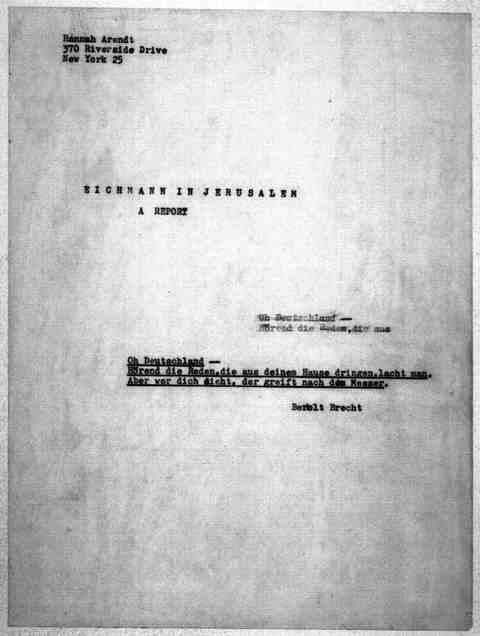
The work of Hannah Arendt has been in the press recently for two reasons in particular: first, the 50th anniversary of her book Eichmann in Jerusalem, published in 1963 from reports she filed for The New Yorker on the 1961 trial of the archetypal Nazi bureaucrat. Then there is Margarethe von Trotta’s 2012 biopic Hannah Arendt, starring German actress Barbara Sukowa as the German Jewish philosopher. Recent coverage of the book and the film have focused on Arendt’s reputation as a philosophical journalist most closely identified with the famous descriptive phrase “the banality of evil,” a comment on Adolf Eichmann as an exemplar of genocidal murderers who, as the well-worn defense goes, were “just following orders.”
Arendt scholar Roger Berkowitz argues that this reading of Arendt’s book is a profound misreading. Eichmann in Jerusalem was divisive, setting critics against each other in efforts to vindicate or castigate its author. The controversy, however, at the time of publication and again in the recent re-evaluation, has the unfortunate effect of obscuring the breadth of Arendt’s philosophical thinking apart from Eichmann and Nazism. Those interested in connecting with Arendt’s life, scholarship, and philosophical insight can find a wealth of archival materials online from the collections of Bard College and the Library of Congress. Today, we highlight several items in those collections that may be of interest, including the Library of Congress’s scanned copy of the final typescript of Eichmann in Jerusalem.
First, directly above, hear Arendt’s speech “Power & Violence.” The lecture re-iterates ideas Arendt expressed more fully in a lengthy 1969 essay published by the New York Review of Books as “Reflections on Violence” and as a book titled On Violence. In the lecture and the essay, Arendt references the work of thinkers like Friedrich Engels and, especially, Frantz Fanon in a critical discussion of the roles racism and ideology play in state violence.
That same year Arendt delivered a series of lectures for a Spring semester course at The New School for Social Research called “Philosophy and Politics: What is Political Philosophy.” This fascinating investigation grapples not only with political philosophy, but philosophy in general as a meaningful activity. You can view the full typescripts of her course lectures here.
The Library of Congress has also digitized much of Arendt’s correspondence and uploaded images of her letters, including some to and from such well-known figures as W.H. Auden, Lionel Trilling, and Alfred Kazin (most of Arendt’s letters are only available for viewing onsite at the Library of Congress, The New School University, or the University of Oldenburg).
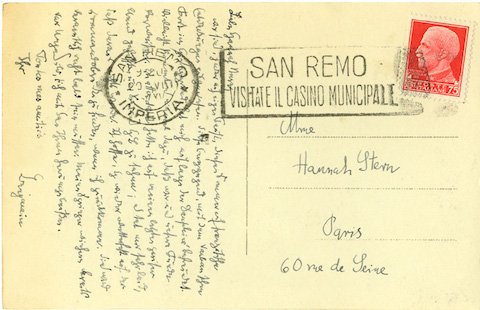
In addition to the “Arendt Marginalia” section, Bard hosts a gallery that includes “inscribed books, journals & manuscripts,” “artwork & photographs,” and “postcards and other correspondence” (such as the above postcard from Walter Benjamin, addressed to “Hannah Stern,” her married name at the time).
Lastly, for an excellent overview of Arendt’s life and work that puts all of the above materials in context, see the Library of Congress’s “Biographical Note” and be sure to read “Three Essays: The Role of Experience in Hannah Arendt’s Political Thought” by Jerome Kohn, director of the New School’s Hannah Arendt Center. As many know, Arendt, and many other German Jewish intellectuals who fled the Nazis, found a home at New York’s New School for Social Research (now New School University). And we have the New School (and an Andrew W. Mellon Foundation grant) to thank for the Library of Congress’s vast, digitized collection of Arendt’s papers, which preserves her legacy for generations to come.
Related Content:
Hannah Arendt Discusses Philosophy, Politics & Eichmann in Rare 1964 TV Interview
Hannah Arendt’s Original Articles on “the Banality of Evil” in the New Yorker Archive
The Trial of Adolf Eichmann at 50
Josh Jones is a writer and musician based in Durham, NC. Follow him at @jdmagness
Read More...The Roving Typist: A Short Film About a New York Writer Who Types Short Stories for Strangers
C.D. Hermelin, a literary agency associate with a degree in Creative Writing, is the self-proclaimed Roving Typist. It’s an apt title for one who achieved fame and fortune — okay, rent money — by appearing in various public spaces around New York City, typewriter in lap. Director Mark Cersosimo’s short film, above, introduces him as a mild-mannered, slightly awkward soul. Engaging with strangers lured by the sign taped to his typewriter case is where Hermelin comes into his own.
The sign promises “stories while you wait,” a concept that recalls the “Poems on Demand” author and writing guru, Natalie Goldberg, who composed poems to raise funds for the Minnesota Zen Center. (Hermelin got his idea — and permission to implement it — from a guy he saw doing something similar in San Francisco.)
He’s open to requests, and payment is left to the discretion of the recipient. He seems to take extra care when his customer is a child.
A harmless enough pursuit in an era where subway musicians and caricaturists lining the path to the Central Park Zoo hustle harder than ‘90s-era shell game artistes.
It’s reasonable to assume that innocently blundering onto a cello player’s turf is the worst trouble a guy like Hermelin’s likely to stir up.
Instead, he became the target of a mass cyberbullying campaign, after a stranger posted a photo of him and his typewriter parked on the High Line on a sweltering day in 2012. Cue an avalanche of hipster-hating Reddit comments, in addition to a meme at his expense.
Rather than succumb to the vast negative outpouring, the Roving Typist confronted the situation head on, publishing his side of the story in The Awl:
Originally, it felt silly labeling my venture a “cause” while I defended myself to an anonymous horde—but now it feels anything but. The experience of being labeled and then cast aside made me realize that what many people call “hipsterism” or, what they perceive as a slavish devotion to irony, are often in fact just forms of extreme, radical sincerity. I think of Brooklyn-based “hipster” brand Mast Brothers Chocolate, which uses an old-fashioned schooner to retrieve their cacao beans, because the energy is cleaner, because they think that’s how it should be done. I think of the legions of Etsy-type handmade artist shops, of people who couldn’t make money in their profession, so found a way to make money with their art.
Subject a whimsical project to the forge, and it just might become a vocation.
Be sure to check out the bonus outtake “I Was A Hated Hipster Meme” and don’t fret if your travels won’t take you near New York City anytime soon. Hermelin and his typewriter are spending the winter indoors, fulfilling the public’s on-demand stories via mail order.
Related Content:
David Rees Presents a Primer on the Artisanal Craft of Pencil Sharpening
Humans of New York: Street Photography as a Celebration of Life
What Happens When Everyday People Get a Chance to Conduct a World-Class Orchestra in NYC
Ayun Halliday is an author, illustrator, and Chief Primatologist of the long running zine, The East Village Inky. Follow her @AyunHalliday
Read More...Why is Ukraine in Crisis?: A Quick Primer For Those Too Embarrassed to Ask
Why have Ukrainians been protesting since November? It’s a question you might feel strange asking in February. But not to worry, The Washington Post has put together a helpful video that explains the crisis in two minutes (above), along with a related primer: 9 questions about Ukraine you were too embarrassed to ask. A deeper analysis can be found in the pages of The New York Review of Books.
For the latest news on what’s happening in Ukraine, you can get live video and social media updates at The New York Times.
Read More...Who Directed the Psycho Shower Scene?: Hitchcock’s Film & Saul Bass’ Storyboards Side by Side
The shower scene in Alfred Hitchcock’s Psycho (1960) is easily one the most viewed, analyzed and parsed lengths of film in cinema history. Constructed from over 70 shots, the scene shows Marion Crane (Janet Leigh) – the supposed protagonist of the movie – meeting a gory end at the hands of a cross-dressing Norman Bates 30 minutes into the movie. Hitchcock’s quick editing and his subjective camera work brilliantly evokes all the scene’s nudity and transgressive violence without actually showing much of either. The scene freaked out audiences when it came out and 54 years later, it still has the power to shock. Critic David Thomson called it “legitimately among the most violent scenes ever shot for an American film.”
Psycho went a long way toward cementing Hitchcock’s standing as a cinematic auteur. So in 1970, seminal graphic designer Saul Bass, who did the title sequence for the movie, made waves when he claimed that he directed the shower scene. His proof is his storyboard, which shows a sequence of images that are similar — though not exactly the same — as what ended up in the movie. Vashi Nedomansky helpfully placed Bass’s storyboard alongside the actual movie. See above.
As you might notice, that eerie motif of the shower head is not to be found on the storyboards. Other images – the knife-wielding murderer in silhouette, the blood spiraling down the drain, the curtain getting pulled from the rod – look like they came straight from Bass. And some have argued that the scene simply looks more like Bass’s previous work than Hitchcock’s.
Others, including many of the people who were actually on set, insist that Hitchcock was at the helm. Janet Leigh — who, of course, was there for the duration of the scene’s seven day shoot, screaming her head off – has been unequivocal about her thoughts on the matter:
Saul Bass was there for the shooting, but he never directed me. Absolutely not. Saul Bass is brilliant, but he couldn’t have done the drawings had Mr. Hitchcock not discussed with him what he wanted to get. And you couldn’t have filmed the drawings. Why does there always have to be controversy?
Related Content:
Alfred Hitchcock’s Rules for Watching Psycho (1960)
A Brief Visual Introduction to Saul Bass’ Celebrated Title Designs
Jonathan Crow is a Los Angeles-based writer and filmmaker whose work has appeared in Yahoo!, The Hollywood Reporter, and other publications. You can follow him at @jonccrow.
Read More...David Foster Wallace’s Surprising List of His 10 Favorite Books, from C.S. Lewis to Tom Clancy
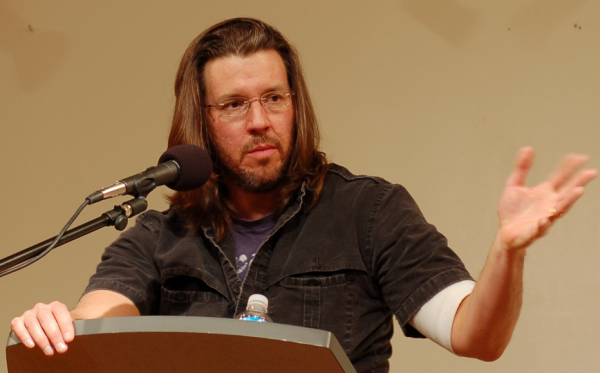
Image by Steve Rhodes, via Wikimedia Commons
Like many David Foster Wallace fans, I bought a copy of J. Peder Zane’s The Top Ten (previously featured here), a compilation of various famous writers’ top-ten-books lists, expressly for DFW’s contribution. Like most of those David Foster Wallace fans, I felt more than a little surprised when I turned to his page and found out which ten books he’d chosen. Here, as quoted in the Christian Science Monitor, we have the Infinite Jest author and widely recognized (if reluctant) “high-brow” literary figure’s top ten list:
1. The Screwtape Letters, by C.S. Lewis
2. The Stand, by Stephen King
3. Red Dragon, by Thomas Harris
4. The Thin Red Line, by James Jones
5. Fear of Flying, by Erica Jong
6. The Silence of the Lambs, by Thomas Harris
7. Stranger in a Strange Land, by Robert A. Heinlein
8. Fuzz, by Ed McBain
9. Alligator, by Shelley Katz
10. The Sum of All Fears, by Tom Clancy
Thrillers, killers, and a dose of Christianity to top it off; I didn’t blame Zane when he asked, “Is he serious? Beats me. To be honest, I don’t know what Wallace was thinking. But I do think there’s a certain integrity to his list.” Wallace himself seemed to read assiduously all over the map — or, more to the point, all up and down the scale of critical respectability. Rattling off “the stuff that’s sort of rung my cherries” to Salon’s Laura Miller in 1996, for a contrast, he named, among other worthy reads, Socrates’ funeral oration, John Donne, “Keats’ shorter stuff,” Schopenhauer, William James’ Varieties of Religious Experience, Wittgenstein’s Tractatus, Joyce’s Portrait of the Artist as a Young Man, Hemingway’s In Our Time, Don DeLillo, A.S. Byatt, Cynthia Ozick, Donald Barthelme, Moby-Dick, and The Great Gatsby. (You can find many of these texts in our Free eBooks collection.)
That, some Wallace readers may think, sounds more like it. But those who’ve paid close attention to Wallace’s language — that often breathlessly but hopelessly imitated mixture of high-caliber vocabulary, casually spoken rhythm, deceptively sharp-edged perception, shrugging presentation, and deliberate solecism — know how fully he simultaneously embodied both “high” and “low” English writing. Just look at the Literary Analysis syllabus from his days teaching at Illinois State University, which demands students read not just The Silence of the Lambs but another Thomas Harris novel, Black Sunday, as well as more C.S. Lewis (in this case The Lion, the Witch, and the Wardrobe) and Stephen King (Carrie). Lest you doubt his commitment to the serious reading of popular fiction, note the presence of Jackie Collins’ Rock Star. In the classroom and in life, Wallace must truly have believed that there exists no low fiction; just low ways of reading fiction.
Looking for free, professionally-read audio books from Audible.com? Here’s a great, no-strings-attached deal. If you start a 30 day free trial with Audible.com, you can download two free audio books of your choice. Get more details on the offer here.
Related Content:
David Foster Wallace’s Love of Language Revealed by the Books in His Personal Library
30 Free Essays & Stories by David Foster Wallace on the Web
David Foster Wallace: The Big, Uncut Interview (2003)
David Foster Wallace’s 1994 Syllabus
Colin Marshall hosts and produces Notebook on Cities and Culture and writes essays on cities, Asia, film, literature, and aesthetics. He’s at work on a book about Los Angeles, A Los Angeles Primer. Follow him on Twitter at @colinmarshall or on his brand new Facebook page.
Read More...Two Animations of Plato’s Allegory of the Cave: One Narrated by Orson Welles, Another Made with Clay
The ever-flickering lights, the ever-present screen, the stupefied spectators immune to a larger reality and in need of sudden enlightenment—Plato’s allegory of the cave from Book VII of The Republic is a marketing department’s dream: it sums up an entire brand in a stock-simple parable that almost anyone can follow, one that lends itself to compellingly brief visual interpretations like those above and below. In the top video, Orson Welles narrates while the camera pans over some colorfully stylized illustrations of the fable by artist Dick Oden. This preserves the didactic tone of the text, but it is a little dry. In contrast, the award-winning three-dimensional renderings of the prisoners and their nonstop nickelodeon in the Claymation Cave Allegory below offers dramatic close-ups of the chained prisoner’s faces and the hypnotic movement of firelight over the cave’s rock walls.
Plato’s “brand” is a doctrine of idealism that posits a realm of ideal forms, of which everything we know by our senses is but an inferior copy. The ironically poetic Socrates relates the story to illustrate “the effect of education and the lack of it on our nature.”
And yet it does much more than this—Plato illustrates an epistemology that supports notions of the soul and immortality, and hence his ideas survived in theology long after they was supposedly vanquished by analytic philosophy.
Plato’s idea of reason as a perfect, unchanging realm of which we’re only dimly aware is intuitively compelling. Most of us are at some time conscious of how limited our perceptions truly are. But just because the allegory of the cave is fairly easy to communicate to philosophy 101 students doesn’t mean it’s easy to adapt to the screen like the two examples above. Mark Linsenmayer of The Partially Examined Life points us toward these 20 YouTube takes on Plato’s cave, “many of them,” he writes, “frightfully amateurish and some of them presenting a warped and/or incomprehensible version of the story.” I am particularly intrigued by the silent film version below. As always, your comments on the soundness of these various interpretations are most welcome.
Courses on Plato can be found on our list of 100 Free Philosophy Courses, a subset of our larger Free Online Course collection.
Related Content:
The Drinking Party, 1965 Film Adapts Plato’s Symposium to Modern Times
Philosophy Bites: Podcasting Ideas From Plato to Singularity Since 2007
Famous Philosophers Imagined as Action Figures: Plunderous Plato, Dangerous Descartes & More
Josh Jones is a writer and musician based in Durham, NC. Follow him at @jdmagness
Read More...An Undertaking: Woodworker Honors His Grandma with a Custom-Made Coffin
Good thing Austin-based designer Michael Yates studied abroad. Three months spent in the vicinity of Kyoto as a Texas A&M electrical engineering student ultimately inspired him to abandon the profession for which he had trained, in order to pursue woodworking. “…the sacredness of the process and attention to detail resonated with me in a way that nothing had before,” he recalls in an Apartment Therapy profile. “I’ve since learned in practice what I saw evidence of in the temples—that completely focusing on where you are will get you the best product at the end. Every step of the process is precious.”
Had he not changed horses in midstream, his grandmother would have likely stuck to the plan too, departing for the afterlife in a standard-issue coffin or urn, rather than asking Yates to build her something special. In his mind, it was a collaboration, a process documented above, at the behest of Whole Foods’ online magazine, Dark Rye. (Indicating, perhaps, that artisanal, upcycled coffins will soon be available for purchase beside bamboo cutting boards and locally sourced, grass-fed, beef jerky?)
Yate’s grandma placed her request pre-need, in the industry lingo, a move that afforded him plenty of time to study—and reject—the overly ornate vessels that have become a cultural norm. Luxurious details have no place, he feels, when the user can derive no enjoyment from them. (Guess he and Grandma weren’t considering going with the off-the-wall Ghana approach.)
The coffin is the most meaningful piece he’s ever created, even before it could be beta tested. It caused him to think deeply about our relationship with death and each other. The soundtrack hints that something very sad is about to happen, as do the photos of his grandmother as a vibrant, younger woman. (Such shots have become de rigeur for anyone mourning an older relative on Facebook.) Yates mentions that his grandmother, healthy when she hatched this scheme, has been diagnosed with cancer. I think we can assume where this is going, right?
At the risk of a spoiler, I’d like to commend the filmmakers for allowing some key scenes to occur off-camera. Yates remarks that after all that went into making the coffin, it would be “a terrible miss” if his grandmother did not get a chance to see it. He’s filmed loading it into his truck, but viewers are not privy to its delivery. Some things, it would seem, are still personal.

Related Content:
Carl Gustav Jung Ponders Death
Find Yale’s Course Death in our collection of 825 Free Online Courses
Leonard Cohen Narrates Film on The Tibetan Book of the Dead, Featuring the Dalai Lama (1994)
Ayun Halliday operates in the shadow of the South Brooklyn Casket Company. @AyunHalliday
Read More...How Coffee Affects Your Brain: A Very Quick Primer
The morning cup of coffee sweeps the cobwebs off of your brain. Almost magically. Just like that. If you care to get analytical about what’s going on in your caffeinated brain, we give you a short video from PHD comics — short, of course, for Piled Higher and Deeper. For more of their videos see:
The Higgs Boson, AKA the God Particle, Explained with Animation
What’s Next for the Large Hadron Collider? PhD Comics Introduces the Search for Extra Dimensions
Dark Matter Animated: The Next Frontier of Discovery for Physicists and Cosmologists
Read More...Discover Cy Endfield’s “Microwriter,” The World’s First Portable Word Processor (Circa 1980)
The hallmark of an enduring invention is the difficulty others encounter when attempting to improve on its original design. The QWERTY keyboard is a prime example: since the emergence of the Remington No. 1 typewriter in 1874, the keyboard has confidently withstood any significant challenges. That’s not to say that curious alternatives haven’t occasionally come along. Indeed, several weeks ago we wrote about the Malling-Hansen Writing Ball, the late 19th century typewriter Friedrich Nietzsche used while travelling. Unfortunately, the writing ball proved too fragile and expensive to manufacture, and today survives solely as a relic.
The most unusual recent attempt to reinvent the keyboard was devised by Cy Endfield in the early 1980s. Endfield was a Hollywood director of some success prior to being declared a Communist by Joseph McCarthy’s House Un-American Activities Commission and blacklisted in 1951. An altogether enterprising fellow, Endfield kept his chin up and his upper lip stiff, opting to head to England where he worked on films (e.g., Zulu, 1964), wrote a book, and performed card tricks with remarkable skill. He also created a six-button word processor he called the Microwriter.
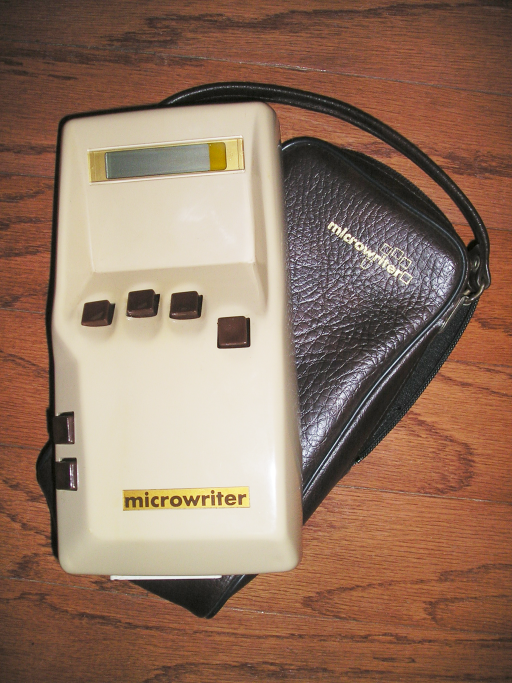
In a 1984 interview with NPR, Endfield recounted wanting to reduce the number of keys used when typing. Instead of pushing a key and obtaining the corresponding letter (a 1‑to‑1 ratio), he wanted to use a handful of keys to yield the whole of the alphabet. He decided that chords were the answer:
“It occurred to me that… it would be possible to combine a set of signals from separate keys, and therefore you could reduce the total number of keys. But, of course, this involved the learning of chords… difficult to memorize… But how do you make these chords memorable? And, one day, staring at a sheet of paper on which I was drawing a set of five keys in sort of the arch formed by the finger ends, it occurred to me, ah! if I press the thumb key, and the index finger key, anybody can do this just listening now, press your thumb key and your index finger down and you’ll see that a vertical line joins those two finger ends, a short vertical line. There is an equivalence between that short vertical line and one letter of the alphabet. It’s the letter “I.”
The above video provides a much simpler and more concise explanation.
Equipped with 16 kb of RAM and a single line LED display, the Microwriter allowed users to quickly type notes on the go and transfer the results to their computers through the serial port. Five of the buttons corresponded to the various chord-keys, and the lower thumb button allowed users to cycle through various input modes.
While it was possible to achieve a quick pace with the device when typing textual rather than numeric input, users of the device remember needing several days of training to remember the various key combinations and to begin using the device with some proficiency. Needless to say, in spite of Endfield’s claims of being the world’s first portable word processor, the Microwriter simply wasn’t user friendly enough to survive. It entered production in the early 1980s, and ceased in 1985.
To read or listen to Cy Endfield’s full interview, head over to the NPR Archives tumblr.
Ilia Blinderman is a Montreal-based culture and science writer. Follow him at @iliablinderman.
Related Content:
Mark Twain Wrote the First Book Ever Written With a Typewriter
The History of the Seemingly Impossible Chinese Typewriter
The Enduring Analog Underworld of Gramercy Typewriter
Discover Friedrich Nietzsche’s Curious Typewriter, the “Malling-Hansen Writing Ball”
Computer Science: Free Online Courses
Read More...Designers Charles & Ray Eames Create a Promotional Film for the Groundbreaking Polaroid SX-70 Instant Camera (1972)
For several decades of its history, the Polaroid was called a “Land Camera” after the company’s founder Edwin Land, and the product line included not only consumer devices but also high-end machines like the SX-70, a folding SLR camera introduced in 1972. The SX-70 boasted a host of impressive features that allowed photographers to achieve the effects of non-instant SLRs such as “changes in depth of field, double exposure, fixed-point focusing, and closeup photography.” The SX-70 made a considerable impression on famed husband and wife design team Charles and Ray Eames, so much so that they produced the 11-minute advertisement above describing in detail the SX-70’s highly complex operations. In his introduction, Charles Eames tells us that no less an authority than Alfred Stieglitz “favored any means that might free the photographer’s whole energies so that they could be channeled in the direction of the decision, the picture itself.” Thus, Edwin Land’s inventions are given the imprimatur of the father of fine art photography himself, and in 1972, the SX-70 was Land’s highest achievement to date.
The Polaroid instant camera seems to have come full circle from consumer toy to utilitarian snapshot-maker to artists’ experimental tool to instrument of retro-hipsterism to consumer toy again. But the physical, real-world Polaroid aesthetic almost met its end in 2008 when the company discontinued production of its instant film, prompting the creators of the Impossible Project to “[save] analog instant photography from extinction by releasing various, brand new and unique instant films.” VP Dave Bias demonstrates the project’s device, which allows smartphone photogs to print images on Polaroid-style film. Responding to the massive demands of 21st century détourned nostalgia, Polaroid has introduced new lines of instant cameras, and Fuji is also bridging the Instagram/Polaroid divide with a portable printer this spring. But what the Impossible Project highlights—as the Eames did in ‘72—is just how much the Polaroid became a means of making fine art as well as kitsch, a too often unremarked upon application of the famous instant camera and the visual aesthetics it bequeathed the digital age.
via Mental Floss
Related Content:
Watch Laurence Olivier, Liv Ullmann and Christopher Plummer’s Classic Polaroid Ads
The Masterful Polaroid Pictures Taken by Filmmaker Andrei Tarkovsky
Josh Jones is a writer and musician based in Durham, NC. Follow him at @jdmagness
Read More...Support Us
We're hoping to rely on loyal readers, rather than erratic ads. Please click the Donate button and support Open Culture. You can use Paypal, Venmo, Patreon, even Crypto! We thank you!

About Us

Open Culture scours the web for the best educational media. We find the free courses and audio books you need, the language lessons & educational videos you want, and plenty of enlightenment in between.
Advertise With Us
FREE UPDATES!
GET OUR DAILY EMAIL
Get the best cultural and educational resources on the web curated for you in a daily email. We never spam. Unsubscribe at any time.
FOLLOW ON SOCIAL MEDIA
Open Culture editor Dan Colman scours the web for the best educational media. He finds the free courses and audio books you need, the language lessons & movies you want, and plenty of enlightenment in between.
Advertise With Us


