Richard Feynman on Religion, Science, the Search for Truth & Our Willingness to Live with Doubt
A completely unsurprising thing has happened during the first season of Neil deGrasse Tyson’s Cosmos reboot. Creationists vocally complained that the show does not give their point of view an equal hearing. Tyson responded, saying “you don’t talk about the spherical earth with NASA and then say let’s give equal time to the flat-earthers.” The analogy is more amusing than effective, since roughly fifty percent of Americans are Creationists, while perhaps 49.9 percent fewer believe the earth is flat. But the point stands. If scientific theories were arrived at by popular vote, the “equal time” argument might make some sense. Of course that’s not how science works. Is this bias? As Tyson put it in one of his well-crafted tweets, “you are not biased any time you ever speak the truth.”
“But what is truth?” asks a certain kind of skeptic. That, suggests the late Nobel prize-winning physicist Richard Feynman above, depends upon your method. If you’re doing science, you may find answers, but not necessarily the ones you want:
If you expected science to give all the answers to the wonderful questions about what we are, where we’re going, what the meaning of the universe is and so on, then I think you can easily become disillusioned and look for some mystic answer.
Going to the sciences, says Feynman, to “get an answer to some deep philosophical question,” means “you may be wrong. It may be that you can’t get an answer to that question by finding out more about the character of nature.” Science does not begin with answers, but with doubt: “Is science true? No, no we don’t know what’s true, we’re trying to find out.” Feynman’s scientific attitude is profoundly agnostic; he’d rather “live with doubt than have answers that might be wrong.”
Feynman couches his comments in personal terms, admitting there are scientists who have religious faith, or as he puts it “mystic answers,” and that he “doesn’t understand that.” He declines to say anything more. While similarly agnostic, Neil deGrasse Tyson states his opinions a bit more forcefully on scientists who are believers, saying that around one third of “fully-functioning” “Western/American scientists claim that there is a god to whom they pray.” Yet unlike the claims of Answers in Genesis and other Creationist outfits, “There is no example of someone reading their scripture and saying, ‘I have a prediction about the world that no one knows yet, because this gave me insight. Let’s go test that prediction,’ and have the prediction be correct.”
Both Feynman and Tyson seem to agree that the scientific and Creationist methods for discovering “truth,” whatever that may be, are basically incompatible. Says Feynman: “There are very remarkable mysteries… but those are mysteries I want to investigate without knowing the answers to them.” For that reason, says Feynman, he “can’t believe the special stories that have been made up about our relationship to the universe.” His wording recalls the phrase Answers in Genesis uses to characterize human origins: “special creation,” the description of a method that places meaning and value before evidence, and doggedly assumes to know the truth about what it sets out to investigate in ignorance.
Confronted with the Creationists of today, Feynman would likely lump them in with what he called in a 1974 Caltech commencement speech “Cargo Cult Science,” or “science that isn’t science” but that intimidates “ordinary people with commonsense ideas.” That lecture appears in a collection of Feynman’s speeches, lectures, interviews and articles called The Pleasure of Finding Things Out, which also happens to be the title of the program from which the clip at the top comes.
Produced by the BBC in 1981, the hour-long interview was taped for a show called Horizon which, like Cosmos, showcases scientists sharing the joys of discovery with a lay audience. Like Neil deGrasse Tyson, and Carl Sagan before him, Feynman was a very likable and accomplished science communicator. He had little time for philosophy, but his practice of the scientific method is unimpeachable. Of the Feynman TV special above, Nobel Prize-winning chemist Sir Harry Kroto remarked: “The 1981 Feynman-Horizon is the best science program I have ever seen. This is not just my opinion — it is also the opinion of many of the best scientists that I know who have seen the program… It should be mandatory viewing for all students whether they be science or arts students.”
Related Content:
Josh Jones is a writer and musician based in Durham, NC. Follow him at @jdmagness
Read More...Enjoy 15+ Hours of the Weird and Wonderful World of Post Soviet Russian Animation
Back during the waning years of the Soviet Union, animator Aleksandr Tatarsky left the state-run studio Écran to form his own animation company called Studio Pilot, the first privately owned company of its kind in Russia. The studio quickly made a name for itself by turning out bizarre, surreal and, at times, downright disturbing animated shorts. If you went to animation festivals during the Clinton presidency, you probably saw something from Studio Pilot.
Metafilter user “Nomyte,” who clearly knows both animation and Russian, put together an exhaustive list of movies on Youtube from Studio Pilot. A whopping 17 hours of footage. Here are a few favorites:
His Wife is a Chicken (1989) — A surrealist domestic drama tale about a guy who rejects his loving, hardworking wife when he realizes that, well, she’s a chicken. Told completely without words, the film (shown above) masterfully fuses everyday banality with some truly unnerving bits of weirdness – like that horrific worm dog creature with a human face. I saw this movie at some point in the early ‘90s and it gave me nightmares.
The Coup (1991) – An animated political cartoon that — 20 some odd years later — has become a fascinating historical document. The short shows a svelte Boris Yeltsin literally flush away the leaders of the doomed 1991 coup attempted against Mikhail Gorbachev. The incident was the last gasp of the Soviet old guard; its failure resulted in the eventual dissolution of the USSR. As the film’s end title points out, all of the short’s animators were personally involved in fighting the coup: “From 19 to 21 of August 1991, all animators who made this film have been [sic] defending the white house of Russia. Only by night on August 21 they could start working on the film.”
Gone with the Wind (1998) – Nothing about romance during the Civil War here. Instead, this movie is about, once again, a chicken. The short animation is a macabre tale about a boiled bird that comes back from the dead and struggles to return to its original unplucked state. You won’t look at eggs in quite the same way again.
2+1= (2003) – A lighthearted comedy about dinosaurs in love.
If you want to see the complete list of Studio Pilot animations, check it out here. Many more great animated shorts can be found on our list of Free Animated Films, part of our bigger collection 4,000+ Free Movies Online: Great Classics, Indies, Noir, Westerns, Documentaries & More.
Related Content:
Watch Dziga Vertov’s Unsettling Soviet Toys: The First Soviet Animated Movie Ever (1924)
Jonathan Crow is a Los Angeles-based writer and filmmaker whose work has appeared in Yahoo!, The Hollywood Reporter, and other publications. You can follow him at @jonccrow.
Read More...Michel Foucault and Alain Badiou Discuss “Philosophy and Psychology” on French TV (1965)
If subtitles don’t play automatically, please click the “CC” button at the bottom of each video.
When Sigmund Freud died in 1939, the year Hitler invaded Poland, W.H. Auden wrote a eulogy in verse and remarked “We are all Freudians now.” One might have said something similar of Michel Foucault after his death in 1984. Foucault became a fiercely political philosopher after the May 1968 Paris student uprising and in a year that saw the Tet Offensive in Vietnam and the assassinations of Martin Luther King Jr. and Robert Kennedy. In the following year—after the Manson murders and the grim events at Altamont—the sixties effectively came to an end as its utopian projects flared up and fizzled.
In the next repressive decade, Foucault published Discipline and Punish (1974) and his History of Sexuality (1976). Even as he used Freudian concepts, he declared Freudian psychoanalysis complicit in what he called “disciplinary society,” another method, like prisons, schools, and hospitals, of keeping masses of people under constant surveillance and in states of submission. It is this post-‘68 Foucault many of us came to know—an anti-philosopher whose deep distrust of all institutional forms of power seemed the perfect ally for post-adolescent college students in comfortable rebellion. This is why it is a little surprising to see the Foucault above, in a 1965 conversation with philosopher Alain Badiou, ensconced in the bourgeois world of a French philosophical culture, with its lineages and ordinary citizens browsing paperback copies of Marx and Hegel, instead of staging Situationist actions to disrupt the social order.
But of course, it’s only logical to infer that the one culture led directly to the other. For all his rhetorical theatrics, Foucault never gave up on the humanist institution of the university, but always made his home in classrooms, lecture halls, and yes, even TV interviews. His topic in conversation with Badiou is “Philosophy and Psychology” and they came together on the educational television program L’enseignement de la philosophie—another testament, like the well-stocked bookstores and cultural landmarks, to a sixties French culture steeped in philosophical attitudes. Unfortunately we have only the first two parts of the interview, above, with English subtitles (the third and final part is still waiting to be translated). You can, however, see the full interview in French below.
The interview opens with the question “What is psychology?” Foucault’s answer, which he would revise many times in the coming decades, along with his terminology, begins by asking that we “interrogate” the discipline of Psychology “like any other type of culture.” Prodded by Badiou, he elaborates: Psychology is yet another institutionalized “form of knowing” that makes up a disciplinary society, the core concept of his philosophy. Foucault’s interviewer Badiou is now an elder statesman of French philosophy, its “greatest living exponent,” writes his publisher. His most recent book documents forty years of what he calls the “’French moment’ in contemporary thought”—one greatly inspired by Michel Foucault.
Related Content:
Clash of the Titans: Noam Chomsky & Michel Foucault Debate Human Nature & Power on Dutch TV, 1971
Free Online Philosophy Courses
Josh Jones is a writer and musician based in Durham, NC. Follow him at @jdmagness
Read More...A Romp Through the Philosophy of Mind: A Free Online Course from Oxford
These days, neuroscience seems to have a monopoly on the mind. Flip to the science section of an established newspaper or magazine, and you’ll likely see the most alluring headlines describing the latest neural findings. So, now that powerful methods of neuroimaging can delve deeper into the structure of the brain than ever before, is there anything that we don’t know about the mind? Well, yes. Apart from stating that it is a manifestation of the brain, science doesn’t offer much to explain what the mind is. In an unfortunate turn for neuroscience, no amount of brain scanning will reveal that, either.
It is at this sort of juncture that science passes the baton to philosophy. Over the past few weeks, we’ve brought you two introductory philosophy courses (Critical Reasoning for Beginners and A Romp Through Ethics for Complete Beginners) by Oxford University’s Marianne Talbot.
Today, we bring you another of Talbot’s excellent philosophical primers: A Romp Through the Philosophy of Mind. The five-part lecture series begins with a discussion of René Descartes’ dualism, which comprises the idea that the mind is non-physical and is therefore distinct from the body. The course then moves through an exposition of Identity Theory, according to which all of our mental states are merely manifestations of an analogous set of brain processes. Once Talbot outlines the drawbacks to each of these theories, she explains the views of several other phenomenological camps, including the epiphenomenalists, who see mental states as real but not physical, and eliminativists, who do not think that mental states are real at all. She then promptly proceeds to upend these conceptions of the mind. As with all of Talbot’s previous courses, this one is highly recommended.
A Romp Through the Philosophy of Mind is currently available on the University of Oxford website in both audio and video formats, and also on iTunesU. (See the lectures above.) You can find it listed in our collection of Free Online Philosophy Courses, alongside classes like Contemporary Issues in Philosophy of Mind & Cognition, Hegel’s Phenomenology of Spirit, and Merleau-Ponty’s Phenomenology of Perception. They’re all part of our collection, 1,700 Free Online Courses from Top Universities.
Ilia Blinderman is a Montreal-based culture and science writer. Follow him at @iliablinderman, or read more of his writing at the Huffington Post.
Related Content:
Learn Right From Wrong with Oxford’s Free Course A Romp Through Ethics for Complete Beginners
The History of Philosophy Without Any Gaps – Peter Adamson’s Podcast Still Going Strong
Read More...Publisher Places a Politically Correct Warning Label on Kant’s Critiques
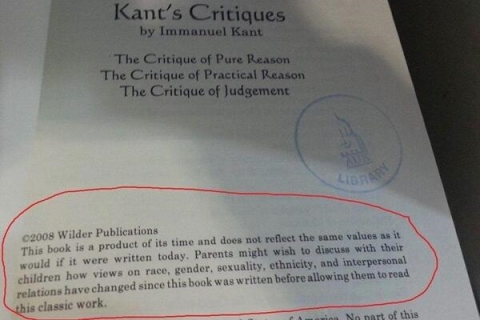
Most times when I hear someone on a tear about the dangers of “political correctness” I roll my eyes and move on. So many such complaints involve ire at being held to standards of basic human decency, say, or having to share resources, opportunities, or public spaces. But there are many exceptions, when the so-called “PC” impulse to broaden inclusivity and soften offense produces monsters of condescending paternalism. Take the above omnibus edition of “Kant’s Critiques” printed by Wilder Publications in 2008. The publisher, with either kind but painfully obtuse motives, or with an eye toward pre-empting some kind of legal blowback, has seen fit to include a disclaimer at the bottom of the title page:
This book is a product of its time and does not reflect the same values as it would if it were written today. Parents might wish to discuss with their children how views on race, gender, sexuality, ethnicity, and interpersonal relations have changed since this book was written before allowing them to read this classic work.
Where to begin? First, we must point out Wilder Publications’ strange certainty that a hypothetical Kant of today would express his ideas in tolerant and liberal language. The supposition has the effect of patronizing the dead philosopher and of absolving him of any responsibility for his blind spots and prejudices, assuming that he meant well but was simply a blinkered and unfortunate “product” of his time.
But who’s to say that Kant didn’t damn well mean his comments that offend our sensibilities today, and wouldn’t still mean them now were he somehow resurrected and forced to update his major works? Moreover, why assume that all current readers of Kant do not share his more repugnant views? Secondly, who is this edition for? Philosopher Brian Leiter, who brought this to our attention, humorously titles it “Kant’s 3 Critiques—rated PG-13.” One would hope that any young person precocious enough to read Kant would have the ability to recognize historical context and to approach critically statements that sound unethical, bigoted, or scientifically dated to her modern ears. One would hope parents buying Kant for their kids could do the same without chiding from publishers.
None of this is to say that there aren’t substantive reasons to examine and critique the prejudicial assumptions and biases of classical philosophers. A great many recent scholars have done exactly that. In her Philosophy of Science and Race, for example, Naomi Zack observes that “according to contemporary standards, both [Hume and Kant] were virulent white supremacists.” Yet she also analyzes the problems with applying “contemporary standards” to their systems of thought, which were not necessarily racist in the sense we mean so much as “racialist,” dependent on an “ontology of human races, which underlay Hume and Kant’s value judgments about what they thought were racial differences” (an ontology, it’s worth noting, that produced systemic and institutional racism). Zack respects the vast gulf that separates our judgments from those of the past while still holding the philosophers accountable for contradictions and inconsistencies in their thought that are clearly the products of willful ignorance, chauvinism, and unexamined bias. An informed historical approach allows us to see how books are not simply “products of their time” but are situated in networks of knowledge and ideology that shaped their authors’ assumptions and continue to shape our own—ideologies that persist into the present and cannot and should not be papered over or easily explained away with skittish warning labels and didactic lectures about how much things have changed. In a great many ways of course, they have. And in some significant others, they simply haven’t. To pretend otherwise for the sake of the children is disingenuous and does a grave disservice to both author and reader.
via Leiter Reports
Related Content:
Man Shot in Fight Over Immanuel Kant’s Philosophy in Russia
100 Free Philosophy Courses Online
Josh Jones is a writer and musician based in Durham, NC. Follow him at @jdmagness
Read More...A Reading of Charles Bukowski’s First Published Story, “Aftermath of a Lengthy Rejection Slip” (1944)
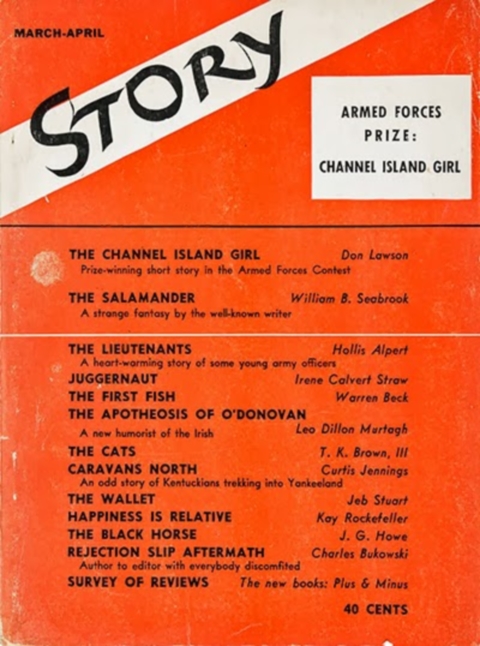
“Everyone’s got to start somewhere,” a banal platitude that expresses a truism worth repeating: wherever you are, you’ve got to get started. If you’re John Updike (who would have been 82 years old yesterday), you start where so many other accomplished figures have, the Harvard Lampoon. If you’re Charles Bukowski… believe it or not, you actually start in an equally renowned publication. Bukowski’s first fiction appeared in Story, a magazine that helped launch the careers of Cheever, Salinger, Saroyan, Carson McCullers and Richard Wright.
But if you’re Charles Bukowski, you come out swinging. Your first published work in 1944 is a nonsense story written as an eff you to the editor, Whit Burnett. You feature Mr. Burnett as a character, along with a cat who shakes hands (sort of), a prostitute named Millie, a few card-playing drunks, an imperious “short story instructress,” and a mysterious “bleary-eyed tramp.” Oh, and you open the story by quoting verbatim one of Burnett’s rejection letters:
Dear Mr. Bukowski:
Again, this is a conglomeration of extremely good stuff and other stuff so full of idolized prostitutes, morning-after vomiting scenes, misanthropy, praise for suicide etc. that it is not quite for a magazine of any circulation at all. This is, however, pretty much the saga of a certain type of person and in it I think you’ve done an honest job. Possibly we will print you sometime but I don’t know exactly when. That depends on you.
Sincerely yours,
Whit Burnett
I won’t spoil it for you—you must read (or listen to below) “Aftermath of a Lengthy Rejection Slip” for yourself—but the letter sets up a typically Bukowskian punchline: wry and sarcastic and wistful and lyrical all at once.
Bukowski was 24 and had only been writing for two years by this time. He later recalled being very unhappy with the publication. For one, writes Booktryst, “it had been buried in the End Pages section of the magazine as, Bukowski felt, a curiosity rather than a serious piece of writing.” However, Bukowski had already sent Story dozens of what he considered serious pieces of writing before penning “Aftermath,” which he admits he tamed for the sake of Burnett’s sensibilities. In an interview near the end of his life, Bukowski remembered submitting to the magazine “a couple of short stories a week for maybe a year and half. The story they finally accepted was mild in comparison to the others. I mean in terms of content and style and gamble and exploration and all that.”
Bukowski may have been bitter, but his first publication, and last submission to Story, might deserve credit for inspiring a lifetime of boozy material: looking back, he recalls that after the perceived slight, he “drank and became one of the best drinkers anywhere, which takes some talent also.” Everybody’s got to start somewhere.
Booktryst has more to the story, as well as several images of the rare 1944 Bukowski issue of Story. Above, in two parts, listen to the story in the wonderfully dry baritone of Tom O’Bedlam, whom you may already know from our previous posts on Bukowski’s poems “Nirvana” and “So You Want to Be a Writer?”
Related Content:
Three Interpretations of Charles Bukowski’s Melancholy Poem “Nirvana”
Listen to Charles Bukowski Poems Being Read by Bukowski Himself & the Great Tom Waits
So You Want to Be a Writer?: Charles Bukowski Explains the Dos & Don’ts
Josh Jones is a writer and musician based in Durham, NC. Follow him at @jdmagness
Read More...The History of the Movie Camera in Four Minutes: From the Lumiere Brothers to Google Glass
For their annual Lifetime Achievement Awards, the folks over at the Society of Camera Operators put together a lovely, surprisingly rousing video about the evolution of the movie camera over the course of the past century or so of cinema. And, as you can see above, it has changed quite a bit.
The piece begins at the beginning, with the early pioneers of film: the Lumiere brothers’ first motion picture cameras and their revolutionary actualités, Georges Méliès’ baroque flights of fancy, D. W. Griffith’s sprawling epics. The cameras that shot these films were crude, boxy and hand-powered but their basic mechanics were roughly the same as the sophisticated 70mm cameras Stanley Kubrick used to shoot 2001: A Space Odyssey six decades later.
Then in the ‘80s, things started to change with the release of analog video. Suddenly, you could capture movement in a manner that didn’t involve exposing frame by frame an unspooling reel of light-sensitive celluloid. And with the digital revolution that started in the ‘90s, cameras, and the very nature of cinema, changed. Dazzling spectacles like Avatar and Gravity could be created almost entirely within a computer, while at the same time the cameras themselves grew smaller and more portable.
To underscore just how democratized the technology of movie making has become, the end of the video shows Hollywood cameramen shooting movies with iPhones. The piece ends with what could only be seen as an ominous technological development for the Society of Camera Operators: Google Glass, which has the potential to turn every single person into a perpetual camera operator.
Related Content:
40 Great Filmmakers Go Old School, Shoot Short Films with 100 Year Old Camera
What David Lynch Can Do With a 100-Year-Old Camera and 52 Seconds of Film
A Trip to the Moon (and Five Other Free Films) by Georges Méliès, the Father of Special Effects
Jonathan Crow is a Los Angeles-based writer and filmmaker whose work has appeared in Yahoo!, The Hollywood Reporter, and other publications. You can follow him at @jonccrow.
Read More...
Monty Python Sings “The Philosopher’s Song,” Revealing the Drinking Habits of Great European Thinkers
Did you know, student of dead white philosophers, that Heidegger was a “boozy beggar”? Wittgenstein a “beery swine” and Descartes a “drunken fart”? What about Plato, who, “they say, could stick it away; Half a crate of whiskey every day”? Neither did I until I saw members of Monty Python sing “The Philosopher’s Song,” above, from their 1982 live show at the Hollywood Bowl. Eric Idle, in what looks like an Australian bush hat strung with teabags, introduces the number, saying it’s “a nice intellectual song for those two or three of you in the audience who understand these things.” Then Idle, joined by Michael Palin and frequent Python collaborator Neil Innes, launches into a paean to drinking that colorfully calls the great philosophers crazed dipsomaniacs. Well, all but John Stuart Mill, who got “particularly ill” from “half a pint of shandy.”
It’s all nonsense, right? Maybe so, but the Pythons were no strangers to philosophy. Having assembled from the august bodies of Oxford and Cambridge Universities, they perpetually revisited academic themes, if only to mock them. And yet some philosophers take the work of Monty Python very seriously. In his Monty Python and Philosophy: Nudge, Nudge, Think Think!, Philosophy Professor Gary Hardcastle refers to an essay called “Tractatus Comedio-Philosophicus,” which “wants us to know that the only difference between Monty Python and academic philosophy is that philosophy isn’t funny.” So there you have it. Skip the years of penury and overwork and go directly to Youtube for your higher education in the classics from the Pythons. Then listen to Professor Hardcastle—in Open Court’s “Popular Culture and Philosophy” podcast above—expound at length on the philosophic virtues of Cleese, Idle, Palin, Gilliam, and Jones. And finally, a bonus: below watch Christopher Hitchens sing “The Philosopher’s Song” from memory in a 2009 interview.
The song grew out of an earlier Python setup known as “The Bruce Sketch” (below). The sketch is pretty dated—some moments certainly come off as more offensive than perhaps deemed at the time. (Our English readers will have to let us know if “pommy bastard” smarts.) Four Australian philosophy professors at the fictitious University of Woolamaloo, all of them named Bruce, welcome a new member, Michael Baldwin (whom they insist on calling “Bruce”). The Bruces seem a nice bunch of chaps until they start in on their rules, revealing a contemptuous obsession with keeping out the “poofters.” It’s perfectly in keeping with this assembly of amiable right-wing nationalists: The Bruces inform their English colleague that he may teach “the great socialist thinkers, provided he makes it clear that they were wrong,” and then they get a visit from a shuffling caricature of an Aboriginal servant (whom one mustn’t mistreat, state the rules, “if there’s anyone watching”). In addition to bigotry, Australia, politics and prayer, the Bruces, their new member learns, seem mostly concerned with drinking rather than philosophy. In my personal experience of some academic quarters, this is at least one part of the sketch that hasn’t aged at all.
Related Content:
Monty Python’s Best Philosophy Sketches
Watch Monty Python’s “Summarize Proust Competition” on the 100th Anniversary of Swann’s Way
Monty Python’s Life of Brian: Religious Satire, Political Satire, or Blasphemy?
Josh Jones is a writer and musician based in Durham, NC. Follow him at @jdmagness
Read More...William S. Burroughs Reads From Naked Lunch, His Controversial 1959 Novel
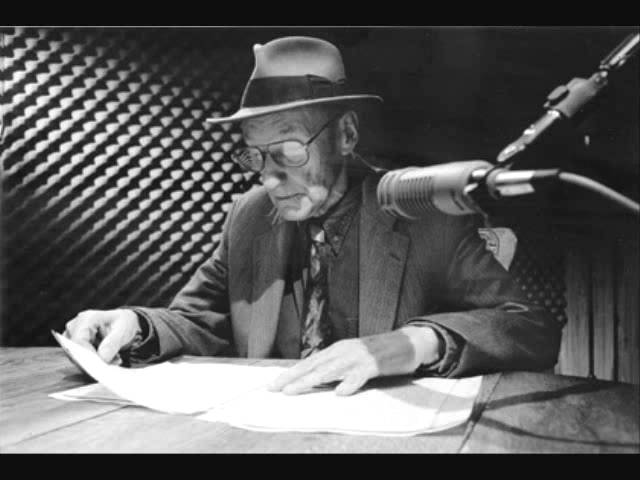
Published in 1959, Williams S. Burroughs’ Naked Lunch ranks with other mid-twentieth century books like Henry Miller’s Tropic of Cancer and the works of Jean Genet as literature that sharply divided both critical and legal opinion in arguments over style and in questions of obscenity. Among its disturbing and subversive characters is the sociopathic surgeon Dr. Benway, who inspired the medical horrors of J.G. Ballard and was inspired in turn by Aldous Huxley’s Brave New World. Benway provides some of the more satirical moments in the book, as you can hear in the section below, which Burroughs reads straight with his distinctive nasally Midwestern twang. A short film of the scene (sadly unembeddable), called “Dr. Benway Operates,” has Burroughs himself playing the doctor, in a dramatization that looks like low rent farce as directed by John Waters.
A series of loosely connected chapters that Burroughs said could be read in any order, Naked Lunch seems both fascinated and repelled by the grisly medicalized violence in scenes like those above (one vignette, for example, presents “a tract against capital punishment”). This ambivalence was not lost on writers like Norman Mailer. The highest praise of the novel probably came from Mailer during the novel’s 1966 obscenity trial before the Massachusetts Supreme Court. In one among a handful of literary depositions, including one from Allen Ginsberg, Mailer described Burroughs’ “extraordinary style,” and “exquisite poetic sense.” Despite the fact that its images were “often disgusting,” Mailer called the book “a deep work, a calculated work” that “captures that speech [‘gutter talk’] like no American writer I know.”
Perhaps one of the work’s most damning pieces of criticism comes from the Judicial Officer for the U.S. Postal Service, who called for the book’s banning, appraising the writing as “undisciplined prose, far more akin to the early work of experimental adolescents than to anything of literary merit.” Mailer, Ginsberg, and the book’s other supporters won out, a fact beat essayist Jed Birmingham laments, for a surprising reason: The unbanning of Naked Lunch led to the book’s taming, its gentrification, as it were: “The wild, exuberant offensiveness of the novel fades,” he writes, “in the face of all the legal arguments and the process of canonization.” In fact, the full novel may never have been published at all had it not been for the Post Office in Chicago seizing several hundred copies of The Chicago Review, which contained some few Naked Lunch sections. Hearing of the controversy, French publisher Maurice Girodias hastily threw together a manuscript of the first 1959 text.
And yet, prior to the mid-sixties, the decision to ban Naked Lunch, “even before it was published in book form,” meant “that questions of obscenity and censorship dictated the academic and public reception” of the book. Burroughs commented on the effects of such censorship—using an analogy to “the junk virus”—in part of a new preface to the 50th edition called “Afterthoughts on a Deposition.” The heath risks of opiates “in controlled doses,” he writes,“maybe be minimal,” yet the effects of criminalization are outsized “anti-drug hysteria,” which “poses a threat to personal freedoms and due-process protections of the law everywhere.”
Since the novel’s vindication, critical consensus has centered around sober, reverent judgments like Mailer’s—and to some lesser extent Ginsberg’s terse, irritable testimony. While there are still those who despise the book, it’s significant that Burroughs’ work—which the Washington Post called the first of his “homosexual planet-operas”—has achieved such widespread admiration amidst the notoriety. The novel deals in themes we’re still adjudicating daily in courts legal and public some 55 years later, pointing perhaps to the continued gulf between the thoughts and aims of the reading public and those of hysterical authoritarians and “the media and narcotics officials,” as Burroughs has it. After all, at its 50th anniversary in 2009, Naked Lunch was pronounced “still fresh” by such mainstream outlets as NPR and The Guardian, evidence of its persistent power, and maybe also of its domestication.
Clips of Burroughs reading Naked Lunch can also be found on this Columbia University site.
Related Content:
William S. Burroughs Reads His First Novel, Junky
William S. Burroughs on the Art of Cut-up Writing
550 Free Audio Books: Download Great Books for Free
Josh Jones is a writer and musician based in Durham, NC. Follow him at @jdmagness
Read More...Listen to Tree Rings Getting Played on a Turntable and Turned into Music
There’s something oddly soothing about listening to music on vinyl. Regardless of what digital music lovers say, and irrespective of the fact that the same sound may be produced digitally, die-hard vinyl fans will tell you that nothing compares to the warm scratchiness of a needle on a record. I don’t have a horse in the race, but having grown up with a record player in my bedroom, I can’t help but slip into a brief reverie whenever I hear an old Satchmo record spinning on a turntable.
In an elegant twist on the digital/analog battle, German-born Bartholomäus Traubeck has created Years, a “record player that plays slices of wood,” using a process that translates the data from the tree’s year rings into music. This process is, however, completely digital. Instead of using a needle to pick up the sound from the record’s grooves, Traubeck used a tiny camera to capture the image of the wood, and digitally transformed this data into piano tones. More than merely a clever contraption, however, Years is also an intriguing interaction between the physical and the temporal. As Traubeck notes,
“On regular vinyl, there is this groove that represents however long the track is. There’s a physical representation of the length of the audio track that’s imprinted on the record. The year rings are very similar because it takes a very long time to actually grow this structure because it depends on which record you put on of those I made. It’s usually 30 to 60 or 70 years in that amount of space. It was really interesting for me to have this visual representation of time and then translate it back into a song which it wouldn’t originally be.”
A little convoluted? Don’t worry. Play the video above, and enjoy the eerie melody.
via LiveScience
Ilia Blinderman is a Montreal-based culture and science writer. Follow him at @iliablinderman, or read more of his writing at the Huffington Post.
Related Content:
How Vinyl Records Are Made: A Primer from 1956 (That’s Relevant in 2014)
A Song of Our Warming Planet: Cellist Turns 130 Years of Climate Change Data into Music
Global Warming: A Free Course from UChicago Explains Climate Change
Harvard Thinks Green: Big Ideas from 6 All-Star Environment Profs
How Climate Change Is Threatening Your Daily Cup of Coffee
Read More...
Support Us
We're hoping to rely on loyal readers, rather than erratic ads. Please click the Donate button and support Open Culture. You can use Paypal, Venmo, Patreon, even Crypto! We thank you!

About Us

Open Culture scours the web for the best educational media. We find the free courses and audio books you need, the language lessons & educational videos you want, and plenty of enlightenment in between.
Advertise With Us
FREE UPDATES!
GET OUR DAILY EMAIL
Get the best cultural and educational resources on the web curated for you in a daily email. We never spam. Unsubscribe at any time.
FOLLOW ON SOCIAL MEDIA
Open Culture editor Dan Colman scours the web for the best educational media. He finds the free courses and audio books you need, the language lessons & movies you want, and plenty of enlightenment in between.
Advertise With Us

