The Evolution of London: 2,000 Years of Change Animated in 7 Minutes
Give “The London Evolution Animation” seven minutes, and it will show you the historical development of London over the course of 2,000 years. The animation moves from the Roman port city of Londinium (circa 50 AD) through the Anglo-Saxon, Tudor, Stuart, Early Georgian, Late Georgian, Early Victorian and Late Victorian periods. It then brings you through the Early 20th Century and into Postwar London. Developed by The Bartlett Centre for Advanced Spatial Analysis, the animation was made with historical data about London’s road networks and buildings. The video recently appeared at the “Almost Lost” Exhibition in London, an exhibition that contemplated how digital maps can help us rethink the past, present and future of great cities.
If you find it difficult to read the text in the animation, you can view the video in a larger format here.
And in case you’re wondering, the enlarging yellow dots show “the position and number of statutorily protected buildings and structures built during each period.” More information on the animation can be found here.
via Metafilter
Related Content:
Prize-Winning Animation Lets You Fly Through 17th Century London
The Curious Story of London’s First Coffeehouses (1650–1675)
Read More...Do Rappers Have a Bigger Vocabulary Than Shakespeare?: A Data Scientist Maps Out the Answer

Each year brings us a new list of words that, once hip or subcultural, signal their admission into the mainstream by entering the pages—print or online—of the Oxford English Dictionary or Merriam Webster’s. Many of those come from the world of hip hop. The form is a veritable laboratory of linguistic innovation, spawning dozens of region-specific argots that mutate and evolve beyond the capacity of hip lexicographers to document. One data scientist, Matt Daniels, has made an interesting attempt, however, in a project he calls “The Largest Vocabulary in Hip Hop.” Proceeding from the premise that certain rappers might match or best Shakespeare for the title of “largest vocabulary ever,” Daniels used a methodology called “token analysis” to analyze the lyrical content of “the most famous artists in hip hop.” He relied on Rap Genius transcriptions, which are only current to 2012, to produce a sample size of 35,000 words (the equivalent of 3–5 studio albums).
Topping the list by far with a total of 7,392 unique words used is rapper Aesop Rock, whom, Daniels admits, is somewhat obscure by comparison with Jay Z or Snoop Dog. More well-known artists like Wu Tang Clan, The Roots, and Outkast also rank highly, but what Daniels discovered is that many of the rappers near the top of the scale are underground or obscure artists who don’t sell millions of records. And occupying the lower end are some top-selling artists and household names like Lil Wayne, Kanye West, and Snoop Dog (DMX is dead last at #85). King of the hill Jay‑Z, whose 2013 album Magna Carta…Holy Grail sold half a million copies in its first week, ranks somewhere in the middle, and Daniels quotes from the mega-selling rapper’s “Moment of Clarity” from his Black Album in which he plainly admits that he’ll write middlebrow lyrics for million dollar sales figures, saying “I dumbed down for my audience to double my dollars” (one wonders how many listeners perceived the slight).
Daniels admits in an NPR interview that this is “not a serious academic study” but a project he undertook for the fun of it. And a great many of the “unique words” counted in each rapper’s totals are slang coinages or variants like “pimps, pimp, pimping, and pimpin,” each of which counts separately. Even so, writes Daniels on the project’s site, “it’s still directionally interesting,” as well as sociologically. And of course, literary writers have been contributing made-up words to the general lexicon for centuries. See Daniels’ site for an interactive visualization (screen shot above) of the rankings of all 85 rappers surveyed.
If you’re wondering who has a bigger vocabulary — Shakespeare or rappers — here’s the quick answer in purely numerical terms. In his sample size of 35,000 words per artist, Daniels determined that Aesop Rock used 7,392 unique words (and Wu-Tang Clan, 5,895) against Shakespeare’s 5,000 unique words. And there you have it.
Related Content:
Jay‑Z: The Evolution of My Style
The Greatness of Charles Darwin Explained with Rap Music
The Art of Data Visualization: How to Tell Complex Stories Through Smart Design
Josh Jones is a writer and musician based in Durham, NC. Follow him at @jdmagness.
Read More...Sigmund Freud Appears in Rare, Surviving Video & Audio Recorded During the 1930s
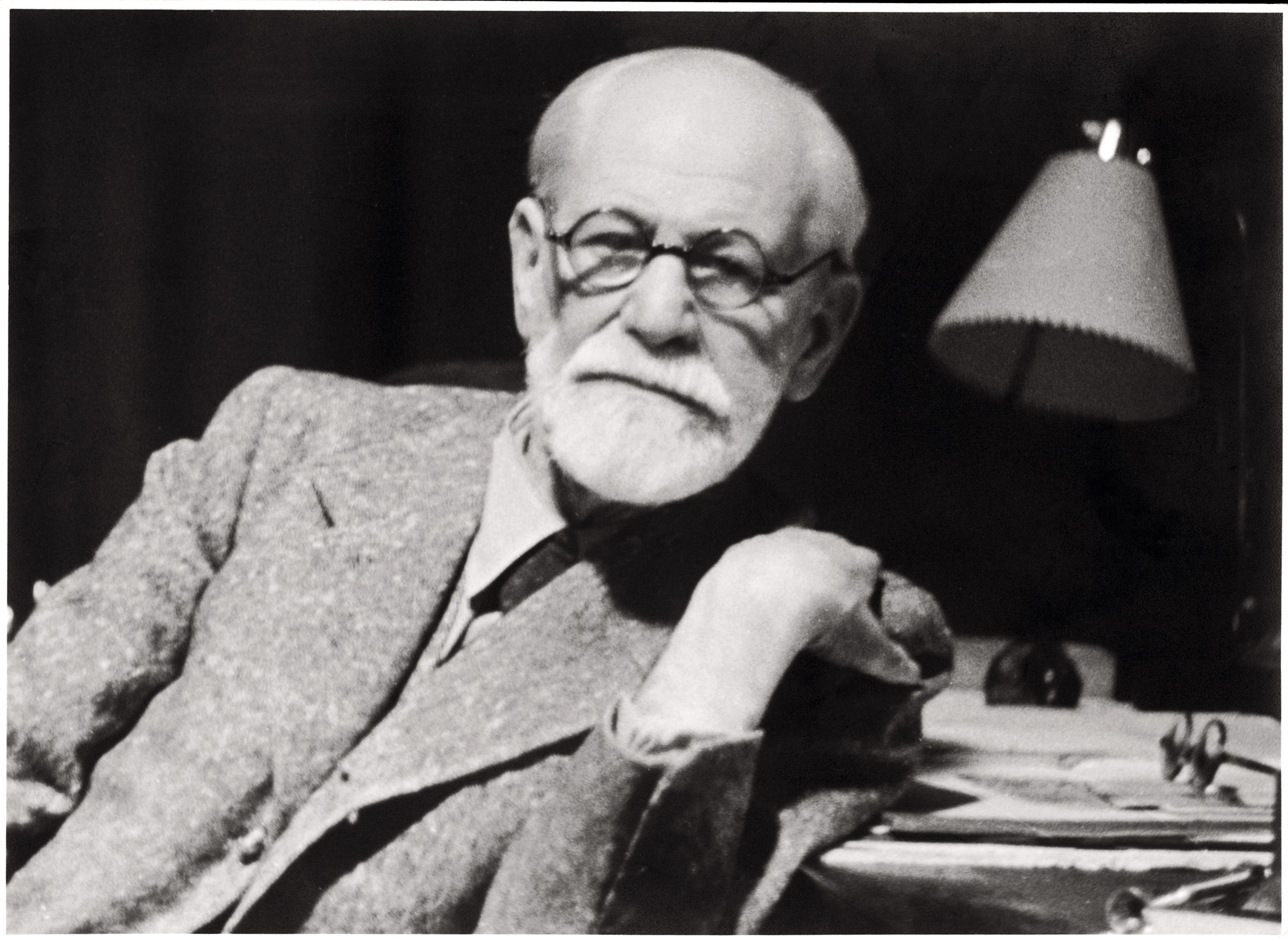
What, I wonder, would Sigmund Freud have made of Hannibal Lector? The fictional psychoanalyst, so sophisticated and in control, moonlighting as a bloodthirsty cannibal… a perfectly grim rejoinder to Freud’s ideas about humankind’s perpetual discontent with the painful repression of our darkest, most antisocial drives. While Freud’s primary taboo was incest, not cannibalism, I’m sure he would have appreciated the irony of an ultra-civilized psychiatrist who gives full steam to his most primal urges.
Freud—who was born on this day in 1856, in the small town of Freiberg—also had a carefully controlled image, though his passionate avocation was not for the macabre, salacious, or prurient, but for the archaeological. He once remarked that he read more on that subject than on his own, an exaggeration, most likely, but an indication of just how much his interest in cultural artifacts and ritual contributed to his theoretical explication of individual and social psychology.
In the film above, we see Freud in conversation with a friend, a professor of archaeology, whom the psychiatrist consulted on his extensive collection of antiquities. Later, we see Freud with his dog, then reclining outdoors with a book. Over this footage we hear the narration of Freud’s daughter Anna, who only allowed this film to be viewed by a small circle until her death in 1982.
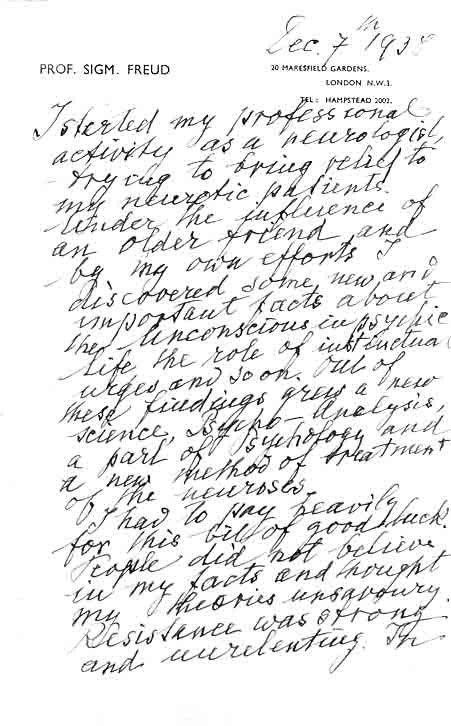
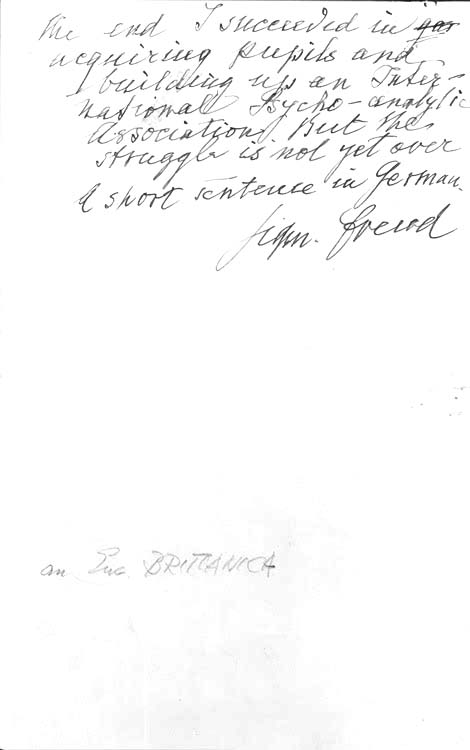
Though Freud lived many decades into the era of recording technology, precious little film and audio of the founder of psychoanalysis exists. While the home movies at the top may be the only moving image of him, perhaps the only audio recording of his voice, above, was made in 1938, the year before his death. At 81 years old, Freud’s advanced jaw cancer left him in considerable torment. Nonetheless, he agreed to record this brief message for the BBC from his London home in Maresfield Gardens. Read a transcript of the speech, and see Freud’s handwritten copy, below.
I started my professional activity as a neurologist trying to bring relief to my neurotic patients. Under the influence of an older friend and by my own efforts, I discovered some important new facts about the unconscious in psychic life, the role of instinctual urges, and so on. Out of these findings grew a new science, psychoanalysis, a part of psychology, and a new method of treatment of the neuroses. I had to pay heavily for this bit of good luck. People did not believe in my facts and thought my theories unsavory. Resistance was strong and unrelenting. In the end I succeeded in acquiring pupils and building up an International Psychoanalytic Association. But the struggle is not yet over. –Sigmund Freud.
The Library of Congress online exhibit Sigmund Freud: Conflict & Culture has many more primary documents including a holograph page from Freud’s manuscript of Civilization and its Discontents, in which he theorized the bedrock impulse of serial killers, fictional and real: the so-called “Death Drive,” our “human instinct of aggression and self-destruction.”
Many important texts by Freud can be found in our collection, 600 Free eBooks for the iPad, Kindle & Other Devices. And you’ll inevitably find a few courses covering Freud’s thought in our collection of Free Online Psychology Courses, part of our list of 950 Free Online Courses from Top Universities.
Related Content:
How a Young Sigmund Freud Researched & Got Addicted to Cocaine, the New “Miracle Drug,” in 1894
Jean-Paul Sartre Writes a Script for John Huston’s Film on Freud (1958)
Free Online Psychology & Neuroscience Courses
Josh Jones is a writer and musician based in Durham, NC. Follow him at @jdmagness.
Read More...Mr. Rogers Introduces Kids to Experimental Electronic Music by Bruce Haack & Esther Nelson (1968)
Experimental electronic musician and inventor Bruce Haack’s compositions expanded many a young consciousness, and taught kids to dance, move, meditate, and to be endlessly curious about the technology of sound. All of this makes him the perfect guest for Fred Rogers, who despite his totally square demeanor loved bringing his audience unusual artists of all kinds. In the clips above and below from the first, 1968 season of Mr. Roger’s Neighborhood, Haack introduces Rogers and a group of youngsters to the “musical computer,” a homemade analog synthesizer of his own invention—one of many he created from household items, most of which integrated human touch and movement into their controls, as you’ll see above. In both clips, Haack and longtime collaborator Esther Nelson sing and play charming songs as Nelson leads them in various movement exercises. (The remainder of the second video mostly features Mr. Roger’s cat.)
Although he’s seen a revival among electronic musicians and DJs, Haack became best known in his career as a composer of children’s music, and for good reason. His 1962 debut kid’s record Dance, Sing & Listen is an absolute classic of the genre, combining a dizzying range of musical styles—country, classical, pop, medieval, and experimental electronic—with far-out spoken word from Haack and Nelson. They followed this up with two more iterations of Dance, Sing & Listen, then The Way Out Record for Children, The Electronic Record for Children, the amazing Dance to the Music, and several more, all them weirder and more wonderful than maybe anything you’ve ever heard. (Don’t believe me? Take a listen to “Soul Transportation,” “EIO (New MacDonald),” or the absolutely enchanting “Saint Basil,” with its Doors‑y organ outro.)
A psychedelic genius, Haack also made grown-up acid rock in the form of 1970’s The Electric Lucifer, which is a bit like if Andrew Lloyd Webber and Tim Rice had written Jesus Christ Superstar on heavy doses of LSD and banks of analog synthesizers.
While Haack’s Mr. Rogers appearance may not have seemed like much at the time, in hindsight this is a fascinating document of an artist who’s been called “The King of Techno” for his forward-looking sounds meeting the cutting edge in children’s programming. It’s a testament to how much the counterculture influenced early childhood education. Many of the progressive educational experiments of the sixties have since become historical curiosities, replaced by insipid corporate merchandising. What Haack and Nelson’s musical approach tells me is that we’d do well to revisit the educational climate of that day and take a few lessons from its freeform experimentation and openness. I’ll certainly be playing these records for my daughter.
Related Content:
Mr. Rogers Takes Breakdancing Lessons from a 12-Year-Old (1985)
Mr. Rogers Goes to Washington
Josh Jones is a writer and musician based in Durham, NC. Follow him at @jdmagness.
Read More...Listen to “Brian Eno Day,” a 12-Hour Radio Show Spent With Eno & His Music (Recorded in 1988)

In early 1988, visual artist, rock producer, and “non-musician” musician Brian Eno came to San Francisco. He’d made the trip to put together “Latest Flames,” a “sound and light installation” using his own music and “television as a radiant light source” to “create a contemplative environment.” He created this contemplative environment at the Exploratorium, a one-of‑a kind museum of “science, art, and human perception” I remember fondly from my own childhood in the Bay Area (though alas, I didn’t start going until just after “Latest Flames” closed). During that visit, he spoke on Berkeley’s KPFA-FM about his great admiration for the very existence of the Exploratorium, which he thinks could never have happened in his native England, “too fussy” a country to accept such an experimental institution. He also emphasizes how much gratitude he thinks Americans should show for their public radio stations like KPFA, which, in contrast to the admittedly “great radio”-producing broadcasters of the U.K., work more loosely, with greater creative freedom not scheduled on “five-year plans.” It surely didn’t dampen Eno’s appreciation for KPFA that he appeared during the station’s “Brian Eno Day,” a twelve-hour marathon of material related to his work: music, music analysis, interviews new and old, and even listener calls.
This happened during KPFA’s regular pledge drive, and as every American public radio listener knows, pledge drives hold out the promise of desirable thank-you gifts to donating callers. In this case, these enticements included items signed right there in the studio, between turns at the microphone answering questions and chatting with composer-host Charles Amirkhanian, by Eno himself. The autographed Oblique Strategies decks run out first, and even after that people still call in with questions about their origin, their best use, and their future availability. They also (and Amirkhanian, and ambient music expert Stephen Hill) have much else to ask besides, filling the hours — those not occupied by pledge pitches, records Eno produced, or the full length of his own Thursday Afternoon album — with talk of the meaning of his inscrutable lyrics, the recording studio as musical instrument, the making of “Latest Flames,” his impatience with computers and synthesizers, his recommended English art schools, and how ambient music differs from new age “muzak.” A fan could ask for no richer a listening experience, even 26 years after it first aired — and few more entertaining listening experiences than, toward the end of this long Brian Eno day, the man of the hour’s (or rather, of the twelve hours’) decision to deliberately answer each and every remaining listener question with a lie. You can stream all of KPFA’s 1988 Brian Eno Day above. It’s also broken into nine thematic segments at the Internet Archive.
Related Content:
The Genius of Brian Eno On Display in 80 Minute Q&A: Talks Art, iPad Apps, ABBA, & More
Brian Eno Once Composed Music for Windows 95; Now He Lets You Create Music with an iPad App
Brian Eno on Creating Music and Art As Imaginary Landscapes (1989)
Watch Brian Eno’s “Video Paintings,” Where 1980s TV Technology Meets Visual Art
Jump Start Your Creative Process with Brian Eno’s “Oblique Strategies”
Colin Marshall hosts and produces Notebook on Cities and Culture and writes essays on cities, language, Asia, and men’s style. He’s at work on a book about Los Angeles, A Los Angeles Primer. Follow him on Twitter at @colinmarshall or on Facebook.
Read More...Watch Glenn Gould Perform His Last Great Studio Recording of Bach’s Goldberg Variations (1981)
“The best reason to hate Bach’s Goldberg Variations,” writes pianist Jeremy Denk, “is that everybody loves them.” As part of Denk’s iconoclastic challenge to this universal love, he cites another reason: “everyone asks you all the time which of the two Glenn Gould recordings you prefer.” Without a doubt the most celebrated pianist of the twentieth century, and perhaps the greatest interpreter of Bach’s keyboard compositions, the eccentric genius Gould famously opened and closed his career with the Goldberg Variations, Bach’s “annoyingly unimpeachable” (in Denk’s words) Baroque piece, written originally for the harpsichord. Gould made his first recording of the piece in 1955, and it immediately launched him to stardom, becoming “what may well be the best known of all piano recordings,” Colin Fleming tells us, with its “masterful showing of command, balance, [and] vigor.”
Twenty-six years later, Gould made his second recording, in 1981, a year before his untimely death at the age of 50. Gould had already retired from public performance 18 years earlier, due in part to his stage fright, but also to a devotion to studio recording techniques that allowed him total control over his musical output. The filmed recording session of Gould’s second Variations, above, opens with a shot not of the pianist and his instrument, but of the bank of analogue dials and switches inside the studio’s control booth. As the camera pans over and pushes in to Gould himself at the piano, we hear the familiar melody of the Goldberg aria, slowed to a snail’s pace. Gould sits in his familiar hunched-over posture, looking aged beyond his years, his body swaying over the keys in an expressive genuflection to the piece that made him more famous—and more controversial—than perhaps any other classical musician.
The shift in Gould’s style between the two Goldberg recordings is remarkable. Revisiting Gould’s legacy thirty years after his death, pianist Steven Osbourne writes in The Guardian of the 1981 performance above:
The contrapuntal detail he finds in every bar is amazing; no one has equalled the way he plays the aria. But even more extraordinary is the line he creates that connects the whole piece. I’m not sure I have heard anything where every single note is placed so carefully, is so carefully thought about. For some people, it’s too controlled, but I don’t find that.
“And yet,” says Osbourne, “I prefer his 1955 recording of the piece. I can’t think of a single artist who made such a profound change in their approach to a piece throughout their whole career.” Certainly Gould’s first Goldberg recording—fueled, as the liner notes inform us, by five bottles of pills, “all different colors and prescriptions”—stands as perhaps the most idiosyncratic, and memorable, rendering of Bach’s composition. But while the first performance has “speed and lightness going for it,” writes Erik Tarloff in Slate, the second has “an autumnal grace and the marvelous clarity Gould seems to privilege above all other qualities.” Luckily for us, Gould, who “never recorded the same piece twice,” but for this “significant exception,” left us these two career bookends to debate, and enjoy, endlessly.
Related Content:
Glenn Gould Explains the Genius of Johann Sebastian Bach (1962)
The Art of Fugue: Gould Plays Bach
Josh Jones is a writer and musician based in Durham, NC. Follow him at @jdmagness.
Read More...Who Are the Most Pernicious Thinkers? A List of Five Bad Western Philosophers: Name Your Own
Over at his blog Leiter Reports, UC Chicago professor of philosophy Brian Leiter is currently conducting a very interesting poll, asking his readers to rank the 25 philosophers of “the modern era” (the last 200 years) who “have had the most pernicious influence on philosophy.” The pool of candidates comes from an earlier survey of influential philosophers, and Leiter has imposed some conditions on his respondents, asking that they only rank philosophers they have read, and only include “serious philosophers”–“no charlatans like Derrida or amateurs like Rand.” While I personally wince at Leiter’s Derrida jab (and cheer his exclusion of Rand), I think his question may be a little too academic, his field perhaps too narrow.
But the polemical idea is so compelling that I felt it worth adopting for a broader informal survey: contra Leiter, I’ve ranked five philosophers who I think have had a most pernicious influence on the world at large. I’m limiting my own choices to Western philosophers, with which I’m most familiar, though obviously by my first choice, you can tell I’ve expanded the temporal parameters. And in sporting listicle fashion, I’ve not only made a ranking, but I’ve blurbed each of my choices, inspired by this fun Neatorama post, “9 Bad Boys of Philosophy.”
While that list uses “bad” in the Michael Jackson sense, I mean it in the sense of Leiter’s “pernicious.” And though I would also include the proviso that only “serious” thinkers warrant inclusion, I don’t think this necessarily rules out anyone on the basis of academic canons of taste. One might as well include C.S. Lewis as Jean Baudrillard, both of whom tend to get dismissed in most philosophy departments. My own list surely reveals my anti-authoritarian biases, just as some others may rail at fuzzy thinking with a list of postmodernists, or socialism with a list of Marxists. This is as it should be. Defining the “bad,” after all, is bound to be a highly subjective exercise, and one about which we can and should disagree, civilly but vigorously. So with no more ado, here are my five choices for “Most Pernicious Western Philosophers.” I invite—nay urge you—to make your own lists in the comments, with explanations terse or prolix as you see fit.
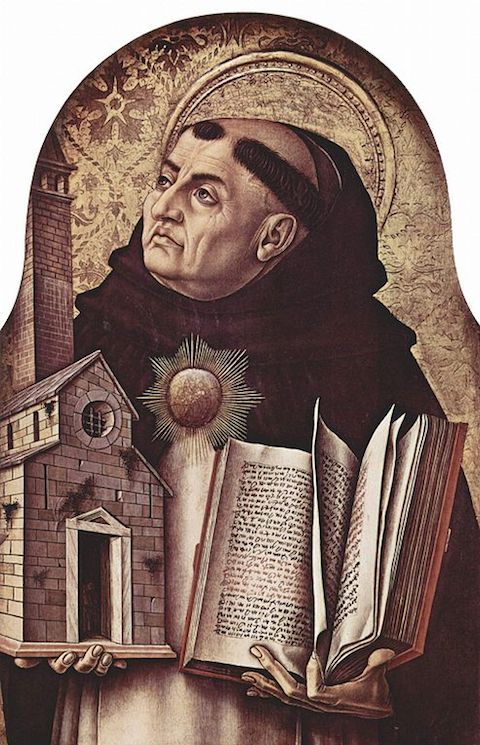
The Dominican friar and author of the near-unreadably dense Summa Theologica made it his life’s work to harmonize logical Aristotelian thought and mystical Christian theology, to the detriment of both. While for Aquinas and his medieval contemporaries, natural theology represents an early attempt at empiricism, the emphasis on the “theology” meant that the West has endured centuries of spurious “proofs” of God’s existence and completely incomprehensible rationalizations of the Trinity, the virgin birth, and other miraculous tales that have no analogue in observable phenomena.
Like many church fathers before him, Thomas’s employment as a kind of Grand Inquisitor of heretics and a codifier of dogma makes me all the more averse to his thought, though much of it is admittedly of great historical import.
2. Carl Schmitt
Schmitt was a Nazi, which—as in the case of Martin Heidegger—strangely hasn’t disqualified his thought from serious appraisal across the political spectrum. But some of Schmitt’s ideas—or at least their application—are particularly troubling even when fully divorced from his personal politics. Schmitt theorized that sovereign rulers, or dictators, emerge in a “state of exception”—a security crisis with which a democratic society cannot seem to cope, but which is ripe for exploitation by domineering individuals. These “states” can legitimately appear at any time, or can be ginned up by unscrupulous rulers. The crucial insight has inspired such leftist thinkers as Walter Benjamin and theorists on the right like Leo Strauss. Its political effects are something altogether different. Writes Scott Horton in Harper’s:
It was Schmitt who, as the crown jurist of the new Nazi regime, provided the essential road map for Gleichschaltung – the leveling of opposition within Germany’s vast bureaucracy – and it was he who provided the legal tools used to transform the Weimar democracy into the Nazi nightmare that followed it.
This same road map—many have alleged—guided the unilateral suspensions of constitutional protections and human rights protocols machinated by Bush and Cheney’s Neoconservative legal advisors after 9/11, who read Schmitt thoroughly. (I intend here no direct comparison whatever between these two regimes, Godwin willing.)
3. John Locke
Though he wrote copiously on epistemology, religious toleration, education, and all sorts of other important topics, Locke is often remembered as everyone’s favorite liberal political philosopher. His anonymously published Two Treatises of Government has had an outsized influence on most modern democratic constitutions, and given his primary antagonist in the first part of that work—Sir Robert Filmer, staunch defender of the divine right of kings and natural hierarchies—Locke seems positively progressive, what with his defense of a civil society based on respect for labor and private property against the unwarranted power and abuse of the aristocracy.
But Locke’s Filmer works as something of a straw man. Examined critically, Locke is no democratic champion but an apologist for the petty tyranny of landowners who gradually eroded the commons, displaced the commoners, and seized greater and greater tracts of land in England and the colonies under the Lockean justification that a man is entitled to as much property as he can make use of. Of course, in Locke’s time, and in our own, proprietors and landowners seize and “make use of” the resources and labor of others—slaves, indigenous people, and exploited, landless workers—in order to make their extravagant claims to private property. This kind of appropriation is also enabled by Locke’s thought, since property only justly belongs to the “industrious and the rational”— characteristics that tend to get defined against their opposites (“lazy and stupid”) in any way that suits those in power.
Another darling of Enlightenment tradition, Descartes gets all the credit for founding a philosophy on radical doubt, and thereby doing away with the presuppositional theological baggage imposed on thought by scholastics like Aquinas. And yet, like Locke, Descartes gets too easy a pass for reducing his method to terms that are by no means unequivocal or universally meaningful, though he pretends that they are.
Descartes explains his method as a means of eliminating from his mind all conceptual clutter but those ideas that seem to him “clear and distinct.” Oddly the two bedrock concepts he’s left with are an unshakeable faith in his own individual ego—or soul—and the existence of a monotheistic creator-God. Thus, Descartes’ method of radical doubt leads him to reaffirm the two most core concepts of classical Western philosophy, concepts he more or less assumes on the basis of intuition—or perhaps unexamined ideological commitments.
This is a tough one, because I actually adore Kierkegaard, but I love him as a writer, not as a philosopher. His critiques of Hegel are scathing and hilarious, his takedowns of the self-satisfied Danish petit-bourgeoisie are epic, and the tonal range and ironic deftness of his numerous literary voices—personae as diverse as desert saints and scheming seducers—are unequalled.
But I recoil from the ethical philosophy of Søren Kierkegaard, as so many people recoil from Nietzsche’s brinksmanship with traditional Christian morality. Kierkegaard’s reduction of the human experience to a false choice paradigm—“Either/Or”—, his ethics of blind irrationalism couched as a justifiable leap of faith, exemplified by his glorification of Abraham’s willingness to kill his son Isaac… these things I can’t help but find abhorrent, and if I’ve ever been tempted to read them as ironic expressions of the author’s many masks, further study has robbed me of this balm. Kierkegaard the writer offers us a great deal; Kierkegaard the moral philosopher, not so much.
So there you have my list—riddled, to be sure, with inaccuracies, prejudice, and superficial misreadings, but an honest attempt nonetheless, given my inadequate philosophical training. Again I’ll say that the inclusion of any of these five names in a list of philosophers, pernicious or no, means that I believe they are all thinkers worth reading and taking seriously to some degree, even if one violently disagrees with them or finds glaring and grievous error in the midst of seas of brilliance.
Now that you’ve read my “Five Most Pernicious Philosophers,” please tell us readers, who are yours, and why? Your griping explanations can be as short or long as you see fit, and feel free to violently disagree with my hasty judgments above. Ad hominem attacks aside, it’s all within the spirit of the enterprise.
Related Content:
Take First-Class Philosophy Courses Anywhere with Free Oxford Podcasts
Download 90 Free Philosophy Courses and Start Living the Examined Life
Josh Jones is a writer and musician based in Durham, NC. Follow him at @jdmagness.
Read More...Slavoj Žižek: What Fulfils You Creatively Isn’t What Makes You Happy
While theorist and provocateur Slavoj Žižek tends to get characterized—especially in a recent, testy exchange with Noam Chomsky—as obscurantist and muddle-headed, I’ve always found him quite readable, especially when compared to his mentor, psychoanalytic philosopher Jacques Lacan. As an interpreter of Lacan’s theories, Žižek always does his reader the courtesy of providing specific, concrete examples to anchor the theoretical jargon (where Lacan gives us pseudo-mathematical symbols). In the short Big Think clip above, Žižek’s examples range from the history of physics to the Declaration of Independence to the familiar “male chauvinist” scenario of a man, his wife, and his mistress. Žižek’s point, the point of psychoanalysis, he alleges, is that “people do not really want or desire happiness.”
This seems counterintuitive. Happiness—our own and others—is after all the goal of our loftiest endeavors, no? This seems to be the pop-psych rendition of, say, Maslow’s theory of self-actualization. But no, says Zizek, happiness is an integral part of fantasy. Like the philanderer’s mistress, the object of desire must be kept at a distance, he says. Once it is achieved, we no longer want it: “We don’t really want what we think we desire.” And in keeping with Žižek’s example of infidelity—which may or may not involve the chauvinist killing his wife—he tells us that for him, “happiness is an unethical category.” I find this statement intriguing, and persuasive, though Žižek doesn’t elaborate on it above.
He does in much of his writing however—explaining in Lacanian terms in his essay collection Interrogating the Real that our desire for something we think will bring us happiness can be construed as a kind of envy: “I desire an object only insofar as it is desired by the Other.” Furthermore, he writes, “what I desire is determined by the symbolic network within which I articulate my subjective position.” In other words, what we think we want is determined by ideology—by the cultural products we consume, the soup of mass media and advertising in which we are permanently immersed, and the political ideals we are taught to revere. What does authentic “self-actualization” look like for Slavoj Žižek? He tells us above—it means being “ready to suffer” for the creative realization of a goal: “Happiness doesn’t enter into it.”
Žižek cites the example of nuclear scientists who willingly exposed themselves to radiation poisoning in pursuit of discovery, but he could just as well have pointed to artists and writers who sacrifice comfort and pleasure for lives of profound uncertainty, religious figures who practice all kinds of austerities, or athletes who push their bodies past all ordinary limits. While there are several degrees of pleasure involved in these endeavors, it seems shallow at best to describe the goals of such people as happiness. It seems that many, if not most, of the people we admire and strive to emulate lead lives characterized by great risk—by the willingness to suffer; lives often containing little in the way of actual happiness.
Whatever stock one puts in psychoanalytic theory, it seems to me that Žižek raises some vital questions: Do we really want what we think we want, or is the “pursuit of happiness” an unethical ideological fantasy? What do you think, readers?
Related Content:
Noam Chomsky Slams Žižek and Lacan: Empty ‘Posturing’
Slavoj Žižek Examines the Perverse Ideology of Beethoven’s Ode to Joy
Slavoj Žižek on the Feel-Good Ideology of Starbucks
In His Latest Film, Slavoj Žižek Claims “The Only Way to Be an Atheist is Through Christianity”
Josh Jones is a writer and musician based in Durham, NC. Follow him at @jdmagness.
Read More...
Read 10 Short Stories by Gabriel García Márquez Free Online (Plus More Essays & Interviews)
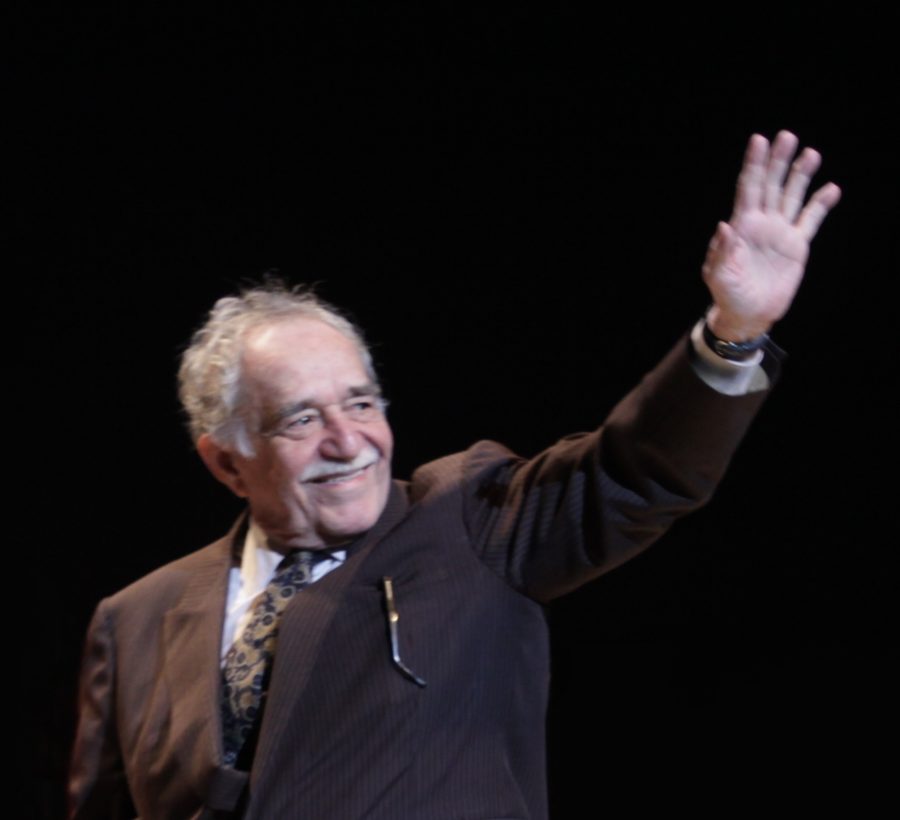
Image by Festival Internacional de Cine en Guadalajara via Wikimedia Commons
“Our independence from Spanish domination did not put us beyond the reach of madness,” said Gabriel García Márquez in his 1982 Nobel Prize acceptance speech. García Márquez, who died yesterday at the age of 87, refers of course to all of Spain’s former colonies in Latin America and the Caribbean, from his own Colombia to Cuba, the island nation whose artistic struggle to come to terms with its history contributed so much to that art form generally known as “magical realism,” a syncretism of European modernism and indigenous art and folklore, Catholicism and the remnants of Amerindian and African religions.
While the term has perhaps been overused to the point of banality in critical and popular appraisals of Latin-American writers (some prefer Cuban novelist Alejo Carpentier’s lo real maravilloso, “the marvelous real”), in Marquez’s case, it’s hard to think of a better way to describe the dense interweaving of fact and fiction in his life’s work as a writer of both fantastic stories and unflinching journalistic accounts, both of which grappled with the gross horrors of colonial plunder and exploitation and the subsequent rule of bloodthirsty dictators, incompetent patriarchs, venal oligarchs, and corporate gangsters in much of the Southern Hemisphere.
Nevertheless, it’s a description that sometimes seems to obscure García Marquez’s great purpose, marginalizing his literary vision as trendy exotica or a “postcolonial hangover.” Once asked in a Paris Review interview the year before his Nobel win about the difference between the novel and journalism, García Márquez replied, “Nothing. I don’t think there is any difference. The sources are the same, the material is the same, the resources and the language are the same.”
In journalism just one fact that is false prejudices the entire work. In contrast, in fiction one single fact that is true gives legitimacy to the entire work. That’s the only difference, and it lies in the commitment of the writer. A novelist can do anything he wants so long as he makes people believe in it.
García Márquez made us believe. One would be hard-pressed to find a 20th century writer more committed to the truth, whether expressed in dense mythology and baroque metaphor or in the dry rationalist discourse of the Western episteme. For its multitude of incredible elements, the 1967 novel for which García Márquez is best known—One Hundred Years of Solitude—captures the almost unbelievable human history of the region with more emotional and moral fidelity than any strictly factual account: “However bizarre or grotesque some particulars may be,” wrote a New York Times reviewer in 1970, “Macondo is no never-never land.” In fact, García Márquez’s novel helped dismantle the very real and brutal South American empire of banana company United Fruit, a “great irony,” writes Rich Cohen, of one mythology laying bare another: “In college, they call it ‘magical realism,’ but, if you know history, you understand it’s less magical than just plain real, the stuff of newspapers returned as lived experience.”
Edith Grossman, translator of several of García Márquez’s works—including Love in the Time of Cholera and his 2004 autobiography Living to Tell the Tale (Vivir para Cotarla)—agrees. “He doesn’t use that term at all, as far as I know,” she said in a 2005 interview with Guernica’s Joel Whitney: “It’s always struck me as an easy, empty kind of remark.” Instead, García Márquez’s style, says Grossman, “seemed like a way of writing about the exceptionalness of so much of Latin America.”
Today, in honor and with tremendous gratitude for that indefatigable chronicler of exceptional lived experience, we offer several online texts of Gabriel García Márquez’s short works at the links below.
HarperCollins’ online preview of García Marquez’s Collected Stories includes the full text of “The Third Resignation,” “The Other Side of Death,” “Eva Is Inside Her Cat,” “Bitterness for Three Sleepwalkers,” and “Dialogue with the Mirror,” all from the author’s 1972 collection Eyes of a Blue Dog (Ojos de perro azul).
At The New Yorker, you can read García Marquez’s story “The Autumn of the Patriarch” (1976) and his 2003 autobiographical essay “The Challenge.”
Follow the links below for more of García Marquez’s short fiction from various university websites:
“Death Constant Beyond Love” (1970)
“The Handsomest Drowned Man in the World” (1968)
“A Very Old Man with Enormous Wings” (1955)
Visit The Modern Word for an excellent biographical sketch of the author.
See The New York Times for “A Talk with Gabriel Garcia Marquez” in the year of his Nobel win, an essay in which he recounts his 1957 meeting with Ernest Hemingway, and many more reviews and essays.
Finally, we should also mention that you can download Love in the Time of Cholera or Hundred Years of Solitude for free (as audio books) if you join Audible.com’s 30-day program. We have details on it here.
As we say farewell to one of the world’s greatest writers, we can remember him not only as a writer of “magical realism,” whatever that phrase may mean, but as a teller of complicated, wondrous, and sometimes painful truths, in whatever form he happened to find them.
Related Content:
Read 18 Short Stories From Nobel Prize-Winning Writer Alice Munro Free Online
Read 12 Masterful Essays by Joan Didion for Free Online, Spanning Her Career From 1965 to 2013
600 Free eBooks: Download Great Books for Free
Josh Jones is a writer and musician based in Durham, NC. Follow him at @jdmagness
Read More...How a Young Sigmund Freud Researched & Got Addicted to Cocaine, the New “Miracle Drug,” in 1894
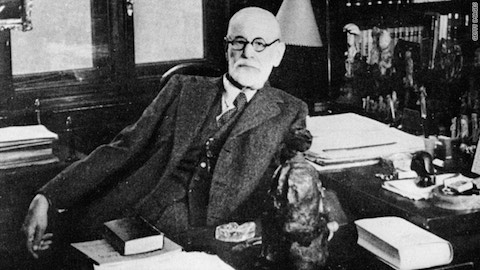
As David Bowie had his cocaine period, so too did Sigmund Freud, beginning in 1894 and lasting at least two years. Unlike the rock star, the doctor was just at the beginning of his career, “a nervous fellow” of 28 “who wanted to make good,” says Howard Markel, author of An Anatomy of Addiction: Sigmund Freud, William Halsted, and the Miracle Drug Cocaine. Markel tells Ira Flatow in the NPR Science Friday episode below that Freud “knew if he was going to get a professorship, he would have to discover something great.”
Freud’s experiments with the drug led to the publication of a well-regarded paper called “Über Coca,” which he described as “a song of praise to this magical substance” in a “pretty racy” letter to his then-fiancé Martha Bernays. (He also promised she would be unable to resist the advances of: “a big, wild man who has cocaine in his body.”) Two years later, his health suffering, Freud apparently stopped all use of the drug and rarely mentioned it again.
[T]he accomplished young phsyiologist Ernst von Fleischl-Marxow, whose morphine addiction Freud had tried to treat with cocaine, with disastrous results. As Freud wrote almost three decades later, “the study on coca was an allotrion” — an idle pursuit that distracts from serious responsibilities — “which I was eager to conclude.”
The drug was at the time touted as a panacea, and Fleischl-Marxow, Markel says, was “the first addict in Europe to be treated with this new therapeutic.” Freud also used himself as a test subject, unaware of the addictive properties of his cure for his friend’s addiction and his own depression and reticence.
While Freud conducted his experiments, another medical pioneer—American surgeon William Halsted, one of Johns Hopkins “four founding physicians”—simultaneously found uses for the drug in his practice. Freud and Halsted never met and worked completely independently in entirely different fields, says Markel in the news segment above, but “their lives were braided together by a fascination with cocaine,” as addicts, and as readers and writers of “several medical papers about the latest, newest miracle drug of their era, 1894.” Halstead is responsible for many of the modern surgical techniques without which the prospect of surgery by today’s standards is unimaginable —the proper handling of exposed tissue, operating in aseptic environments, and surgical gloves. He injected patients with cocaine to numb regions of their body, allowing him to operate without rendering them unconscious.
Halsted, too, used himself as a guinea pig. “No doctor knew at this point,” says Markel above, “of the terrible addictive effects of cocaine” before Freud and Halsted’s experiments. Both men irrevocably changed their fields and almost destroyed their own lives in the process (see a short documentary on Halsted’s medical advances below). In Freud’s case, much of the work of psychoanalysis has come to be seen as pseudoscience—his work on dreams significantly so, as Markel says above: “Cocaine haunts the pages of the Interpretation of Dreams. The model dream is a cocaine dream.” The “talking cure,” however, engendered by the “loosening of the tongue” Freud experienced while on cocaine, endures as, of course, do Halsted’s innovations.
Related Content:
Freud’s Thought Explained in Yale Psych Course (Find Full Course on our List of 875 Free Online Courses)
Sigmund Freud Speaks: The Only Known Recording of His Voice, 1938
Sigmund Freud’s Home Movies: A Rare Glimpse of His Private Life
Jean-Paul Sartre Writes a Script for John Huston’s Film on Freud (1958)
Josh Jones is a writer and musician based in Durham, NC. Follow him at @jdmagness
Read More...Support Us
We're hoping to rely on loyal readers, rather than erratic ads. Please click the Donate button and support Open Culture. You can use Paypal, Venmo, Patreon, even Crypto! We thank you!

About Us

Open Culture scours the web for the best educational media. We find the free courses and audio books you need, the language lessons & educational videos you want, and plenty of enlightenment in between.
Advertise With Us
FREE UPDATES!
GET OUR DAILY EMAIL
Get the best cultural and educational resources on the web curated for you in a daily email. We never spam. Unsubscribe at any time.
FOLLOW ON SOCIAL MEDIA
Open Culture editor Dan Colman scours the web for the best educational media. He finds the free courses and audio books you need, the language lessons & movies you want, and plenty of enlightenment in between.
Advertise With Us


